

Fifty Shades Of Leadville
Leadville 100-Mile endurance run: just before 4:00 a.m., Saturday, August 18, 2012
Courtesy of Mike Pastore
This was my first time, and I was scared. It was dark, 37 degrees, and there were just over 800 of us lined up for the start of “the Race Across the Sky,” the 30th running of the Leadville Trail 100-mile run.
I moved myself into the front third of the group, not because I was that fast but to be closer to the front when we hit the technical single track around the lake. Jay B. (a friend and Leadville veteran finisher and also, like me, from Greenville,
South Carolina) had told me it was very difficult to pass on the 10-plus miles around Turquoise Lake. He would be right. We were running. Nervous laughter, bobbing headlamps, dropped GUs, and dust, it had been a
long journey—finally I was running Leadville. About two miles into the race, I heard a happy, familiar voice shout my name: it was Sheri. She and Scot and I had met running up Sugarloaf the first day of the
Leadville training camp. We talked and ran; it was good to catch up and reassure each other about the day in front of us. We hit a steepish half-mile climb on the dirt road, Sheri moved ahead, and that would be
the last I saw of her until the back side of Hope Pass, 11 hours later.
▲
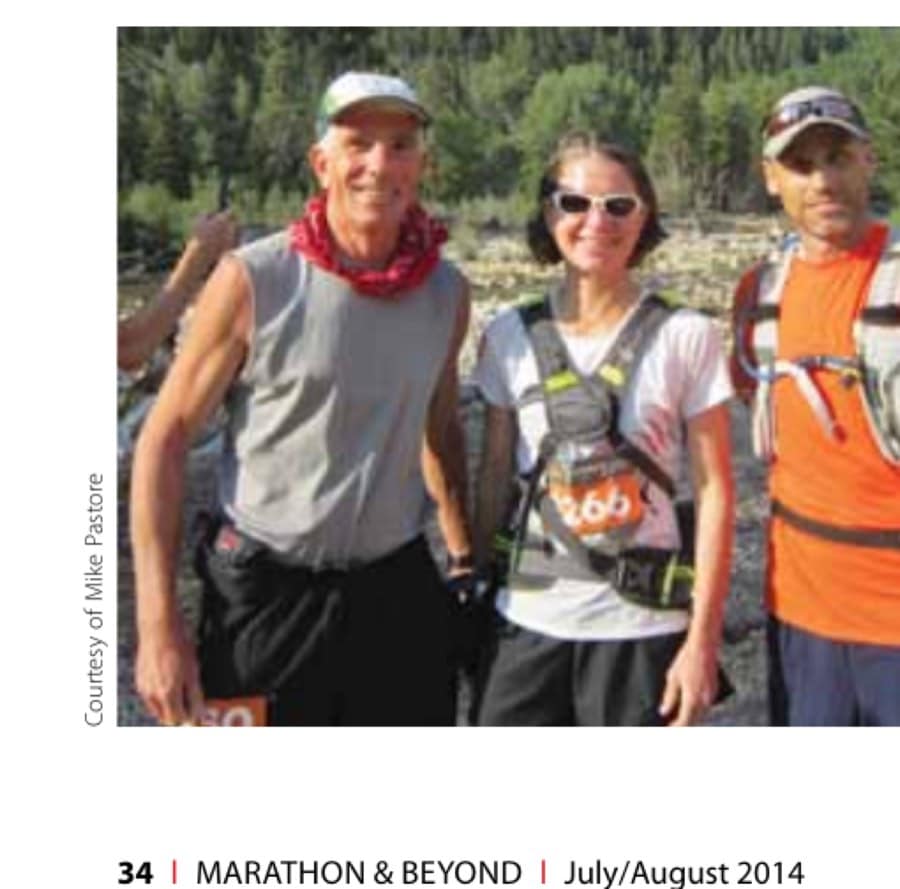
Leadville training run day 2. Left to right: the author, Sheri Foster, and Scot Hartman.
Greenville, South Carolina, October 2011 Sometime in October 2011, this race started for me. Ashley (my fiancée at the time, now my wife) returned from a business trip to the Vail/Denver area. She told me how many people she had met who had run or ridden or helped with the Leadville 100-Mile trail run. That started me thinking: perhaps I could be one of those people.
My online research included the race website, blogs from Leadville runners of the previous few years, and any race accounts from my running books at home. This is the first step of running a race for me; it is important know what to expect. “Knowing” not only helps you to decide but also helps you to prepare. Preparing allows you to remove as many variables as possible before you arrive at the starting line.
Signing up for an ultra is never an easy decision for me. Of course the race will be hard, that is expected and accepted, but in the months leading up to the run, there are countless miles of training required and trade-offs to be made. Yet as complex as the decision is to run, “ultra math” is one of those simple if-then propositions. If you want to finish the run, then you must do the training. Your training schedule is like a contract, and you must submit yourself to it daily.
All of Leadville is run above 9,000 feet elevation, some of it as high as 12,600 feet. I had never been exposed to anything like that before. This would be my first time running at altitude, and that scared me and excited me at the same time. I signed up for the race, and as soon as I hit the “send” button on my screen, I wondered whether I had done the right thing. This was going to be hard and there was a chance I would not finish, but after running for 12-plus years I had never had a DNF, so there was no reason to think this run would be any different. It was October, and Leadville was still 10-plus months away, so I had to fill in the blanks with training and training races to keep me motivated along the way.
Chicago Marathon, October 9, 2011 This would be my third time running this event. The Chicago Marathon is a megamarathon done well, easy to fly in, plenty of hotel rooms, and you can walk or catch the train to the start. The course is mostly flat and it has big aid stations and millions of friendly faces, all in stark contrast to 100-mile runs. But as the old ultra-training joke goes: “We do marathons for speed work.”
I never take any race for granted, but I was not nervous waiting for this start; in fact, I was looking forward to the race. Ashley and I started together, but after countless marathons I went out at a pace that would later prove to be my downfall. Essentially, I struggled all day, to the point that Ashley went to the medical tent to see where I was after 3 1/2 hours. It would be my second-slowest marathon
time in more than 14 years: 3:58. I just made it in four hours. The Leadville 100 was the furthest thing from my mind.
Leadville 100: from the start, around the lake to May Queen (mile 0 to 13.5 miles) After that half-mile climb, we were on technical single track, and a quick glance at my heart rate monitor rudely reminded me I was running above 9,000 feet. I slowed down, watched the runner in front of me, and wished I had brought a handheld flashlight along with my headlamp. There were places to pass, if you wanted, but they were few and far between. It was easy to fall on the trail, and you were almost guaranteed a fall if you jumped off the trail to pass. So Jay’s prerace words of wisdom rang true: this was no place to pass, even though the first 13.5 miles are net downhill. A few speed goats passed, but I was in a small group of six or seven runners, and we were content to hold our pace and stay vertical.
By 6:30 a.m. we had a trace of light, and it was still very cold. Headlamps ahead of me slowly switched off, but everyone’s long sleeves stayed on. The ability to see more of the trail allowed the overall pace to pick up on the way to May Queen, now less than one hour away. This was hard running, but I was feeling good about the day ahead.
Richmond Marathon, November 12, 2011 Richmond Marathon is not super-sized like Chicago, but it is very well attended and professionally run. The course is mostly flat, with one short climb up from the James River, a few rolling hills, and good crowd support.
This is my hometown and where, coincidentally, I have run my best marathon time, so I planned on running well. Of course I had goals. The “easy” goal was to better my Chicago time. The middle goal was to run under 3:20, which would seed me in the B corral for the Comrades Marathon in June 2012, and finally there is always that chance for another PR.
My 3:20 pace stayed intact until mile 18 or so but fell off in small chunks for the next eight miles, so I crossed in 3:27:22, by the chip. Only one of the day’s original goals had been met, but I felt OK about the effort compared with the last marathon.
Leadville 100: May Queen (mile 13.5) to Fish Hatchery (mile 23.5) What I had thought was “really hard runnin’” did not get any easier after May Queen. There was plenty of climbing, but the trail did not seem as technical and we were on some forest roads for much of the time. The warming sun and climb-
ing allowed me to tie my long-sleeve technical around my waist. My headlamp (from the start that morning) was left at the May Queen aid station, and I fully expected to switch it out on the return trip sometime Sunday morning.
Running down Sugarloaf/Powerline is formidable: the trail is a very, very steep, washed-out fire road, and there are no switchbacks. Every single step is on foot-tripping, sharp rocks that are waiting to take you down. Add in the same size rocks that roll under your foot the millisecond you step on them, and you can begin to appreciate the fun. There is no line to run; the likely route moves from one side of the road to the other every time you look up to pick the best line to run. The only thing that would be more fun would be climbing back up this trail in the wee, dark hours on Sunday morning.
The trail eventually found a paved road. There was a substantial ranch along the right side of the road and a large, unmanned race sign at the entrance to the house—“Fresh horses and more whiskey for my men!” I smiled and picked up my pace.
John Bruno (to be my pacer #3 on the return trip) was waiting for me on the near side of the aid station and told me where the crew was parked. I told him about a blister that needed attention and to have the gear out. I grabbed some Fig Newtons while my bottles were being filled and ate them as I walked and then ran.
Ryan Kamp (pacer #1), Ashley (pacer #2 and wife) and John were about a quarter mile away. (I honestly thought I had missed them.) There were cars and runners everywhere. They took off my shoe and I grabbed my iPod, cleaned my foot, stuck the moleskin on the spot, and actually got my toe sock back on over the whole mess. Ash put my shoe on, and as I slowly started running, they told me I was 40 or 50 minutes ahead of the 25-hour pace.
A few minutes later they drove by me yelling and taking pictures. I smiled, stood up a little straighter, went a little faster, and kept running.
Kiawah Island Marathon, South Carolina, December 10, 2011 Runners travel from all over the country to this up-market, seaside golf resort. We live only three hours away, so I take advantage of the race as often as I can. My guess is that I have run the marathon 12 or 13 times.
The half-marathon usually has about 2,000 runners, and the full marathon has 600 to 800 runners. Both races start at the same time. This is currently a twoloop course, and you can’t buy a hill—even if you want one. The only change in elevation is a small rise on the road within a mile of the start/finish line as the road climbs over the golf-cart path below. It redefines flat.
My race goals for the day were the same as for the Richmond Marathon: beat my previous marathon time, run under 3:20 for a B seeding at Comrades, and get a PR. Some things don’t change. After the first loop I usually run mostly alone,
Courtesy of Mike Pastore
▲
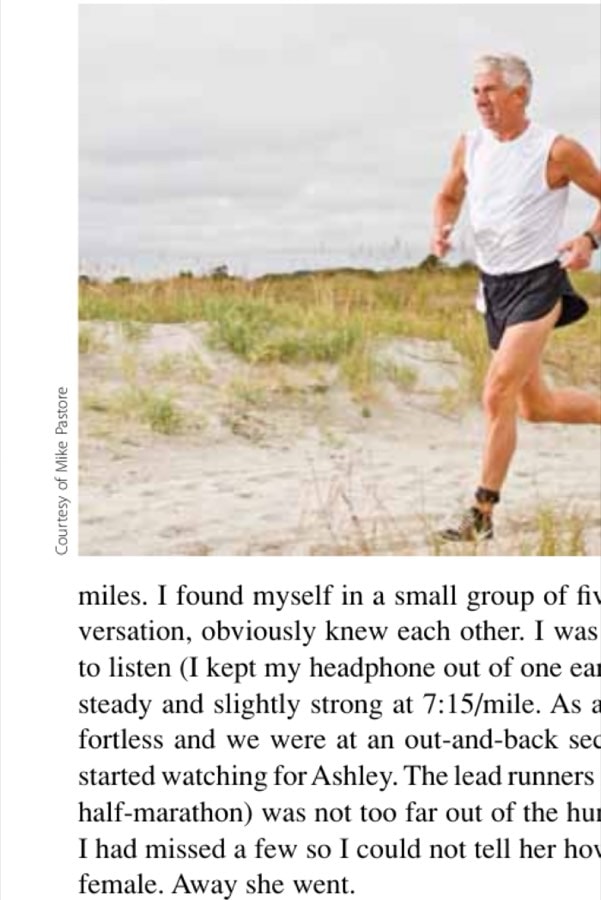
Training for the Kiawah Island Marathon.
so for the first time I decided to run this race with my iPod (allowed). Although I always train with music, I had never run a race with music. The start was crowded on the twolane island roads but thinned out after two
miles. I found myself in a small group of five other runners who, by their conversation, obviously knew each other. I was hanging in the back, close enough to listen (I kept my headphone out of one ear) but not to interrupt; our pace was
steady and slightly strong at 7:15/mile. As always, the first few miles were effortless and we were at an out-and-back section seeing returning runners, so I started watching for Ashley. The lead runners flew by me, and Ashley (running the
half-marathon) was not too far out of the hunt, but because of the course layout I had missed a few so I could not tell her how she was doing relative to the lead female. Away she went. We made the turnaround as a group, and our pace was the same: 7:15 to 7:20
per mile. I felt OK and would hang with them as long as I could. Although the conversations had stopped, our group stayed intact, but now as a small line: the two guys in the front, three girls, and then me. It occurred to me I was the only
person in our group without a tattoo and/or an earring. Mile marker 11 was within sight, and I noticed a tempo change in our little bus. The guys had opened a very noticeable gap, and the girls were going faster
to keep up. When I caught back up it was mile 12, and I asked the girls how long they were going to keep this pace. “All the way to the finish! We are almost done! Come on; stay with us!” Damn. They were running the half-marathon.
Mile 13 came up and my group turned left toward the finish line while I turned right, back on the main course for loop two. I ate a GU and checked my watch. I had gone out too fast, but I was still running well, nothing hurt, my stomach was
behaving. I decided to hold the pace and take it mile by mile. Now I was running almost all alone. There was no one behind me and only a few guys in front of me.
Over the next hour my splits never dropped below 7:30 per mile, and by then there were only five miles to run. When mile marker 25 was in sight, I knew I had beat my Richmond time and had that B seeding for Comrades, but most important, I still had a chance for a PR, so I pushed really hard and forgot about my watch. Sunday morning started with brunch at the Sanctuary Hotel. I am almost sure this meal is Ashley’s primary reason for coming to Kiawah, and it is impossible to find fault with her logic. Driving back up to Greenville we talked about what was next: Umstead 100, Comrades, and Leadville 100, and how my 3:14 finish in Kiawah would affect my expectations for those runs.
Leadville 100: Fish Hatchery (mile 23.5) to Twin Lakes (mile 39.5) Although the sun was bright, it was not too hot—ideal for running, really. I was taking in at least two GUs every hour, along with whatever looked good enough to carry out of the aid station to eat. My stomach was OK, but as I ran down a longish grade I saw and heard another runner whose stomach was not OK. As I got closer he took his hands off his knees, wiped his mouth, and took a drink from his water bottle as he started walking. I slowed down and walked up next to him and asked how he was feeling. “
Pretty shitty about now. My stomach is a mess.” We started walking. I asked if anything else was wrong. He managed a smile and said no, but as soon as he did he turned away from me and got sick again, but there wasn’t much left. I waited and asked if he could drink. I told him to rinse his mouth out, and we walked some more. A sick runner will do about anything you ask.
He told me this was his first 100-miler; I laughed and told him he had really jumped in with both feet. He took small sips from his bottle; thankfully, it stayed down. I gave him all four of my Pepto-Bismol tabs and two pieces of my hard ginger candy. He took the tabs with some water and opened a candy. I told him that we all had bad patches and not to give in, that it would pass, and that when it did he would be running again. There was nothing else I could do for him. I wished him well, and he did the same and thanked me. I moved down the trail and started running again.
The long views of mountains and trees against the endless sky were so beautiful they almost seemed animated at times. I did not slow down, but I did my best to take it all in. Like most other runners around me, my pace was holding steady. There was very little chasing or passing taking place at this stage. Some of us were faster going up the mountain, and some of us were faster going down.
As I ran out of the start/finish area and the main aid station, my crew and #1 pacer were waiting up the hill on the right. Marisa was ready to go. Joe (her boyfriend) and Ashley would pace me later. Marisa would now be pacing me from mile 62.5
to mile 75, one 12.5-mile loop in Umstead State Park. Marisa and Joe were both excited about helping me, even though Joe had his Boston Marathon in just a few weeks; their enthusiasm was heartfelt. Very few
people will give up an entire weekend and then stay up all night to run part of 100 miles with someone, and here were Marisa, Joe, and Ashley—they were actually cheering! The cheering was corny, but it made me smile and pick up my pace a
little. We were walking hard up the hill while I finished eating my Fig Newtons, and then I would run. Marisa talked, pushed me some, and cared about how I was feeling. She was a good pacer. The weather was a bit of a concern as we were seeing lighting flashes,
but they were far in the distance. According to the weather forecast earlier in the day, the storms were to move out by evening. The 12 miles and two hours or so went by quickly. Joe was jumping, ready to go for his loop. There were only 25 miles remain
ing to run. Like Marisa, he talked but not as much; he pushed me harder on the flats and downhills, and then he would slowly speed up with me in tow. He was sneaky and good. We were seeing more lightning, but it still looked
far away, although we could hear thunder now. After about six or seven miles in this loop, the wind picked up and Joe pushed it a bit harder, too. Nothing really hurt, but I was tired after running 85 miles and just did not have a
lot to say. Joe made sure I was eating and drinking and he commented on the weather only when I brought up the subject. There was about a mile left to run in this loop when the sky simply opened up, complete with wind,
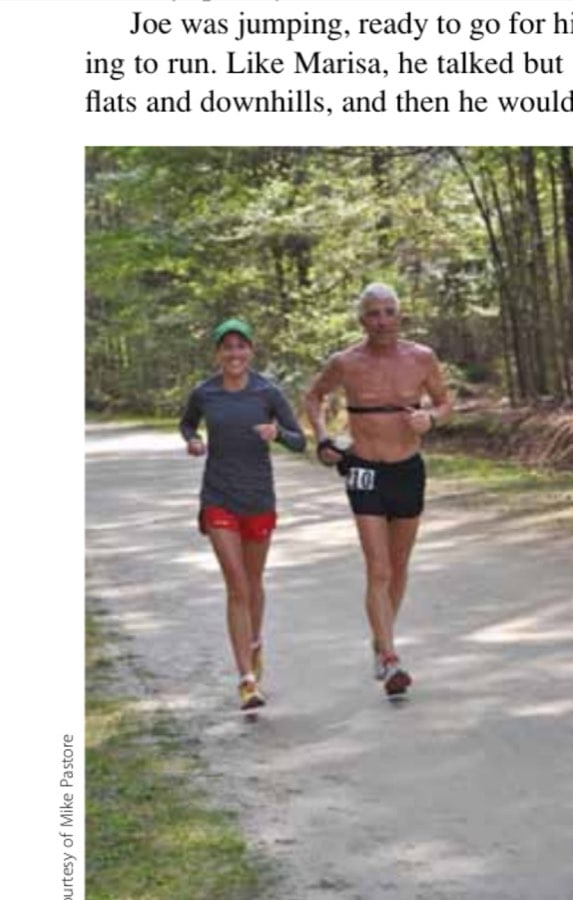
plenty of lightning, and thunder. Ashley Pastore pacing the author at the Umstead 100-Mile Endurance Run.
▲
Courtesy of Mike Pastore
Umstead 100-Miler, Raleigh, North Carolina, March 31, 2012
Joe’s loop was done and Ashley was dressed for the occasion and ready to go, but I asked that she please stay in the tent while I finished the last loop. This was a really strong storm, and there was absolutely no need for both of us to be exposed. She was unhappy (meaning really pissed off), but it was only logical. I had my Brooks rain jacket, a hat, and a fresh hand-held flashlight; the headlamp was virtually useless in this downpour. My resolve to run was strong, but it would not be pretty, and I would finish in just over two more hours or so. It quickly became clear to me that Fig Newtons are not suited for eating when you are running in the rain.
The storm did not let up much for the next hour. As I approached the middle of the last loop the storm had almost stopped, but so had I for that matter. I was very weary. There was a breeze, and I was soaked and chilly, too, not that it mattered. I knew I had less than two hours to run.
I walked the uphills and started running as I got close to the top, repeating my mantra: “smooth is efficient, efficient is fast, the faster you run, the sooner you’re done.” My original Umstead goal(s) of under 20 hours and/or a PR had been lost early in the day between miles 38 and 50, during the third lap. Stomach problems and leg cramps had reduced me to a walk for most of that loop. It was very early in the run for a bad patch, but I just tried to fix one thing at a time and I did, but I knew the PR and sub-20 hour run were gone. Now I just wanted to finish under 21 1/2 hours.
When I came up out of the woods, about five miles from the finish, I saw someone running toward me with a headlamp; it was very late, very dark, and I was very tired. Without even looking up, I said, “Hey.” “
Mike! Is that you?” It was Ashley! I was very happy she had run out to meet me and to run back in with me for the last few miles. She asked how I felt, what it was like in the rain, whether I had been drinking and going to the bathroom. She knew the pacer drill well. My pace had picked up just having her running beside me.
We passed the eight-mile marker, I did the math, and based on my pace the past few miles, I told her we would be in at 21 hours and some change. She looked at her watch and explained to me that if I would “just speed up some” we could be in under 21 hours, and then she proceeded to tell me how much better I would feel about a 20-hour finish instead of a 21-hour finish. “
No, that’s not happening.” I looked at my watch. “We have about 35 minutes to run over four miles.” Hell, I had not run many eight-minute miles all day. Now was not a good time to start. She implored me to just stay beside her as she picked up the pace. I have a hard time saying no to her under normal circumstances, and I now was simply too tired to argue, so I ran beside her—but I was none too happy with this new pace and did not talk.
When we passed mile nine, she said we had run about an 8:40 pace. I knew she was lying, but mile 10 came in faster, mile 11 faster still, and with about a half mile to go we had five minutes left to finish in that 20-plus-hour range. Joe, Marisa, Ashley, and I were glad to be done, and we made it: 20 hours, 57 minutes, 25 seconds. If 100-mile runs have a saving grace, it is that they have a lot of built-in goals. You just need to keep adjusting and never stop running.
Twin Lakes is a big aid station with lots happening. John was yelling my name at the bottom of the very steep drop that poured us onto the dirt road and into the crowd. I almost fell sliding down that hill. He went with me into the aid station.
There was food everywhere, but none of it held any interest for me. I recognized this was a problem. Ryan and Ash were waiting at the car not far outside the aid station, and they told me I was still slightly under the 25-hour pace but had lost some time during
the last section. They all asked about my food intake and GUs, which I was still getting down with fluids. My stomach was OK but I was very, very tired and simply not hungry. My GUs were replenished, I had my Brooks ultralight rain gear, I told the crew
I would see them in a few hours on the other side of Hope Pass, and I walked out of the aid station. There are a few flat miles after the aid station before you start the climb up Hope Pass. I ran, but I could not hold a pace more
than a few minutes, and I was getting passed a lot. Not good and I knew it. Nothing hurt. My stomach and feet were fine. I kept going over my internal dashboard. Everything was as normal as it could be for the distance and
effort, so I kept trying to run until the trail slanted upward. There are not a lot of switchbacks going up Hope Pass, which means it is very steep going. There was a boisterous mountain stream to our right, and I could
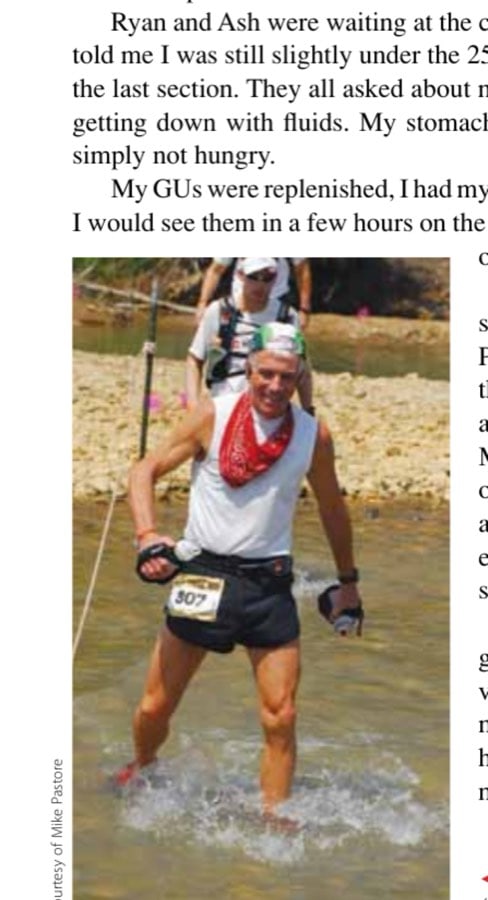
hear it above my own breathing, which by now had become unusually labored. My The author at Twin Lakes, the lowest point (9,200 feet) on the Leadville course.
▲
Courtesy of Mike Pastore
Leadville 100: Twin Lakes (mile 39.5) to Hope Pass (mile 44.5)
Courtesy of Mike Pastore
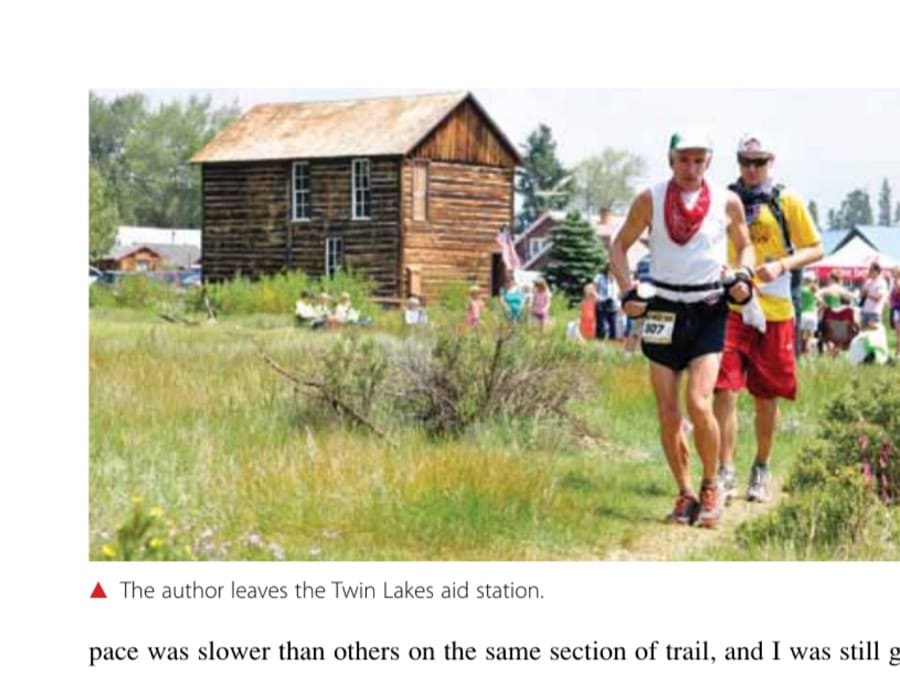
▲ The author leaves the Twin Lakes aid station.
pace was slower than others on the same section of trail, and I was still getting passed. They passed slowly, but it was very clear to me at this point that I was falling behind where I needed to be to finish this run. Clearly, my 25-hour dream had been just that, a dream.
I stopped, took a long drink, ate a GU, and set my new goal at 28 hours or so. I started walking faster up the mountain. The race leaders passed me (going down) when I was close to the tree line where Hope Pass aid station is located. Anton Krupicka ran by me as if he had wings; it was truly impressive and inspiring to see someone run that fast going down a technical trail.
When I finally arrived at the aid station, one of the medical guys asked if I was OK. I quietly said no. He asked for specifics, and I told him I just could not breathe fast enough, and he asked where I was from. Then I saw his knowing, faint smile at my nonaltitude zip code response. I stayed put for about five minutes and walked out. There was still plenty of hard climbing to the peak, but at least the snow from the training run in late June had finally melted.
The Comrades Marathon, Pietermaritzburg, South Africa, June 3, 2012 We had been running for about 90 minutes before I was able to settle in to a pace and not worry about the crowd, falling down, or whether I was running at the right speed. It was early fall in this part of the world, the dark, early start (5:30 a.m.) in the Drakensberg mountains was chilly, and I still had on my throwaway shirt and gloves.
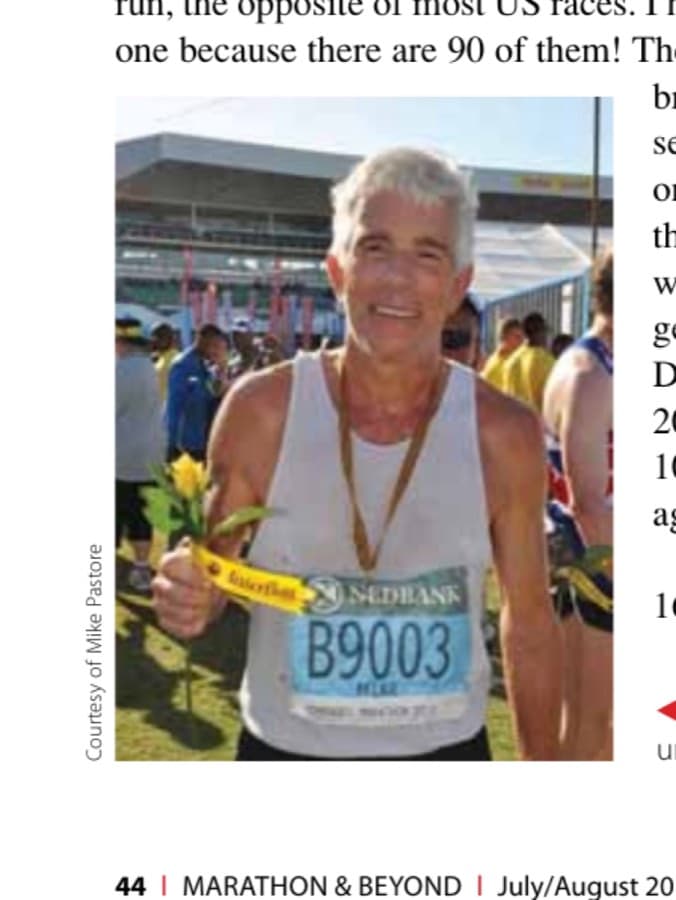
The author after his ninth Comrades finish, in under 9 hours. A rose for everyone is a nice touch.
▲
Courtesy of Mike Pastore
Comrades is not a lonely trail ultra, and this year’s race was the 87th year it had been run. Comrades Marathon is run on 89K/56 miles of road with 19,000plus starters in 2012 on the “down” course from Pietermaritzburg to Durban. Next
year the route would be reversed and would be run “up,” starting in Durban and finishing in Pietermaritzburg. Unlike in the United States, everyone in South Africa knows exactly what an ultramarathon is and what kind of training it takes to finish “the beast.” This
race is broadcast on national television, start to finish, all 12 hours. Television viewership is highest during the last hour because that is when most runners finish, and everyone wants to watch the dramatic ending. When the clock reaches
the 12 hour cutoff, the finish line is blocked by very large, well-dressed men, and anyone on the “over 12-hour side” is not allowed to cross. Seeing the end of this event gives new meaning to the word “drama.”
By 9:35 a.m., at the halfway point (44K/mile 28), my pace was slightly ahead of where I should be to hit my goal time of 8 hours, 50 minutes (a finish between the 7 1/2-hour mark and under nine hours earns you a Bill Rowan medal, or as
the locals call it, a “simi-silver,” because it is a bronze medal rimmed in silver, and the finishing time of the first winner of this race). I had not walked a single step, even on the climbs, but I knew this would change in the second half.
The blue background of my race numbers (unfolded numbers are required front and back) told everyone around me I was an international runner, and I had a small US flag stitched on the back of my singlet. The flag and blue number
often earn me an extra “well-run” cheer from fellow runners. The distance markers count down and tell you how far you have remaining to run, the opposite of most US races. I have found that it is best not to look at each
one because there are 90 of them! The Comrades becomes digestible for me if I break it down into three 18-mile parts, each section run slightly slower than the previous one. The second half of the down run has
three very long and very steep downhills that will properly tenderize your legs before you get into the rolling hills outside the city of Durban. Leg cramps in Pinetown (with about 20K to run) slowed me to a walk for almost
10 minutes, but I was able to start out slowly again and get back to a reasonable pace. I ran hard and my heart rate stayed at 160-plus for the last 15K. I crossed the line,
smiling, in 8:48:11: this was my third Bill Rowan medal and my ninth Comrades start and finish. Next year when I pick up my race number the background will be yellow, signifying that this is my 10th Comrades run, and when I cross the finish line of that race my race number will officially become a “green number.” This means that #9003 will never be given to another Comrades runner. It could be worth a tattoo (Ryan’s suggestion, to Ashley’s chagrin).
Leadville 100: Hope Pass (mile 44.5) to Winfield (mile 50.0) I am very fortunate: my work has taken me to many far-off and incredible places, so please trust me when I tell you the view from the top of Hope Pass is magnificent. During the training run I even stopped at the summit for a picture with a new friend, Scot Hartman, but today I did not even look over my shoulder. I ran over a timing mat in the middle of nowhere! Sitting next to the mat were two people and a large dog. I said “Cool dog” and continued down the backside. It was very chilly.
The run down the backside is almost as brutal as the climb up. Running down the Winfield side is shorter, hence steeper, so from the top of Hope Pass down to the tree line, if you misjudge a switchback, it could ruin your whole day. Every time I slowed down to make a turn, it was progressively harder to start running again.
When I reached the tree line, more and more runners were coming back toward me from the 50-mile turnaround at Winfield. Jay Baker (also from Greenville) was the first runner I saw heading back that I knew; he looked good and was climbing up faster than I was headed down, not a good sign for me. We spoke, he was very encouraging, and I ran a little faster after seeing him.
Runners were going by me now in small groups, back up Hope Pass. Most now had fresh-faced, smiling pacers at their side. I was very much looking forward to reaching Winfield. I had promised the crew that if I made it to the 50-mile turnaround I could finish, because I too would have a pacer. Based on my current pace and the time, that promise was clearly in jeopardy.
Looking down over my left shoulder, I could see lots of tiny cars at what I assumed was the Winfield aid station. It was still a long way down. When I looked up I saw Sheri Foster (another friend I had made at training camp) coming back up the mountain with her pacer. We both stopped, hugged quickly, and lied to each other about how great we looked, and she ran up the hill. It was the first time I had smiled since Twin Lakes.
When I came into Winfield aid station John was there, as always, telling me where to go. I saw Ashley and Ryan and without even thinking I said, “I’m done. I cannot go back over Hope Pass.” They were surprised at my statement and moved me to the weigh-in, telling me I looked OK and was still ahead of the cutoff. It was hard to even stand on the scale and not fall off. My weight was down 9 pounds
Courtesy of Mike Pastore
▲
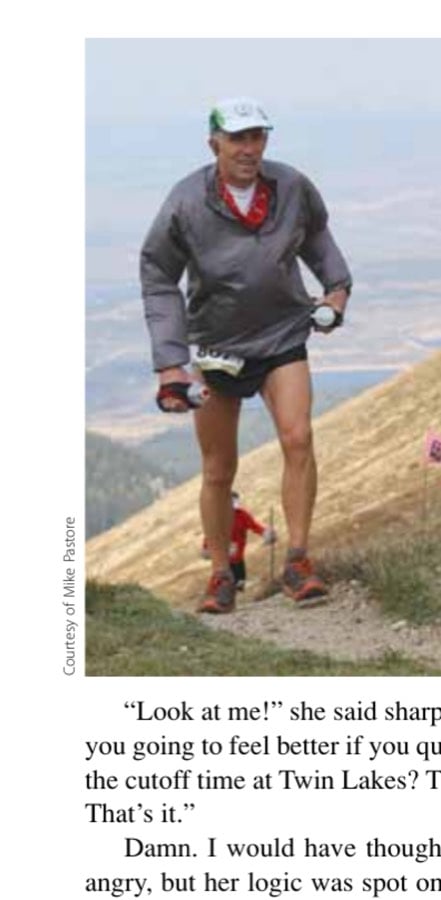
The author climbing up to Hope Pass Summit, the highest point (12,600 feet) on the Leadville course.
from when I started; they moved me to the medical tent, and I sat down. John and Ryan kept giving me food and drink and telling me, “We could do it!” They were insistent, and rightfully so, but they did not know what was up the hill or how I really felt, or how mad I was, not at them but at myself. Because of my overconfidence, I had let them all down. Ashley asked them to give us a minute, and they stepped aside. She looked at me very hard and said, “OK, let’s say you are right and you won’t make the next cutoff at Twin Lakes.” I was feeling sorry for myself and was looking down at my feet. “Look at me!” she said sharply. “When you wake up tomorrow morning, are you going to feel better if you quit here and take a DNF or get pulled for missing the cutoff time at Twin Lakes? That is what you have got to answer for yourself. That’s it.” Damn. I would have thought it was impossible. Not only was I now more angry, but her logic was spot on. There was no other choice for me now. I was actually going to run back over Hope Pass, even though I could barely stand up. John made sure I ate watermelon with salt. It was good. I ate what I could. Ryan made sure we had lights and GUs, but I made John and Ashley promise to wait one hour before leaving, because if I felt worse we were coming back. I was not even talking to Ryan. We walked out
of the aid station and started back up the grade that led to Hope Pass.
Leadville 100 training camp weekend, June 23-24, 2012 “Leadville is your first 100-miler, Sheri? Really?” That was all I could say. Between my obvious surprise, climbing yet another hill, and running at this altitude, I was choosing my words carefully—meaning the fewer, the better. On our first morning at training camp, Scot, Sheri, and I had met on the trail, going up yet another nonrunable climb; we had all just ended up together. Scot had finished Leadville 100 five or six times. He lived in the Denver area, so he knew
the race. Sheri and I wanted to pick his brain, and he was cool with our endless questions. This may have been Sheri’s first 100, but as it turned out she was a Subaru-sponsored adventure racer and Enduro Mountain Bike racer from Calgary.
We stayed together most of the first day and learned a lot about the race from other runners and about each other. It made the very hard running less intimidating. We never even brought up the A word. The altitude was something we were all dealing with, we could not change it, we all knew we had other issues to worry about, and the altitude was a given.
At the group pizza dinner that night, the three of us agreed that we were OK with the times we ran that day—you could even say “pleased.” We all had our pictures taken with Anton Krupicka, ate more pizza, and wondered what Hope Pass would be like tomorrow.
Sunday morning was ideal weather, just like the day before, and despite the double crossing of Hope Pass that we had in front of us, the overall mood that morning was lighter than the day before. Now everybody knew somebody, and we ran out in small groups of eight or 10 runners. We were instructed to take rain/ cold gear, so we did. Sheri and I stayed close in another small group, and Scot went ahead after about the first hour. We were about halfway up the climb, and Sheri was climbing faster than me. We stopped. She took a picture of me, I took one of her, and she disappeared on the trail in front of me.
This was hard climbing, but there were other runners around and I came up on Scot in a small group. He said Sheri had passed him too. We both laughed. She was strong. As we came close to the tree line, I asked Scot how much farther it was to the top. He said we had a “ways to go, you really can’t see it from here.” There were about five of us climbing up the trail, and there was one section that still had some snow. Snow is very novel for anyone from South Carolina, but snow in late June is unusual to most. The more we climbed, the more space there was between us, the more we slid, and the less we talked. The only words you could really hear were the cuss words that seemed louder than normal conversation. You know them all, so there is no need to add them here for color, but I assure you, none of them were left out and they were all used as a noun, verb, and adverb, sometimes in the same sentence.
It was noticeably cooler at the summit. We stopped for about three minutes, Scot took our picture, and he gave me some tips on how to run the downhill back side. (“Butt surf if you can’t make the turn. It will slow you down so you don’t go off the side.”) Then he was off down the trail. I followed as best I could but lost him after three or four switchbacks, and I basically ran alone to the bottom unless I passed someone or was being passed. During the run down, all I could think about was that I had to come back over this monster today, just as I would during the actual run in August. What was I thinking when I signed up for this?
My trip back over was mostly alone, and most of the other runners were like me. Talking was not part of the program on the return trip; it was all I could do to run back to the bus taking us into Leadville.
Unlike yesterday, there was no sense of accomplishment for me in today’s run, just the harsh realization that this 100-mile run would be a risk for me, no matter how well I had been running. I did not see Scot or Sheri before I drove to Denver for the red-eye back to Atlanta/Greenville.
I was very tired, my toes were already a mess before I did this, and now they were significantly worse. I did not want to make a snap decision, so I promised to give myself 10 days to decide whether I would return for the race. Could I finish this in less than 30 hours?
Leadville 100: Winfield (mile 50.0) to Twin Lakes (mile 60.5) Going back up Hope Pass, Ryan was slightly ahead of me. Ryan and John are both Ironman finishers (fast) and manage Run-In, our largest local running store. Just a few weeks before Leadville, they had both paced a friend (Kyle Kugler) at Western States 100 to a sub-24-hour finish on his first 100-mile run. Today they would see a very different side of ultrarunning.
Ryan kept pushing GU on me, and I was feeling better, but I was still not talking. The disappointment I had felt at Winfield had not subsided. Ashley and John were now on their way back to Twin Lakes, so there was no turning around, and we had just started our climb up Hope Pass. There were still a few people coming down, but not many, and we were passing runners going up, but every 10 or 15 minutes I would have to stop to catch my breath and yawn. The yawning was very odd, because I was not sleepy in the least.
Ryan told me he had never been above 12,000 feet, and I told him that would be changing tonight. He was consistently positive, concerned, and pushy: the ideal pacer. It was close to that point that I realized how fortunate I was, and I stopped feeling sorry for myself. It was getting dark as we came out of the tree line. We stopped and put on our headlamps; above us we could see other dots of light moving slowly across and up the mountain. Ryan asked me how far they were away, and I told him about an hour. We sucked down a GU and kept climbing.
As we neared the top, I did another dashboard check: my stomach was OK, and I was not thirsty, hungry, or cold. I was simply weary; there was no “run” left in me. Clearly, I had not been in this environment long enough to be hardened to the altitude, but I had run enough miles over the last 10 years to know how to compartmentalize pain.
We reached the top and the timing mat was still in place, but the two mat watchers and the mat guard dog were gone. I told Ryan, “Just stop here, turn off your headlamp, let your eyes adjust, and enjoy this. This is the highest you
have ever been.” Neither of us said much, but what we saw around us justified the climb. We stopped for only a few minutes, and then we trotted off down the pass. I fell once or twice, it was steep and the rocks moved with every footstep, but at least we were now moving faster.
Hope Pass aid station (inbound) looked surreal with the pack-toting llamas in our headlamps, but we did not hang around. We filled our bottles and left. On the way down we talked about anything and everything. It was as good a run as I have ever had. When we finally reached the bottom, we still had the river to cross, and it was just damn cold. Finally we saw lights at Twin Lakes, and we both walked a little faster.
John and Ash were waiting. They were a very welcome sight. They handed each of us a beer, and we all walked to the aid station as a group. I had missed the time cutoff, so they took my timing chip, I thanked the volunteers, and we laughed about our day on the walk back to the car. John, Ryan, and Ashley had been awake, taking care of me, for the last 20-plus hours. I had to keep up my spirits, which was not a simple task after earning my first DNF.
It was just before midnight on Saturday as we pulled into the Safeway in Leadville. We were all hungry and knew the Safeway was open 24 hours for the race. We put two pizzas, some chips, cookies, and two six-packs of beer in the basket. The store manager came to check us out, and told us he could not sell us the beer. It was past midnight, and now it was Sunday. “No beer sales until 5:00 a.m.,” he said. He was very apologetic. It was the second cutoff I had missed in the last 24 hours.
Leadville 100, town of Leadville, August 19, 2012 The gym was completely packed for the awards ceremony. We all wanted to see the winners, but I really wanted to see Jay get his Leadman award and Sheri get her buckle. The awards started, and one of the first things the organizers did was ask everyone in the gym who had not finished the race to stand up. We stood, there was genuine applause, and I could not sit back down fast enough.
There were amazing stories told about the top finishers and the multiple-time finishers, but to me, anyone who completed that run and received a buckle was simply amazing. That morning, before we went to the awards ceremony, Ashley asked me if I was coming back, and paraphrasing my friend Byron Backer, my response was: “I have no unfinished business at Leadville.” That was then.
Ash recently picked up a DVD at Costco, The Best Exotic Marigold Hotel, and a quotation from the movie keeps coming back to mind: “When you reach the end, everything will be OK. If it is not OK, then perhaps it is not the end.”
This article originally appeared in Marathon & Beyond, Vol. 18, No. 4 (2014).
← Browse the full M&B ArchiveMore like this
1,000+ stories from 19 years of Marathon & Beyond
The complete archive of the legendary long-distance journal — digitized and free to read.
