

Fifty Years To Finish An Ultra
Never say die. I had power walked 52 miles nonstop in 13 hours, and extreme weariness set in. I slumped into a comfy chair at the parish church of Saint Bridget’s in the village of Bride on the Isle of Man. I never give in, but back-toback marathons for a 72-year-old with a dodgy knee was my realistic aim, so really no shame. I started pulling off my race number. However, at the checkpoint was a former winner of this 85-mile race who cajoled and then insulted me not to be such a wimp. I couldn’t rise from the chair but, lifted bodily, was shoved up the hilly road rather like trying to push-start a car. I spluttered into life to continue the Parish Walk through the closing dusk. This is my story of how I tried to walk farther, faster while 50 years older.
The largest ultrarace in Britain: the Parish Walk
▲
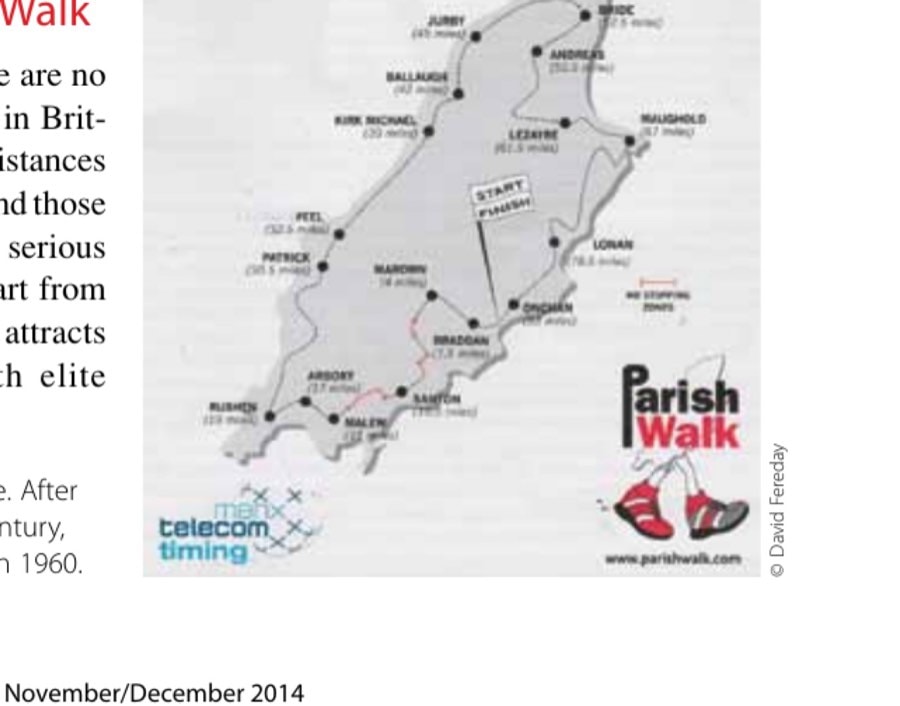
The map of the racecourse. After first being run in the 19th century, the Parish Walk was revived in 1960.
© David Fereday
Unlike in the States, there are no mass-participation ultras in Britain. Beyond-marathon distances rarely raise a field of 50, and those are contested largely by serious club athletes. That is, apart from the Parish Walk, which attracts 1,500 competitors, both elite
toe-and-heelers speeding at near 10 minutes a mile and recreational walkers just trying to finish. The race circumnavigates the Isle of Man, a picturesque island situated between England and Ireland. The task is to touch the gates of each of the 17 parish churches on the island, which involves 85 miles of extremely hilly terrain, albeit on tarmac. The origins date back to 1852 when local man John Cannell, who—for reasons unknown, perhaps a bet in the pub—trotted round on a horse visiting the 17 churches in a time of 15 hours. A year later he repeated the exercise minus his horse and then again the next year in 24 hours. The Parish Walk was replicated twice more in the 19th century by a Colonel Anderson.
In 1913 the Isle of Man Examiner published an account of these gentlemen’s achievements, which inspired some local businessmen to organise a commemorative race. Twelve started and three finished within the 24-hour time limit. The First World War interrupted the Walk’s continuance, but—inspired by a renaissance in British racewalking with Don Thompson and Ken Matthews winning Olympic golds and 57-year-old Dr. Barbara Moore walking epic distances, including a stint from San Francisco to New York—the Parish Walk was revived in 1960.
The first modern Parish Walk—1960
© David Fereday
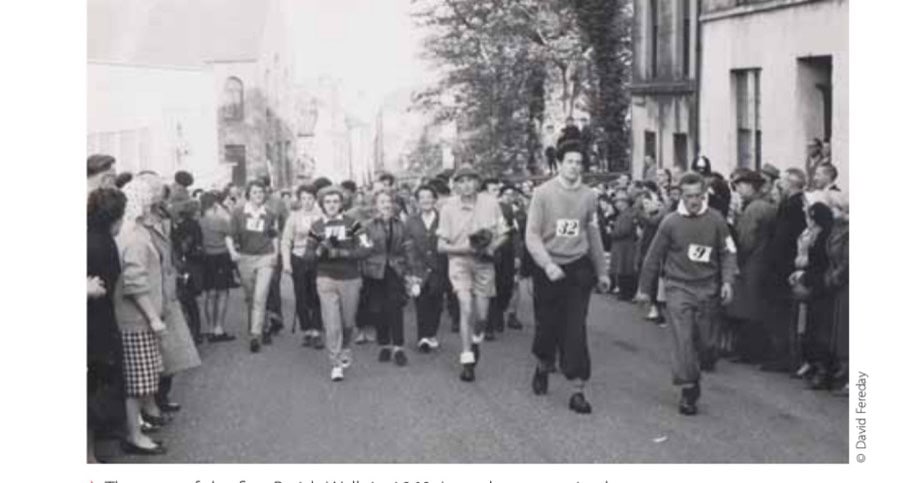
At the time I was a 22-year-old serving in the Royal Air Force on the Isle of Man. Ever eager for a physical challenge but with only the impetuous fitness of youth and inadequately clothed, I lined up on a cold, wet May evening with 34 equally
▲ The start of the first Parish Walk in 1960. I am the geezer in shorts.
unprepared “adventurers.” There were no serious racewalkers and we set off as if hurrying to the shops. There were only three finishers. I lasted more than most but after walking nonstop for 12 hours and covering 45 miles through the night, legs became inoperative and I collapsed for a DNF.
Fifty years on I had a customer on the Isle of Man (my company manufactures food-warming equipment), and I casually mentioned my exploit 50 years previous. I was astonished to learn that the Parish Walk was to celebrate its 50th year and had grown into a massive event. Against my better judgment I was persuaded to give the race another go, particularly as I had recently converted from marathon runner to racewalker. I had started running aged 41 with the intent of just attempting one marathon, a lifetime’s ambition, but like so many got hooked and to date have completed over 50 with a best time of 2:44 at age 47. In the process, cartilage in one knee has worn away, making running impossible. The reduced impact of racewalking enabled me to continue the streak of finishing all London Marathons—currently 34.
The challenge I set myself a challenge to walk faster, farther, at 72 compared with a youthful 22 years. I had racewalked the London Marathon in five and one-half hours so back-to-back six and three-quarter-hour marathons was a reasonable task, which would be significantly faster than the effort in 1960, but to finish the 85 miles was realistically beyond the radar. Preparation Leading up to the London Marathon in April, I had gained good fitness from training 35 miles a week. This left eight weeks to prepare for twice the distance. Advice from research indicated that 60 miles a week at an easy pace, including some back-to-back 13-milers and a maximum session of 20 miles, could be sufficient. In any event, I built up to 100 miles over a 10-day period and felt half ready for the task. My plan For any endeavour in life, there best be a plan. So often I see participants in races simply setting off without any realistic schedule in mind, only to dismally fail. Whilst completing the 85-miles distance was fantasy, nevertheless my plan had to take into account that possibility. The cutoff of 24 hours equated to averaging 17 minutes a mile, and that pace had to be maintained to each checkpoint to prevent disqualification. I have always attempted and usually succeeded in running evenpaced marathons but noted that generally ultra participants substantially slowed.
Therefore, I planned to start faster than 17 minutes a mile, besides which such a slow speed would be inefficient when muscles were fresh. Fourteen minutes a mile for the first undulating 19 miles should be comfortable, leaving me ready for the challenging extremely hilly next 12 miles, for which 17 minutes a mile should be doable and then 15 minutes a mile back on the flat for the 14 miles to the point of failure 50 years earlier. Adding on 10 minutes for brief stops would give a time of 11 1/2 hours for the 45 miles to Saint Patrick’s Church Jurby—half an hour faster and 50 years older, job half done! I reasoned that tiredness would not allow that pace to be maintained, with a slowing to 17 minutes a mile up to the double-marathon distance in a little over 13 1/2 hours, the further bit achieved. Thereafter any estimate of progress was probably hypothetical, but I guessed that 18:30 a mile could be managed for the third marathon, and with the relatively downhill last six miles at 18 minutes a mile plus 13 minutes for stops meant I would arrive back in triumph in 23 hours, 45 minutes with just 15 minutes to spare—phew! Simple on paper, but in reality?
Logistics Whilst in the early stages there would be feeding stations, after 19 miles I would need support. I had advertised in the local press for a volunteer. Jane, who had previously completed the race, came forward and we set about emptying the local supermarket of carbohydrates, including the necessary salty snacks and ample water. Then all manner of clothing was loaded to the support car to counter whatever weather was thrown—warm, wet, or wind. My hotel did a great spaghetti carbonara to boost the glycogen reserves the day before the race.
The race 2010 The forecast was for the Parish Walk to be the hottest in 33 years, so no difficult decisions on the clothing front, just a minimum till nightfall. My usual last-minute toilet panic left me right at the back of the 1,498-strong field as the gun blasted at 8:00 a.m. We had to cover a lap of the stadium track before pouring on to a narrow path, the mother of all bottlenecks. It seemed silly to worry about the slow shuffle when 85 miles lay ahead, but 64 minutes for the first four miles was eight minutes behind the schedule pinned to my vest and monitored by a Garmin on the wrist. Then leg and arm room became available to enable my planned pace of 14-minute miles. Strangely, there was no thought for the long miles ahead. Thinking was just for the here and now. It was all becoming rather pleasant, passing over undulating roads through pretty villages bedecked with refreshment tables enabling a delicacy to be grabbed and a happy word with the good ladies on duty.
Being hot, hydration was important but I had “overwatered.” When running marathons I had rarely had to stop for nature, but after seven miles of walking, a
pit stop through a farm gate was necessary. I lost a minute and another at 13 miles for similar release. If toilet stops were to be every seven miles at a minute each, over the 85 miles some 12 minutes would be lost. That could be critical were I to be near the 24-hour deadline. If I could take liquid in on the hoof, then it must be similarly expelled and save precious minutes.
After touching the gates of the churches at Marown, Santon, Malew, and Arbory, I reached the whitewashed church of Kirk Christ Rushen 19.1 miles into the journey. My time was 4 hours, 38 minutes, compared with the planned schedule of 4 hours, 27 minutes (14-minute miles). The 11 minutes shortfall mirrored the time lost at the start and the two calls of nature, so after the initial four miles I was walking to plan. Now, bolstered with my lady support crew, the next 12 miles was up and over the dreaded Sloc, rising 1,200 feet in four miles. I took ample sustenance, shouting what I fancied to Jane, who drove on up the road to hand me my order as I passed. The road bore resemblance to the Tour de France, but instead of bikes a motley bunch plodded upwards. The views were breathtaking as height was gained and then the drop back to the coast.
After six hours the first hint of a problem: my disadvantaged knee was rather reluctant on the steep downhills. Without the benefit of cartilage, tibia crunched painfully against femur and it was quicker to walk backwards. The good news was that I had covered this 12-mile hilly section to the Holy Trinity Church Patrick at just under 16-minute miles, 13 minutes faster than planned. That more than wiped out the shortfall, and without taking any of the planned stops I was now nine minutes to the good.
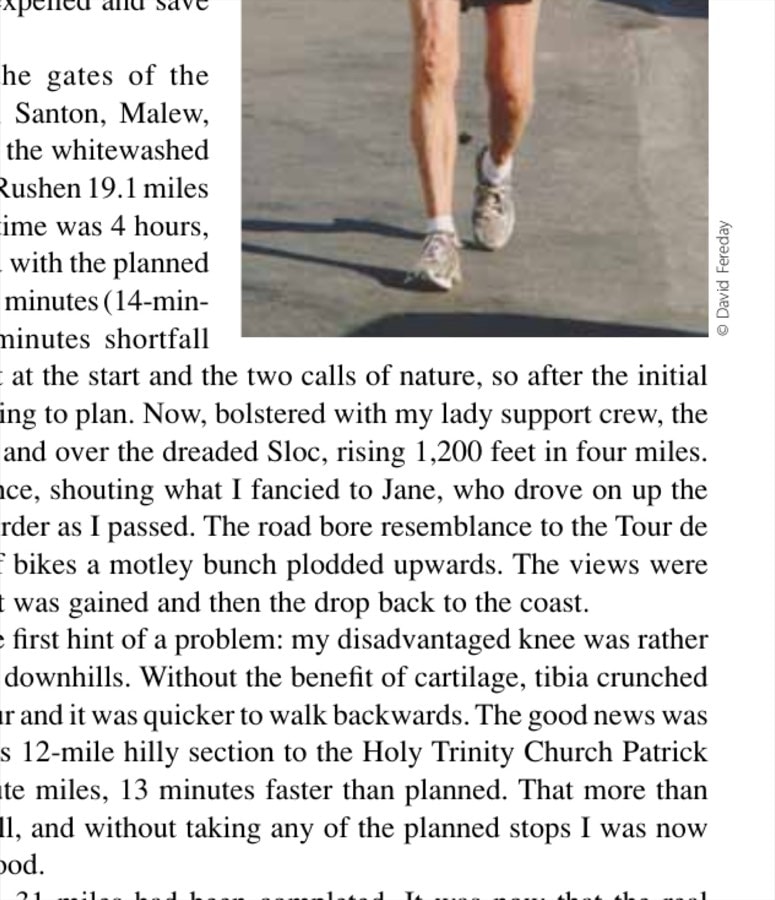
Back at sea level, 31 miles had been completed. It was now that the real battle with myself was to begin. My focus shifted to speed the 14 flat miles to the “faster 50 years older” target at the 11th church of Saint Patrick’s Jurby, passing the churches at Peel, Kirk Michael, and Ballaugh. It was getting seriously hot and my support lady went AWOL just when I most needed carbs and water. I was walking into trouble. Desperate, I had to flag down and beg sustenance from
© David Fereday
▲
The 2010 race at 32 miles—feeling fresh and perky!
© David Fereday
another walker’s crew. After a couple of hours, Jane reappeared and my panic was over. I didn’t want to chide her, as after all she was a volunteer. There was a detour up a steep track to touch the gate of the church at Jurby. It was very much déjà vu except I was now an old man! I had managed just under the 15 minutes a mile scheduled for this section and without taking the planned five minutes for stops gained seven minutes, to be 16 minutes up on the master plan. The “faster” challenge had been well and truly conquered.
With seven and one-half miles to go to achieve back-to-back marathons, I was seriously weary. With just a mile to Saint Bridget’s, the 12th church, the brain was faltering and sort of reasoned that my day was done. Nevertheless, I had only slowed to a little under 16 minutes a mile and had gained seven minutes, to be 23 minutes ahead of schedule. The double marathon had taken 13 hours, 15 minutes. The “further” challenge was now in the bag—mission accomplished. Was there any point in distressing my body further?
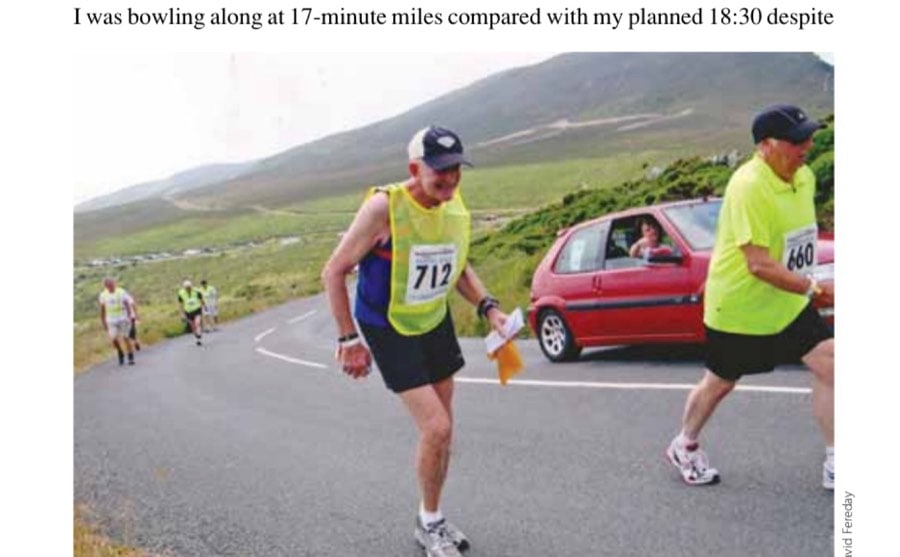
However, the ex-winner of the Walk forced me to pin back my number, and after an eight-minute rest of macaroni, cheese, and milky coffee I reluctantly reengaged the enemy. My calves were like concrete, but after suffering up the hill from the church, a happening happened. Tiredness vanished and legs seemed to be like new. It was surreal. In the gathering darkness I breezed past the next checkpoint at Saint Andrews Church Andreas, wisecracking that ultras were a piece of cake. I was bowling along at 17-minute miles compared with my planned 18:30 despite
▲ Tackling the Sloc in 2010. I am #712.
© David Fereday
very hilly terrain and had time well in hand to afford a few minutes to stop for more macaroni, cheese, and coffee at the 14th church of Holy Trinity, Lezayre, and then again after 67 miles at Saint Maughold, the 15th church.
It was now 1:30 a.m. and I was faced with the longest stage of 11.7 miles. I still doubted I could finish the job, but halfway into the stage I suddenly realized that there was a chance of success. That was a massive psychological boost. My resolve strengthened, but the road seemed never ending. The chairs outside a pub seduced me for some respite and a hot drink. Then on and on to the 16th church at Lonan. The field had become extremely strung out but occasionally I could see someone up ahead in the darkness giving a target to aim for. I seemed to be moving faster than others.
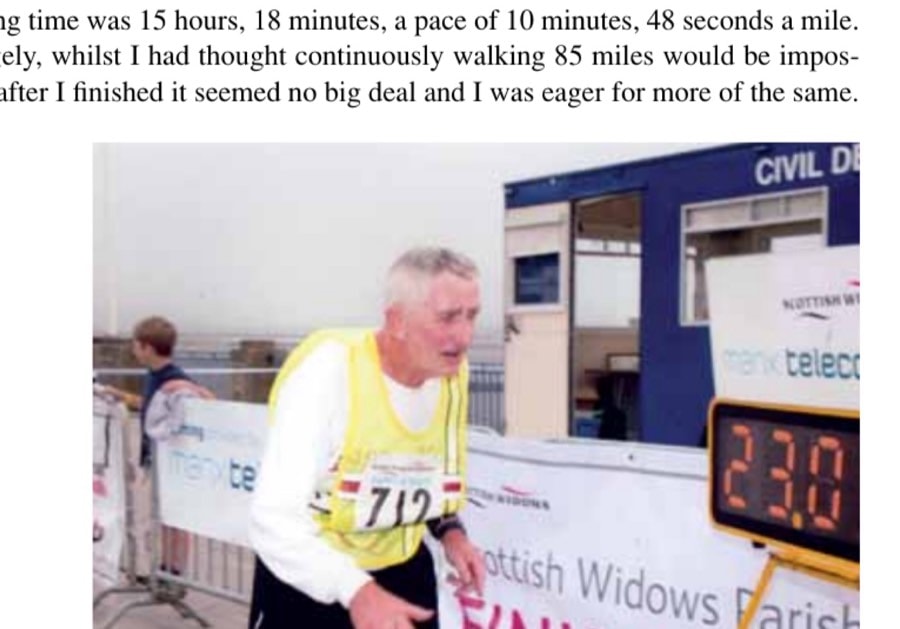
With only six miles to go, surely I had cracked it, but the road violently switchbacked up and down valleys and the dodgy knee again forced me into reverse gear. Dawn was on the horizon when I made it to the last church of Saint Peter’s Onchan, then down to the sea front at Douglas, the Isles capital, for the final mile. There still seemed a bit in the tank as I spurted to the line and was ushered into an ambulance, which I didn’t really need.
The final 32 1/4 miles from my “nonretirement” at Bride had taken 9 hours, 41 minutes compared with the planned 10 hours. My final time was 23 hours, 3 minutes, beating my target by 42 minutes. I was 106th out of only 133 finishers. The winning time was 15 hours, 18 minutes, a pace of 10 minutes, 48 seconds a mile. Strangely, whilst I had thought continuously walking 85 miles would be impossible, after I finished it seemed no big deal and I was eager for more of the same.
▲
Staggering to the finish in 2010.
Twelve months later It would be a pity not to use my newly discovered ultra ability, so doing the Parish Walk 12 months on was a must do. A challenge could be to beat the over-70-yearsof-age record of 21 hours, 52 minutes. To achieve this, my pace would have to be increased on average by a considerable 48 seconds a mile to 15 minutes, 15 seconds, so I hatched a plan accordingly.
I conceived my new challenge to be four separate conjoined races, each to be focused on separately, without thought to the next section. The first race would be the undulating 19.1 miles to the church in the South of the island at Rushen. I would need to walk this distance in a state of relaxation to reach the following mountain stage still feeling fresh. A pace of 13 minute, 40 second miles compared with 14 minutes the previous year should be just right. I penciled in 15 minute, 20 second miles for race two up 1,200 feet over the Sloc for 11.7 miles compared with the 15:51 m/m achieved in 2010. Race three would be the flat 21.9 miles to the double-marathon checkpoint at Bride, paced at 14:24 m/m—15:08 last year. Finally, the fourth race of 32.2 miles full of ups and downs through the night. I designated at 16 minute, 45 second miles compared with 18:16 m/m a year ago to bring me in just on the record. For me an ultra is very much a mathematical equation in addition to a physical endeavour, and the maths conveyed a big task.
Again I advertised for crew, and a lady and gent volunteered—Sara for the day and Kevin for the night shift. Kevin’s car was about the oldest banger I had ever seen. Would it last till dawn?
The Parish Walk 2011 Race 1: 19.08 miles to Kirk Christ Church Rushen At 8:00 a.m. the gun set off 1,505 starters on what was forecast to be another hot day. Not to be thwarted this year, I was well near the front, opening with a 13:47 mile. I progressed nicely, averaging 13 minutes, 52 seconds per mile, to arrive just after midday at the quaint fifth church at Rushen in 4 hours, 24 minutes, three minutes behind schedule but feeling good.
Race 2: 11.67 miles to Patrick Church The temperature rose as I ascended the dreaded Sloc. Walkers quail at this mountain stage, which rises from near sea level to 1,200 feet, but I looked on it as a challenge to be relished and attacked with gusto. Fortunately, this year my knee without cartilage behaved on the steep downhills back to the coast and so reverse gear was not necessary, enabling me to complete this “race” at 14 minute, 46 second miles, quite a bit quicker than the plan, and I was now four minutes up on the over-70 record.
Race 3: 21.87 miles to Saint Bridget’s Church Bride I knew this would be a difficult stage, and I prepared the mind for pain. It had become seriously hot, the field had thinned out, and it was a lonely chore. I was having difficulty maintaining my target pace of 14 minute, 24 second miles, and when I drifted to over 15 minutes a mile, I had to really get stuck in. I was overheating but had the inspiration for Sara to thoroughly soak a towel and drape it over my head. As the cooler evening came, the crisis passed. I had managed to average just under 15 minutes a mile for race three, in total 12 minutes slower than scheduled. I was now eight minutes down on the record. Unlike last year I felt quite fresh at the double-marathon point and considered skipping my first planned rest at this, the 12th church. I stuck to my plan and sat down for some creamy rice and sweet milky coffee and donned some warmer clothing for the night ahead. This took three minutes more than the eight minutes I had allowed, so I arose with a deficit of 11 minutes against the beat-the-record schedule. Sara signed off for Kevin to take over, supporting me with his “might get through the night” car. Race 4: 32.23 miles to the finish Buoyed by the rest, I started to slaughter my schedule, beetling along at 15-minute miles compared with the scheduled 16 minutes, 45 seconds for the first nine miles. Severe hills slowed me to 15 minute, 52 second miles for the next five miles to the 15th church at Maughold, where I really needed my planned stop. The tremendous news was that I had completed the 14 miles from Bride 20 minutes faster than my plan and was now nine minutes ahead of the over-70 record.
It was midnight, but the good ladies of Maughold had forgone their beds and were waiting with lashings of homemade soup. Three delicious cups set me up nicely to nail the longest hilly 11.7 miles through what had become a foggy night
▲
© David Fereday
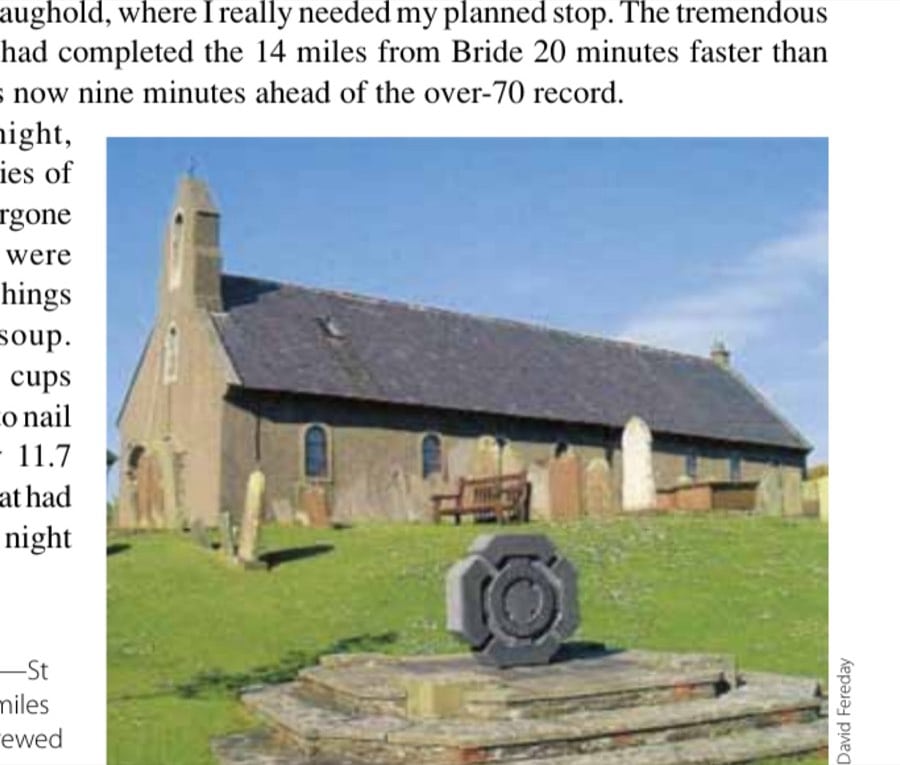
The 15th church—St Maughold—at 67 miles where the ladies brewed fantastic soup.
to Lonan Church. I was well into racing mode, scything along at 15 minutes, 45 seconds a mile, 60 seconds faster than the figure on my schedule. With just over six miles to go, after a session of nasty hills there came a sting. As dawn broke, a forceful drizzly gale drove right in the face as I strove to the last church of Saint Peter’s. It was an arduous battle after over 18 hours of effort, but somehow my pace maniacally increased and I was down to 15-minute miles, obliterating what was down on paper. Last year I finished in style, but by the time I reached the final mile and a half along the promenade, I was done for. I made a passable impression of Dorando Pietri staggering to the finish, clocking 21 hours, 21 minutes, beating the old record by just over half an hour. I was 95th out of 159 finishers, with the winner recording 15 hours, 2 minutes.
What next? A few years back, a guy of 74 completed the course, so the next challenge may be to become the oldest finisher of the Parish Walk.
Reflections My absolutely brilliant crew helped ensure my success the second time round. They constantly shepherded me, supplying every need, especially keeping me well topped up with carbs. Eating little and often, almost like drip-feeding, ensured my energy levels were sufficient without overloading the stomach. I conclude a task may never be too big to contemplate. The human body and spirit is a marvellous creation.
▲
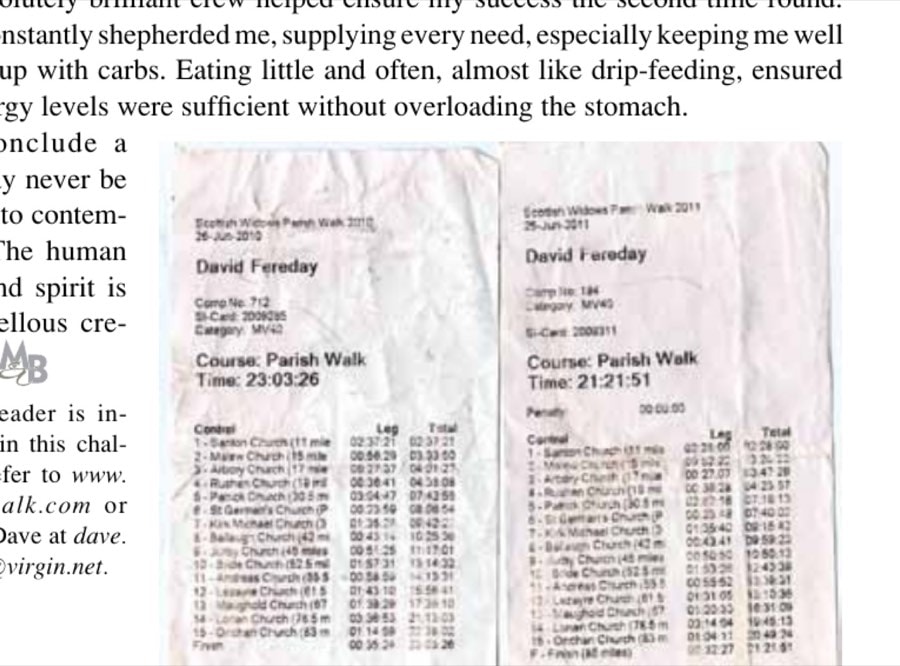
Printouts of my individual stats for the 2010 and 2011 races.
© David Fereday
If any reader is interested in this challenge, refer to www. parishwalk.com or contact Dave at dave. fereday@virgin.net.
This article originally appeared in Marathon & Beyond, Vol. 18, No. 6 (2014).
← Browse the full M&B ArchiveMore like this
1,000+ stories from 19 years of Marathon & Beyond
The complete archive of the legendary long-distance journal — digitized and free to read.
