

Following My Grandfather’s Footsteps
Deception all around During the Walk, the Indian witnesses complained that the men were running, not walking. Later, the chiefs filed complaints to the authorities, but they received no help. Deception and harm did not affect only the Lenni Lenape people. It seems that Marshall never received either the 5 pounds or the 500 acres. From my reading, I cannot say whether he knew the treaty was a fake. He certainly knew the goal was to gain maximum acreage. He had applied to purchase a tract of land within the area to be obtained. And years later, when the Indians were being forced from the land, they attacked the white settlers. Marshall’s wife and a son were killed and a daughter was injured.
In 2010 I learned of my ancestor Edward Marshall and his part in the Walking Purchase. Having been a runner for about three years, I wondered whether I
© Dale Marie Potter-Clark
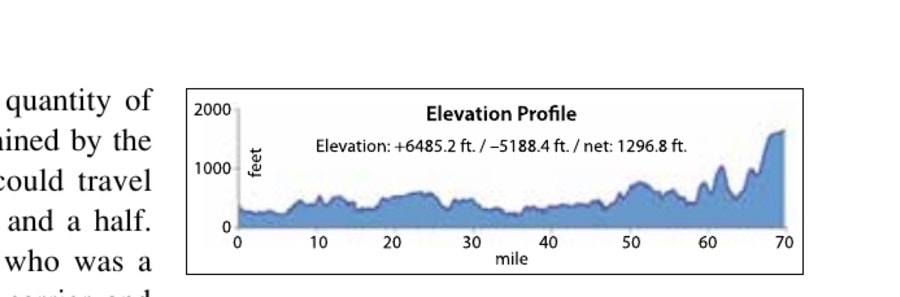
the transfer of a quantity of land to be determined by the distance a man could travel on foot in a day and a half. My grandfather, who was a surveyor’s chain carrier and an outdoorsman, was one of the runners who were recruited to go as far as possible for 12 hours one day and for six more hours on the second day. They were promised a payment of 5 pounds for the attempt, with a reward of 500 acres for the man who went the farthest.
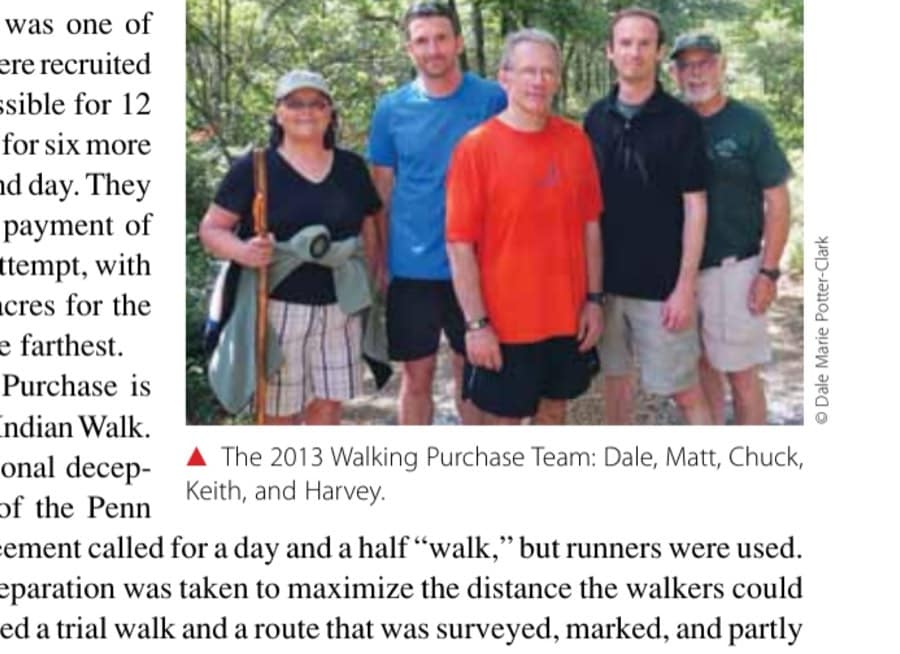
The Walking Purchase is also known as the Indian Walk. There was intentional decep- ▲ The 2013 Walking Purchase Team: Dale, Matt, Chuck, Keith, and Harvey. tion on the part of the Penn brothers. The agreement called for a day and a half “walk,” but runners were used. Every possible preparation was taken to maximize the distance the walkers could cover. This included a trial walk and a route that was surveyed, marked, and partly cleared. The “treaty” document used to convince Chiefs Lapowinzo, Nutimus, and Tiscohan was a draft from the prior generation that had never been signed. But the Penns presented it as having been agreed upon and still to be carried out. There was a map with some details misrepresented to make the chiefs think the expected land transfer was less than really intended by the Penns.
▲
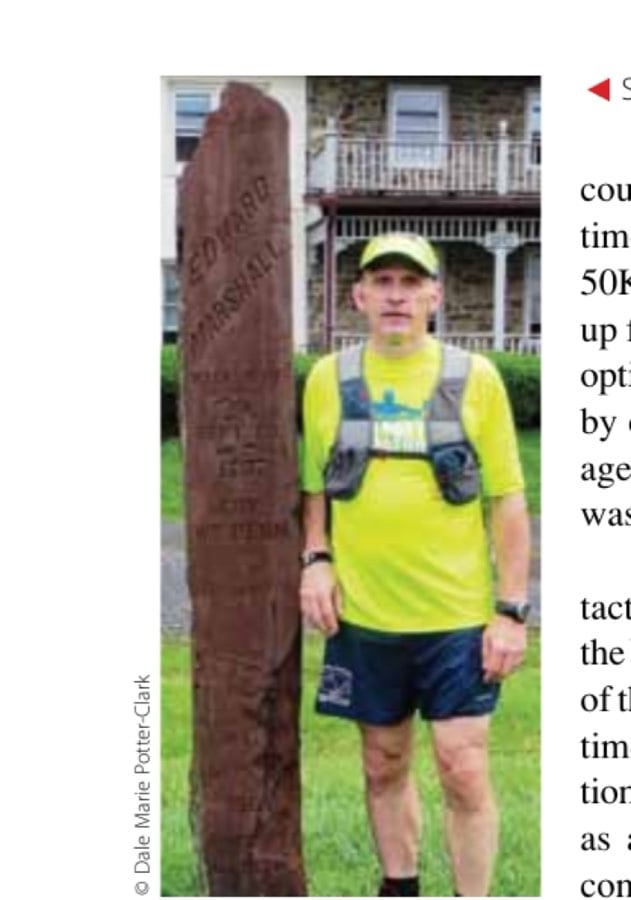
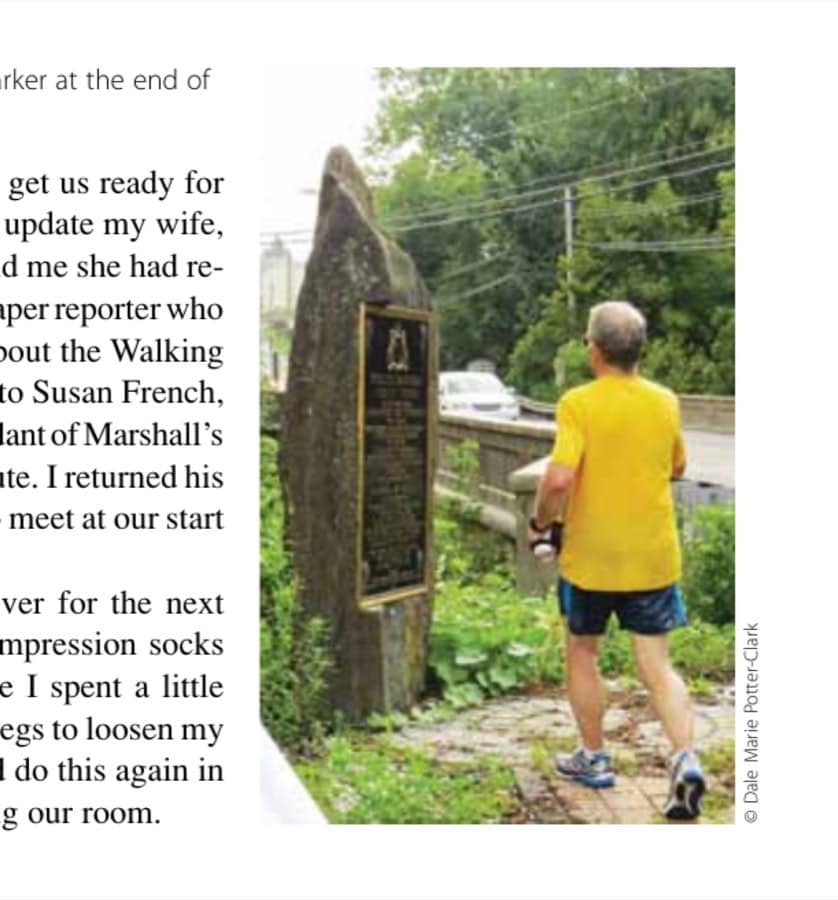
Stone marker with Edward Marshall’s name.
© Dale Marie Potter-Clark
could someday run the same route within the same time limits. I had done some longer runs, including a 50K trail race and a few marathons, and I had signed up for the JFK 50-Mile. I apparently already had the
optimism of an ultrarunner because I was not bothered by either the distance or the difference between my age and Marshall’s. He was 27 years old in 1737; I was 55 when I learned of his feat. So I began to research and plan a course. I con
tacted members of a hiking group who had retraced the Walking Purchase as a two-day hike. Susan French of that group has completed its version of the Walk 22 times and was very helpful with background informa
tion and walk-route details. And I continued to develop as an endurance runner; by spring of 2013, I had completed 10 marathons, six 50Ks, and the JFK 50.
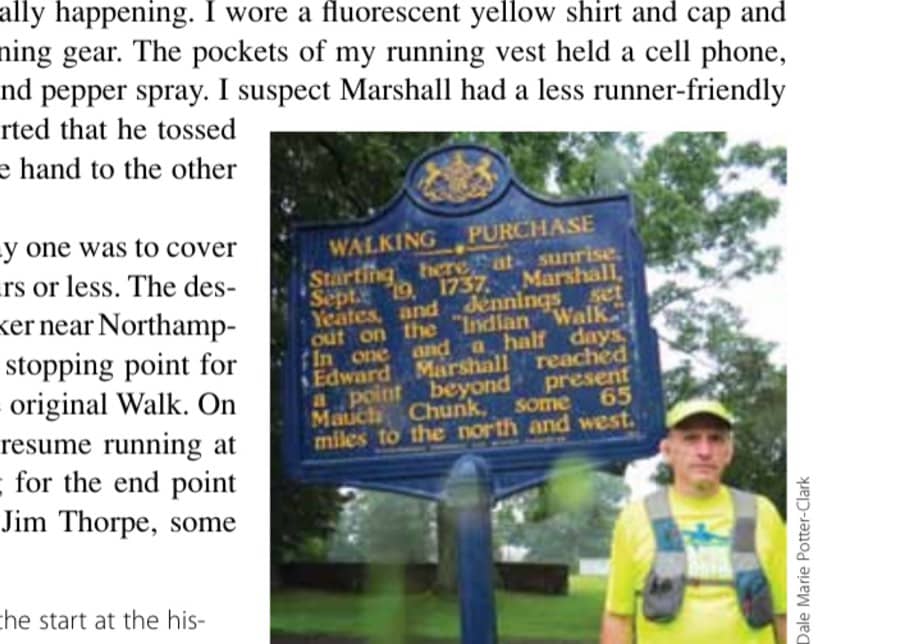
At 7:35 in the morning during heavy rain, I started my run by touching the stone historical marker in Wrightstown and splashing across the soggy lawn to run along the edge of the road. My son Matt ran with me. My long-anticipated
adventure was finally happening. I wore a fluorescent yellow shirt and cap and other modern running gear. The pockets of my running vest held a cell phone, route directions, and pepper spray. I suspect Marshall had a less runner-friendly
outfit. It was reported that he tossed a hatchet from one hand to the other as he went. My plan for day one was to cover 47 miles in 12 hours or less. The destination was a marker near Northampton located at the stopping point for
the first day of the original Walk. On day two I would resume running at that spot, heading for the end point near the town of Jim Thorpe, some ▲
Moments before the start at the historic marker in Wrightstown.
© Dale Marie Potter-Clark
Day one
23 miles and a couple of mountain climbs away. I wanted to make it in six hours or less. Meeting these goals would match the run my grandfather Marshall had completed between the same points almost 276 years earlier. The runners in 1737 were accompanied and supported by men on horseback. There were also Indian monitors along to observe the “Walk.” My support crew included my grown sons Keith and Matt, plus my cousin Harvey Boatman and his life partner
Dale Marie Potter-Clark. They drove a full-size SUV along the course as a rolling aid station, meeting me at about three-mile intervals. Matt would run with me off and on, eventually covering a little more than half of the total distance. Keith primarily drove the support vehicle but also ran with me for a few segments of the course. Harv was the navigator, reading out the turn-byturn directions, and he was also the main food-and-drink handler. Dale, our one female crew member, was photographer, health monitor, and head cheerleader. As a dedicated family-history researcher, she is the one who uncovered our connection to Edward Marshall and his place in Pennsylvania history.
It took a while for Matt and me to coordinate our pacing. He was more cautious about traffic and waited more often for cars to pass. About three miles from the start, our crew was waiting, parked just off the road on the right side. My plan had been for them to bring a carrier with food (gels, bananas, PBJs, cookies, chips, and pretzels) and water across to the running side and walk along with me while I refueled. At this stop, traffic was too busy for them to cross easily, so we crossed to them. And we changed the plan so I would always stop at the car since the roads didn’t have room for a walkthrough aid station. After this stop, they mostly parked on my side of the road in driveways or parking lots.
Dangers of the not-so-open road The risks of running close to traffic were at the forefront of my thoughts. I had been warned by Susan about the dangerous traffic and narrow roads. On average, we had about two feet of pavement outside of the driving lane. We ran facing traffic, hoping to have time to react if someone drove into our space. We often stepped off into the unpaved edges and waited at places where bushes crowded the road and along curves where drivers tend to hug the inside lines. When I could see ahead, I would run in the driving lane so drivers would see me sooner. As the vehicle approached, I would then return to my space outside of its lane. Running within arm’s length of traffic was made worse by the heavy rain, which continued all morning. The dark and rainy conditions had me wishing for my headlamp, but I had left it at home since this was to be a daylight run. Many times I thought of friends who were praying for my safety, and I regularly asked for God’s protection.
Mainly, I just ran. My intent was to run on the slower side of my easy longrun pace (9:30 or so per mile) and allow walking periods and aid-station stops to
soften the overall effort. If the average pace slowed too much, I planned to shorten the aid-station time. Early in the run, these stops were more like visits with my support team than efficient in-and-out stops appropriate
for an ultra. I kept my attention on completing the next three-mile segment rather than on how much of the total distance remained. At about the third stop, I discovered that my cell phone had gotten wet and had stopped
working even though it was inside a sandwich bag in my vest pocket. I handed it off, hoping it could be dried out. When necessary I ran in the grass along the road. One of those areas had taller grass that hid the uneven ground, and I turned an ankle. This was about
two hours into the effort and caused some soreness but was not exactly painful. I reminded myself to consider only whether everything was working rather than how I was feeling. At one point I came to a farm with a nicely mowed path parallel to the road. I
followed that path, even when it gradually crept away from the road. I expected it to return to the road, but it just ended at an overgrown field. Rather than retrace my steps, I waded through the scratchy weeds to get back to
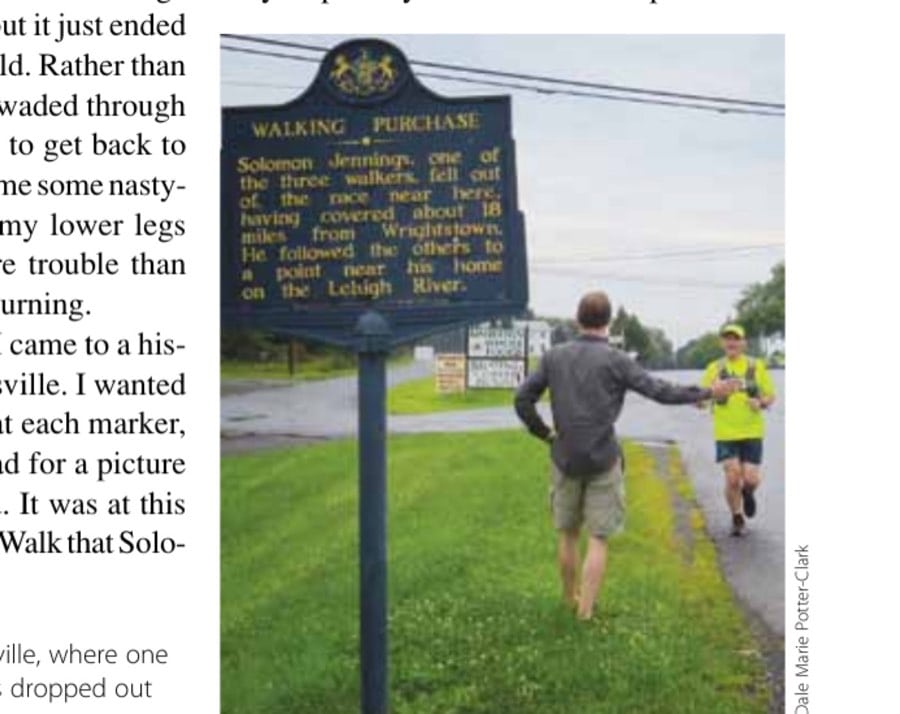
the road. This gave me some nastylooking marks on my lower legs but caused no more trouble than some itching and burning. After 18 miles I came to a historic marker at Ottsville. I wanted a photo of myself at each marker,
so I crossed the road for a picture and some more aid. It was at this point in the original Walk that Solo-
▲
The marker at Ottsville, where one of the original runners dropped out after 18 miles.
© Dale Marie Potter-Clark
© Dale Marie Potter-Clark
▲
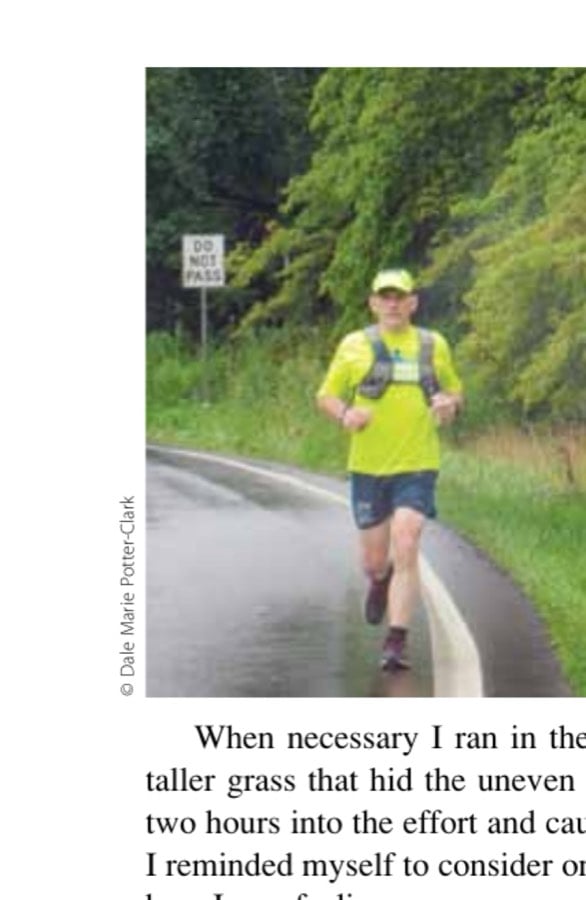
Around 12 miles from the start, the author has only a narrow shoulder to run on.
mon Jennings became the first runner to abandon the effort. I had no thoughts of dropping out. I was competing only with my hope of matching my grandfather’s time, which required an average pace of about 15 minutes per mile. To this point I had averaged about 12-minute miles. The rain was dwindling by now, but it had provided a welcome temperature-control effect.
Halfway through the day Soon there was a convenience store where my crew was buying sandwiches for lunch. I entered for a bathroom visit and then continued the run, with Matt along for another segment. The next stop would be at another marker. This one indicated the place where the walkers “left the Old Durham road on the first day and followed the well-beaten Indian path which led northwesterly through present Hellertown, Bethlehem, Northampton and the Lehigh Gap.” Cousin Harv mentioned that I was about half done with the mileage for the day. The rain had stopped, the sun was appearing, and the humidity was rising. Temperatures would reach the mid-80s for this day. After some pictures, some refreshment, and shedding vest and cap, I was on the road again.
In a mile or a little more, I finally turned off the main road onto one with less traffic and more shade. On this road I ran my fastest mile of the run (8:56) and crossed the marathon mark for the day. But this segment seemed to go on and on. I think it was probably five miles rather than three. And I was getting too warm, so it seemed really long. My attitude was sagging; I doubted my memory of the course and pulled out my turn-by-turn notes. I was on course, so the only thing to do was to keep moving forward.
This long-awaited stop was where earlier that morning we had seen a sign indicating the bridge was to be closed on this date. A road worker at the site confirmed that the bridge would be closing before the day was over; I was glad for no detour that would add to the planned distance.
There were two more historic markers here. On the original walk, the two remaining walkers and their entourage had stopped here for lunch at noon. My GPS watch had recorded 5 hours, 45 minutes and almost 29 miles before it stopped during the break due to low battery. I was moving just a little faster than my grandfather. In addition to taking more pictures and nourishment, I switched watches and changed into dry shoes, socks, and shirt. My outlook was probably at the lowest point of the day here. The physical challenge of the heat and humidity would not ease for another couple of hours, but with Matt running with me for this next section, my head got into a better place.
More rolling hills, some walking, some conversation, and we were coming into Hellertown, where my request for a fast-food burger was granted. I visited the restroom there and noticed a young boy giving me a funny look. I guessed
that it was my plastic headband, but there could have been other things about my look (or smell) to explain that. We picked up a bunch of salt packets, which I would use for the reminder of the run—about one per hour.
I ran alone to the north edge of town where my crew waited in an area of road construction. It was sunny and hot here too. I was feeling the heat and fatigue but was not discouraged. From what I had read, it seemed that the original walkers had waded across the Lehigh River near here. I would use a bridge. Leaving from this stop, Matt again accompanied me. He said it was mainly because he thought he should keep an eye on me. He also said he felt that he was my bodyguard. Matt certainly looked out for me, suggesting when to run or walk, cross the street, and similar things. We walked most of the uphill sections to the next stop on the east side of Bethlehem. I don’t remember thinking of it, but I should have been encouraged that less than 10 miles remained for the day. The next section took us near the historic industrial quarter of Bethlehem and out the northern side. We passed Moravian College, a landmark from the Christian group that had founded Bethlehem.
The road too traveled Our next stop was at a shopping center in a more-suburban area. I was rather improved both physically and mentally by then. Matt decided to sit out the next section because his knee had been bothering him. I now had more of a challenge finding room to run because the road now had multiple lanes, exit/entrance ramps, and such. After the road returned to one lane each way, I met the crew next along a series of sweeping curves with barely any room to run. Again Matt joined to run with me.
There were just two segments to go. We were running along farm fields and through small villages. Our next stop was quicker and we continued on, walking some but running more. There were some hills, which gave reason for walking. We made the last turn of the day and just kept moving forward, and finally we could see the stopping point. When we arrived there I ran up to touch the marker to end day one. Although I was weary, I think I felt better than my grandfather had at the same point. “
The two walkers had now been kept twelve hours on their feet, and . . . Timothy Smith, with his watch in his hand, bid them hurry up for a few minutes, as the time was almost out . . . when he announced its expiration Marshall clasped a sapling to support himself. The sheriff asked him what was the matter, when he said he was nearly gone and could not have proceeded much farther.” (Buck, 94-95)
My time for the day’s 47 miles was 10 hours, 50 minutes. We took some pictures and headed for our hotel. The original walkers had slept on the ground near the end of the day-one walk. We had showers, a nice restaurant dinner, and
comfortable hotel beds to get us ready for day two. I called home to update my wife, Rose, on my day. Rose told me she had received a call from a newspaper reporter who was working on a story about the Walking Purchase. He had spoken to Susan French, who told him that a descendant of Marshall’s was retracing the same route. I returned his call, and we made plans to meet at our start point for day two. To help my legs recover for the next day, I wore knee-high compression socks overnight. Before bedtime I spent a little time using a roller on my legs to loosen my thighs and calves. I would do this again in the morning before leaving our room.
Day two I got out of bed feeling predictably tight and sore, but not terribly so. A warm shower and moving around while getting ready gradually loosened my running parts. I had never done more than a short recovery run the day after a long run, to say nothing of the day after covering ultra mileage. This day I would face 23 miles to complete the total of 70. The route would have significant climbing, crossing one mountain and ascending another. The weather forecast was a nice contrast from the prior day—a cool start in the mid-50s, reaching upper 70s for a high, and clear skies with low humidity all day.
At the same place where we had finished the day before, we spent some time with the reporter and a photographer from the Morning Call. I had guessed that it might take 30 minutes, but it was at least double that. One of the questions he asked was what I thought about how the Walking Purchase had taken so much land from the Lenni Lenape. The deception and manipulation of it certainly offends me. I don’t know how much my grandfather knew of that. I do know that he performed a difficult physical task in running so far, and that is what I was trying to emulate. An interesting thing about my family tree is that one branch includes an American Indian second-great-grandmother, Nancy LeBree. She is four generations closer to me than is Edward Marshall. Those two branches came together with my mother’s parents. It seems ironic that a grandfather participated in something that caused harm to the people of a grandmother.
© Dale Marie Potter-Clark
▲
The author touches the marker at the end of day 1.
© Dale Marie Potter-Clark
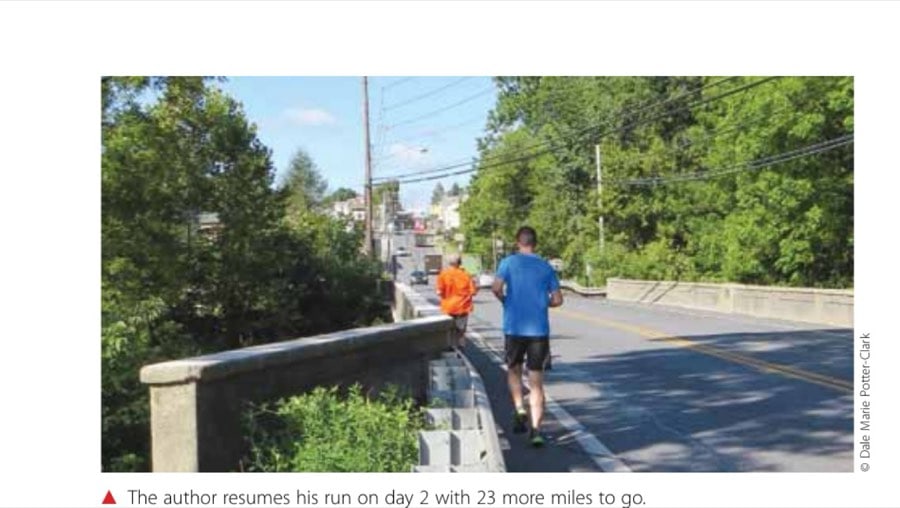
▲ The author resumes his run on day 2 with 23 more miles to go.
My day-two running started at 9:26 in the morning. I touched the marker, stepped over a guardrail, and jogged west into Northampton. Matt again started the day with me. After two short blocks, we turned and began the first uphill of the day. This day would have about twice as many turns as the previous one even though the mileage was about half. In less than a mile, we crossed Main Street at the top of the hill. The news photographer was there waiting for us. Of course, I tried to look like I was doing OK. And surprisingly, I was feeling OK.
Soon we were out of town enjoying a bright, sunny morning along a country road. Running to the first crew stop became almost as relaxed and easy as it had early the day before. For about an hour the photographer drove ahead a little and waited for me to approach and pass. She took pictures from the front, back, and side—running, walking, eating. The reporter accompanied us for the whole day. He interviewed people along the way for his story and took notes on what we were doing.
The Lehigh River passes through the Kittatinny Ridge at a place called Lehigh Gap. This was at about the nine-mile mark of day two and seems to be about the place in the original Walk where Yates, the second runner, dropped out, having grown “lame and tired” (Buck, 96).
Here, the course presented a section of expressway that I didn’t want to run. But there was a trail nearby that I could use. At this place, my route crossed the Appalachian Trail. There is an access area and parking spot for the AT a short distance before this problem spot. The AT goes up the mountainside to the ridge top, but another trail parallels the road and goes into Palmerton. This trail is high above the road and the Lehigh River, passing below some cliffs. It seems very remote and wild for almost a mile. I had asked Keith and Matt to do this section
© Dale Marie Potter-Clark
▲
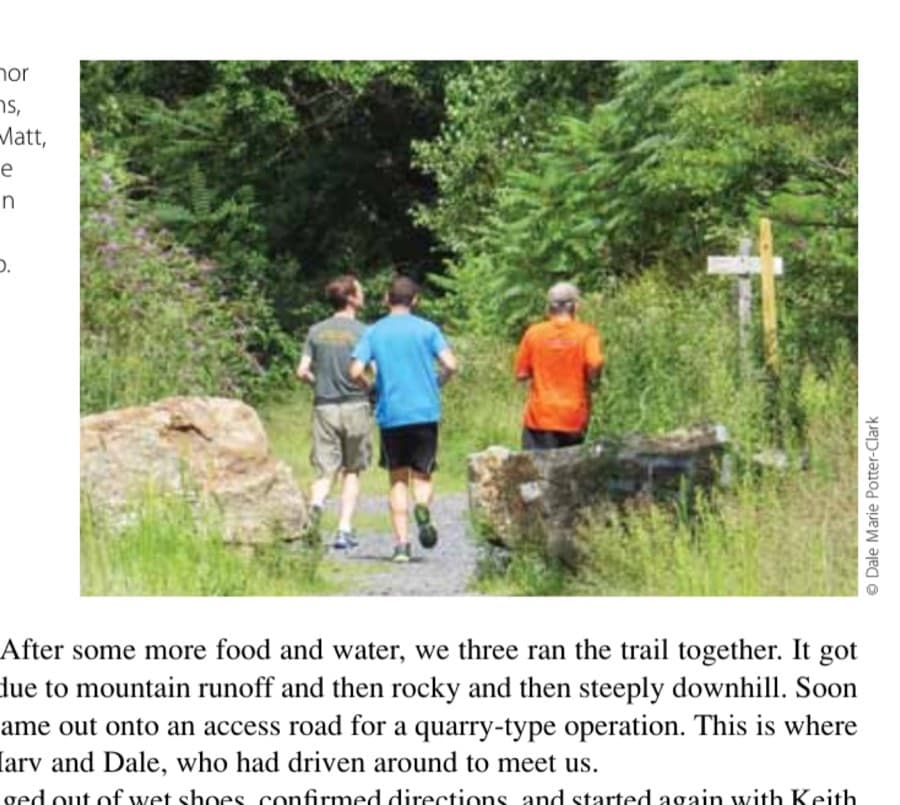
The author and his sons, Keith and Matt, crossing the Appalachian Trail at the Lehigh Gap.
with me. After some more food and water, we three ran the trail together. It got swampy due to mountain runoff and then rocky and then steeply downhill. Soon the trail came out onto an access road for a quarry-type operation. This is where we met Harv and Dale, who had driven around to meet us.
I changed out of wet shoes, confirmed directions, and started again with Keith running with me. Since we would begin the serious uphill miles, I asked that the aid stops now change to two-mile intervals. We ran through a neighborhood on the edge of Palmerton and noticed a train station that looked newer than seemed to fit here. We also waited for a concrete truck that blocked the road while making a difficult turn. And then we turned steeply uphill and began a long walk to the next stop. I tried to make it a purposeful walk. After a quick stop, we continued walking uphill and then ran briefly downhill before one more climb to the next stop. We were able look back and see the gap we had taken through the mountain on our trail section. The slower progress due to extended uphill walking had me thinking I would not make the six-hour goal for the day. I chose to accept that and still make the best time that I could.
Uphill—and lost? Keith switched out and Matt joined me for the next section. There was more uphill walking and then a longer downhill, which was bad for Matt’s sore knee. After a couple of miles, we came out to Interchange Road near the northeast extension of the Pennsylvania Turnpike. And we were lost—I thought. Something about the road looked different from what I remembered when driving it. The road that we were to take seemed like it was to the left, where it should have been to the right. I was so confused and bothered by this that Matt wondered whether something
© Dale Marie Potter-Clark
was going wrong with me. Being lost seemed really serious to me since we had no phone and would have little chance to connect with our crew. In any case, we turned onto the next road according to the directions and soon met our crew. And it was OK.
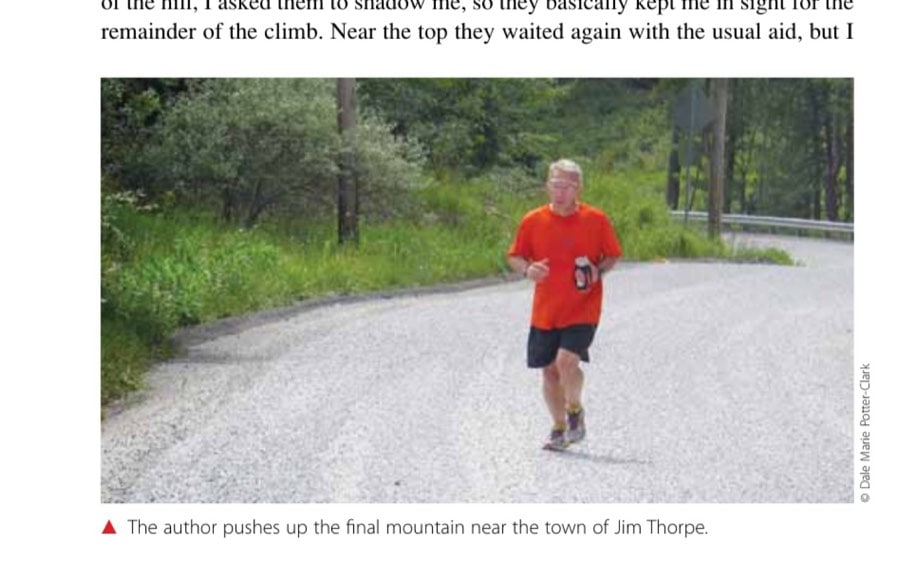
After a quick aid stop, I was off again, this time by myself. This was the beginning of the final long, steady climb—about 1,100 feet over six miles. And just then I realized it was feasible to finish under six hours. This gave me a valuable mental boost. I realized this was one of those times to dig deep and give my best effort, so I ran uphill as much as possible. I wondered how Edward Marshall felt as he pushed on in the last hour or so. At first the road was not so steep and even leveled off briefly at the next aid stop. When the hill was too steep for continuous running, I would run 100 steps and then power walk until my breathing recovered. At times, keeping up the effort caused me to choke up as though I would cry. This has been common for me in races when I felt like stopping or slowing, but I know that doing my best requires more.
As we continued up the mountain, my crew was there, as always, helping me at every turn. As the extra work made me hotter, Dale handed me a cool, wet washcloth to refresh me. We stopped where Indian Hill Road crossed Long Run Road because it seemed to me an appropriate photo for this adventure. It had surely been a long run. The road here had a steeper grade and the added difficulty of loose gravel since it had recently been resurfaced with the oil-and-stone-chips method. When my crew members expressed concern about my running so much of the hill, I asked them to shadow me, so they basically kept me in sight for the remainder of the climb. Near the top they waited again with the usual aid, but I
▲ The author pushes up the final mountain near the town of Jim Thorpe.
▲
The author buries the “time capsule” with Keith, Matt, and Harvey.
© Dale Marie Potter-Clark
called out that I just wanted a water refill and a gel. As soon as I received them, I ran on. It was less than two miles now, and Matt again joined me on the run. The road leveled off and I tried to maintain my effort, logging a nine-minute mile. I rechecked the time remaining to finish under six hours, and it seemed now a sure thing. But I wasn’t ready to ease up. We reached the last turn and I knew there was less than a half mile before we would go into the woods to find a suitable place to proclaim as the end point. Again the crew drove ahead, this time to request a landowner’s permission to enter private property on the mountain above Jim Thorpe.
As Matt and I caught up to the crew, Harv gave the good news of permission granted and directions on where to enter the woods for the route we would follow. For many years there had been a historic marker there that described the end of the Walking Purchase as “near here.” It is no longer standing. Matt and I ran ahead into the woods. The others followed. Unfortunately, in my focus on pushing to the finish, I forgot about our plan to walk through the woods together to our end of the Walk. Matt and I ran and walked until the terrain leveled off. I marked the end spot by setting down my handheld bottle. It was 3:06 p.m., 5 hours and 40 minutes after the start that morning. I had retraced the Walking Purchase of 1737 from start to finish and matched the time of Edward Marshall.
Soon the others joined us, and we noted the end of my Walk. We chose a spot that we could find again and accurately describe to family, and we buried a time capsule. The aluminum tube contained a document describing what we had done together and our connection to Edward Marshall of the original Walk. It also listed the generations between Edward and us. All four of us guys are direct descendants of his. Of course, we took photos to record all of this. And then my cousin Harvey surprised me with a framed certificate that noted the achievement and that was signed by each of my faithful crew. And I cried a little. We had done such a memorable thing together. I think Grandfather Edward Marshall would approve.
ns
uyR e n ur
Jo
This article originally appeared in Marathon & Beyond, Vol. 18, No. 1 (2014).
← Browse the full M&B ArchiveMore like this
1,000+ stories from 19 years of Marathon & Beyond
The complete archive of the legendary long-distance journal — digitized and free to read.
