

Following Pheidippedes
AT A minute before midnight in Malendreni, a small village in the northeastern Peloponnese, it is very noisy. Everyone in town is on the broad porch of Mr. Dede’s taverna in the main square instead of asleep in bed. The villagers are sitting at brightly lit tables, talking loudly, eating souvlaki with bread and lemons, drinking beer, and smoking strong tobacco.
Boys are jumping their heavy bicycles off the taverna steps. Giggling children are clustered in knots, playing running and jumping games. A harried young waiter brings our table a plate of steaming roast pork and potatoes. His English is excellent; he is a student in London, home for a holiday to help out in his father’s taverna. “Yes, yes, I remember you from last year,” he replies to my question. “Many people are coming back for Spartathlon every year. Spartathlon is very well-known in Europe and Japan, but not so many from America. Who is winning tonight?”
He rushes off to a call from another table before I can answer.
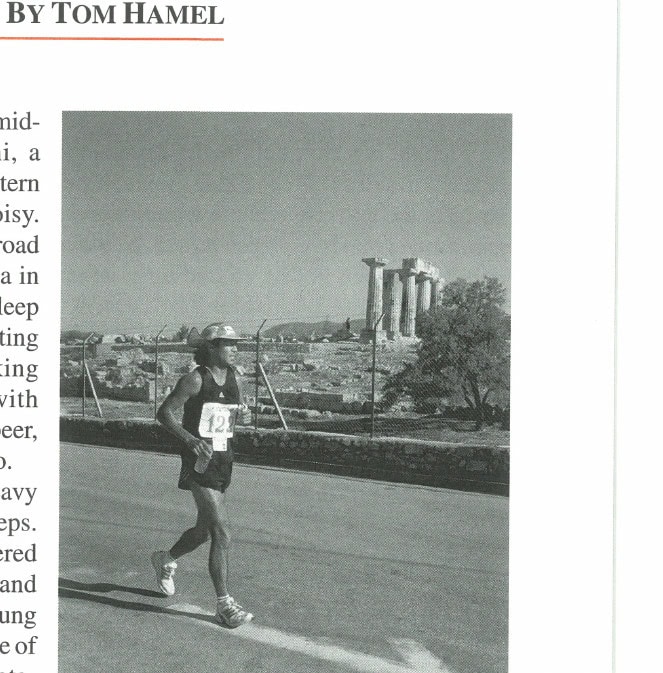
The Spartathlon is one of the most celebrated ultradistance footraces: 154 miles from Athens to Sparta. From sunrise on the last Friday in September to sunset the following day, a string of towns and villages, roadside tables, and mountaintop tents mark the course through the Greek countryside. Malendreni is the 40th checkpoint; it is at mile 87. I ate alone at this table last year; this year Chris Byrne is buying my dinner. She and I are the support crew for her husband, Rob Byrne, at the 18th running of the Spartathlon.
A 10-year-old boy has come into the light at the edge of the porch. He has pulled down some of the orange and white ribbons that mark the course and tied them as streamers to his wrists. The boy laughs and struts between the tables, showing off. An old man stiffly gets up and yells at the boy, his hands demonstrating what will happen if he catches him. The boy exits the porch quickly, leaps onto his bike, and races across the square, disappearing between houses at the far side.
Tonight is a dark chill night. I remember last year, a full moon above the still-warm stones of the village square. I had stood in the plaza with my camera, framing the taverna, when a white-haired man with ramrod-straight posture approached me. In a British accent, he told me that my pictures would not turn out. It was John Foden, retired RAF wing commander, distance runner, and Godfather of the Spartathlon.
IN THE BEGINNING . . .
In 1982, Foden, together with two other RAF officers, John Scholtens and John McCarthy, ran from Athens to Sparta, recreating the run made by Pheidippedes before the Battle of Marathon in 490 BC. Foden told his story with little prompting. “Herodotus records that Pheidippedes left Athens and arrived in Sparta the following day, but The History doesn’t say much more than that” (see The History, pages 43–44). “We wanted to know if that was really possible—for a man to run 150 miles straight through in a day and a half. So we decided to give it a try. We weren’t certain of the historic route. Actually, we weren’t certain of the modern route. At the time, mind, because of the invasion of Cyprus by Turkey, there weren’t any decent road maps available. The authorities had confiscated them all.
“So we laid out aerial navigation charts and sort of made an educated guess at the logical path. The easy route was across the Argolid plain, but Pheidippedes would have avoided Argos, since the king there was in league with the Persians. That was why he had to go over Mount Parthenio.”
I asked Foden what he ate en route. “We didn’t have all these modern concoctions. No protein bars or sports drinks. We ate RAF iron rations. I rather liked them.”
The History
“I, Herodotus of Halicarnasus, present my History, that Time may not draw the color from what man has brought into being, nor fail to report those great and wonderful deeds of both Greek and barbarian or the reason why they fight one another.” So begins the 650-page account of the Persian War, some firsthand, some already turning to legend, along with every factoid Herodotus ever heard in his wide travels as, it is surmised, a cloth merchant. The History is our first record of the ancient world not carved in stone by self-glorifying tyrants; Herodotus names both the victors and vanquished, monarchs and squires, tells where they lived, what they wore, ate, dreamt, and feared. He was a boy the year Pheidippedes ran to Sparta. Here is the whole reference to the famous run, from Book 6, paragraphs 105 and 106:
“The generals in the city [of Athens] sent to Sparta a herald, one Pheidippedes, an Athenian, who was a day-long runner and a professional. According to Pheidippedes himself when he reported to the Athenians, Pan met him on Mount Parthenio, above Tegea. Pan called him by name, ‘Pheidippedes,’ and bade him to tell the Athenians: ‘Why do you pay no heed to Pan, good friend to the people of Athens in the past, and who would be so again?’ This story the Athenians believed, and when fortune was again with the Athenians, they erected a shrine to Pan under the Acropolis and honored the god with sacrifices and torch races.
“This Pheidippedes, sent by the general, after Pan appeared to him, arrived in the city of Sparta the day after he left Athens. He came before the headmen and said: ‘Men of Lakedaemon, the Athenians beg you to help them; do not suffer a most ancient city in Greece to meet with slavery at the hands of the barbarians. Even now Eretria has been enslaved, and Greece is the weaker by one distinguished city.’ So he discharged his task. The Spartans wanted to help the Athenians, but they said it was not possible to do so at that moment as it would break their law. It was the ninth day of the first phase of the moon [the Karnea, festival of Apollo, when warfare was forbidden] and they said they would not leave Spartan land until the full moon.”
The battle that followed between the invading Persians and the Athenians was the Battle of Marathon. The Roman historian Plutarch, writing more than 400 years after the Persian War, muddles events and names Pheidippedes as the herald that drops dead after running in full armor to Athens with news of the victory. In Sparta, a young man named Kostas told me that after help was denied, the herald turned around and ran back to Athens with the bad news. He also gave me the most convincing answer yet to a question I have asked all over Greece: what does the name “Pheidippedes” mean? Likely a nickname; in Modern Greek it is pronounced “Feetheepeethees,” with the accent on the “pee” and sounds like it is composed of the words for “snake” and “foot.” Kostas agrees with the “foot” part but says that “feethee” is a children’s game of taking long strides.
Foden continued: “In the middle of the night, I lost my way. I crashed about until I found a dry streambed, and I started down that. A road crossed the stream, so I got onto the road, hoping to find our support man. I had come about a hundred miles already and wasn’t thinking too clearly, and I spoke no Greek at all, so I couldn’t ask directions even if I had found a local.”
Foden found his man after all and ran on to Sparta, finishing 36 hours after setting off from Athens. Scholtens had beaten him by half an hour; McCarthy arrived almost four hours later. In many accounts, Foden is named as the creator of the Spartathlon. Over the past year, I have enjoyed a correspondence with John. He has asked me not to give him sole credit as progenitor of the race. Instead, let the record show that the idea originated with a group of drunken RAF officers after their run to Sparta.
“We were testing Herodotus, not racing against each other. That idea came two days later when the Mayor of Sparta had been very generous with the beer,” John wrote to me recently. “I might have originated the RAF expedition, been one of those who reached Sparta, after a few beers (well, some would say a gallon or two) suggested a race, and then returned to Greece to help plan it, but 90 percent of the work of getting the first race on the road was Mike’s.”
Mike is Mike Callaghan, a member of the British Chamber of Commerce of Athens in 1983. He delivered an organized plan for the race based on the RAF effort to SEGAS, the Greek Athletics Federation, which in turn sponsored the first race that year.
Callaghan attracted a cadre of volunteers, a high-spirited group of British expatriates and Greeks, some of whom are still involved with the race. Alekos Boudras is in charge of the Herculean task of supplying checkpoints, made more difficult this year by a trucking strike. Eddie Parsons was one of the founding members; he now wears the credentials of race judge but is actually a massage therapist, bombing up and down the course during the race in a little white car, smoothing and soothing.
A RACE OF EXCESS
The early years of the race had a certain glamour. Runners were quartered free of charge at the Ledra Marriott Hotel, shown off at a media cocktail party at the Foreign Press Association, and wined and dined for days until “it was a wonder
there were any finishers,” remembers Keith Ledgard, a volunteer from the race’s inception.
During the race, runners were required to wear the official Spartathlon colors and obliged to carry a message from their own hometown leader, just as Pheidippedes had done, but not every participant was as high-minded as their model. In an early running, on the scorching stretch to the Corinth canal, one runner, Richard Dalby, became “a wee bit overheated and decided to go for a swim,” recalls Keith. “Having completed this exercise it was necessary to cool off with a glass of beer, and that’s where the rot set in.” Foden tells a similar story but names Ted Marsh, a member of the original RAF team. Marsh made it back to the course and finished; Dalby did not.
In 1984, International Spartathlon Association, a nonprofit organization, was formed. ISA, which maintains an excellent Web page (see the sidebar Race Connections on page 54), sends out race information, processes the applications of the athletes, books the hotel rooms at the start and finish, and organizes the hundreds of volunteers and their supplies at the 75 aid stations, some of which are not on any road, let alone any map.
ISA picks up runners who drop out during the race and provides transport back to Athens after the race. ISA worries over the runners, offering a prerace medical exam and arranging the mandatory ambulance ride to the Sparta Hospital for the athletes who finish.
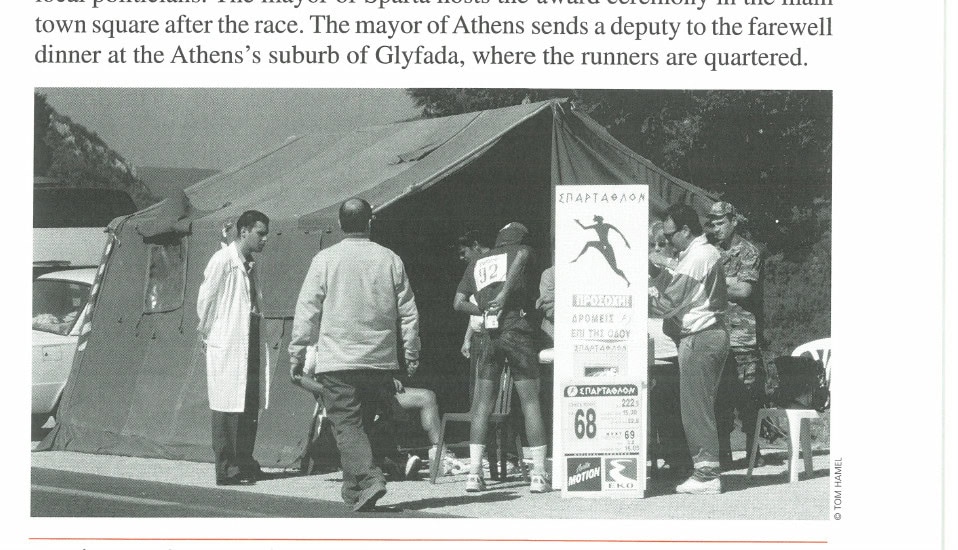
ISA has helped to elevate the prestige of the event with the patronage of local politicians. The mayor of Sparta hosts the award ceremony in the main town square after the race. The mayor of Athens sends a deputy to the farewell dinner at the Athens’s suburb of Glyfada, where the runners are quartered.
In 1999, the mayor of Nafplion provided lunch and a tour of the ruins at Mycenae the day after the race. This year, the mayor of Epidavros showed off the ancient theater for the postrace tour.
It must be recognized that all of this is accomplished in the land that gave us the words “labyrinthine” and “byzantine.” The machinations are invisible and meant to be that way. A Swiss friend doing business in Greece tells me, “the under-the-table stuff going on over here is sometimes very useful.” The Greeks put it another way: if you have a problem, do you have a mason (a “friend with connections”)?
Considering the logistical complexities normal to the Spartathlon, complicated this year by strikes and gasoline shortages, ISA must have well-connected friends, indeed. To all outward appearances, the race ran smoothly (see the sidebar It’s Greek to Me on page 51).
CREW ACCESS RESTRICTIONS
While ISA maintains checkpoint aid stations every two to three miles along the course, organizers recognize that participants have individual needs. Runners may have drop bags placed at any checkpoint and are also allowed to provide their own support crew. Crew access to the runners is limited to 14 of the 75 checkpoints, and strictly enforced rules govern what type of assistance may be rendered.
Most crews are small, like round-faced Rudiger and friends, jovial German supporters, wearing matching running-club warm-up suits.
Penelope and Paros are locals supporting Marios Fournaris, one of the Greek entrants, but they will with equanimity render aid through the race to another Greek, a Finn, a Bulgarian, and others. They simply help those in need.
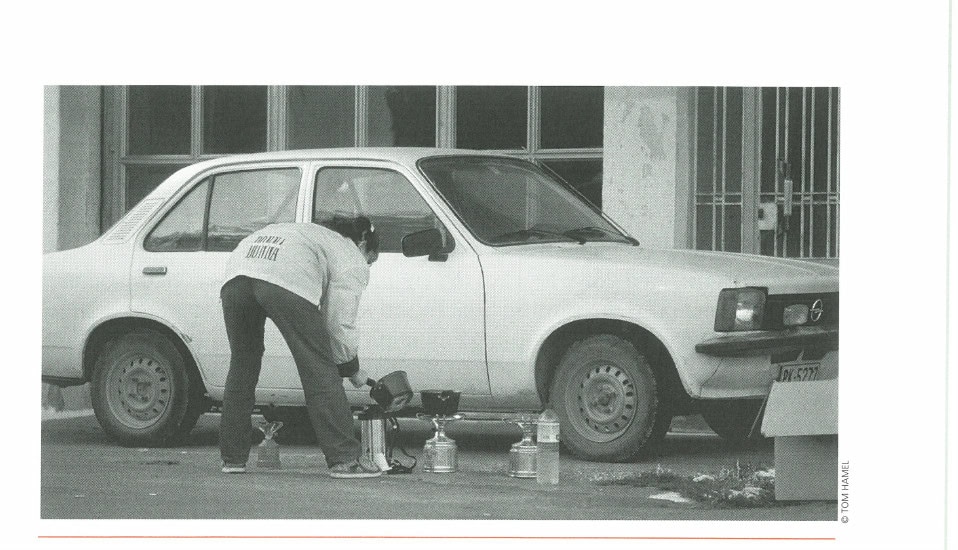
There are more Japanese runners than any other nationality, and their supporters are characteristically well-organized. The group has a terrifically able translator, Kimiko, a marathon runner herself, who calls out her orders in English, Greek, and Japanese. A tour bus, a couple of vans, and several cars make up the Japanese convoy, all marked with blue and white Spartathlon support banners. At each access point, the convoy spreads cushions and cooks up pots of steaming ramen over portable gas stoves. In Japan, a practice Spartathlon course has been created, imitating the one in Greece. The Japanese have come to win.
Not everyone feels that support beyond that supplied by the race organizers is right. The Japanese runner Kazuhiro Kawamura is one nail that sticks up. I met Kawamura-san last year when he was assigned to our hotel room in Sparta. We had become fast friends instantly then and resumed our conversation of last September without noticing that a year had passed.
“For me, is important run me alone, no many Japanese support. I think Japanese have much help. I think Japanese must try be more in this place here, in Greece,” Kawamura-san slaps his chest. “I run. Me alone.”
Foden weighs in on the topic: “One thing we British are proud of is that we all run the Spartathlon as unsupported individuals. We have a hearty contempt for people who think they are emulating Pheidippedes with loved ones shadowing them in massive coaches with all the modern conveniences.”
Stefan Peterson, the young American who finished fifth this year, expresses his more moderate view: “I don’t think banning supporters would be too big a deal. The race support is excellent anyway, and they allow you to pre-position anything you want at any point of the course. So long as they didn’t ban having supporters cheer at checkpoints, I wouldn’t care much. I find it is very helpful to look forward to meeting someone I know on the course—it really boosts my morale.” Stefan’s morale booster is named Sanja, a beautiful young Croatian woman who works as a diplomatic protocol officer. She borrows Chris to act as navigator on the drive out of Athens at the start of the race. (Chris had managed to get herself out of Athens once before, in 1997.) Just to make certain they won’t get lost, they tell me they will follow my car. I would not see them again for many hours.
THE SHIFTING START LINE
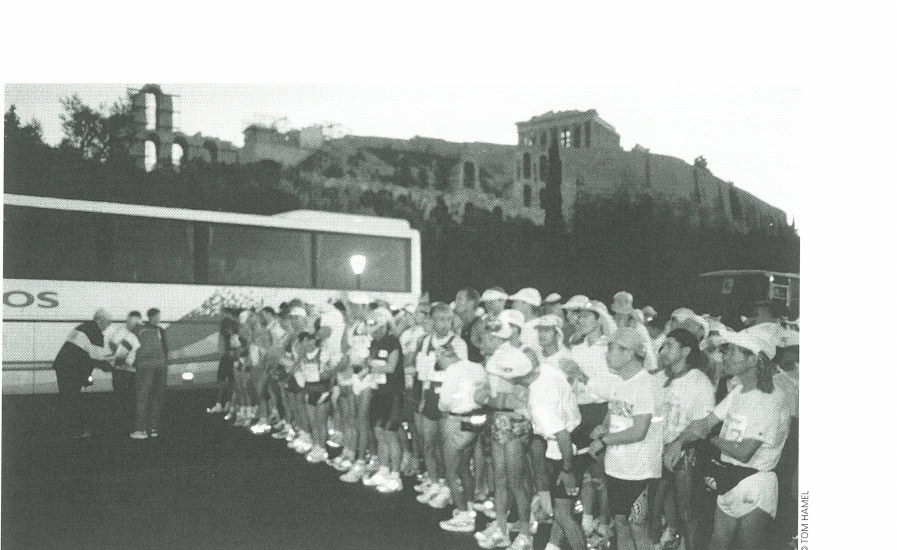
The starting line of the race shifted yet again this year. Foden and his group left from the Agora, the ancient marketplace of Athens. In the early years of the race, runners set off from the Kali Marmara, the white marble stadium built for the birth of the modern Olympic Games. For the last several years, the start has been the slick, stone-paved plaza in front of the Beule Gate to the Acropolis.
This year the start is in front of Odio Irodou Atikou, the ancient theater at the foot of the Acropolis. The level pavement is a good choice: there is room for the 200 runners and all the well-wishers.
As rosy-fingered dawn touches the columns of the Parthenon, the runners jostle for position at the starting line. Exactly at 7 o’clock, the starter’s pistol fires, and Athens’s dismal morning commute gets a little bit worse.
To the edge of the city, police hold cross-traffic back as the runners pass. A few miles farther on, the course leaves the New National Road for the Old National Road, a two-lane blacktop that hugs the Saronic Gulf. Years ago, Athenians would vacation in the little towns along the old road, but now the towns are down on their luck, bypassed by the new highway. Punctuating the towns are three oil refineries, and the course passes right along their fences. Last year, in this stretch to Corinth, the mercury closed in on 100 degrees, with high humidity; the result was the lowest ratio of finishers to starters in the race’s history.
This year, the Meltemi, a seasonal wind, is blowing; the fumes are dispersed. Temperature and humidity are both comfortable, and many runners are ahead of their planned pace.
The runners cross the improbably deep and narrow Corinth canal and move on to the Peloponnese, the peninsula that extends like a huge hand into the Mediterranean. At the 50-mile mark, the course takes a quick turn at a low stone wall. The wall was last repaired by the Roman Emperor Justinian, and it was ancient in his day.
All day and night and day long, runners follow the beaten track of history, passing the ruins of thousands of years. The Corinth that Saint Paul knew is at the bottom of a hill at 58 miles. Nemea, reeking with the must of new wine, was a classical site of Pan-Hellenic Games on par with the Olympic Games. The beautifully rebuilt town of Tegea outside Tripoli was for centuries the object of city-state tugs-of-war until Alaric the Visigoth flattened it in the fifth century.
Many of the runners know the story of Pheidippedes and revel in the recreation of his run. Stefan Peterson: “I get stoked thinking about it. I believe that the Battle of Marathon was one of the pivotal events in history. King Leonides? Probably the savior of civilization. No Leonides: no Thermopylae, no philosophy, no science, no humanism.”
Vlastic Skvaril, a Czechoslovak-born Tasmanian, watched a National Geographic Explorer segment filmed during the 1999 race and decided to participate. “It is a fantastic idea. I ran all through the night in the hills near my home to train. Now, I am here and it is like I am a part of history.”
Not every monument the runners pass is old. On the long grade down to Sparta, at mile 138, an aid station is set up across the road from an obelisk that stands as a memorial to 118 Spartan resistance fighters executed by the Nazis on November 26, 1943.
WHEN PHEIDIPPEDES RAN
What was the scene in Pheidippedes’s day? The herald would likely have run on a maintained military road, dirt for most of the way between Athens and Sparta, paved with stone in the cities. Heralds ran naked; it is not clear if sandals were worn. The caduceus, a baton carried as professional identification, protected the herald from attack by people—at least in theory.
Wolves roamed through the mountains of the Peloponnese (they still do in the north of Greece), and one can imagine them dogging Pheidippedes through the night. He would have been able to demand food and drink at any peasant cottage along the way, eating the dinner right off the table of some poor crofter.
When the RAF made their run, the old military road had long since been largely lost or paved over. They ran on goat trails and farming lanes. In the last 15 years, Greece has built a national highway system and paved many of the smaller roads. Today’s Spartathlon runner pounds unforgiving asphalt for all but about 40 miles of the course.
When asked what he most remembers about the course, Tony Savva of Cyprus replied, “Petra!” Stone. He means the mountain. At 95 miles, the road makes a sharp turn, not right or left, but up. A lung-bursting climb into the night, a dozen switchbacks, and the runners leave the road and find themselves in a very odd setting. A military campaign tent is pitched on a semilevel patch of scree. A string of bare bulbs fade and glimmer on again with the vagaries of a generator behind a boulder. A bearded man sits at a camp table, shouting Greek into a radio microphone, laughing insanely.
Three beautiful women in long warm coats glide over the loose stones, gently offering hot soup to dazed runners wrapped in woolen blankets. This is checkpoint 47, and it feels like the edge of the world. Brian Davidson, a Scottish Marine who dropped earlier, is wandering uphill. He stops and squints, “What’s happened to the stars?” A great wedge of the sky is blotted out, black but for a zigzag scattering of blinking colored beacons.
It is the mass of the Artemission, an east-west ridge that blocks the way south, rising as high as 5,500 feet. The runners cross over the pass at Sangas, around 3,700 feet. Often described as a trackless wilderness of loose stones and thorn bushes, the beacons actually mark Bey’s Ladder, a military path (a bey is a Turkish commander) that is plain to see in the day. But it is not day; the runners are exhausted and some are beginning to hallucinate.
Mark Williams admits to seeing “men sort of crouching behind boulders and people standing among the trees. I had to look twice at the aid stations to make sure those were real people there.”
It is, after all, in these mountains that Pheidippedes met Pan. A wind-whipped tent at the top of the ridge is the 100-mile mark. Race officials radio the passage of each runner over the mountain to ensure the god Pan leads no one astray. For several years, a volunteer contingent of U.S. Navy Seabees coordinated the mad ascent and descent; now, Keith Ledgard and “a willing team of nuts” scramble up and down the slopes through the night. Runners who make the cutoff time by the village of Nestani on the far side run into the dawn and on, back to the National Road for the last grueling 45 miles to Sparta.
NOTHING’S ON THE LEVEL
My encyclopedia calls Greece “a land of mountains and of sea”—a good summation. There is little level terrain in the whole of the country. After miles of hills to get to the mountain, once over it, the up and down does not end.
The last 20 miles of the course are a steep grade down onto the Spartan plain, shared with speeding motorists. In 1984, Yiannis Kouros of Greece, a demigod in the ultraracing universe, set the course record of 20 hours and 25 minutes. (Yiannis is a native of the Peloponnese, and his history as a runner is the stuff of local legend. A story of his youth has him in Tripoli without the change for a phone call to friends in Sparta. Instead, he ran there to speak with them.)
It’s Greek To Me
Language. English is widely spoken in Greece, and the Spartathlon can be run or supported without knowing a word of Greek. Greek is a difficult language, but runners and supporters alike will be rewarded for learning a few civil words and phrases with the generous hospitality for which the Greeks are rightly famous.
Supporters who intend to follow the race by car will find the ability to sound out written Greek, in both upper and lower case, invaluable for recognizing street signs. Many, but not all, street signs are bilingual; Roman alphabet spellings are approximations of spoken Greek, leading to variants such as Piraeus and Pireefs, both appearing as the name of the port city of Athens. Some are conventional English spellings (Athens for Athena and Sparta for Sparti) that don’t sound like Greek pronounciation.
Driving. Being able to read road signs is only the first hurdle to driving in Greece. Normally, there is no notice of upcoming intersections: the sign pointing to a town is right at the turn. While the New National Road is excellent, most roads are narrow and poorly paved. Make certain your rental car is insured against road damage. Greek drivers are fast and fatalistic. The small shrines you pass with alarming regularity mark where life was lost in a car wreck. Invest in a detailed road atlas of Greece while in Athens. The map in the rental car glove box is nearly useless. Navigating in Athens traffic? This should be a medalled event at the 2004 Olympiad.
Customs. The Greeks are a conservative people. Even in cosmopolitan Athens, docents at museums cluck their disapproval of men in shorts and women in halter tops. Although Greeks drink, they are rarely drunk, and while Greek men ogle women, open flirting is not done. The Greek as an individual is highly expressive and genuinely warm. The tradition of filoxenia, literally “friend to stranger,” is still observed. Nonetheless, when encountering difficulties with hotel rooms or plane reservations, you may hear the phrase, “It is a problem,” followed by a shrug that indicates the end of the exchange. Persevere.
The 2000 winner, Masayuki Ohtaki of Japan, needed 3-1/2 hours more than Kouros, completing the course in 24 hours and 1 minute. The first woman finisher was also from Japan, Hiroko Okiyama, with a time of 29 hours and 16 minutes.
There is no prize money for winners; organizers and participants eschew commercialism in favor of higher ideals. The prize at the finish is uniform from first place to last: a garland of olive leaves, a drink of water, and a medal.
The finish is tremendously emotional. At the edge of Sparta, as they cross over the Evrotas River, each athlete picks up an escort: local youths run alongside them, partly for encouragement, partly to make sure the exhausted man or woman finds the finish. On the last stretch of road that leads to the 15-foot tall statue of King Leonides, boys on bikes stretch a banner between them behind the runner, and often the runner’s supporters or family run the last quarter mile with them, the only time in the race when pacing of a runner is allowed.
Nearly every runner can manage one last effort, some semblance of a sprint, up the steps to the statue. To touch it is to complete the race—there is no line to cross or tape to break. A local dignitary crowns the exhausted finisher with the traditional prize from time out of mind—a garland of leafy olive branches. A maiden wearing a flowing karyatida hands the athlete a kylix of river water. After drinking, the cup is handed back, and the medal is awarded. The medal is an object of elegant simplicity, a cast bronze bas-relief of a runner, the stylized image borrowed from a Grecian urn. But it is the wreath of olive branches that the finishers treasure most and can be seen clutching for the remainder of their visit, carrying it to meals and through hotel lobbies. Finishers are in a state of grace, and people in the crowd, recognizing that, reach out and touch them reverently, as though they were touching a saint.
In Sparta, night falls after the race, and the wide town square fills with townspeople and race people. Hundreds of seats set out for the occasion are claimed, and the hundreds of fans left standing lean on lamp standards and each other.
GODS AND MONSTERS
I’m at the back of the crowd, seriously thinking of going back to the hotel for a nap, when a petite, brown-haired woman pops out of the crowd. She grabs my arm and tells me to come with her. It is Isabel Cabell, the high-wattage volunteer who seems to be involved with every aspect of the race. She is an American who transplanted to Athens “a while ago—when I realized I was actually Greek.” A hybrid with the fearlessness of an American and the guile of a Greek, she has persuaded a policeman to allow us onto the balcony of the old town hall across the square from the awards rostrum.
We join Isabel’s friends, Amalia and Kostas, and the wife of the mayor of Sparta to listen to a speech by the mayor. He asks us all to observe a minute of silence to honor the memory of those lost at sea. A ferry, the Samina Express, had gone down off Paros the Tuesday night before the race, drowning at least 74 and then, freakishly, the Zeus III ran aground a few days later with the loss of one life.
During our stay in Greece this year, we were caught up in the life of the country. Rendezvousing under Hadrian’s Arch one night before the race, we
found ourselves at the edge of an angry street demonstration over gasoline prices. During the race, Chris and I missed Nestani in the night, our turn hidden by the lines of trucks abandoned by striking drivers. After the race we drove through a police cordon to return to Athens; rioters had occupied the toll plaza on the main road. At the same time as the strikes, somber services were being held and church bells tolled all over Greece; the sinking of the Samina is the worst maritime disaster in 34 years in a country that prides itself on its relationship with the sea.
And while Greek athletes were winning 13 medals in Sydney, the IOC was calling into question the preparedness of Athens to host the Olympic Games of 2004. The international press reported rumors of the IOC taking the Games away from Athens and giving them to Seoul or Barcelona, where facilities already exist, a slap in the face of Greece and Greeks.
We were in a hotel lobby when the gold medal was being given to Kostas Kenteris, winner of the 200-meter race. The Greek anthem played on the television in the corner. Every Greek in the room stood. We turned back to the desk clerk and saw she was crying. “I’m sorry,” she smiled and wiped her eyes. “I love my country.”
On my flight out of Greece, I discussed the Olympics debacle with a young Greek woman, an actress who trains at the State School of Classical Theatre. She fixed me with her dark eyes and made her pronouncement, sounding like the oracle herself: “2004 will not be a tragedy. This IOC—they do not know us. If we Greeks want to do something, then we do it. You will see. The world will see.”
* * * * *
It is midnight in Malendreni, and the air is turning cold. A boy with ribbons tied to his sturdy bike suddenly races in out of the night, small stones skittering as he slides to a stop at the edge of the porch.
The boy shouts out, “Theka tria!” The taverna erupts into cheers of “Bravo, bravo!”
A tall, dark-haired man has emerged from between houses at the far side of the square. This is my cue: theka tria is 13, Rob Byrne’s number. Rob is running loose and fast. He lopes into the circle of light and up to the roped-off table where I am standing. Three women at the table take turns calling out the number as a fourth duly marks it on a clipboard.
I empty packets of powdered electrolyte drink into wide-mouthed plastic bottles and fill them with water. Chris and Rob talk quietly. Rob is excited and in good spirits. Last year, he dropped at 100 miles, the victim of a season of injury and undertraining.
This year he is saying good-bye to all that. This year, he is running like a man possessed. He is exorcising his demon. Tomorrow, he will shake off weariness and burst ahead of his escort into the dazzling Spartan afternoon. He will be crowned with olive branches.
Right now, however, he’s hungry and demands some “real food.” From our dinner table, I quickly fix a thick sandwich of roasted pork on great slices of fresh bread. Rob wraps his hand around it, and turns to leave the porch.
As he strides away, the patrons applaud. Boys on bikes make sure Rob heads in the right direction out of the square. I see him run up the dirt road into the night, turned white as marble by the last glare of the taverna lights. The hairs stand up on the back of my neck; I am gripped by a vision. For a moment, on a crisp fall night, deep in the bosom of timeless Greece, it is not my friend my eyes follow. It is Pheidippedes.
Race Connections
Searching for “Spartathlon,” my favorite Web crawler brought back 436 sites. Here are five worth looking at:
- http://spartathlon.webvista.net The official ISA Web site, with pieces by Keith Ledgard, course map and profile, entry forms, finishers, and more.
- http://fox.nstn.ca/~dblaikie/n20ap99a.html John Foden tells his own story.
- www.coolrunning.com.au/ultra/1997028.shtml Mark Williams’s 1997 experience—the runner’s perspective. The moral? Don’t eat two potatoes.
- http://www.lehigh.edu/~dmd1/yiannis.html A paean to Yiannis Kouros, his achievements and his humanity.
- www.vmathios.gr If you tour Greece outside of the race, contact Konstantinos Papalexis. He lives on the island of Santorini and runs a guest villa, but he is also a travel agent who seems to have connections all over Greece: cars, hotels, tours, you name it. Great guy—a real mason!
This article originally appeared in Marathon & Beyond, Vol. 5, No. 3 (2001).
← Browse the full M&B ArchiveMore like this
1,000+ stories from 19 years of Marathon & Beyond
The complete archive of the legendary long-distance journal — digitized and free to read.
