

Forever French
Zátopek A dozen years after the war, following his Olympic exploits, Mimoun was awarded France’s highest honor, the Légion d’Honneur. During that decade after the end of hostilities, Alain (as he was now known) Mimoun represented France internationally 84 times. He won 32 national championship titles and set 20 national records. In addition to European, African, and other championship honors, he won one Olympic gold and three Olympic silver medals. Those three silvers might well have been, indeed almost certainly would have been, gold but for one man, a man whom Mimoun describes with pride and tears as “more a brother than a rival. There was something of the saint about him.” That man was Emil Zátopek.
The Czech was born almost 18 months after Mimoun, in September 1922. Approaching their mid-20s, both would be considered old nowadays to begin careers as international sportsmen. But the war had changed many perspectives. Having spent the war working in a shoe factory in occupied Czechoslovakia, Zátopek had had more time and free space to nurture what he nonetheless claimed was “an ordinary talent; I just worked hard.” The pair met almost immediately after Mimoun’s demobilization.
Although he had been unable to run and train for the previous two years, when Zátopek was invited to race in a cross-country event in Algiers in early 1946, Mimoun returned briefly to his native country. Unable to tackle the Czech in the fields, Mimoun was not to be outdone in the restaurant. At the reception afterward, he introduced the mystified Zátopek to the wonders of seafood. “He’d never seen a shrimp in his life; they didn’t have that in Czechoslovakia, certainly not at that time. I had to show him how to take off the shell, but he loved them.” A decade’s rivalry on the track and a lifetime’s friendship began that day in 1946.
By now, Mimoun was living permanently in France but hardly in style. After a successful race at St. Cloud, one of the famous hippodromes on the western edge of Paris later in 1946, he was enticed to the celebrated Racing Club de France with the offer of a job. While the intellectual Fanon, who had been captured and imprisoned by the Germans, was studying psychiatry, the war hero Mimoun was employed as a waiter in the club restaurant. But even though he would win his first national title, the 5,000 meters, in the colors of Racing the following year, the club could not help him get lodgings, which were proving difficult in the immediate postwar years.
Indeed, social and sporting life went far from smoothly for Mimoun, despite his continuing accomplishments on the track. For example, he learned early in his career that it didn’t pay to mess with amateur sports officials. When a rival Parisian sports club, Stade de France, offered Mimoun an apartment as an enticement to join, he decided to sign forms for it, only to be suspended from competition for three months by the Fédération Française d’Athlétisme, the national athletics federation.
When an invitation came from the Czech federation for Mimoun to go to Prague to race Zátopek, the suspension was quietly forgotten. But Mimoun, effectively at the start of his career, was nowhere nearly in the same class as Zátopek. The “Czech Locomotive,” as Zátopek was becoming known for his intransigent running tactics, almost lapped Mimoun in the 5,000 meters. “But when I finished, he kissed me on the cheek and said ‘not bad,’ so as not to discourage me. I was no champion; I wasn’t even training properly at that time. But you could say that he sensed something, he recognized that I could be a champion, too.” As Mimoun recalls, the celebrations afterward were more even handed. “We drank glass for glass, Russian champagne. Not bad!”
The Olympic Games in London the following year would be the first since Berlin 1936. The 1940 Games had originally been scheduled for Japan, with the Winter Games in Sapporo and the Summer Games in Tokyo. But when the Japanese expanded their conquest of China in the mid-’30s, the Olympics were reawarded, the Winter Games to the 1936 site of Garmisch-Partenkirchen in Germany and the Summer Games to Helsinki.
The German invasion of Czechoslovakia in 1939 changed all that and more. The Games of 1944 were never awarded, and despite the ravages of the Blitz—the German aerial bombardment of the British capital—and the necessary austerity of the immediate postwar years, there was unanimity in the awarding of the 1948 Summer Games to London.
The weather lived up to all expectations—it rained constantly! The cinder track—in fact, ground-up red-brick dust—was like tomato soup. It did not stop Fanny Blankers-Koen, referred to by the British press as the “Dutch Housewife,” from winning four Olympic gold medals and being ranked in the 20th-century
pantheon of multisports stars alongside Mildred “Babe” Didriksen. Nor did it prevent 17-year-old Bob Mathias of the USA from making history as the winner of the decathlon despite not knowing all the competition rules. He had to be told by judges not to walk out of the front of the circle after his first shot put, since that made it a foul. Fortunately, Mathias had two more puts to cement his path to glory.
There were other indicators of that more innocent time in athletics. Despite being a relatively slight woman, Micheline Ostermeyer of France won two gold medals in what nowadays are classed as heavy events, the shot put and the discus. She also won a bronze medal in the high jump. More extraordinarily, Ostermeyer was already a successful concert pianist, a graduate of the Paris Conservatoire. She was by far the most successful French competitor in London, and this time Mimoun played a support role, but not without some success.
He would get only one chance to beat his friend and nemesis Zátopek, and it was not nearly enough. Despite his own ascendancy in France, where he was becoming practically unbeatable—though still prey to the vagaries of the athletics federation—he was still a long way from challenging the Czech. The pair would meet in the 10,000 meters, one of the first races of the 1948 Games. It would be Mimoun’s only Olympic competition that year, although Zátopek would go on to contest the 5,000 meters shortly afterward, when he would finish a close second to Gaston Reiff despite trailing the Belgian by 40 meters with a lap to go.
But in the 10,000 meters, it was no contest, although the Czech was certainly not the prerace favourite. That was world record holder Viljo Heino of Finland, who had also won the most recent championships, the Europeans in Oslo two years earlier, while Zátopek, just beginning to make his mark, had finished fifth in the 5,000 meters. At that stage, Mimoun had barely been out of uniform.
As it turned out, Heino was never really in the race at Wembley, and the Finn dropped out when Zátopek began to dictate the pace at the halfway stage. The Czech went farther and farther away from his pursuers, eventually lapping all but two of his rivals: Mimoun, who finished second some 300 meters and almost 50 seconds behind Zátopek, and Bertil Albertsson of Sweden, who was a further six seconds back. But the race was characterized by a series of gaffes by the officials.
Seemingly entranced by the Czech’s runaway performance, they signalled the start of the final lap when in fact there were still two to go. Zátopek knew better and kept running. The initial result also had the fourth and fifth finishers reversed, with sixth going to a man who had dropped out four laps from the end. Everything was ultimately resolved, but there was no doubt about the winner, and the way that he won suggested that Zátopek was going to be hard to beat. And so he was. It took Mimoun eight years and many attempts to do it.
But Mimoun would enjoy almost unparalleled success on a stage that has always deserved greater public acclaim. That it does not receive such acclaim may have something to do with shared experience. Generations of schoolboys
and schoolgirls across the world have reason to hate cross-country running. The typical cross-country event was doubtless reproduced in countless schools across the globe. A last-minute cigarette behind the cycle sheds before a reluctant stroll in an ill-fitting shirt and shorts to the starting line, presided over by an enthusiastic masochist masquerading as a teacher who sent the runners off plowing disconsolately with equally disgruntled colleagues through icy streams, across bramble fences and fields of glutinous mud above the ankles. For those few who loved it, Mimoun was an icon.
In addition to numerous victories in French championships, stretching into the 1960s, he won the International Cross-Country Race four times, a feat equalled only by two others in history—Jack Holden of the UK immediately before him and Gaston Roelants of Belgium immediately afterward—and beaten only latterly by two Kenyans and one Ethiopian, John Ngugi and Paul Tergat and the dominant distance runner of the early 21st century, Kenenisa Bekele. Like Roelants, Mimoun would win all four victories in the British Isles, particularly satisfying for both men since Britain was the cradle of the sport.
The first properly organized running clubs in the early to mid-18th century in Britain were known as “Hare and Hounds,” a reference to the practice of one runner, the hare, setting off in advance of the rest and setting a paper trail for the hounds to follow. Such an event was the annual Crick Run, named after its founder and
ad
immortalized in Tom Brown’s Schooldays, a somewhat-derided volume now but once a seminal novel, which introduced to Anglophiles the formative pedagogic philosophy known as muscular Christianity. It is celebrated in the famous phrase of the Duke of Wellington, “The Battle of Waterloo was won on the playing fields of Eton.” And it was a philosophy much admired by Baron Pierre de Coubertin, the founder of the modern Olympic movement. De Coubertin was a regular visitor to Britain, attending sports events throughout the country and proselytizing about “British/English sporting values” back home in France.
In keeping with that philosophy, the British cross-country runners were the best in the world, often individually, almost always collectively. When the annual International Cross-Country Race was mostly a European event with occasional entries from North Africa, North America, Australia, and New Zealand, the British, particularly the English, won over half the individual titles and over threequarters of the team events. For Mimoun to venture into the (British) lions’ den and come away with four precious victories was a fine achievement. He won the International, as it was known, in 1949 in Dublin, in 1952 in Hamilton, Scotland, in 1954 in Birmingham, and in 1956 in Belfast. “
We actually called it ‘English cross-country’ at that time,” Mimoun recalled in early summer 2001. “And in my heyday, the British were fantastic, the strongest in the world at middle- and long-distance running. Only Mimoun could beat ’em. Cross-country in France was hard, but not like in Britain. They didn’t have a 10 kilometers, only fit for women. It was 15 or 16 kilometers, and you should have seen the hedges and stiles! Like ladders you had to clamber up, like a dog. There was even barbed wire. You could leave your shorts on it. But it was wonderful stuff. I loved it because you had to be a real runner to win at cross-country. And I won four times, every one of them in the British Isles.”
Although he was already well on his way to becoming that now-celebrated “Athlete of the 20th Century” in France, Mimoun was still to many of his putative compatriots a member of an unwelcome minority. That minority would become even more unwelcome with each attempt by the Algerian rebels to dislodge France from their territory.
Mimoun will never willingly use the word “racism.” Even 50 years later, whenever the subject is broached, he will say, “You said it!” He claims that North African footballers and cyclists (a rare breed) in France were the target of criticism and hate mail, “but never Mimoun.” Nevertheless, he must have been a regular target for comment, even in the rarefied atmosphere of the Racing Club restaurant where, despite multiple national titles, he still occupied the classical immigrant role of waiting on tables.
But when pushed, the stories come streaming out. “When I think that I had two uncles that were gassed during the war, that I could have died myself in Monte
Cassino . . . that Algeria was dyed-in-the-wool French! . . . When I first began running in 1946, there was one French runner, well known, who was openly racist. Just after the start of a 5,000 meters, he literally manhandled me off the track and into a steeplechase barrier. I ran back onto the track, chased him down and raked my spikes down his arse, then went on to win. I was disqualified, of course. “
Then there was an incident in London ’48, my first Olympics. I was humiliated, but I see it now as a sad tale rather than a stupid one. I wanted to get a massage before I ran the 10,000 meters, so I go to the massage room, knock on the door, and no one answers. Eventually, I open the door, and there’s the French team masseur with Gaston Reiff, a Belgian, on the table, and Marcel Hansenne (later the editor of L’Equipe) standing by. So the masseur is talking to two of the stars. But he turns round and says, ‘What do you want, kid?’ This to someone who’s recently come back from six years at the front! I was furious, but I kept calm and just said, ‘Monsieur, I’m running in the 10,000 meters, you couldn’t . . . ?’ He cuts me short, and says, ‘Sorry, kid, but I’ve been sent to massage the elite.’ A few hours later, I was an Olympic silver medalist.”
The slight was exacerbated on his return to Paris. Despite his Olympic accolade, the day after Mimoun’s arrival, he was back at work as a waiter at the Racing Club. “I went to see my boss, but . . . nothing! To make matters worse, I even had to serve a guy who I’d hammered in my first International Cross victory—Pujazon.”
Raphael Pujazon was a Basque who had taken French nationality and both won and led to victory the French team in the International Cross in 1946 and 1947. Mimoun, in his first International, pipped Pujazon by one second in 1949. “I’ve got photos of it, there am I, serving at table, and there’s Pujazon, sitting there like a film star. I’d kicked his arse and fought seven years of war, while he was a Spaniard who’d simply naturalized.”
Mimoun’s views on the regular current practice of North Africans competing for France are equally acerbic. “When I see these young Moroccans and Algerians, they live here six months and they want to run for France because they’re not good enough to run for their own country. And the (French) federation falls over itself to sign ’em up. It’s a disgrace; you can’t buy success like that. Arseholes!”
The transformation is complete. Alain Mimoun is French! And if he needed any more confirmation, it came just a few weeks prior to our first interview, in May 2001. He tells with pride how women approach him in the street—“It’s always women, even though I’m with my wife” (Germaine duly rolls her eyes and smiles benignly). “Even at 80, a man can still dream, can’t he? This particular day and this particular woman happened in a supermarket. ‘Ah, Monsieur Mimoun,’” he tells the story animatedly. “‘Permettez-moi de vous embrasser. Vous êtes un Français plus français que nous.’ (‘May I kiss your cheek, you are more French than we are’).” The subtext (that he is not French at all) is lost on him. All he hears is confirmation of his life’s ambition.
He launches into his reply. “‘Ah, Madame, vous venez de me dire quelque chose, là. Vous savez que j’ai trois médailles d’or?’ Et car ils sont au courant, ils disent, ‘ah, on croyait que c’était Melbourne, et que vous aviez trois médailles d’argent’. ‘Vous n’êtes pas au courant? Trois médailles d’or! La première médaille d’or, c’est ma femme, la deuxième médaille d’or, c’est Melbourne. Et la troisième, c’est ce que vous venez de me dire, que je suis plus français que vous.’ (‘Madame, you’ve come out with something there. Did you know I’ve got three gold medals? And because they know, they say, we thought it was Melbourne (gold) and three silver medals. You don’t know? Three golds! The first is my wife, the second is Melbourne, and the third is what you’ve just told me—that I’m more French than you are!’)”
Gold, at last To many people, Zátopek’s victory in the 1952 Olympic Marathon, after he won the 5,000 and 10,000 meters previously, characterized his panache, his resolve, yet only added to his legend. Mimoun’s Olympic marathon victory four years later was much more than that. After three Olympic and four European silvers—all in the wake of Zátopek—the marathon in Melbourne on December 1, 1956, was the apotheosis of Mimoun’s career.
There is a strong connection between the French and the marathon. Pierre Frédy—better known as the Baron de Coubertin, the man credited with reviving the Olympic Games—following a seminar at the Sorbonne in 1894, asked his historian/linguist friend, Michel Bréal, to suggest an event for the first modern Olympics in Athens two years later. Looking for something that would synthesize the history, tradition, and legends of ancient Greece, Bréal came up with a stroke of genius—the marathon.
In 490 BC, a tiny Athenian force had repulsed a huge Persian army that had sailed into the Bay of Salamis and debarked at Marathon, then no more than a hamlet on the edge of a vast plain. While the Battle of Marathon was still in the balance, a hemerodromos, or foot messenger, named Pheidippides was dispatched to Sparta to beg for reinforcements. Sparta is over 200 kilometers away, over what would have been impossibly rocky terrain. No friends of Athens, the Spartans said they would send help after completing a religious festival. Pheidippides ran back to Marathon, by which time the Athenian troops had somehow prevailed. Pheidippides, who had done the Sparta round trip inside 48 hours, was sent back to Athens, some 40 kilometers away, to relay the news. On reaching the Agora, he gasped out, “Rejoice, we conquer,” before expiring.
According to the British running historian Roger Gynn, in his Guinness Book of the Marathon (1984), the first mention of anything resembling this story comes in Herodotus 50 years after the battle. There was no mention of the return
to Athens. Five hundred years after Herodotus, Plutarch wrote of a soldier, possibly wounded, who brought the news of victory from Marathon to Athens before dying. Lucian follows this up years later by attributing the run to one Philippides. But as Gynn observes, “in the enduring ancient Games, there was no race that in any way could be construed as being a distance event which would at least have given some evidence to substantiate the legend.”
Mimoun claims that he always believed in signs or portents, but given the indications of success in 1956, this belief may date from Melbourne rather than precede it. Although Mimoun was only a month short of his 36th birthday, and as such discounted by everyone including the French press (but, significantly, not Zátopek), there were historical precedents that pointed to a French victory.
Two Frenchmen prior to Mimoun had won the Olympic marathon, although curiously, like him, neither was born in France. Michel Théato, who won in Paris 1900, was born in Luxembourg. And Boughera El Ouafi, born in Algeria, won in Amsterdam 28 years later. Now another 28 years later, another Algerian-born Frenchman would go to the start line of an Olympic marathon. But there was more.
Unknown to almost everyone, Mimoun had left a heavily pregnant wife at home. He had met Germaine two years before in Berne, Switzerland. Although suffering badly from sciatica, which prevented him from running in the European Championships in Berne, Mimoun was named captain of the French team. Following the championships, there was a banquet at which Mimoun was guest of honor. During the evening, a young woman came to ask for his autograph. “A good-looking girl, I gave her the once-over, and she comes back a while later,
© Universal/TempSport/Corbis
▲
Helsinki 1952: Mimoun earns another silver medal behind Zátopek.
saying this time it’s for her friend, who’s too shy. They were visiting from Tulle, where they lived, but they were studying as beauticians in Paris. So I end up dancing all night with the pair of them. But it was the shy one I fancied. “
Since we were all leaving the following day, I invited them for breakfast at my hotel. Eight o’ clock in the morning, I’m woken by a phone call, it was my wife—she could see it was her I preferred—saying they had to leave early. I was beside myself, but I gave her my address at the INS (National Sports Institute). I didn’t want to give her the address of my little lodging house. I told her to contact me, but for six months I heard nothing.”
Meanwhile, Mimoun had more pressing problems. His sciatica refused to clear up, and, unable to train, he gained 9 kilograms (20 pounds) in weight. But one of his fans came to the rescue with an unusual offer. “It was a guy who owned a travel agency near to the Paris Opéra. He used to take me out to dinner twice a week because he knew I still couldn’t afford to eat properly. One night he said, ‘I can’t bear to see you like this, what would you say to a trip to Lisieux?’ I jumped at the suggestion because I knew the story of Edith Piaf. The little Piaf was blind, and the prostitutes took her to Lisieux, and she was cured.”
It’s ironic that Mimoun should fall prey to the legend of the “little sparrow,” if only because elements in his own life have given rise to embellishment, particularly the rumor that news of his daughter’s birth on the eve of his Olympic victory was kept from him by French team officials. To which the only response can be why, unless they were particularly vindictive, since that is the sort of news that would solicit success.
Edith Piaf had an eventful life. Born in a Parisian street (literally), raised in a whorehouse, her string of lovers included Yves Montand and boxer Marcel Cerdan, who abandoned a wife and five kids to be with her. Cerdan died in a plane crash on his way to join her in New York. But if Piaf had experienced everything ascribed to her, it’s doubtful that she would have lasted even her 48 years. As it was, she was as iconic a figure in 20th-century French social history as Charles de Gaulle and Mimoun himself.
Mimoun gave credence to the story of the famous chanteuse being blind as a child and taken by the whores of Pigalle to Lisieux, where she had been cured. The truth—which hardly diminishes the legend—according to Bernard Marchois, who runs the Edith Piaf Museum in the 11th arrondissement in Paris, is that Piaf was successfully treated for cataracts when she was four years old. But Piaf having visited Lisieux years later and, like Mimoun, become a devotee of Ste. Thérèse, the stories had become conflated.
Likewise, that version does not diminish Mimoun’s tale. “This guy, Monsieur Mallet, paid for me to go to there (Lisieux) and even came with me, although he told me frankly that he was an atheist. But he knew I was a believer. At the basilica, he stayed at the foot of the steps. So I go inside; it was almost empty.
I go in front of the relic and kneel down. But I didn’t even have time to pray; I just burst into tears.” Mimoun cannot explain further what happened to him in the Basilica of Ste. Thérèse at Lisieux, but the import is that it contributed to a “miracle” cure of his sciatica. He has a shrine to the saint at the back of his garden in Champigny-surMarne. “For a week afterward, it’s as if someone was telling me to take it easy. I walked a little, and at the end of the week, I took the metro from Jaurès to Porte Dauphine, near where I used to work as a waiter. I ran a few steps but with great care, as if someone was saying, ‘Don’t overdo it, arsehole.’ “
I ran 50 meters and then sat down before walking 50 meters. The incredible thing is, before that, I couldn’t even walk properly. So I did that for another week. The following Monday, I started to jog, and I was overcome with this indescribable feeling of joy, but again the voice inside told me to stop after a hundred meters. I did that for another week, and at the end of it, it was like a ball and chain had fallen away from me. I trained like a madman, harder even than Zátopek, but in the woods and forests. I was a nature boy. I lost those 9 kilos inside seven months.”
At the end of his period of restoration, Mimoun sought a small race in the backwoods, a 3,000 meters that he won easily. But if he thought he would make a gradual comeback, an eagle eye at the national federation had other ideas. “They selected me for a match in Bordeaux, against the English. It was crazy, I was like a beginner again, and here I was in an international 10,000 meters. “
We used the regional sports center in Bordeaux as changing rooms, and I was having a nap before the event. I’d been raised part of the time by my grandmother, my father’s mother. Whenever I had any holiday as a kid, I’d go and stay with her, an extraordinary woman, died when she was 80. She always told my mother, when I was in Cassino, ‘Don’t cry, I know my grandson will come back.’ “
I’m telling you about my grandmother because, during my nap, I dreamed that I was in an old farmhouse, in a room with a bare earth floor. It was empty except for a coffin, a glass coffin in the middle of the room. And what do I see? My grandmother’s corpse, and suddenly the corpse opens its eyes, and says, ‘Don’t worry, son, everything’s going to be all right.’ And I woke up, just in time to go off to the stadium.”
Mimoun won the race by half a lap. The following morning, the sports pages were full of the feat. The headline in L’Equipe read, “The Resurrection of Alain Mimoun.” It also resurrected his aborted love affair. Germaine was holidaying with her pal in Saint-Tropez and saw the headlines. Too shy to contact Mimoun after their first meeting, the reports prompted her to finally get in touch. “It was a year to the very day that we had first met,” says Mimoun.
But they made up for lost time. The pair married very soon afterward, at the beginning of 1956, and Germaine conceived almost immediately. The night before the marathon in Melbourne, Mimoun received a telegram. “It said, ‘Wife and
children doing well.’ Children! I thought we’d had twins.” In fact, it was a single child, a girl who would be christened Marie but named “Olympe.” If the Battle of Waterloo was won on the playing fields at Eton, as the Duke of Wellington would have it, then Alain Mimoun’s Melbourne gold medal was forged on the forested hills of La Corrèze in southwestern France—“mon pays, le pays de ma femme” (my land, my wife’s birthplace). The word “pays” often has a localized yet broader meaning than simply “country” in the political sense of a delineation by borders. It refers to that particular region of France where someone is born or raised, it harks back to the old regional names, which are still widely used—Anjou, Aquitaine, Orange—and it harbors the sense of belonging to the land, to the earth, to the soil itself, a sentiment redolent of the peasant culture, which still dominated despite the metropolitan propaganda abroad for Paris as the City of Light, well into the 20th century in France itself.
There is something preternatural about Mimoun going back to the womb of his wife’s birthplace, which had become his own—“mon pays”—to create a new persona, that of a marathon runner. Speaking of his rehabilitation after his experience at Lisieux, he refers to himself as “coureur sauvage-dans la nature,” effectively “a child of nature.” His success at cross-country running certainly emphasized that. Thus, to prepare for the greatest performance of his life, he buried himself away in the heart of France—La Corrèze.
There is something about distance runners that separates them from the rest of the pack of athletes. They are treated as if not slightly crazy, then completely so. Maybe it is the long, lonely training hours in conditions from torrid heat to aching cold—thinking, dreaming, cajoling, talking to themselves. But they are a race apart, ebullient to a fault, letting out all that they discover and keep locked inside during those lonely hours. If you’re inclined to think the average distance runner has got a screw loose, then people like Emil Zátopek and Alain Mimoun had a whole toolbox clattering around.
Slightly unhinged they may be, but they are far from stupid. Zátopek could entertain guests in six languages and is the author of one of the greatest running epigrams—“If you want to run, run a hundred meters; if you want to experience another life, run a marathon.” Mimoun too has developed a whole philosophy about his running. He begins by comparing long-distance running to sprinting. “Like day and night, I’ll shout it from the rooftops. Sprinting? A hobby. But a marathon runner, there’s a man for you. He might have talent, but that’s only the base, that’s not enough. “
To be an Olympic champion, you need talent. A donkey’s never going to win an Olympic title, but talent”—and it’s Mimoun telling you this, this isn’t some theory—“talent is only a third of it, there are two-thirds more. The second third is the will to train, because you need literally to eat up the kilometers. Me, I gorged myself on 40 kilometers a day for two years, up in Corrèze, in my wife’s
© Universal/TempSport/Corbis
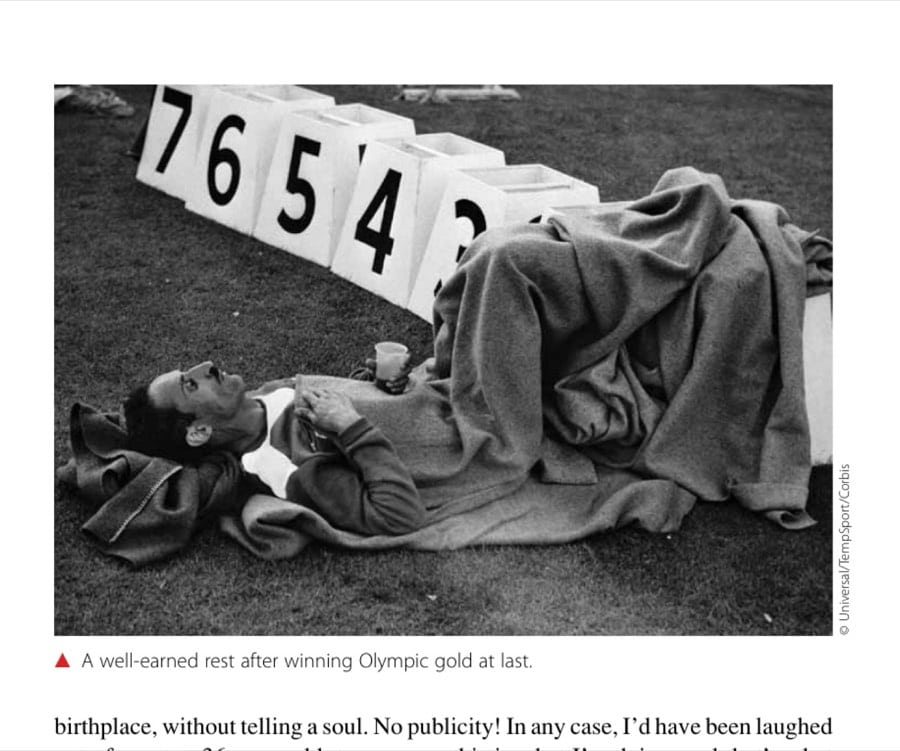
▲ A well-earned rest after winning Olympic gold at last.
birthplace, without telling a soul. No publicity! In any case, I’d have been laughed out of court at 36 years old, to say, yes, this is what I’m doing, and that’s what I’m going to do. “And I was kept by my parents-in-law. I wasn’t rich; I wasn’t earning enough to feed my wife despite those three Olympic silvers. It was my parents-in-law who fed me while I trained three times a day in the pure air of Corrèze. People will say nowadays, oh, I train twice a day. Me, three times! One hour first thing in the morning, before breakfast; one hour later, between 11 and midday; and two hours in the evening, between five and seven. And no two training sessions were the same, that’s the key. But you have to find out for yourself, you won’t read about that in books. It’s not like a donkey, just running, running, running. It’s scientific. You can’t become an Olympic champion if you don’t have a head on your shoulders as well. “
So, the first third is talent, the second, the will to work and the desire to do something with your life. And to be capable of that, I believe you have to have suffered, it’s not any mommy’s boy who’s going to achieve something, it’s not the sort who’s too well fed. You have to have a hunger. Look at those Kenyan champions, it’s because life is hard. It was the same with me. When I was little, in Algeria, and my mother would kill a chicken for Sunday dinner, it was a real occasion. I’ve never forgotten that, sometimes I tell my wife about it . . . nostalgia, eh?
“You’ve got to have talent; then work, training; and the third third is your way of life— seriously! I was married to a saint, and the same year I was an Olympic champion—perfect! If you’re lacking one of these thirds, you’ll end up as a regional champion, perhaps a national champion, but no more than that. You need all three qualities.”
The element of surprise often features highly in the Olympic marathon. The race is rarely won by a favorite. Even the most experienced marathon runners insist that the event, or rather the distance, should not be underestimated, no matter how many times they have run the 42.195 kilometers. The uncertainty must have been tenfold throughout most of the first century of marathon running. Until the marathon became a commonplace for millions of joggers throughout the world, it was often a last resort for the slower or aging distance runner, such as Mimoun. But the advantage to someone like him is that Olympic team places were not avidly sought and fought over, as they are nowadays, which is how Zátopek could decide to race at almost the last moment in 1952, his federation having left a place open for him.
So it was with Mimoun in 1956. He trained for the marathon in Melbourne for well over a year, but few, even among his teammates, knew that he was taking it seriously, especially since he had won selection for the 10,000 meters, where he had twice finished second to Zátopek, in London 1948 and Helsinki 1952. In Melbourne, he didn’t kill himself in the 10,000 meters and finished 12th. In any case, he would have had a hard time keeping up with the younger generation. Vladimir Kuts was a worthy successor to Zátopek, with his furious front-running tactics, and the Ukrainian spread-eagled the 10,000-meters field.
Mimoun hadn’t even told his wife and parents-in-law, from whose house in rural Corrèze he had trained for a year, that he was going to run the marathon. But when he declared the day after finishing 12th in the 10,000 meters, few thought he would be a factor. Even now, he grunts at the memory of the derisory three lines afforded him in L’Equipe at the announcement. The French sports daily had found the Soviet team chief: “Mimoun? He’s a great champion, but at 36, he’s too old.” But one man who twigged very quickly in Melbourne was his old rival Zátopek. “He came and said, ‘I hear you’re running the marathon.’ I tried to tell him he was still the favorite, but he said, ‘Not this time, it’s you. But watch out for the Russians, they’ve done 2:13 (two hours, 13 minutes) in Moscow.’” Although Zátopek was defending his marathon title in Melbourne, the debilitating training was beginning to tell on the Czech. He had been badly injured for months before the Olympics and was not going to figure. But with relations between the Czechs and their Soviet masters still good at that point in history— it would be a dozen years until the Prague Spring—“Záta” had been enlisted to coach the Russian marathoners. Hence the inside information, since at this point in sporting history, the Soviet athletes were advised not to mix with the
foreigners. As Mimoun says, “If you tried even to go up to one of the Russians, they simply walked or ran away.” On that score, it was Mimoun who was to have the last laugh. It was Mimoun who ran away from the field in Melbourne in temperatures that reached close to 40 degrees Celsius out on the roads. But in the rapidly diminishing group at the head of the field since the start, Mimoun was reluctant to strike out alone. “
There was a young American named Kelley (a Bostonian, John “The Younger” Kelley, to distinguish him from his equally famous namesake, no relation, an earlier Boston Marathon winner). He trained with me in Melbourne; he spoke a bit of French. I’d hardly considered him a threat, he was only [25], although he finished [21st]. Anyway, I hadn’t counted on him at all. “
But as we approached the turn (on the out-and-back course), he draws level and slaps me hard on the shoulder and yells, ‘Come on, Joe’ (in English), which I took to mean, ‘You’ve got to get on with it.’ I said to myself, Jesus, so there is a god in heaven. The kid was a springboard for me, I followed him away from the others, but just at the turn, he virtually stopped. I looked around and saw the Russians about 70 meters behind. I hesitated a little, not much, then said to myself, Let’s go.”
Which he did. But running the second half of the race alone, in such temperatures, with no one to tell you how far behind the opposition is and with little understanding of the local lingo, was never going to make for an easy task. “At 32 kilometers, I felt as if I’d got four stories sitting on my shoulders, I was almost wishing that someone would catch me so that we could run together and share the pain. “
And to make matters worse, there was a French film crew alongside, choking me with their motorbike. The cameraman told me later, ‘We could see that we were causing you problems, but we had our job to do.’ But finally, they left me alone, and I could breathe a little better. But the handkerchief my wife had given me, which I had on my head, you’d have thought it weighed a ton. I threw it into the crowd, there were thousands of them, but when I tossed it, I could see it was a pretty blonde who picked it up.”
There was one last crisis for Mimoun before he could call himself “Olympic champion.” And it’s indicative of the interior world that the marathoner inhabits that he could go from spotting a “pretty blonde” picking up a discarded handkerchief to making a crucial error in his whereabouts on the course. Any long-distance runner can tell the tale of going from A to C in a straight line but having no recollection whatsoever of passing through B, of not even being able to conjure it in the mind’s eye. Mimoun chose the Olympic marathon to experience such an aberration. “
There were two railway bridges on the course; one was about a kilometer from the finish and the other around 12 kilometers (seven and a half miles). I was
out of it; I got to the bridge at 12 kilometers and thought it was the one at one kilometer, and I said to myself, I’m Olympic champion! But then I saw the road stretching out three kilometers ahead and realized my mistake. It’s at points like that, if you’ll excuse the expression, that you need balls. I started to insult myself, ‘Arsehole, you haven’t come this far just to fuck it up.’ I thought of my wife, who’d just given birth; I thought of my daughter ’cause I knew by then it was a daughter I’d had. But the main thing I thought, and this straight up . . . I thought, You’ve seen that flag raised three times to the side, and this time it’s going to be in the middle. It’s not money; it’s the flag.”
But there was to be something else, something that Mimoun would come to treasure, he says, more than the victory itself. “When I’d crossed the line, I stayed on my feet. The officials wanted me to lie down, but I was waiting. I said to myself, Perhaps Emil is second? But it was Mihalíc (Franjo, a Yugoslav, another close friend of Mimoun and Zátopek); I was happy for him. So I thought, Perhaps third? No, it’s Karvonnen (Veikko, of Finland). Fourth? No, a Korean (Lee Chang-hoon), Jesus! Fifth, a Japanese (Yoshiaki Kawashima). “
He came in sixth, a great champion. The crowd applauded him like they’d applauded me. That’s sport for you, as if he’d won. But he didn’t know that I’d won. He fell to his knees, and I went over and said, ‘Emil, listen! You were right, I’m Olympic champion; I won.’ And I looked at this saint—I always call him a
ad
saint—it was like he was waking from a dream. ‘Really?’ he says, and he gets up, stands to attention like the soldier he was, takes off his cap, and salutes me. ‘I’m happy for you,’ he says, and then he kissed me. To me, that was worth all the money in the world.” A kiss on the cheek from Emil Zátopek, a man whom many call the greatest athlete in history, was the personal touch that Mimoun needed to underline his talent and achievement. But the totem was “the flag.” As the tricolor was raised, this time on the middle, tallest pole, the once-Algerian Berber named Ali cried without tears—“I was so dehydrated”—as he saw his life’s ambition realized in that simple act.
Charly et Alain Back at home, Mimoun was presented with the Légion d’Honneur, France’s highest decoration, by René Coty, the final president of the Fourth Republic. But otherwise, he got little more than he got after his first Olympic medal, in London eight years earlier. Then he had returned to Paris, thinking that maybe life might change for the better, and he was back waiting on tables the day after.
This time, there were more newspaper headlines but little comfort elsewhere. It was a function of amateur sport at that time—and particularly athletics, the principal Olympic discipline, thus subject to the most stringent supervision on earnings—that athletes could not capitalize on their fame, not even to the extent of writing about their exploits. It’s difficult to appreciate in these days of high earnings and celebrity for the best in even the most marginal sports to imagine that a man saluted as “The Athlete of the 20th Century” could have won three Olympic silver medals and one gold and go home to a two-room apartment without running water or inside lavatories. The tin bath on the hearth characterized home for Mimoun, his wife, and new child.
And only a chance remark at a presidential reception altered things. “It was six months later. I was having a break from competition after the exertions of Melbourne, but I’d been made traveling captain for the cross-country team for the International in Belgium that year, ’57. We went to a reception at the Elysée the night before we left Paris. President Coty happened to ask me if I was OK in my social life, and I told him frankly, no! I explained the situation with our lodgings, and he turned to an aide, a functionary, and said we’ve got to do something about this. When we got back after the race a few days later, I was met by an official at the Gare du Nord and given the deeds to this land, where you’re sitting now.”
There was still the problem of constructing a house on the land. But the ball was rolling now, and the sports daily L’Equipe helped find a way around the amateur impasse. One day later that year, the newspaper put a franc on its cover price and gave the proceeds to Mimoun’s club Racing, which employed builders
to construct the white pavilion at Champigny-sur-Marne where Mimoun and his wife have lived ever since. It had taken a while, but France and the French had finally come good for Mimoun. The woman in the supermarket—“You are more French than we are”—is almost too good to be true as a raison d’être for Mimoun. But this extract from La Chronique de la France et des Français (The Story of France and the French) underlines Mimoun’s patriotic fervor. “Every morning when I wake, I thank God for having blessed me with French citizenship . . . . It pains me a little sometimes, to think the people don’t deserve France. For me, nothing compares to France. For me, France is the finest daughter in the world, something sacred.”
Mimoun was one of just 100 people chosen to characterize France in that volume. In our interviews, he explained further. “I’ve got France in my pores, in my guts, because I fought for her. The medals are fine, but what counts is the blood I spilled. If I hadn’t done that, if I hadn’t fought for France, if it had only been a case of those four medals, honestly, I don’t think I could sleep easy at night. You have to ‘earn’ France, to deserve her. I’m the only one who can stand up and say that in front of a president” (and he met five of them). “In fact, there has only been de Gaulle who could say better, only de Gaulle who could beat me.”
And de Gaulle had reciprocated. On that visit to the National Sports Institute in the early ’60s, when Mimoun had declared his allegiance to France, de Gaulle had responded with an unheralded compliment. “Monsieur Mimoun,” he thundered—Big Charlie always did tend to talk in headlines—“Monsieur Mimoun, I have followed your career closely. I am proud of you. On behalf of France, accept our gratitude.” “Mon Général,” Mimoun replied, with equal ferocity, “I have only done what I felt necessary, for I consider myself a son of France.” “I know,” yelled de Gaulle, before adding in a conspiratorial stage whisper, “Monsieur Mimoun, we have something in common, you and I. Our names will endure.”
This article originally appeared in Marathon & Beyond, Vol. 17, No. 1 (2013).
← Browse the full M&B ArchiveMore like this
1,000+ stories from 19 years of Marathon & Beyond
The complete archive of the legendary long-distance journal — digitized and free to read.
