

Forming A Pearl
It wasn’t easy keeping my eyes forward as I entered Memorial Stadium nearing the finish line of the 2010 Amica Seattle Marathon. I could see many runners already sporting their finisher’s medals, yet I did not want to know the design until after it was placed around my neck by an active-duty army soldier. Surely it was bad luck to take a peek ahead of time.
After crossing that line and receiving my medal, I looked to my left and saw a young woman in tears as she received her prize. It drove home how very important the finisher’s medal was and how it represented the massive achievement that is a marathon. But what led up to this moment? Did the runners have any idea how many dozens of people were involved in creating and handling this rare hunk of metal that was now proudly handed over to us? As I looked at the Space Needle on my medal, it brought back memories of the fireworks that stream into the night skies from that landmark every New Year’s night.
Rearview mirror On that night and the day after, most people make resolutions that are difficult to achieve. One of the loftier ones has become: “I want to finish a marathon!” But even that seems like a walk in the park compared with Brian Birney’s resolution for 2010. His was: “I want a 21st-century medal with a 20th-century theme!” Birney, the race director of the Detroit Free Press Marathon, which has run 33 times, wanted to capture the heritage and spirit of the event and the city all on one medal.
This unique marathon crosses the Canadian border twice and has presented large, heavy, and well-received medals to their finishers prior to 2010. Still, Birney was determined to realize his vision of combining four historic, yet timeless elements onto one medal . . . good luck with that! To keep business in the state,
he brought the Maxwell Medals & Awards design team into the mix, and they amazingly rendered his dream of a Motor City collage into a tangible reality. The 2010 medal represented Detroit’s automotive background, the Renaissance Center (made up of five glass towers), Motown Records, and the Ambassador Bridge. Birney wanted the city’s grittiness factor incorporated into what the runner took away from this event. The 1950s Buick on their medal was totally classic, and the race ultimately succeeded in driving forward while still looking behind.
Digging for pearls In their office in Boca Raton, Florida, Christopher Colgan and Matthew Lorraine, along with three other Fort Lauderdale A1A race committee members, were brainstorming how to improve the overall experience for the marathon runner. They agreed that the finisher’s medal represented the best solution for added investment. So what could they do to improve their medal from its 2009 shell design? An idea suddenly emerged. “We can create a clamshell that opens up!” In addition to presenting something unique to the marathon world, it also doubled the design area. This fairly new marathon, in only its sixth year, hit upon a fresh concept. But how could they pull off something like this?
Colgan called his medal-design representative, Michael Foster from Maxwell Medals. Foster’s first instinct was that it would be a hard medal to design, but he promised to think about it and make some inquiries. He called the company’s plant in China, near Hong Kong, which suggested using a small hinge that could be made without shelling out too many extra clams (forgive the pun). Maxwell manufactures most of its finisher’s medals in China but also makes some medals, plaques, trophies, and other awards in the United States.
Making the idea a reality was not an easy task, but Colgan and his colleagues felt that they had hit the jackpot. The cost per medal went up by two-thirds, but it was an investment in excellence. Additionally, the committee felt its new concept was a solid foundation that could launch additional creative medals in the years to come. We don’t want you to jump ahead to the results page quite yet, but the financial sacrifice obviously paid big dividends.
Sleight of hand From her desk, Debbie Jansen, event manager for the Community First Fox Cities Marathon, sat comparing two proofs for the marathon’s 2010 medal. Should she go with the previous three years’ tradition? In one hand, she had the landmark medal proof for Appleton, Wisconsin. It was an attractive medal in the style that had proven popular with the runners, plus it would provide a sense of continuity. In her other hand, she held an image of history’s most famous magician, Harry
Houdini, who claimed to be from Appleton, though it was discovered that he was born in Budapest. Maxwell Medals had presented her with a beautiful design that looked wonderful on the graphic proof, but it did not fit the previous years’ molds. The race committee had decided to feature all seven cities of the area, rotating them each year, and had already featured medals of Neenah, Menasha, and Kaukauna with scenery themes. Jansen had a weighty decision in front of her.
The proofing process is more involved than most realize. Each year, Jansen has gone into the community to take several pictures of different city icons that she sends to the creative-design staff at Maxwell to be made into a medal proof. At the same time, Maxwell’s Jon Scott had selected a Houdini image that he thought would evoke immediate recognition while still achieving an eye-catching final result. Jansen e-mailed the two computer-generated proofs to the race committee for its opinion, hoping that her instincts were right about breaking with tradition and going with Houdini. She was right on the money, as the response was overwhelmingly in favor of the famous magic man, and Fox Cities made our medal list again this year. With the proof stage completed, moving to the initial mold phase would be the next step.
Fireworks display Denis Therrien, president of the SSQ Quebec City Marathon, had a new theme for 2010 using the innovative design the race has been refining each year. Making changes to a medal that runners already love is a delicate balance. Therrien recounts how he and his wife, Johanne, were at the ING Ottawa Marathon expo with their 2007 fireworks theme in mind when an idea flashed before his eyes. He turned to his wife and blurted out, “I’ve got it; LED [light-emitting diode] lights!”
But how do you create such a bold undertaking? The medals were already being manufactured in the United States, and the only practical place the marathon could get the LEDs was China. Five thousand light displays had to be painstakingly glued to the existing medals that year, but the process has since evolved. Therrien chose Always Advancing, a medal firm that produces many difficult designs, including the minted coinlike medals from Portland that have been in our Top 25 two years in a row. Always Advancing’s design representative, Kevin Sullivan, had to work hand in hand with two Chinese manufacturing firms to realize the Quebec City vision.
After Therrien gave a thumbs-up to the graphic proof, the coordination process began. A mold was created at a Chinese factory, which then produced a sample medal that was hand painted and shipped 25 miles to another factory that designed the LED display. The LED was then inserted by hand into the sample
Medal manufacturers Special thanks to the many wonderful medal manufacturing companies for their knowledge and assistance in the writing of this article. Ashworth Awards 8 Commonwealth Avenue P.O. Box 831
North Attleboro, MA 02760 508/695-1900, 800/325-1917 info@ashworthawards.com http://www.ashworthawards.com Notables: Boston, Mississippi Blues, Space Coast, Glass City, and Shamrock marathons Maxwell Medals & Awards
1296 Business Park Drive Traverse City, MI 49686 800/331-1383, 231/941-1685 maxwell@maxmedals.com http://www.maxmedals.com Notables: Fort Lauderdale A1A, Route 66, Running for the Bay (Apalachicola), Detroit, and Flying Pig marathons
Pro Specialties Group, Inc. 4863 Shawline Street, Suite D San Diego, CA 92111 858/541-2519, 800/882-7467 richardn@psginc.com http://www.psginc.com Notables: RnR Series, Surf City, Lost Dutchman, and Skagit Flats marathons
Always Advancing, LLC. 1313 S. Pennsylvania Avenue Morrisville, PA 19067 215/295-1133 chris@alwaysadvancing.net http://www.alwaysadvancing.net Notables: Quebec City, Portland, Eugene, and Long Beach marathons
Mission Awards 2030 Tonawanda Lake Road Grawn, MI 49637 866/396-5481 info@MissionAwards.com http://www.missionawards.com Notable: Marine Corps Marathon
medal and shipped to Quebec, where Therrien gave his final approval so mass production could begin. As the announcer says at the Indianapolis 500: “Ladies and gentlemen, start your engines!” The medals were produced and shipped to the LED factory for the insertions. This wasn’t just a simple gluing, as nearly 7,000 medals had to be assembled, complete with lights; small, round wristwatchlike batteries; and on/off switches. The medals were then trucked back to the die-cast factory to be packaged and shipped to Quebec City. The process took around 65 days, so planning ahead was a must as marathon running dates are not subject to change. Plus, marathon runners generally prefer more than a handshake after they cross the finish line.
Spinning gold John Sewell, one of the directors of Blue Cross and Blue Shield in Mississippi, title sponsor for the Mississippi Blues Marathon, called a creative meeting to improve the race’s guitar-shaped finisher’s medal. Like many other marathon organizations, the Mississippi Blues sponsors wanted to build upon the past. That improvement for 2010 came in the form of a guitar medal that was held by the ribbon like a guitar strap. The blues originated in the north-Mississippi Delta following the Civil War. With many great blues-guitar players, such as B. B. King, Muddy Waters, and John Lee Hooker, this area has a rich musical history that made the guitar a natural choice. With that musical heritage in mind, Sewell calls Dan Ashworth each year to have his medal created.
Ashworth Awards has a manufacturing facility in North Attleboro, Massachusetts, as well as its Zhongshan City plant in China, and a support warehouse and distribution center in Los Angeles. Having such diversification makes it easier to satisfy nearly any creative medal request.
When your marathon runs in early January, like Mississippi Blues, you have to work on your medal the year prior. For 2011, the design was a gold record-shaped medal with Mississippi native Elvis Presley on it. But that required working with the Presley estate in Memphis on a licensing agreement. The Mississippi Blues Marathon is a great example of how many race directors across the United States and Canada are making extra efforts to better the marathon experience for the runner from year to year.
Ashworth also creates Boston’s finishers’ medals, made in the United States at the race’s request. The medals are manufactured out of solid fine pewter created from U.S. soil, keeping the tradition that Paul Revere started as a crafted silversmith. The most cost effective method is using zinc-alloy based metals from China, where the Mississippi Blues medals are made. Whether the medals are produced in Massachusetts or overseas, the color filling process is the same, with each color hand-injected into the medal by a syringe. Each inlaid color needs
to dry for a day before the next color can be added. It takes 12 solid weeks to manufacture 28,000 multicolored medals for Boston.
Thank you; may I have another? Richard Nucci, director of sales for the corporate division of Pro Specialties Group Inc. (PSGI), received two local San Diego calls from the Competitor Group for new marathons needing finisher’s medals. His world is an ever-expanding one due to new additions each year from Competitor Group’s Rock ’n’ Roll marathon clients. He and his creative designer, Jennie Ryan, incorporate ideas from the event managers of 10 different RnR full marathons, and he credits Ryan with being 90 percent responsible for the innovative and appealing medal designs the series has offered.
Having more and more responsibilities must drain many a coffee pot, especially after the Denver and Mardi Gras marathons were inserted into an already hectic 2010 schedule. Imagine performing a juggling act between an art director and seven graphic designers in San Diego and another art director with five designers in the China office. Along with the RnR series, PSGI also coordinates the creation of the extremely popular Surf City medal.
After each sample is approved, the manufacturing of the medal comes into play again. Then the finished gems begin the long journey from the factory in Dongguan, China. The products are driven 61 miles to Hong Kong and loaded onto a ship that crosses the Pacific Ocean. When the ship arrives in Long Beach, the medals have to clear customs and are then driven to San Diego, where they are distributed to each marathon. It’s not just one person who puts that finisher’s medal around a marathoner’s neck. The number of people passing the medal baton from the concept to the completion of a race is mind-boggling.
Rising from the ashes Kami Ellsworth, race operations manager for the St. George Marathon, takes a different approach by continuing a native-stone medal tradition carried on for over two decades. She simply makes a phone call each year to Robert Kenworthy of Kenworthy Monument Company, which in turn creates these gorgeous finisher’s medals locally, but it’s far from simple!
The medals began as ash spewed from the mouth of a volcano, which with exposure to heat and pressure is turned to rhyolite stone, a granite-looking rock that is found along the Utah/Nevada border. Iron oxides (chemical reactions) produce the rhyolite’s interesting streaks of color, which is why it’s also known as rainbow rock. The medals start in boulder form and are not altered in any way except to be cut down and sanded. Then each year’s design screen is printed upon them individually.
Like St. George, having its marathon support the local economy is also very important to Tom Swinford, race director of the Newport Marathon in Oregon. He went to the 2010 marathon committee meeting and asked for ideas for the next medal. Judy Luther, an area glass artist, quickly asked, “What about glass?” Swinford was skeptical at first, but after Luther and Ryan Bledsoe, owner of the Edge Art Gallery, came up with some examples, he realized they were on to something quite special.
They found a way to keep the medal-crafting job in town and to be environmentally conscious. In nature, volcanic eruptions or lightning strikes meld sand and minerals together to form a transparent noncrystalline material—in other words, glass! Edge Art Gallery mimics this natural phenomenon by first melting 400 pounds of glass in a giant furnace at 2,100 degrees. They gather the clear glass on a punty (an iron rod that holds and shapes soft glass) and then manipulate shape and color. At this point the glass is relayed to a 2,300-degree reheating furnace where it is reduced to half-dollar-size globs of glass on a metal table. Then Tia Bledsoe hits it with a 3,000-degree torch and applies the marathon-design stamp.
The medals are then cooled in a 950-degree annealer, which allows the molecules inside the glass to stabilize over a 15-hour period. Next morning, we have marathon finisher’s medals instead of cookies coming out of the oven! The leftover 2010 finisher’s medallions were even recycled into Newport Marathon glass floats that were placed around town to raise money for the Newport Boosters. In a way, local history was kept alive, as many decades ago glass floats were extensively used by area fishermen to keep their fishing nets afloat.
Because the glass is not poured into a mold, no two medals are the same in Newport. Just as each marathoner finisher carves out his or her training regimen, pace, and race in a slightly different way, the medals reflect that individuality. Like chiseled ice sculptures, they are all mostly the same shape, but they have beautiful differences.
Journey’s end Minutes before the start of the 2010 Marine Corps Marathon, the organizers announced to the nearly 22,000 runners that the MCM finisher’s medal was chosen number one for 2009. Though MCM didn’t repeat in 2010, the organizers took Marine-worthy pride in completely redesigning the medal for their race. I stood close to the front of the starting line that day, knowing that what lay ahead was a challenge but that I would have something special to show for it a few hours later.
The medal went on a journey from conception, creation, and manufacturing to shipping and ultimately to the Marine Corps captain who presented it to me. His were the final pair of hands handling my medal while he draped it around my neck. It’s enough to make a grown man cry, though I wouldn’t suggest it in front of a Marine!
Though that race was over for me, the process leading up to that day never ends for the marathons across North America and around the world. Yes, it’s you alone against the road, but what you take away in the end is a symbol of pride that may have been created from the very earth you just journeyed across.
Footnotes Every marathon has a budget to work with, and each does its best to reward the finishers with a prize worthy of all the work they have put into it. Race directors have to weigh not only design choices but also manufacturing choices, generally knowing that they will receive either cheers or jeers for whatever decisions they make. And it’s not just all about the medal. Many times special swag is given out as well, and the organizers need to balance every cost for maximum benefit to the participants. A $3 difference per medal might not seem like a lot to an RD overseeing a race with 1,000 runners, but it definitely makes a difference for 10,000. Additionally, more and more small races with limited budgets are finding creative new ways to reward runners by creating local wooden medallions and other inventive alternatives.
We had a new medal panel of judges for 2010 with two marathon finishers from each of 10 geographical regions across the United States and two finishers from Canada. These 11 men and 11 women painstakingly went through a huge abundance of medal submissions. In the end, it was clear that originality was a key factor in the final results from the panel. Interestingly, ocean and highway themes were the cream of the crop this time around.
Some well-known marathons that continue to pass out great finisher’s medals were not selected by our panel this year, with only one-third of our 2009 Top 25 repeating. This is not a dim reflection on those marathons but demonstrates the increasing number of amazing medals being designed by more and more marathons. The recurring comment from our panel was how difficult it was to narrow down the most brilliant diamonds from the dozens of gems from 2010.
Our panel Don Allison (Massachusetts) is a prolific writer and former editor-in-chief of coolrunning.com and the former publisher of UltraRunning magazine. He has completed hundreds of races, including more than 50 marathons and 30 ultras. He is the founder of Back Bay Road Runners, a 100-member Bostonbased club, and the race director of the Eastern States 20 Mile. Malcolm Anderson (Canada) has written three marathon books, including the newly released The Messengers, which is about runners from around the
world who have run more than 100 marathons. He has run 35 marathons and two ultras. He is the founder of Run for Tomorrow, a run-around-the-world charity event. His blog is RunPlaces.com. Dick Beardsley (Texas) is a running legend whose course records have
stood the test of time in several different marathons. He holds the fifthfastest U.S. marathon time ever and continues to set records in the masters division. He was inducted into the Road Runners of America Hall of Fame
and currently runs for Team New Balance. His complete bio can be found at http://dickbeardsleyfoundation.org/. Dave Bell (Colorado) has been running marathons for 16 years. In 1998 he caught the 50-state marathoner fever and is currently working on his fifth
circuit of the states. He has completed 277 marathons. Claudette Dahlberg (North Carolina) has been running for 12 years and is currently one of the leaders of the Waxhaw, North Carolina, chapter of ChristianRunners.org. She has completed seven marathons and has plans to
enter the world of ultras this year with her first 50K! David Daniels (Minnesota) ran short distance races for 20 years before setting out for his first marathon. He is a junior high English teacher and has
completed 20 marathons in the last three years, plus training for his first Ironman. David and his wife have two daughters and are expecting twins. Cara Esau (Oregon) is a 39-year-old personal trainer and an RRCA running
coach. A running convert since 2005, she has seven marathons under her belt, including Boston and the Death Valley Marathon, where she was the first woman. As a mother of four young children, she prefers marathons in small,
scenic towns where her family can enjoy a vacation while she races. Elaine Gimblet (Arkansas) has been running for 28 years, during which she raised five children. She credits running with keeping her sane! Elaine has
run 35 marathons, including 11 Pikes Peak races. She taught high school civics for 24 years and is an active member of three running clubs, including the Hash House Harriers. Dan Horvath (Ohio) is the race director of the North Coast 24-Hour Endur
ance Run. He is a contributor to Marathon & Beyond and several running newsletters and writes his own humorous blog. Dan ran 3,465 miles in 2010 and has completed over 100 marathons and ultras. Thomas Kastner (New York) is the Dean’s Chief of Staff and Academy
Professor in Mathematics at the U.S. Military Academy. He is an Army colonel and serves as the coach of the West Point marathon team. He has been running competitively for over 10 years and has completed 14 marathons, including Marine Corps and Boston.
Sue Mantyla (Utah) won many running awards before joining the Utah Marathon Maniacs in 2010. She ran 23 different U.S. marathons that year, her third, a Boston qualifier. She has five children, six grandchildren, and a husband of 33 years, who are all her inspiration. Katy McMahon (Virginia) started running in the spring of 2002 and ran her first marathon that fall. Her favorite run is the Marine Corps, where she raises funds for Capitol Hospice. This wife and mother of two is an active member of several seeMOMMYrun.com groups. Steve Moisan (Canada), 38, has run nine marathons thus far. He is planning to complete all 50 states by his 50th birthday. A family man, he usually finishes his marathons with his son in one arm and his daughter in the other. He is a consultant for Pro-Gestion.com in Quebec, an R&D tax-creditoptimization company. Tito Morales (California) is a longtime M&B contributor who lives in Southern California. He has won hundreds of awards during his competitive career, and he can still vividly recall the satisfaction he felt after earning his first running-related medal. Bart Muzzin (Maryland) discovered his love of running in 2008. Now 31, he has completed 12 marathons and in the process lost 100 pounds! He is a Marathon Maniac, runs exclusively in “barefoot” shoes, and works as a software engineer in the video game industry. Mark Plucinski (Missouri) is a 56-year-old reliability engineer who has run 31 marathons in 22 states. Since 2007 he has run 10 ultramarathons, including his first 100-miler. His wife, Karen, was a 1984 Olympic Trials marathoner. Larissa Ralph (Washington) has run six marathons, over two-dozen halfmarathons, and several endurance relays. She belongs to the Marathon Maniacs and Half Fanatics clubs. Along with racing, she works in the running industry as a sales rep and volunteers for local club races. Marla Rhoden (Kansas) is a health-occupation credentialer with a passion for fitness. In 2005, at age 50, she placed first in Boston in her age division, was first masters at Kansas City, and was the overall female victor at the Mountain Home Marathon. Sherry Ricker (Vermont) has completed 26 marathons in 14 states and two countries. She is a member of the 50 States Club, the Green Mountain Athletic Association, Marathon Maniacs, Half Fanatics, and Team In Training. Sherry is a CPA. Kathrine Switzer (New York) is best known as the first woman to officially run the then men’s-only Boston Marathon, opening the doors for women in
running. She created 400 Avon women’s races in 27 countries and was a leader in getting the women’s marathon into the Olympics. Now an author (notably, Marathon Woman) and TV commentator, she has run 37 marathons
and won the New York City Marathon in 1974. Her Web site is www. marathonwoman.com. Marcela Todd (Florida) is an RRCA-certified-marathon-coach and the program director/head coach of Friends In Training, one of the largest mara
thon/half-marathon training groups in South Florida. Marcela has run 35 marathons and one ultra. She is a marathon pacer and belongs to the U.S. Marathonpacing.com team. Julie Weiss (California) started running marathons in 2008 and has since
finished a total of 19. Her 19th run qualified her for Boston. Julie has two grown children, and her training regimen includes tons of miles balanced with yoga.
And the 2010 winners are . . . (drum roll, please) Honorable mention: Austin, Cowtown, Crazy Horse, Fox Cities, Harrisburg, Park City, San Francisco, Texas, Tucson, and Tyler Rose.
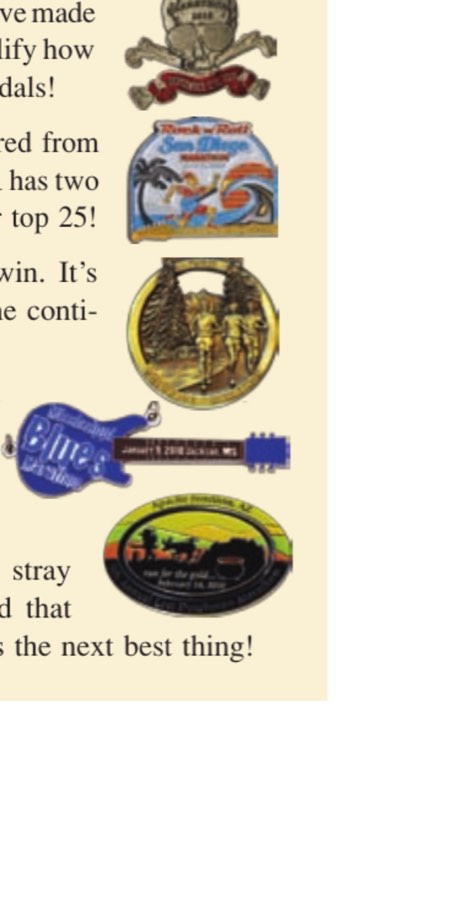
25. Tupelo. These skull-and-crossbones medals have made our top 25 list two straight years. They exemplify how a 250-finisher marathon can create great medals! 24. Rock ’n’ Roll San Diego. No expense is spared from
the longest-running RnR marathon event. RnR has two of its weighty medals making a splash in our top 25! 23. Colorado. Running this marathon is win–win. It’s known as one of the most scenic runs on the conti
nent, and the medal reflects that beauty! 22. Mississippi Blues. After jamming several hours, you can strap on this guitar as your reward. The 2011 medal is destined to provide positive riffs! 21. Lost Dutchman. Some may be tempted to stray
off course at Superstition Mountain to find that famous gold mine, but this spinner medal is the next best thing!
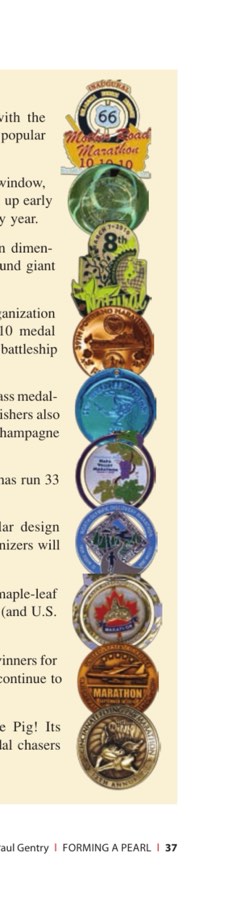
20. Mother Road. Its three-state design with the spinning legendary 66 road sign was a popular choice among our judges. 19. Newport. Hang this medal up near a window, as it is also a gorgeous sun catcher! Sign up early
because this flat marathon sells out every year. 18. Little Rock. Having the largest medal in dimension made this 7 3/4 by 6 inch, 1.67-pound giant a natural choice for our panel. 17. Portland. Each year, this first-class organization
gives us a history lesson, with the 2010 medal sporting the USS Oregon, an American battleship used in the Spanish-American war. 16. Wineglass. These beautiful, handmade glass medallions alone are worth the entry fee, but finishers also
receive a logo-inscribed wine glass and champagne bottle! 15. Napa Valley. This tour of wine country has run 33 times, with a medal redesign each year. 14. North Olympic Discovery. This popular design
stood out well in light blue, and the organizers will go gold for their 10th anniversary. 13. Ottawa. This stupendous, eye-catching maple-leaf design would make any Canadian proud (and U.S. finishers, too)! 12. Air Force. Our military-marathon medal winners for
2010! These large, heavy plane designs continue to fly high each year. 11. Flying Pig. Everyone loves to run the Pig! Its breakthrough design has brought in medal chasers for over a decade now.
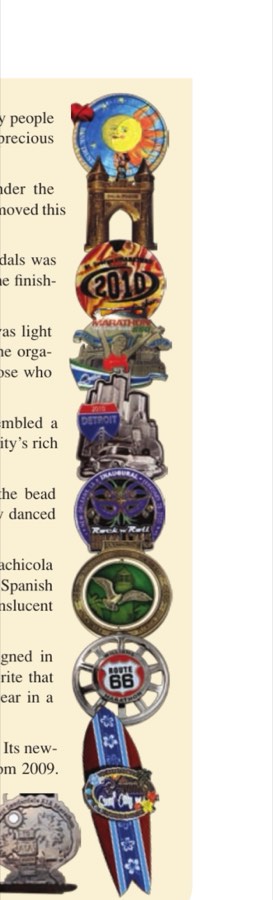
10. First Light. These medals were designed by people with intellectual disabilities and are a precious commodity. 9. Hartford. Its medal makes finishing under the Memorial Arch memorable! The redesign moved this
medal up seven places this year. 8. St. George. This Mount Rushmore of medals was specially carved out of stone for each of the finishers! 7. Quebec City. This top Canadian medal was light years ahead with its LED idea. Perhaps the orga
nizers can include a plug next year for those who wear out their battery! 6. Detroit. This Motor City marathon assembled a spectacular, detailed medal reflecting the city’s rich history. 5. Rock ’n’ Roll Mardi Gras. Let’s face it, the bead
ribbon was brilliant, and the medal simply danced the night away! 4. Running for the Bay. This top-notch Apalachicola Bay spinner medal sports a sunken treasure Spanish coin on one side and a seagull on green translucent
glass on the reverse. 3. Route 66. This iconic medal was redesigned in 2010 as a spinning hubcap—a panel favorite that remains in the top three for the second year in a row! 2. Surf City USA. Surf’s up to the runner-up! Its new
est board design moved up nine places from 2009. Cowabunga! 1. Fort Lauderdale A1A. Its innovative clam was the open-and-shut, clear-cut number one medal for 2010! All photos by Robert Rayder
This article originally appeared in Marathon & Beyond, Vol. 15, No. 3 (2011).
← Browse the full M&B ArchiveMore like this
1,000+ stories from 19 years of Marathon & Beyond
The complete archive of the legendary long-distance journal — digitized and free to read.
