

Fox Cities Marathon
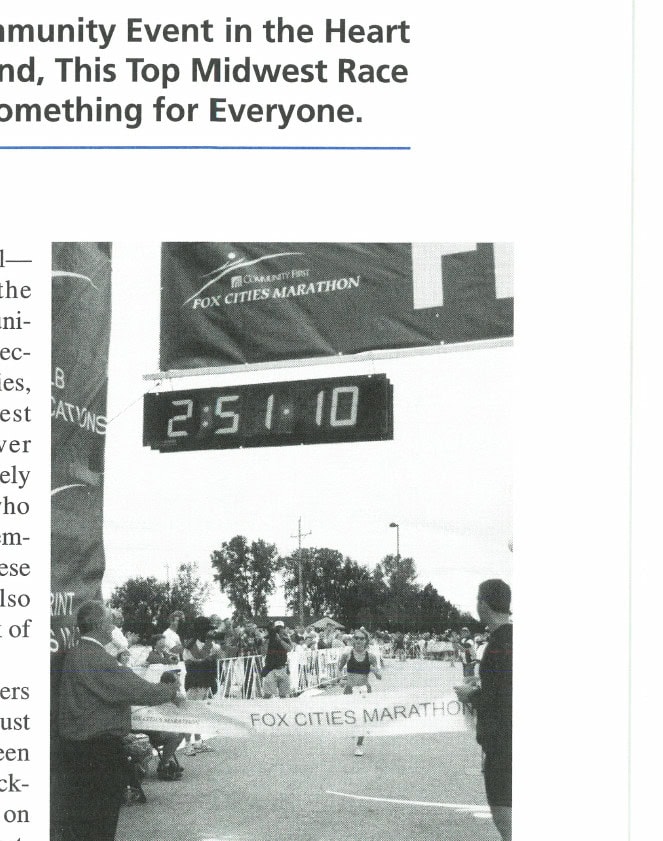
FALL MEANS football—namely, NFL and the Packers—for the 14 communities along the Fox River collectively known as the Fox Cities, one of Wisconsin’s fastest growing areas (now over 200,000 residents). Fortunately for the 2,500+ runners who travel to the area each September for a festival of races, these Packer-loving residents also know how to host one heck of a marathon.
How “big” are the Packers in the Fox Cities, which lies just 30 miles southwest of Green Bay? Consider this: if the Packers home game scheduled on race day 1999 had a noon start, “we would have changed the marathon’s start time from 8:00 A.M. to 7:00 A.M.,” says race director, Bret Younger. He’s serious. Here in the Fox Cities you don’t interfere with the Packers—at least not successfully. During the 1998 race, the finish line announcer piped in Packer updates in between names of finishing marathoners. In fact, Packermania is so strong here that at one water station you’ll feel as if you’re really on Green Bay’s Lambeau Field (read on for details).
Simply put, here in the Fox Cities, the Packers are HUGE. But not to worry: with the scheduled 3:15 P.M. Packers-Vikings home game this year, residents can spectate or volunteer at a water stop or the finish line and still be home in time for the pregame show. There should even be time to drive to Green Bay for the game—which an estimated 1 in 10 Fox Cities residents will do.
The Fox Cities, also known as the Paper Valley, is home to the world’s largest concentration of paper mills and is considered one of the nicest places to live in Wisconsin. The 14 communities include Appleton, home of escape artist Harry Houdini; Kaukauna, with its 320-acre nature and education preserve; the city of Menasha, along the north shore of Lake Winnebago, Wisconsin’s largest inland lake; the city of Neenah, with its nationally recognized historic downtown; Combined Locks, the smallest incorporated community in the Fox Cities; Kimberly, along the banks of the Fox River; Little Chute, nestled in the heart of the Fox Cities, just east of Appleton; the town of Menasha (not to be confused with the city of the same name), 143 years old and situated on the picturesque banks of Little Lake Butte des Morts; the rustic, quaint, and semi-rural town of Neenah (why do they name their towns after their cities? Sorry, we didn’t ask!). And let’s not leave out Buchanan, Freedom, Grand Chute, Greenville, and Vandenbroek, each contributing a distinct personality to this community along one of the few rivers in the United States that flows north.
RACE HISTORY
The Community First Fox Cities Marathon began in 1991 as a way of unifying the 14 neighboring communities. What better way to connect them than to schedule a marathon to go through as many of the cities, towns, and villages as possible? Instead of joining in border scuffles, energies were poured into a joint effort to host a high-quality running event. It’s this “community attitude” that is helping Fox Cities remain one of the best marathons in the region—currently ranked fifth in the midwest in the Ultimate Guide to Marathons.
Gloria West, owner of a race promotion company at the time, was the driving force behind the first two years of the race. Through 1997, three others had handled the race director’s chores. After John Safranski resigned the directorship in April of 1997 to open a business in Door County, a new partnership was formed with the Appleton and Neenah-Menasha YMCAs. The YMCAs agreed to manage the Fox Cities Marathon, and Bret Younger, physical director at the Appleton YMCA, was tapped as race director. The affable and unflappable Younger combines years of experience directing complex Y events with savvy marketing and business skills.
SOMETHING FOR EVERYONE
In addition to the marathon, race weekend offers an array of other events: a marathon relay; a half-marathon, starting at Triangle Park in Kimberly and following the second half of the marathon course; a 5K, which, like the marathon, finishes at the University of Wisconsin-Fox Valley campus; and a top-notch kid’s run, which takes place on Saturday in the front lawn area of the Barlow Planetarium on the Fox Valley campus. Children six and younger complete a one-percent marathon (.26 miles) in separate heats by age, and the 7- to 10-year-olds run a 1K, again in heats by age. Five bucks gets each kid a T-shirt, a kid-friendly goody bag, a finisher’s ribbon, and a warm memory. If you’re coming to town with your children, don’t miss this event, which kicks off at 9:30 A.M. on Saturday.
Saturday also offers an expo, held in the sizeable, wide-aisled, and well-lit UW-Fox Cities field house. (Improving the expo, which was small and devoid of energy in 1998, should be a priority for the race committee for 1999.) This field house doubles as the packet pick-up and seminar venue and serves both purposes quite well.
In 1998, the featured speaker at the seminar and pasta loading was the inspirational three-time Olympian Jim Spivey, who offered on-the-money advice the night before the marathon. On the other hand, the food at the pasta-loading was not quite as inspiring (as you might expect on a college campus). This year—with the popular Italian restaurant, The Olive Garden, catering dinner—the fare will be much improved. And while you load up on pasta, another great speaker, Olympic marathoner Mark
The Basics
| PHONE: | 877/230–7223 (toll free) |
| FAX: | 920/830–0921 |
| E-MAIL: | FCM@execpc.com |
| WEBSITE: | http://www.runningzone.com/foxcitiesmarathon |
| RACE DIRECTOR: | Bret Younger |
| YEAR RACE ESTABLISHED: | 1991 |
| SANCTION: | USATF: No |
| CERTIFIED: | USATF: YES |
| START TIME: | 8:00 AM |
COURSE RECORD HOLDERS
| Open men: | Eric Morrison, USA, 1995, 2:15:52 (original course) |
| Open women: | Tamara Karlivkova, Russia, 1991, 2:39:02 (original course) |
| Masters men: | Doug Kurtis, USA, 1993, 2:20:34 (original course) |
| Masters women: | Sharlet Gilbert, USA, 1992, 2:39:56 (original course) |
PRIZE MONEY: $8,000: Top five male/female finishers in the open; top three male/female finishers in masters, senior, and wheelchair divisions. Plus top three male/female finishers from seven Fox Cities communities.
TIE-IN EVENTS: Half-Marathon, Marathon Relay, 5K Run/Walk, Kid’s Run
NUMBER OF VOLUNTEERS: 1,400
MARATHON FINISHERS IN 1998: 750
PROPORTION MALE/FEMALE FINISHERS: 60% male; 40% female
COURSE MARKINGS: Every mile
NUMBER OF MEDICAL STATIONS: 5, starting at 13.1 miles. First Responders and EMTs on bicycles throughout course.
NUMBER OF WATER STATIONS: 22
FUTURE RACE DATES: 26SEP99, 01OCT00, 30SEP01
ENTRY COST FOR 1999: $35 before 01SEP99; $45 after.
AREA HOTELS: There are many to choose from in the Fox Cities area. For a complete list, contact the Fox Cities Convention and Visitors Bureau at 3433 W. College Ave., Appleton, WI 54914-3919; 800/236-6673. Web site: www.foxcities.org. Don’t wait too long to book your hotel reservation for the 1999 race because the Packers are playing at home on race weekend—and they’re facing the Vikings.
FOX CITIES INFORMATION: Again, the Fox Cities Convention and Visitors Bureau is your best bet. Request a copy of The Answer Book: Your Guide to the Fox Cities. Conveniently, the bureau is located right off the highway in Appleton.
GETTING THERE: Anyone driving from the eastern United States should get to Milwaukee and then take Route 41 north to Appleton. From the south and west, head north on Route 151 out of Madison up to Fond du Lac, and then take Route 41 to Appleton. United Express, Midwest Express, Skyway, Northwest Airlink, and Comair all fly into Outagamie County Regional Airport in Appleton.
East Central Wisconsin’s Fox Cities boast 200,000 residents. This community of 14 towns, cities, and villages is one of Wisconsin’s fastest growing areas but appears to be absorbing the expansion gracefully. The Fox Cities doesn’t feel touristy like sections of its neighbor to the west, the Wisconsin Dells. Each of the 14 communities celebrates a distinct personality yet embraces its place within the collective Fox Cities network. We didn’t really find any areas you should avoid. Besides being called the “Paper Valley,” the Fox Cities are also known as “Happy Valley.” The unemployment rate is very low, the schools are excellent, and everyone is polite and friendly . . . unless the Packers lose, that is. Here’s a sampling of some sights to take in while you’re visiting the Fox Cities.
GO SEE IT
Octoberfest. This 18-year-old community festival kicks off on Friday evening and runs all day on Saturday along College Avenue in Appleton. You can feast on food from over 120 vendors, listen to live music from five different stages, stroll through the picturesque campus of Lawrence University to check out the wares of 200 local artisans, and treat the kids to live entertainment, rides, games, and clowns. Shuttle buses to and from Octoberfest are available from the UW-Fox Valley campus, where Saturday’s prerace activities take place. Octoberfest Hotline: 920/734-3377.
License to Cruise. The official kickoff to Octoberfest, License to Cruise is your ticket to the past. Come to town early on Friday to catch the 6:00 p.m. parade of over 300 classic cars. You’ll see everything from turn-of-the-century Model Ts to souped up Corvettes and sparkling Porches. After the parade, the cars are parked along College Avenue until 9:00 p.m. The car’s owners will be happy to answer all your questions or just soak up your adoration. A car lover’s paradise.
Victoria’s on College Ave. Bring a cooler with you when you dine at Victoria’s, not because it’s BYOB but because you’ll need it to haul away the leftovers. You’ll take home more than you’ll eat. You’ll find a very diverse menu, quite tasty meals, and very reasonable prices. The servings are the biggest we’ve EVER seen in a restaurant. 920/730-9595.
Outagamie Museum/Houdini Historical Center at 330 East College Ave., Appleton. World-renowned escape artist Harry Houdini—born Ehrich Weiss—came from Appleton, and the center in his name features the world’s finest collection of artifacts once owned and used by Houdini. Prior to 1988, the Houdini collection and its secrets were hidden in the basement of Sidney Radner of Holyoke, Mass. 920/733-8445.
Gordon Bubolz Nature Preserve at 4815 N. Lynndale Drive, Appleton. If you’re looking for a quiet, relaxing spot to unwind before race day, head over to this nature preserve. You’ll find miles of trails through a white cedar forest, a trout pond, and more at this nature lover’s oasis in an urban setting. 920/731-6041.
Barlow Planetarium-UW Fox Valley. The only one of its kind in Wisconsin, the planetarium offers a skyward view of the world as three-dimensional projections explain the wonders of the stars. The planetarium offers shows on weekdays, weekends, and holidays. Call for a schedule. The planetarium is located right by the finish area, where Saturday’s activities are happening. 920/832-2848.
Fox Cities Children’s Museum at 100 W. College Ave., Appleton. If your family isn’t into the expo or race day seminars, consider a trip to the impressive 20,000 square-foot children’s museum. Sixteen hands-on exhibits will intrigue, involve, and challenge even the most precocious child. Adults will love it, too. 920/734-3226.
Packers vs. Vikings. Sunday, September 26, 3:15 p.m. NFL rivalries run deep, and this one is right up there. You can run the marathon in the morning, partake in the postrace festivities, and still have time to shower and drive 30 miles northeast to vintage Lambeau Field in Green Bay. Start scrounging for tickets immediately.
AVOID IT
Don’t denigrate the Packers out loud and don’t wear non-Packer NFL attire. Flaunting a Vikings and/or Bears T-shirt or cap is an especially bad idea, especially at the water station on Sue Street in Little Chute.
WHAT’S UP WITH THE COURSE?
Conover, will pump you up for the race.
Yet another new course will be unveiled for the 1999 Fox Cities Marathon. Some race veterans may be a bit miffed to see a third course in nine years, but good reasons precipitated the changes. The same course was used for the first seven years, starting in Riverside Park in Neenah and ending just north of the Oneida Street Bridge, adjacent to the Trinity Lutheran Church in Appleton. Major construction on one of Kaukauna’s two bridges forced a course change for the 1998 race. Younger notes, “For the race to take the other bridge away during the race would have caused a real hardship for the citizens of Kaukauna. We’re very cognizant of how the race affects the communities we run through.”
Since the course had to be changed anyway, Younger took the opportunity to address other concerns voiced over the years about the first course—namely, hills, wind, and the late start.
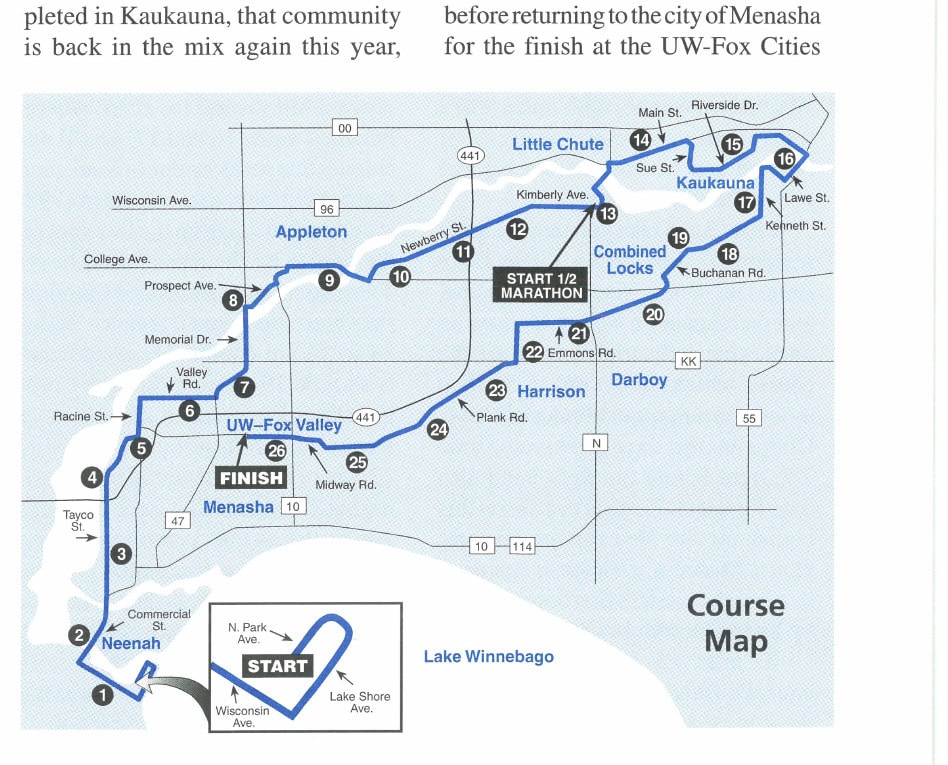
The race’s original ending point precluded an earlier start time because the finish would have interrupted church services. The “new” course repositioned the finish line at the University of Wisconsin-Fox Valley on Midway Road in Menasha. The new venue is centrally located and provides a good staging area for the expo, seminars, pasta loading, and Lamers Bus Lines, which provide efficient transportation for the weekend. More important to the runners, the new course skirted the church issue—hence, the earlier start time. With bridge construction now completed in Kaukauna, that community is back in the mix again this year, which meant another “new” course. The newest new course will combine much of what folks liked about the original course, with a few added twists.
The marathon will pass through 10 Fox Cities communities. Starting in the city of Neenah, the course then acquaints you with the city of Menasha, the town of Menasha, the city of Appleton, the villages of Kimberly and Little Chute, the city of Kaukauna, the village of Combined Locks, the town of Buchanan (locally known as “Darboy”), and, last but not least, the town of Harrison. You’ll touch Appleton again on the way back before returning to the city of Menasha for the finish at the UW-Fox Cities campus. The course features six bridge crossings and, new for 1999, banners will stretch across roads to announce each city, town, or village you enter during the race.
THE “NEW” “NEW” COURSE
As it has every year since 1991, the Fox Cities Marathon will start in beautiful, tree-filled Riverside Park in Neenah, right along the Fox River. New for 1999 is a first-mile loop around a section of mansion-lined Lake Winnebago, quite possibly the most scenic area in the Fox Cities. The 1-mile marker is the old course’s start line. Mile 1 to 2 will pass along Wisconsin Avenue, with miles 2 to 3 touring the commercial areas of Neenah and Menasha. Two bridges punctuate this section.
Miles 3 to 5 take you into the quiet residential area along Little Lake Butte Des Morts. You turn on Racine, and then again on Valley to enter an unexciting industrial section of the course, which ends at mile 6.5, when the course turns onto Memorial Drive. Bridge number three greets you at mile 7.5, right before the right-hand turn onto Prospect. Keep an eye out on this corner for the Hearthstone Historic House Museum, a Victorian mansion that was the world’s first home lighted by hydroelectric power.
At mile 8.5, you’ll pass the old course’s finish line and turn toward downtown Appleton. The nice downtown area quickly becomes Lawrence University Campus at mile 9. After a fourth bridge crossing at mile 9.5, you’re back in residential area for the next 3 miles. After that, you enter the village of Kimberly business district, which is followed by a loop around Triangle Park at the 13.1-mile point. At this point you begin to chase the half-marathoners, who started their race at 8:45 a.m. A short climb to the Community Bridge brings you into the Dutch community of Little Chute, where you might see little Dutch girls dancing along the street.
Between miles 14 and 15 is the famous Packer-inspired Sue Street water station. Drink it up! After mile 15, you’ll follow the Fox River through a residential area and head down a hill toward the river, where, between miles 16 and 17, you’ll encounter that pesky bridge in Kaukauna that caused the course change in 1998. As you climb up from the low spot on the course by the river, you’ll be on Third Street and then around Lafollete Park and onto Kenneth Avenue. Miles 18 to 22 are completely residential, with mile 19 passing through Combined Lock and miles 20 and 21 in Buchanan, or “Darboy,” USA. Mile 23 is very rural, and you’re now heading back into Appleton. Mile 24 brings you to the award-winning Appleton Papers water stop (see page 127), and a long-distance view of the finish area. The last two miles are residential. Miles 9 through 22 of the 1999 course will be part of the original course but now run in the opposite direction.
WILD WATERSTOPS
Without question, some of the coolest features of the Fox Cities Marathon are the water stations. The 22 stations are each hosted by a different community group or business, who pays for the privilege of anchoring the stop. One lucky company earns bragging rights for the year by winning the annual Best Water Station award. (Gloria West, the race’s first director, is credited with the water station competition idea.)
Since 1995, the residents of 521 Sue Street in Little Chute have orchestrated one very memorable watering hole. Dawn Franzke and her grandfather Eugene Vandehey, whose home is “headquarters” for this stop, are the organizers. In 1997 Vandehey and Franzke used a Green Bay Packers theme, transforming their neighborhood street into a mini Lambeau Field, using leaf blowers to dry the ground so that yard markers can be put down. “We wanted to change the theme for the 1998 race,” says Franzke, “maybe to a Haunted Sue Street—but no one would let us because of what the Packers have meant to this area.”
Back in 1995, 10 to 15 neighbors staffed the water station. “Last year, the number swelled to 100,” says Franzke. It’s not uncommon for a few runners to stop for a beer with the Sue Street neighbors before continuing to the finish line.
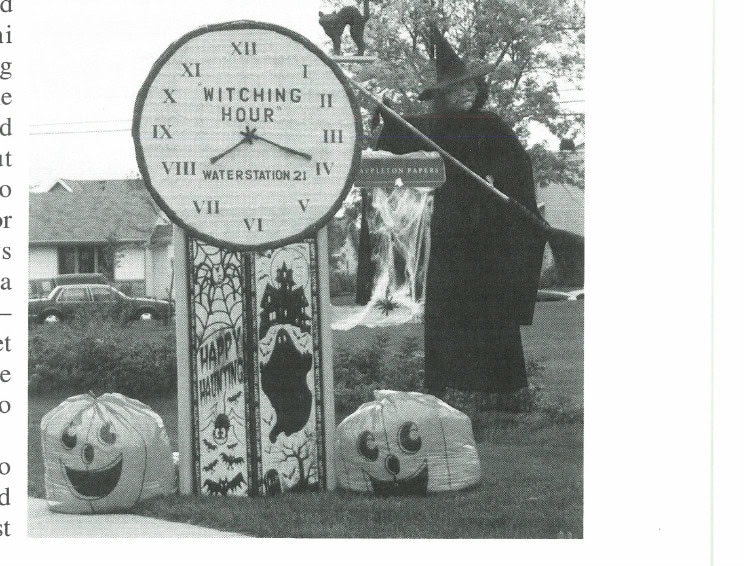
Appleton Papers, a frequent winner of the top-water-stop award, also puts on quite a show. One year they created Gilligan’s Island, complete with palm trees, a volcano, the professor, Marianne, and the whole gang. In 1998, their theme was Halloween. Two-hundred and fifty Appleton Paper employees worked the stop, which was so elaborate they needed two semitrucks to haul all the props to the station. Look for the Appleton Paper water station at the corner of Kernan Avenue and Midway Road in Appleton, about mile 24 and within eyesight of the finish line at UW-Fox Valley.
Runner’s High/Runner’s Low
| HIGHS | LOWS |
|---|---|
|
|
MIDWESTERN HOSPITALITY
Race weekend in the Fox Cities is truly a treat. You’ll soak up warm Midwestern hospitality, from the cheery volunteers at packet pickup and the supportive community members along the race course to your personal escort through the finish chute. The area’s well-oiled local running club, the Pacesetters, will be leading pacing groups in the 1999 marathon. Hotels are abundant, and a free shuttle bus will pick you up at your hotel on race morning and take you to the start (don’t be late for your hotel’s assigned pickup—the shuttle buses are very prompt). You’ll get more than you can eat and drink at the finish line, exhibit your handsome finisher’s medal proudly, and take home a “keeper” race shirt. And, if you really want to make some friends in the Fox Cities, be sure to load up on your Packers gear at the border!
The Bottom Line
We have weighed various aspects of a marathon within a 1,000-point scoring grid. Besides the author of the article, a dozen runners at the race were randomly chosen to score the race for us. (FCM = Fox Cities Marathon.) The results follow:
1. HISTORY/TRADITION
Evaluate the race’s sense of history and tradition.
[Possible points: 30 FCM score: 25]
2. ENTRY FORM
Is the race entry form clear, concise, attractive, complete, and easy to fill out?
[Possible points: 20 FCM score: 20]
3. ENTRY COST
For most races, the entry fee covers between 30 and 50 percent of the cost of putting on the event. Rate the value of your dollar relative to this race.
[Possible points: 30 FCM score: 30]
4. LOCALE/SCENICS
Is the race held in an area that is easy to get to and scenic, offers adequate food and housing services, and nonrace activities for family and friends?
[Possible points: 50 FCM score: 50]
5. REGISTRATION
Is registration well organized and efficient? Does it bog down unnecessarily?
[Possible points: 20 FCM score: 20]
6. PRERACE ACTIVITIES
Evaluate activities such as pasta feeds, parties, and so on, during the days before the race.
[Possible points: 50 FCM score: 35]
7. EXPO
Does the expo offer a fair number and variety of booths relative to the race’s size? Are there quality exhibitors and good guest speakers?
[Possible points: 50 FCM score: 20]
8. COURSE
Take into consideration the following: degree of difficulty, certified, sanctioned, quality of road or trail surface, adequate mileage and directional markers, aid stations, medical coverage, race communications, accessibility to course for friends and family, typical weather, and so on.
[Possible points: 400 FCM score: 340]
9. RACE AMENITIES
This category includes race T-shirt, finisher’s medal, finisher’s certificate, adequate and efficient finish area, ease of sweatbag retrieval, showers, postrace refreshments, awards ceremony, raffles, results postcard, results book, and so on.
[Possible points: 250 FCM score: 225]
10. VOLUNTEERS
Are the volunteers experienced and adequate in number?
[Possible points: 100 FCM score: 100]
TOTAL SCORE FOR FOX CITIES MARATHON
865 points (out of 1,000)
This article originally appeared in Marathon & Beyond, Vol. 3, No. 4 (1999).
← Browse the full M&B ArchiveMore like this
1,000+ stories from 19 years of Marathon & Beyond
The complete archive of the legendary long-distance journal — digitized and free to read.
