

Fred’s Final Lap
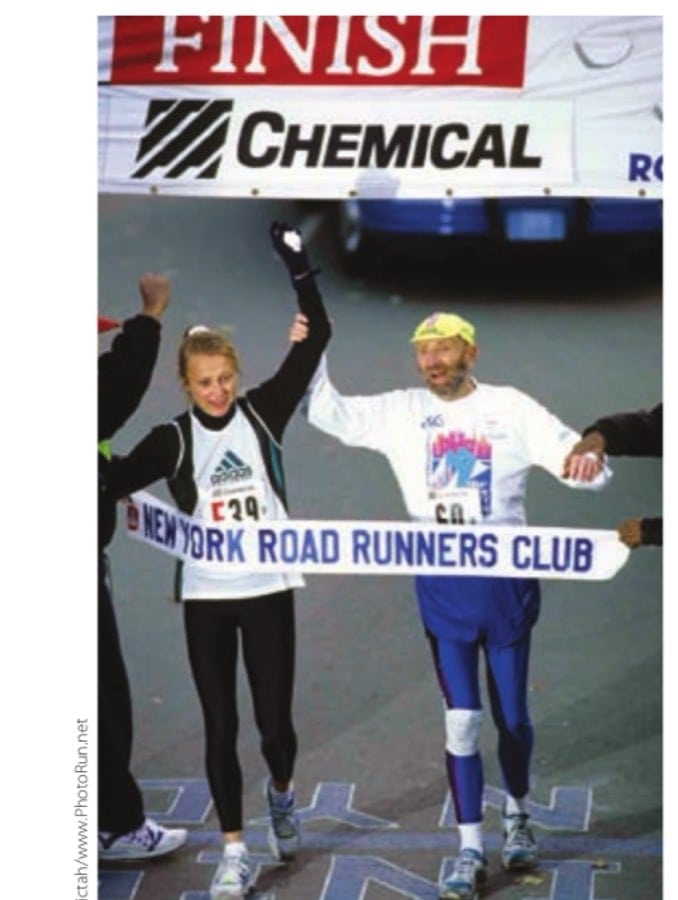
A dream come true: Fred Lebow (running his only five-borough New York City Marathon) finishes “his” race with Grete Waitz in 1992.
▲
© Victah/www.PhotoRun.net
For running aficionados, 1994 was scheduled to be a very important year. It would mark the 25th running of Fred Lebow’s pampered child, the New York City Marathon. Planning for the big event began within a few weeks after the 1993 race, as
we caught our breaths and luxuriated in some much-deserved R&R—which in our case meant getting out of the New York Road Runners Club offices at 6:00 p.m. instead of 9:00 or 10:00. The year before (1992), fear
ing that his battle with brain cancer might deprive him of ever running his own race, Fred completed the course while being accompanied by his close friend, Grete Waitz, nine-time winner of the race. An
aggressive series of chemo treatments had for the time arrested Fred’s cancer, and he was looking forward to many more years as maestro of the famed marathon. As was his habit for the many decades I knew him and worked with him, Fred was brimming over
with ideas for making the 25th running of the NYC Marathon special. First out of the blocks, Fred wanted to invite back all of the race’s past champions for a black-tie affair at Tavern on the Green on the Friday before the marathon. Tavern on the Green was within shot-put distance of the marathon’s finish line.
Next on his agenda, Fred cooked up the idea for a coffee-table-sized book commemorating the race’s 25 years as a New York City tradition. Fred knew someone at the venerable publishing house of Rizzoli whom he convinced that this was a bona fide winner. Fred was always good at getting people to buy completely into his ideas. But there was a hitch. The book would be a very expensive proposition, and Rizzoli needed money up front to make the numbers work. Fred had not foreseen that eventuality, as he believed that the book would sell itself as soon as it came off the presses. But in this case Fred’s faith in the project wasn’t going to sway Rizzoli; it was not in the habit of gambling on big-ticket projects of the sort that Fred envisioned. As always, Fred came up with a ready solution, as he did to confront so many problems in his career.
Since the foreign-tour operators were assured of guaranteed spots in the race for their customers, Fred decided that part of their entry fee for that year’s race would be the retail price of the book minus a discount. Naturally, there was some grumbling, but when you put that added cost against the bigger picture of what their entire trip was costing, the additional charge was minimal—and besides, they would get a commemorative book that they would proudly and prominently display to impress their friends. After Fred finished selling the idea to the tour operators, everyone came on board “willingly,” as people usually did once Fred got done working them over. The next few months saw us spending hours poring over photos and lining up a suitable writer. We settled on Peter Gambaccini, someone well known to us who was deeply immersed in our sport.
Fred’s MO This was so typically Fred. He erupted with ideas, spewing them as a volcano spews lava and ash. And although I deeply loved Fred, even I have to admit that not all of his ideas were practical or particularly good—but there were so many of them that for every one that was a dud, there was another one that was simply brilliant.
For those who didn’t know Fred—and that is certainly their loss—he emigrated to America from Transylvania (honest!). Occasionally he would go to a social event dressed all in black, topped with a long leather coat. But most times he would dress like a homeless runner, wearing warm-up pants, a T-shirt, and one of his famed bicycling hats. This was ironic since he had made his mark professionally in the very tough garment industry, where people supposedly knew something about fashion.
© Victah/www.PhotoRun.net
Once he took up running, it became his passion. And when Fred developed a passion for something, there was no such thing as going halfway. Before getting too far into Fred’s final year, I should probably lay the groundwork for how we became joined at the hip. I had been involved with the
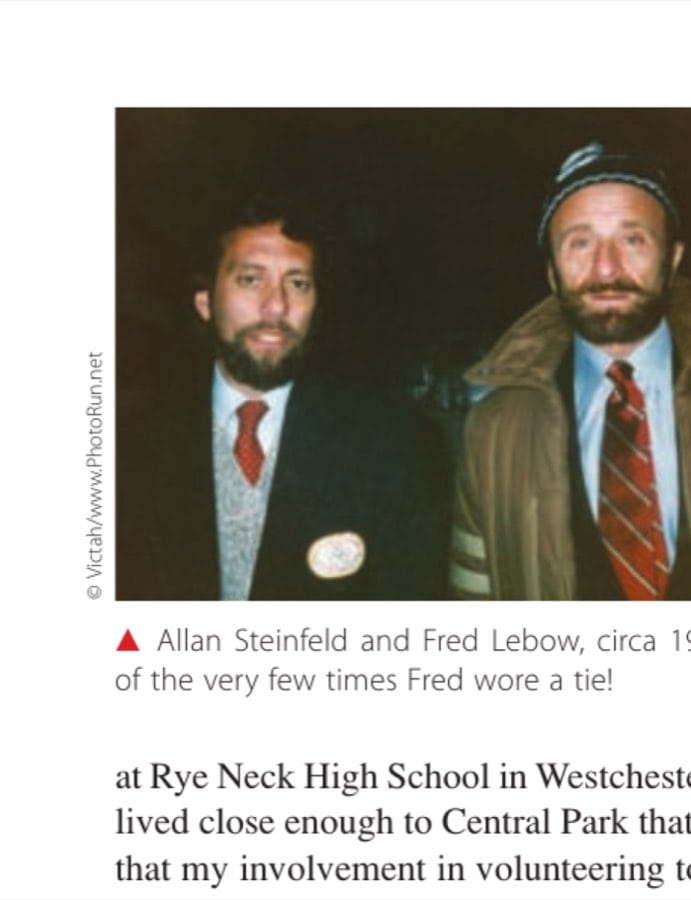
New York Road Runners Club ▲ Allan Steinfeld and Fred Lebow, circa 1985, one since 1963. I had been a runner of the very few times Fred wore a tie! most of my life, mostly a sprinter. I was teaching physics and math
at Rye Neck High School in Westchester, New York, while living in Manhattan. I lived close enough to Central Park that I did some of my workouts there. I guess that my involvement in volunteering to help the NYRRC started in 1975 on the
day the club ran the marathon as loops in Central Park. I was running by and Kurt Steiner, a friend of mine from the New York Pioneer Club, was doing announcing for the race; he was known as the voice of the New York Road Runners. He
called to me to see if I would be willing and able to help out. He wanted me to help separate lapped runners from those finishing the race. I made the mistake of letting Fred see me help out, and he latched on to me. I continued as a volunteer
until 1978, working closely with Fred, who was the majordomo of the club. I was pretty much like most volunteers. We stuffed envelopes and helped out at some of the races, doing such exotic things as getting there early to set up the
start and finish areas, fill cups with water and help with scoring duties. The more we did, the more we were given to do. In 1977 Fred asked me to work as a race director with Kathrine Switzer at the
Bonne Belle Mini-Marathon, a 10K series for women only. The Mini-Marathon is the original and most prestigious women-only 10K race, started in 1972 by the New York Road Runners Club. We expected some 2,000 women to run the race,
and I anticipated disaster if we continued to organize the finish line the way it had been since the days when the wheel was invented. The finish line was OK for a few hundred finishers, but it would have been totally inadequate to handle 2,000.
I cooked up a system where we could simultaneously empty out multiple chutes while taking finisher numbers and not have one long, snaking line of panting and sweating runners waiting to have their numbers recorded. I took the idea to Fred,
and thank goodness he was enthusiastic about it. We used the system, it worked, and it was soon picked up by other races that were suddenly dealing with much larger fields than they were used to.
That was essentially how Fred and I worked throughout our relationship. Fred would come up with a challenge, and I would get to figure out how to pull it off.
Make me an offer I can’t refuse In the summer of 1978, Fred saw that our relationship had been working very well, a sort of Mutt and Jeff act, so he asked me to take a paying job with the NYRRC, which at that time consisted of about eight people. But first he asked me how much I was earning as a teacher. I told him it was around $25,000. He said he could pay me half that much to come on board as his right-hand man. I told him I would think about it and get back to him. I spoke to my superintendent, who knew of my involvement with the club, since I annually tapped into the teachers and students at the school to volunteer at the finish line of the marathon. He proposed that I take a two-year leave of absence to work with Fred, but at the end of the two years I would have to make a decision: teach school for $25,000 and have summers off, or work with Fred literally seven days a week for half my current salary.
It speaks to what a good salesman Fred was and to my passion for what we were doing with the burgeoning NYRRC that I said yes to Fred and never looked back. I often wonder what Fred would have offered me if I had said I was earning $45,000.
The rest, as they say, is history. Fred depended on me to figure out how to solve logistical and technical problems. I was very fortunate to have a cadre of wonderful professionals who were volunteers who believed in what we were doing and wanted to be a part of it.
Fred and I worked closely during the 1980s to grow the marathon and the club. We traveled all over the world as consultants to other big-city marathons, and we saw how other race committees approached problems and learned from them. Butch and Sundance, Laurel and Hardy, Rowan and Martin, Martin and Lewis, Lebow and Steinfeld. We were on top of the world, and then Fred was diagnosed with brain cancer. He was treated and the cancer obviously hadn’t had that much of an effect upon his brain, because he was coming up with as many ideas as before, some goofy and some the stuff of genius. The cancer was in remission and we looked forward to many more years of innovation and challenge.
Then it happened: the expected unexpected! I believe it was in April 1994 that Fred came back from his regularly scheduled MRI, took me aside, and told me that the cancer was no longer in remission and that the doctors had run out of options. He had already undergone the maximum chemo they could use without killing him. There were no options left. It was now just a matter of time. We had all hoped—believed—that Fred would make it safely to the 25th running of his race, but it was not to be.
▲
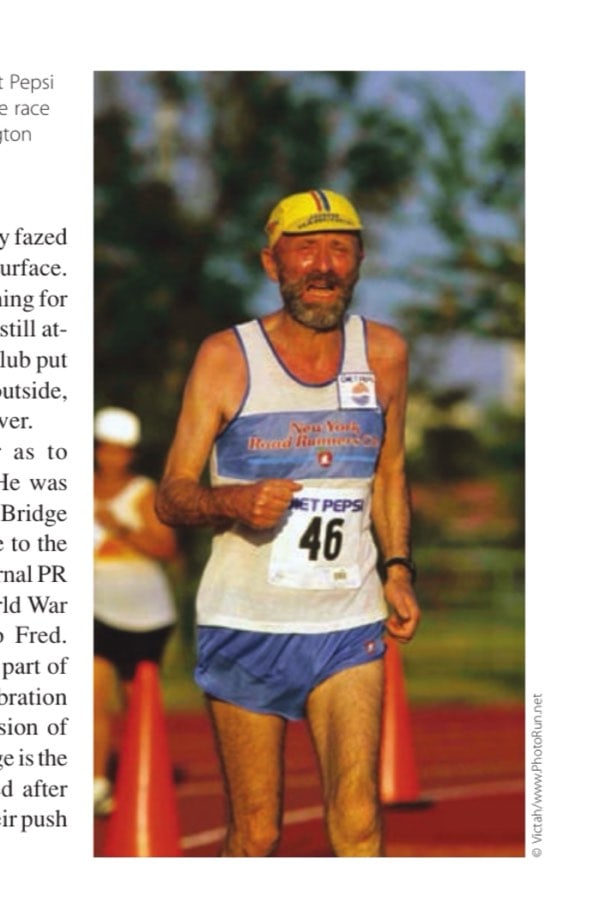
Fred Lebow finishes the Diet Pepsi 10K sometime in the 1980s. The race started on the George Washington Bridge.
© Victah/www.PhotoRun.net
The horrible news barely fazed Fred—at least, not on the surface. He moved ahead with planning for the big anniversary, and he still attended weekend races the club put on in Central Park. On the outside, he was as enthusiastic as ever. He even went so far as to schedule a trip overseas. He was invited to attend the Peace Bridge Half-Marathon, which, due to the input of the NYRRC’s external PR man Joey Goldstein (a World War II buff), was dedicated to Fred. The race was to be held as part of the 50th-anniversary celebration of D-Day, the Allies’ invasion of Normandy. The Peace Bridge is the span that the Allies crossed after landing at Normandy on their push toward liberating Paris.
Feted in France My wife, Alice, and I, along with Joey and his wife and Fred and his girlfriend, made the trip, where Fred was feted as the celebrity that he was. It was interesting to observe that Fred was more well known outside of the United States than inside. As the trip progressed, Fred began to show signs of weakening, but he did his best to keep up his chipper demeanor. It was inspiring to those of us who knew him well, but we were also concerned that he was expending what was beginning to become a precious commodity: energy.
As is to be expected, as the months wore on Fred became progressively worse. He could no longer walk the four flights to his office at the NYRRC building; instead, he used the building’s antiquated elevator. Additionally, he began using a cane. I remember vividly the day someone came running into the building to report that Fred had fallen on the sidewalk on his way to lunch. Everyone in
the neighborhood knew Fred; he was a local celebrity, so it wasn’t unusual that someone who was a stranger to us knew exactly where to run to in order to report on Fred’s accident. I ran out to 91st Street and Madison Avenue, where I found Fred sitting on the sidewalk sporting a new collection of bruises. One of the first citizens on the scene had called 911, and when the ambulance came roaring up, the EMTs jumped out and began examining Fred, cleaning up his bruises. They were getting ready to put him in the ambulance so they could take him to the emergency room when Fred revolted. They tried a new tactic—to cajole him into the ambulance—but that didn’t work either. Fred had made up his mind there was no way he was going to an emergency ward, and that was that. Emergency rooms were for the seriously debilitated and for those with life-threatening complications. Fred just had brain cancer, that was all. The EMTs finally gave up and made him sign a release absolving them of liability. I helped him to his feet and back to the office and got him his lunch.
Our internal PR person took me aside and expressed his feelings that Fred should not be at the office in his condition, that it was not good for people who worked in the office or who came by to see the once-vital Fred Lebow in such a sorry state. I stood my ground on that one, feeling it was good for Fred to come to work as often as he felt able, that the NYRRC offices were his “home” and his creation and that being around people would help him psychologically a whole lot more than sitting alone in his apartment would.
By September Fred was confined to a wheelchair. His sister, Sarah, took over his care at his home on 72nd Street, a little over a mile from the office. Now he would occasionally visit the office, pushed there by Sarah. He was not able to stay very long.
A fitting tribute Earlier that year Dan Mitrovich, a runner who was deeply in love with the New York City Marathon, had approached Fred and me about the possibility of creating a statue of Fred that would stand in Central Park. Dan said he would raise the funds, and all he wanted from us was our blessing and a list of sponsors so he could solicit them for donations. Fred was against the idea, but Dan and I eventually wore him down, and he was finally persuaded to let it go ahead. The plan called for the statue to be finished before that year’s marathon; it would be placed at the race’s finish line, near Tavern on the Green. But there was a problem. The Monuments Commission was adamant that no new statues were permitted in the park and there were to be no monuments to a living person. Mayor Giuliani interceded, stating that the statue would not be erected on a permanent site until after Fred’s death, which daily seemed imminent. The statue’s semipermanent home is at 90th Street and the East Drive of the park, a spot where most of the
club’s races used to start. Runners entering the park for their daily run or warming up to start yet another NYRRC road race back in the late ’90s would do so under the watchful eye of Fred Lebow. It is difficult to express how grateful we all felt to Mayor Giuliani for stepping in. For the week of the marathon the statue resided at the northwest corner of the park’s West Drive and 67th Street. The statue (which, come to think of it, got around that first year as much as if not more than Fred did) was unveiled to the public at the marathon finish line a day or two before the ’94 race. The unveiling ceremony was orchestrated by several previous winners of the New
York City Marathon, Fred’s family, Brian Crawford (Fred’s best friend and his roommate for some 20 years), and me. The ceremony was emceed by George Plimpton! There wasn’t a dry eye in sight. Several weeks earlier we had our annual reception at Gracie Mansion, the home of the mayor. The reception was for the staff, key volunteers, and agencies involved with the marathon. It was our way, and the mayor’s way, of saying thank you to many of those who made this annual celebration of life in New York City possible. The mayor loved the event, but he also loved the free PR the race brought to the city from the rest of the world, not to mention the significant economic
ad
impact the race had on the City of New York. The club paid for the event, and annually it was money well spent. For 1994 the event was moved up on the schedule in consideration of Fred’s failing health. Most of the people at the reception were used to seeing Fred at City Hall agency meetings and during marathon week, where he was traditionally cheerful, feisty, and full of health. They were astonished and saddened when they saw this formerly vibrant man a mere shell of his old self. He was wheeled into Gracie Mansion, and I can still hear the intake of breath as people saw how weakened he had become. His voice was barely audible, but he did his best to shake hands and give people his famous impish smile.
When Mayor Giuliani spoke, he praised Fred for all his good work on behalf of the city and made it known to all that he had a special honor and gift for Fred. He stepped away from the microphone and came down to greet Fred as an aide handed him a street sign. Our local councilman had convinced the powers that be that 89th Street between Madison and Fifth Avenue (the location of the Road Runners’ offices) should be renamed Fred Lebow Place.
As the mayor handed Fred the sign, Fred couldn’t stop tears streaming from his eyes. The photographer had me and the mayor pose with Fred, while Fred held the gleaming new street sign. At the time I had a black patch over one eye, making me look like Moshe Dayan. Today the picture hangs in our living room, the last photo I have of Fred before he passed away.
Fred’s visitors Alice and I saw Fred every few days at his home, where I gave him progress reports on the upcoming marathon. Since it was common knowledge that Fred was dying, pilgrimages to visit him began. Grete Waitz, whom Fred had helped turn into a star of the running world while she in turn put our little marathon on the map with her world records and nine wins in New York, visited. It wasn’t until 1992 that Fred managed to run in his own race, and you’ll remember it was Grete who ran that race with him while his cancer was temporarily in remission. Alberto Salazar, three-time winner of the New
York City Marathon and the course record holder, came to visit, as did Eamonn Coghlan, who was the inspiration for the Fifth Avenue Mile. “King Carl,” Carl Lewis, came by to pay his respects. Carl had met Fred many times at the New York Games track and field meets that we put on, and they had become close friends. At the 1988 USA Track & Field Olympic Trials, Joe Douglas and some other managers approached Fred in an attempt to get him to help promote track and field the way he had promoted road racing. Joe was the man behind the famed Santa Monica Track Club. They persuaded Fred to put together a track meet
in New York in either May or June, before the European season started each year. Joe promised that his entire Santa Monica team would participate. Since he didn’t know anything about track and field and since I had been a sprinter in college and loved track and field, Fred approached me to see if I would be willing to produce such a meet. As usual, it didn’t take Fred long to have me agreeing to go along with his plan.
A few days before Fred died (he was in and out of consciousness by that time, more out than in) I visited with some good news. Fred had always dreamed of the “king” of running shoes and apparel, Nike, being a major sponsor of his marathon. We even went to Beaverton, Oregon, to visit Phil Knight, the cofounder of Nike, to ask him for sponsorship. At the time he was noncommittal. Our agreement with our current shoe sponsor was ending after the upcoming marathon, which is why we had approached Nike about stepping in to take over. Nike agreed in early October to come on board. During that visit Fred appeared to be nonresponsive, so I held his hand and told him the good news about Nike. I swear to this day that he heard me and squeezed my hand; as he did, tears came to my eyes.
I saw Fred the day before he died. Alice and I visited him on Saturday, October 8, after the Corporate Challenge Championship on Park Avenue. He was comatose, and we knew that he was dying and just wanted to say good-bye to him. Later that afternoon we drove out to our house in eastern Pennsylvania. Around noon the next day the phone rang, and I knew that it was the news that Fred had left us. My good friend Phil Greenwald was on the phone. He reported that Fred had passed and that our PR director had notified all the TV and radio stations and the press. She informed them that there would be a memorial ceremony at the marathon finish line in Central Park on Wednesday. After Alice and I cried out our sorrow at the tremendous loss in the lives of so many people, we dried our eyes and drove to our apartment in Manhattan.
© Victah/www.PhotoRun.net
▲
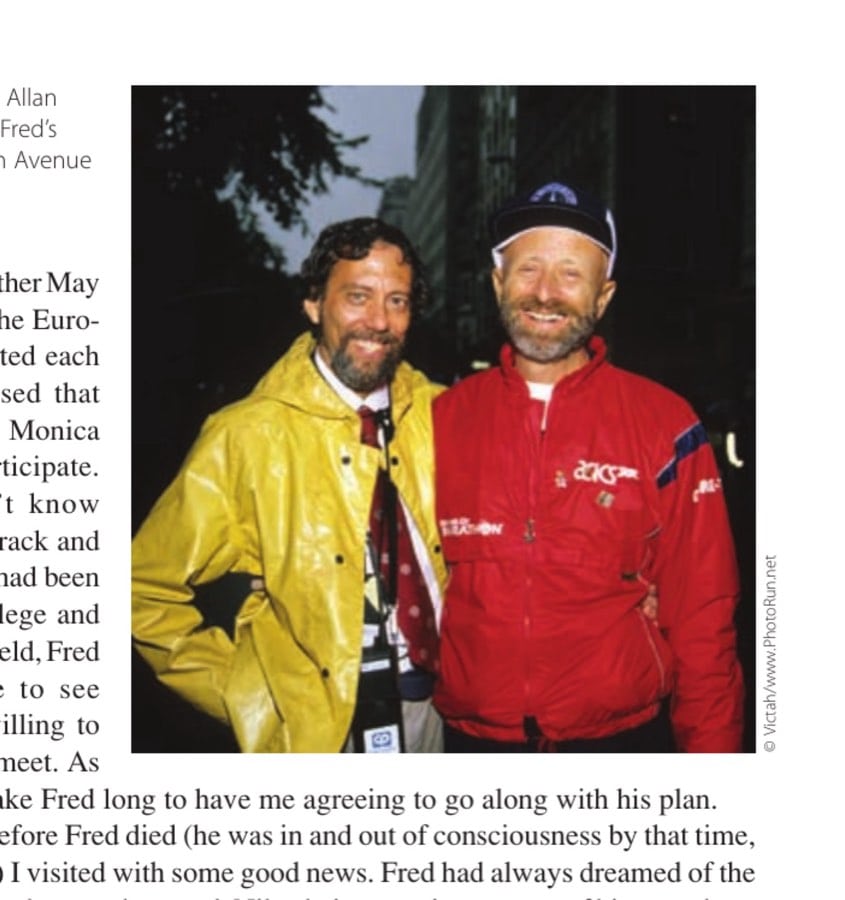
Fred Lebow and Allan Steinfeld at one of Fred’s creations—the Fifth Avenue Mile.
Buried the next day Fred was raised as an orthodox Jew but in his later years did not practice it very much. But Fred’s brothers and sister were still very much orthodox Jews and so, according to tradition, they planned to bury Fred the next day, Monday.
Brian Crawford, the executor of Fred’s estate, arranged for the chapel and the cemetery. Cemeteries denote their streets by name or number. The cemetery Brian picked in Queens used numbers, so Brian chose a plot on number 26, about two-tenths of the way in.
The plan was that after the eulogy in the chapel, we would drive into Central Park, stop at the marathon finish line, and then drive up to our club building and from there out to the cemetery. Brian convinced me that the staff should not attend the chapel ceremony but that the Road Runners’ building should stay open as Fred would have wanted. To this day, I kick myself for agreeing to go along with that. The staff members, who so much loved and revered Fred, should have had the opportunity to pay their last respects at the chapel.
One of our sponsors, who had very good relations with the police department, arranged for a major police escort for Fred; it consisted of several police cars and motorcycles. These policemen, who knew Fred well, felt honored to be picked to escort his mortal remains to his final resting place. As we left the chapel with our escort, we entered Central Park (the park is closed to motorized traffic from 10:00 a.m. to 3:00 p.m.) and proceeded to the marathon finish line. A lone bagpiper played a mournful “Amazing Grace” and so I stopped the procession. Alice and I got out of the car sobbing, and we were soon joined by many other mourners. After a brief moment of consoling each other, we proceeded to the Road Runners’ building. The entire staff had lined up outside the building, their heads hung in sorrow. We stopped to share our sorrows and then moved on toward the cemetery.
As we moved toward the Triborough Bridge, the motorcycles shot off ahead to cut off intersecting traffic until we passed. As we moved onto the Grand Central Parkway, the police blocked the ramps as we bore Fred to his final home. My thoughts were that if Fred was with us he would have very much appreciated this gesture by his police force friends. He was being treated as the VIP that he certainly was.
We arrived at the cemetery and proceeded to the gravesite, where Fred’s simple pine box waited. I had never been to an orthodox Jewish burial. There is a very defined separation of the sexes: the men bury the deceased while the women look on but do not take part in the actual burial. A few prayers are offered and the men begin shoveling dirt onto the casket. Several of the men then passed their shovels to Brian Crawford, George Hirsch (the publisher of Runner’s World at the time), and me to continue the burial process. It occurred to me that this was indeed the
end of an era—and the end to what had been a beautiful friendship. Although Fred had never married, it seemed at that moment that his bride had been the New York City Marathon, and at least for the moment, she was a widow.
Who would be Fred’s successor?
Courtesy of New York Road Runners
No sooner had Fred’s mortal remains been returned to the earth than the controversy began. The question arose as to whether I would be a worthy successor to Fred. Although fast friends, Fred and I could not have been more different. As Fred’s right-hand man, I had always stood in the background, executing the details to his often elaborate and sometimes skeletal ideas. I was shy and self-effacing and certainly not an in-your-face kind of person. Some within the organization felt I might be too weak and that we would be better off to bring in someone who was a known quantity to take the reins of the prestigious New York Road Runners Club and the New
York City Marathon. To be very honest, I wasn’t certain that I wanted the position, but I uttered those doubts only to a very small circle of intimates. I really enjoyed being the architect behind Fred’s ideas and events. I went down the list of the seemingly
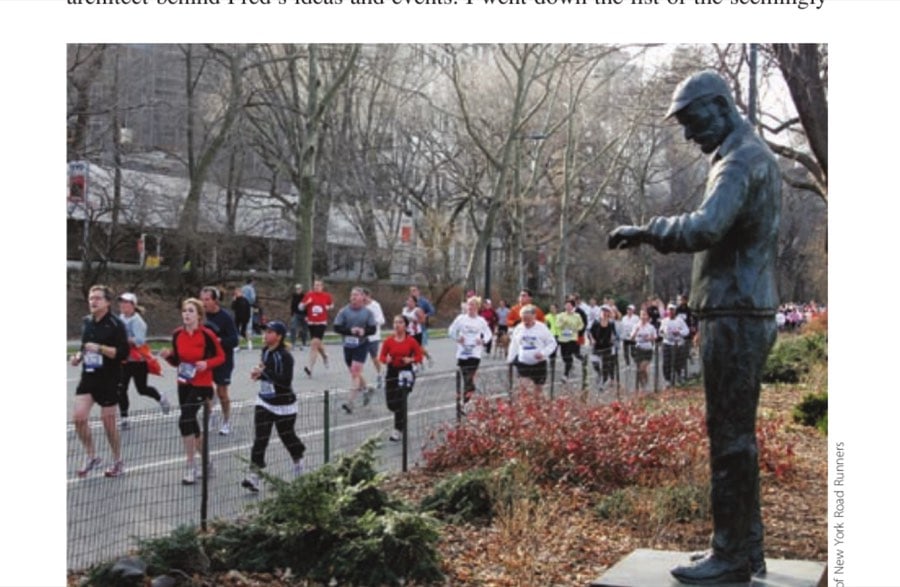
▲ Fred Lebow (his statue, that is) watches over the thousands of finishers in the New York City Marathon as he had done in the flesh for countless marathons before.
crazy things that Fred had thought up and that I had helped bring to fruition: the World Cross-Country Championships, Fred’s follies like the Six-Day Run (which was shown nightly on Ted Koppel’s ABC network show “Nightline”; so much for it being a folly), the World Racewalking Championships, the Fifth Avenue Mile, the New York Games, and on and on and on. Those were exciting and enervating projects. I was part of a unique two-man team: Fred was the producer and I was the director. And now the producer was gone, and the world seemed bleak and hollow.
Most members of our board voiced their support of my moving into the leadership role, but not all agreed. Some thought that name recognition was more important than track record. As Wednesday approached and with it the memorial service, I became extremely anxious. This would be our final farewell to Fred. We didn’t even know if anyone would take the time to show up for his memorial service in the park. We had planned to have four speakers on the platform at the finish line. The mayor would speak first, then the rabbi who had been so close to Fred’s family, then Grete, and finally I would close things out.
On Tuesday night, Alice and I discussed what was to come the next day. I was attempting to come up with something to say that would be pertinent and of a logical length. There was so much I could say about Fred that I could have gone on for hours, but I wanted to hone it to something appropriate—something short enough that it would have held Fred’s attention. I’m used to speaking at events, functions, and all sorts of gatherings without relying on notes. But Alice suggested that for this function, I should write down exactly what I would say since I would probably be crying my eyes out. As is often the case, Alice was perfectly in sync with circumstances. I followed her advice and it is a good thing I did, because her prediction was right on point.
Fred’s memorial On Wednesday morning we made our way down West Park Drive and 67th Street, to the marathon finish line. And I was shocked! It was estimated that there were some 3,000 people there that day, some sporting running clothes, others wearing suits, and some dressed casually. I knew a fair number of them: some runners, some captains of industry, some friends. What floored me was the number of press people who showed up. TV stations from around the world that have offices in New York City were there; many print reporters whom I knew from the marathon—and some with whom I was not familiar—were there. It was as though this was the marathon finish line on marathon day.
It came time for the four of us to speak. Mayor Giuliani led off, then the rabbi, then Grete, and then it was my turn. I began speaking and crying at the same time,
something that is not easy to pull off. My tears threatened to turn my carefully prepared notes into a Rorschach test. As I neared the end of my little speech, I asked everyone to join hands and walk over Fred’s beloved marathon finish line. One of Fred’s driving philosophies about race directing was to never underestimate the power of a T-shirt. Before the crowd finally reached the finish line, I said that this was one event where there was no T-shirt. It brought a little chuckle from the crowd. The four of us came off the stage and walked, with heads bowed, to the front of the crowd with Grete on one side of me and the mayor on the other.
As soon as the ceremony was over, I was besieged as never before by the press. There were notebooks being scribbled in, TV cameras pushed into my face—it was close to madness. I thought with a little smile that Fred would have been thrilled with the press coverage!
It is no secret that I decided to take the reins of the organization and the marathon. I knew it would be what Fred would have wanted and I always did what Fred wanted—even if it was after a knock-down, drag-out fight over it. Those who had doubted my ability to get the job done gradually changed their minds. I’m sure I was always looked at like Truman to FDR. But in this instance I had an advantage Harry Truman never had: Fred was certainly dead, but he just as certainly was not gone. And as far as I’m concerned, he steps forward each year as the cannon on Staten Island fires to once again start his marathon.
This article originally appeared in Marathon & Beyond, Vol. 15, No. 3 (2011).
← Browse the full M&B ArchiveMore like this
1,000+ stories from 19 years of Marathon & Beyond
The complete archive of the legendary long-distance journal — digitized and free to read.
