

From Arusha To Fort Sill Via Boston
Iknew we were in trouble when the fierce rumbling sound of wind kept us awake all night before the 2007 Boston Marathon. Whispering over to my African son, Beatus, who lay awake in the bed next to mine, I said, “Can’t sleep. Can you?” “
No, Baba.” (Swahili for father.) “Doesn’t sound too good,” I added. “No, Baba.” I first met Beatus Mushi nearly four years earlier in Arusha, Tanzania, while there to climb Mount Kilimanjaro and run the Mount Meru Marathon. (See “What, No Porta-Potties?” Marathon & Beyond, November/December 2007.) I saw him standing by the sidelines at Arusha Stadium, where the marathon ended. He approached me and asked in excellent English what I thought of the race. Beatus explained that he was always interested in running but didn’t know very much about how to train for running long distances. Basically, he wanted to learn more and do what it would take to complete a marathon.
As our conversation continued, I learned that Beatus had dropped out of high school to work and support his family after his father’s death. But he always remembered his father’s words to him about the importance of education. So he walked the countryside, looking hard and wide, until he eventually found a Roman Catholic school that would let him enroll as a student in exchange for cooking and washing dishes, scrubbing floors, and cleaning the priests’ robes.
I was intrigued by this very likable, soft-spoken young man. When I learned that he did well enough not only to graduate but also to serve as class president, I immediately thought about how he was the kind of student I would like to have at Chapman University in Orange, California, where I serve as president. We said our good-byes, but not before exchanging e-mail addresses.
© Ann Cameron
Thirteen months, hundreds of e-mails, and countless hours of bureaucratic hassling later, I drove to Los Angeles International Airport to bring Beatus to his new home and life as a freshman business and economics major at Chapman University. As we drove from the airport to campus, Beatus filled me in on his trip. He recalled his first escalator ride at Nairobi’s airport in a tone reminiscent of someone describing a scary horror flick, “I watched and studied it very carefully before I got on that machine.”
He sat quietly for a time, studying the passing landscape. Suddenly, he broke the silence by slowly and thoughtfully stating, “Remarkable infrastructure.” I had never heard a California freeway referred to in such a, well, unusual way. Even more surprising to me was when we passed a sign advertising Disneyland and he asked, “Baba, what is Disneyland?”
No question, Beatus was in for quite a culture shock. But Beatus quickly found a large circle of friends who helped him over many of the hurdles he faced. Still, they didn’t always recognize that things they took for granted were unfamiliar to him. For example, it was several weeks into the semester when Beatus told me in a way that suggested he had just solved a great mystery, “I now know why the water coming out of the shower is sometimes hot and sometimes cold.”
All in all, Beatus adapted quite well. He worked hard and earned good grades, and he became a highly regarded and popular friend to his fellow students, as well as a close and loving member of my family.
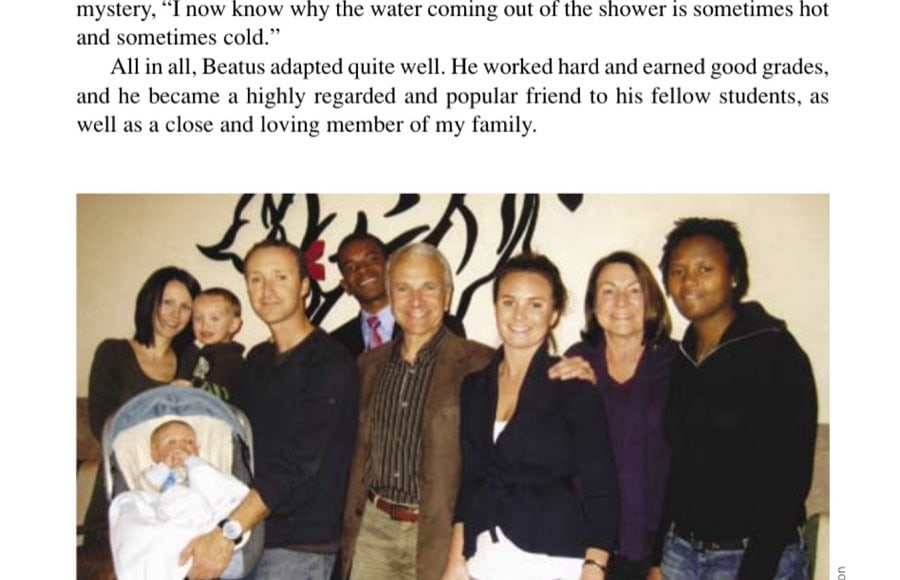
▲ The Doti clan, with Beatus in the background, between me and my other son, Adam.
In addition to his course work, Beatus held down a half-time job on campus. His first Christmas at Chapman, he sent his mother $700 he had saved so that she could have running water piped to the two-room, cardboard-roofed home where she and his six siblings still lived. He continued to live modestly and save as much as he could to assure that his brothers and sisters would have a good education.
But despite all that had happened since our first meeting in Tanzania, Beatus had never forgotten his dream of running a marathon. So it wasn’t long before we started running together. We were only about a mile into our first run when Beatus asked with a cringe on his face, “Baba, what’s this pain I have in my side?” I doubt that my admonition to him that this was the first of many aches and pains he would endure as a runner was of much comfort.
Given my hectic schedule, Beatus had to run on his own most of the time. Since he was terribly fearful of getting lost, he identified a quarter-mile square adjacent to the campus that he ran round and round and round . . . even for his 20-miler.
Beatus ran his first 26.2 miles in pounding rain at the inaugural OC Marathon on December 5, 2004, with a finishing time of 3:40:54. (Yes, it does rain in Southern California.) He remained determined to excel and push the envelope, so it wasn’t long before he started asking me about Boston and qualifying times. For him, it was a time of 3:10.
Eager to meet that goal as soon as possible, Beatus ran the Surf City Marathon in February 2005 and followed it up with the Long Beach Marathon in October. Frustrated that he still wasn’t able to make his qualifying time, he came to me for advice. “Baba, what should I do to get to Boston?”
I knew the answer. “Beatus,” I said, “You’ll have to do what I did. Hal Higdon’s novice plan gets you to the finish line. But to get to Boston, you have to move up to the advanced plan. If you’re able to keep up with that kind of rigorous training, I know you’ll qualify for Boston.” “
Ah, I see,” he responded. “It’s the five p’s.” “The five p’s?” I asked. “Yes, Baba, my father often told me, ‘Preliminary preparation prevents poor performance.’” “That’s right, Beatus,” I said. “It’s all about the five p’s.”
So Beatus conscientiously followed Hal Higdon’s advanced training program, and in December 2005 we headed to the California International Marathon in Sacramento, both of us with our sights set on qualifying for Boston. I’ll never forget the moment I crossed the finish line at the steps to the state capitol building and saw Beatus there cheering me on. After hugging me, he told me he hadn’t qualified. Then, seeing the utter disappointment on my face, he smiled broadly and shouted, “I did make it, Baba! I ran it in 3 hours, 3 minutes.” We jumped together, high-fiving each other ecstatically. We were going to Boston!
© Ann Cameron
Now that we were here, our worries turned to the possibility that the Boston Marathon would be canceled. While that had never happened in the 110-year history of the race, this might be the year. A nor’easter was forecast to hit Boston on Patriots’ Day—the traditional
day for the running of the Boston Marathon. The storm would start at night and pelt the entire northeastern seaboard with heavy rain and maybe even snow. As if that weren’t enough, hurricane-force winds would blow from the northeast,
directly against the runners who would start in Hopkinton, a town lying 26.2 miles southwest of Boston. On Sunday, the day before the race, the weather was already miserable. We had box seat tickets for the Red Sox-Angels baseball game, where I would at last
fulfill my lifelong dream of seeing the Green Monster, the fearsome 37-foot leftfield wall of venerable Fenway Park. Given the rain, cold, and wind, however, it was not a surprise when the game was canceled.
Although our hearts were set on going to the game and we were disappointed, our greater concern was about the race. All reports called for a steady worsening of the storm, increasing the likelihood that the marathon would be canceled.
The sound of our alarm at 5:00 Monday morning wasn’t needed to wake us. We had been awake pretty much all night. I tried to peer out through the rain that pelted our window and saw large trees downed during the night.
We turned on the Weather Channel and found severe-weather alerts peppering the screen. The nor’easter would hit hard until noon. But, thankfully, there were no reports of cancellation of the race. I bundled up with several layers of clothing. A supposedly waterproof jacket
and pants protected the two layers of thermals that covered my body. On top of it all, I wore a full-body vinyl poncho. I had even wrapped my feet with plastic bags to keep my shoes dry, at least until the race started.
We ran through the wind and downpour to our waiting cab, which would take us downtown to board one of the buses that would transport the 20,000-plus runners to Hopkinton. Along the way,
▲
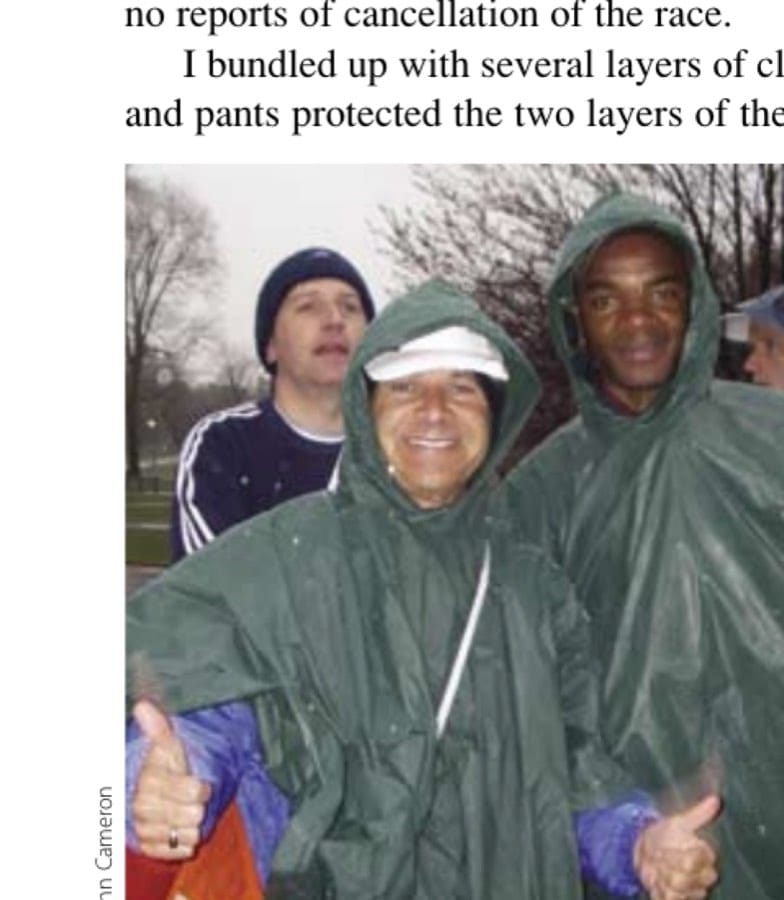
Waiting for the bus to Hopkinton in our full-body ponchos.
© Ann Cameron
our driver swerved around the sheets of aluminum siding and tree branches that clogged the streets. The wind was still steady at about 15 to 20 mph, but the 50 mph gusts had died down. While still raining when we jumped off the bus in Hopkinton, it was not coming down in the buckets of water that had earlier lashed our faces. Maybe, just maybe, our luck would hold out.
As we waited our turn for a porta-potty, I looked at the thousands of runners in line. It was reminiscent of photographs I’ve seen of German soldiers being led out of Stalingrad after their disastrous defeat. But once the race started, we pulled the plastic bags from around our shoes and threw off the rain ponchos. We actually began to look like runners again as we took our first strides toward Boston. It was still windy, with big gusts, but the sky cleared a little and the rain slowed to a drizzle. Even better, the temperature was near 50—well above the predicted 35 degrees.
Funny thing about running. Once you get started, you begin to ignore weather and listen to what your body is saying to you. Mine was telling me it was too hot and I should start taking off some clothes. So gradually, off came the various layers. Some I left on the wayside; some I tied around me. I tossed a pair of wind pants and later realized I had left my driver’s license and credit card in a zippered
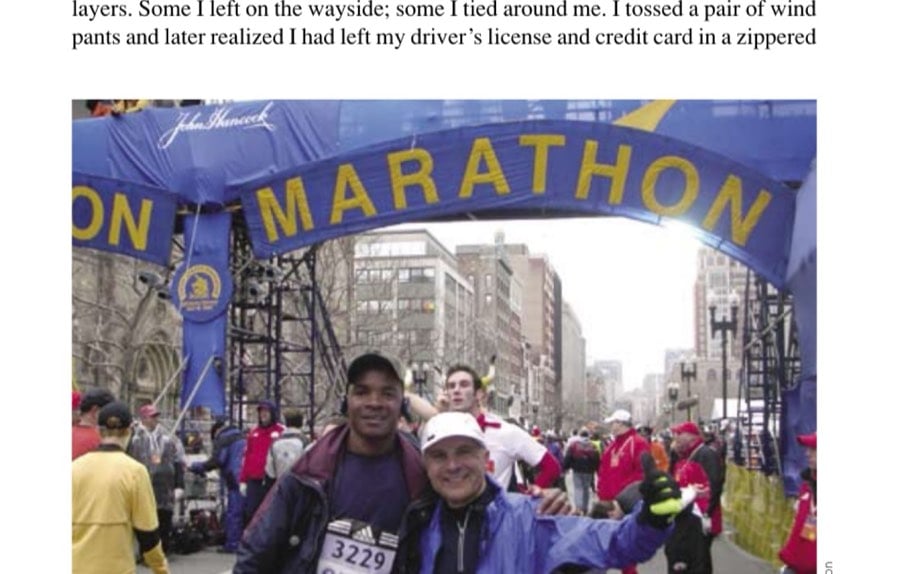
▲ Father and son, triumphant at the finish line.
▲
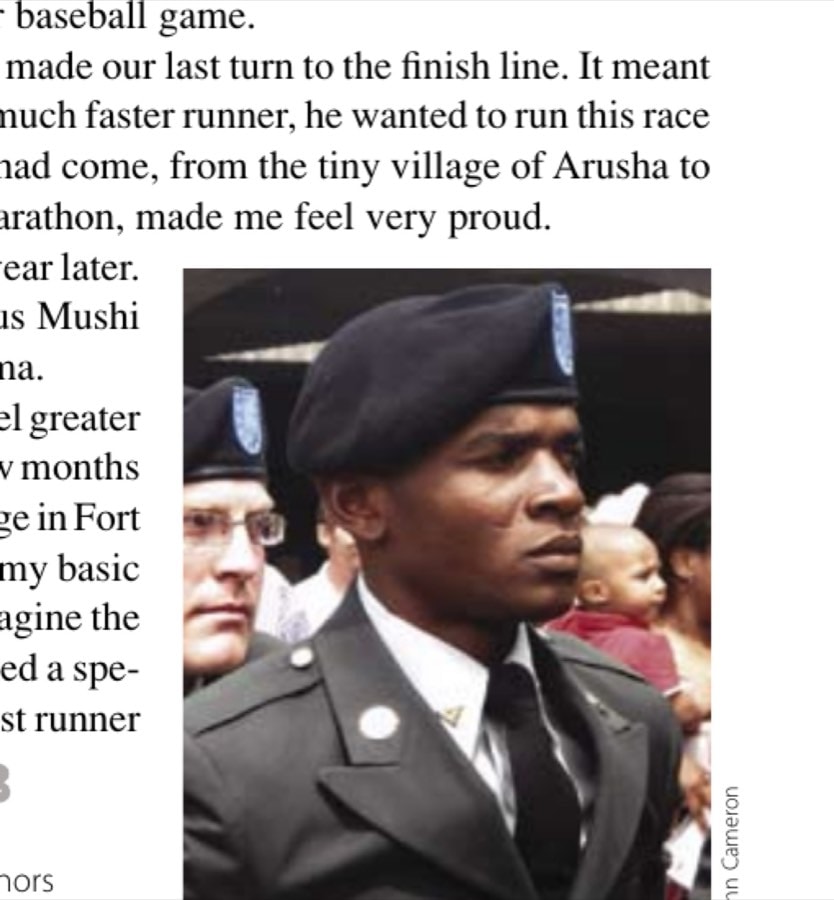
Beatus Mushi becomes a U.S. Army honors graduate.
© Ann Cameron
back pocket. We had to run back about two miles to retrieve them. Thankfully, they were still there. But the trip added to our time, since it made our marathon 30.2 instead of 26.2 miles. By then, however, we weren’t worried about our time. The weather had improved enough that we actually began enjoying the race. Now that I was running lighter, I no longer felt like Ralphie’s littler brother Randy in the classic movie A Christmas Story, when his mother bundled him up with so many winter clothes that he couldn’t walk.
Compared with the Boston Marathon I had run two years before, the crowds, though thinner, seemed more boisterous. Perhaps it was the imbibing they did to keep warm. One moment I will never forget is arriving at an aid station just as a big gust of wind hit it. All at once, thousands of used paper cups filled the air. I’ve run through rain, sleet, snow, and even hail, but never a sea of cups.
When we hit the 12-mile mark, we could hear the famous Wellesley women screaming a mile away. As we approached Heartbreak Hill at mile 20.5, Beatus and I were feeling so good that we gave it everything we had and ran all out to the top.
Reaching mile 23, we saw the distant CITGO sign beaconing the finish line. We knew we had nailed it. We had survived the nor’easter. At mile 25, under the CITGO sign, I looked to the right and saw it looming like a large green monster—Fenway Park. Gazing at it at that point in the race, I realized that seeing it at mile 25 of the Boston Marathon was more special than being inside the stadium at a regular baseball game.
Beatus and I were together as we made our last turn to the finish line. It meant so much to me that, although he is a much faster runner, he wanted to run this race with his baba. Knowing how far he had come, from the tiny village of Arusha to a triumphant finish at the Boston Marathon, made me feel very proud.
I felt even more pride about one year later. It was the day that I presented Beatus Mushi with his Chapman University diploma. But I don’t think it’s possible to feel greater pride in my African son than just a few months ago, when Beatus walked across a stage in Fort Sill, Oklahoma, to become a U.S. Army basic combat training honors graduate. Imagine the glow on my face when Beatus received a special medal for being the second-fastest runner in his company of 250 soldiers.
This article originally appeared in Marathon & Beyond, Vol. 15, No. 2 (2011).
← Browse the full M&B ArchiveMore like this
1,000+ stories from 19 years of Marathon & Beyond
The complete archive of the legendary long-distance journal — digitized and free to read.
