

From Kidnappingto Kona
Jose Ramirez had never thought about qualifying for a coveted slot at the Hawaii Ironman World Championships, but it happened at Ironman Cozumel on December 1, 2013. His second-place finish in the male 70-74 age division secured him a spot when the first-place male in his age division didn’t want it. The Kona slot would roll down to him as long as he showed up at the awards ceremony the following day to claim it. With fewer than 2 percent of triathletes ever qualifying for the annual event in Kailua Kona, Hawaii, it was an opportunity that most of them only dream of.
The problem was, he couldn’t make it to the awards ceremony: he had been kidnapped. Jose Ramirez moved from his native Puerto Rico as a teen and in 1968 joined the New York City Police Department as a patrolman in Fort Apache, South Bronx. When the department needed Spanish-speaking police officers, he went to the Intelligence Division a year and a half later and then to the Organized Crime Control Bureau (as it was called then) until he retired in 1988. He had run marathons but didn’t compete in triathlons until after he retired. “
I was in Puerto Rico riding a broken-down old bicycle when I saw a friend and started talking to him,” Ramirez said. “He told me I should try this event called a triathlon that he was doing. “I couldn’t even swim at the time,” he said with a laugh. “But I signed up anyway. When the swim started, I tried dog paddling but wasn’t getting anywhere. So I grabbed the buoy line and pulled myself along. After the race my friend asked me if I saw that guy who was cheating in the swim! I said no, but years later when I could swim, I saw him [my friend] again and admitted to him that it was me.”
Ramirez spent 10 more years competing in triathlons of varying distances and tried his first full-distance Ironman in 1999. Ironman Cozumel was his fourth race of that distance, a 2.4-mile swim, 112-mile bike ride, and 26.2-mile run. It had been a tough race, with pounding head winds on the bike and so much rain on the run that athletes had to run through ankle-deep water on much of the course.
▲
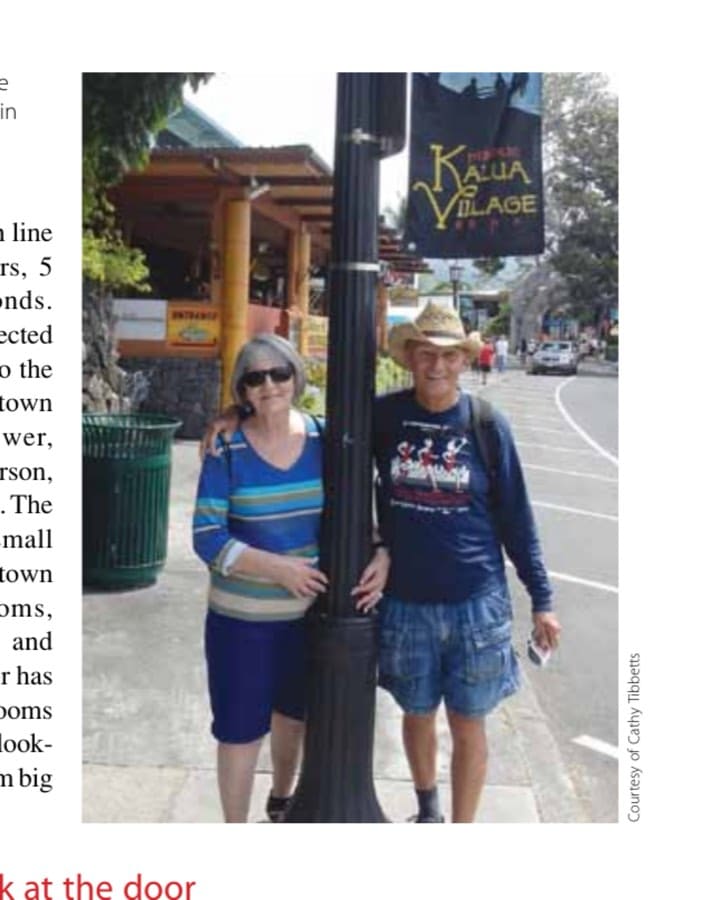
Jose Ramirez and his wife before the Hawaii Ironman in downtown Kailua Kona.
Courtesy of Cathy Tibbetts
He crossed the finish line in Cozumel in 16 hours, 5 minutes, and 42 seconds. Afterward, Ramirez collected his gear, trudged back to the Flamingo Hotel in downtown Cozumel, took a shower, called his wife in Henderson, Nevada, and went to bed. The Flamingo Hotel is a small boutique hotel in downtown Cozumel with 20 rooms, a small bar/restaurant, and friendly staff (this author has stayed there). All of the rooms were taken by triathletes looking for lodging away from big all-inclusive resorts.
That fateful knock at the door Sometime after he went to bed, Ramirez heard noise outside of his door, thought it was triathletes coming in from the race, and went back to sleep. Then the phone in his room rang. A Spanish-speaking male said, “We’re from the Zetas [a Mexican drug cartel], and if you don’t do what we say, we will come over, knock the door down, plant narcotics in your room, [and] you’ll spend the rest of your life rotting in a Mexican jail.”
The caller went on to tell him the gang knew where his wife was and that he needed to leave the hotel, go to a local all-night convenience store called Oxo, and buy a local cell phone where the gang could call him—and that the gang would be watching. “
At that point I thought the noise outside of my room had been them,” Ramirez said. “I looked out of my third-floor window, and there was no way to escape. Fearing for my life, I did what they said. “I went to the store to buy the phone. A local police car pulled up and blocked the road. A white woman was standing outside of the store looking in, making sure I saw she was there.
▲
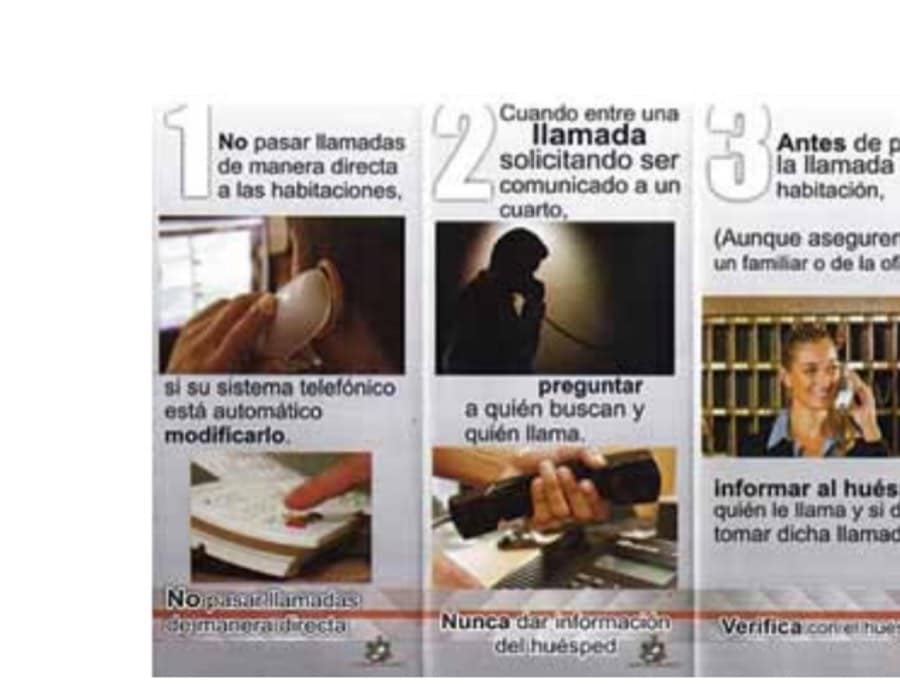
A pamphlet distributed to Cozumel hotels explaining how to screen phone calls in order to keep guests safe.
Translation: Panel 1: Do not put direct calls straight through to the room; if your telephone system is automatic, change it. Do not put direct calls through. Panel 2. When a call comes in asking to be connected to a room, ask who the caller is looking for and who is calling. Never give out information about the guest. Panel 3. Before connecting a call to a room (even if the caller assures you he/she is a relative or calling from the office), inform the guest who is calling and ask if he/she wants to take said call. Verify with the guest.
“I called them, and they told me to go to another hotel, which I did,” Ramirez said. “They told me to get a room, don’t talk to the attendant, turn on the television, and keep the phone on my chest. They kept calling me every 10 minutes and also called my wife. They told her if she didn’t send them a million dollars they’d break my legs and kill me. “
On Monday morning, they instructed me to go to a bank and take out $10,000. They said they had people in the bank. The bank would only let me draw 10,000 pesos on my credit card (about $700), but I got that and then deposited it toward several different cell-phone numbers at the cell-phone store. “
Then they had me go to another small motel. I was thinking about running to one of the cruise ships and getting on board. Then the captain would be in control. The whole time I was trying to figure out how I could save myself.”
Back in Henderson, Nevada, the kidnappers called Mrs. Ramirez, who doesn’t speak Spanish. They found a translator and wanted the phone numbers of his son, daughter-in-law, and a cousin in Puerto Rico. They demanded a million-dollar ransom from Mrs. Ramirez and said they would break her husband’s legs and kill him. Mrs. Ramirez called the Henderson Police Department, which sent officers to her home. After the next phone call, the FBI was called in.
According to Special Agent Jae Beasley, the FBI has seen an increase in this type of kidnapping. It’s known as a “virtual kidnapping,” and the kidnappers are never actually there. Fear is created in a different manner. “You don’t know if they are really there or not,” Special Agent Beasley said. “
We don’t know why they picked Mr. Ramirez,” Beasley said, “maybe because he spoke Spanish, maybe because he was traveling alone, maybe because he was older. The fact [is] that from his prior police experience, he knew who the Zetas were; he had an understandable fear of them. “
The FBI has legal attaches around the world that we contact in these situations,” Beasley said. “They know how things work in their countries. On our end, we all have certain areas that we specialize in to help the families.”
Special Agent Beasley would not go into further detail. “As much as we want the public to be aware of virtual kidnappings, we can’t give answers that could compromise our operational techniques.”
From the Flamingo’s perspective Hotels in Mexico take the safety of their guests seriously. A Flamingo Hotel employee who requests anonymity said via e-mail: “After the kidnapping, everything was quiet for a bit. Local authorities and media didn’t want to mention this because it was kind of first of its kind, at least the first time I knew about it. Tourism people came to the hotel and talked to the manager, who later talked to the whole staff about the prevention of this situation, which was basically: hang up the phone as soon as the caller can’t answer the simple question of what’s the full name of the guest. Actually, these calls are common in the whole country, but it’s easy to determine which ones are fake calls. Unfortunately, the night guard was not very familiar with this situation, but now he is fully aware of this danger. Tourism secretary and police talked to all the hotel’s management, and they discussed the issues privately with the staff. I personally thought that it was kind of fool[ish] of the guest to get out of the room, but fear is an important fact. Also, you know for sure that these organizations are just a bunch of little rats, they’re not Zetas. Zetas don’t do that stuff. But I also knew it was an error and that the hotel staff should have been prepared for things like that.”
According to Mr. Ramirez, Mexican authorities got a picture of him and went from hotel to hotel until they found him in the middle of the day on December 3. “Two Mexican agents knocked on my door when I was on the phone with the kidnappers,” Ramirez said. “I thought they were there to beat me up and I cracked the door. When I saw the attendant was there with them, I thought I was OK but still didn’t believe them. They put me on the phone with another agent in Cancun, so I asked what my shield number was from my police days and they had it. Then I left with them but kept looking back.
“After the local police finished interviewing me, they took me to a beautiful hotel where an agent stayed with me that night, and two policemen guarded outside. At breakfast the next morning, one policeman had a machine gun, and I just kept eating and eating.”
Back to the Kona slot The World Triathlon Corporation (which owns Ironman events) had no idea that any of this had happened. Another athlete was awarded Ramirez’s roll-down slot at Cozumel. Six months later, Mrs. Ramirez contacted the World Triathlon Corporation. “
It was a truly unbelievable story,” said April Dickerson, manager of athlete services for World Triathlon Corp via e-mail. “His wife, Yetta, approached our team after slot allocation and roll down at the 2014 Memorial Hermann Ironman Texas, after he did not receive a roll-down slot, and informed us of the situation in Ironman Cozumel. We then extended a slot to the Ironman World Championships due to the extremely extenuating circumstances.” Mrs. Ramirez remains traumatized and declined an interview.
Finally at Kona In October 2014, Jose Ramirez finally lined up with the world’s best 2,178 triathletes in the crystal-blue waters of Kailua Bay. In terms of ocean currents and extreme winds on the bike, it was to be one of the most difficult years in the history of the Hawaii Ironman. And the strap on his goggles broke at the start of the swim. “
It cost me over 20 minutes fixing them so they would at least stay on and continually emptying the water out of them as I swam. I made the swim cutoff, but the winds were unbelievable on the bike. I had never been in that kind of wind before. I didn’t make the bike cutoff after losing so much time on the swim, and my race was over before I ever started the run. “
The volunteer in the bike transition felt terrible when he gave me the bad news, but I told him not to worry, it wasn’t his fault. My wife and I had a great time in Hawaii, and I’ll qualify again—just not in Mexico.” “
Virtual kidnappings are on our radar screen now because people are attempting it more,” Special Agent Beasley said. “The easiest way for the FBI to combat virtual kidnapping is to have it not happen.”
Information on how to avoid becoming a victim of a virtual kidnapping can be found on the FBI website at: http://www.fbi.gov/news/stories/2014/november/ virtual-kidnapping/avoid-becoming-a-victim-of-virtual-kidnapping
This article originally appeared in Marathon & Beyond, Vol. 19, No. 6 (2015).
← Browse the full M&B Archive1,000+ stories from 19 years of Marathon & Beyond
The complete archive of the legendary long-distance journal — digitized and free to read.
