

From Mothballs To Marathon
Rational people make major commitments only after long and serious consideration. But since rationality has never been my strong suit, my decision to run a marathon was prompted by sheer impulse. Not that I hadn’t ever run a marathon. I had—two of them, in fact. But I had trained hard for them, putting in two months of 65-mile weeks for each. But that was 30 years and 30 pounds ago, when I was at the top of my running game.
Now, even though I still run, sort of, when it comes to marathons, I am clearly overweight, undertrained, and way over the hill. But marathons weren’t the least bit on my mind when I was in Fort Myers, Florida, back in mid-May. Instead, I was visiting my family, catching the rays, and chilling—if that’s possible in 90-degree weather.
Anyway, I was in one of those super bookstores, the ones with the built-in chichi coffee shops, when I happened to spot an odd little magazine called Marathon & Beyond. Huh? What’s this? I wondered as I skimmed it. It was a running magazine, certainly, but unlike any I had ever seen. It wasn’t slick or chock-full of advertisements, nor did it feature some new diet guaranteed to take hours off my half-marathon times, vitamins that would add years to my life, and the rest of the mumbo jumbo.
Also, the articles were long, in depth, sometimes even controversial. It seemed the magazine actually wanted to appeal to people who had some substance and who really liked to read.
ARTHUR SPEAKS TO ME—AGAIN I bought a copy, took it to my table, and leafed through it while swilling my coffee. Suddenly, my heart skipped a beat when I ran across an interview with Arthur Lydiard. Arthur Lydiard had been one of my first inspirations to run a marathon
way back when, in running’s Dark Ages (if not its Stone Age). His book Running to the Top had been like a bible to me. And now here he was, all these years later, still as feisty, outspoken, opinionated, and knowledgeable as ever. And he was still something else, too: just as inspiring as ever. After I read his interview, it hit me: I was going to come out of retirement and run a marathon!
The next day I hied down to Mike Pemberton’s shop, Fast Feet, a running store run by a runner, catering exclusively to runners. And while my description is overdone, his shop is not. It’s small but with an excellent array of gear, and with none of the schlock. So if you live in Fort Myers or are ever there, stop in and give him your business. When it comes to running stores, he’s a one-man army fighting the multinationals.
After buying a pair of running shoes, I indulged myself and bought a pair of real running shorts. My last running shorts were Frank Shorter sportswear that finally fell to shreds sometime in the late ’80s, after at least 10 years of daily wear. After I gave them an honorable burial, I ran in whatever shorts I found lying on the bedroom or bathroom floor, among them soccer shorts, gym shorts, Bermuda shorts, and boxer shorts.
But now that I was going to run a marathon—no matter how slowly, shakily, or sloppily—I was going to run it in genuine marathoner’s shorts. And once that was settled, I considered things of less importance, namely, which marathon from the plethora of marathons available these days, and what training schedule I would follow.
Actually, only one marathon came to mind: the Raquette River Marathon in Potsdam, New York, which would be run on September 5. It would be ideal for me, since it’s about 60 miles away, is run on back roads, and has no entrance requirements other than coughing up some filthy lucre. And most important, the organizers keep it open until the last person struggles in. As I said, it was my kind of marathon.
As for training? As I saw it, no matter what kind of training I did, it would be marginal at best. In my current condition, in 3 1/2 months, I would never amass enough mileage for any kind of serious running. Instead, the best I could hope for was to finish in six hours or so.
I REMEMBER THE IMPORTANCE OF THE LONG RUN I decided on a schedule built around one long run a week, building up to a 20miler three weeks before the race. On the other days, I would just listen to my body and do the best I could. My main concern was not pushing so hard I would get injured. When it came to fear of injuries, there was a big split between my friends and me.
SURVIVING THE LONG RUN—BARELY I did it, but it was a real drag. Basically, my breathing was fine, but nothing else was. It took me four and one-half hours, slower than I expected, and I felt like hell the whole time. Plus, the next day my legs were sore and ached all over, something that hadn’t happened until then.
I was still sore for the next several days, and it became apparent I was in no shape to run 20 miles the next week. And if I was crazy enough to try, and lucky enough to finish, I knew I would never recover by race day.
So now I had to confront the essential question: Was I going to continue my training, in some fashion or other, and plan to run the marathon? Or was I going to scrap all my plans and say to hell with it?
I mulled over it for several days. Finally, after a bunch of agonizing, I decided to give up. At this point, I didn’t enjoy the long runs and couldn’t see the sense of having three more weeks of unenjoyable running, and risking injury besides. Of course I was disappointed—with myself more than anything—but I finally accepted my decision and was at peace with it.
Then, three days later, after I had achieved a state of philosophic acceptance that would make the Dalai Lama turn green with envy, what appeared in my mailbox but a letter from Richard Benyo, editor of Marathon & Beyond.
Sweet Lord in heaven! I had forgotten all about the proposal I had sent in 10 weeks before. I opened the letter, quickly looking for key words of rejection like “sorry,” “regret,” “unfortunately,” and the like. But I didn’t see them.
Then I reread the letter, looking to see what euphemisms had been used to conceal the rejection, but I couldn’t find them, either. Finally, after reading it twice, I realized it was actually an acceptance letter. Furthermore, Rich said he was interested in my attempt “no matter how ugly.” Enclosed was my contract, stipulating terms of submission and payment.
There were two copies of the contract, one to return to him, the other—in Rich’s exact words—to put under my mattress. Not only was I delighted to have my proposal accepted, but I was flattered that he had taken time to find out where I store my important documents.
So how could I possibly give up, now that I would be published in an international magazine and would be a professional runner? The answer, of course, was that I couldn’t.
A DECISION MADE, SOME RESOLVE GENERATED And with that, the pressure was off. With three weeks to go, no miraculous transformation with my fitness would take place. So my training plan was simple. No more long runs but as many short ones as I could do, along with hiking, biking, and stretching as I saw fit. In essence, I wanted to maintain the fitness I had, to keep building my endurance, and to take no chance of strain or sprain of any sort.
And then, before I knew it, I was at the starting line of the Raquette River Marathon. I stood in the back of the pack, and even though several of my friends from home were running the marathon or the half, I wasn’t speaking to them, or to anyone else. I figured once the race started, I would be by myself until the bitter end, so there was no need to turn into a social butterfly for a mere five minutes or so.
Plus, something was bugging me: the broccoli and green pepper pizza I had eaten the night before. It had been sheer delight at the time, but now it felt like a
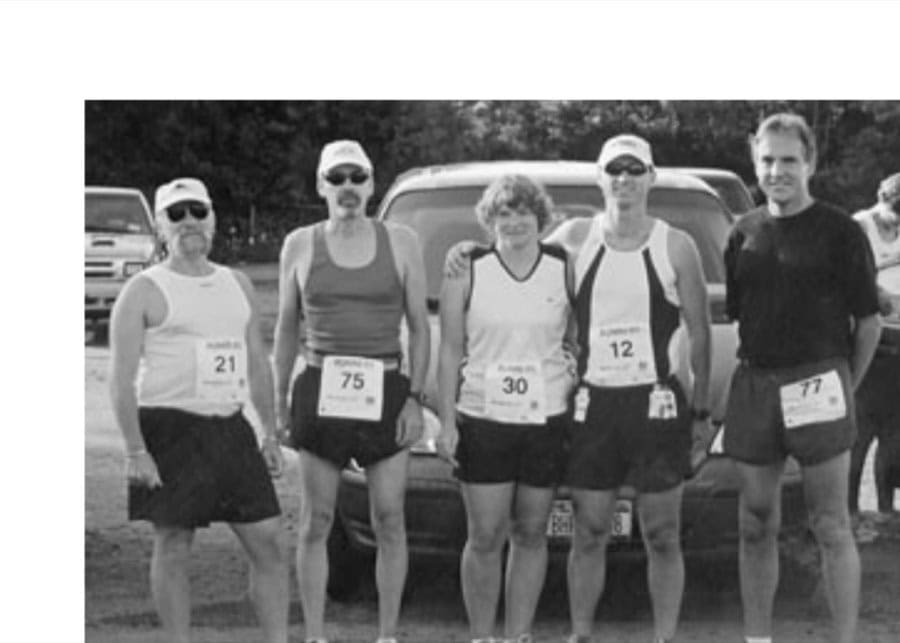
Courtesy of Becky Sutter
▲ Here I am (far left) at the start with most of the hometown crew (left to right): Phil Gallo, Lynda Peer, Bill Peer, Henry Voelkman. Bill and I ran the marathon; the others ran the half.
shot put that was lodged in my colon. When the race director went into his spiel, I listened only to hear where the first porta-potty was. When he said it was at the six-mile station, it gave me my first short-term goal of the race.
The weather was ideal for me, around 75. I like to run in the heat; it’s the cold I dread. A fast runner might be wary of heatstroke, but I can’t generate that much energy, plus I’m scrupulous about rehydrating.
The cold, however, is my enemy. Running in it for six-plus hours, especially if there was wind and rain, would be impossible for me. The gun was fired, and everyone was off with the usual high spirits and jocularity—everyone but me, that is. I did what I was going to do the whole time—pick ’em up, put ’em down, and keep putting one foot in front of the other.
I had only two goals, aside from getting to the porta-potty. One was to finish; the other was to run the whole way. In reality, I figured if I ran and walked the marathon, I would do it faster than if I only ran. But this was a matter of pride, not time. Aside from finishing, I cared only about running nonstop.
After two miles, I never saw another runner, which was fine with me. I thought of that Allan Sillitoe book, The Loneliness of the Long Distance Runner—not that I recalled anything from the book itself, it was just the title that held my interest. “
Loneliness” has an interesting etymology. It’s related to the word “alone,” and they’re both derived from “all one”—which pretty much is my running credo. At various times I’ve felt very lonely, but never while running.
AND HOW ABOUT THAT “ALL ONE”? As for “all one”? That, I do feel. It’s why I love running and why the marathon was so important to me. The way I run now, there is no skill or luck involved. It’s just a matter of pushing myself past the limits I think I have, of forcing myself to continue when I want to quit, of enduring. The first six miles went well, fermenting pizza and all. But after I made a pit stop at mile six, I got back on the road with a light heart (and lightened digestive system) and all but cakewalked my way to eight miles.
There, my best friend, Becky Sutter, the Amazon Queen, caught up with me on her bike. “How ya doin’?” she asks. “Great,” I say. And I was. My breathing was fine and my legs felt good. “OK,” she says. “I’m gonna catch up with the others and I’ll find you later.” “
Fine,” I say, having no idea just how much later that would be. From eight to 11 miles, everything went well. But then, precipitously and for no reason I could figure out, it all changed. Suddenly, everything hurt. It wasn’t localized pain, so I knew I wasn’t injured. But it was pain nonetheless.
Oddly, the worst pain of the whole marathon was from miles 11 to 14. At 14, it lessened, at least somewhat, and then I had my work cut out for me. There are, of course, no secrets to enduring pain—at least none I know. It’s completely individualistic, which perhaps is part of the pride of being an endurance athlete. As in, “Yeah, it hurt like hell the whole time, but I outlasted it. So there!” It’s not something I would ever say aloud, but I’ll admit it’s something I think to myself.
In fact, there are times when I even brag to myself about it. And while I know bragging has a negative connotation, I think of that Dizzy Dean quote: “It ain’t bragging if you can back it up.” But that’s after the run, after you’ve backed it up. During the run, there’s no room for bragging at all.
At 16 miles, I recall something Frank Shorter said about marathons—something like, “First you worry about finishing, then you worry about time and place.”
HOW TO MANGLE SHORTER’S QUOTE I apply it to myself. After running 16 miles, running 10 more seems an impossible chore. I rephrase Shorter’s quote: “First I worry about finishing. Then I worry some more about finishing. And finally, I keep worrying about finishing.” Occasionally a car goes by. When one passes me headed back to Potsdam, I’m struck by one thought: I could hitch a ride to the 25-mile mark and then jog in. No one would be the wiser. I would be a Rosie Ruiz in reverse, sneaking a ride to come in last.
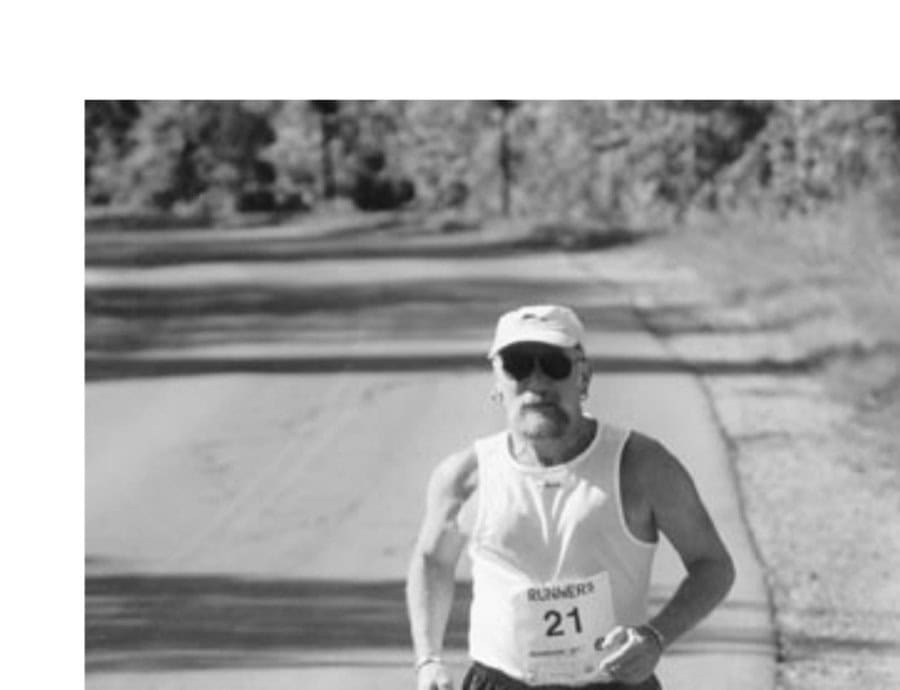
Courtesy of Becky Sutter
▲ At the 8-mile mark . . . still on cruisin’.
On and off, I think about the Amazon Queen. She said she was coming back, but she hasn’t. The nerve! I imagine her back in Potsdam, hanging out with the finishers, sipping an ice-cold Evian and sharing in everyone’s delight. Meanwhile I’m stumbling around hell’s half acre, unloved, unacknowledged, perhaps even unremembered. I plan my speech when I finally meet up with her. You can bet it won’t be pretty. Probably the nicest thing I’ll say is that I never want to see her fine freckled face again, which would be pretty presumptuous of me, since she is my ride home.
Suddenly, at 18 miles, she appears on the horizon and rides up. Instantly, I forget my farewell speech and all the rest. “Damn,” she says. “I lost you out there. Lost myself, too. I’ve been going up and down all these back roads for the past two hours. It’s unreal. The course may haven been sanctioned by USATF, but it was laid out by King Minos.”
She’s right, but I’m too hammered to laugh. “So how ya feel now?” she asks. “Hurtin’,” I say. “What hurts?” “Everything,” I say. “My shoelaces, my beard, my earrings.”
She laughs. I can’t. She rides with me for a while, and we chat back and forth about nothing. Then she takes off, saying she will see me again at mile 23. At my current pace, that will give her plenty of time to explore the area.
After she leaves, I plan my funeral. It won’t be like any funeral I have ever been to, that’s for sure. For one thing, there will be no coffin. But there will be an open bar, a huge buffet, and a great blues band. No crying or eulogies, either. I just want everyone to have the time of their life. What the hell, I never was a somber guy when I was alive. Why should I be one just because I’m dead?
I then think of people who might not approve of my funeral. “Screw ’em,” I say aloud, shocked that I actually responded to a nonexistent reaction to an imaginary scenario.
WHAT’S SO INTERESTING ABOUT MY FEET? At mile 21, I realize I’m looking down at my feet and have been for hours. I’m surrounded by acres of pastures and scenic farms on a beautiful Indian summer day, but I’m not taking any of it in. This is not like me.
I tell myself to look at the scenery, as I always do. I look up, but only for a moment. The next thing I know, I’m looking at my feet. I look back up; a moment later, I’m again looking at my feet. Then it dawns on me. My neck has gotten so tired that I can’t hold up my head. Nothing I can do but go with it, keep my head down, keep shuffling on.
The AQ returns at mile 23, as she said she would. I’m at the bottom of a long uphill that seems to go on forever and then doglegs to the left. The hill doesn’t bother me, but everything else does. Now in addition to my legs, my arms and stomach muscles are hurting. I remember when I last ran marathons, I said how my arms and stomach hurt, but I couldn’t recall the feeling. Now I can. At 24, I’m pretty sure I’ll finish, but I’m still not taking it for granted.
I haven’t walked yet, but I’m not sure that will last either. At 25-plus, I’m in the outskirts of Potsdam, trotting, if not strongly, at least steadily. It’s now about 2:20 Sunday afternoon. There is almost no one around and I’ve got to be a sight for anyone who is: a solitary old geek, in running togs (with a number, no less), jogging at a snail’s pace. I figure if anyone sees me and I actually register on their consciousness, they will think I’m some part of a film project at the university. And by now I feel like something from a film—a film by Fellini, that is. Anyhow, I made it to the finish line, and it was pure anticlimax. There was no crowd, no brass band, and no strong kick on my behalf. I just trotted in, and that was that.
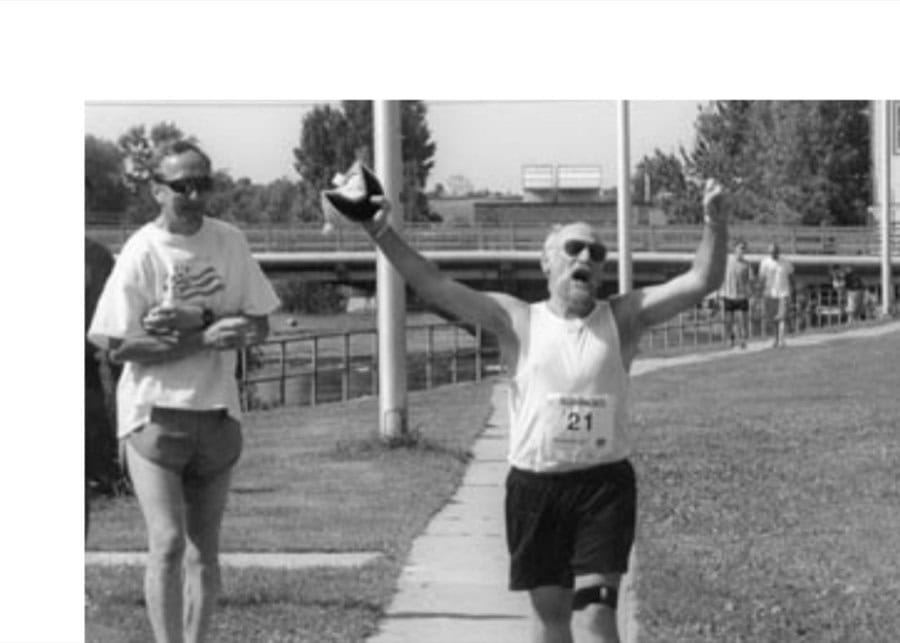
Courtesy of Becky Sutter
▲ The finish—at last. At the left is another hometown pal, Bill Amberman, who waited for me to come in, almost four hours after he finished the half.
The race director and a volunteer were there, as were my friends who had run the race. Bill Peer, Bill Amberman, and Phil Gallo had waited patiently for me for hours, and that was better than any brass band, any crowd, even any kick I could have mustered. Later, sitting down, drinking fruit juice, trying to get my head together, I had an insight of sorts. Races can be glamorous events, full of flash, drama, and glory, full of unimaginable speed and courage—at least concerning the leaders.
DEAD LAST, BUT NOT QUITE DEAD But running a marathon as I did, coming in dead last at 6:17 and change, while lacking all those elements, can still be a great life lesson. It’s about the simple virtue of finishing what you start. It reminds us that all too often success is not a triumph over the competition, but it’s always a triumph of the will. A few days later, after I had had time to reflect on my marathon adventure, the inevitable question presented itself: would I ever run a marathon again?
The answer seemed as inevitable as the question. Yes, I certainly will. And why is that? Well, the only answer I can give is a paraphrase of what W. C. Fields said about sex. There are some things better, and some things worse, but there’s nothing quite like it.
This article originally appeared in Marathon & Beyond, Vol. 9, No. 6 (2005).
← Browse the full M&B ArchiveMore like this
1,000+ stories from 19 years of Marathon & Beyond
The complete archive of the legendary long-distance journal — digitized and free to read.
