

Gender Equity
In 2000 the Marquette University women’s cross-country team advanced to what would be its first of six consecutive NCAA Division I Cross-Country Championship appearances. A year removed from competing for the men, I had witnessed its rapid ascent from better than average to national class. As recently as the 1980s, the women had been running as an NAIA school. Now they were competing with the best teams in the land.
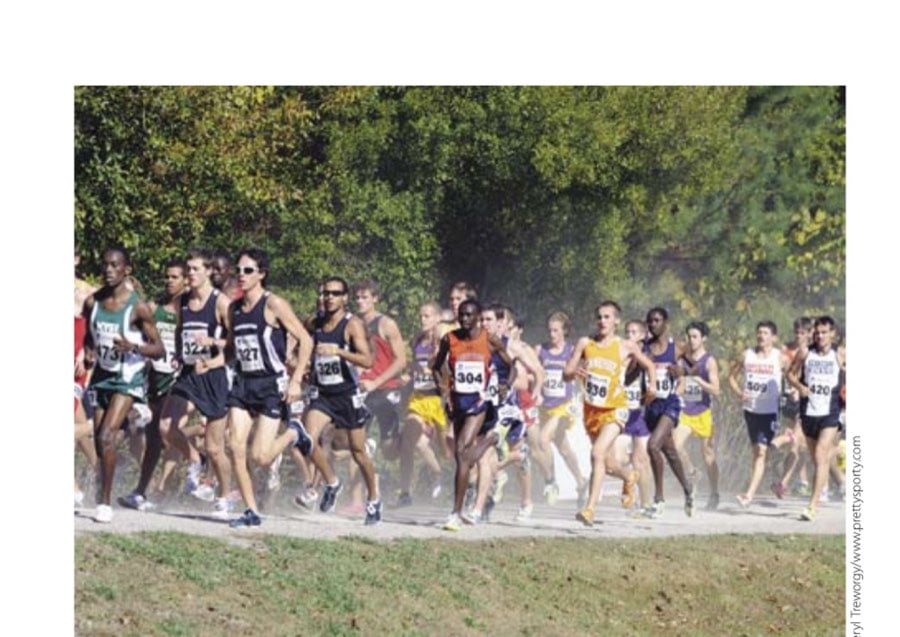
While the Marquette women flourished, the men languished in what I would personally describe as the dark days of the program. Long gone were the days of the nationally ranked squads of the early ’80s. For the ladies, a ninth-place finish at the district meet would have meant bitter disappointment. For the men, it would have had us doing cartwheels of joy.
What always struck me as odd about this situation was that both teams were coached by the same person. As a rule, the men ran a slightly higher volume of miles, but otherwise our workout schedule was essentially the same. We rode to practice in the same vans, listened to the same speeches, ran the same meets, and drew about the same caliber of recruit. Yet while the women turned into a powerhouse, the men struggled just to be competitive.
For years I pondered this paradox. During this time I began coaching high school runners myself, first a boys’ team and then a girls’ team. And wouldn’t you know it, while the boys’ team seemed to flourish under my guidance, the girls flummoxed me with their lack of progress. It got me wondering. Is there something innately different about the physiological or psychological makeup of male and female athletes that requires radically different approaches to achieve coaching success?
Desperate for an answer, I decided to ask some of the top coaches and physiologists in the land for their opinions on the matter. What began as a few simple interviews turned into a fascinating series of conversations with some of the brightest coaching minds the sport of distance running has to offer.
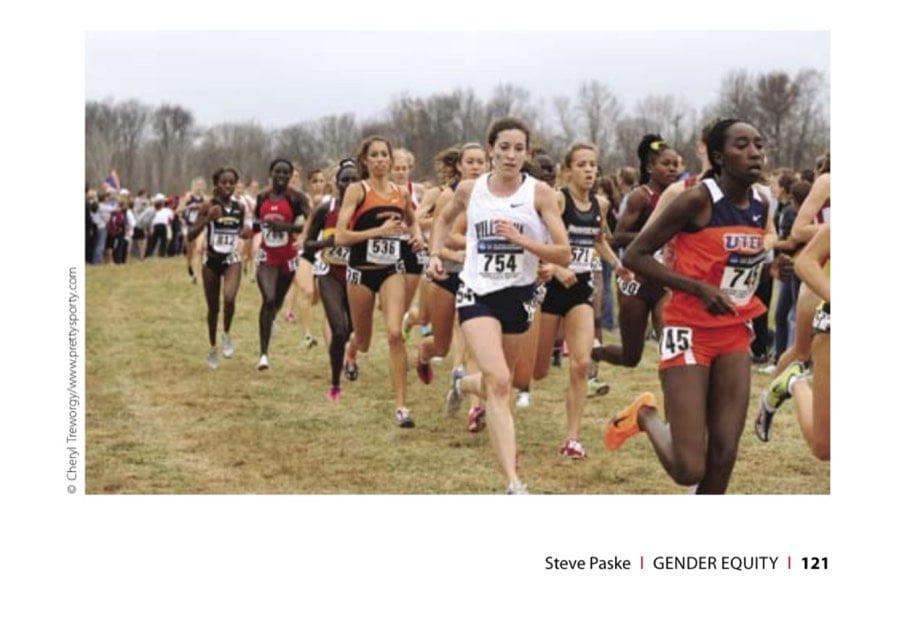
I make no claims that this article is the Holy Grail that will provide you with the answers you need to solve your struggles coaching a particular sex. However, if you’re a coach who has found that you seem to have a lot more success with one sex than the other, I do think the article provides some insights that are at least a starting point to evening out your level of success between the two sexes.
A matter of volume and intensity
© Cheryl Treworgy/www.prettysporty.com
One theme that appeared as I started interviewing coaches was the idea that while men respond well to high-volume heart-rate training, women tend to respond better to a lower volume of training with a higher percentage of it close to VO2max. “
In my experience, men can train in higher volumes, but women can train at higher percentages of max without getting hurt,” says current University of Wisconsin women’s coach Jim Stintzi, who also coached both men and women
together at Michigan State his last five years on that job. “That’s not to say that longer tempo runs aren’t effective for women, it’s just that there’s probably some truth to the idea that men can recover better from longer tempo runs than women can.”
Stintzi was far from alone in this opinion. Villanova women’s coach Gina Procaccio offered similar sentiments, even adding an element of psychology to the mix. “In my experience, the women need to train at a higher intensity to perform
well,” she says. “When they train within their heart rate, they don’t bring the intensity to the races.”
However, while many coaches touched on the idea of female runners generally responding better to higher-intensity training, another segment said this line of thinking was more a thing of the past. “My feeling is that some of these statements may have been true 20 years ago, but over the past 20 years, competitive attitudes have come pretty close for both men and women,” says University of Minnesota Coach Gary Wilson. “I don’t think that we can lump all men or all women into one framework anymore. I have women that respond very well to shorter, faster stuff and others that love to go out and run longer and slower.”
Coach Damon Martin of Adams State, who has won numerous national titles with both men and women, also spoke of an evolution in theory. “When I first started coaching in 1989, there was a theory going around about the law of thirds,” he says. “It was the idea that women should do a third less volume. However, over my 21 years, I’ve developed the mind-set that volumewise, they can do close to what the men do. They run about the same number of minutes the men do.”
Every coach interviewed emphasized the importance of not overgeneralizing when it comes to working with athletes. While certain themes rang true as generalities, all agreed that regardless of sex, you had to approach each athlete as an individual and not stick to a certain philosophy simply because it fits a stereotype.
That said, certain stereotypical themes did commonly appear during the interviews. What about this idea that women respond better to shorter, faster training? Is there any physiological evidence to back it up? Former U.S. Olympic Team Coach Brad Hudson, who has coached the likes of Dathan Ritzenhein, Jorge Torres, and Shayne Culpepper, weighed in on the matter. “
I used to think that women responded better to intensity, though not so much anymore, particularly with elite runners,” he says. “I have heard the theory that since women don’t produce as much testosterone, short, intense, intervals release growth hormone. It does seem that women seem to respond a little better this way. It seems like there have been a lot of successful younger female athletes who trained at a higher intensity.”
Levels of testosterone may influence success Hudson was not the only coach I spoke with to suggest the idea that differences in testosterone levels might affect how men and women respond to training. “With men, just the fact that they have a lot more testosterone, they can weather a lot of things better than women,” says Minnesota’s Wilson. “Take something as simple as travel. If you get on a plane and travel three time zones, that inherent strength factor seems to allow men to recover more quickly than women can.”
© Cheryl Treworgy/www.prettysporty.com

And what do exercise physiologists think about all this? Dr. Robert Chapman of Indiana University offers a unique perspective on the matter. He is currently employed as a full-time faculty member and researcher of exercise physiology at
the university. What adds to his credentials is that he also spent nine years coaching the distance runners there, and he currently coaches Team Indiana Elite. “I haven’t seen anything to suggest that the idea of more growth hormone
being produced due to interval training is true,” he says. “Even if it is the case, it would be an insignificant difference, and all the other things that we do in training would overwhelm it.” He then provided an interesting analogy to put the level of insignificance into perspective. “
I’m a 40-year-old, slightly overweight guy,” he says. “It’d be like if I were to train for the 100-meter dash and shave off all my body hair. Would it make me faster? With less wind resistance and such, probably yes. But it wouldn’t be
significant enough to matter from a practical standpoint.” What Dr. Chapman does think matters, and many of the coaches I spoke with agree, is that the general level of physical readiness of young female dis
tance runners is not the same as that of their male counterparts. “Are there physiological differences? Sure. Women have a greater Q angle (the angle from the hipbone to the knee), and this steeper angle can cause a greater
instance of IT band issues and problems all up and down the kinetic chain, leading to injury,” he says. “But at the end of the day, the reason most college coaches use lower volumes with women is because they can keep them
healthy. Many women we’re dealing with have less lifetime physical activity than many of the men do and therefore haven’t developed the years and years of structural adaptation necessary to absorb the pounding.”
Former Olympic bronze medalist Brian Diemer, who routinely coaches the men and women at Calvin College to the national meet, offered some perspective. “On a Division III level, I think you have to be more careful with the mileage and intensity with the women than the men,” he says. “Over time, with proper buildup, the mileage could be the same. But the biggest thing for me is watching the amount of stress on the legs resulting in stress fractures. The women I coach tend to get stress fractures quicker than the guys will.”
University of Wyoming Coach Randy Cole offered similar thoughts. “In my humble opinion, I just think because of their background and sporting activities growing up, the women probably don’t do as much volume of work as the guys,” he says. “I’m finding that because of this lack of natural activities growing up—playing in the yard, climbing, jumping—I don’t think their bones are as strong, though I do have some individual exceptions.”
Sometimes it’s a matter of terrain Another interesting point Cole made had to do with how he had adapted his coaching style after moving from low-lying Kansas State to the mountains of Wyoming. “When I was at K-State, we definitely leaned a bit more toward the highintensity stuff,” he says. “But once I moved up here, it’s been the other way.”
In fact, all the coaches I spoke with who worked at a high-altitude school thought women performed just as well if not better off a higher volume of training. Coach Martin of Adams State believes strongly that women do very well working with a higher volume of miles. “
It’s always been my belief that females respond very well to endurance training,” he says. “I think it’s a good fit for their genetic makeup. They carry more body fat to cushion reproductive organs and have a little less lean body mass. I think a lot of their ability to do well with high-volume training has to do with their energy utilization because of the way they metabolize more fat and have more of a supply to do it.”
It should be noted that although Coach Martin and other coaches at high-altitude schools thought women responded just as well as men to high-volume training, none of them espoused the idea that women should be doing more volume than men. In fact, in terms of mileage, they generally had their women doing less than the men. However, once you took into account the slower average pace per mile for the women, their total number of minutes logged was about the same as for their male counterparts.
Something else to keep in mind when considering the opinions of the coaches from higher-elevation schools is the role that altitude plays in the development of their training schedules. With the thinner air, higher-intensity training wouldn’t be
Is it a matter of higher intensity? Earlier in this article, Coach Procaccio of Villanova was quoted as saying, “In my experience, the women need to train at a higher intensity to perform well. When they train within their heart rate, they don’t bring the intensity to the races.” Is there truth to what she says? Is it possible that though there is no physiological explanation for women responding better to more intense training, there
© Cheryl Treworgy/www.prettysporty.com
practical even if they wished to do more. As a result, both men’s and women’s squads at these schools tended to focus a lot more on volume of work. All of this brings us full circle. Some coaches believe women respond better to highintensity training than men do. Others don’t think there’s a difference. Physiologically speaking, there does seem to be evidence that the higher level of physical activity most boys have growing up compared with girls gives them an advantage in terms of staying healthy at a higher volume of training.
But none of this seems to explain why the Marquette women of the early part of this decade were routinely going to national championship meets while the men who were doing very similar training were going backward. Nor does it help any of the frustrated coaches reading this article who have a great team with one sex and simply can’t figure out the other.
This leads us to the other, trickier realm of possibility—that of psychology. Might there be some dramatic psychological differences in how men and women approach the task of running? If so, what are these differences, and more important, what can coaches armed with this knowledge do to maximize the performance of their runners?
© Cheryl Treworgy/www.prettysporty.com
might be a psychological reason for it? Coach Hudson seems to think there might be something to the idea. “I don’t want to sound sexist, but I sure believe it inside,” he says. “Here’s what I truly believe. The way men are biologically made, we have high levels of testosterone; we’re huge risk takers. Guys you have to hold back in workouts or they’ll kill each other. Women tend to be more reserved and so they don’t push themselves as hard. I’ve trained some women where I’ve stayed away from the intensity, and when they got to the race they didn’t seem to know how to push themselves.”
Once again, it is important to mention that Hudson is talking in generalities. He doesn’t seem to think that this is nearly so often the case as you move into the more elite levels of racing. And he likes to point out that he has worked with some women who were very mentally tough from a competitive standpoint. Nevertheless, the idea that a coach needs to do more to build a woman’s confidence than a man’s was an overarching theme of the interviews. “
My feeling, and again I’m generalizing, is that you need to give a woman confidence before she goes into a race, whether that’s in the form of specific instructions or something else,” says Wisconsin’s Stintzi. “Guys, on the other hand, believe they’re the best thing on the earth. Sometimes they need to be brought down.”
Calvin’s Diemer agrees that confidence is a very important issue for the success of distance runners. However, rather than focus on higher-intensity training for his female athletes, he prefers a different method. “
I try to take the competition out of it on a daily basis,” he says. “I try to group like athletes together in workouts and in races. The idea is that they run as a pack and work together as opposed to having to beat someone out to make your spot. If there’s competition on a daily basis, they get too bogged down by getting all nervous, and it takes the fun out of it for them. If they can do something great together, they want more of that, and then watch out.”
The other role psychology may play is in the way that the different sexes approach workouts. Time and time again throughout the interviews, I came across the idea that men needed to be held back in training to avoid beating themselves into oblivion. Women, on the other hand, were sometimes so passive that they had to be told that it was OK to run harder. “
Sometimes you have to tell a woman that it’s OK to beat your teammates,” says Stintzi. “Sometimes you need to tell them that it’s OK to want to be the best.” Dr. Chapman also weighed in on the psychology issue. “
Women tend to be very task specific. They want to be given a direction, and they’ll follow that direction very closely. If you tell them I want you to do this workout at this pace, they’ll follow it to the letter,” he says. “Men are different.
ad
They want to be given a lot of freedom. They want to be able to adjust to different cues when they’re running.” He then went on to speculate why many coaches may believe that higherintensity work for women seems to be more effective. “
Perhaps the reason that many coaches feel that lower-volume, higher-intensity training works better for females is that you can be there on the track for those workouts and make sure they’re doing them correctly,” Chapman said. “In highervolume programs, on the other hand, you’re not as able to do this since the kids are often out on the trails on longer runs. In general, men have an easier time running on feel than women do. So you have to teach women how to approach these types of longer tempo runs.”
Conclusions So what can we take from all of this? What can a coach who struggles with one sex or the other learn from these interviews? I’m not providing a magic wand, but from my perspective, these are the main points.
Although it may have been the case in the past, there is a growing consensus among coaches that there are no major physiological differences between how men and women respond to certain types of training. Where there may be a difference, however, is in the general readiness of males and females as it relates to their ability to handle a higher volume of training without getting hurt. As a rule, boys tend to be more active growing up than girls do. As a result, boys’ bodies are more likely to have made muscular and skeletal adaptations that allow them to run higher volumes without getting hurt.
From a psychological standpoint, women generally need a bit more to boost their confidence than men do. This confidence boost could come in many forms. For many women, it seems to be in the form of high-intensity workouts that allow them to transfer that aggressiveness to races. For others, it is the task of running pressure free within the confines of a pack, where instead of worrying about their personal performance, they are forced to think more about the good of the whole. And for still others, it may be as simple as providing specific instructions for things as basic as a trail run so that there is no confusion about what you as coach would like them to do.
Perhaps most important, though, is to heed the advice of the coaches I interviewed and remember that each athlete is an individual who will respond to what best fits him or her. Generalities may help coaches find a starting point to approach their training plans with a particular sex, but no stereotype can replace good communication between coach and athlete when it comes to maximizing performance.
This article originally appeared in Marathon & Beyond, Vol. 15, No. 6 (2011).
← Browse the full M&B ArchiveMore like this
1,000+ stories from 19 years of Marathon & Beyond
The complete archive of the legendary long-distance journal — digitized and free to read.
