

George Littlewood
It’s called multiday racing today. However, 150 years ago it was called long-distance pedestrianism, and the man who inspired the blue-ribbon event in the sport, the six-day race, was the then-incredibly
famous American “walkist” from Providence, Rhode Island, Edward Payson Weston. The world-famous sporting superstar was just 40 years old in 1879 when, for the first time in his professional career, he actually ran to claim a world record of 550 miles in six days around an eight-lap-to-the mile sawdust track at the Agricultural Hall, London, to win the Astley Belt.
By December 1, 1888, that world record had been broken many times. “Blower” Brown, of Fulham, England, added three miles in 1880. Frank Hart, aka “Black Dan” of Boston, Massachusetts, upped the tally to 565 soon after. Then Charlie Rowell, the Englishman, who had made $50,000 by winning two races at Madison Square Garden, New York, in 1879, banked even more money when he added a mile to Hart’s score later that year. The “Cambridge Wonder” (Rowell) wasn’t in the race when John “The Lepper” Hughes made it 568 in 1881, nor when the “Brooklyn Cobbler,” Robert Vint, ran 10 more miles to make 578 in the same year. The Irishman, Patrick Fitzgerald, would add his name into the record books with 582 before George Hazael, an Englishman, became the first person to break the 600-miles-in-six-days barrier. That was achieved at Madison Square Garden in 1882. Fitzgerald would reclaim the honor with a staggering 610 miles two years later, but it wasn’t until February 1888 that an American from Philadelphia made mincemeat of that score with a staggering 621 3/4 miles. His name was Jimmy Albert.
But could it be beaten? Well, yes, it could! The man who would eventually accomplish the feat was George Littlewood, and this is the story of how the “Sheffield Flyer” managed to add two more miles to that total and keep the world record for almost 100 years!
George was born on March 20, 1859, in Rawmarsh, Yorkshire, England. He moved to Attercliffe, a suburb of Sheffield, seven miles away, when he was 2 years old, where his father, Fred, a useful runner in the local pedestrian events, took his son to the well-attended races where the runners were handicapped according to previous performances. Betting was common and the thousands that turned up to watch them perform would wager on their fancied athletes who battled it out for cups, medals, ornamental belts, and prize money. Fred was a short-distance runner, and George probably was excited at watching his dad winning a race and even more excited when he was hoisted above the crowd that was cheering his victory.
Like father, like son Dads, being dads, will always urge their kids to perform well in sports that they are good at themselves. Fred was no exception. He wanted George to be better than he was, so he pushed him from an early age to succeed in a professional sport in which, if you were really good, you would be handsomely rewarded.
As a schoolboy, George excelled in other sports, including boxing, cricket, and wrestling, but it was in the field of athletics that he showed the most aptitude, especially running and fast walking. Sheffield is surrounded by beautiful countryside and, in particular, moorland, where, at the age of 8, the young lad was encouraged to run alongside the hounds in local hunts by his father, who would watch from a distance as his son, possibly wearing breeches, a white collarless shirt, and jockey cap, pursued a fox with other boys, men, and riders on horses.
George’s training regimen was meticulously planned by Fred. It was both daunting and vigorous. Attercliffe was an industrial area where steelworks were in abundance. A canal runs through its heartland, and the towpath adjacent to it would have been the perfect place to put the budding champion through his paces.
ad
It was during one of these training sessions that the boy complained to his dad that his muscles were sore and that he couldn’t carry on. But his father knew that if George could prove to himself that he could overcome the pain barrier, the experience he was about to put him through would prove valuable for his future career. So he offered George the carrot of a financial reward to get him through it. “
If you’re going to be the best one day, Son, you’ve got to do better! If you can catch me, you can have this halfpenny. If you really want it, you can get it. Do you want it?” “Yes, Dad, I want it.” “
Then catch me and it’s yours!” Fred set off running and George went after him, and when he caught his dad and passed him, he was given his prize for his determination. With that experience in the bag and with a 40-yard start, the now 9-year-old went on to beat the 12-year-old half-mile champion of England and 27 others in a half-mile handicap running race for £15 in front of a big crowd.
As the years rolled on, Fred continued to nurture his son as he dedicated his spare time to perfecting George in the art of footracing. His dedication paid off when, at the age of 16, George won his first long-distance heel-and-toe walking event and was awarded a silver cup donated by several Sheffield publicans.
Watching the boy perform that day, a local judge said of him: “He is completely genuine, without any deviation from the strict laws of walking.”
Bringing home the meat George’s mother had a favorite butcher. She swore by the meat he sold and, having no real means of refrigeration, needed the meat fresh. But there was a big problem: the butcher’s shop was 17 miles away in Doncaster! As she couldn’t afford to go and collect it on the three days she would have liked to, the solution to the problem was easily found in George’s young legs, which were the perfect mode of delivery. So during the next four years, and as part of his punishing 200-miles-a-week-plus training regimen, the boy would run to Doncaster and back three times a week in a 34-mile round trip—before breakfast!
Later in George’s career, one of his trainers, Fred Bromley, whilst talking about the influence of diet in the performance of an athlete, once told George: “If you want to raise a lot of steam and power, you must stoke the coals on the fire!” Indeed, there were reports that during his races, his mum would be on hand to cook her son’s favorite meal of chicken fricassee for him.
With his stamina built up, by November 1879, the 20-year-old athlete appeared in his first ultra-long-distance race, a six-day, 72-hour, 12-hours-per-day, go-as-you-please (run and walk) event. Along with 27 other contestants, he made his way round a 19-lap-to-the-mile track at the Drill Hall, Wolverhampton, near
Courtesy of Paul Marshall
Birmingham. An established “ped” called Sam Day won the race and £50 for doing so with a record score of 360 miles. But it was Littlewood’s name that was scribbled in the notebooks of sporting men as he took home fourth-prize money of £4 for scoring 275 miles in the allotted time, his performance attracting attention of reporters who wrote: “
Littlewood is a very well built young fellow and such a good natural walker, that he ought, in time, to make a name for himself.” And: “With more experience, Sheffield’s George Littlewood will make the top grade and challenge the best in the world.”
In February 1880, George appeared in his next race, at Nottingham, where, in a seven-day, six-hours-per-night, go-as-you-please contest, he came in fifth of 19 runners. He won £2 for scoring 252 miles, just 18 miles behind the winner, George Cartwright, the “Flying Collier.”
But he needed to win, and when he did a couple of months later in a circus rink at Leeds, Yorkshire, he did it in style, creating a 12-hours-per-day, 72-hour world record of 374 miles. He beat 12 others for the £35 first prize plus an extra prize of £10 for beating the record. George publicly stated some years later that this was the greatest race he ever won, accomplished on a 38-lap-to-the-mile track: incredible!
With his first victory secured, he made his first trip to London, where, in September of the same year and competing in field of 29 at the Agricultural Hall, Islington, the 21-year-old won the 72-hour Sir John Astley Champion Gold Medal and prize money of £60, which included £10 for beating the world record of 405 miles by 1 and 3/4 miles.
▲
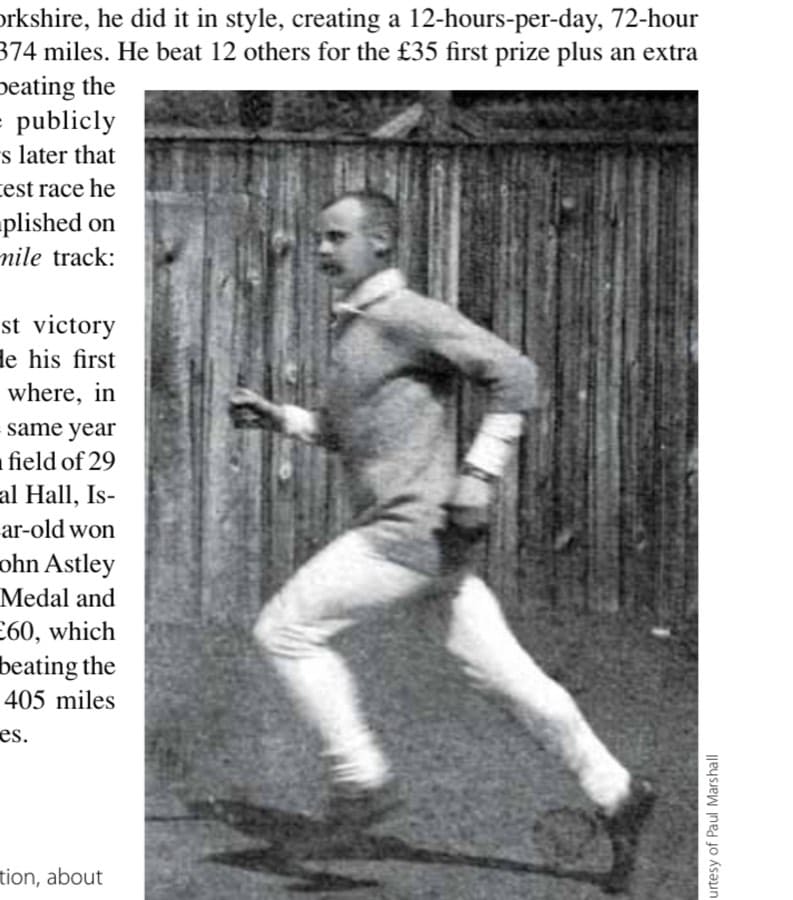
Littlewood in action, about 1887.
Up against the Americans Charlie Rowell, another Englishman (who thought nothing of jogging 150 miles on the first day of a race), was being touted as the favorite to win the sixth international version of the Astley Belt against some very good American athletes, Blower Brown, and Littlewood, whose managers had entered him into the 142-hour, sixday, go-as you-please contest, again at Islington’s “Aggie.” (The races, although advertised over six days beginning on Monday morning just after midnight, nearly always ended just after at 10:00 p.m. on the following Saturday night to avoid clashing with the start of Sunday. There were no competitive events on a Sunday, and if there ever was, this would be frowned upon by the church and the media.)
It was George’s first crack at the 142-hour contest, and he did amazingly well to finish runner-up to Rowell, six years his senior, who won the belt with a score of 566 miles. The “Sheffield Flyer” managed 470, but it was a great introduction to the blue-ribbon event and he would have been very happy with second-prize money of £155.
George’s first trip over to America to compete in the 2nd O’Leary International Belt contest at Madison Square Garden, in May 1881, ended in failure because although starting the favorite, he managed to make only 480 miles before retiring hurt due to a foot injury. Many said he would have won it, if only . . .
In his next race, a 142-hour heel-and-toe walking match against five others in March 1882 at the Norfolk Drill Hall, Sheffield, George managed to make 531 miles on the 13-lap-to-the-mile track. That was one mile better than Charles Harriman’s previous world record for walking, and it still stands today!
He then competed in the first, second, third, fourth, and fifth 12-hours-perday, 72-hours-per-week “Long-Distance Astley Belt” races, which took place in Birmingham, London, and Sheffield between 1882 and 1884, securing the belt outright for winning it three consecutive years.
In 1885, Littlewood took on Rowell again in the International Pedestrian Tournament (retired) and then again in February 1887 in the “International Pedestrian Go-As-You-Please Tournament” (won), both races being held at the Westminster Aquarium, London.
After those races he went back to America for the second time, first to Philadelphia, where he annihilated the opposition in the “Championship of the World Sweepstakes” in November 1887 before returning to New York to compete in a race at Madison Square Garden in May 1888, where he broke the 600-mile barrier for the first time despite running on a raw bone in his foot.
A staggering 39 competitors stood at the starting line at the same venue on November 26 in the same year to try to win the “Fox Diamond Belt.” One of them was Littlewood, and all eyes were on the race favorite as he set off determined to win at all costs.
The beer was a bit off
Courtesy of Paul Marshall
At the end of the first 24 hours, George had managed to score only 122 miles, 15 miles short of his personal target and 13 miles behind the leader. That was because he had been feeling poor due to drinking a bottle of beer that had “gone off.” As Fred bathed his son’s sleeping head in vinegar, the bookmakers adjusted their odds and 8:1 was chalked up next to his name on their slates. When he woke up, and now feeling much better, George took the odds about his chances before he bounded back on the track in his pursuit of glory and a world record.
That 13-mile gap was extended to 22 miles by midnight on the second day with E. C. Moore leading the race with 240 miles. But then Littlewood got down to work. With his stomach problems seemingly over, the then 10:1 shot in the race started to make ground, and by midday on that third day, Moore’s lead over the prerace favorite had been reduced to 17 miles, and by midnight to just three miles. “
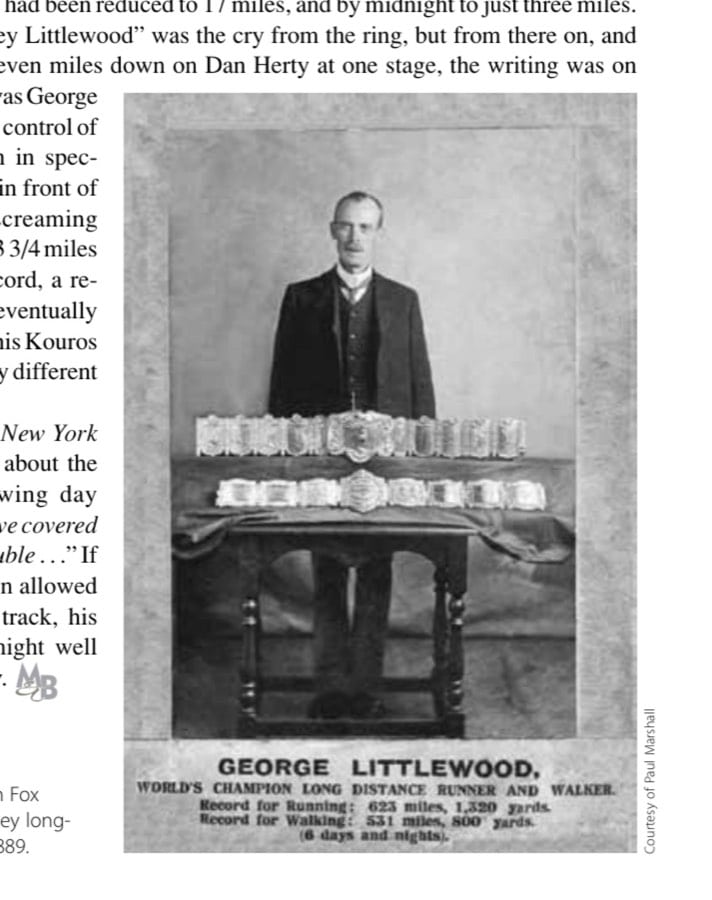
Even-money Littlewood” was the cry from the ring, but from there on, and despite being seven miles down on Dan Herty at one stage, the writing was on the wall, and it was George who would take control of the race to win in spectacular fashion in front of thousands of screaming spectators—623 3/4 miles and a world record, a record that was eventually broken by Yiannis Kouros in 1984 in totally different circumstances.
Part of the New York Times headline about the race the following day read: “Could have covered 650 without trouble . . .” If George had been allowed to stay on the track, his world record might well still stand today.
▲
Littlewood with Fox Diamond and Astley longdistance belts—1889.
This article originally appeared in Marathon & Beyond, Vol. 18, No. 4 (2014).
← Browse the full M&B ArchiveMore like this
1,000+ stories from 19 years of Marathon & Beyond
The complete archive of the legendary long-distance journal — digitized and free to read.
