

Gillian Adams Horovitz
It’s a blustery and cold February afternoon. Down in the depths of Manhattan’s Chinatown, the sixth-graders from PS 1 are bundling up to walk down to the East River and run a mile as part of a youth-running program geared to low-income communities. Setting up the course on a strip of pavement under the FDR Drive is their coach, Gillian Adams Horovitz, who greets each child with a warm smile and words of encouragement as they reach the half-mile turnaround. When the last child has reached the mark, Horovitz jogs back to the start with her. Afterward she hands out snacks of apple slices. It’s obvious that she cares about these kids and that they in turn like and respect her. To them, she is just Coach Gillian. They have no idea that this gentle woman with the soft voice and shaggy white hair was ranked sixth woman runner in the world by The Runner magazine in 1980 or that she came in second to the legendary Grete Waitz in the 1979 New York City Marathon as a 24-year-old. When that old story comes up, Horovitz points out that she was 11 minutes behind Waitz. “The only time I saw Grete was when we were talking at the starting line,” said Horovitz with her customary humility.
I’ve known Gillian for a few years through New York Road Runners, where we both work in the Youth & Community Services Division. She is always friendly and quick with a smile, and I knew there was something special about her. But it wasn’t until I started learning—through others, of course—of her many running achievements that I decided to dig further and to get to know her more intimately. And the more I found out about her, the more of an anomaly she became. She ran 94 marathons with a PR of 2:36 (Grandma’s, 1993) over the course of 27 years, sometimes competing in 10 a year. Most of them were under three hours, with the exception of the last two, where she ran New York in 3:10 to finish as the second master and then the next week ran the Richmond Marathon in 3:12, and again was second master. Who does this? And where did she find the time to compete internationally while raising her twins, Hannah and Oliver? Who is this woman who ran the Boston Marathon in 1980 in 2:39, finishing third female, and
▲
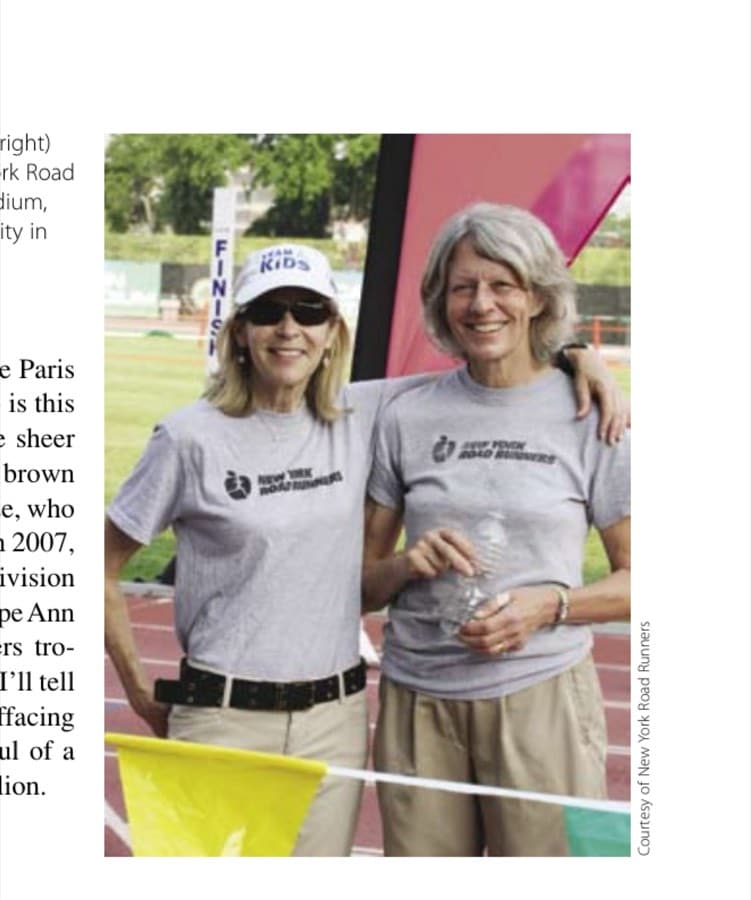
Gillian Adams Horovitz (right) and the author at a New York Road Runners event at Icahn Stadium, Randall’s Island, New York City in 2011.

Courtesy of New York Road Runners
four weeks later won the Paris Marathon in 2:49? Who is this woman who ran for the sheer fun of it with her long, brown hair flowing in the breeze, who battled ovarian cancer in 2007, and who still wins her division in the annual Around Cape Ann 25K—where the winners trophy is named after her? I’ll tell you who she is: a self-effacing classy lady with the soul of a saint and the heart of a lion.
A British tomboy Gillian Adams was born June 7, 1955, in Bromley, England, the oldest of three sisters. She was a tomboy, as athletic girls were called back then, and played netball (an English version of basketball), field hockey, and swam competitively. But running is what she loved to do. And she was good at it. By age 12, she persuaded her parents to let her join the Kent Athletic Club. It didn’t take a lot of pleading, as her father was a runner and still kept his spikes in the cupboard. It was those same spikes—modified to fit her—that she clutched to her chest as she rode the bus to Kent for practices. She did a bit of everything at the club: the long jump, 100 meters, 200 meters, and cross-country. She ran so much that she wore out her dad’s spikes, which convinced him that she was going to stay in the sport so he bought her a new pair. Her father was a great supporter of her running. He was the designated driver on Saturdays when the team traveled to other towns for cross-country events. “He would stand in the cold, cheering for us,” says Horovitz. “When I did my workouts at night, he rode his bicycle next to me. “
We didn’t have a lot of money, so I really had to learn to take care of my equipment,” recalls Horovitz, as she sips tea with me on a rainy March afternoon in the West Village townhouse she shares with her husband, playwright Israel Horovitz. The kitchen has posters featuring his plays and a painting of Gillian at a race, but nary a trophy is in sight, nothing that hints of her world-class running
history. When I ask about records and personal bests, she has to go down to the basement and returns carrying two huge boxes filled with the records, logs, and newspaper clippings. She is laughing at how jumbled she has kept her records, and I realize that every time I see Gillian she is usually smiling and treating each day as a gift.
Back at the Kent Athletic Club, by age 14, she was winning races quite a bit and started working with a coach. Her life revolved around running, and she loved it. No one ever had to force her to practice. She met another runner at the club, Denise Brown, who would become a lifelong friend. In their first race together, Horovitz didn’t know the course, so she followed Denise. When Denise fell in a stream, she waited for her: “I didn’t know where to go, so I just waited in the stream till she got back on her feet and continued running.”
As an 18-year-old student at the University of Reading, she kept up her running by working out with the men’s team. When the men realized she was fast, they accepted her as one of their own. She raced every weekend and put in 50-mile weeks. That perseverance paid off, and in 1975 she became the cross-country champion representing all of the British universities and held that title for three consecutive years.
When she graduated in 1976, she wanted to be a town planner, but jobs were scarce. Her friend Denise—the one who fell in the stream—had taken an au pair job in Philadelphia, and the agency was looking for another. Horovitz jumped at the chance to join Denise and at the same time fuel her other passion, traveling. She explored her new surroundings by running everywhere, eventually joining a local running club, the Philadelphia Flyers, and started racing every weekend. “I didn’t care what the distance was, I just wanted to run,” says Horovitz, who was usually the lone woman at events.
First marathon run for a watch She thoroughly enjoyed her life in Philadelphia. Still pinching pennies, she wanted to get a sports watch but couldn’t bring herself to spend her hard-earned money on one. When she heard that the Penn Relays Marathon (1977) offered a watch to the winner, she decided to run it. To get an idea of what a marathon looked like, she and Denise traveled to Boston to watch the Boston Marathon. “It was scary,” recalls Horovitz. “I kept hearing about this wall and didn’t quite understand it. I just knew I didn’t want to hit it.”
Her longest run prior to the Penn Relays Marathon was 14 miles. Based on the lack of distance preparation, she should have hit the Wall but didn’t and won in 3:10. But she was devastated to find out that the watch was only for the track events that were held simultaneously with the marathon. “I won a trophy,” exclaims Horovitz. “I really wanted that watch.”
Although she didn’t get the watch, she realized that she loved the distance and was good at it. She was still in touch with her coach back in England, Cliff Temple, who told her to take the marathon more seriously. Five months later, she entered the Philadelphia Marathon, winning in 2:57. Her au pair assignment came to a close in 1977. Before leaving, she and Denise toured America in a Greyhound bus, backpacking the Grand Canyon, visiting Disneyland in California, and seeing the Pacific Ocean for the first time.
Becoming more serious
© Victah/www.PhotoRun.net
Back in England, her coach picked up her marathon training. In May 1978, she entered the Isle of Wight Marathon. It was a brutal course with lots of hills, and she dropped out—a devastating decision, as her father was there to cheer for her.
Not one to be haunted by disappointment, one month later she ran the Windsor Castle Marathon and won in 2:54. The prize was a china double egg cup. The following month she won a jewelry box at the International Milton Keynes Mara
thon, finishing third in 2:59. Horovitz closed out 1978 with her fourth marathon and first New York City Marathon, finishing 15th female in 2:55. During this time she was holding down a full-time job with a travel
agency and living at home. She did double training sessions, one in the morning and one at night. At the end of 1978, it was becoming apparent to Horovitz and others that she was emerging as a world-class marathoner.
The next year, 1979, would become her breakthough year in which she ran five marathons. She ran 2:43 in the Women’s AAA Marathon Championships in Sandbach, England, placing second to Joyce Smith. At that point, Horovitz knew she could
▲
After coming to the States, Gillian immersed herself in the New York running scene, becoming a fixture on the winner’s podium.
ad
run with the best: “I took 12 minutes off my time and was racing with a very competitive field and felt I belonged.” Three months later, she ran the Oregon Track Club Invitational Marathon in Eugene, where she finished in 2:41—second to Joan Benoit—and established a British marathon record. That became the defining moment in her marathon career: “Being invited to the Nike OTC Marathon, traveling all the way to Eugene, and then running the British best in 2:41 and finishing second to Joanie confirmed that I had a future in marathon racing, and it gave me confidence in my ability to run well.”
Six weeks later, she ran the New York City Marathon, finishing second to Grete Waitz in 2:38, a personal best at the time for Horovitz. Not one to rest, she finished out 1979 with the Tokyo Marathon in November (second place, 2:39) and the Honolulu Marathon in December (third place, 2:49).
She can play back her important marathon moments as if they were run yesterday: being invited to the 1979 New York City Marathon by Fred Lebow and passing Jacqueline Gareau on Central Park South to clinch second place in 2:38; and traveling to Tokyo for the world’s first elite-women-only marathon with Allison Roe, Nina Kuscsik, and Joyce Smith. Kuscsik recalls meeting Horovitz for the first time: “I enjoyed her upbeat personality from the first time we met. She was so refreshing. After the Tokyo Marathon, we toured Japan together, and that cemented our lifelong friendship.”
Career highlights • Second-place female, 1979 New York City Marathon. • Third-place female, 1980 Boston Marathon. • Represented England at the Commonwealth Games in Kuala Lumpur, finishing fourth in the marathon in 1998. • Set the masters course record for Around Cape Ann 25K in Gloucester, Massachusetts, in 1:35 at age 42 in 1998
As she reflects on her past, Horovitz smiles. Outside, the winter snow has piled up in huge drifts as New York suffers through a severe winter. But inside the townhouse, it is warm, and it seems that the warmth is radiating from Horovitz. Her competitiveness is not immediately apparent. Her slight frame and soft, almost whispery voice make you feel protective around her. She is described by friends as a free spirit, laid back, relaxed, and light hearted. There is a calmness about her that makes you want that second cup of tea because spending time with Gillian is just so damn comfortable.
The 1980s: coming to America, getting married, more marathons Coming off a high from her personal best in 1979, one would think that taking time off to rest and recover would be in order. Not Horovitz. In 1980, she ran 10 marathons, including her first Boston Marathon, placing third in 2:39. A month later she won the Paris Marathon in 2:49. “It was an exciting time. I got to travel, run, and meet people. I ran because I loved it. I was not about to follow a plan so I could get faster or rest more so I could be stronger,” says Horovitz. “I followed my own path, not anyone else’s.”
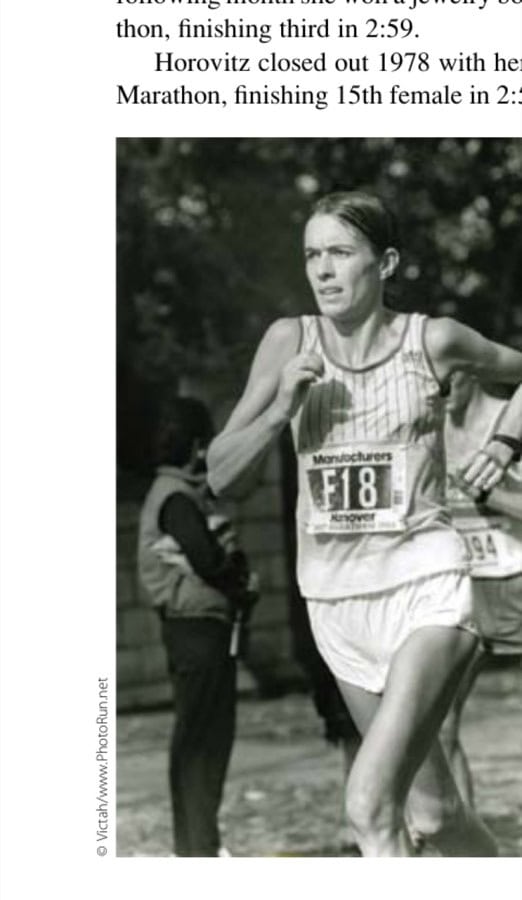
When asked whether she could have been a faster, stronger runner, maybe even an Olympic qualifier, if she listened more to her coach and cut back on the number of marathons, she ponders that thought for awhile. She obviously had talent, consistency, and durability. The top female marathoners of that era—Grete Waitz, Allison Roe, Joan Benoit, Patti Lyons, Ingrid Kristiansen, and Jacqueline Gareau—posted faster times, but they weren’t running 10 marathons a year. They concentrated on their key races and listened to their coaches. At Boston in 1980, she was five minutes behind the winner, Gareau, who ran 2:34. Later that year in New York, she finished in 2:37 behind Waitz’s 2:25. “I was strong headed
▲
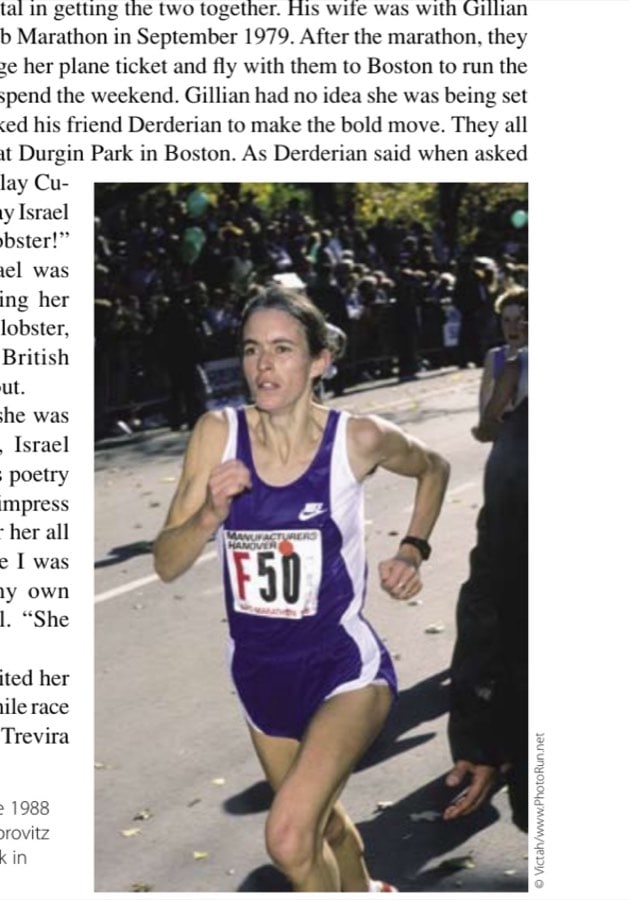
Shown here running the 1988 New York City Marathon, Horovitz finished second at New York in 1979.
© Victah/www.PhotoRun.net
and didn’t want the pressure to try and be the best,” says Horovitz. “I enjoyed passing people too much to hold back or do any type of strategy.” The one time she listened to her coach’s advice to hold back and run smart, she couldn’t. The first time she ran for prize money, she was so stressed that she dropped out: “The money just got in the way. It wasn’t my thing.”
Her good friend Tom Derderian calls her running “heroic.” “There are very few runners who can post good times for a long time, and Gillian was one of them,” he states. “She was too laid back to care about the prize. She loved her running more.”
Derderian, who knew both Gillian and her future husband, Israel Horovitz, also a runner, was instrumental in getting the two together. His wife was with Gillian at the Oregon Track Club Marathon in September 1979. After the marathon, they suggested that she change her plane ticket and fly with them to Boston to run the Freedom Trail Run and spend the weekend. Gillian had no idea she was being set up. It was Israel who asked his friend Derderian to make the bold move. They all met for a lobster lunch at Durgin Park in Boston. As Derderian said when asked whether he did indeed play Cupid that day: “Let’s just say Israel wasn’t there for the lobster!” Gillian recalls that Israel was very attentive in showing her the correct way to eat a lobster, something the young British beauty was clueless about.
Upon learning that she was heading to New York, Israel invited her to one of his poetry readings. “I wanted to impress her and kept looking for her all night to the point where I was getting distracted at my own reading,” recalls Israel. “She never showed!”
Undismayed, he invited her to be his partner at a 10-mile race in Manhattan called the Trevira
Twosome. Gillian finished in 59:00 and he in 63:00. “That cemented our relationship,” says Israel. “She would be the runner, and I would be the writer.” Horovitz moved to New York City in September 1980 to be with Israel. Three months later, at the start of the NYRR Midnight Run, he proposed with a dime-store diamond ring. She said yes at the finish. They were married at a simple ceremony in July 1981, combining their passions for running and for each other.
Becoming a New Yorker, a top NYRR runner, and a mother Gillian immersed herself in the New York running scene, becoming a fixture on the winner’s podium. George Hirsch, chairman of the board of directors of New York Road Runners as well as publisher emeritus of Runner’s World magazine and The Runner before that, has known Gillian for 30 years. He recalls the New York City 1980s running scene, when everyone knew everybody. “Her achievements are extraordinary. She ran at a high level of consistency year in and year out,” says Hirsch. “She runs for the sheer pleasure of it and makes it seem so easy.”
Her highlights during the ’80s include first place at the Madrid Marathon (1981) and the Paul Bunyan Marathon in Maine (1983). But her proudest achievement was the birth of her and Israel’s twins, Oliver and Hannah, in December 1985. They were born in Gloucester, Massachusetts, where Israel is the Founding Artistic Director of Gloucester Stage, and where Gillian is an 11-time Around Cape Ann 25K champion. “Some of my fondest memories take place in Gloucester where we spend our summers,” said Gillian. “My kids would start school after Labor Day back in New York, so this was their carefree time of life.” And just like everything else in life that she did, Gillian took it all in stride. The West Village townhouse was becoming overrun, but everyone was happy. Israel learned to write his plays with the constant chatter of kids around him, and Gillian continued to run her marathons. When she left them for the first time to run the Osaka Marathon in 1987 when the twins were 3, Israel wrote a book for them called Mommy’s Gone Away. When they were older, she took them with her on her trips.
She continued running marathons for the next three decades. When she wasn’t winning races outright, she was winning her age division and, upon turning 40, the masters division. She was a three-time masters champion at the New York City Marathon (1995, 1997, and 1999) and won masters awards at Boston three times (1998–2000).
When asked what she was most proud of in her 30 years of running, she says: “The performance I am most proud of is being selected for the England Team at the Commonwealth Games in Kuala Lumpur and finishing in fourth place in 1998. When I think back at my best performances, the ones that stick out may not be the best performances in absolute terms but rather those where I competed at a higher level than I realized I was capable of.” Horovitz retired from professional running
▲
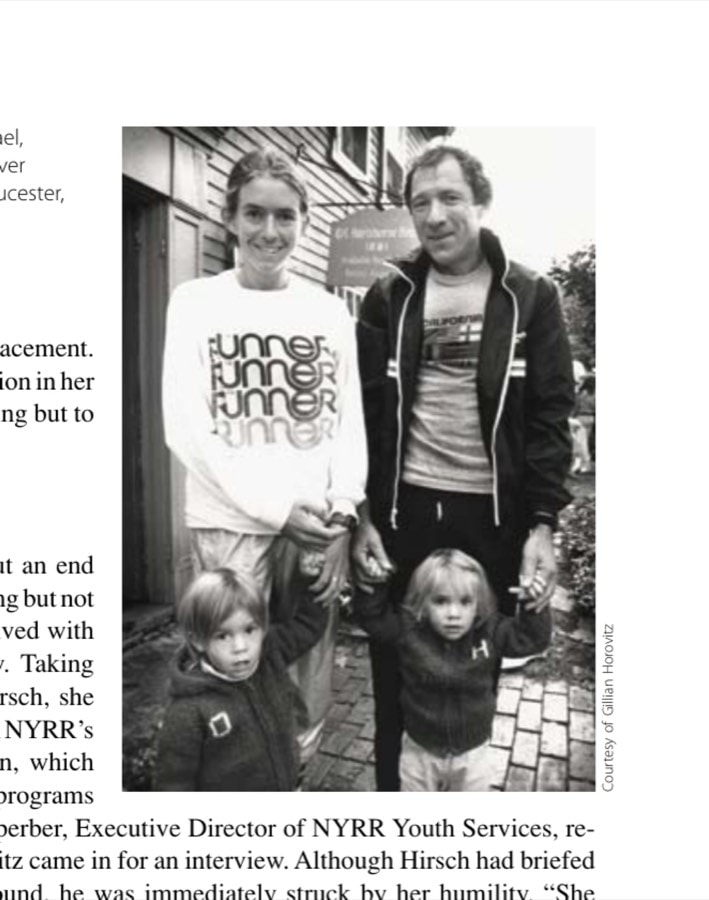
Gillian and husband, Israel, with two-year-old twins Oliver and Hannah in 1987 in Gloucester, Massachusetts.
in 2007 due to a hip replacement. Ironically, the deterioration in her hip was due not to running but to a birth defect.
The hip replacement put an end to her competitive running but not to her desire to be involved with the running community. Taking advice from George Hirsch, she decided to volunteer with NYRR’s Youth Services Division, which provides free running programs to at-risk youth. Cliff Sperber, Executive Director of NYRR Youth Services, recalls the day that Horovitz came in for an interview. Although Hirsch had briefed Sperber on her background, he was immediately struck by her humility. “She was egoless and never talked about herself,” says Sperber. “She wanted to know about the kids we serve and how she could help make their lives better by using running as a vehicle that would uplift them.” She started out in the office learning the ropes, but before she could work in the field with the kids, she received devastating news.
During a trip to Scotland with Israel, she started to feel ill and knew that something was wrong. Back in New York, a series of tests disclosed that she had stage 4 ovarian cancer, known as “the silent killer.” After leaving the doctor’s office, she and Israel walked back to the townhouse in a fog. Hirsch and his wife, Shay, happened to bump into them on the street and were told the news. The four of them went to dinner and discussed the options. Recalls Hirsch of that night: “Gillian was her normal, lovely self. She was positive and upbeat. She was not going to let this insidious cancer defeat her.” The day of Gillian’s surgery at Sloane Kettering, Israel and the children camped out in the waiting room. “I was making deals with God,” said Israel. A day after the surgery, Gillian walked one mile through the hospital corridors with her IV pole dragging alongside. By day three, she walked three miles, and her doctors were astounded at her progress. Through
Courtesy of Gillian Horovitz
Cancer strikes
Courtesy of New York Road Runners
▲ Horovitz with her youth running team from Chinatown’s PS1 in June 2011.
the next few months, Gillian faced her toughest opponent and won. Cancer lost to a stronger and more determined competitor.
Giving back and staying strong The cancer in remission for three years, Horovitz, 55, works three days a week at three different schools teaching children the joys of running. She starts her day with a swim and then usually bikes to her schools’ locations throughout Manhattan. At some point, she manages to fit in a run. Some evenings are spent babysitting her grandchildren, who live right around the corner. Reflecting on her life, she is surprised at all that she has achieved. “Growing up in Bromley, I never imagined that I would be a top-ranked marathoner, move to the States, or marry an American,” says Horovitz. “I would have to say that my life’s path is all due to running. If you love what you do and work hard at it, then anything is possible.”
Israel gets in the last word about his wife: “From the first day I met her, I just had a feeling about her. I couldn’t get her out of my mind and still can’t 30 years later. I admire everything about her. She’s a terrific runner, mother, wife, friend, and fighter. What’s not to love about her?”
And that pretty much sums up everyone’s opinion about Gillian. She is definitely a two-cups-of-tea kind of girl. In fact, make that three cups, please.
This article originally appeared in Marathon & Beyond, Vol. 15, No. 6 (2011).
← Browse the full M&B ArchiveMore like this
1,000+ stories from 19 years of Marathon & Beyond
The complete archive of the legendary long-distance journal — digitized and free to read.
