

The Long Way Around
I WAS FLOATING in tropical blue water, being rocked like an infant in a cradle by the gentle swells. A French doctor from Lyon and I were discussing in Spanish about where in France the purest French is spoken as he sipped on a Cuba Libre from an ingenious floating drink caddie. Just a few hours earlier I had been in five inches of early snow in Toronto, talking to that trouble-magnet, “Arctic Joe” Womersley, about putting together a relay run from Inuvik in northern Canada to Ushuaia in Tierra del Fuego. This warm water was nothing like my beloved, frigid San Francisco Bay, where, even with the El Niño effect, the water temperature rarely goes above 60 degrees. But I wasn’t in San Francisco. I was in Cuba. How I got there surprised even me.
AN OFFER I COULDN’T REFUSE
The whole thing began with a telephone call from my friend Jean.
“Hey, José, let’s go to Havana.”
“Havana? Yeah, right, Jean, we’ll just hop on a plane, go smoke a big Cohiba cigar with Fidel, jump on a conga line, and get sloshed on rum. Don’t you know that Americans aren’t allowed to go to Cuba?”
Jean is a French-American. More specifically, he is from Brittany, and his sense of humor tends in the direction of leg pulling. Every July he and I put on a helluva Bastille Day party, costumes and all, for our running club, The Hash House Harriers, the bad boys of running. I was nursing an injury, frustrated at not being able to run for a couple of months, and I didn’t feel like listening to him mess with my depressed head.
He continued. “Listen, you dummy, I mean it. There’s a marathon in Havana in November, and I know how to get us down there with no problems. Honest.”
Not kidding me? Hmmm. Havana? Hmmm. “Okay, Jean, I’m all ears,” I said. “Tell me about it.”
The first thing he did was straighten me out about the law. It is not illegal for Americans to go to Cuba, he said, but that doesn’t mean that getting there is easy. Since the Eisenhower administration there have been restrictions on U.S. citizens traveling to Cuba. In 1996 the passage of The Helms-Burton Act, which prohibits U.S. citizens from spending money in Cuba, made it even tougher.
MANY ROUTES TO CUBA
Essentially, you cannot fly to Cuba directly from the United States; if you get there via another route, you cannot spend money when you get there—unless you get special permission. But asking for permission puts Big Brother on notice that you are up to something, which is an invitation for a visit from the FBI. [Editor’s note: The ban on direct flights to Cuba was lifted in July 1998.]
Despite these restrictions, in 1996 roughly 100,000 U.S. citizens traveled to Cuba—Cuban-Americans, journalists, athletes, diplomats, probably a spy or two, and a lot of just ordinary citizens. Cuban immigration authorities, sensitive to our problems, do not stamp U.S. passports.
There are a lot of routes to get to Cuba, the majority of which detour U.S. citizens through Canada, Mexico, or any of several Caribbean islands. If you want a real detour, you can fly to Europe first and then take a direct flight from there; flights go to Cuba from every country between Italy and Iceland. Cuban immigration officials have no problem admitting U.S. citizens.
“Okay, Jean, I think I’ve got it straight. The United States is punishing Castro by forcing its citizens to take a long, expensive detour that everyone in the world doesn’t have to take. We do it on some foreign airline so the U.S. carriers don’t get the business, and when we get there we can’t stay in hotels or eat at restaurants like the Europeans and Canadians. No problem! We’ll bring bagged lunches and sleep on the beach. You bring the beer.”
ON THE BEACH
Five of us made the trip: The Frenchman, The Dakota Cowgirl, China Lady, The Long-Distance Waiter, and me. We admit to no wrongdoing or lawbreaking. We went down with no political agenda. We just wanted to run in a marathon, something we have been doing all over the world for many years. Why shouldn’t we run one in Havana, only about 100 miles from the toe of Florida?
We landed in the tourist ghetto of Varadero, a long, skinny island about 80 miles east of Havana on the north shore of Cuba. The beach stretches unbroken for 16 miles, with warm, clear, blue water and white sand the consistency of sugar. The beach slopes gradually out to a reef, and the surf is mild. Hotels line the strip like Miami Beach, with capacity for over 10,000 paying hotel guests.
But average Cuban citizens are not allowed to visit Varadero unless they either work or live there. So much for freedom of movement. (You can ask the 1.5 million Cubans in Florida about that.) We stayed right on the beach at a place called Cuatro Palmas, a luxurious resort with fine restaurants, a pool, and all of the amenities one would expect in such a place. But we couldn’t spend any money, could we? Boy, what a way to save money while on vacation!
Resort security consisted of a dozing guard at every place where a Cuban might try to sneak in to mingle with the rich tourists. Most of the tourists were from Europe, with a sprinkling of Canadians. Unless they were in disguise, we spotted no other Americans.
There is a sad joke among the Cubans who live near the Varadero resort area: A father asks his son what he wants to be when he grows up. The kids answers, “A tourist, Papa.”
For three days we prepared for the marathon by lolling in the gentle surf, taking siestas, jogging barefoot on the beach, and walking to the nearby villages. We snorkeled, explored a cave, gorged on coconut and papaya, and generally took it easy. We put our stress meters on Cuban time.
One day we were able to hitch a long ride to the south shore of the island, to the Bay of Pigs, the site of the unsuccessful CIA-sponsored Cuban-American invasion. As we drew closer, we saw more than a hundred individual concrete memorials, one for each Cuban militiaman who was killed in the invasion.
We snorkeled along the reef amid a dazzling variety of colorful fish. It is difficult to envision a war in this lovely spot, but somewhere out there in the water are the rotting remains of the unsuccessful invasion fleet. Castro has built a museum here, a reminder to Cubans of the constant threat from “los Norte Americanos” and of the power of a determined people. I suspect that if we had not given him the golden opportunity to become a heroic defending David against a cruel invading Goliath, it is likely that Fidel Castro would have been gone long ago. Instead, he has outlasted eight American Presidents.
INTO THE PAST
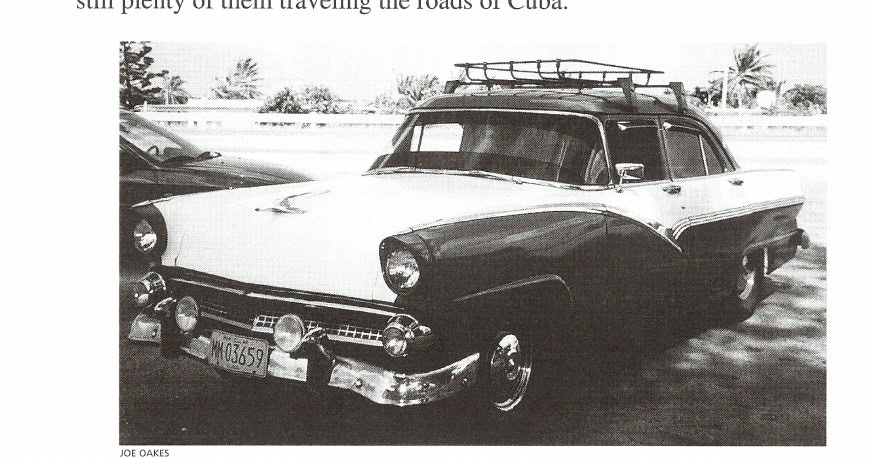
The trip through the countryside was an eye-opener. The Cuban people have nothing. Local transportation is by horse and buggy, or by automobiles from the 1940s and ’50s. At first it seems quaint and nostalgic, but this isn’t Williamsburg, Virginia, made up to look like a Colonial town; this is really how the Cuban people are forced to live. The old cars are held together by ingenuity and great mechanical skill. Parts for old American-made cars are unavailable, so the owners make what they need, using the old coat hanger, rubber band, and chewing gum theory of vehicle maintenance, sort of like we did with our junkers in high school in the ’50s. I watched one guy hand-carving a piece of rubber into a water hose for his Chevy. My beloved ’52 Plymouth Deluxe sedan was beyond repair and had to be decommissioned 30 years ago, but there are still plenty of them traveling the roads of Cuba.
Cuba’s economy is abysmal. Tourism has great potential, but the infrastructure is limited, and facility expansion is slow. Tough restrictions have kept U.S. vacationers away. The void is partially filled by European, Canadian, and Latin American travelers, who are copping great vacations at fire sale prices.
CIGAR, ANYONE?
The foremost manufactured Cuban product is the famous Havana cigar. The worldwide boom in cigar-smoking has come as a blessing for Cuba, but how long the boom will last is the guess of anyone who follows such fads.
Hand-rolled cigars are very labor-intensive, and manufacturing capacity in Cuba is limited. Other countries with modern technology are snatching pieces of the market from under Cuba’s nose. Until the death of the USSR, the costly energy needs of Cuba were filled by their erstwhile pal, Russia. Communism, it seems, has not brought prosperity to Cuba.
A skilled cigar factory worker earns the U.S. equivalent of only a pitiful $10 per month. A doctor makes about $15 a month. That hardly pays for the most meager existence. Workers are paid in Cuban National pesos, which cannot be used in shops that carry imported consumer goods, and that covers nearly all goods. The only currency acceptable in those shops is the U.S. dollar, or its evil identical twin, the Cuban Tourist peso. Dollars are hard to come by for the average Cuban. Because the people are so much in need, a large portion of the population has taken to breaking the law, trading in currencies, in contraband cigars, and in flesh. Why work hard for $10 a month when you can make twice as much with a quick score from a cooperative tourist? Penalties are severe if you’re caught, but judging by the large number of players in the game, it seems the risk is worth the taking.
Despite the fact that there is a lot of petty economic crime, at no time did any of us feel unsafe or personally threatened. Violent crime against tourists is almost unknown.
It didn’t take long for us to feel cooped up in Varadero. We didn’t feel like we were really in Cuba. We felt like we were in one of the high-class, white-collar prisons where we send unlucky stock swindlers, bankers, or Congressmen, and we wanted out. It was time to make our escape to Havana. We had a date with the Havana Marathon.
AL CAPONE AND ERNEST HEMINGWAY SLEPT HERE
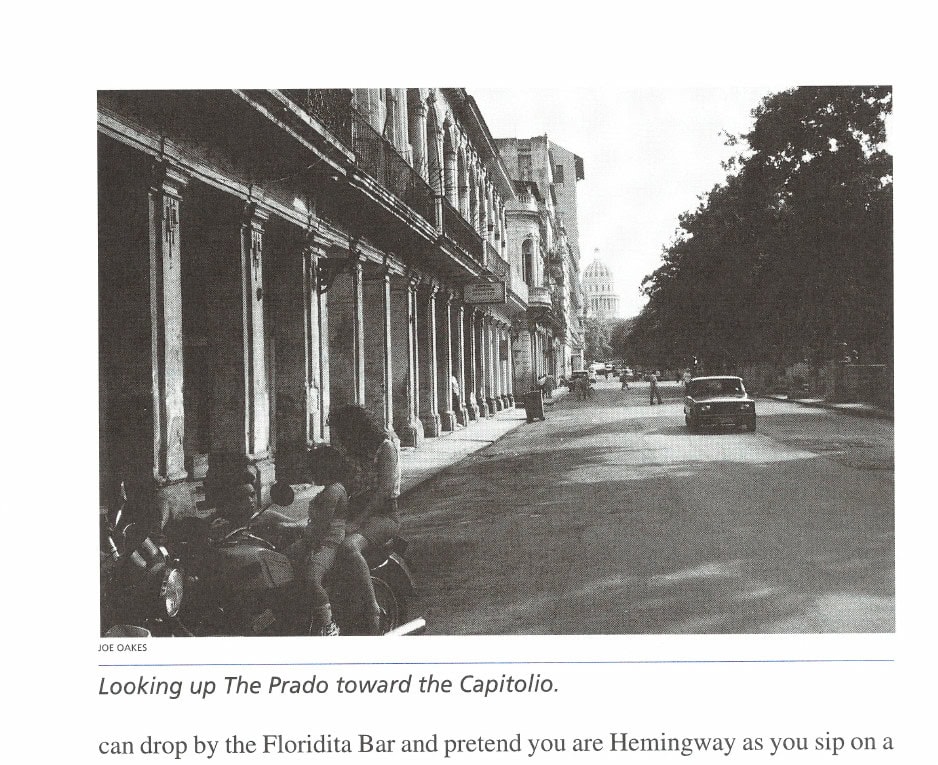
Like most big cities, Havana is a sprawl. Most of the 2.5 million inhabitants live away from the downtown area where government, commerce, and tourists coexist. The centuries-old heart of Havana is squeezed inside a small triangle between a lovely shaded walking street called The Prado, and the avenue running along the waterfront, the Malecon. At the southwest corner of the triangle is the national capitol, a duplicate of the U.S. Capitol, but much more ornately decorated.
The Prado, formerly the digs of the upper crust of Havana, was once lined with opulent homes of sugar and tobacco barons. It is a wide street where people can sit in the shade and chat or stroll the broad promenade. A few architectural gems remain, but most of the buildings have gone to seed. At the north end of The Prado, the Malecon faces outwards, looking north toward the open sea and the United States. The remnants of luxurious mansions face the sea opposite a seawall that takes the full brunt of an often violent ocean during the annual hurricane season.
Nestled between The Prado, the Malecon, and the sea is Old Havana. Ernest Hemingway hung his hat here, and he is remembered with affection by the Cuban people. His favorite watering holes have become tourist meccas. You
can drop by the Floridita Bar and pretend you are Hemingway as you sip on a too-sweet mojito.
Or you can take the elevator up to the roof garden of the Sevilla Hotel (formerly the Biltmore) for a fine dinner. This is where Al Capone and Meyer Lansky held court. Capone kept an entire floor in the Sevilla. During the time of Batista, before Castro’s revolution, the Mafia made Havana the sin capitol of the Western Hemisphere.
The streets in Old Havana take you back to another time—a time of fabulous fortunes and magnificent architecture. Today crowds jam streets that are too narrow for modern traffic. Shops on Obispo Street sell antiques, art, and old books, all trading in dollars only. Quality is good, and prices are reasonable. Cubans are frequently stopped on the street by the all-too-numerous police and asked to show their papers. They had best have a good reason for being there. Despite the police presence, Old Havana is a vibrant, exciting place. It smells like a city: old concrete, cooking odors, and the various smells of a crowd of people moving in every direction at once. Tourists are easy to identify, and the hustlers move in quickly and brazenly. Instant friends are easy to come by. All encounters start with, “Please, I only want to practice my English” and end up with you owning a box of bargain cigars of questionable quality—or something to see your doctor about if you aren’t careful.
Standing outside the Sevilla Hotel, Cowgirl and I met a young man who was clean, intelligent, and polite. José looked about 22 years old, very dark, with a big smile. Like everyone else in Cuba, he was lean. He quietly told us in good English that he was a factory worker and that he was learning English. We chatted for a few minutes before a pair of policemen came around the corner, walking in our direction. José’s pal, whom I had not noticed before, grabbed him by the arm and whisked him away. We walked several blocks in the other direction, and sure enough, there was José again, standing with some people who were eating Cuban pizza in front of an apartment that served as a take-out restaurant. The pizza smelled delicious, and José bought some for us, refusing to accept money for it. We strolled together for a few blocks, and José asked if we had bought any cigars yet. No, we hadn’t. He would take us to a place where we could get the best cigars for about half price. We crossed to the side of The Prado where tourists do not venture, down side streets, and finally into a very narrow alley. We didn’t belong in this place, and a hundred eyes told us so. José knocked three times on a door. A woman opened it part way and told us to come in. José’s friend kept watch in the alley as Señora Ramirez cleared the table to display her wares. José kept nervously peeking through the window. Six boxes of cigars were placed on the table, all Cohibas and Monte Cristos, the best and most expensive brands.
Those six boxes of cigars represented five years’ salary for a factory worker. We examined and sniffed them, pretending that we knew what we were doing. Prices were discussed, and a bargain was reached. The Cowgirl settled on a box of Number 4 Monte Cristos, paying for them in American greenbacks. A boy of about 17, who said that he worked in the cigar factory, applied a legal-looking stamp and sealed the box. When Cowgirl asked for a receipt to get the cigars through Cuban customs, our hosts became visibly upset. No, they would not be able to give her a receipt.
They might risk doing some jail time if there were paper evidence of the transaction. José sneaked us out of the apartment, through the alley, and back to Touristland. When I asked him what he got out of the transaction, he told me candidly that his commission was 10 percent. Two boxes of cigars a month would double his salary. How can you blame José or anyone else who is trying to make a few illegal dollars in this extremely harsh environment?
NIGHT LIFE
The days may be hot and humid in Havana, but the nights are HOT, HOT, HOT! There are a hundred places to go for a drink, a show, to dance, or just to listen to a variety of good music, from salsa to jazz to classical. Cubans love music. The hottest spot of all is the Tropicana night club, where the extravagant show rivals Las Vegas. The highlight of the two-hour show is the parade of lovely ladies wearing not much more than huge, illuminated chandeliers on their heads. With skin shades from very dark to very fair, they represent the spectrum that is Cuba.
If your heart cannot tolerate that kind of excitement, maybe your spirit will be lifted by the Cuban National Ballet. Housed in a century-old cheater very much like the Bolshoi in Moscow, but larger, the Cuban ballet company has long been one of the best in the world. Don’t try to get in unless you are properly attired. We were lucky to get two tickets ($5US) to a show that included Chopin’s classical ballet La Sylphide, followed by three modern dance vignettes and a short dramatic sketch done to flamenco music. The crowd was well-dressed, attentive, and appreciative. As we strolled back along The Prado toward our lodgings, I felt privileged to have attended the show.
The night crowds were out on The Prado, families taking the cool Saturday night air, lovers walking hand-in-hand, chess players under street lamps, and a handful of street hustlers. It was midnight, and we had to get some sleep. There was a marathon to run early the next morning.
RACEDAY
The weather had been consistently humid and quite warm, with a sky threatening to unload some time real soon. It would be to our advantage if it were overcast during the marathon, and a cooling shower or two would be appreciated.
We had arranged for a 5:30 A.M. breakfast so we could get to the 7:00 A.M. start without rushing. The Prado took on an almost ghostly appearance as we strolled the few blocks to the start in the predawn stillness, the late-night crowds having evaporated off to wherever late-night crowds vanish.
Roughly 600 runners were already gathered when we arrived, a goodly number of them from France, Germany, Italy, Scandinavia, and Canada. A cluster of German runners headed by a man named Manfred was singing beer hall songs for the crowd. A group from the Medoc region of France were dressed in clown suits, advertising their own marathon, where only wine is served at aid stations. They claim that it is the longest certified marathon in the world, because no one can run a straight line after two aid stations.
But the Cuban runners looked very serious. Like today’s crop of African runners, they had Cassius’s “lean and hungry look,” ready and even eager to accept whatever pain was necessary to run their best possible race. I wondered what we might do to instill that hunger in young U.S. distance runners.
A hot, red sun came up at 6:50 as if to announce that it was not going to be an easy day. At 7:00 the gun started the race from in front of the Capitol
building, and the runners were off for the first of two 13.1-mile loops. The route followed The Prado north, then west on the Malecon, making a big circle around most of the city. Runners had a choice of stopping after one loop for a half-marathon or going on for the two-loop marathon.
After four kilometers a lead pack of three runners was moving steadily away from the crowd. As the run progressed, the temperature and humidity rose. By the time Cuban runner Angel Rodriguez Ramos crossed the half-marathon mark just after 8:00 in a time of 1:04:35, both the temperature and the humidity were in the 80s.
Our runners (The Frenchman, The Dakota Cowgirl, and China Lady), unaccustomed to the heat and humidity, were wisely holding back. They would not pass the halfway mark before the winner of the full marathon, Freddy Lopez Arbolaez, finished in 2:26:39. The Long-Distance Waiter steadfastly waited at his post by the finish line, camera in hand (I am not currently a runner due to having broken too many pieces of myself on a fall on the Dipsea Trail, north of the Golden Gate Bridge).
The marathon organization was very professional. Despite a few language difficulties in the literature and in the prerace announcements, the organizers went out of their way to accommodate its visitors. Aid stations en route were plentiful and well-stocked with plastic “bite me” bags of water and oranges. Kilometers were clearly marked, and every intersection was guarded.
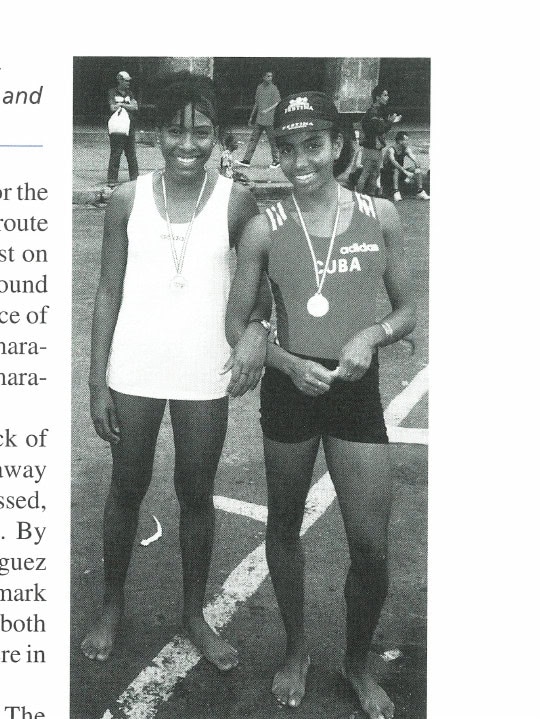
Race director Carlos Gattorno took pity on me, and I was invited to ride with him in the lead vehicle. I have participated in many marathons as a runner, but this opportunity gave me a very different perspective. As we moved around the course, Carlos wielded his bullhorn with authority, thanking the hundreds of volunteers for showing up for their tasks, and correcting any minor deployment imperfections. For the first loop, we traveled with the front-running gazelles. They acknowledged the cheers of an appreciative crowd. They were all grit and concentration, measuring out every bit of energy carefully: too much too early and you fall apart later; too little and you give away the race to someone who wants it more. Behind the lead athletes I noticed several athletes running barefoot, and many others with shoes close to falling apart. A good pair of running shoes would cost a Cuban several months’ salary. Lack of shoes didn’t stop them, though. If you love to run enough, you’ll find a way.
During the second loop we hung back to be close to the slower runners. Some of them seemed to be having a lot of fun. The Medoc gang, clown suits and all, seemed to be faring well. Just behind them were Jean and The Cowgirl, determined to go the distance.
THE SKIES OPEN
About halfway through the second loop the sky blasted open with a fury. Bolt after bolt of lightning shot from the sky with terrifyingly loud thunderclaps right behind. The rain came down in sheets, and in minutes the streets were flooded. Bottles, cans, and rubbish rushed down the middle of the road. Cars stalled out. The runners were dripping wet from headband to Adidas, but the cool rain brought blessed relief from the heat.
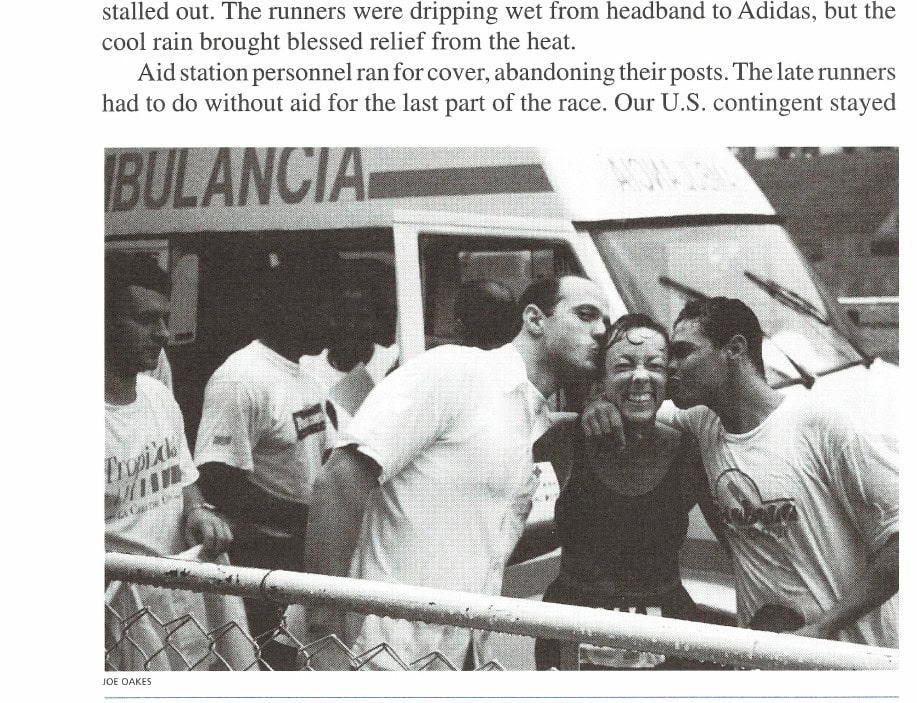
Aid station personnel ran for cover, abandoning their posts. The late runners had to do without aid for the last part of the race. Our U.S. contingent stayed the course, with China Lady finishing last of all in 5:37:13. For company she had an ambulance, an army truck, and a dozen admirers. She gave out at least a dozen very wet hugs before accepting her shiny medal. The Long-Distance (and very drenched) Waiter had braved the storm at the finish line, and he got the biggest wet hug of all.
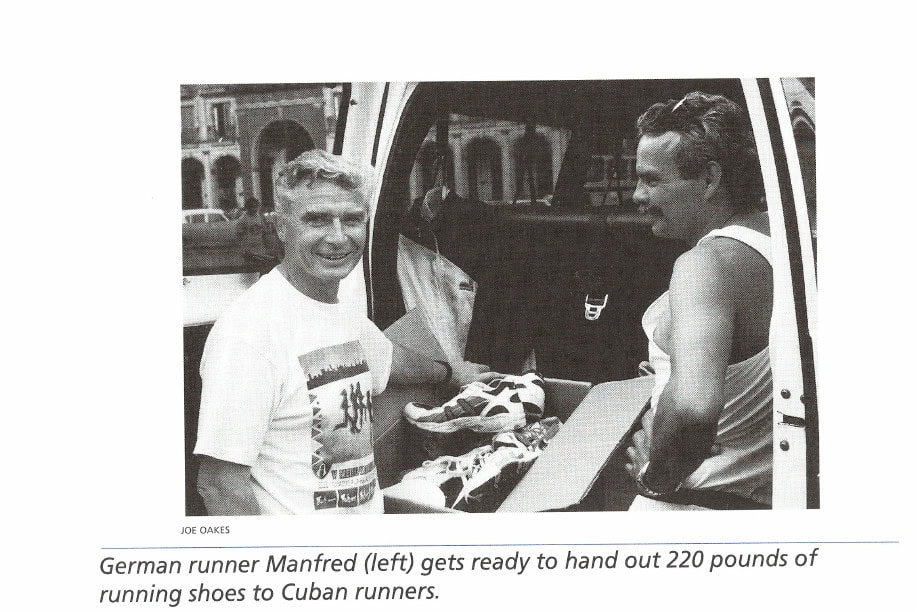
After the marathon I spotted Manfred and some of the German runners in the back of a truck, surrounded by Cuban runners. He was giving them running shoes. Before coming to Cuba Manfred had collected used shoes from his friends, gathering together 100 kilograms (220 pounds) of shoes. This was his 15th year coming to Cuba. In addition to shoes for the runners, his team had also lugged 600 kilograms (1,320 pounds) of medical and school supplies all the way from Germany. He asked me in a nonconfrontational way if I thought my country would lift the oppressive embargo soon. I wished I had a good answer for him, but I didn’t.
WE WENT TO RUN A MARATHON, BUT . . .
We found a private home that was operating as a 12-table restaurant. For $10 we could have whatever we wanted, but we had to wait while they went out and bought it. The operation was licensed, highly taxed, and closely scrutinized. But it was a small vestige of almost free enterprise. The meal was good.
We went to Cuba to run a marathon. We didn’t want to get involved in politics, but now it seems inevitable that we would at least form some strong opinions. We learned that the Cubans are warm, friendly, generous, and cultured. The Cuban people are suffering, at least in part because of the blockades and restrictions that we have imposed on them. Castro isn’t suffering—the people of Cuba are. Much of the rest of the world thinks we’re bullies, and that after almost a half-century we should just let it go. They might be right.
Besides the matter of trade, is there a good reason for us to continue to shun one of our closest neighbors but at the same time cozy up to Communist China? Is our policy inconsistent? Hypocritical? It isn’t much of a stretch to see how our European allies would cast Jesse Helms as the Devil and would see people like Manfred as the guys in the white hats. I love my country, but sometimes I think it is run by a bunch of damned fools who have forgotten all about compassion and decency. Maybe, Manfred, things will change for the better. Soon, I hope.
Cuban bureaucrats at the airport moved very slowly. Even the airport in Moscow is more efficient. We thought we might miss our plane, but the airlines are used to it. They held the plane for us and several others caught in the same bind. With the speed of jet planes, we were soon home in our own comfortable world. I’ve got a lot to think about, but I do have one wish regarding Cuba: I wish that my country would give me just one more thing to be proud of.
This article originally appeared in Marathon & Beyond, Vol. 2, No. 6 (1998).
← Browse the full M&B ArchiveMore like this
1,000+ stories from 19 years of Marathon & Beyond
The complete archive of the legendary long-distance journal — digitized and free to read.
