

Going Far, Part 5
Going Far It all goes back to a certain Kiwi coach named Arthur. Part 5. BY JOE HENDERSON
S16. The salesman
UNNYVALE, CALIFORNIA, June 1970. You might never have had an in-person coach, but you aren’t self-coached. You’re the product of all instruction and inspiration received, regardless of how remote the source.
I’ve never been without a coach. From my start, coaches had come from afar to instruct and inspire me with their own writings and from reports about them. In order of arrival in my Iowa mailboxes, the coaching lineup was: Franz Stampfl from Austria and England, Fred Wilt from Indiana, Percy Cerutty from Australia, Arthur Newton from South Africa and England, Arthur Lydiard from New Zealand, Ernst van Aaken from Germany, Mihaly Igloi from Hungary and California, and Bill Bowerman from Oregon.
They all traveled great distances to help me and had no idea at the time who I was or how much they had helped. Only later did I get to tell most of them how far their influence had spread. My first meeting with any of these coaches came 10 years after his words had first reached me and a hemisphere away from where he had written them.
Arthur Lydiard was no taller than I, so we could look each other straight in the eyes. But his persona was so outsized that he would always remain bigger than life to me. Lydiard had revolutionized running training, knew it, and didn’t hesitate to take credit.
Lydiard had the manner of a traveling salesman, convinced that he had the best product and wanting everyone to know. When we met for the first time, he was on a worldwide selling mission that had begun in the early 1960s and would continue the rest of his long life.
Nine o’clock, Monday morning. I sat down to scribble a few questions for that day’s interview with Arthur Lydiard, and had only reached “2” when in walked Forrest Jamieson—an ex-Drake University runner like me, a generation earlier. “Jamie” employed Lydiard’s training practices in his own running and with runners he coached. Now he acted as Arthur’s host and unofficial public-relations man during the New Zealander’s short stay in our area.
Jamie was in my cubicle a half minute before I realized that he hadn’t come alone. Standing in the outer office was a fit-looking little man with intense blue eyes peering out from a deeply tanned face. The face had looked at me dozens of times as I had read and reread his classic training book, Run to the Top. Now we were meeting before I had prepared myself for that.
Lydiard asked the first question: “What do you want to know?” About all I had to do as an interviewer was turn on the tape recorder, prompt him every five minutes or so, and hear a fascinating monologue.
Back in the 1960s, other coaches, even in his own country, had scoffed at the idea that a large volume of slow training (many overlooked the fact that it was topped off by a considerable amount of fast “sharpening”) could result in fast racing. Lydiard answered his critics by taking a largely unsung band of Kiwis to the Olympics in Rome. Peter Snell won the 800, Murray Halberg won the 5,000, and Barrie Magee finished third in the marathon. Between Olympics, the New Zealanders set world records and then Snell won twice at the Tokyo Games.
Since 1964 not much had been heard about Arthur Lydiard’s athletes. The reason was simple. He hadn’t coached many individuals since then. Instead, he had concentrated on “coaching coaches,” selling his ways to them so they in turn could pass it along to their athletes. He did this as a Mexican and Finnish national coach and had continued pressing his points at lecture after lecture wherever he found a stage.
The evening after our interview, Lydiard spoke to an audience like those he faced almost daily to deliver the same basic speech. This latest talk received precious little publicity, but the word spread well enough through the running grapevine to draw a crowd of 150 to a school auditorium. These runners and coaches wouldn’t let Lydiard leave the auditorium for an hour after his lengthy formal presentation ended. He had convinced them that what he said was valid, and they grasped for every last word.
Update: Lydiard’s farewells In 1999, Arthur Lydiard took what he and we thought at the time was his “farewell tour” of the United States. He had been coming here from New Zealand for almost 40 years by then, and he still loved the attention that greeted him in the United States. That acclaim kept him going.
Most of today’s runners hadn’t yet started when Arthur Lydiard was in his coaching prime. Many weren’t yet born. Some critics now call Lydiard’s methods “outdated.” But there is no expiration date on expertise, no statute of limitations on what works.
Rich Englehart, a longtime Lydiard devotee, saw him in Boston during that “last” tour. “It was an interesting evening—and a bit sad, quite honestly,” said Rich. He saw his coach as an unsteady old man of 82. Most runners attending were in their masters years. “My pervasive feeling was that I was at a meeting of People Whose Time Has Passed. Right outside the auditorium, one of the local clubs was running a group interval session on the track. The conference organizers went out and invited them in for free. But they all decided they would rather stay out and do intervals than come in and listen to some old guy tell them that maybe they should be doing something else.”
Rich added, “My experience isn’t going to change anyone’s mind. But it assures me that I chose to follow the right leader—both when we were all much younger and recently when I signed up for his online coaching advice and improved by 1:45 in the track 5,000.”
That 1999 U.S. tour wasn’t Arthur Lydiard’s last after all. He encored in late 2004, at age 87, bringing along the baggage of four strokes and two knee replacements. Rich Englehart again met his mentor in Boston and then drove him to Washington, DC, with an overnight stop en route. “This was one of the greatest experiences of my life, spending two days alone with him,” said Rich.
The high point of the tour, and not just in elevation, was Lydiard’s talk in Boulder before his largest crowd of 400. He shared the stage with Mark Wetmore, the college coach whose methods closely follow the Lydiard system. Wetmore’s Colorado teams had won both NCAA cross-country titles the week before. “I owe everything to Arthur,” said Wetmore. “I am just the delivery boy for his great message.”
Little more than a week later, the greatest running coach we’ve ever known was gone. After speaking to a Texas audience, he returned to his hotel room and suffered a fatal heart attack that evening. Lydiard left on a high note, not in reclusive retirement in New Zealand but on the road, still spreading his timeless message to anyone who would listen. The message outlives the man.
17. The relay LOS ALTOS HILLS, CALIFORNIA, June 1970. You need to go too far before you can know how far you can safely or willingly go again. Between mid-1970 and late 1971, I found that my limits were farther out than I had imagined they could be—and beyond where I would ever want to push later. This period included my longest training runs (30 miles, twice), longest completed race (a 50K), longest
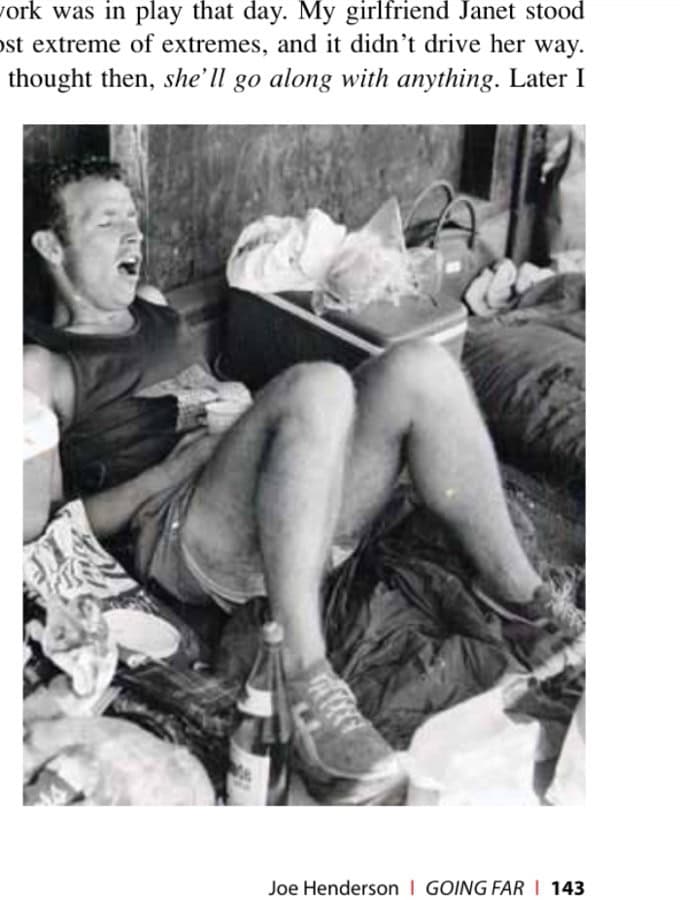
steady run (40 miles of a 50-mile race), and longest run-walk (70 miles of a 100-mile race). I would pay a steep price for all this, but only later—in 1972-73. My most extreme race was none of the above. I never ran farther, faster, than the day of 26 miles at 5:38 pace. This wasn’t a true 2:27 marathon but a “marathon” of individual miles, on the track, with almost an hour in between, spread across a full day.
Bob Anderson put me up to this. He was the idea man at Runner’s World— the one who gave the magazine its life and name, the one who spawned a book division, the one who would conceive a national fun-run program. When he said, “Let’s do a 24-hour relay, 10 runners to a team, a mile at a time in a set order, seeing how many miles we can total,” this sounded like a great idea to me. We were of an age and stage in our running lives when we would try anything.
This was interval training at its extreme. Without the team, competing against five other teams, I wouldn’t have run even two of these miles. Without the team, I wouldn’t have given up a night’s sleep. Without the rest breaks that the nine teammates gave me, I wouldn’t have averaged almost a minute per mile faster than in any true marathon.
Another type of teamwork was in play that day. My girlfriend Janet stood by while I went to this most extreme of extremes, and it didn’t drive her way. If she’ll put up with this, I thought then, she’ll go along with anything. Later I would learn otherwise.
Update: team theme This race in Shreveport, Louisiana, gave no advance warning that it would be one of my most memorable in years. I hadn’t even planned to run the race before traveling there. This wasn’t a true running event but a triathlon of sorts: a walker, a biker, and a runner competing as a team. Two women I knew only
▲
Grabbing some rest, right on the track, during my longest interval session. It lasted all day.
as Jan and Gigi recruited me as their 5K runner. Our teamwork added an element that had been lacking from my racing for a long time. For one who claims to be a loner—who trained apart from my high school and college teams and who now runs alone 99 days in every 100—I still have a fondness for team racing. Spending so much time by myself makes the rare chances I have to work together all the more special.
Nowhere else in this sport does teamwork mean so much as in a relay. Team scoring in track, where milers and shot putters are as unrelated as swimmers and football players, always seemed artificial to me. In cross-country, individual runners’ places are pooled for a team score that means something. But if anyone in the top five falters, other runners can step up to replace them in the scoring.
In relays, no one succeeds unless everyone does. The resulting pressure and pleasure places relay races among my fondest memories. What I did there wouldn’t have meant anything if we all hadn’t done our part in these races: •
Running on the two-mile relay team my first season of track, as a high school freshman and being lifted all the way to the Iowa state meet • Breaking the tape at only one major race in college, while anchoring a
distance-medley relay team (which set a short-lived school record) at a Kansas indoor meet • Competing (as noted in this chapter’s opening) in the first Runner’s World 24-hour relay for the company team—and running more miles, faster, than
I would have thought possible • Circling Lake Tahoe, 72 total miles, as part of a group of seven strangers who became a team that day Both my biggest failure and greatest success in track center on relay races. South Page High School would have won the state indoor track title the first year of that school’s existence if a relay team had placed first. My teammates did their jobs by handing me the baton within reach of the leaders to start the final half-mile leg. I focused on catching up little by little and forgot about everything else—including counting laps. I “finished” one lap too soon, and the team lost not only the race but the meet.
In college, I wouldn’t have run many big meets if not on relay teams. Twice in my junior year, at the Texas and Kansas Relays, I led off four-mile relay teams. In both, I ran 4:18. It wasn’t by chance that these would be the two fastest miles I would ever run.
These stories illustrate the two sides of teamwork. You gain extra support from the teammates but also carry added responsibilities. Running for a team adds to the prerace concern over letting the others down, but in turn the worry makes you push harder and multiplies the postrace joy over your joint successes.
It’s no accident, then, that my fastest 5K in years came at the Shreveport Triathlon Relay. That race brought back the old mixture of fretting about failing the team and excitement over doing better together than I would have done alone. The nice twist in teamwork is that by giving more of yourself to the team, you get more from and for yourself in return.
18. The missionary BELMONT, CALIFORNIA, August 1970. Before running could grow up, it had to become more than a competitive sport. It had to pull in more than its mostly young, almost exclusively male, largely lean and fast demographic of earlier years. Kenneth Cooper, who himself had grown up as one of those runners, now reached far beyond them.
The first time I saw him, Cooper wore the uniform of an Air Force officer. He would have looked equally at home in the white coat of a physician and medical researcher or the robe of an evangelical preacher. Attendance at this speech on a Coast Guard base was mandatory, and the guardsmen responded in a fashion typical of military personnel under orders. They filed into the dreary auditorium dutifully but with little enthusiasm. Slouching into folding chairs, they lit cigarettes and chatted full-volume. “
Quiet!” an officer-turned-MC shouted. “Douse those butts and give the speaker your full attention.” This order was hardly necessary. Before the guest had talked five minutes, he had shamed these listeners out of ever wanting to light up again, and their attention to him was voluntary.
Before he said a word, Lieutenant Colonel Kenneth Cooper commanded respect. The Air Force doctor was tall, trim, and military in bearing and supremely confident in voice. Winning over reluctant audiences was his specialty, and his message was less that of a military or medical man than of a missionary.
Dr. Cooper leaped immediately into convincing and converting. A decade of research supported his speech, and hundreds of repetitions had polished his delivery. He marched out the facts: “Heart disease is the number-one killer” . . . “Smoking damages the heart” . . . “So does obesity” . . . “The average American, of all ages, is dangerously unfit.” Simply by looking at themselves or their near neighbors, the listeners could identify with these frightening figures.
After first striking fear in his audience, Dr. Cooper laid out his alternative: “aerobic exercise.” The concept meant nothing to this group, so he defined it as low-intensity, sustained activity that raises the heart rate but still allows normal breathing. “Running, swimming, walking, bicycling—all of them will do this,” he said. “But jogging and running are definitely the most practical and time efficient.” Slides of real people flashed across the screen. Cooper named them and told before-and-after stories about reversing the effects of physical neglect. He
didn’t talk about the athletically gifted training for competition but about normal people “training for life.” His arguments impressed me, but I thought then that they had little to do with me. I was beyond all this—running far more than he recommended, racing almost weekly, often in marathons and with ultras on that year’s agenda. Little did I know that by the 1980s my routine would ease down to the level that Kenneth Cooper had preached, prescribed, and practiced in 1970, that I would settle at that amount for decades to come and that I would have so much company there.
Update: running’s revolutionaries Running, the act, didn’t need inventing. It came to us—take your pick— from the great master planner of the universe or by evolutionary accident. Humans are designed to run, and only in the last blink of our history has this act become optional.
The activity of running, the modern sport and exercise, did need shaping. Inventors, innovators, and instigators had to step forward to lead us where we are today. Who are they? I’m better at reporting than predicting, so I can see now what was hazy to me in 1970: how big running would become, how long that first boom would last (it quieted in the 1980s before booming again, louder, in the 1990s), and who laid the early foundation for all that we still have.
ad
Two major and separate streams—running for fitness and training to race—came together in the late 1960s and early 1970s. The two greatest pioneers were Kenneth Cooper and Arthur Lydiard. Fittingly, each had dipped his feet into both streams.
Dr. Cooper was a college miler, and then he ran the Boston Marathon while in medical school. As a military physician, he began researching fitness, which led him to praise endurance activities such as running, which led to his best-selling book Aerobics, released in 1968. This book inspired hordes of new adult-onset runners because running was simple and time efficient. Many of them reached Cooper’s prescribed amount—two to three miles, three to five days a week—and looked to go longer and faster.
Lydiard is the New Zealander who exported fitness running, “jogging” as it was called then, to the United States by way of Bill Bowerman. Lydiard is better known, though, as a coach of Olympic medalists: four runners with four golds and two bronzes among them, all coming from his Auckland neighborhood. This coach turned away from the standard training of his day—almost all of it fast and on the track. His runners trained long miles on the roads and trails. Their success bred imitation, and soon runners everywhere were training longer and slower.
The two separate streams joined in the 1970s to flood the roads with runners. Aerobics graduates took the next logical step up, to low-key road races. Lydiard devotees found they liked training on the roads and began to race there as a welcome step down from the intensity of track.
Others, athletes and journalists, organizers and entrepreneurs, are credited with igniting running’s first boom—Kathrine Switzer for women’s opportunities, Frank Shorter and Bill Rodgers for success at high levels, Jim Fixx and George Sheehan for their writings, Bob Anderson for his magazine. But they are at least equally the products and beneficiaries of the running revolution that Kenneth Cooper and Arthur Lydiard had the most to do with inspiring.
19. The speech CULVER CITY, CALIFORNIA, September 1970. Even this early in my writing life, written journalism was already losing ground to the spoken word. More Americans named radio and television, not newspapers and magazines, as their main sources of information and entertainment. Writers could still earn a living with their typewriter, but their prospects were better if they added their voice.
Though I wasn’t trained for public-speaking parts and had spent my early years actively avoiding them, I would become increasingly verbal through the years: giving speeches, appearing on radio call-in shows, sitting for television interviews, voicing color commentary for event broadcasts, PA announcing at races, narrating instructional videos, and taping promo ads.
But all of this was yet to come in 1970. As a writer I wrote, nothing more. Then a call came from Southern California. Syd Kronenthal, director of the Western Hemisphere Marathon, said, “We’re organizing a symposium for runners here in Culver City, and we want you as a speaker. Interested?” Well, no, but I couldn’t bring myself to say that. With my belly already knotted at the mere prospect of standing before an audience, I agreed to appear.
My first-ever appearance before a runners-only group wasn’t professional in any sense. I bought my own plane ticket, a cut-rate commuter fare, and took up Orville Atkins and Ron Larrieu on their offer to stay free at their apartment. I had bunked there three earlier times in as many years, always for the Western Hemisphere Marathon in Culver City. I had slept fitfully each time, but now my nerves revved to a whole new level for the talk at the same building where the marathon had started and ended.
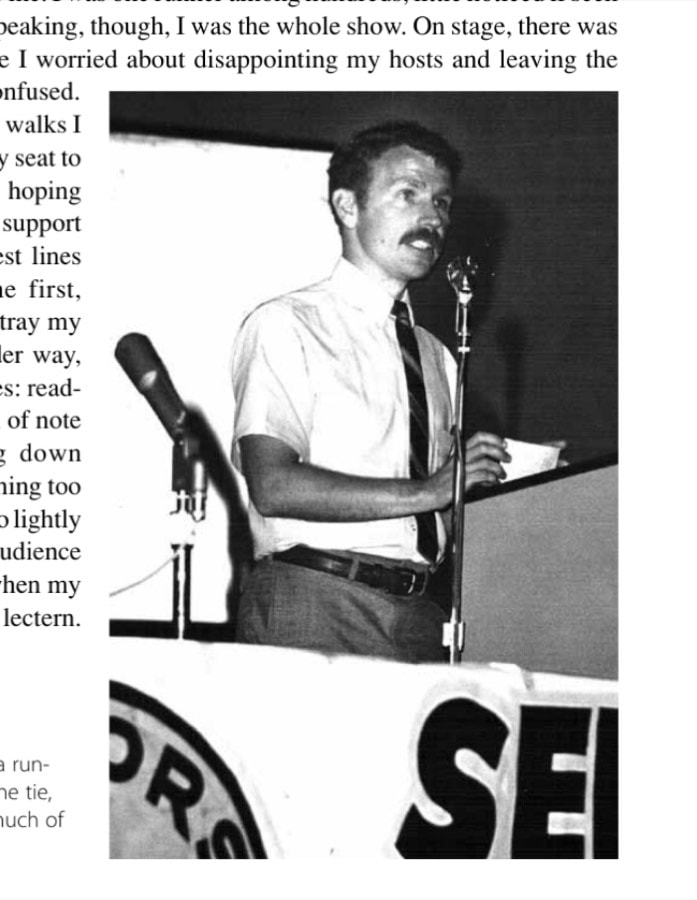
I fretted before marathons from not knowing how they would go. But the results really mattered only to me. I was one runner among hundreds, little noticed if seen at all in midpack. In speaking, though, I was the whole show. On stage, there was no place to hide. Here I worried about disappointing my hosts and leaving the listeners dazed and confused.
One of the longest walks I ever took was from my seat to the Culver City stage, hoping my weak knees would support me. One of the hardest lines I ever spoke was the first, hoping it wouldn’t betray my near panic. Once under way, I made rookie mistakes: reading from a thick stack of note cards while looking down instead of around, leaning too heavily on facts and too lightly on storytelling. The audience was as relieved as I when my last 3-by-5 card hit the lectern.
▲
After this first talk to a running group, gone were the tie, most of the notes, and much of the tension.
With practice I would grow more comfortable with public speaking but never totally relaxed at it. Nor would I want to be. As in races, a little uncertainty and anxiety make the big effort go better.
Update: name calling My favorite type of public talking became race announcing. There I was a mostly anonymous, disembodied voice, putting attention where it belonged: on the runners, directing them to the start and welcoming them at the finish.
My main qualification for this job was that I didn’t suffer from microphobia, a fear of the amplified voice. I was happy to arrive early and stay late to talk to a captive audience of runners. My role as announcer was to talk directly to them—to inform and then recognize them—and not to whip up excitement from sparse crowds of spectators.
Announcers “run” the starting line. Their voice herds the runners to their proper place at the right time, which gives a sense of power. Yet the job can also be humbling. Runners assume that the person holding the mike really is in charge and has all the answers. Either that or they make the announcer a paging service for lost running partners. Or they make him a handy target for complaints.
As race day dawned at an Oklahoma City Memorial Marathon, I announced that the baggage drop would be on the street east of the starting line. “Which way is east?” someone asked. Uh, look toward the rising sun.
The longer and more satisfying job comes at the finish line. That’s where the announcer reads as many names as possible. In Oklahoma City, the last finisher checked in 8:05 after starting. The least she could expect was a proper welcome home, which is why I set a “PR” that day for longest time at a marathon’s microphone.
Runners’ chip times popped up on my computer screen as they finished. Using that system forces the announcer to watch the screen instead of the finishers themselves. It caused me to miss Dick Beardsley, the weekend’s featured speaker. He anchored the winning two-man relay team, but only his team’s name was called. Another famous relay pair ran under their own names: Frank Shorter and Bill Rodgers.
The big names soon were gone. The local TV crew signed off, packed up, and left. My task here had barely begun. By the cutoff time, I had chanted thousands of names. Thanks to the computer, I hadn’t missed many and regretted missing any. I know how it feels to cross a finish line unnoticed.
To an uninvolved bystander, my voice sounded like it had read nonstop from a phone book. But the runners had heard the most wonderful words in the world, their own name, even if it wasn’t spoken quite right. Each one took only seconds to say. But it left each finisher with a final, lasting memory of the event.
20. The duel ROCKLIN, CALIFORNIA, October 1970. If you go to enough events, you might one day see running history in the making, not on television, film, or tape but as an eyewitness. If you’re really lucky, you might even see that historic event as a bit player on the same stage where the stars perform that day.
For most sustained drama and strongest personal investment, the greatest race I had seen in person so far was the national 50-mile championships in Rocklin. Fewer than 100 people, equally divided between runners and watchers, witnessed this event. None of them, not even the two main characters, knew what was about to unfold that day.
In my first race at this distance, I saw little of how their race played out until the very end. We repeatedly looped a five-mile course, and as the leaders lapped me I switched from running to spectating—dropped out, that is. I would like to say that I quit my race to watch the one up front. In fact, the miles had taken their toll on me before the top two runners roared past, locked in a duel. At the lap-counter’s checkpoint where I stopped, I first heard that “Skip Houk and Bob Deines are on American-record pace.” That mark was 5:38:11.
From then on, I took care not to favor one front-runner over the other with my cheers. Bob Deines had become a good friend and sometime training partner, but I also knew his rival, Skip Houk. Road racing of that era was so underpopulated that everyone knew almost everyone else.
Houk had led most of the way. Then Deines had entered the last lap eight seconds ahead. Ex-boxer Houk had lost his lead but not his fight. Deines now came into view first—tie-dyed orange singlet pasted to his ribs, blond hair bouncing at shoulder length. Seconds later someone yelled, “My God, there’s Houk! He’s closing in!” His stocky figure looked all the more so compared with Deines’s skin and bones. Houk closed faster, shrinking the gap to 10 yards before the distance ran out. He might have won if the race had been a tenth-mile longer. Their times—5:15:20 and 5:15:22—both broke the national record by almost 23 minutes. What they did was all the more impressive because of what I couldn’t do on the same course that same day.
By 1970, I had already seen events as lofty as the Olympics. I would go on to see two more Games in person, along with several U.S. Trials and major track meets by the dozen. The best race I would ever see wouldn’t be the 1972 Olympic 10,000, where Lasse Viren fell in midrace and then jumped up to win in world-record time. It wouldn’t be the 1982 Boston Marathon, the “Duel in the Sun” where Alberto Salazar eked out a victory over Dick Beardsley. The greatest would remain Bob Deines versus Skip Houk at 50 miles.
Update: short longs My career as a would-be ultrarunner was as brief as it was dismal. It took me exactly 19 months and four failed tries in five attempts to realize that I wasn’t cut out to go this far. Or maybe I just never trained enough for it, since my nonrace runs beyond marathon distance totaled exactly two—ever.
Never mind that my first ultra attempt resulted in my longest distance to date—35 miles. This came on the first day of a stage race that was scheduled to reach 100 miles on the third day. The first round left me too sore and tired to answer the bell for the second.
Never mind that my first stab at 50 miles produced my second-longest run so far. This came while Bob Deines and Skip Houk dueled for the American 50-mile title and record. I couldn’t face another five-mile lap and stopped at 30 miles and watched their stirring Deines-Houk finish.
Never mind that my first experiment with run/walk led to the longest distance, by 30 miles, that I would ever travel on foot. This came in a 100-mile race, and by dropping out at 70, I would never leave so much of a race—another 30 miles— incomplete. (This eye-opening failure gets a closer look in a later chapter.)
Never mind that my last try at ultrarunning yielded the longest run ever without scheduled walk breaks. This came in the same 50-mile races as the year before, on the same five-mile course. This time I came two laps closer to finishing but still couldn’t push past 40 miles.
Each of these failed attempts to finish left me with a consolation prize. But only one race beyond 26.2 miles was an unqualified success. No surprise that it also was the only one I went into well prepared, first with the 30-mile training run of sorts in the “Deines-Houk” race of late 1970, then another 30 with Jeff Kroot (my longest-ever true training run) about a month later, and finally a marathon race (more training in disguise) a month after that.
Then I entered a 32-mile race from Santa Rosa to Petaluma, California, and back. Today’s ultrarunners who climb mountains on trails might call this race of little more than a 50K on flat roads “nothing but a slightly long marathon.” It seemed plenty long to me, thank you, as I passed the marathon checkpoint (in 3:01) with almost a 10K to go.
This time I didn’t stop, didn’t slow, but actually upped the pace a bit in those extra miles. I would have taken more pride that day if I had known it wouldn’t be the first of many finishes in ultras but the one and only. Going Far will continue in our July/August issue.
This article originally appeared in Marathon & Beyond, Vol. 17, No. 3 (2013).
← Browse the full M&B ArchiveMore like this
1,000+ stories from 19 years of Marathon & Beyond
The complete archive of the legendary long-distance journal — digitized and free to read.
