

Going For The All-Geezerteam
My goodness, it’s a lovely day! I’m running easily through gorgeous, leafy suburban Concord, Massachusetts, surrounded by fleet, fit females as we hit the first mile mark in the local Fourth of July five-mile road race in something like 6:50. It’s a treat to be running with Karin, Cricky, Lindsey, and Emma—the core of our high school’s second-in-the-state cross-country team—and as a 60-year-old coot, I savor all the more this rare chance to run with some of the girls I coach in the fall. Ah, life is sweet, but, damn it, I have an agenda. The girls are larking, gabbing, and into a fun outing, while I, well, I’m a tad behind schedule and have to get a move on, because—gulp—I want—it’s hard to admit this, but—I want to win today. Win, you ask? Win? Um, come in first? What about that crowd of runners ahead of you?
OK, OK, here’s the thing: I harbor no illusions about jetting up to the race leaders, who are already close to two minutes ahead of me after a mile. But I do want to win my age group, which I believe I can do with a sub-34-minute time (last year’s 60-plus winner clocked a 33:44, a time I had bettered back in April in winning a Lexington five-miler). So, hate to say it, but girls, I gotta go! I have (if only to myself) promises to keep, and at least four more miles to go before, well, whatever. * * * A brief history: I didn’t start running until I gave up smoking at 31 and sort of spontaneously broke into a trot a couple of months later. The trot grew into a habit—you runners know the story. The runner then gets curious about racing as he feels himself getting into shape, and so on. I was doing this in the mid-1970s (with a few million others—no visionary pioneer I!), and I was young and strong and all was right with the world—at least, with the running world. I loved it, and I even got pretty good at it, though there were so many better runners around that
I hardly noticed my own prowess. It was personally thrilling, sure, to be under 28 minutes for five miles—but I was one of a crowd. Breaking 2:50 for a marathon was a worthy achievement—but only what anyone had to do to run the Boston Marathon, and thousands did it. It was exciting to plan, and then to run, a subfive-minute mile—but since more people finished ahead of me than behind me in that mile test event I had orchestrated, my satisfactions were personal and didn’t include any notion of general . . . victory.
Victory. Finishing first. Going faster than everyone else. That was not on the menu, it seemed, no matter how good I got as a runner. And I never even really thought about it. I generally ran with people who were good runners, clearly faster runners than I, and I simply never expected to beat them. I knew who the best racers in my club, Cambridge Sports Union, were, and I wasn’t among them. Then there were the heavy hitters from gangs like the Greater Boston Track Club—whew! Forget about competing with them! And, of course, you constantly read about the superstars of running, the Seb Coes and the Steve Scotts and the Mary Slaneys and the Joan Benoits. You could be inspired, but you didn’t actually dream of doing what they did, which was, over and over, winning.
Besides, my arc of progress was inevitably slowing and finally stopping. After nearly a decade of running, it began to dawn on me that PRs hadn’t been coming along much—in fact, hadn’t been coming at all! My 27:16 for five miles at 36 was—I swallowed hard and had to admit after a few years—going to be it. And 1983, the year of my older son Patrick’s birth, saw me plummet from a 2:50-ish Boston to being a basic nonrunner for months after his arrival. My plans for a comeback in 1984 were grand but came to nothing as I struggled (and often failed) to get in training months that matched the 70- or 80-mile weeks I had put in a few years earlier. As I turned 40, I had a 1-year-old son and was way out of the trainingfor-marathons business. But having a baby around wasn’t the whole problem—I also found cranky tendons, cranky back, and general bodily crankiness becoming more the norm than the exception. I got in a few races over the next couple of years, but second son Eamonn’s arrival when I was 42 basically knocked me out of any racing at all. I never stopped running—that would have been unthinkable! But I was a very different runner than I had been a decade before. * * * My earliest foray into age-group racing, in a 1985 hometown three-miler in Connecticut, was symbolic. I had actually gotten in some sporadic training, had some speed left, and felt as though I could run hard and have a shot at a masters (over 40) win. I ran well, a 16:41 for second place overall—the closest I’ve ever come to actually winning a race, in fact! Amazing, really, and more a testament to the residue of years of hard training than to any then-current work. I felt pretty darn good, I can tell you, ready to have my ego boosted by recognition in front of my old neighbors and my family as I strode up to receive whatever massive
trophy would surely be mine. But as it turned out, the one guy who finished (five seconds) ahead of me was 40, too, and was handed the winner’s trophy and the master’s winner’s trophy, and I watched in fuming disbelief as a train of others came forward to get their age-group prizes, me empty handed, seething, the odd man out.
As I hit 50 in 1994, I thought I could get my running act together again. I was in a steady job situation, baby management had become much-easier boy management, and I aimed to see what I had left, working back to a steadier (if more modest) training scheme of 30- to 35-mile weeks. Whereas I had no regular running log for 1985, my 1995 log (just purchasing one was a sign of hope) shows that I had enough left to turn in a 30:55 five-miler in Lexington on Patriots’ Day, then push to a 14:59 two-and-a-half miler—yikes, six-minute pace!—the following Saturday at the regular Fresh Pond race. OK. I was actually called by some running-club mates and recruited to be on their 50-plus team in the following weekend’s James Joyce Ramble 10K. So my 40s hadn’t seen me emerge as an age-group star—my time was here at last!
A week later I had banged up my Achilles tendon sufficiently to shelve me for nearly a month en route to a disappointing 40:55 10K where I did neither the team nor myself any good and should doubtless have dropped out instead of hanging in only to worsen my injury. The temptations of age-group glory had done me in. The same year, I started coaching the girls’ cross-country team at the high school where I teach and discovered something all coaches know: coaching is not good for your own training.
Finally, as I approached 60, I thought again about trying to make an age-group splash. Just in time, too, as that’s about it on the age-group front: most road races have masters (40-49) and veterans (50-59) categories, then slide to whatever they call age 60 and above. If it didn’t work out this time, in other words, there was not going to be a chance later to mix it up with the septuagenarians or octogenarians separately. I was already in their camp. (This isn’t true for events like national track competitions—there you find age groups right on up in five-year denominations, so you could, for example, take part in the 400-meter race for 75- to 79-year-olds. But 99 percent of local road races figure—correctly, I’m sure—that giving age-group awards for groups that are unlikely to participate in measurable numbers would be silly.)
So, as 2005 dawned, there I was: training about 25 miles a week less than in my heyday and weighing about 25 pounds more—not an ideal combination. On the other hand, I was 60, a bona fide oldster, and ready to go to work. I began to ratchet my mileage back up into the 30s from the lows to which it had dropped as I coached in the fall and worked to peel off some poundage. The all-geezer team beckoned!
Courtesy of Tom Hart
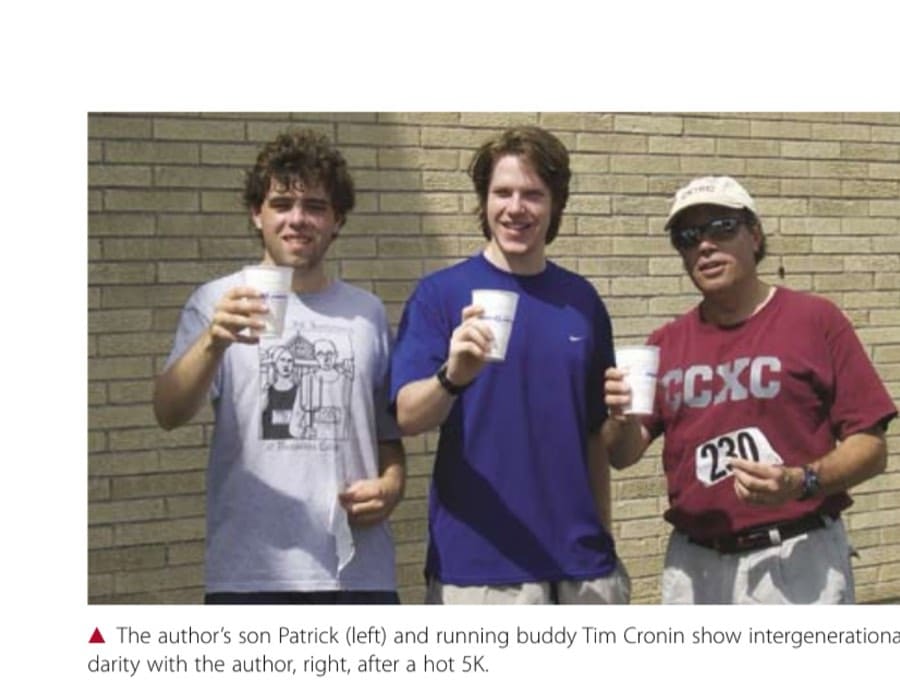
▲ The author’s son Patrick (left) and running buddy Tim Cronin show intergenerational solidarity with the author, right, after a hot 5K.
What follows is the story of my quest: some highs, some lows, some surprises, and some lessons. For whatever they’re worth, and for whatever amusement they afford my fellow runners, I offer them here. One man’s quixotic search for WMD—in this case, of course, the letters don’t stand for weapons of mass destruction, but for winning my division.
Race #1: February—Super 5K, Lowell Either I wasn’t ready, or no age-group race opportunity presented itself in January— probably both. I had decided to begin my trophy-hunting career at a race I had done a year before to mark progress in my early weight-loss and reconditioning efforts, an event on February 6 (Super Bowl Sunday) called the Super 5K, in nearby Lowell. I did get in a local fun-run 2.5 miler at Cambridge’s Fresh Pond a couple of weeks before that event as a kind of tune-up and did that in 16:44, which I felt OK about, since it was my first race in a long time and was over a snow-packed course in places. I felt pretty good, in fact, and looked forward to a solid race in a couple of weeks—solid enough, at least, I thought, to be a factor in my age group.
Race day turned out to be warmish for February. I actually was regretting wearing my winter tights and took off a couple of top layers to race in just a Tshirt with them. I wanted to be fairly aggressive, hoping to get near 20 minutes and bag a WMD, so I went out reasonably hard. I could see a guy who clearly was in my age group (and hoped maybe he wouldn’t be able to tell quite so clearly
that I was an age-group rival, in case that helped me sneak past him—I was definitely in a most competitive mindset!), and he was moving along pretty darn well! I tucked in behind him and also noticed in our group another possible old guy and a couple of womenfolk—one a young girl, in fact, who was running along effortlessly, it seemed, and looked like a middle schooler. Jeez, she would surely fade . . .
I had checked the previous year’s results and seen that the winner in the 60plus group had done 20:21. I had been pleased enough with my own 22:02 then, as a kind of starting point on what I hoped would be a journey back to competitive fitness. I knew that I could beat my own last year’s time and thought I could be somewhere around the previous winner’s time—and now it seemed as though I was probably running along with that guy, or some version of him. We passed the mile in 6:18, which seemed, simply, too fast. Oh, no! Had I blown it and been too aggressive? Who was going to fall apart first in our little flotilla? There was indeed a bit of jockeying and position shifting, but, rather surprisingly, no one crashed and burned, and we all kept together.
And we all finished within 10 seconds—first, the woman, who won the women’s overall in 20:22, and next (wow!), the 13-year-old, in 20:25—the fast start appeared to have taken anyone’s ability to kick away, and we crossed in the line we had been in for the last mile plus. First across in our division was the previous year’s winner, 68-year-old Bill Spencer of New Hampshire, in 20:28, followed by 62-year-old Joe Drugan in 20:30, and 60-year-old me in 20:32. So much for kicking age-group butt! So much for things being less competitive in my new division! WMDs were no easier to find for me than they were for the American soldiers in Iraq. I had run a pretty darn good race and been beaten by two older guys and two younger women. Yikes!
I did take home a trophy—a little statuette of a football player (get it, Super 5K on Super Bowl Sunday?)—and I did have the satisfaction of having cut a minute and a half off of my previous year’s time as well as hearing various wows
Courtesy of Tom Hart
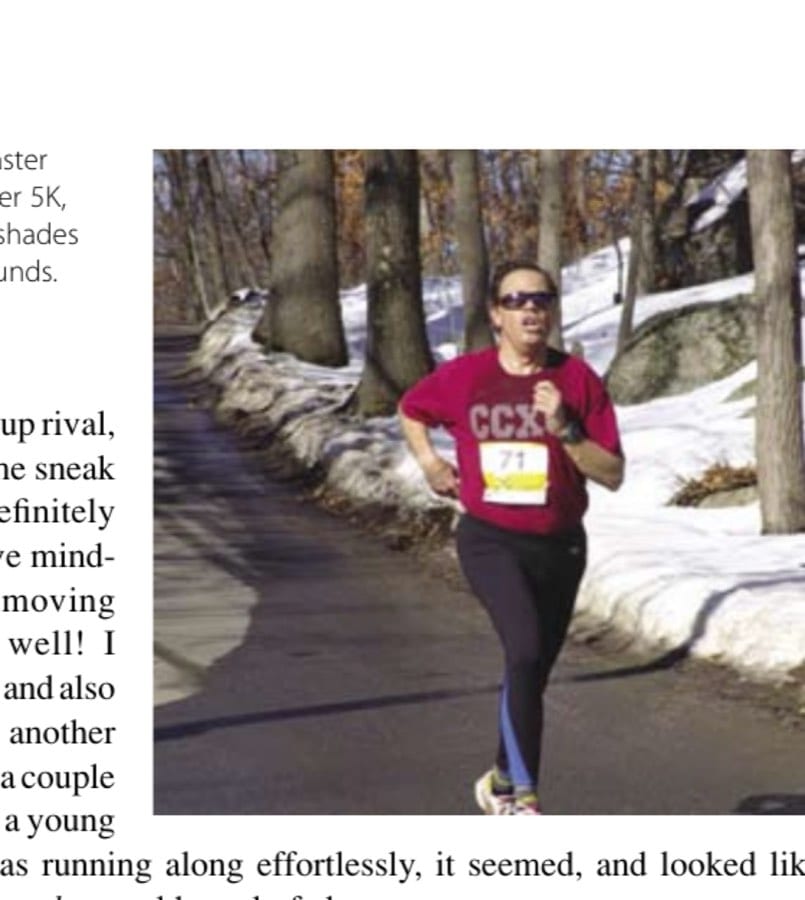
▲
The author chases faster geezers at Lowell’s Super 5K, hoping speedy winter shades will offset the extra pounds.
murmured about the fast competitive oldsters. But, coupled with my memories of dashed age-group hopes in earlier decades, I admit that overall I wasn’t as happy as I had hoped to be on the way home. My campaign was underway, but I had gotten my first lesson, too. Lesson #1: serious racing, whatever age you are, whatever your goal, is hard. Sometimes we need a visceral reminder of even the most obvious of truths.
Race #2: March—An Ras Mor, Cambridge I was a little nervous about this one. The race seemed like a bigger one than the Super 5K, so things might get even tighter. I didn’t feel especially sharp. In fact, a treadmill session about 10 days earlier had left me with some sort of hamstring strain as I got too ambitious trying to put in some hard miles or halves—what else is there to do on a treadmill, anyhow? The snowy winter had left me on the treadmill a few times and also using cross-country skiing (as I learned to skate ski—not well, but it was fun and certainly a workout!) in place of running. The day before the race, in fact, I had been out during a damp snow skiing on my very own street.
I hoped that, with modest expectations and a more modest start, I might be able to improve or at least match my 20:32. I meant to coddle my iffy leg with a slow buildup and then hope to get into a groove of some sort—and the race felt pretty good at the start, actually. They had had to adjust the course somewhat after the previous day’s snow and some late construction work, but we basically ran from somewhere around MIT up to Harvard Square and then back down, mostly on Massachusetts Avenue, so I had a rough sense of the halfway point, anyhow, even if there were no actual mile markers. I felt, at about two miles, as though I was having a pretty good race, but that’s as specific as it got. As my watch neared 20 minutes, I kept pushing, and we seemed to be getting back home, but as 20 passed and 21 came, and we didn’t turn into the area I thought meant the finish, I got nervous. Damn! Had I screwed up somehow? Twenty-two minutes! Where the heck was the finish line? Twenty-three minutes? Another turn—OK, I could see where we were headed now, but this is no 5K distance! Twenty-four! How bad was this, anyhow? I drove myself, enraged, to a 24:37, totally bummed, and drifted achingly away from the finish afterward, sharing complaints with my fellow sufferers. The common theme was that was no 5K, expressed in fatigued frustration.
After a light cool-down, needed as much mentally as physically, I found my way to some posted results—the organizers conceded that their calculations of the last-minute course changes were (considerably) off and were calling it a 3.6mile race now—only an extra half mile! I thought the new distance still seemed short given how I had felt—those hadn’t seemed like 6:50s I was running. But
my mood lightened fast when I saw a little number one next to my name, before the 60-69 notation. I had done it! Victory! Better yet, two places behind me I saw another number one and realized that I would have won the 50-59 category as well as my own. Ah, sweetness and bliss, WMD, my new favorite race.
Along with my small trophy (still small, but at least with a runner on it instead of a football player this time—no more Heisman jokes at home), I received a check for $40—wow, there went my amateur status and Olympic eligibility! My ride home felt much better than it had from Lowell the previous month. And there was a lesson here as well, a useful one for road racers of any age: expect the unexpected.
Race # 3: April—Patriots’ Day Five-Miler, Lexington I remembered this one somewhat. When I had stopped marathoning years before, I had done this Patriots’ Day classic at least once. It bills itself as the fourth-oldest road race in New England and draws a pretty big field—there were over 450 finishers this year. I didn’t remember any big hills, but maybe I had just repressed them, or maybe I was in good enough shape then that I hadn’t noticed stuff that now would bring me low. I ran into some familiar faces from my years on the roads here and had some pleasant chats.
Well, OK, not all of my chat with Bob Reagan was pleasant, since he looked me over, after hearing I had hit the 60s, and opined that, “Gee, Tom, I don’t know quite how to say this, heh heh, but gee, if you lost some weight you could really do well in this division!” The unthinking judgment of the naturally skinny. Thanks, Bob!
I forgot about Bob once the race began, though, and instead focused on Duke Hutchinson up ahead. I knew he would be competitive in the 50s age group and thought I could use him as a target/pacer. After a pretty-good-feeling 6:37 opening mile, that strategy seemed a good one. Two miles in 13:20 felt good, too.
I had been biking into work more—no big trek, but the round trip couldn’t be hurting my fitness level as an add-on. I had also been out to the track for the first time in years and had done a few modest speed-work sessions (repeat quarters in the mid-80s with quarter jog-rests). Once or twice a week I might also get in a short routine with light free weights at home, too, and along with these I was doing some of the ab-circuit routines the girls’ cross-country team does. I was, I have to admit, actually getting into shape!
I missed the three-mile checkpoint but hit four in 27:04, and, more important, though tired, I still had some strength left and could maintain pace. I knew pretty much where we were (no new course adjustments this time), and turning into the final (downhill and flat, thankfully) half mile, I could push with some confidence, so push I did, and crossed the line in 33:25—a solid five miles.
And a solid division win, too. Take that, skinny Bob! No 50s-group win this time, with Duke, fifth or sixth in that category, in a good 15 or 20 seconds ahead of me, but I didn’t care at all. This was a good time in a big race, and I was plenty happy. My trophy this month was in fact huge, matching my happiness. I went home to watch the marathon on TV, feeling I had earned that pleasure fully. The lesson here? Basically, that work always pays off and that, whether you’re 16 or 60, working out gets you into better condition. It’s hardly shocking wisdom but exactly what I had let slip from my consciousness as I meandered through middle age, spending as much time and energy thinking about what I couldn’t do any more as a runner as I did planning for what I could do.
Races #4 and 5—May and June A much smaller race: the Parker School Five-Mile Classic in nearby Devens— was on my plate for May. Somehow, with various days ruled out because of preparations related to one son’s high school graduation and picking up another as his college year ended, this seemed to have to be the weekend for a race, and this seemed to be the race. I liked the fact that it was not far from home, and I admit that I also liked the idea of a breather in my campaign. This race seemed to draw around 100 folks each year, and my researches into past editions on the Cool Running Web site didn’t turn up what appeared to be threats to my tworace-long win streak.
Wrong again, Tom. First, I ran into problems just getting to the race, as the related two-miler seemed to be in progress as I drove up, preventing me from parking where I wanted to. Also, I had stupidly forgotten my watch as I left home—not a good omen. Furthermore, as I circled around finding a parking spot, I couldn’t help noticing that I was going up and down quite a bit: hills? And let’s see, what else—oh, yes, the gray skies opened as race time approached, and we headed out into a downpour. Was I having fun yet?
Most distressing at all, there was no doubt that, as we went off, I was in the company of a grizzled bunch—a fleet of gnarled veterans who sure looked like they might be—gulp—in my age group! Jeez, wasn’t that guy one of my fellow oldsters from Lowell? Hey! This was supposed to be a breather, guys, and now here I am, watchless and wet, hanging onto a crowd as I slog my heavy, rainsoaked shoes toward a finish still miles and hills away. Suddenly I realized that a new mind-set had replaced the one I had known throughout my earlier racing years. My successes of recent months had subtly altered my outlook. I had come here not just to run well but to win. This was new, and this wasn’t 100 percent good. I felt a kind of pressure previously unknown.
But all’s well that ends well, and I pushed hard, pulled away from that pack, and finished in a mushy-but-respectable 34:24. I saw my bunch stream in for the
next minute or two—it turned out in the end that there was quite a group of 60s guys there. On this day the top five in my division would have won the mysteriously weak 50s division! You go, geezers! My trophy had been harder to come by than I had expected, but that made it simply sweeter. Still, I had surprised myself with my attitude and had to do some thinking about that. Was I putting myself into a position where no WMD actually meant having a bad race? Where only by winning, or by doing really well, could I be satisfied? That didn’t seem like a good thing—certainly it is exactly what as a coach I preach against. Racing would be a poor thing indeed if only winners succeeded!
That attitude issue accompanied me to my June race, the big Bunker Hill five-miler in Boston. Also coming along were 90-degree temperatures and heavy humidity—ugh! I wasn’t focused on the nasty weather, though—after all, everyone would have to face the same conditions. I figured that if I could get back below 34 minutes, I might win this one, too, to head into my major goal race of the year (next month’s hometown five-miler) on a four-race win-streak high. I was actually kind of cocky as I warmed up, imagining my name being called and strolling up to accept my richly deserved trophy. I picked out a guy at the start who might have been my age and who appeared pretty fit and imagined letting him pace me for a couple of miles before pulling away.
And pace me he did, as the first mile passed in 6:35. Didn’t feel all that bad, either, but I was a tad concerned—after all, that was a bit faster than my Lexington split and on a day that clearly wasn’t going to permit PRs for anyone. I tried to get into a slightly slower groove and had no trouble doing that as the second mile, featuring a long climb up Bunker Hill, went by in just over seven minutes—13:39 was our split. It was during the third mile that I knew that I wasn’t really controlling my own pace anymore—I was simply slowing. Another seven-minute mile, and at this point I also knew that I couldn’t keep up even that pace. There had been another hill—not huge, but a hill—in that third mile, and we appeared headed to loop around up Bunker Hill again. Aargh! Not fun!
My mental calculations, such as I was able to accomplish in my wilting state, told me that, far from breaking 34 minutes on this day, I probably wasn’t going to be able to hang in for even a sub-35. I imagined staggering in with about a 37 or so, possibly dropping dead on arrival. These so-called calculations in fact did me in completely, and after three miles I did what most runners have done at one point or another and what all runners hate: I stopped. Why go on with a crummy time? Why go on and get no trophy? Weren’t times and trophies the most important things?
Aargh! So much for my prerace conceit and pride! I jogged wearily back through the streets, returning to the start/finish area as some midpack finishers arrived.
There went my win streak, and the ponderings about new pressures as an age-group competitor I had felt a bit the previous month now loomed even more hugely. Why had I gone out that recklessly (as in retrospect I so clearly had)? Why not a calm 6:50 or so and a steady try just to beat 35 minutes and my competition? My ego and my expectations had blocked out my sense!
Worse yet, when I eventually checked the Web for results that night, I saw that if, instead of jogging back, I had just jogged on in from my 20:30 three-mile split in, say, nine- to10-minute miles, I would have brought home another WMD trophy, since the winner finished in over 40 minutes! I had blown it from every single standpoint!
So: getting into my winning mind-set had made me blind and stupid. And that realization was going to be what I took into my target race for the year, rather than a triumph. OK, then that’s what I had to learn from, I guess. Lesson #4: Run the race circumstances dictate, not the race your ego has led you to fantasize about.
Race #6: July—Patriot Classic Five-Miler, Concord So back to my sunny holiday ramble and the need to pull away from my betterlooking but differently motivated traveling companions. I worked a bit harder and did pull away, though the two-mile 13:40-ish split showed that my pushing had simply allowed me to maintain pace through the only mile in the race with anything like hills. I gained a bit more in the third mile, helped no doubt by running right behind my son Eamonn, and hit four miles in about 27:20. I would have to close with my fastest mile of the race to break 34:00 now and was struggling. No more rhapsodizing on the glorious day at this point! I had done a decent job of banking down the competitive fires coming into the race, but the fact was that this hometown five-miler was the biggie for me. There would be time for another race or two over the summer, probably, but with coaching coming around again late next month and school starting up soon after that, my focus was bound to slip away. This was the race I most wanted; this was the race I had really pointed toward.
Focus! I didn’t know who was doing what up ahead and certainly couldn’t see any geezer targets to go after. Focus! I was doing everything I could to stretch it out, to keep my leg turnover going. I knew very well where I was in relation to the finish line and what I had to do.
Focus! Down to the last turn onto Stow Street, two long blocks to go, the watch moving on relentlessly. Pumpthumpungh! Pumpthumpungh! Pumpthumpungh! Can I get my weary legs to push me to that oncoming finish line before the big digital clock clicks twice more, ungh! 33:58 ungh! 33:59. Done!
When the results were taped up for all to see, about a half hour later, I was inordinately grumpy that I was clocked at exactly 34:00 but very happy to see that I had come just over a minute ahead of the second-place old guy (the previous year’s winner, actually) and had the victory I most wanted. I might have had a better shot at another mid-33:00s time if I had been a little more aggressive at the start, but I had run a solid outing and had won the race I had most wanted. Maybe this meant I was getting smarter at last. Apparently not, as my next effort showed.
I stuck this one into the mix late for a couple of reasons. Mainly, I was greedy to keep racing a lot while things were going well, and this race, 17 days after the Concord one and two weeks before the Beverly 5K that was to be my August finale, seemed well positioned. Also, I had done it a couple of times before, in the early 1990s—coming up to entering my 50s then and giving so-so, not-veryactively-racing-type performances. I found no records of them in my spotty nonlogs of that era. I also wanted to get into a big race to see what things looked like. I knew there had to be more competition out there, and this one definitely qualified on that score, with a field of around 1,500.
As the race approached, though, I was less than enthusiastic. My weight had been creeping up—a summer trend, given looser schedules, more room for lunches, and so on. Heavier is not better. Furthermore, we had been in a stretch of very hot and muggy weather—race day turned out to be slightly better than average for this stretch, but that simply meant humidity nearer 80 than 90 and temperatures of nearly, instead of above, 90. My pokey time at Concord and my disaster at the Bunker Hill race were on my mind as I stood at the airless-feeling start, the asphalt parking lot of Bayside Expo, amid a huge crowd.
I’ll spare you the details and just note that my high-34-minute time felt respectable given the conditions (and given my own apparently slipping condition), and that my streak of wins (at least in com▲
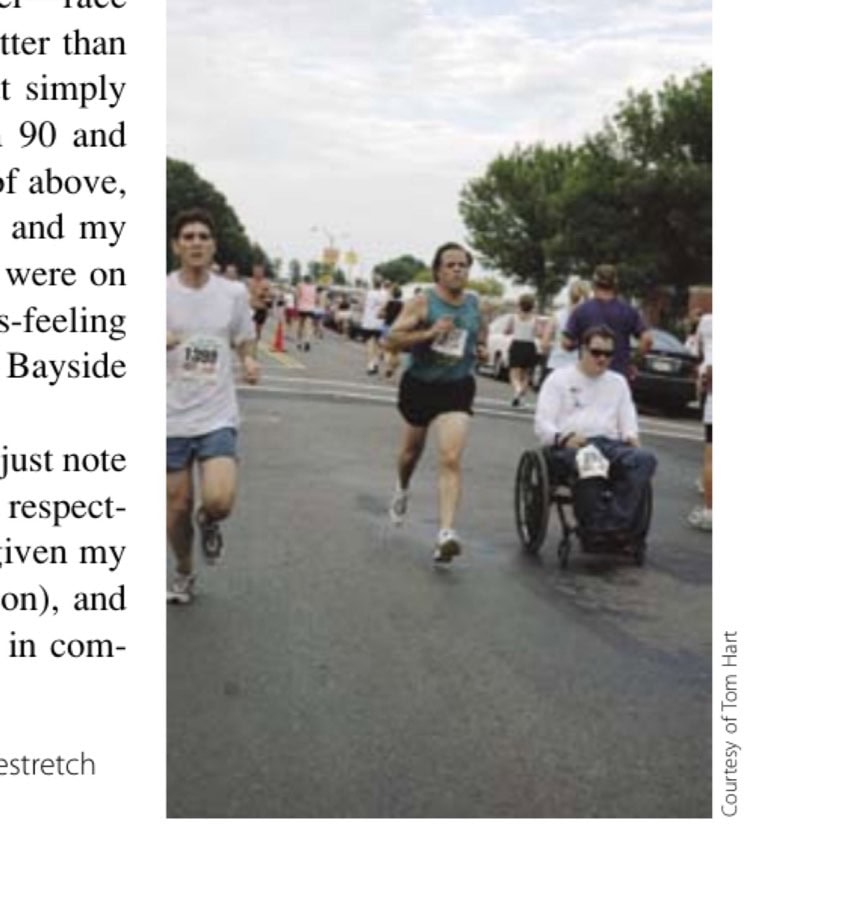
The author battles down the homestretch of the Boston Sugar Bowl Five-Miler.
Courtesy of Tom Hart
Race #7: July (again)—Sugar Bowl Five-Miler, Boston
pleted races) ended. I settled for a second-place trophy, and it wasn’t even close: I was over four minutes behind oldster winner Colin McCardle’s 30-and-change time. Guess my goal of finding some competition at the bigger race had been fulfilled (except that this competition had been so far ahead I had never even glimpsed him).
And as I dragged my race-battered body around for the next couple of weeks, it became clear that the July 4 accomplishment represented a kind of high-water mark (yearly goal achieved), and that the July 21 race was a mistake—but not one I could simply acknowledge and move past! I had overdone it and wasn’t sure that I could recapture the focus that marked the months from February through June. And therein lay lesson #5: Focus giveth, and focus taketh away. The energy—physical and, just as important, mental and emotional—I had channeled into building for and winning the July 4 race came at a price, and I didn’t have the resources—again, physical, mental, or emotional—to keep training and racing at that level. Modest though 6:40-type pace might seem, to prepare for it and execute it over a period of months had left at least this particular geezer gasping. I acknowledged to myself that I might just have found my last WMD.
Race #8: August—Beverly Yankee Homecoming 5K Well, um, ah, OK. That was my reaction after running not as well as I might have but well enough to win again, in a 20:43 time that actually represented a slight slowdown from my February Lowell 5K. I started cautiously, having warmed carefully without testing what had become a chronic hamstring tightness through any prolonged striding, and as I built to a steady pace, I could indeed feel those darned tightnesses ready to jump out and grab me. This led me to that doubt-filled head that often spells disaster, as I mulled whether dropping out was the thing to do, and so on. I got through the first mile in 6:29 and, given the short distance, decided to try to tough it out if the legs didn’t really protest significantly—and, luckily, they didn’t. This may have been due to a
slowing for mile number two to something more like 6:50—some rolling terrain— nothing serious, but the race was thinning out now (the start had been crowded: about 400-plus runners), and I was slipping past people rather than being passed, so I wasn’t panicking. I did, however, try consciously to maintain and even perhaps pick it up over the last mile plus, and managed to do so. As we turned down into the park for the finish, I found enough to stretch it out more—I wasn’t worried by then that I would trigger race-ending leg issues. No sub-20, though, and I was aware even as I crossed that I had not matched the Lowell time—grr!
So: why had six months of racing and paying attention left me no better off than I had been in February? First, the leg issues were real, and in a way I was lucky to get in a race at all, to say nothing of a decent one that took my age group. (Related to this, of course, I hadn’t really been able to train effectively for the previous couple of weeks, even though I kept getting in my miles.) Second, there is a difference between a hot summer race and one on a perfect, crisp 50-plusdegree February midday. The fact is, I had just gotten kind of stale, and even though I squeezed out one more race—and another WMD—at a Labor Day 5K, the end of my time of intense focus had definitely arrived. I had planned back at the beginning of the year to train hard and race hard through the summer, but coaching was coming up in a few weeks, and teaching, too, soon after that. My story, my year of exploring winning, was coming to its inevitable end, which led me to realize lesson #6: Recognize when you’re ready to rest.
And rest I did—from my minor-league version of serious training and racing, anyhow. School began and coaching began, and—as usual—I found plenty to do even without getting to road races. That was that, and, well, dare I ask, so what?
You’ve undoubtedly noticed that the lessons I’ve mentioned hardly seem revolutionary insights. Turns out that the whole effort was like that: nothing exactly new, but rather everything seen with an intensity that gave it freshness. Paying more attention to my running, I saw why our running rewards attention. In my fourth decade of going out for a run, I saw that it was still very possible to learn: about running, about limits, about myself.
The trophies, ribbons, plaques, and even one shiny wristwatch, featuring a drawing of Concord’s North Bridge, from my search for WMDs have found a home of sorts on a corner bench in my basement office. From the vantage point of a full year, I admire them fondly when I occasionally notice them. The real legacy of my efforts, however, is in my continued desire to run, with the renewed knowledge that there is a vast well of challenge and satisfaction waiting for anyone in running whenever you choose to actively engage it. And that, whether at 60 or 26, can only be a good thing.
This article originally appeared in Marathon & Beyond, Vol. 14, No. 1 (2010).
← Browse the full M&B ArchiveMore like this
1,000+ stories from 19 years of Marathon & Beyond
The complete archive of the legendary long-distance journal — digitized and free to read.
