

Going Very Long In Detroit
PART I: THE MOTOR CITY MARATHON YEARS
This year marks the 30th anniversary of the Detroit Free Press International Marathon. However, the roots of this race reach back another 15 years to 1963. That year marked the fifth season of the Michigan Road Runners Club. The group had organized in 1959 to fill a void in local amateur athletic long-distance running events.
From its beginning, the club held a host of events each year and by 1963 felt that it was ready to conduct a marathon. The event was held on Belle Isle, a 982acre island park in the middle of the Detroit River. The course was considered fast; each flat lap of the island was 5.4 miles long. The entire marathon distance involved approximately 4 3/4 laps. This event would continue to be held on the island for the next 15 years.
The inaugural race was held on Thanksgiving Day 1963, when 23 hardy souls paid 50 cents each to attempt the classic distance in cloudy, mid-40-degree weather. The eventual winner took an early lead, which he maintained throughout the race. At the finish, Bob Berger, of Lincoln Park, Michigan, clocked 2:32:50 and was one of only three contestants who cracked the three-hour barrier. Twelve finishers were able to complete the race in time to arrive home for their turkey dinners. Eight race officials were on hand, including race directors Fred McGlone and Frank McBride. McGlone had finished in eighth place or better in the three Boston Marathons he ran in the early 1940s and was the national marathon champion in 1942. McBride, Wayne State University’s track and cross-country coach, had finished seventh in the 1,500-meter race at the 1952 Olympic Trials. For the second race, in 1964, the size of the field and the number of finishers expanded to 33 and 24, respectively. The winner of the race was Scotto Gonzales, of the Boston Athletic Association, who finished in 2:44:46 on a cloudy day in
▲
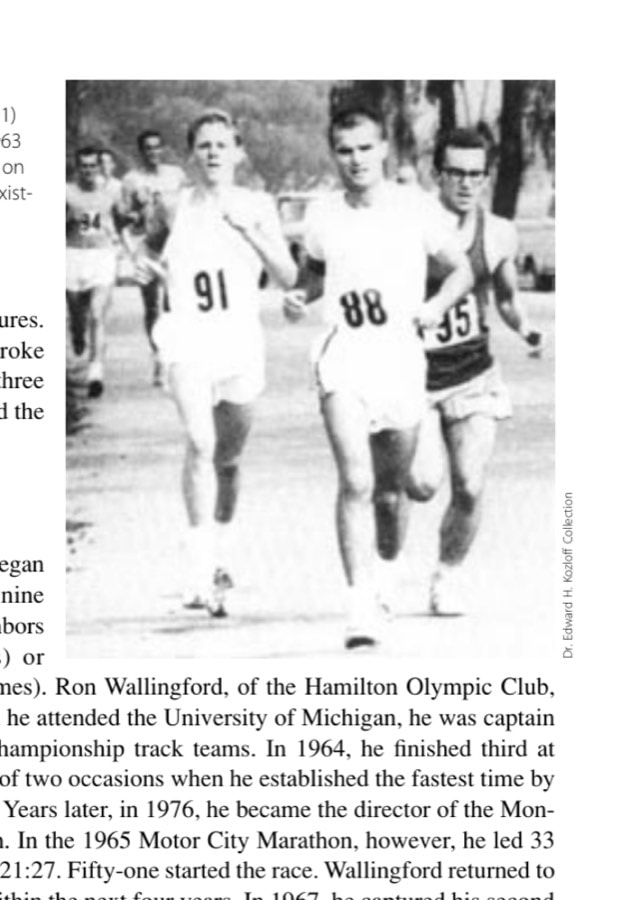
Ed Kozloff (88) leads City Mile Champ Brian Moore (91) and Bob Berger (95), the 1963 marathon winner, in a race on Belle Isle. (This is the only existing race photo of Berger.)
An Invasion From the North The Canadian invasion began in 1965. For the next nine years, our northern neighbors either won (six times) or placed second (three times). Ron Wallingford, of the Hamilton Olympic Club, started the string. When he attended the University of Michigan, he was captain of one of its Big 10 Championship track teams. In 1964, he finished third at Boston, which was one of two occasions when he established the fastest time by a Canadian in that race. Years later, in 1976, he became the director of the Montreal Olympic Marathon. In the 1965 Motor City Marathon, however, he led 33 finishers to the line in 2:21:27. Fifty-one started the race. Wallingford returned to this event three times within the next four years. In 1967, he captured his second victory in 2:24:34. In 1966 and 1969, he finished second. The 2:20 barrier was cracked for the first time in Michigan when Mike Hazilla, of Western Michigan University, set a course record of 2:18:47 in 1966. In doing so, he became just the third American to break 2:20. Thirty-six of the 59 starters finished on another cloudy day with temperatures ranging between 38 degrees and 44 degrees. Finishing third this day behind Wallingford was Ron Warhurst. A year earlier, he had finished second to Wallingford in this race. In 1973, Warhurst would become a track coach at the University of Michigan. He has coached track and cross-country at the University of Michigan since that time. In 1967, a conflict arose with the Road Runners Club of America regarding the use of the name “Michigan Road Runners.” In October, the club’s name was changed to the Motor City Striders, and, having resolved the dispute with the national body, it continued conducting area road races. Wallingford returned to
Dr. Edward H. Kozloff Collection
mid-30-degree temperatures. The first 10 runners broke three hours, and only three of the finishers exceeded the four-hour mark.
the victory platform in1967, as temperatures dropped to a frigid 18 degrees to 22 degrees. Only 36 of 62 starters completed the distance. On June 2, 1968, a pre–Olympic Trial was held on the Belle Isle course for Canadian runners. Peter Buniak (who later changed his name to Jerome Drayton) won by 25 seconds over Andy Boychuck in 2:23:57. On this sunny, 70-degree day, only 17 of the 37 starters finished the race. Later in the year, the race on Thanksgiving Day 1968 saw the largest field ever, as 73 started. Running in driving rain throughout the entire race with the temperatures at 40 degrees, only 30 contestants were able to complete the distance, the smallest number since the second year of the event. Wayne Yetman, of the North York Achilles Club, won in 2:32:18.
In 1969, the race was moved from Thanksgiving Day to the third Sunday in October to profit from more favorable weather. This proved to be a successful decision, as Jerome Drayton (formerly Peter Buniak) took advantage of overcast skies and upper-40-degree weather to record the largest margin of victory ever in this race. He won with a 15-minute lead over the second-place finisher, Wallingford, who was nevertheless running the sixth-fastest time ever in Michigan! At the finish, a North American record had been set as Drayton cruised to a 2:12:00 clocking.
A Question of Drayton’s Record Time However, Drayton’s time was not accepted without question. The Amateur Athletic Union felt the course must have been short. After some angry correspondence between the Striders and the national body, the AAU sent a representative to remeasure the course, which was determined to be accurate. The dispute was dismissed even further in December when Drayton beat his Detroit time in Fukuoka, Japan, by winning that international race in 2:11:12.8.
Drayton returned to the course in 1970 and successfully defended his title in 2:23:08 while Canadians took the first five places. The field remained at the same consistent numbers as in the past, as 70 started and 45 finished in sunny, 60-degree weather. Following a five-year absence, Mike Hazilla returned to the race and the victor’s circle in 1971, when he ran the second-fastest time on the course in a 2:16:21 effort. Again, warm weather was the order of the day as temperatures in the upper 50s and overcast skies offered some help for the 67 finishers.
The Toronto Olympic Club lived up to its reputation on a rainy day in 1972. Team members swept the first four places, led by a 2:18:46 effort by Brian Armstrong. The Motor City Striders conducted two additional marathon races in 1973 and 1974. A March event was sponsored by the Detroit News in conjunction with the annual NCAA Indoor Track and Field Championship held at Cobo Hall. In cloudy, damp, 40-degree weather in 1973, Norm Patenaude, of the Laurentian Track Club, won in 2:24:05. In addition to being a fine runner, Norm was one of the founders of
Dr. Edward H. Kozloff Collection
the Ontario Roadrunners Association, organizer of the Voyageur Marathon, one of the chief measurers of the 1976 Montreal Olympic Marathon course, and—eventually—a member of the Canadian Road Running Hall of Fame in Ottawa.
In the race held in October 1973, 110 contestants struggled to the finish line. Duane Spitz was first across in 2:23:05. In the earlier March race, he had finished second to Patenaude by only 14 seconds.
The March 1974 race was run in sunny, high-30-degree weather. Paul Pearson, of the Toronto Olympic Club, who had finished second to Spitz in October, won in 2:29:02. Ultimately, despite the popularity of the March event, the Detroit News decided to drop its sponsorship to concentrate on the indoor meet, which provided larger crowds and a paying audience. In October 1974, Ed Griffis battled 60-degree temperatures on a sunny day to win the Motor City Marathon in 2:25:29. This was a banner year: the first in which women participated. Eight women entered, and six finished. Sue Mallery, the leading woman, finished 54th of 149 starters in 3:09:47, registering a 25minute margin over the second woman, Jeanne Bocci, who was the first woman to become a member of the Motor City Striders.
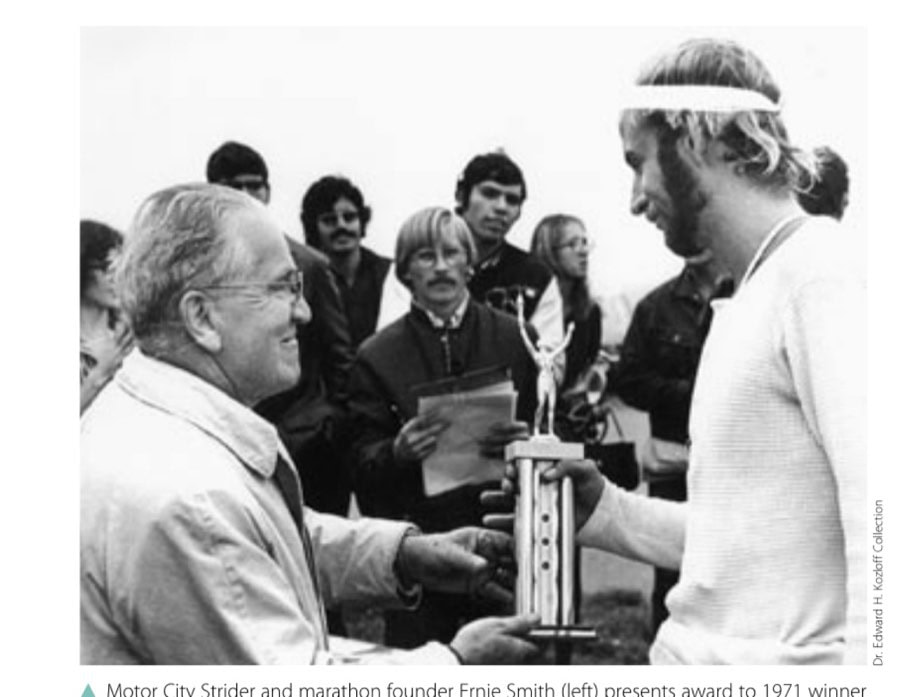
▲ Motor City Strider and marathon founder Ernie Smith (left) presents award to 1971 winner Mike Hazilla (2:16:20), who also won the race in 1966.
The field saw nearly 200 starters in 1975, as 151 finished in nearly ideal 40to 50-degree weather. Bill Stewart set a 30-39 age-group record as he raced to a 2:25:05 victory. Despite running marathons, Stewart did not lose his speed at shorter distances. Eight years later, in 1983, he set the masters indoor mile record when he clocked 4:11.00. Ella Willis, the first female finisher, placed 90th in 3:13:51. Her margin over the second-place woman was only two minutes, as competition in the women’s division improved considerably. At the age of 18 and a high school senior, Willis distinguished herself as the state’s high school half-mile champion with a time of 2:14.9.
RRCA Championship of the North Region In 1976, the race was designated the Road Runners Club of America North Region Championship. The day was ideal for the 250 entrants as temperatures hovered in the 45- to 50-degree range in a misty atmosphere. When the watch was stopped for the winner, Gordon Minty, the third-fastest time ever on the course—2:17:49—had been run. This former Eastern Michigan University runner had been a 14-time All-American and had won the Mid-America Conference Cross-Country Championship three times. In the women’s division, Alexa Kraft just missed breaking the three-hour barrier as she clocked 3:00:41 to establish the women’s state record.
In March 1977, an effort was made to reinstate a spring marathon. The West Bloomfield Parks and Recreation Department assumed sponsorship, and a course was developed in the West Bloomfield area. The winners of the event were Leo Desjardine in 2:29:53 and Alexa Kraft in 3:17:37. The race was subsequently dropped from the Strider program in 1978 because of traffic conditions that were difficult to control. In March 1978 and 1979, the race was held on Belle Isle under the sole sponsorship and direction of West Bloomfield. The field nearly doubled to 428 entrants for the 15th running of the Motor City Marathon in 1977. On a windy day that saw low-40-degree readings, Bob McOmber from Bowling Green, Ohio, placed first in 2:23:37. In 82nd place was Ann Forshee, who broke the year-old women’s record with a time of 2:55:59. This performance placed her in the all-time top 25 performances by U.S. women. This was also the first year in which a wheelchair contestant entered the race: Randy Wix completed the distance in 3:05:32.
PART II: THE DETROIT FREE PRESS YEARS Early in 1978, the Striders were contacted by Neal Shine, managing editor of the Detroit Free Press, about possible sponsorship of a major marathon race for the Detroit area. Since the Motor City Marathon was well known and successful, the thought was that the Free Press would assume sponsorship of the event and bring it to a new level.
The original plan was an ambitious one, as sports editor Ladd Neuman suggested that the event should be international in scope, using both the Detroit-Windsor Tunnel and the Ambassador Bridge connecting the Canadian city of Windsor, Ontario, with Detroit. The race would start on Belle Isle, go to the Detroit-Windsor Tunnel, continue in Canada, cross the Bridge at about the 17-mile point on the way back to the United States, and finish back on Belle Isle. Authorities for both the tunnel and bridge agreed, and the course was initially measured. However, just one month before the race, the Ambassador Bridge Authority nullified the earlier agreement, maintaining that the person who approved it had not been authorized to do so. This, coupled with a labor dispute among bridge employees, removed the Ambassador Bridge from the marathon course. Negotiations with the tunnel were also difficult. The tunnel had never been closed, not even during World War II. However, those in charge of the tunnel were convinced by Neal Shine that this would, indeed, be a special event, and an international race was born. The race would be unique as the only marathon course to run through a mile-long underground tunnel and one of only two courses that crossed an international border. The first race started in Windsor, Ontario, under the shadow of the Ambassador Bridge. Runners proceeded along the Detroit River to downtown Windsor, then through the Detroit-Windsor Tunnel to downtown Detroit, out to the Grosse Pointe suburbs, and returned to the finish on Belle Isle where the University of Michigan marching band greeted the finishers.
There was extensive cooperation between United States and Canadian Immigration and Customs as well as government officials of both Detroit and Windsor. Race results were tabulated by first-generation computers of the Burroughs Corporation. Strider officials gave Burroughs sheets with handwritten places, race numbers, and times, and these were then typed into the computers to give “virtually instantaneous” results. This was six years before the first personal computers were available.
Race weekend was a full one, with a prerace clinic at the Radisson Cadillac Hotel the day before. The spaghetti dinner cost $3. Despite all of the preparations for this first marathon clinic, two critical items were forgotten. There were no chairs and very few tables for the hundreds of diners! Nevertheless, the crowd members, in a jovial mood and undeterred, ate their spaghetti either standing or sitting on the floor! It was truly a night to remember!
On October 22, 1978—marathon day—it wasn’t just a 26-miler that was available for runners. Nearly a thousand runners entered a 10K on Belle Isle and several hundred more entered a mile event. Both of these events were conducted as the marathon started in Canada. The entry for each event—the 10K and the marathon—was $5. The size of this marathon field exploded from 428 entrants the previous year to 1,942 starters. Bob McOmber returned and was victorious for the second
straight year. In a tremendous effort of solo running, he led from the start and improved on his 1977 time by nearly five minutes to finish in 2:17:37. He was over four minutes ahead of the runner-up. Equally impressive was the women’s leader, Erma Trantor, who clocked 2:55:51 and was nearly five minutes ahead of the second-place woman.
With marathoning continuing to boom throughout the United States, the Detroit-Windsor race field nearly doubled to 3,784 starters in 1979. Temperatures hovered in the 40s, with sunny skies, as enthusiastic spectators saw a three-way duel for first place. Gordon Minty, winner of the 1976 race, ran the second-fastest marathon in Michigan’s history, finishing in 2:15:42. McOmber and Duane Spitz, who won in the 1973 race, tied for second place in 2:18:15. In all, eight runners qualified for the 1980 Olympic Trials. Not far back, in 108th place, was Karen Blackford, who shattered the old women’s state record by over 11 minutes with a 2:44:29 clocking. When it was all over, 2,890 runners finished, making this the largest race ever held in the state of Michigan at that time.
Stupendous Growth In 1980, the race cracked the 4,000 barrier as 4,168 runners lined up at the start. Again, temperatures ranged in the mid-40s, although this year a light mist could be felt. As the race began, three runners—Greg Meyer, Doug Kurtis, and Duane Spitz—moved away from the pack until Meyer established a lead at eight miles. At the finish Meyer, running his first marathon with a time of 2:13:07, not only earned himself a nearly three-minute margin over second-place finisher Kurtis, who finished in 2:15:55, but Meyer established an American record for a first-timer. The record, however, was short lived. Several weeks later, Alberto Salazar captured the New York City Marathon title in 2:09:41 in his first race at that distance. For the women, Debby Froehlich, a student at Michigan State University, finished 233rd overall with a time of 2:49:17. A total of 3,384 runners reached the finish line.
Enthusiasm for the marathon did not diminish in 1981, for 4,956 contestants attempted the distance. Temperatures were in the 40s, and the sun broke through the clouds at the start. Fighting a head wind most of the way, Mike McGuire, the leader, shocked the crowd by stopping 40 yards from the finish to throw up. He quickly regained his composure to win the marathon in 2:15:47. Maureen Griffith, the women’s winner, felt more relaxed. With a 2:48:40 clocking, she moved to second place in all-time Michigan times. The last finisher to cross the line was in 4,102nd place with a time of 7:03:51.
Although the race had been run four times through the Grosse Pointe neighborhoods, this was not without controversy. The Grosse Pointe Ministerial Association voiced concern about disruption to Sunday church services. The ministers approved of the race itself, but they wanted and received from the marathon committee more authority in planning.
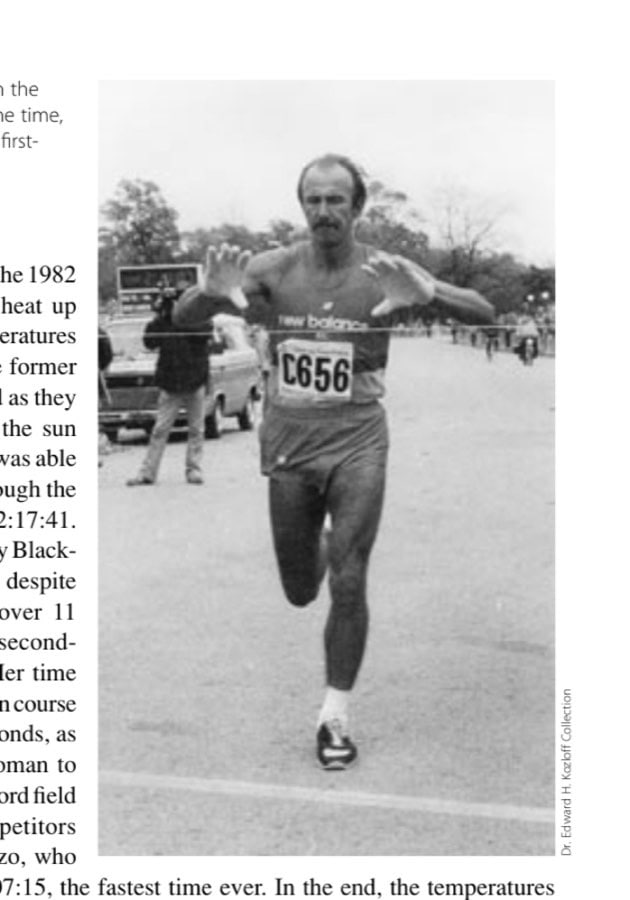
Ninety minutes into the 1982 race, the sun began to heat up the course, sending temperatures into the high 70s. Three former roommates held the lead as they paced each other until the sun took its toll. Dave Hinz was able to continue his pace through the last four miles to win in 2:17:41. Karen Hubbard (formerly Blackford) ran a strong race, despite the heat, and finished over 11 minutes ahead of the secondplace female finisher. Her time of 2:45:05 missed her own course record by a mere 36 seconds, as she became the first woman to win this race twice. A record field of 14 wheelchair competitors was paced by Kris Lenzo, who toured the course in 2:07:15, the fastest time ever. In the end, the temperatures set the final record, making this race the hottest in the history of the event.
Cooler weather and a strong northeast wind kept the leading pack of runners bunched together for the first half of the 1983 race. At the far turning point in the race, Dave Olds, worrying about running a qualifying time for the Olympic Trials, picked up the pace and finished in 2:16:10—the fifth-fastest time ever for the event. Bill Weidenbach ran a strong race behind Olds. His finish time of 2:17:17 was the eighth fastest on the all-time Michigan list.
In the women’s division, Cindy Barber bettered her previous best by 13 minutes to win in the third-fastest women’s time in the state at 2:47:22. A concentrated and successful effort had been made to increase the wheelchair field. Forty-six raced from the starting line and 44 finished, making the race the largest wheeler marathon in the United States. Marty Ball led the men with the second-fastest time for the race—2:11:55. In the women’s category, Jennifer Smith became the race’s first female finisher in 3:15:49. For this year, 4,141 participants entered the
Dr. Edward H. Kozloff Collection
▲
In 1980, Greg Meyer won the race in 2:13:07, setting, at the time, the U.S. record for the best firsttime marathon.
race. This number represented a slight decrease from the 4,593 of the previous year and the record 4,956 of 1981.
The Question of Prize Money Money or race expenses had never been given for this race. As more marathons grew around the country, the size of the Detroit field was no longer increasing. Winning times for men gradually declined as top athletes traveled to the races that offered ever-increasing prize money.
Fog shrouded most of the 1984 event and provided one surprise and three expected results. In the men’s division, Loren Bandt came from behind to pass the slowing leaders and win in a time of 2:23:40. Although his time was the slowest men’s winning time to that date in the Free Press Marathon, the other divisions produced record performances. In the women’s division, Karen Hubbard knocked 1:29 off her course standard as she finished with a time of 2:43:00. Her win added a third championship to her 1979 and 1982 victories. The wheelchair category, with 73 entrants and 59 finishers, saw another U.S. record. Marty Ball wheeled to a course record of 2:02:20 to win his second-consecutive race. Jennifer Smith broke her course record by over 40 minutes as she took her second title in 2:34:36.
Once again, controversy plagued the 1985 event, as a group of at least 35 eastside Detroit ministers sought to have the race stopped, claiming it disrupted their morning church services. To accommodate the ministers, the race starting time was moved from 9:00 A.M. to 7:00 A.M. to clear the areas of runners for the 10:30 or 11:00 services. This compromise was accepted, though not happily, by the protesting ministers.
At the 21-mile mark during the race, the lead runner, Tim Fox, who had been running a well-paced race, was knocked down by an aid station volunteer. His 25-second lead vanished, and it took two miles before he could recover his rhythm and pull away to secure his 2:23:58 victory, setting a record as the slowest victory time to date.
In the women’s division, Liz Watch moved to the front at the 20-mile mark and proceeded to run away from the rest of the field to finish nearly seven minutes ahead of her nearest rival with a time of 2:51:59.
Fifty-two of the 65 wheelchair competitors were able to finish. Mike Trujillo took advantage of the 60-degree weather and improved his 1984 performance by 12 minutes to tie the year-old course record of 2:02:20. Jennifer Smith set her third record in the race as she lowered her women’s course standard to 2:33:30. Registration for the event, however, continued to drop, although the field of 3,200 ensured that the marathon remained the nation’s 10th largest.
The ninth-annual Free Press race (24th in the series) awarded prize money for the first time and established a new route. A total of $10,000 was to be divided
equally between men and women, with wheelchair athletes receiving a portion as well. Continued pressure from the eastside ministers caused part of the course to be moved to the west side of the city, eliminating the popular Grosse Pointe community. The bricked portion along part of Michigan Avenue proved hard on the runners’ legs and caused much displeasure for this new course.
For this race, an early conservative pace kept the four race favorites together for nearly 20 miles. However, by the 23rd mile, Somali Olympian Ahmed Ismail was in control. He reached the finish line in 2:17:24. Patricia Wassik-Hinson and 1983 race winner Cindy Barber ran together for nearly 14 miles before WassikHinson opened a gap and held it to her finish in 2:47:58.
Mike Trujillo barely managed to defend his wheelchair title with a recordbreaking 1:57:34 win that was only a few tenths of a second faster than Marty Ball. Candace Cable-Brookes, a three-time Boston Marathon winner, lowered the women’s record by nearly 20 minutes to 2:14:16. Forty-nine of the 52 wheelers finished. In the marathon, 2,335 of the 2,788 starters finished.
THE ASCENSION OF DOUG KURTIS The fourth time was the charm for Doug Kurtis in the 1987 race after finishing second in 1980, 1981, and 1986. His time of 2:18:03 was more than three minutes ahead of 1984 winner Loren Bandt. At age 35, Kurtis was the oldest overall winner ever in the race, running his 37th sub-2:20 marathon.
In the women’s competition, Christine Iwahashi sprinted past three-time winner Karen Hubbard just 200 yards from the finish line to win in 2:47:25 to 2:47:36. For the second year, the men’s wheelchair race was a sprint to the finish as Phillippe Couprie defeated defending champ Mike Trujillo 1:54:55.89 to 1:54:56.28. Candace Cable-Brookes successfully defended her title in 2:18:30. Fifty-four wheelers finished.
Prize money for the 1988 race was increased to $13,500. Running the last six miles unchallenged, Doug Kurtis repeated his 1987 victory. Unfortunately, however, his time of 2:20:14 failed to add to his incredible list of 38 sub-2:20 marathons.
Ella Willis, who had won the 1975 Motor City Marathon as a high school senior 13 years earlier and had developed into one of the region’s top runners, finally took a Free Press title and, in the process, knocked 1:11 off the course record with a time of 2:41:49.
Records continued to be set in the wheelchair division as Doug Wight lowered the men’s standard to 1:54:02. Chantal Petitclerc led the women in 2:29:48. Forty-five wheelers finished. The possibility existed that the 1989 race might be the last. Race attendance was down 25 percent since the course was changed from the east to the west side in 1986. Runners preferred the scenic eastside route along Lake St. Clair as well
as the huge crowd support in the Grosse Pointe area. Cobblestones on the western course along Michigan Avenue did not help. A request to return to the east side was withdrawn when the ministers again protested.
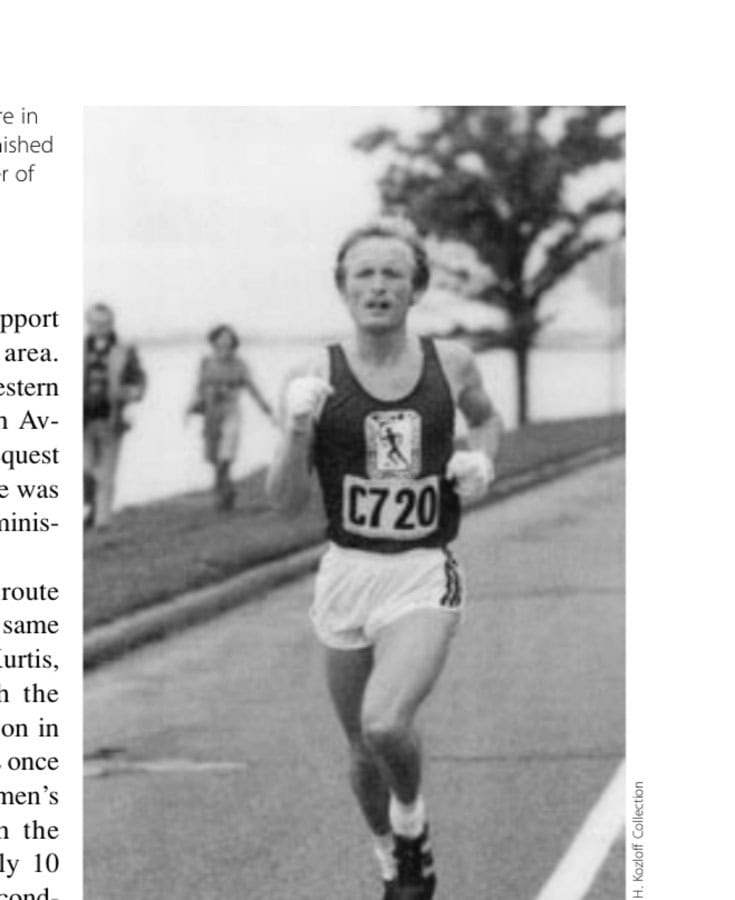
In 1989, both the route and the results were the same as the previous year. Kurtis, unchallenged through the last half of the race, won in 2:17:34, and Ella Willis once again lowered the women’s record to 2:38:22. In the process, she was nearly 10 minutes ahead of the secondplace finisher. The men’s wheelchair record continued to be lowered. This year, it was Luke Gingras who took nearly six minutes off the record with a time of 1:48:32. Rose Winand took the women’s title in 2:38:29. There were 44 wheelchair finishers.
Any danger of the Free Press Marathon being discontinued because of lack of sponsorship was given a reprieve in 1990 as Mazda Motor Manufacturing Corporation became a sponsor, signing a five-year contract. It is interesting to note that the Detroit Marathon committee, located in the Motor City, despite repeated efforts, was never able to persuade an American car company to sponsor the event. The 1990 race drew a field of 2,828, the most since 1987 and nearly 400 more than 1989. The sponsor, Mazda, flew in from Japan one Wataru Adachi, an employee and world-class 30K runner. For 16 1/2 miles, he stayed with defending champion Doug Kurtis but faded as Kurtis won the race for the fourth straight year. Kurtis’s time of 2:19:36 was his 54th sub-2:20 finish. Despite fading, Adachi held onto second place in a distant 2:27:55. Barbara Remmers led the women’s field in 2:44:56, qualifying for the Olympic Trials with three seconds to spare.
Dr. Edward H. Kozloff Collection
▲
Doug Kurtis, shown here in the 1980 race where he finished second, is a six-time winner of the event.
The 82 wheelchair contestants continued to make this the largest event of this type in the country. The men’s race, as in the past, was close to the end. Jimmy Green just edged Luke Gingras at the line, and both were timed in 1:47:07. The first four finishers broke the old record of 1:48:07 that had been set by Gingras in 1989. The first two female finishers also broke the old record with top honors going to Colette Bourgonhe, who wheeled to the finish on one good wheel and a rim. A record 65 of the 82 wheelers finished the race.
THE RRCA NATIONALS The 1991 race was designated the Road Runners Club of America national marathon championship. Additionally, total prize money increased to $35,000. Another attempt was made to encourage the Ambassador Bridge to become involved with the race; again, that proved futile.
Near-freezing temperatures greeted the 2,500 starters. A first-place prize of $5,000 brought in 19 men with times better than 2:25. However, at the finish, the story was the same, as Doug Kurtis made it five victories in a row with a time of 2:18:36. This was his sixth sub-2:20 performance of the year. Ella Willis, the women’s course record holder, had spent months recovering from shin splints and captured her fourth victory in 2:42:49.
What can you say about the wheelchair race? Another two-man race to the finish and another record, as Kenny Carnes barely edged Phillippe Couprie, with both timed in 1:38:38, a new record by 8:29. In the women’s race, Daniela Jutzeler took top honors from Ann Walters by four seconds in 1:59:45—another course record. Fifty-three wheelers completed the distance. The following year, for the first time since the marathon began in 1963, the finish line was moved off Belle Isle. For the 1992 race, a new course was developed that left the much-maligned Michigan Avenue portion a thing of the past. Coinciding with this change, the finish was moved to Hart Plaza in the downtown area of Detroit.
Despite these changes, top honors in both the men’s and women’s races went to the “old.” Doug Kurtis, running as a master at the age of 40, took his sixth straight men’s title. In a tougher run than most of his Detroit races, he didn’t take the lead until the 24th mile. His 2:19:25 time represented his 66th sub-2:20 marathon. The women’s 42-year-old master, Karen Hubbard, raced to her fourth victory in 2:45:21. Of the 65 wheelchair entrants, Tom Sellers topped them all in 1:46:27 while Ann Walters led the women in 2:09:02. The weather for this race was the worst in the history of the event, with 30-degree temperatures, 30-mileper-hour winds, and rain throughout. The 1993 race, for the first time, was not international. Reconstruction on the Detroit-Windsor Tunnel kept the race on American soil. Once again, an attempt was made to use the Ambassador Bridge, this time for only one year, but
the request was rejected. The new course would keep the last 18 miles the same as in the past, with changes only to the first 7 1/2 miles. This was a bonus for spectators because the start and finish were only 200 yards apart, allowing them to comfortably view both for the first time. Rain plagued the first part of the race for the second year in a row, but 60degree temperatures made it more tolerable for everyone but Doug Kurtis, who saw his six-year victory streak end. Instead, Peter Maher, who had two 2:11 races to his credit, took the title. His time of 2:19:53 represented the first victory for a Canadian since the earlier days of the Motor City Marathon.
In the women’s competition, Amy Legacki had the race well in hand for the first 18 miles when she suddenly began to falter. While her pace slowed, she was able to keep moving as Kim Goff picked up her own pace. While Goff was still gaining as the two approached the finish, she was never able to overtake Legacki, who finished in 2:43:08 to Goff’s 2:44:16. The 29 finishers in the wheelchair field were led by Scot Hollonbeck and Debbie LaPlante in 1:39:35 and 2:35:40, respectively.
In 1994, the race returned to Canada, and the route returned to the same course as the 1992 event. Don Johns surged at 23 miles and won by a minute and a half in 2:21:24. However, the women’s contest was the highlight of the day. May Allison, running only her second marathon, broke the course record by over three minutes with a time of 2:34:55. Ann Boyd followed in 2:40:14 with the third-fastest time ever in the women’s race. These women finished 13th and 23rd overall in the entire field. James Briggs lowered the men’s wheelchair record to 1:37:15 and Ann Walters took her second victory in the event in 2:07:58. In the racewalking division, 1988 Olympian Gary Morgan set a course record with a time of 3:39:41.
PART III: INTERNATIONAL MANAGEMENT GROUP Major changes were made in the event in 1995 when the International Management Group (IMG), which was also involved with the Detroit Grand Prix and similar events, assumed management of the race. For the first time, the accompanying shorter race was moved from Saturday to the same day as the marathon. The prize structure also took a leap upward as the top man and woman each received a 1996 Mazda 626LX car for their efforts. An additional $17,200 in prize money was offered to the runners and $7,000 in the wheelchair division. Mike McGowan and Ann Boyd earned the keys to the cars. McGowan, of Toronto, was all alone in the race after mile 16 and finished in 2:18:11. Boyd, who had finished second in the 1994 race, was almost alone and crossed the finish line in 2:38:36, five minutes ahead of her nearest competitor. Tom Sellers led the male wheelers in 1:47:21, and Deanna Sodoma took female honors in 2:01:47. Significant wind conditions hampered the contestants most of the way.
The prize ante was increased to $22,000 for the 1996 event, again with an additional $7,000 going to the wheelers. The top prize was $3,000 and a oneyear lease on a 1997 Mazda 626LX. The winners weren’t able to keep the car as they had the previous year. However, the same prize was given to the man and woman—runners, walkers, and wheelers—who had the most-improved time over their performances in any of the previous three Free Press marathons.
Finally, this marathon enjoyed better weather, with early-morning temperatures rising from the mid-40s to the mid-50s. Paul Audfemberge took the lead at three miles and kept command of the race until the 21st mile. At this point, Michael Dudley, of West Virginia, passed him and won in 2:20:50. Cindy Keeler (Barber) was running her eighth Free Press Marathon. She had placed second twice, third three times, fourth once, and had won the event 13 years earlier in 1983 with a time of 2:46:22. Now, at age 38, she took command of the women’s race at 10 miles and improved her best time, winning in 2:43:36. In the wheelchair division, Tom Sellers avoided a police car, which backed onto the final stretch of the course, and just edged Don Dowling in 1:49:50 to 1:49:52. Deanna Sodoma, despite being briefly sent off the course, still set a women’s record with a time of 1:59:26. For the 1997 race, $3,700 was awarded to the top finishers in the 5K for the first time. Additionally, the marathon winners now received a two-year lease on their 1998 Mazda. Runners enjoyed the best weather in many years with temperatures ranging from the upper 40s at the start to the lower 60s as the last runners finished.
A group of four runners ran together through 18 miles. As they continued, three remained close, and at the finish, less than two minutes separated them. A former All-American at the University of Oregon, Brad Hudson, led the group in 2:15:50, the fastest winning time since 1981. Lyubov Klochko, a 1996 Olympian and former Russian national champion from Ukraine, led the women the entire distance. Her time of 2:39:59 was nearly four minutes faster than that of secondplace finisher Cindy Keeler, the 1996 race winner.
Flagstar Comes Onboard as Sponsor Flagstar Bank assumed major sponsorship of the race in 1998. Prize money escalated to $39,000 and included wheelers, but there was no car lease as there had been the past three years. The deepest international field ever was entered in the race, but driving rain and wind gusts up to 35 miles per hour took a toll on the field of 2,300. Zithulele Sinque, holder of South Africa’s marathon record of 2:08:04, expected an easy victory. While he took top honors by just over a minute in 2:18:52, he stated that this was the most difficult of all of his victories. Tatiana Maslova of Russia, the winner of the Helsinki Marathon in July, took the lead with three miles remaining and won in 2:45:06. Krige Schabort of South Africa led the wheelers in 1:39:24. Wind and a flat tire kept him from breaking the 1:37:15 course record. Patricia Bowen, the only female wheeler, finished in 3:29:56.
Jim Ramsey, at the age of 90, came out of retirement to run one last marathon in memory of his wife, Julia, who had passed away earlier in the year after 69 years of marriage. Ramsey, who ran his first marathon in 1982 at the age of 73, had retired from that distance in 1994. He came back to clock 7:52:46, a national over-90 marathon record.
PART IV: THE BRIDGE AND THE TUNNEL New management came to the Free Press International Marathon in 1999. Sadly, after 36 years, the Motor City Striders no longer played a role. After decades of attempts at incorporating the Ambassador Bridge into the marathon, the bridge authority decided to become part of the event. Thus, a new course was born. The race started at Tiger Stadium, Detroit’s baseball field, progressed over the bridge and into Windsor, Ontario, back to the United States through the tunnel, wound around the city, and returned to the finish line inside Tiger Stadium. This was the last year baseball was played at Tiger Stadium before moving to the new Comerica Park in 2000.
With the inclusion of the bridge, the character of the event changed. One hundred ten five-person marathon relay teams, as well as the 5K event, increased the participant numbers by 60 percent over the year before. About 4,600 participated, with approximately 3,500 of these running the marathon.
In the men’s race, Fred Keiser, a Lakewood, Ohio, science teacher and track and cross-country coach, ran his best time ever. He finished four minutes ahead of his closest competition with a time of 2:18:27. In the women’s competition, Leslie Carson, of Cambridge, Ontario, paced the women through the first 25 miles. She was passed by Irina Khramova, who went on to finish in 2:43:57, 27 seconds ahead of Carson. This was the third straight year that a Russian woman took top honors. Krige Schabort led the wheelchair field for the second year. Despite two flat tires, he finished in 1:41:36. Patricia Bowen, once again the only woman in the field, won in 2:58:18. Fourteen wheelers finished.
Tiger Stadium was no longer available for the year 2000, so the course was redesigned. The finish line was now at Chene Park, about a mile and a half east of the downtown Detroit area. The number of events increased and included the marathon, a two-person and a five-person relay, a 5K, a racewalk, a wheelchair division, and a two-person wheelchair relay. Cash prizes totaled $25,550 and were offered for each of these categories.
Both the bridge and the tunnel were part of the race for the second year. The men’s race turned out to be less than stellar as Joseph Maina, of Kenya, who was training in Toronto, won in 2:24:47, the slowest winning time since 1974. His time may have been comparatively slow; however, he was more than 10 minutes ahead of the second-place finisher. In a much closer contest, Lisa Veneziano, of Dublin, Ohio, reached the lead during the 23rd mile and won the race by less than
a minute in 2:54:30, the slowest women’s winning time since 1978. There were no women in the wheelchair field, which was won by Tony Iniguez, of Aurora, Illinois, in 1:47:27. Total participation for all events declined to about 3,300 with approximately 2,200 marathoners.
9/11 Causes a Course Change A new sponsor, Casino Windsor, joined Flagstar Bank as one of the primary backers of the marathon in 2001. The competitive categories remained the same as the previous year with a similar prize-money structure and $3,000 as the top marathon reward. Less than six weeks before the race, the attack on New York’s World Trade Center caused increased border security and a course change. For only the second time since the Free Press assumed sponsorship in 1978, the race was held completely in the United States. Detroit officials were quite cooperative as eight miles had to be added in the city. The race started at Hart Plaza, circled at one point around Comerica Park (the new home of the Tigers baseball team), and finished along the Detroit River by the Free Press printing plant. Kenyan Jacob Kirwa won the race in the closest finish ever for the event—one second—over Chris Wehrman, of Okemos, Michigan, with a winning time of 2:17:49. Just 13 days earlier, Kirwa had finished eighth at the Ocean State Marathon with a time of 2:24:17. This finish was not without controversy. Apparently Wehrman was paced by two of his teammates who were each competing on their own relay teams, one on a two-person team and the other on a five-person team. Kirwa claimed that his race was hampered by them, but in the end, he had the strongest sprint to the finish. The women’s victor, Lupe Hegan, of Loveland, Colorado, enjoyed an easier time, winning by 1:29 in 2:52:16. Taking his second straight victory in the wheelchair division, Tony Iniguez finished in 1:43:24. The lone woman in this competition, Christy Campbell, wheeled home in 4:03:14. The popularity of the relay concept was on display with 127 two-person and 155 five-person teams competing.
The 40th anniversary of the race and the 25th year of Free Press sponsorship was celebrated in 2002. Just one year after 9/11, the Windsor portion of the race was brought back as well as the dual border crossing with the bridge and tunnel. The new course added an indoor finish on the 50-yard line of Ford Field, the new home of the Detroit Lions football team. The total prize purse was now $35,000. John Kariuki, formerly of Kenya and now residing in Chicago, took the winner’s share. As the record holder of the Salt Lake Marathon with a personal best of 2:12:15, he hoped to lower Greg Meyer’s 1980 race record of 2:13:07. However, this was not to be. Through the first 20 miles, he ran with the previous year’s winner, Jacob Kirwa, and was able to leave him behind at that point and continue on to win in 2:19:14. Fred Keiser, the 1999 race winner, moved up through the field and finished second in 2:20:56.
Angela Strange, of Toronto, who had finished second in the 2001 race, improved her best time by two minutes to lead the women’s field in 2:43:22. The wheelchair leaders were no strangers to winning this race. Krige Schabort took his third title in 1:39:10 to accompany his 1998 and 1999 victories. Christy Campbell, again the only female, finished in 3:19:05. Hand cycles made their first appearance in the race this year. Seth Arseneau, of Grand Rapids, led the men in 1:21:09 while Julie Bishop, of Sturgeon Lake, was the first woman in 2:12:40. Both the wheelchair and hand-cycle divisions had 14 competitors each.
Finally, after 20 years, the 2003 event set a new mark for participation. This year saw 3,250 entered in the 26-miler, 2,392 in the 674 relay teams, 915 in the 5K, and 37 in the wheelchair division. In 1981, 4,956 had entered the marathon, and 1,062 ran in the accompanying 10K event.
On this day, three Kenyans set the early pace and Mike Dudley, the 1996 race winner, was close behind. At 20 miles, the contest was between the previous year’s winner, Kariuki, and Hillary Lelei, who then took the lead and held it to finish in 2:19:27. Dudley passed Kariuki entering the stadium to finish second in 2:20:29. The first four finishers were under 2:22.
Russian Women Continue to Dominate Russia’s Elvira Kolpakova led the women’s race from start to finish, enjoying a two-minute victory over the second-place finisher in 2:46:59. Krige Schabort scored his fourth victory here in the wheelchair division in 1:41:10. April Coughlin led the women in 2:38:40. Hand-cyclist Seth Arseneau captured his second title in 1:17:26, while Monica Bascio led the women in 1:53:12.
When the half-marathon was added to the program in 2004, the event saw another breakthrough as the field jumped from 6,594 participants the previous year to 10,318. For the fifth straight year, a Kenyan led the men’s field. It was a competitive race, as the top four finishers were all under 2:20:30 and within 1:14 of one another. Joseph Nderitu pulled away from the others at 20 miles and held on for a 37-second victory over Andrei Gordeev, of Belarus, 2:19:15 to 2:19:52. Nderitu, a three-time winner of the Ottawa Marathon with a best of 2:14:04, was also the course record holder for the then 111-year-old Hamilton Around the Bay 30K, which he also won three times. For the women, it was the fifth Russian victory in eight years. Elena Orlova, running alone the last half of the race, lowered the race record by 39 seconds to 2:34:16. In doing so, she took home a prize of $10,000, the largest cash award ever in the event. She received $5,000 for winning, $3,000 for the new record, and $2,000 for running the course under 2:40. The inaugural half-marathon champions were Patrick Lencioni, of Ann Arbor, in 1:14:11, and Angela Plamondon, of Ottawa, Ontario, in 1:25:51. Tyler Byers won the wheelchair division in 1:49:40, and Tricia Downing led the women in 2:54:09. Krige Schabort, who had won
Dr. Edward H. Kozloff Collection
the wheelchair title four times, took on the hand-cycle division and won that in 1:26:06 while Julie Bishop took the women’s hand-cycle title in 1:57:51. A year later, runners were greeted with an ideal day for running, with clear blue skies and little wind. A record crowd, now over 13,000, participated in the events. It was an even better day, though somewhat lonely, for Andrei Gordeev, who took off at the two-mile mark and ran alone for the rest of the race, crossing the finish line in 2:14:59. His time was the third fastest since the race began in 1963 and the second fastest behind Greg Meyer’s 1980 Free Press record. He was over a half mile ahead of second-place finisher Jim Jurcevich and received $7,000 for his efforts ($5,000 for finishing first and $2,000 for being under 2:17).
In the women’s race, the 2004 winner, Elena Orlova, could not match the pace of Wioletta Kryza of Poland. Halfway through the race, Kryza was on a pace to better Orlova’s record, which had been set the year before. Her personal best was 2:31:45, set at the Pittsburgh Marathon in 2002. However, thigh cramps slowed her to 2:40:46, giving her a 1:47 margin of victory and her 24th marathon win.
In other competition, Ryan Desgrange, of Belleville, Michigan, and Kim Peterson, of Farmington, Michigan, led the half-marathon field in 1:12:09 and 1:26:53, respectively. Josh Cassidy and Melanie Hawtin, both from Oakville, Ontario, topped the wheelchair contingent with times of 1:44:33 and 2:28:18. John Emrietto, of Fort Wayne, Indiana, was the first hand cyclist in 1:41:03. There were no female contestants in the hand-cycle division.
▲ Andrei Gordeev, of Belarus, the 2005 winner in 2:14:59, crosses the Ambassador Bridge into Canada.
For the 29th edition, this Free Press race enjoyed the title of the “fastestgrowing marathon for the last five consecutive years.” The entry field of 15,804 proved another dramatic increase from the record of the year before. Defending champion Andrei Gordeev returned to the race for the third year. His main competition would come from Kenyan Josephat Ongeri, who paid his own way as a last-minute entrant to the race. Having finished second in each of the three marathons he had previously run, he decided to take the lead on this day. With less than half the race left, he had nearly a two-minute lead on Gordeev. The cold weather and strong, gusty winds of the day took their toll on him as his lead nearly disappeared. However, in the second-closest finish in the race’s history, he held on to win by four seconds over Gordeev, 2:18:22 to 2:18:26. Ongeri’s victory was the seventh for a Kenyan in eight years.
The women’s competition was nearly a carbon copy of the year before. This time, however, the roles were reversed as Elena Orlova, who had finished second to Wioletta Kryza in 2005, beat her to the finish line by two minutes, 2:41:26 to 2:43:48. This was the third Russian women’s victory in the last four years.
In the half-marathon, the leaders were Jake Crowe, of Grand Ledge, Michigan, and Suzanne Larsen, of Fenton, Michigan, in 1:12:25 and 1:21:13. The wheelchair division had only three entrants, as the growing popularity of hand cycles continued. This wheelchair race was once the largest in the country and one of the largest in the world. It was sponsored by Wright & Filippis, a health-care equipment company, for over 20 years, and entrants received free travel, room, meals, and entry expenses as well as prize money in all of the various disability classifications. The company eventually ended its sponsorship so that more of its funds could go to its disabilities summer-camp program.
This year will be the 30th anniversary of The Detroit Free Press/Flagstar Marathon and the 45th anniversary of the marathon event that began on a gloomy Thanksgiving Day in 1963. The marathon world has changed considerably throughout these years. This year, more than 380 marathons are scheduled to be held in the United States and another 500 will be run internationally. The Free Press date is October 21, 2007. It offers events for running and walking enthusiasts of all levels, and athletes have a chance to compete on a course that race director Pat Ball Dlugokinski says ranks as “arguably the most interesting and exciting in the world” with the opportunity to cross the international border twice between the United States and Canada. Runners will finish less than three-quarters of a mile from the site of the 2006 World Series and the 2005 All-Star Game, the Super Bowl XL in 2006, WrestleMania 23, and the home of the Detroit Red Wings. Everyone is invited to join the country’s 10th-oldest marathon for another record-breaking year. In our next issue: A detailed look at the original Motor City Marathon, raced in the good old days of The Roaring ’20s.
This article originally appeared in Marathon & Beyond, Vol. 11, No. 5 (2007).
← Browse the full M&B ArchiveMore like this
1,000+ stories from 19 years of Marathon & Beyond
The complete archive of the legendary long-distance journal — digitized and free to read.
