

Going the Distance
Right from the start, I knew it would be a challenge. I knew it might hurt. I knew it meant sacrificing sleeping in on weekends and missing precious time with my family. What I didn’t know was that completing a marathon would be one of the best things I have ever done.
A sedentary lifestyle and poor eating habits finally caught up with me in my mid-20s. The day I decided to lose the 45 pounds I had gained, I simultaneously quit smoking and adopted jogging to curb my nicotine and food cravings. It took nine long months to shake off the excess weight.
Over the next decade, I ran several times a week to keep the weight off, although I never considered myself an athlete. Running was just something I did, like brushing my teeth. Somewhere along the way, I grew to love the way running made me feel about myself; I was physically stronger, less stressed, and more energetic.
Having set a personal goal to run a half-marathon before my 40th birthday, at the age of 39, I completed my first 13.1-mile event and was immediately hooked on the racing experience. I started challenging myself to run faster, to go farther. My enthusiasm must have been contagious, because my family began to take notice and soon expressed an interest in running. My 13-year-old son joined the cross-country team at school and completed his first half-marathon the following year. My 10-year-old son and 5-year-old daughter ran their first 5K together a few months later.
The notion of running a marathon percolated in my head for three years before I finally acted on the idea to try one. I was plagued with doubt at first. Could I really do it? Could I run 26.2 miles without falling apart? And how would I juggle everything that I already had on my plate while training for a marathon, too?
Since transitioning from my daily five-mile runs to a half-marathon had been achievable, I naively convinced myself that graduating from 13.1 to a full 26.2 miles would be the same. I chose the Santa Rosa Marathon for my first because it was small (400 half-marathoners and 400 marathoners), the terrain was relatively
flat, and it was cool even in August. As an added bonus, Santa Rosa was a twohour drive from the Sacramento area, where I lived, so if I made a complete fool of myself, no one there would know me. Once the $75 registration fee was charged to my credit card, I was committed. I scoured the Internet for marathon training advice and customized my own training routine based on a beginners’ marathon plan I found online. It was late April, and the Santa Rosa Marathon was on August 28. That gave me a mere 16 weeks to train. At this point, I had just completed a half-marathon with my son and could run 13 miles with comparative ease, so I felt that 16 weeks would be enough time to prepare.
Everything I read said that the longest training run should be no more than 20 miles, but I decided that my longest run was going to be 26.3, which I planned to run three weeks before the actual marathon. Because my brain balked at running such a preposterous distance as the marathon, I had to prove to myself that I could accomplish this feat. During training, I also incorporated an 18- and a 20-miler a couple of weeks apart.
With a full-time career, a husband, and three active, young children, I was already a proficient multitasker. Training for a marathon turned me into an expert. I learned to squeeze my training runs in whenever and wherever I could. I kept a pair of running clothes in the trunk of my car so I could slip on my Asics at a moment’s notice.
I ran laps around the school parking lot while my son attended football practice; I turned down the auto-dealership’s courtesy ride and would run home whenever I had my car serviced. I slogged through 95-plus-degree heat and missed out on precious Sundaymorning breakfasts with my active family. My husband was supportive when I rose at dawn on the weekends and disappeared for five hours at a time to go on my long runs. He had never run a marathon himself, but he accepted what drove me.
▲
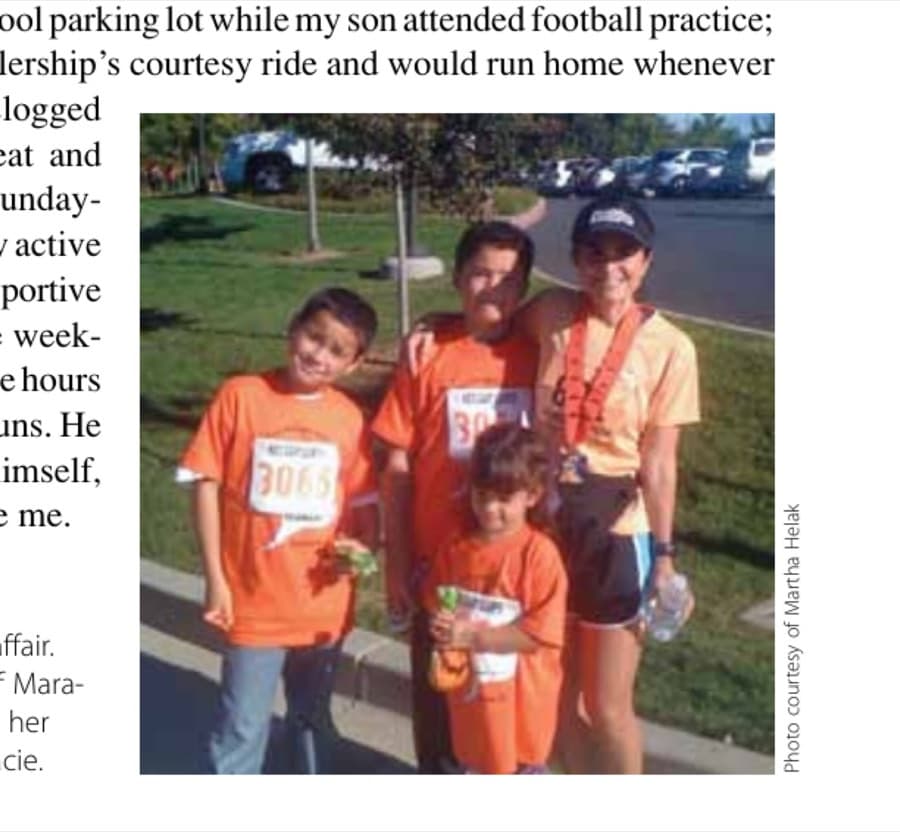
Running becomes a family affair. Martha at the Four Bridges Half Marathon in Folsom, California, with her children Daniel, James, and Gracie.
Photo courtesy of Martha Helak
An overdistance goal
I really loved most of the process, although there were many days when I had to force myself out of bed to hit the pavement. During the 16 weeks that followed, I missed several short runs here and there, but I never skimped on the longer runs. I treasured these lengthy runs, because it meant quiet time (a rare commodity in my hectic life!) when I could lose myself in my thoughts, work out problems, and totally focus on only me. I had a habit of running with ear buds, but my iPod was always off. The plugs in my ears merely served to drown out the sound of the world around me so I could think. I did not want anything to intrude on this special time, not even music I liked. I was training for a marathon, but I also continued to run for the satisfaction it brought me. Running kept me sane.
We arrived in Santa Rosa the day before the race and headed straight to the race expo, which was held at the Marriott downtown. The guest speaker was Marshall Ulrich, who had run across the continental USA, more than 3,000 miles, in 52 days, at the age of 57. While I stood in line, waiting to meet this incredible author/runner, I overheard the conversation he was having with a teenager who was also running the Santa Rosa Marathon the next day. This young man could not have been more than 19 years old, and he had already completed a 72-mile endurance run! Here I was, a 42-year-old novice, running my first marathon, while this teenager had conquered nearly three times that distance. What on earth was I doing here? What if I was the only first-timer running this race? What if I came in dead last, or worse yet, what if I bonked and DNF?
Dinner on the eve of the marathon was a welcome distraction—a fabulous family affair. I ate an entire loaf of warm, sourdough bread bathed in butter. I cleared my plate of pasta and one giant meatball. Perhaps carboloading was a myth, but I wasn’t taking any chances!
After a fitful night’s sleep (I was up every hour, afraid the alarm wouldn’t go off and I would oversleep and miss the marathon.), I finally woke at 5:00 a.m. with bags under my eyes. I had laid out my clothes, hat, sunscreen, and running bib the night before. The timing chip was attached to my right shoe. My stomach was in turmoil, but I choked down a banana, because I knew I would regret it later if I did not eat something.
Going with what I had tested As part of the race registration, I received a bright-pink Adidas running shirt. I loved the shirt and was tempted to wear it during the race but stuck with what I knew to be tried and true: my scrappy running shirt and shorts that I had worn dozens of times before, that would not chafe no matter what. Just in case, I slathered on Vaseline, especially between my toes.
My husband constructed a pullover out of a hotel garbage bag. I wore it to keep me warm while waiting for the race to start (it was 6:30 a.m. and chilly when he dropped me off at Juilliard Park). I probably looked ridiculous wearing a garbage bag, but I was too nervous to care. At least this way, I could simply rip off the bag when I warmed up instead of carrying a discarded sweatshirt for 26 miles.
The morning dawned cool and crisp, in the mid-50s, with a touch of mist— perfect running weather. The venue was picturesque, an out-and-back course of 13.1 miles on a combination of asphalt, pavement, and dirt trails. Since I was doing the marathon distance, I would run this loop two times. This is the part that worried me. Half-marathoners and marathoners would start at the same time. The half-marathoners would run the course once, while the marathoners would continue on. I knew that watching runners exit at the halfway mark would be difficult for me; I would want to leave right along with them! But I had mentally prepared myself for this.
There were so many people that I could not find the starting line at first. Runners were milling about, and from snatches of their conversations, I realized they had come from all over the country to run this race. I used the porta-potty (nerves!) and then walked around some more, too intimidated to ask where the start was because I thought it was a stupid question—something I should have known. At 10 minutes to start time, I was seriously starting to worry about where I needed to go when a grizzled old man walked by, announcing that the race was about to start and that we had better get going. That old man turned out to be Arthur Webb, the race director, an amazing runner who has run Badwater (a 135-mile race that is one of the world’s toughest) 14 times!
I lined up in the back, shuffling my feet to keep warm while waiting for the race to start. Looking around, I was surprised that many of the participants did not have the lean look of what I considered to be a typical athlete. I would soon learn that physical appearance did not mean anything when it came to endurance. Marathoners come in all shapes, sizes, and ages. Two women would qualify for the Olympic Trials that morning, and dozens more would earn the privilege of running the holy grail of road races—the Boston Marathon.
For the first few miles, I just took it all in, enjoying the scenery. I resisted the urge to start out fast and instead paced myself, running much slower than my usual 10-minute mile. I had prepared for this, and I was feeling great. Hawks flew overhead, and I watched as a snowy egret landed in the river that cut along the left side of the trail. Every so often, a squirrel (at least I hope that’s what it was!) would rustle in the bushes that lined the dirt path. I purposely left the iPod at home. Other runners’ conversations served as my entertainment, and although I was content to listen, I did not join in the discussions. From what I gathered, most of my companions would exit at the halfway point, and I felt a prick of disappointment that I would be going the distance on my own.
At mile nine, I fell into conversation with a half-marathoner who had seven half-marathons and two marathons under her belt. That nagging worry returned with a vengeance. Did everyone here have more experience than I did? I never got the half-marathoner’s name, and when she exited at 13.1 miles, I was tempted to follow. Had I run the half, I thought, I would be done by now.
To my relief, I was not alone. Many of the runners continued on for the second loop. At mile 18, I was still feeling great, so I picked up my pace. The cheering spectators were few and far between. I expected to hit the Wall between miles 18
and 20. Without pausing, I took in small quantities of water at each aid station, popped a few Jelly Belly Sport Beans, and braced for the dreaded Wall. I ran on and on, but amazingly, nothing happened.
After mile 20, I dedicated each mile I ran to the people I love: mile 21 to my oldest son, Daniel, who ran his first half-marathon in April; mile 22 to my 10-year-old son, James; mile 23 to my daughter, Gracie, who started kindergarten
the week before; mile 24 to my dear husband, Jeff, without whose support I would not be there; and mile 25 to my father, who ran before running was fashionable. He passed away in 2006. How I wished he had been there to run this race with
me! And finally, mile 26 I ran for myself. In the last two miles, I played a mental game of “pass that person,” setting my sights on someone and then running hard to pass him or her. I overtook every single runner I saw except
for one lady in a white hat and purple shirt who was just too fast! I could not catch up to her no matter how hard I pushed myself. Then she dropped her running glove, bent down to pick it up, and I flew past. I never looked back, and
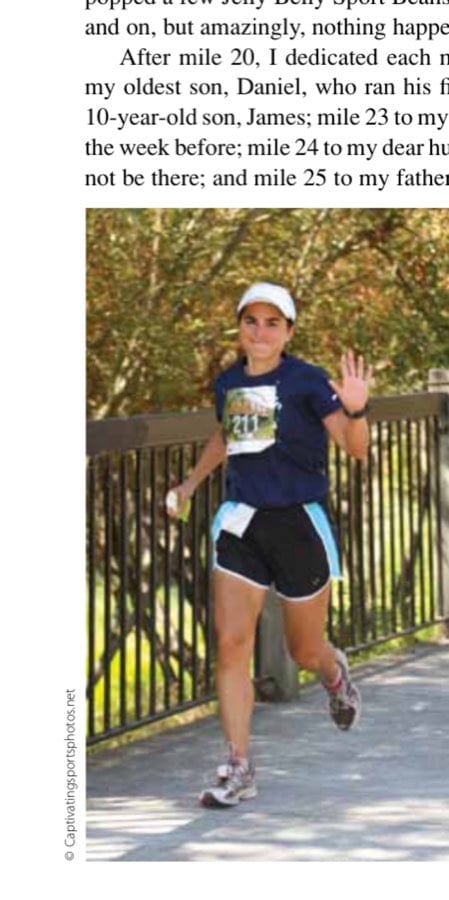
she never did catch up to me after that. With one bathroom stop, I covered the distance in 4 hours, 37 minutes. I did not break any records, but I was At the 2011 Santa Rosa Marathon. Martha is in the home stretch (around mile 24) and still feeling great.
▲
© Captivatingsportsphotos.net
Who misplaced the Wall?
▲
(Top) Martha and Gracie cross the finish line at the Santa Rosa Marathon. There were many wonderful moments during this race, but this one was the best!
▲
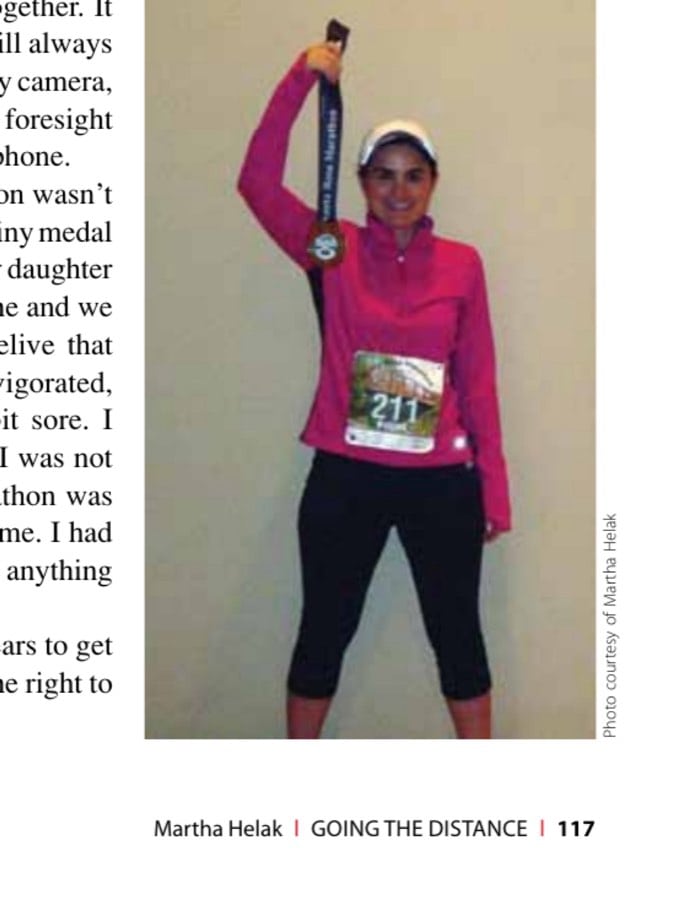
(Bottom) The coveted finisher’s medal.
Photo courtesy of Martha Helak
© Captivatingsportsphotos.net
happy with my time. I placed 19th out of 31 in my age group. My goal was to run the entire distance and finish, which I did. If there was a Wall, I never hit or felt it. I guess I was just too lost in my thoughts toward the end and also excited to finish.
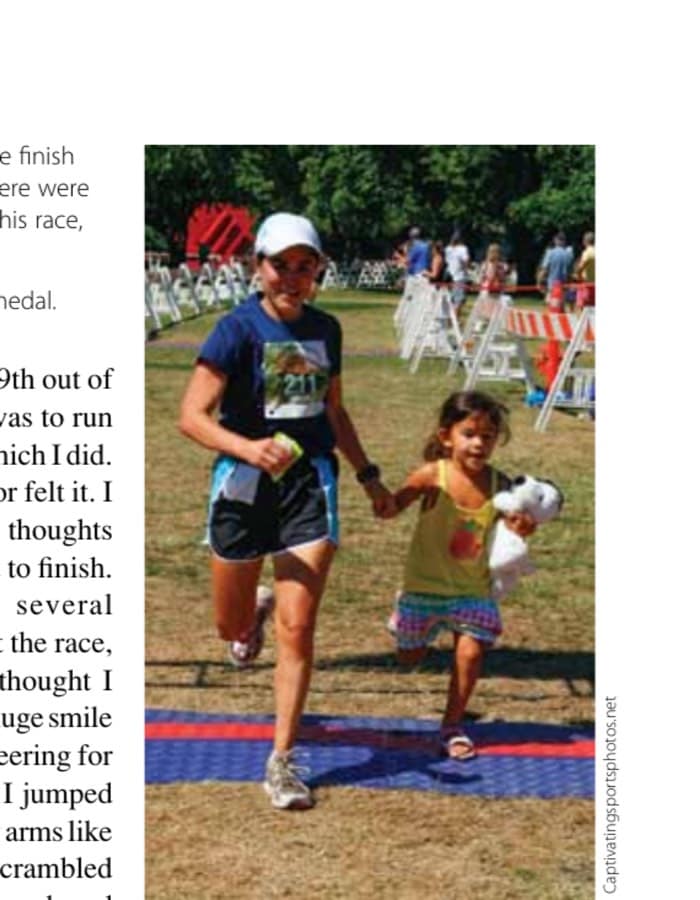
Although I experienced several emotional moments throughout the race, I did not cry at the end, as I thought I might. Instead, I finished with a huge smile on my face. I saw my family cheering for me as I rounded the bend, and I jumped around, laughing and flailing my arms like a crazy person. My daughter scrambled under the barrier and took my hand, and we ran across the finish line together. It was a wonderful moment—I will always remember it. I forgot to bring my camera, but luckily, my husband had the foresight to snap a picture with his cell phone.
The best part of the marathon wasn’t when a race volunteer put the shiny medal around my neck, it was when my daughter slipped her small hand into mine and we ran together. I wish I could relive that moment all over again. I felt invigorated, elated, relieved, and a little bit sore. I know this sounds strange, but I was not even breathing hard. The marathon was a life-changing experience for me. I had proven that I could accomplish anything I set my mind to.
It may have taken me 20 years to get there, but I had finally earned the right to call myself an athlete.
This article originally appeared in Marathon & Beyond, Vol. 17, No. 1 (2013).
← Browse the full M&B ArchiveMore like this
1,000+ stories from 19 years of Marathon & Beyond
The complete archive of the legendary long-distance journal — digitized and free to read.
