

Got To Do It Every Day
You’ve seen the videos, maybe on your local TV news. Maybe you’ve seen them on YouTube, the ones where someone constructed an unbelievably elaborate arrangement of dominoes, perhaps in a spare room, a basement, or maybe a garage. The ones where thousands and thousands of dominoes collapse into each other in precise order, sometimes folding back into each other, sometimes splitting, allowing two rows to collapse simultaneously before eventually reuniting into a single column diving along until the final domino falls.
Those videos are fun and easy to watch. They rarely last more than a minute, and that should lead a viewer to wonder about whomever it was who spent how long—days, weeks, months—thinking of how those dominoes are to be arranged, what sorts of creative patterns they can be set into, spacing them precisely, carefully setting them close but not too close to each other lest the collapse begin too soon, maybe running out to KMart to buy another set of dominoes (who has thousands and thousands of dominoes lying around the house, after all?), only to destroy the entire creation in a few seconds.
Similarly, you’ve heard about streak runners, people who really mean it when they say they run every day. Maybe you’ve read Runner’s World Daily or at Letsrun.com in December when there’s a little piece announcing that Ron Hill has extended his running streak—which began on December 20, 1964—for another year. Maybe there was a piece in your local paper about someone in your area who is about to complete 10 or 15 or 25 years of running every day. Perhaps the author of that piece cleverly distinguished between people with running streaks and practitioners of the old ’70s fad of running in public wearing nothing but shoes. There was probably some “gore story,” a tale of running when some sort of disease or injury made doing so seem insane at best and impossible at worst. You might have wondered what your longest stretch of uninterrupted running days was or why someone would run while in a cast or with a 100-plus-degree fever or in an airport lobby or through a hurricane. If so, consider the similarities between the streak runner and the creator of the domino lines. Each has slowly and painstakingly constructed a thing that generally did not require great effort
to continue but that could be destroyed in a tiny, tiny, fraction of the time it took to create. And there is no going back. You cannot set one or two of the dominoes back up and re-create what you just knocked down, and you cannot make up for not running on Monday by running twice on Tuesday.
The secret origin story
© Charles Hood
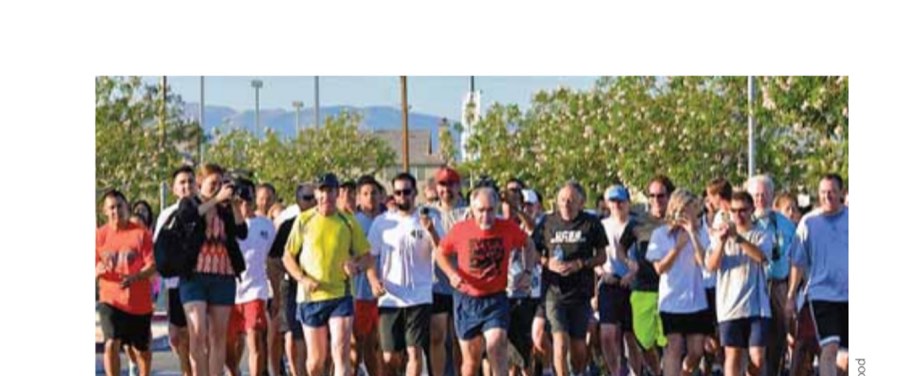
On July 23, 1968, Mark Covert’s family had just returned from a vacation and he went for a 15-mile run. Over the next 13 days he did two runs of that length each day. On July 23, 2013, he ran three miles. Hundreds of people ran with him. Some had flown to his hometown of Lancaster, California, to run with him. Most were local runners. Some were former teammates. Some were runners he coached. Some of the run was videotaped. There was a sort of party afterward. That’s on video as well. Mark’s comments began, “I promise that I used to run faster than that.”
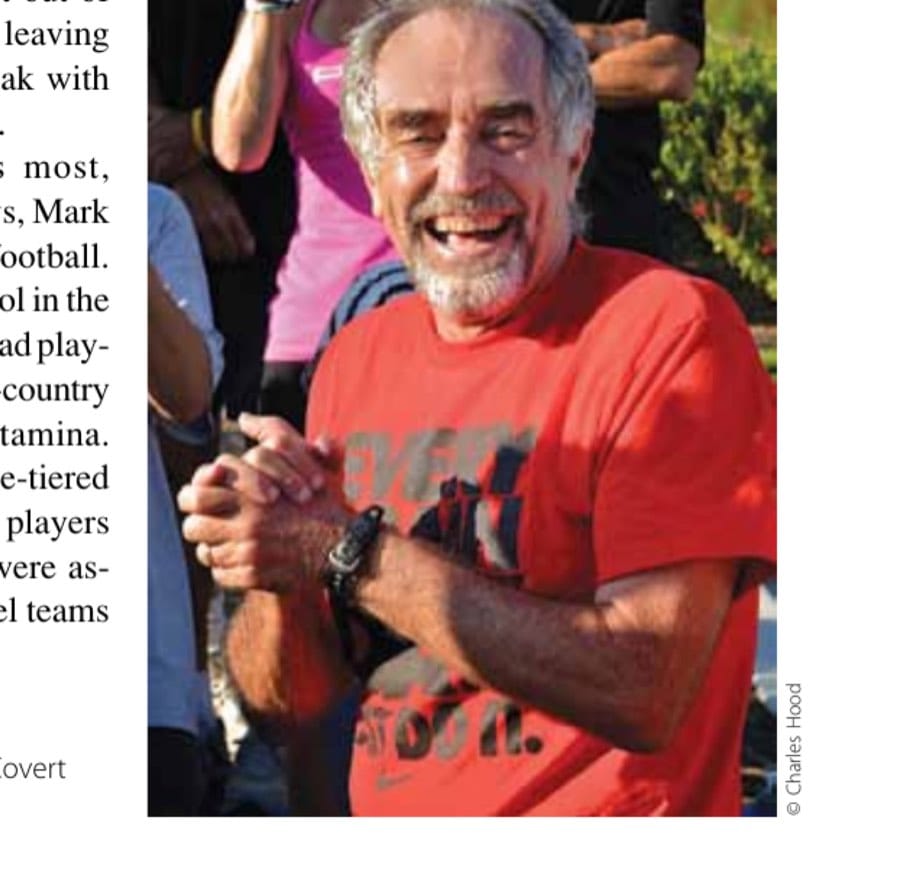
On July 24, 2013, he did not run at all for the first time in 45 years. The longest running streak in the USA had ended. During those years he ran after having a knee scoped and on a cruise ship in the Caribbean during a tropical storm. “The crew was betting on when he’d go overboard,” his wife reported. There was a day when he mentioned to his father that he was feeling sick and that he was thinking of not running. His father promptly told him to get into the family car and then drove him five miles from their house, made him get out of the car, and drove home, leaving Mark to maintain his streak with a five-mile run while sick.
Like many, perhaps most, American high school boys, Mark thought he would play football. But at Burbank High School in the 1960s, the football coach had players work out with the cross-country team to improve their stamina. California then had a three-tiered system in which football players exhibiting less potential were assigned to “B”- or “C”-level teams
▲
A happy ending for Mark Covert after 45 years on the road.
while bigger, faster, more athletic players went to the “A” level. Mark was too small and slow to make the A-level team, but he did well at running. He decided he would rather be a varsity cross-country runner than a B football player. Asked how good a high school runner he was, he answers, “Not good at all.” His high school coach, Frank Kallem, had his runners doing a lot of miles, often in twicedaily installments. Covert loved the hard work and got to a point where he had run on 100 consecutive days. That got him thinking that maybe he could run every day for a solid year. Once the yearlong streak was in place, the “domino effect” took over. Why have a day off when you really didn’t want or need one? One year down, 44 to go. He ran twice a day during the summer. His parents told him that as long as he was running seriously, they didn’t expect him to get a summer job. “
Not good at all” still got him a two-mile in 9:27 before graduating, a time better than all but a handful of US high school runners can manage. But in those days it was a fairly big handful who went faster. College coaches were not lining up with scholarship offers, so Mark set off to run at Los Angeles Community College, a two-year school where he was coached by Laszlo Tabori. Not coincidentally, a teammate at LACC, Jon Sutherland, has succeeded Covert as the American runner with the longest unbroken running streak, recently passing 45 years of daily runs.
The Hungarian Revolution Historically, other nations have been to distance running what Ethiopians and Kenyans are today. In the late ’70s and early ’80s, Mexicans were looking as if they might rival the Kenyans as the fastest distance runners in the world. Arturo Barrios set the 10,000-meter world record, and Mexican marathoners like Rodolfo Gomez, Andres Espinosa, and German Silva were winning major marathons. The Finns of the 1970s— Viren, Vasala, Vaatainen, and others—followed Arthur Lydiard’s New Zealanders to the top of the running world, and the 1920s version of the Finns—Nurmi, Kolehmainen, Ritola—had done the same. In the 1950s a group of Hungarians coached by Mihaly Igloi worked their way to the top of the distance-running world. Sándor Iharos held world records at 1,500 meters, 3,000 meters, two miles, 4 1,500-meter relay, and 5,000 and 10,000 meters, and István Rózsavölgyi had records at 1,000 and 1,500 meters. Tabori was part of that group, becoming the third person ever to run a mile in under four minutes.
Igloi had represented Hungary at 1,500 meters at the 1936 Olympics. By 1950 he was coaching runners. Distance training prior to World War II usually involved less hard running and less overall running than is common now. It was commonly believed that running was too stressful and that the amount and intensity should be limited. By 1950, under the influence of runners like Emil Zatopek and coaches like Igloi, that idea became outdated. Igloi’s athletes trained twice a day and did
interval work in most of those sessions. Bob Schul, winner of the 5,000-meter gold medal at the Tokyo Olympics, was trained by Igloi and said that he usually trained for an hour and a half in the morning and two to three hours at night.
Igloi’s Hungarians were expected to do very well at the 1956 Melbourne Olympics, but that was the year Hungarians revolted against their Soviet-backed puppet government. After initially agreeing to negotiations with the rebels, the USSR changed course and launched a full-scale invasion, sending more than 31,000 troops and 1,100 tanks. More than 700 Soviet soldiers were killed, as were more than 2,000 Hungarians. The fighting was going on as the Hungarian Olympians were in Melbourne. Undoubtedly distracted and weighing the benefits of defecting against those of returning home, their performances were less than anticipated. Igloi, sponsored by Sports Illustrated, which undoubtedly sensed a good story, eventually came to the United States, as did Tabori, who continued to compete and train under Igloi, who managed to find work coaching running clubs and turning US distance running, which historically had been weak internationally, into a world power. In addition to Schul, Igloi coached Max Truex to the highest Olympic 10,000-meter finish to date of any US runner, sixth at the 1960 Olympics, and Jim Beatty to the first sub-four-minute mile run indoors. He took a job as Greece’s national coach in 1970 and finally returned to Budapest after the fall of
ad
Courtesy of Cal State Fullerton
▲
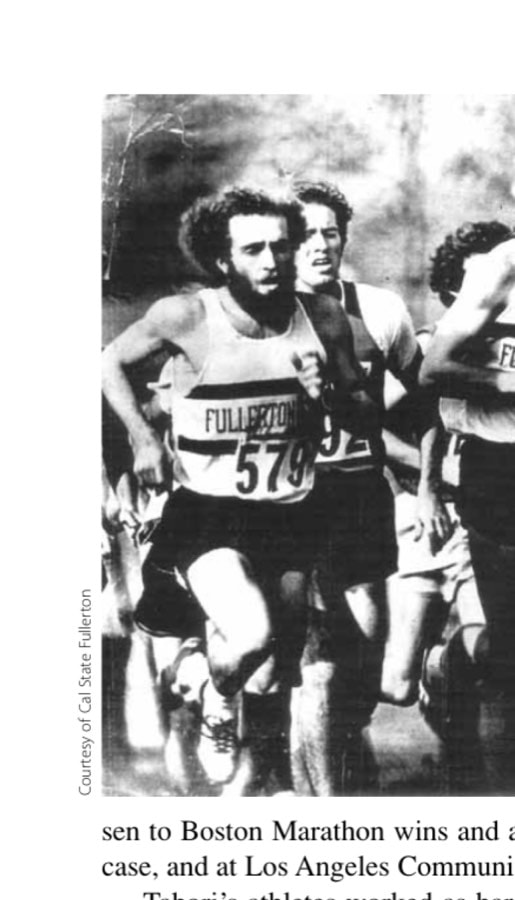
Covert (#579) shows the form that made him an All-American at Cal State Fullerton.
communism until his death in 1998. Tabori, a Hungarian expatriate, could not compete internationally for the United States and would not be named to any Hungarian teams. He competed in open meets in the USA, but his international
career was over. He also turned to coaching and largely replicated Igloi’s interval methods at both the Los Angeles Track Club, where he coached Miki Gorman and Jacqueline Hansen to Boston Marathon wins and also to a world marathon record in Hansen’s
case, and at Los Angeles Community College. Tabori’s athletes worked as hard as Igloi’s had, though Igloi’s runners usually did interval work at both of their daily runs and Covert says he never had to
run two interval sessions in a day. He ran twice nearly every day, covering more than 600 miles in many months and over 6,000 miles a year. And he continued to run every day. “I knew I wasn’t that good. But I did think that if I worked really hard, maybe I could run some decent times and beat some good people.”
Prime racing years Mark got good enough that Cal State Fullerton offered him a cross-country and track scholarship when he was done at Los Angeles Community College. Fullerton, now a Division I school, was in the NCAA’s College Division then, the
predecessor of today’s Divisions II and III. But it was something of a distance powerhouse, with runners doing massive mileage. Two of Covert’s teammates, Doug Schmenk and Dave White, were running 170- to 180-mile weeks and had
respective marathon bests (yes, college runners in those days sometimes raced marathons) of 2:15 and 2:17. Fullerton won the College Division cross-country championship in 1971, but the previous year was an even better one for Covert
as he was the individual champion in the division. In those days, top finishers from the College Division meet were allowed to run in the University Division (Division I) Championship, and he placed 16th, collecting All-America status, following that a few days later with a 17th-place finish at the AAU cross-country championship, which at the time was run in late November, a few days after the NCAA meets. He brought his three-mile time to 13:45, worth roughly 14:14 for five kilometers, and his six-mile to 28:08, approximately 29:08 for 10 kilometers, and qualified for the 1972 Olympic Trials Marathon in Eugene, run in conjunction with the track and field trials. He hung with Frank Shorter and Kenny Moore, the first- and second-place finishers, for much of the race before eventually fading to seventh place with a time of 2:23. Asked what he considers his best race, he mentions the three cross-country races and the Olympic Trials Marathon. “
People seem to think of me as a marathoner because of the streak and all the miles I ran. But I was really better at the 15- to 20-kilometer range. I ran tons of miles but my long runs were usually only an hour and a half to an hour and three quarters. I didn’t do the two-and-a-half hour runs you need for really good marathons.” His fastest marathon is 2:21.
If you ran in 1972 or before, you most likely did it in shoes from either Puma or adidas, though increasingly a Japanese shoe called “Onitsuka Tiger,” now Asics, was penetrating the US market. At the Eugene Trials that year, a new company was offering free shoes to runners. It showed Mark a racer that he liked, and he wore it in the marathon. None of the first six finishers wore the new brand, so Covert holds the distinction of being the first runner ever to finish a race in Nike shoes. After graduation he would go to work for Nike in a store in Southern California. He has maintained a relationship with the company ever since and has been inducted into the Nike Hall of Fame. In later years he began sending out an annual updating of his annual streak mileage totals, always mentioning not only the total of number of miles he had run but also the total he had run in Nikes. “They’ve always been great to me.”
He raced seriously through his early 20s, racking up the sort of mileage that was common among serious racers of the day, more than 5,000 miles most years with a few topping 6,000. But the sport was an amateur one then, and the business of making a living eventually reared its head.
After the peak Mark’s relationship with Nike got him a job in one of its Southern California stores for a time. He did a few other jobs in those years as well, trying, as many runners at the time did, to fit work into his training and racing routine. He passed up an opportunity to manage the Nike store because the time required would have taken away too much training time. Eventually, though, he got married and needed
something more stable. Mark was running near a freeway one day when a friend who at the time was the track coach at Los Angeles Valley Community College saw Mark, called from his car that there was an opening for a cross-country and track coach at the school, and said that if Mark was interested he should apply. He was, he did, and he was hired. He had majored in physical education at Fullerton and began teaching some physical education courses along with coaching. Eventually Mark finished his master’s degree and was hired as a full-time coach and faculty member, a job he has held for over 30 years.
Coaching cross-country and track is not an ideal job for someone who is serious about his own running. If nothing else, your team’s competitions happen at the same times as races you would run. There was never a decision to stop racing, but he competed less and less as time went on. Most serious runners would become much less serious, spend much less time running at this stage, and perhaps run a few miles a day for “fitness.” But there are a few who keep to their old routines even if the original reason for developing the routine is gone or greatly modified. Mark clearly falls into the second group. “
The thing was,” he explains, “I liked working out.” In 1977 he ran 5,566 miles. In 1978 he ran 6,386 miles, totals that were no different from what he had been logging from the late ’60s to mid-’70s when he was focused on competition. He ran more than 4,000 miles every year until 1982. From there the totals drop into the 2,500- to 3,000-mile range for the balance of the decade before settling into the mid-2,000s through the ’90s. His training, once very heavily oriented towards interval work, shifted toward steady running, but he continued running at least one interval session a week into his 50s and ran twice on most days into his early 40s. Asked when he last raced, there is a long pause and then, “I don’t know. There was a relay race a few years ago, and some guys talked me into doing a leg.” But we never learn exactly how many years ago were “few” in this case.
A bit of fame And so he ran on, though in inevitably declining amounts as the years and miles took their toll. “I never really talked about my streak very much,” he says. He did begin sending out an annual e-mail to friends who knew of his streak, giving the updated totals for the previous year. Some of those friends forwarded the e-mail to their own friends. Then in 1994, George Hancock of Windber, Pennsylvania, who himself had gone a number of years without missing a day’s running, read a letter to the editor of one of the running magazines, asking whether anyone had kept any data on people who had running streaks. Evidently no one had, so George took the job, sending about 200 letters to running clubs across the USA, asking if the club had any members with streaks. He kept to this task, originally publishing his results on David Blaikie’s now defunct ultramarathoning website
and later in Runner’s Gazette, a regional publication focusing on running in the mid-Atlantic states. In 2000, John Strumsky of Baltimore took over the job and founded the United States Running Streak Association. Mark’s name topped each list, which included only streaks held by U.S. runners. “Once I was in Palo Alto at the Runner’s World offices,” Mark says, “and we got to discussing running streaks. About five years ago, Runner’s World began to mention my streak maybe once a year.” A bit of fame had found him.
All good things . . .
© Charles Hood
Star Trek fans will recognize this as the title of the final episode of Star Trek: The Next Generation, but it seems worth stealing here. Mark was born with feet that are almost totally flat. Eventually his right one gave out. “It’s called total midfoot collapse,” he says, and it impeded his running more and more as the years went by and the miles piled up. By the start of the century, his annual mileage had fallen into the low 2,000s, and in 2004 he recorded only 1,899 miles. The pace had also slowed dramatically.
Lack of fitness was not the problem. His right foot simply would not function, so he dragged it along on runs that were progressively slower and more difficult. He had once described himself to a friend as a “mono-runner,” one who did not cross-train, lift weights, or swim, but he had begun biking. “I haven’t really trained for years because the foot made it impossible. On the bike I can push myself again.”
All good things come to an end, and he began to consider ending the streak. “I didn’t want it to end because I couldn’t do it anymore. I wanted to end it on my terms.” As the 45th anniversary of the streak approached, he decided that would be the last day. Word got around, and the last run became an event. Typing “Mark Covert last run” into a search
▲
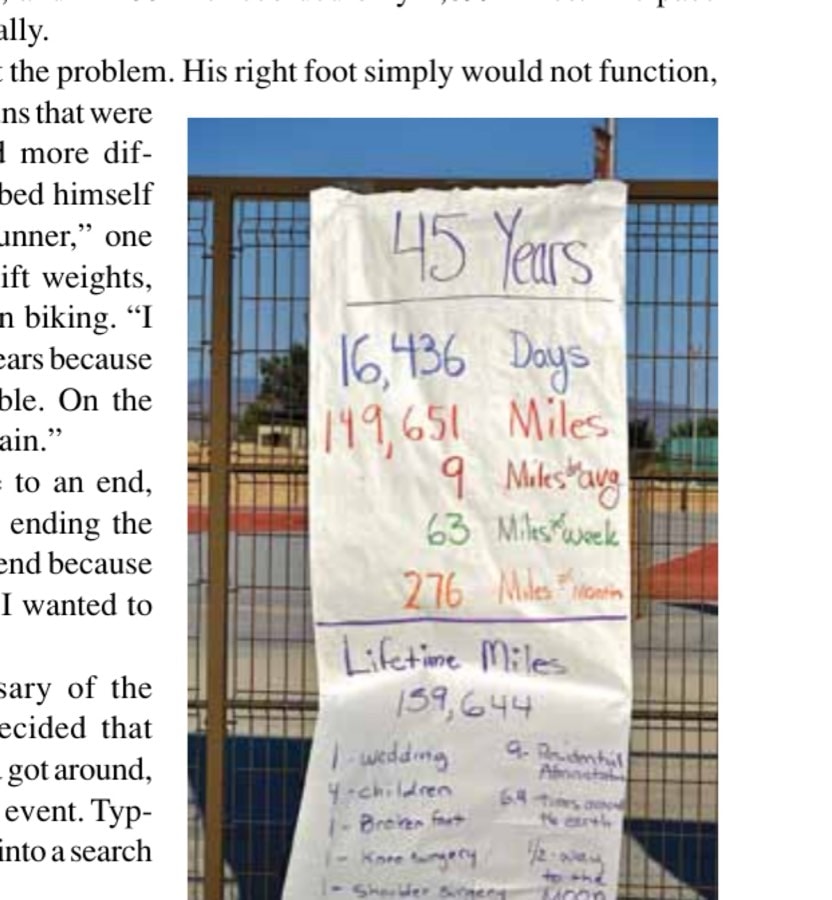
A 45-year running streak: the numbers don’t lie.
engine online will allow you to watch it. It was not, he says, a hard decision to make and in a way the streak lives on because he has ridden his bicycle every day since he stopped running, except for a few days when he was away from his bike. On those days he hobbled through a run. “Eventually I will need an operation on my foot, and I’ll have to stay off of my feet for two months.” So even the modified streak will end.
Regrets? Advice? The streak ended on July 23, 2013. It could have been resurrected with just a mile (his current minimum run that “counts,” down from the three-mile minimum he once had). Was he tempted to shuffle out the door for 15 minutes that day? “Not at all.”
Would he do anything differently if he had it to do over again? “No. I tried as hard as I could. I ran as well as I could. Maybe I trained too hard, a lot of us from that time did, and maybe we left our best races on the roads or tracks where we trained. But maybe not.”
Was the streak a good or a bad thing for his racing? “I don’t think it affected anything. Maybe I would have healed up a little faster from some things if I’d had some time off.” But then he mentions that when he was feeling bad he always seemed to feel better after doing a little run.
Did the streak have any sort of effect on his life? He managed to maintain a 35-year-long marriage and raise four kids during the streak. “Not really. If we wanted to do something like a rafting trip or a holiday, I’d just get up at 5:00 a.m. and get a little run in. I had a normal life.”
Would he recommend starting a streak to others? “No. But if you want to do it, you should.”
Why? Asked if he thinks he is or was different from other serious competitive runners, he says he doesn’t think so. But few other runners go for years and years without taking a day off, so something must have been different. “I show up for work every day. I don’t miss things that I’m supposed to do. Maybe I got that from my dad. He was a butcher and he never missed a day’s work. He’d have cuts all over him, maybe 50 or so, and be in real pain. But he went to work anyway.”
Still, other runners never miss work or school or have parents who never missed work, and they don’t run every day for decades on end. What possesses a few to do so? Maybe we’ll never know. Maybe the streakers themselves can never really know why.
© Charles Hood
▲ Covert (center) finishes his last run with a little help from his friends.
A common refrain about running streaks is that they “take on a life of their own.” That’s essentially true. Run every day for a week or month, even for two months, and then skip a day. If you regret that day off, you can run every day and in a very short time you have a streak of the same length. When you’ve run every day for a year or a decade or for multiple decades, when you’ve normally covered 10 or 15 or 20 miles on most of those days and have found that shuffling along for a few minutes isn’t that hard no matter how bad you feel, certainly not as bad as you would feel if you destroyed this thing that took so long to create, you’ll think long and hard before you skip that day. At some point the answer to “Why?” becomes “Why not?”
Afterward What is it like for Pope Benedict XVI these days, sitting quietly in an apartment watching Francis doing what he had done until recently? How is it to have walked away voluntarily from the top of the pile and watch someone close at hand assuming the role you once had and could still have, had you made a different decision? The comparison may be a reach, but recently Mark’s old teammate at Los Angeles Community College, Jon Sutherland, pushed his running streak past its 45th year. Sutherland is the new pope or the new king of the hill or the . . . well, you get the point.
Apparently it’s just fine. “Jon will do just fine,” Mark says without a hint of regret or envy in his voice. “He’ll go on for a long time.” And for himself and his streak? Was it ever a chore or a problem? Was he ever tempted to break it before it got to the 45-year mark? “Never. I always thought of each day’s run not as something I had to do but something I got to do.”
This article originally appeared in Marathon & Beyond, Vol. 18, No. 6 (2014).
← Browse the full M&B ArchiveMore like this
1,000+ stories from 19 years of Marathon & Beyond
The complete archive of the legendary long-distance journal — digitized and free to read.
