

Governor’s Cup Ghost Town Marathon
On Saturday of Governor’s Cup weekend in Helena, Montana, road racers have a smorgasbord of races to choose from: the famed 5K (with roughly 4,000 runners, one of the largest in the country), the 10K, a 20K, a marathon relay, a marathon corporate cup, and the Governor’s Cup Ghost Town Marathon, one of the most scenic (and most under-run) marathons in the world.
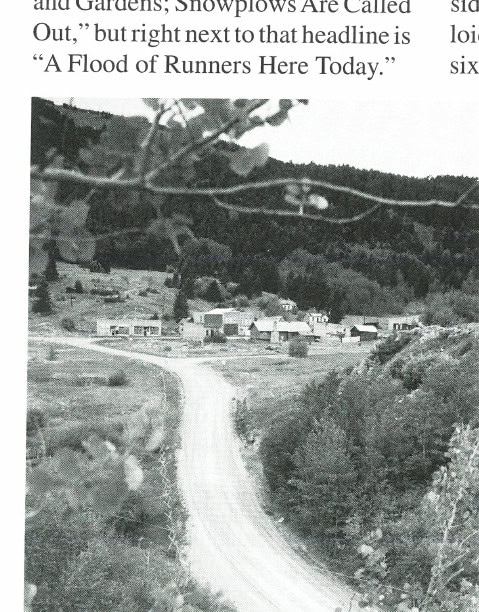
The marathon runs from the “ghost town” of Marysville in the mountains above the city of Helena to the mass finish line downtown on Park Avenue just behind Last Chance Gulch and boasts fewer than 200 runners, half of whom seem to be using the race just so they can check off Montana in their quest to run marathons in all 50 states and D.C. It’s Montana’s only marathon.
It’s unfortunate that the starting field for the marathon is so small because the course is 90 percent downhill, scenic, well-organized, and drips with history. The course (see page 112 for more details) isn’t exactly easy, although much of it is. If the course has one drawback, it’s that it is located at altitude: the marathon begins in Marysville (the liveliest ghost town we’ve ever visited) at 5,200 feet and finishes in Helena at 4,157 feet (the unliveliest city we’ve ever seen on a perfectly lovely Sunday).
Let’s explain those two statements up front. Marysville is listed as one of Montana’s famed ghost towns, the remnants of the gold-mining boom and bust. In the 1880s and 1890s, Marysville was bursting at the seams with a population of 50,000. The former city has one of those strike-it-rich histories so common to Western mining history. “Irish Tommy” Cruse was a down-on-his-luck prospector who used to sleep on the drug store counter in Helena between hitting up locals for grubstake so he could head back into the mountains in search of gold.
Persistence paid off—big. Tommy struck gold, called his mine Drumlummon after his birthplace in Ireland, and the town of Marysville came into being. There are various legends about how the town got its name. The most romantic is that Tommy named it after the woman in Helena who had been grubstaking him.
Tommy reputedly wrenched $150,000 in gold out of the ground over six years. During the 1880s and 1890s, Drumlummon was Montana’s leading gold producer, to the tune of $50 million. Tommy eventually sold the mine for $1.5 million to an English syndicate, which proceeded to mismanage it into ruin.
THE UNDEAD
Today, Marysville is a burg of roughly 75 people and largely deserted and decrepit buildings. The Marysville House, a funky saloon/restaurant, is one of the liveliest places in Montana the night after the race, and nearly half of the marathoners return to the start to enjoy the good restaurant food. Some of them are even bribed by the waitress with free beers at the bar if they will give up their tables.
In contrast, the charming little city of Helena is nearly deserted Saturday night after the races, and on Sunday it looks as though a neutron bomb had exploded nearby: all the buildings stand, but there isn’t a person to be seen anywhere. One local bookstore operator told us that since Helena is the state’s capital and employs thousands of area residents, they tend not to come back to the city over the weekend.
This is unfortunate. If Last Chance Gulch, the walkabout heart of the city, were in any other locale, the place would be teeming with tourists and locals. Last Chance Gulch is the site where the settlement of Helena started. In the summer of 1864 four dispirited prospectors set up a rough camp at what is now Sixth Street and wandered off after supper to look for gold. Reginald Stanley went up the gulch, dug seven feet to bedrock, and pulled out four gold nuggets. Stanley
| The Basics | |
|---|---|
| Governor’s Cup Ghost Town Marathon P.O. Box 451 Helena, MT 59624 |
|
| PHONE: | 406/447–3414 |
| RACE DIRECTOR: | Susan Frazee |
| YEAR ESTABLISHED: | 1974 |
| SANCTION: | USATF |
| CERTIFIED: | USATF |
| START TIME: | 7:00 A.M. |
| RACE RECORD HOLDERS: |
Male: Jim Hatcher, East Helena, MT, 2:20:35 (1982) Female: Karen Sanford-Gall, Billings, MT, 2:53:29 (1991) Male Master: Dave Roberts, Helena, MT, 2:33:42 (1991) Female Master: Priscilla Flesch-Britic, Glendive, MT, 3:12:44 (1992) |
| PRIZE MONEY: | None |
| TIE-IN EVENTS: | 20K, 10K, 5K, corporate cup marathon relay, marathon relay |
| NO. VOLUNTEERS: | 150 |
| MARATHON FINISHERS IN ’97: | 173 |
| PROPORTION MALE/FEMALE IN MARATHON: | 74% male; 26% female |
| COURSE MARKING: | every mile |
| NO. FIRST AID STATIONS: | 13 |
| NO. AID STATIONS: | 13 |
| FUTURE RACE DATES: | 06JUN98 (25th), 05JUN99, 03JUN00 |
| ENTRY COST FOR 1998 EDITION: | $30 |
| LODGING: | For lodging information, contact the Helena Area Chamber of Commerce at 800/7–HELENA (out of state) or 406/442–4120 (within state). |
| FOR INFO ON HELENA AND MONTANA: | Contact Travel Montana, Department of Commerce, 1424 9th Avenue, P.O. Box 200533, Helena, MT 59620–0533; 800/VISIT–MT (outside Montana) or 406/444–2654 (within Montana), or visit their web site at http://travel.mt.gov/ and ask for the Montana Travel Planner and the Montana Vacation Guide. Helena is located in what Montanans refer to as the Gold West Country (for more specific info, call 800/879–1159 or 406/846–1943). |
called in his partners; they dug up more ground, found more gold, decided to call the strike Last Chance (since they were on the verge of chucking the whole gold-prospecting enterprise), spent the night firing their guns to ward off the attention of wolves and coyotes, and, as Stanley said, over the following days, “set to and dug holes, . . . took our time, and did it well and chose what we thought was the best ground.” Helena had been nearly discovered 59 years earlier. Lewis and Clark passed several miles north of it on their expedition to the Pacific Coast.
SATURDAY’S RACES
Since the race is on Saturday, runners interested in Helena’s charming little marathon must switch gears and change their frame of reference by one day. Packet pick-up is on Friday. So is the outdoor expo, which is cleverly set up along both sides of the pedestrian walkway up Last Chance Gulch. Unfortunately, in 1997, a severe hailstorm rolls in on Friday afternoon and pounds the Helena area, stripping leaves and branches from trees, destroying the inventory of local nurseries, and dampening the outdoor fitness and health expo.
However, Saturday, dawns with perfect race weather: sunny skies and chilly air. Blue Cross and Blue Shield of Montana is the title sponsor of the race. Fortunately, the company has not insisted that their name be part of the race’s official title or it would be too long to get on the attractive race T-shirts.
The 1997 edition of the races is the 24th annual. Although in a small city in a remote state, the race draws runners from 32 states and several foreign countries, including England, Canada, and Brazil.
Unlike some cities that tolerate rather than welcome road races, seeing them more as an inconvenience than as a boon to local businesses and the city’s reputation, Helena gets behind the Governor’s Cup Races. Store windows are plastered with race posters, and residents know the course by heart and turn out in droves to volunteer. And it would be difficult to find a city newspaper that gets behind its local race as spiritedly as does the Helena Independent Record.
Friday’s edition carries race news at the top of page one. A report on the 24th edition of the race appears on the top left while a feature story on Curtis Lintvedt occupies the top right. “When Curtis Lintvedt crosses the finish line of the Governor’s Cup Marathon wearing race number 50,” the article notes, “he will have completed a marathon in all 50 states and Washington, D.C., before his 50th birthday in July.”
As the only marathon in Montana, the Governor’s Cup Ghost Town Marathon is a must for the growing number of marathoners (roughly 150 at present) who set a goal of running a marathon in every state and D.C. (Curtis celebrated his accomplishment by dining at The Marysville House on Saturday night.)
Most of the top of the front page of Saturday’s paper is taken up with news about the “STORM! Up To 6 Inches of Hail Wrecks Helena Yards and Gardens; Snowplows Are Called Out,” but right next to that headline is “A Flood of Runners Here Today.”
Sunday’s paper uses 80 percent of its front page to report on the Governor’s Cup Races: “5,801 Hit the Road.” It also tells of 101-year-old Herbert Kirk of Bozeman, who ran the 5K with his 70-year-old son. Inside, the paper carries a 24-page tabloid with complete results from all six races.
The 5K (10:00 A.M.) and 10K (8:00 A.M.) courses are run through the downtown while the longer races run into town from the wide-open Big Sky country.
THE COURSE
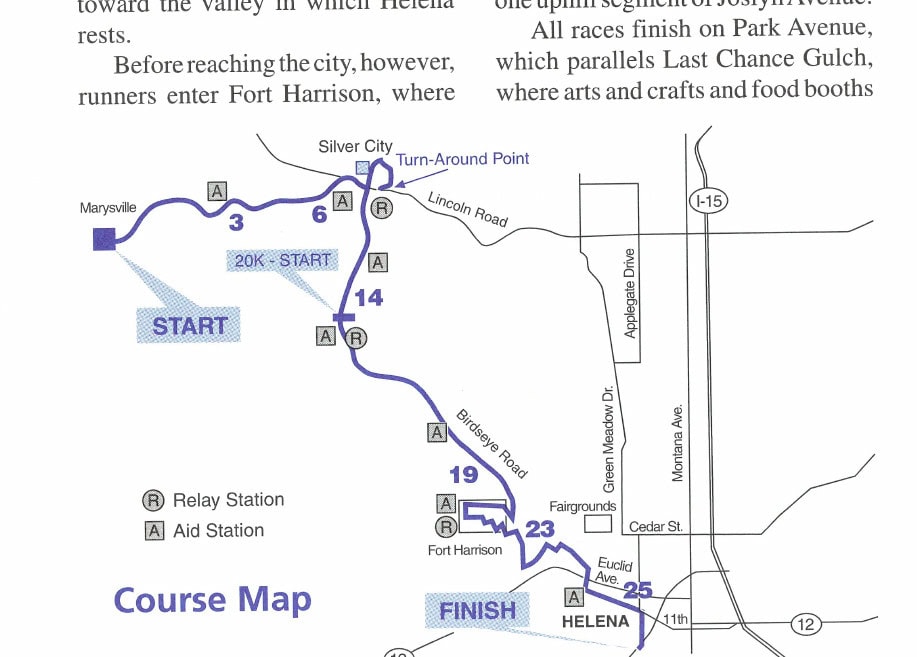
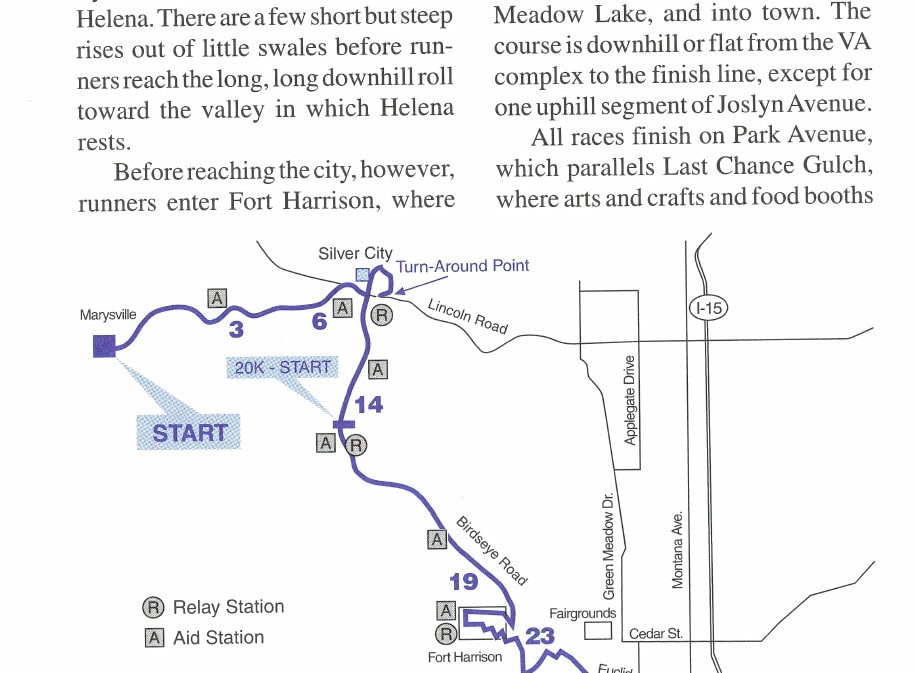
The marathon, marathon relay, and corporate cup relay begin at 7:00 A.M. on the main street through Marysville. The first six miles are along a two-lane gravel road that follows the original horse and buggy trail from Marysville to civilization. After six miles, runners hit the asphalt Lincoln Road (flat) to the Silver City Bar, where they are diverted to a two-mile turnaround loop on a dirt road. They are then sent down Birdseye Road, a rolling (but primarily downhill) country road that heads the runners toward Helena. There are a few short but steep rises out of little swales before runners reach the long, long downhill roll toward the valley in which Helena rests.
Before reaching the city, however, runners enter Fort Harrison, where they take a mile-long gentle uphill run before turning and rolling onto the VA Hospital grounds, then around Spring Meadow Lake, and into town. The course is downhill or flat from the VA complex to the finish line, except for one uphill segment of Joslyn Avenue.
All races finish on Park Avenue, which parallels Last Chance Gulch, where arts and crafts and food booths
Must See/Must Avoid
Every major city in the world features an array of attractions that make it unique and that enlighten and entertain visitors. And, because of its very size, every major city is saddled with areas it would rather have vanish in a puff of smoke. The following is a brief consideration of both.
GO SEE IT
Last Chance Gulch. Snuggled between two hills in downtown Helena is Last Chance Gulch, where gold was discovered in 1864, and where much of the original town developed. The gulch has been turned into a walking mall; the surface is all brick, and both sides are ripe with historic buildings and shops. Keep an eye out for the numerous historic plaques, all of which offer interesting reading if you’re a history buff. The public library is also located along the upper stretch of Last Chance Gulch.
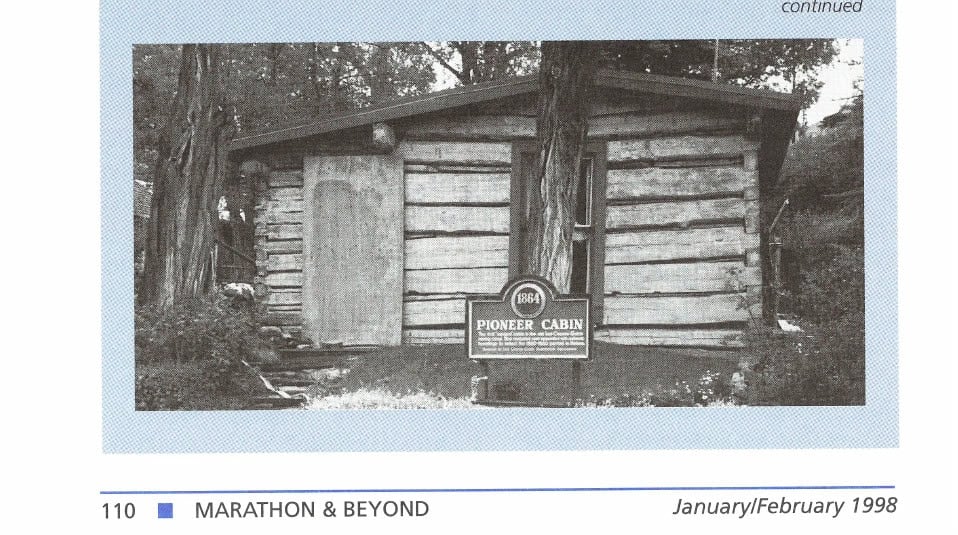
Reeder’s Alley. Diagonally across Park Avenue from the library is Reeder’s Alley, a carefully-restored segment of Helena’s past. Pioneer Cabin, at the base of Reeder’s Alley, is a must. Authentically restored, the cabin houses many 1864-era furnishings.
Original Governor’s Mansion, 304 N. Ewing. Built in 1888, the Victorian-style mansion was the home of nine Montana governors between 1913 and 1959. There are guided tours between April and December.
Gates of the Mountains. North of Helena, off I-15, this natural wonder along the spectacular Missouri River canyon must have been daunting, indeed, for the 1805 Lewis & Clark Expedition. Commercial boat tours are available.
Marysville. Northwest of town, off Route 279, Marysville is a must. It’ll be a “must” if you’re running the marathon since the starting line is in the middle of town. Worth visiting before and especially after the marathon. Eat at the Marysville House. The shrimp or crableg skillet is a hardy way to reward yourself for a job well done.
AVOID IT
Nothing. In Helena, some folks park their cars with the windows open, and the only harm that befalls them is that the interiors get cold at night.
Runner’s High/Runner’s Low
| HIGHS | LOWS |
|---|---|
|
|
are set up and live music is provided. (Cajun music is big in Montana—honest.)
The spectators and racers are festive and enthusiastic but manage to vanish into the woodwork well before evening rolls in. How 5,801 runners, their families, and friends can vanish so thoroughly stumps us. In almost every other city in the country, Helena’s kind of crowd would stretch the Governor’s Cup Races into a weekend-long picnic/festival. Unfortunately, because of the desertion of the city over the weekend, most of the shops along Last Chance Gulch are closed, so even if you want to do something, it’s difficult to find a place open to do it. But on Saturday evening, the most lively place in the area is the supposed “ghost town” of Marysville, where the town’s population easily quadruples, and where the customer mix at The Marysville House of marathoners, bikers, tourists, and locals all joyfully maintain the tradition started more than 100 years ago by “Irish Tommy” Cruse.
The Bottom Line
We have weighed various aspects of a marathon within a 1,000-point scoring grid. Besides the author of the article, a dozen runners at the race were randomly chosen to score the race for us. (GCGTM = Governor’s Cup Ghost Town Marathon.) The results follow:
1. HISTORY/TRADITION
Evaluate the race’s sense of history and tradition.
[Possible points: 30 GCGTM score: 28]
2. ENTRY FORM
Is the race entry form clear, concise, attractive, complete, and easy to fill out?
[Possible points: 20 GCGTM score: 19]
3. ENTRY COST
For most races, the entry fee covers between 30 and 50 percent of the cost of putting on the event. Rate the value of your dollar relative to this race.
[Possible points: 30 GCGTM score: 30]
4. LOCALE/SCENICS
Is the race held in an area that is easy to get to and scenic, offers adequate food and housing services, and nonrace activities for family and friends?
[Possible points: 50 GCGTM score: 45]
5. REGISTRATION
Is registration well-organized and efficient? Does it bog down unnecessarily?
[Possible points: 20 GCGTM score: 18]
6. PRERACE ACTIVITIES
Evaluate activities such as pasta feeds, parties, and so on, during the days before the race.
[Possible points: 50 GCGTM score: 20]
7. EXPO
Does the expo offer a fair number and variety of booths relative to the race’s size? Are there quality exhibitors and good guest speaker(s)?
[Possible points: 50 GCGTM score: 25]
8. COURSE
Take into consideration the following: degree of difficulty, certified, sanctioned, quality of road or trail surface, adequate mileage and directional markers, aid stations, medical coverage, race communications, accessibility to course for friends and family, typical weather, and so on.
[Possible points: 400 GCGTM score: 311]
9. RACE AMENITIES
This category includes race T-shirt, finisher’s medal, finisher’s certificate, adequate and efficient finish area, ease of sweatbag retrieval, showers, postrace refreshments, awards ceremony, raffles, results postcard, results book, and so on.
[Possible points: 250 GCGTM score: 208]
10. VOLUNTEERS
Are the volunteers experienced and adequate in number?
[Possible points: 100 GCGTM score: 91]
TOTAL SCORE FOR THE GOVERNOR’S CUP GHOST TOWN MARATHON:
795 points (out of 1,000)
This article originally appeared in Marathon & Beyond, Vol. 2, No. 1 (1998).
← Browse the full M&B ArchiveMore like this
1,000+ stories from 19 years of Marathon & Beyond
The complete archive of the legendary long-distance journal — digitized and free to read.
