

Graduation to the Marathon
“Uh-huh.”
“Only, I happen to know what you’re thinking. You’re thinking you’ll run that damn Boston Marathon with Georgie. Isn’t that right?”
“Well, . . . I . . . I just thought maybe I’d . . .”
“You listen to me! Running in that race is fine for Georgie. He’s 19 and out of high school. It would be a damn stupid thing for you to do, with one more year of scholastic eligibility . . . and a scheduled track meet the day after the marathon.”
“I know, I know…”
“All right, Johnny. If you know, then you’d better know this: I expect you to race for Bulkeley in the mile on April 20, no matter what.”
“Yes, sir.”
“And with no excuses. Always remember, ‘He who excuses himself, accuses himself.'”
“Yes, sir.”
Jogging off the field this April afternoon, I wince from the knee injury I got during an ins-and-outs workout with George three months back. It hasn’t stopped my training, though I guess I’m only about 80 percent at best, and I haven’t even put the knee to the test of racing. Now, with the “damn” Boston Marathon two weeks off and the command-performance Fitch meet one day later, timely recovery looks about as likely as the return of the dodo bird. Mal doesn’t even know about the knee.
* * *
On Saturday morning George and I run five miles out on the Hartford Road and back to New London along Vauxhall Street, to wind up at Morgan Park, Bulkeley’s “home field.” This was to have been our long tune-up before the Big One, but my game knee halved our planned mileage. George will shag out later on his own for a second run. I’m counting on the bike pedalling I’ll be getting on my Western Union delivery job to take up the running slack.
George has pretty much taken me under his fraternal wing since he fell for my sister, Ellen. He promises to protect me from Mal’s wrath.
“Still, he’ll probably cut off the good knee, he’ll be so mad,” I say.
George gives his little chuckle. “Naw. You know Mal. He’s saying those things now, but when we do good in Boston, he’ll be telling everybody he’s our coach.”
“He’ll be telling everybody he’s your coach,” I correct him.
“Look, lad,” George says, “he already knows about all those good road races you’ve done. He has to figure you can do a good marathon, too.”
“Nah, George,” I reply. “If it were you, he’d believe it; you have to admit, for whatever reason, you’re Mal’s golden boy. I’m . . . well, you know, like the ‘prodigal son’ or something.”
“Sure, lad. Wasn’t the ‘prodigal son’ forgiven and brought back into his father’s house?” (George comes from a Bible-reading family.)
“Well, . . . then that was another story entirely,” I answer. “It’s just that when Mal thinks of my running, he thinks Littleton, Fall River, you know, those flubbed races.”
“But you went on from them, lad. You won Haverhill last July. Then the national junior 30K in Millburn [NJ] a month later,” George says. “He has to know about them. You got write-ups.”
“Sure. Then why does he always say, ‘Johnny, look what happened in Littleton, look what happened in Fall River?’ He never even mentions Haverhill or Millburn . . . or even the fact that we both dropped out at Fall River.
“And, excuse me for saying this, but he’s forever telling me, ‘Georgie did this,’ and ‘Georgie can do that,’ with the clear implication that I’d be nutty to try. . . .”
A careening cumulus cloud squelches the sun. Chilly gusts shake bare maple limbs and rustle budding forsythia. George tugs his cotton hood over his head and starts hiking the half-mile to my Briggs Street home and breakfast with Ellen.
I have to snatch his reply from the jaws of the wind: “Heh, it’ll be okay, lad, you’ll see.”
“But what about the knee?”
“Use plenty of Sloan’s Liniment and run with a stretch bandage,” George says.
* * *
The Irvington Rooms for Men ($1.25 for one night, $5.00 per week) sits between Copley Square and Huntington Avenue, a 50-yard dash from Back Bay Station, where we’ll board the 9:30 A.M. “Marathon Special” on April 19, to be carried 20 miles west to Framingham, and then transferred to a bus for the remaining 6 miles to Hopkinton.
As its name and rates suggest, the ancient Irvington can’t pass for plush by any standard; but our dreams dwell not on the city’s possible luxuries, rather on our impending participation in what a recent Reader’s Digest article has called “the world’s biggest, freest spectacle.”
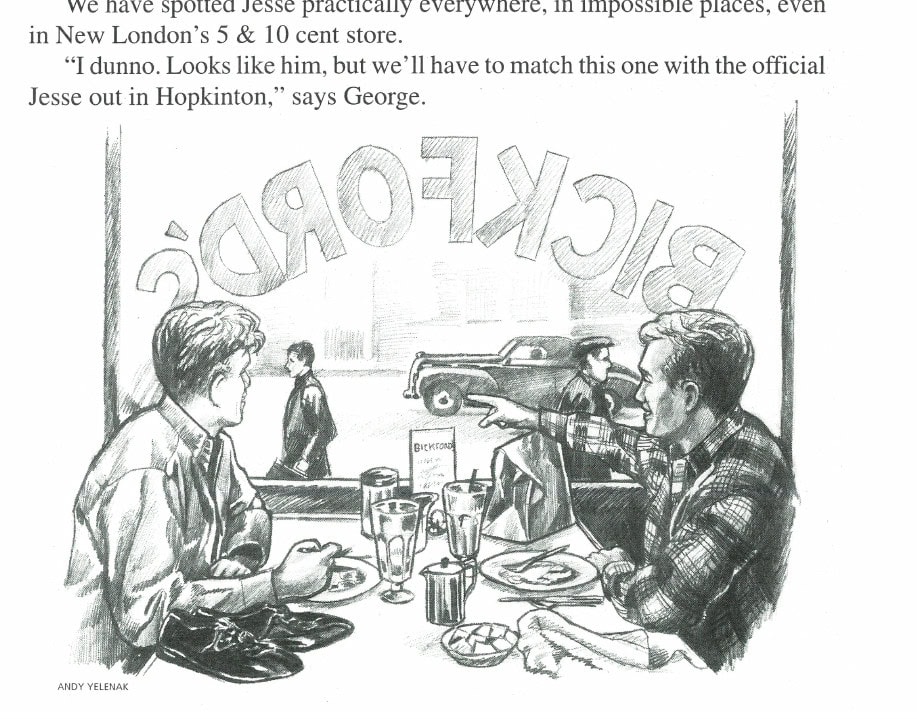
We awake to a fine April day in the making—bright sunshine and a playful west wind. We give our gear the once-over, then hit the street. A Bickford’s eatery presents itself, and we order the pancake special, passing up coffee in favor of double-scoop mocha frappes.
“This oughta keep us,” George says through jowls of starch, adding, “and maybe we can pick up a couple of Hershey bars out at the start.”
From our window-side table we survey Huntington Avenue’s early strollers. Every other male miraculously assumes the form of a marathon somebody.
“I swear I just saw Dyrgall a minute ago,” I say. “He never looks like a runner, does he, you know, with his perfect business suit and briefcase? How d’you think he changes up?”
“Heh, maybe he carries his jock strap in that briefcase,” George says.
“Hey, look, that’s gotta be Jesse!”
The tousled blue-haired youth must be clipping along better than 10-minutes-a-mile, with that wild Jesse Van Zant gleam of an eye, guaranteed to turn any young runner’s blood to ice water.
We have spotted Jesse practically everywhere, in impossible places, even in New London’s 5 & 10 cent store.
“I dunno. Looks like him, but we’ll have to match this one with the official Jesse out in Hopkinton,” says George.
“Think he’ll win this time? I heard Jock’s picking him.”
“Nah, that’s because Jock wants him to keep running for the BAA [Boston Athletic Association]. But you know how Jesse runs,” George says, tapping his head, “no sense of pace. He’ll take off like a shot and go rattraps by 13.”
Stomachs burbling with frappe-drenched pancakes, we hit the street for one last pit stop at the Irvington before catching the Marathon Special. I do my best to ignore the humorless little Jiminy Cricket hiding in my left knee.
The plucky little Marathon Special consists of one yard-switcher and four creaky wooden coaches pulled out of pasture for the occasion. At exactly 9:25 a lone conductor begins to open the long-unused doors. “Last call for cold feet, boys!” he cracks.
He gets no takers.
Plodders of ages spanning generations swarm aboard. Most wear rough overalls and work shirts. They modestly cradle their meager tools-of-trade in cheap cotton zipper bags, brown paper grocery bags, and string-tied towels. Many faces bear the record of depression or war. I realize with a twinge of marvel that probably no event of their lives, however memorable, has inspired more thrilling anticipation than they feel at this moment.
We find our seats amid a flurry of nervous talk of this and that—the weather, jobs threatened or lost for booking off, old-time races and racers, petulant wives demanding equal time, and so forth and so on.
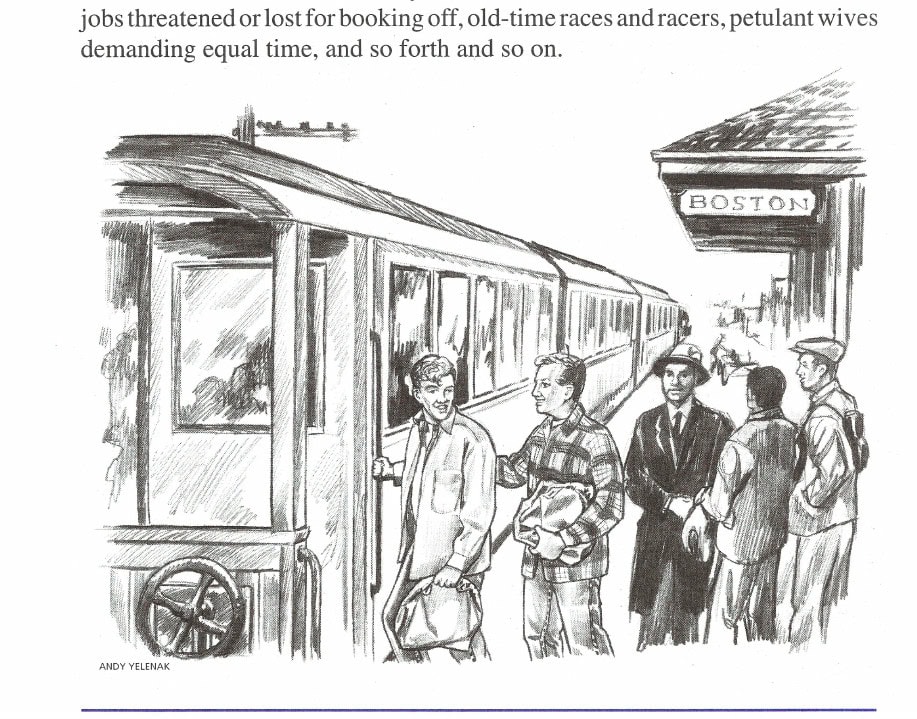
The Marathon Special lurches to life. Soon I drift into reverie watching town after town slide past my window. My wool gathering subtly turns to apprehension. I wonder how even the sturdiest of human legs could be counted on to return their owner to Boston from this end of earth to which we have pledged ourselves.
George must be reading my mind. “Yeah, long time getting there, lad,” he says.
“And let’s not forget the bus ride from Framingham,” I remind him.
I glance proudly at the shoes I sport today—glossy black kangaroo skin “flats” purchased by mail from Osborne K. Winslow of Salem, Massachusetts, for the princely sum of $20. From tracings of both feet on paper, Winslow custom-crafts these beauties for the cream of New England’s road racing crop. Gone from my racing outings are the gutted Keds halfcuts of my disastrous 1947 Littleton debut. [See M&B 1(4), p. 65–72.] But not, alas!, from my training runs. I can’t afford to train in Winslow’s flats, and I can already feel an ominous chafing of bunions unused to comfort on a daily basis.
* * *
Neither cars, electric wires, nor the milling of Patriots’ Day throngs can efface our first impression of Hopkinton—a village benevolently suspended in the springtime of American life. It is as if we have separated ourselves from Boston’s bustle by something at once more and less than 26 miles.
We are shown to a school on the south side of the Green, where we must submit ourselves to the BAA’s last guardians of the gate. Fear seizes me that I will be rejected for being a year under the entry form’s stated minimum age of 19—though the BAA’s Johnny “Jock” Semple has promised to get me through on that score.
More troubling is the form’s boldface warning: TO ATTEMPT THIS RACE WITHOUT SUFFICIENT PREPARATION WOULD BE MOST UNWISE FOR ANY RUNNER.
Happily, George and I both pass muster. We find an alcove off a hallway, hastily change into our running clothes, cram tote bags with street clothes, and then deliver the bags to an attendant to be trucked back to Boston.
“Ready, lad?” George asks.
“Just gotta . . . do . . . this,” I reply, winding and rewinding, tucking and retucking, taping, and finally safety-pinning the encasement of stretch bandage around my knee.
Then we’re out in the lemming migration flowing toward the starting line, a quarter-mile nearer Boston in front of a place referred to by old-timers as Marathon Farm.
We’re closing on the starting line, a seething kettle of 200 registered racers, salted for these thrilling moments with assorted gawkers, glad-handers, honest-to-God celebrities, reporters, and officials.
Faces leap into focus: the real Jesse Van Zant, Jock’s latest hope for club gold, who came “out of nowhere” to grab third last year; good-natured Harry Murphy of the New York Pioneer Club; and his feather-footed teammate, Charlie Robbins of Bolton Notch, Connecticut, said to have a long-shot chance today; Fran Austin, another of Jock’s “A-teamers”; balding, stevedorish Tony Mediros of Fred Brown’s North Medford Club.
And over there, in a world of his own, looking for all the world like a dispossessed Yankee farmer, stands the Boston Marathon’s living legend, seven-time winner, Clarence DeMar; unmoved, Clarence seems, by the arm’s reach proximity of 1935 and 1945 winner Johnny Adelbert Kelley, who’s posing at this instant with a beaming celebrity who turns out to be none other than the famous movie star Buster Crabbe. Word has it that Buster has taken the day off expressly to wish his old Olympic teammate good luck.
George edges us even closer to the limelight. I gaze dumbstruck at a rangy blond fellow flanked by three attendants whose jackets bear silk shields above the word Sverige. Can it be true that Karl Gosta Leandersson actually turned in a 2:27 clocking by way of “tuning up” on the BAA course a week ago?
Just when the excitement threatens to drop me in my tracks, I’m snapped-to by a bullhorned command. Jostling into our places on the starting line, we can’t avoid comparing our homely apparel—cotton gym shorts and tanktop undershirts—with their hand-sewn NLOC [for New London Olympic Club], with the likes of Johnny A. Kelley’s smart Boston Edison Club outfit and the Swedish champion’s immaculate national uniform. Then there’s my embarrassingly swaddled left knee, seemingly alone in this forest of healthy gams.
But there’s no time left for fretting. Photographers are scrambling aboard a flatbed truck. Cigarette-clutching reporters are profanely hoofing it toward a bus; half a dozen open-top convertibles await the BAA directors, staff, and dignitaries.
Mr. Walter Brown cocks his starter’s gun.
George gives me the nod.
“BLAM!!!”
“Early burner” Curt Steiner of New York jumps into a lead he’ll keep just long enough to get him into tomorrow’s Early Editions.
George sprints to tuck himself in beside Ollie Manninen, last year’s surprise third pick for the U.S. Olympic Marathon squad.
Like a chip in raging waters, I have all I can do to escape a knock that might end my race before it begins. Mercifully, the crush eases about a half-mile out. I have miraculously survived what I hope will be my worst crisis of confidence. Ah, but God! I’m listing to port, favoring the gimpy knee, whose ridiculous wrapping is loosening with every stride. Mile One: The encumbrance falls off and is immediately trampled under scores of feet. Surprisingly, the leg feels no worse.
I determine to focus outward, on the race, on the countryside. It occurs to me that I haven’t cornered the market on pain or discomfort. Round and about me, feet slap pavement, and breathing grows louder, labored. Clumps of spectators appear and recede. Dreamy cattle interrupt their browsings to regard this strange human stampede.
“Entering FRAMINGHAM”—Five gently rolling miles lie behind me. Stilted I may be, but I’m not a dead-ringer for Boris Karloff—yet. And not stopped, no, far from it.
But I’ve lost George. He’s up there somewhere, expanding the lead he got off the gun, step by step. In my head I hear Mal’s voice yelling, “Georgie, you can DO it!”
The long haul out of Framingham impresses me with the marathon’s vast indifference to any individual’s expectations or sense of just desserts—as if Columbus could never have known the ocean until he passed the Azores.
Sandbagged in spirit, I’m nonetheless buoyed by crowds swelling along Route 135, cheering wildly and indiscriminately, offering orange slices, cupfuls of water, Coke, coffee, and tea.
A sign identifies the glinting water: Lake Cochituate. Here the great Tarzan Brown once said, “To heck with the race,” and went for a swim.
So far I’ve counted more runners falling behind me than passing me. But the hot sun, my lack of training, the lost mileage our friend Bud Farrar calls “money in the bank,” the nagging knee, and my inexperience are all taking their toll.
“Entering NATICK”—Whoof! “Hap-pee talk, keep talkin’ Hap-pee talk!” I attempt a booster shot of “South Pacific” lyrics. If only they worked on the ailing body.
Leaving Natick at long last, the handwriting is on the road. I’m down to a forlorn trot, something like a 10-minute mile. The tiny, tender pain spot in my knee has by now spread throughout the leg. I’m even starting to wonder if the good leg will hold.
Somewhere in the apparently boundless town of Wellesley, I grind to a dejected walk. The crowds, so enthusiastic till now, seem to take walking in default of running as an insult. “Come on, fella!” they shout. “Can’t quit now!” “Is it possible? His name is Johnny Kelley.”
It’s humiliating. Or it would have been humiliating an hour ago. Suddenly, I don’t even care. My world has been jolted off its center. Cars have returned to the road that was closed to vehicular traffic. It’s a dangerous added feature of my predicament.
The sun, which began this day so cheerily, gradually fades from yellow to orange. The temperature falls as shadows lengthen.
Reaching the crest of a long hill where there is a college with Gothic-style buildings, I give up and sit on a curbside stone. The skimpy tanktop stubbornly refuses to dry. I shiver spasmodically, embracing myself as if to prevent whatever heat remains from escaping into space.
“Sonny, can we give you a ride to the finish?”
I look up to see a man and wife parked in a rumbling Studebaker. Kinkily, I stand up. Before I can open the car’s rear door, a newsboy appears, hawking the Boston Record’s Marathon Edition. “SWEDE WINS BAA” the headline says.
On the drive in, the wife asks, over and over, “Why would they let a boy do something like this?”
On Exeter Street, they ease me onto a cot in the basement of Boston University’s Soden Building.
“Lad!” George greets me. “I was just gonna call out the Saint Bernards!”
I wolf into the little bowl of beef stew he has brought.
“Oh. Man oh man, George! I can’t stop shivering.”
A volunteer podiatrist is relentlessly razoring off my Osborne Winslow flats.
WHAT RACE began in 1921 with 34 runners, survived a world war, economic depression, and political challenges and upheaval, and is now one of the premier ultra endurance races in the world and one of the largest of all races in the world?
Most South Africans know immediately that the race is the Comrades Marathon. The race has long captured the hearts and souls of all South Africans, many of whom watch the entire race live on national television. The 56-mile Comrades Marathon is run along a hilly route between Pietermaritzburg and Durban in South Africa and poses the ultimate physical challenge for its competitors. This past June, 13,700 runners lined up for the race’s 77th staging. The runners were not the only individuals challenged on raceday, however. Nearly every South African television camera and camera operator was recruited for the 11-hour live broadcast. On the medical side, there were 16 physiotherapy stations along the route, which used 200kg of Voltaren (an anti-inflammatory) to treat the aching muscles of the runners. Twenty-five doctors, 14 interns, and 45 other health professionals staffed the medical tent at the finish line area. More than 500 runners were treated, some of whom had completed the race, others of whom had dropped out. Scores of medical papers published in the past 20 years have had their origins in the medical tent at the finish line of Comrades.
What of the runners? Traditionally, the race has been dominated by South Africans, with 46 of the 50 all-time best performances held by South Africans. Spread liberally among those 50 names is that of Bruce Fordyce, who has won the race nine times, each time in splendid fashion.
His effortless running style and endearing personality have brought him unprecedented success during the race and in endorsements and public events after the race. This living ultramarathon legend has set standards that are unlikely to be approached, let alone equaled.

This article originally appeared in Marathon & Beyond, Vol. 2, No. 1 (1998).
← Browse the full M&B ArchiveMore like this
1,000+ stories from 19 years of Marathon & Beyond
The complete archive of the legendary long-distance journal — digitized and free to read.
