

Growing Slow Is Mandatory
Do people ever really change? More to the point, do runners ever really change? In Chasing the Runner’s High, I wrote that all runners can be divided into four groups: • New runners are still trying to figure it out. They often have doubts about
whether they’re going to keep running, and some of them don’t. • Fitness runners enjoy how running helps them stay healthy and build strength and stamina, but they’re casual about it. • Racers are all about testing boundaries and keeping score. They set goals
and make them a priority. Those goals are often about speed, but someone who is jogging through a marathon to collect another state or someone who can’t take a day off to let a minor injury heal might also be a racer. •
Mature runners have taken the final step. Running is still important to mature runners, but they don’t let running control their life. When I first defined the groups, I saw them as a progression. I assumed that people who stuck with running evolved naturally from one stage to the next. That might have been wishful thinking. At the time, I thought of myself as a racer, as I imagine most Marathon & Beyond readers do. Continually striving to go farther or faster creates a lot of stress, both physical and mental. It was comforting to think that by just hanging around, I would inevitably mature as a runner and get better at managing that stress.
As I met more runners, my thoughts changed. Some people enjoy running for fitness without ever needing to test themselves. Others thrive on continual competition and manage to find enough of the success they crave to keep them straining against their limits. Some people even manage to stay in the beginner group, endlessly starting, quitting, and trying again. Time alone is not enough to move a runner on the path to maturity.
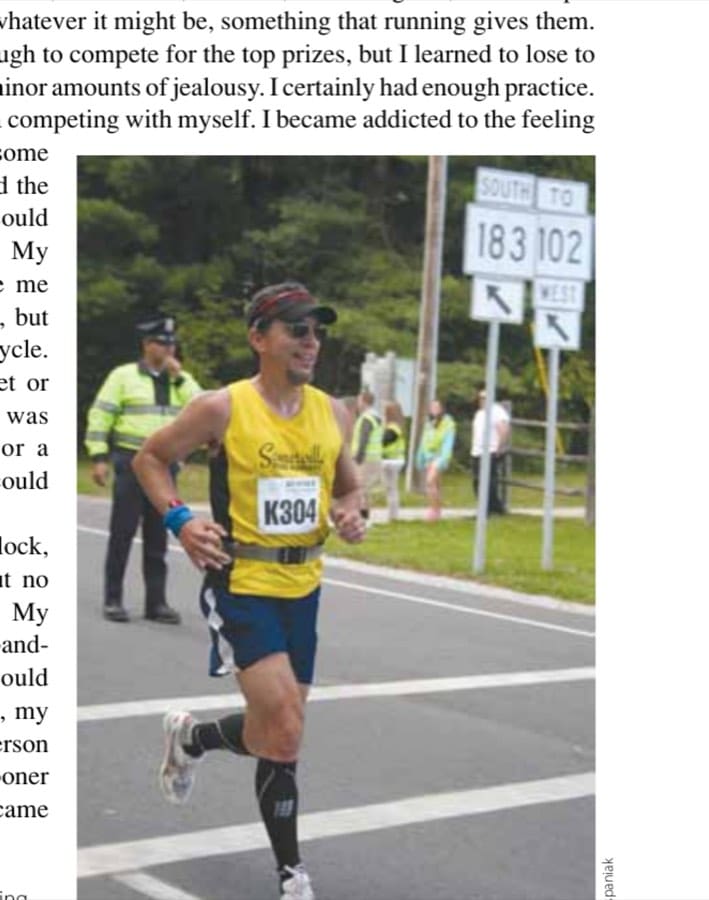
But I still believe that you have to move through one stage to get to the next and that for the richest experience, runners need to move through all four stages.
Taking the ultimate step
© Ruth Sespaniak
The most difficult step is the last: moving from racer to mature runner. Racers strive, and you can’t strive for the acceptance a mature runner needs. You have to embrace your limits, accept yourself, and enjoy what you can do instead of obsessing over what you can’t. Is that maturity, or just surrendering? Until you stop asking that question, you’ve got a ways to go.
Runners become racers when they discover that testing themselves helps fill a need, a need for competition, for success, for clear, concrete goals, or to escape. A need for something, whatever it might be, something that running gives them.
I was never fast enough to compete for the top prizes, but I learned to lose to other people with only minor amounts of jealousy. I certainly had enough practice. Instead, I focused on competing with myself. I became addicted to the feeling I got when I achieved some new victory or stretched the boundaries of what I could do in some new way. My successes helped make me feel good about myself, but it was a never-ending cycle. I set goals, and if I met or exceeded them, there was always a faster time or a longer distance that I could strive for next.
We can all beat the clock, at least for a while, but no one beats the calendar. My goals were always expanding, so sometimes I would fail to reach them. Still, my old self was the one person I could always beat, sooner or later—until the day came when I couldn’t. ▲
In the search for something new, I tried the Josh Billings RunAground.
As I got older, inevitably my capabilities stopped expanding and started to contract. I kept straining to match the runner I used to be, failing, getting hurt, and denying my injuries as long as I could in order to keep running.
When I finally gave in, it took longer to heal. Each day without running was torture. I could feel my fitness ebbing, weight piling on, and goals slipping away. So I would come back too soon, and that helped keep the cycle of injuries going.
I knew I wasn’t unique. Other people have gone through this, figured out how to deal with it, and become mature runners. But I didn’t know how. As a racer, the only way I knew of to achieve a goal was to work at it. I wasn’t afraid to strive, but I didn’t know where to direct my efforts.
Still, even when I was berating myself for getting slower, I never considered quitting. I’m a fairly stubborn guy so it took a few years, but eventually, even I noticed that slowing down was making me unhappy, but that forced time off from running was worse. If backing off was what I needed to do to continue to run, then that’s what I had to do.
If you can’t go faster, go longer For a while, I shifted my focus toward ultrarunning. I couldn’t choose by force of will to go significantly faster, but I could always suck it up and choose to go farther. Or so I told myself. But that choice got more problematic once I realized that there was always farther to go, always more pain to absorb. I learned that my desire for success wasn’t infinite after all.
All this took time to accept. As a racer, I was driven by a need to avoid failure at all costs. I told myself that as long as I was still striving for my goals, I hadn’t failed. But as long as I saw giving up on impractical goals as failure, I could never become a mature runner.
Mature runners find their limits, the hard limits beyond which lie nothing but pain and suffering, and accept them instead of continually beating their heads against them. That requires change. Whatever hole in your soul racing fills, you have to learn how to fill it in other ways or grow as a person so your needs change. Perhaps it’s some combination of the two.
Few people successfully battle their addictions by themselves. I was lucky to meet Ruth, my wife, who has supported my efforts to find other activities outside of running that satisfy my need for accomplishment on my own terms. And Ruth has also served as an example of someone who can strive to improve her running without letting it take over her life.
You can’t get to maturity as a runner without going through the racer phase. If you never try, you can’t lose, and learning to deal with loss is a big part of growing as a person. But we all grow at different rates. Ruth thinks she went through her racer phase while running cross-country in school. It has taken me a bit longer.
▲
Running in nice, soft mud at Pineland Farms.
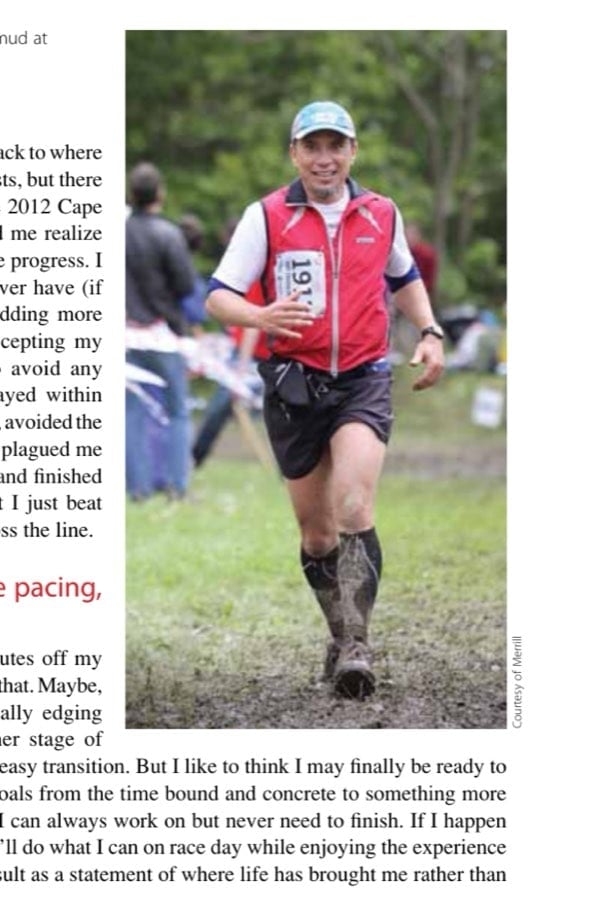
The desire to get back to where I once belonged persists, but there has been change. The 2012 Cape Cod Marathon helped me realize that I have made some progress. I trained as hard as I ever have (if not harder), yet by adding more cross-training and accepting my limits, I managed to avoid any serious injuries. I stayed within myself during the race, avoided the calf cramps that have plagued me for the last 10 years, and finished well, considering that I just beat Hurricane Sandy across the line.
My time was 12 minutes off my PR, but I was OK with that. Maybe, just maybe, I am finally edging into the mature runner stage of life. It hasn’t been an easy transition. But I like to think I may finally be ready to change my primary goals from the time bound and concrete to something more nebulous, something I can always work on but never need to finish. If I happen to sign up for a race, I’ll do what I can on race day while enjoying the experience and try to see each result as a statement of where life has brought me rather than as success or failure.
I’ve continually said that my main goal is to keep running into my 70s and 80s. Now I may actually mean it. I’ll always have a certain wistful longing for when I could run faster or go on seemingly forever. But as long as I just keep running, not only will I have years of running enjoyment ahead of me, but when I reach my 70s I’ll be sure to be winning races by sheer attrition. If I’m bringing home age-group trophies by virtue of being the only one at that age left running, that’s fine by me. OK, maybe I still have some maturing to do.
Courtesy of Merrill
Hard work, sane pacing, mature result
This article originally appeared in Marathon & Beyond, Vol. 18, No. 4 (2014).
← Browse the full M&B ArchiveMore like this
1,000+ stories from 19 years of Marathon & Beyond
The complete archive of the legendary long-distance journal — digitized and free to read.
