

Half-Marathon Training That Will Improve Your Performance
In the previous two parts of this three-part series on the half-marathon, we have reviewed (a) how to set a meaningful and realistic half-marathon goal, (b) how to select an appropriate training level based on your goal, training history, and lifestyle commitments, (c) how to perform each suggested type of training optimally for the greatest benefit, and (d) how to pattern your half-marathon training schedule to fit your life patterns.
In this third part, we will review 10 key concepts in better detail and for greater clarity. These concepts include (1) your intention and attitude; (2) listening to your body-mind feedback; (3) the most important training sessions; (4) adjusting or adapting your schedule where, when, and if needed; (5) assimilating the training fully and addressing areas that may need improvement; (6) factors affecting your realistic half-marathon goal pace; (7) specifics on the intricacies of goalpace runs and hill sessions; (8) when and how to perform our special goal-pace cutdowns in training and on race day; (9) how to taper, sharpen, and be ready to get the most from your current fitness level on race day; and (10) how to extend your schedule for an additional half-marathon race and/or smoothly transition back into marathon training.
YOUR INTENTION AND ATTITUDE Experience has shown me that the intention and attitude you bring to a goal are the single most important factors in successfully achieving that goal. Any truly
wise person knows this, although many runners may benefit from this fundamental concept being explained. Intention is not about either trying or striving for a goal as most people believe. “Trying” and “striving” are both terms that subtly describe a state of not achieving a goal. The five most basic principles of manifestation (or achieving a desired goal) are (1) desire, (2) embrace, (3) allow, (4) know, and (5) receive. By intending, you set into motion an optimal interplay of sequential events that starts with (1) first desiring a goal; (2) then embracing that goal; (3) then allowing that goal to unfold (regardless of what subconscious interference or sabotage may surface); (4) then having a knowing that your goal will be realized; and (5) simply receiving, attaining, or manifesting the desired goal.
Attitude represents your set of beliefs. Attitude, as we will use it for our purposes, is the set of beliefs you have toward training and racing and your potential. As Carl Jung once pointed out, “An attitude or a belief can be seen as a powerful receiving station, that pulls to itself from a field of probability, only those signals to which it is attuned, and blocking out all others. [However,] when you set up a new station [new belief about something], there may be some static or bleed-through from an old one [belief] for a while.” In other words, as we all know to varying degrees, our expectations and beliefs create the reality we experience. It’s the old saying, “You may not always get what you want, but you will always get what you expect.” Our beliefs or expectations, essentially, will create our real-world results.
This is obvious with anyone’s running. Your beliefs about training and racing and your belief about your own potential—or your self-image as a runner—have a huge effect on what you see as possible. Limiting beliefs obviously create limitations in your running. Belief systems that place high value on human potential are open to far greater possibilities. An attitude of intentionality is a solid and empowering foundation or launching pad for successful training and racing.
Everything more easily follows clear intention. Just as a commitment to your goal follows your intention about that goal, maintaining psycho-emotional and physical balance, practicing being in the present moment in training and racing, relaxation, and focus best describe some aspects of the optimal state of body-mind associated with creating a high probability of goal achievement.
This is a key distinction, as a properly channeled intention creates a sense of ease and flow, whereas “trying” or “striving” is best characterized by continual overextension, forced action, and a general lack of ease or tension.
To say, “My intention is to run 1:35 for a half-marathon” or “I intend to run a 1:35 half-marathon” is a lot different from saying “I will try to run a 1:35 half-marathon.” An “I intend” statement creates an optimal balance and a high probability of achievement.
For example, since math is a language that can be used to describe reality, it is interesting to note that the verbal saying “I intend to run a 1:35 half-marathon” converts to roughly an 85 percent mathematical probability (remember, math is a language) of successful achievement. Conversely, the statement or thought, “I will try to run a 1:35 half-marathon” converts to about a 60 to 65 percent mathematical probability of success. Which probability of success do you want?
Our physical reality follows our thoughts and beliefs (attitude), and our language (the higher vibration of giving sound to our thoughts) creates the very vibratory resonance on the invisible plane that creates your physical reality. Your thoughts and language, therefore, are the foundational vibratory element that creates every physical result, whether desired or not.
With clear intention, you get to create what you desire and are able to recognize the static or bleed-through of your own old thought processes and language that may run counter to your intentions. Then, you can proactively shift those old thought/belief/language patterns to be aligned or consistent with your new intention and goal.
Again, a clear intention is far more effective at manifesting any desired outcome than any so-called, albeit gung-ho, trying or striving or any amount of physical training. Knowing that your intentions are to train wisely and effectively and in balance with your capabilities will gradually allow your body-mind to become the potential result you desire. As a result, you will want to keep your training and racing intentions very clear. Your attitude and intention are indeed everything.
LISTENING TO BODY-MIND TO MAINTAIN OVERALL BALANCE With your intention clear, your body-mind knows the target. It does not need to overfocus or underfocus on the target. With your target, goal, or intention clear, your body-mind will naturally be your greatest ally as it (your body-mind) is where the rubber meets the road. As a result, as long as you intend to stay aware of your body-mind feedback, it will serve you very, very well. Just as your eyes might give your hand and fingers feedback on focusing and adjusting to hit a target, your body-mind will provide all of the necessary feedback to adjust your training, nutrition, and mental approach. All you need to do is listen carefully.
Listening to what I will refer to as your own “body-mind feedback” is a key strength or success trait for any runner, or athlete for that matter. The Greek word “soma” refers to the whole body including the mind, which is indeed a part of the body—the last time that I looked anyway! Hence, the field of somatics is the study of the whole body—the body-mind—as one connected and integrated whole.
By listening to your silent thoughts, your verbalizing of those thoughts, as well as how your body is feeling, you can detect when it is at ease or in a subtle state of “dis-ease” or tension. The very word “disease” is the acknowledgment of a state of not being at ease, of being tense, anxious, or stressed.
Not being in balance or at ease physically, mentally, or emotionally sets up a predisposition toward illness, injuries, mental burnout, poor performances, and performance plateaus and declines. In order to be at ease and in balance as a runner, you must make your intentions clear. Your intention must be to find and maintain your own physical/mental/emotional sense of balance in training and in your life. It is your primary task as a runner to pay attention to and understand what is optimally sustainable for you.
Be aware of when you are breaking your body down intentionally (with hard training) and when you need to build it back up (with rest and/or easy running). This means knowing how to apply moderate training stimuli with optimal rest, in order to make consistent progress in training and in your performance potential.
No part of the basic formula that stress plus rest equals potential performance progress is less important than another. In other words, the rest is an equal part of the training process, as is the stress. Far too many serious runners do not make this distinction, and most tend to err on the side of too much training stress.
Generally speaking, the longer a training session, the less intense, the better. Similarly, the shorter the training session, the more intensity you might be able to manage. However, no training session—short or long, easy or hard—is very worthwhile if it risks setting you back in the overall scheme of things.
In order to improve, you must be consistent over a decent period of time. Consistency is best achieved, in part, through an overall balance in your training and developmental approach. A key factor in improved running performance is being able to maintain a consistent level of at least moderately stimulating training.
Consistent, moderately stimulating training sessions with adequate recovery periods over some significant period of time will create the highest probability for potential performance gains. The half-marathon training schedules we’ve outlined intend to provide a balance of training stimulation with optimal recovery within a context of overall variety, consistency, and gradual progress.
Although stimulation, balance, and gradual progress are our intentions, the training schedules presented (in the last issue of M&B) are only flexible, templatelike guidelines given your ability, goal, training history, and lifestyle commitments. They will work if followed closely—and they will work even more effectively if you take extra easy days where needed or perform some workouts with less intensity as your body-mind might be asking you, since maintaining overall balance and consistency is your underlying task.
THE MISSED-WORKOUT RULE Along the lines of maintaining both consistency and body-mind balance, I am often asked about the consequences of missing key workouts in a preplanned training program. My answer is that there are no consequences—only potential benefits—as your goal is to maintain consistency and body-mind balance.
Generally speaking, about four out of every five runners I coach may miss several key quality sessions during any three-month or longer training program. Does that mean they will be less successful? Not at all. In fact, experience has shown me that they are usually just as successful as—and often more successful than—those who run every single workout I’ve prescribed.
Why is this? Basically, for intentional and committed runners to miss a key workout means they had something else come up, were tired, or simply needed the mental break. In doing so, their intention has simply created a built-in protective mechanism for maintaining body-mind balance and homeostasis as well as long-term overall consistency.
As a result, I have learned to reinforce runners in skipping three to five key quality sessions (over any three- to four-month period), should work, family, or other lifestyle commitments arise—as well as skipping a key session at any time that you feel you are getting too much cumulative fatigue, for whatever reason, even if unrelated to the training process itself.
While the training level you have selected is most likely an optimal level for you, it also assumes that your life and energy level are staying in balance. If they are not, you would be very wise to skip a key workout by not running or by replacing it with an easy recovery running day. This is best done without the typical runner’s (or cultural) guilt accompanying your decision. Instead, pat yourself on the back for doing your primary task as a runner/athlete.
In addition, I encourage you to use this “missed-workout” rule (of three to five missed key quality workouts) to plan skipping workouts for any known stressful or busy days or travel periods to ease your mind and keep everything in a nice overall balance.
The one thing you do not want to do is attempt to make up a missed workout and cram it into your schedule! This will increase your risk of losing balance and most likely throw your training and body-mind into unnecessary and potentially detrimental havoc and stress. If you decide to skip a key workout session, there are some guidelines that you can use to ensure that you maintain training balance and your own physical/mental/emotional homeostasis.
THE MOST IMPORTANT TRAINING SESSIONS NOT TO MISS Again, please do not attempt to make up any missed key training sessions. It will cramp your schedule, and it is the opposite of the balance and gradual progress our training programs intend. It is far better to make an intelligent adjustment based on which training sessions are more important to achieving your goal. If you decide to skip a key training session or are simply reviewing your overall calendar and need to plan a skipped key workout, the best thing to do is play musical chairs with certain workouts in order to still optimize the effectiveness of your training.
For half-marathon training, the training elements with the greatest leverage for your overall development can be juxtaposed with the less-important sessions. The highest-impact half-marathon training sessions tend to be (1) goal-pace (GP) runs, (2) lactate-threshold (LT) sessions (tempo runs and/or cruise reps), and (3) power-development or hill sessions. With this in mind, it would be wise to give these three types of training sessions your highest priority and clearest of intentions. Therefore, if you knew that you needed to miss a tempo run scheduled on a Tuesday and have a long run scheduled on a Saturday that same week, it might be wise to perform the scheduled tempo run on Saturday in place of the long run, since it generally will have higher leverage for achieving your goal than the long run.
Again, it all depends on your training needs, and that is where you need to develop the ability to feel out and distinguish what is best in the overall scheme of things so you can make the best adjustments to your own schedule as necessary.
Similarly, if you need to miss a Saturday session where a goal-pace run is scheduled, it may be wise to do it in place of the previous or following Tuesday’s less-important workout. Keep in mind that many marathon runners may already feel they are very strong at LT and GP workouts and feel they instead would derive more benefit from a key aerobic-capacity (AC) session, thus giving it priority in their schedule. Again, it all depends on what each runner senses will be most beneficial. If your intention is clear, trust your gut instinct, intuition, or deepest knowing. In this particular example, runners might simply make sure they flip-flopped any potentially missed AC workout with the next key session that they feel is not as important, should they need to miss a scheduled key training session.
An important reminder also is to always err on the side of less versus more—less intensity or less volume versus more intensity or more volume—when making appropriate changes to your own training schedule.
In addition, it is of the utmost importance that the suggested rest/recovery periods between workouts (as prescribed and patterned into your chosen training schedule) be maintained. For instance, if two easy days are prescribed as recovery between any two key quality workouts, then at least two easy days should be kept regardless of any changes you make to your schedule. Cramming in key workouts to meet your changes is an invitation for disaster. While very fit runners might be able to handle such a reduction in recovery time between workouts, it will certainly increase the possibility of injury or a downward spiral in performance potential if done too frequently. However, it is definitely not recommended, to say the least, and is often a certain warning sign to me of personal insecurity and a lack of clear intention toward the foundational concept of staying in overall balance.
ADDRESSING AREAS THAT NEED IMPROVEMENT AND FULLY ASSIMILATING TRAINING While the majority of runners will find the 13-week schedules ideal preparation time for a half-marathon, many will feel they need more time to prepare adequately or simply have more time until the half-marathon they choose to run.
In these cases, I suggest repeating any number of weeks seven, eight, nine, or 10 before proceeding to the final three to six weeks of the schedule leading up to your chosen half-marathon race. For example, if you have already gotten started with the schedule but your half-marathon date is 15 weeks away—instead of 13 weeks—you may choose to run any combination of weeks seven through 10, thus adding the two extra weeks into the schedule before beginning the more race-ready preparation in the final three to six weeks of the schedules we’ve provided.
In addition, if you simply need more time to assimilate the training benefits because your progress does not seem where you think it ought to be, you may choose to repeat any key workouts that you deem important to feel the confidence and training effect you desire. One caution: still be careful not to overdo it in these sessions, which are simply intended as an adaptation. Do not extend them (with more mileage) or intensify them (with faster speeds) more than is prescribed.
FACTORS AFFECTING GOAL PACE It is essential to remember to take into account such factors as heat, humidity, hills, and wind on race performance. Adjusting your goal pace in accordance with training or racing conditions will ease your mind and allow you to maintain your intention much more effectively.
If you know in advance that race day may have any of these factors, it would be foolish not to adjust for them in your training and in your projected goal pace. Heat and humidity can have a very significant effect on half-marathon performance, as will hilly courses or running into head winds.
If any of the above-mentioned factors are expected on race day, know that it will be wise to adjust your goal pace in advance or accordingly on that morning, should such conditions arise. Similarly, if you are training in similar conditions as the race conditions will most likely be, adjust your goal pace accordingly in training to meet the conditions.
In the summers in Nashville, Tennessee, when humidity is consistently high along with temperatures of 85 to 95 degrees Fahrenheit in both the mornings and evenings, I make sure the athletes I coach are aware of the huge effect these conditions are having on their ability to run at their goal pace. If their goal race will be in the same conditions, it is logical to adjust their goal time (and goal pace) to
match the conditions in which they will be training and racing. Finally, we start our key goal-pace runs before dawn to avoid a lot of direct sunlight. If runners are training in more stressful weather conditions than they will be racing in, we can choose to adjust the training pace accordingly, knowing we will reap the benefit of more ideal racing conditions on race day. If you do not adjust the training pace, then it is important to at least be keenly aware of the extra challenge of the training conditions (and more strenuous nature of them), knowing as well that a large decrease in effort will be reaped when racing in more optimal conditions. While this can add to your race confidence, extra caution needs to be taken in training at goal pace in potentially stressful and sometimes semi-hazardous conditions.
For marathon goal-pace running, depending on the individual runner, I may or may not have runners train at a pace slower than goal pace. However, since halfmarathon goal pace is a much higher intensity—as it is equal to or significantly closer to one’s lactate-threshold running speed than marathon speed—adjustments may be beneficial, as core body temperature can rise exponentially with such higher-intensity running as goal-pace runs get closer to the actual race distance in length. Table 1, on the next page, roughly quantifies the adverse effects that certain temperature ranges might have on performance. For example, running at 7:00 pace in 80 to 85 degrees Fahrenheit feels much more difficult than running in the nearly ideal conditions of 45 to 60 degrees Fahrenheit. In fact, according to Table 1, 7:17 pace in 80 to 85 degrees is equivalent to what 7:00 pace would feel like in ideal conditions (45 to 60 degrees) for the full- or half-marathon distances.
In other words, maintaining 7:17 pace for a half-marathon in 80- to 85-degree weather would be roughly equivalent to racing that same distance at a 7:00 pace, as most experienced runners would verify.
This table is only a rough equivalent adapted for the half-marathon based on many other tables and formulas commonly used by runners and coaches. You can use this table, or similar ones, to get a better feel for the effect that heat can have on training and race performances and make the necessary adjustments.
HILL-TRAINING SPECIFICS One of the most significant aspects of the half-marathon training programs we’ve outlined is the judicious employment of hill training for overall leg-power development. Increased leg power almost always converts to improved running economy—as each stride takes less effort—a not-so-unimportant factor in races that may take 10,000 to 50,000 strides to complete. Furthermore, since nine out of 10 long-distance runners have lost leg power over time because of aging and other factors including the nature of their training, gains in this area can make a
TABLE 1 The General Effect of Temperature on Running Performance Average temp (F)
Your goal pace in ideal temperature (45-60 degrees F)
Heat effect
5:00
6:00
7:00
8:00
9:00
10:00
11:00
12:00
15-24* + 3%
5:09
6:11
7:13
8:15
9:16
10:18
11:20
12:22
25-34* + 2%
5:06
6:07
7:08
8:10
9:11
10:12
11:13
12:14
35-44* + 1%
5:03
6:03
7:04
8:05
9:05
10:06
11:07
12:07
45-60
Ideal
5:00
6:00
7:00
8:00
9:00
10:00
11:00
12:00
61-70
+ 1%
5:03
6:03
7:04
8:05
9:05
10:06
11:07
12:07
71-75
+ 2%
5:06
6:07
7:08
8:10
9:11
10:12
11:13
12:14
76-80
+ 3%
5:09
6:11
7:13
8:15
9:16
10:18
11:20
12:22
81-85
+ 4%
5:12
6:14
7:17
8:19
9:22
10:24
11:26
12:29
86-90
+ 5%
5:15
6:18
7:21
8:25
9:27
10:30
11:33
12:36
91-95
+ 6%
5:18
6:22
7:25
8:29
9:32
10:36
11:40
12:43
96-100
+ 8%
5:24
6:29
7:34
8:38
9:43
10:42
11:53
12:58
101-105
+10%
5:30
6:36
7:42
8:48
9:54
11:00
12:06
13:12
106-110
+12%
5:36
6:43
7:50
8:57
10:05
11:12
12:19
13:26
*Today’s temperature-control running clothes can make these temperatures still feel ideal, with no significant difference in performance necessary.
huge difference in performance potential on top of helping to create leg resiliency to avoid future injury. With improved functional leg power as the primary goal of our hill workouts, it is important that these sessions be performed correctly, which is often counter to popular opinion. In addition, while an effective hill-training phase will reduce the chance of future injuries significantly, this is the only part of the training program where there tends to be a higher propensity for injury if precautions are not taken.
Therefore, extra care is advised in hill sessions—both before and after workouts—to prevent injury. Beginning runners, weak runners, tight runners, and runners who tend to run hills too hard are all more susceptible to revealing their susceptible conditions in the hill-training, or power-development, phase.
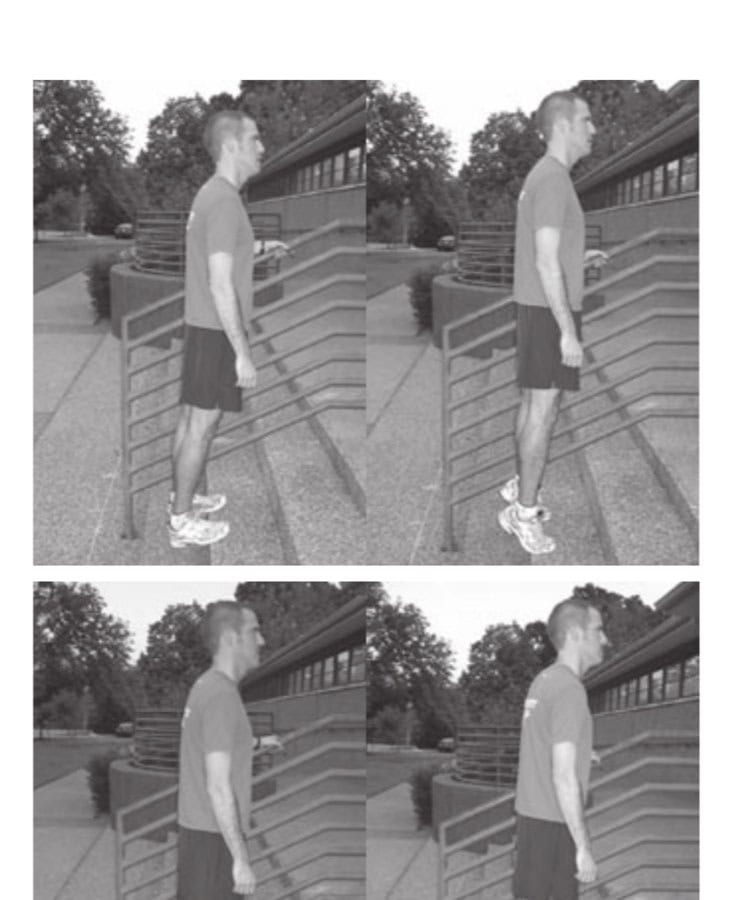
In the photos shown (on page 51), Billy Wallace, 36, a physical therapist and fast-improving 1:24 half-marathoner, demonstrates slow heel raises with full ankle dorsiflexion off a step, which can be performed every other day in the four
weeks prior to hill training. These motions should be performed very slowly and deliberately, and they will go a long way toward strengthening many of the connective tissues that will be put under stress during hill workouts. Warm up with
one set of 12 reps using both feet and the second set isolating and exercising one leg at a time. Gradually build up to a two-legged warm-up set of 20 reps with an additional three sets of 20 reps on each leg with one minute’s rest between
a full set that exercises each leg. This will serve as a sufficient strengthener of ankle and foot connective tissue, improve flexibility and motor function, as well as prevent future injury. It is also important that your pre-hill-session routine gets your legs thoroughly
ready without being too fatigued. Often, a longer-than-normal warm-up of 20 to 40 minutes of easy running, some skipping and strides, and finally some skip bounding on a flat and firm surface will get all the muscles, tendons, and other connective tissues warm, and flushed with blood and lymph, and activated for the
work ahead. Stretching after this preparation and before beginning the first hill rep will have you rested and clear about the session’s intention. A picture is worth a thousand words, and fast-improving 50-year-old runner
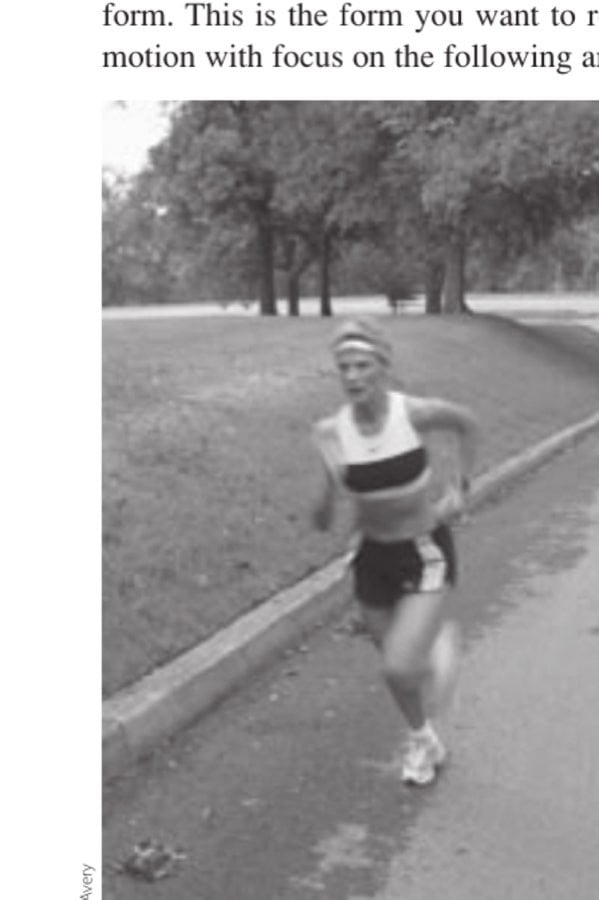
Donna Wittman (in the photo below) illustrates excellent hill springing/bounding form. This is the form you want to replicate within your own natural range of motion with focus on the following areas:
Forward Lean Lean into the incline or grade of the hill at an optimal angle to create maximal resistance against your body weight in order to develop the most leg power from these sessions. Body Aligned Stand tall and aligned in a straight line. Do not do extra leaning forward at the waist. Your intention is to have your entire body basically in a straight line.
Guy Avery
Springing/Bounding Push-Off Push off from the balls of your feet, bounding or springing with each pushoff. Feel that momentary hang time ▲
Donna Wittman, demonstrating good hill running form.
Guy Avery
▲ Physical therapist Billy Wallace, a 1:24 half-marathoner, demonstrates two-legged calf raises to warm-up before performing sets of single-leg calf raises off a step as part of his strength preparation for the hill phase.
in the air after each bounding/springing push-off. That is how increased power will be built.
Near-Maximum Power Speed up the hill is not as relevant as the power and spring that are used. However, running or bounding with each push-off very deliberately, using near-maximum power—or about 90 to 95 percent of effort—is a good guideline. Power is increased by exerting near-maximum force. High Knee Lift Lift the knees in an exaggerated fashion but not beyond any restrictions due to tightness or your natural range of motion. In other words, use high knee lift, but do not force it. Arms and Everything Relaxed Focused relaxation is key. Relaxed face muscles and a relaxed arm carriage will set the tone for everything to be relaxed. While you want your shoulders relaxed, they can still be swung powerfully and in sync with your lower-body movement up the hill. The mantras “relax and focus” or “relaxed power” or “relax and concentrate” can help. Full Recovery Obviously there will be some cumulative fatigue over the course of any hill session, but your intention is to recover as fully as possible between repeats up the hill and between any grouped sets of repeats. Simply jog slowly and even jog in place at the base of the hill if necessary to ensure as close to full recovery after each hill rep or grouped sets of hills reps. Maximum power can only be developed if you do not have major fatigue. This is another reason why grouping reps into sets works great mentally and physically when power development is the focus in power-lifting programs or in near-maximum hill-power sessions. After hill sessions, some strides on flat ground will reorient your legs, and a longer-than-normal cool-down jog (15 to 20 minutes) on a soft, flat surface (if possible) is best in order to sort of massage your legs afterward.
GOAL-PACE RUNNING The obvious intention of goal-pace running is to practice and become more comfortable at your half-marathon goal pace. It is a very common practice for runners to simulate the pace they want to run for their mile to 10K goal times, but it is far less common for runners to intentionally practice their goal pace for the half-marathon distance and above. Nevertheless, practicing your half-marathon goal pace accomplishes several important things.
First and foremost, early goal-pace runs (of four to five miles) serve as an excellent double-check or reality check to see whether your desired half-marathon goal pace is, in fact, realistic and achievable. If the first or second short goal-pace run that you perform early in the 13-week training schedule is too challenging for you, or if your heart rate exceeds guidelines of about 83 to 94 percent of maximum depending on your goal time (see page 106 in Sept/Oct 2005 issue), then it would be wise to adjust your goal accordingly. Frequently, the first goal-pace runs (of four to five miles in length) can feel more difficult than the final, longer goal-pace runs (of seven to nine miles in length). While heart rate and pace (based on past or equivalent race performances) can be important and meaningful guidelines, how you feel is still always the most important consideration. For instance, do you feel that this is a pace that you will be able to hold for 13 miles with logical training progress over the course of the program?
Furthermore, goal-pace workouts allow you to gradually adapt to that particular pace over time as well as feel more comfortable at that pace. In addition, over time, you will know how to run that pace, easily monitor it, and get familiar with the incrementally increased effort that it will take to maintain that pace over the course of a half-marathon race. This will also increase your confidence as you make obvious progress leading up to race day. Most runners will be starting at four to five miles for their first goal-pace run and very gradually building up to seven to nine miles (after five to six such sessions) by their final goal-pace run over the course of their training program (see table 2). TABLE 2 Goal-Pace Runs by Training Level Training level
No. of goalpace runs
Starting goalpace run
Final goalpace run
Percentage of race distance
1
6
4 miles
7 miles
53%
2
6
4 miles
7 miles
53%
3
5
4 miles
8 miles
61%
4
5
5 miles
9 miles
69%
5
5
5 miles
9 miles
76%
Finally, goal-pace running allows you to generally visualize and experience the imagery, sensations, and feelings many times before the race. Essentially, goalpace runs are the quizzes leading up to the final exam. Your successful completion of each slightly longer, key goal-pace run will provide you with the cumulative knowledge and confidence that will have you mentally and physically ready to take on the full distance at goal pace come race day.
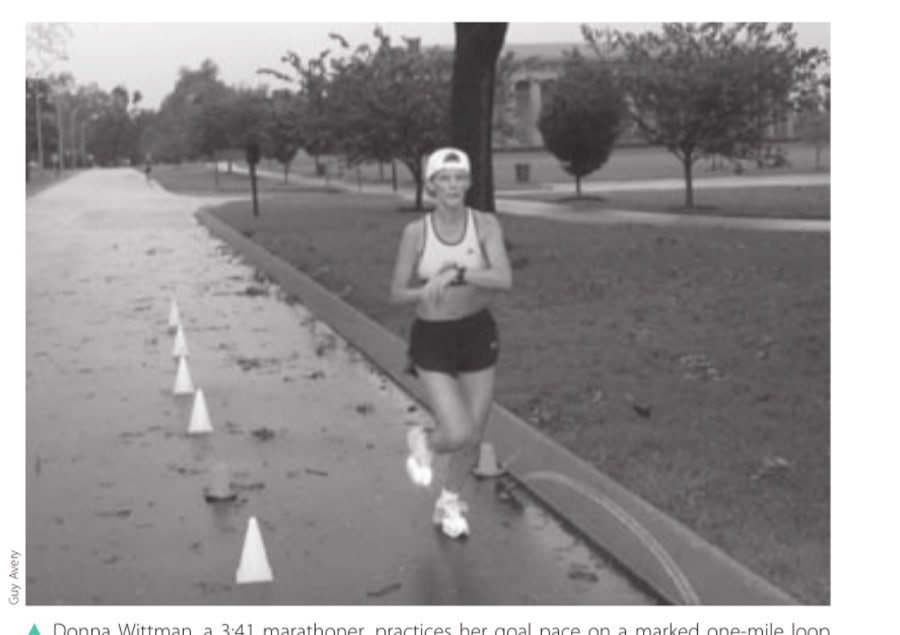
Several things are important when practicing goal-pace runs to ensure that you are ready to run your goal pace on race day: • Find (or create) a marked one- or two-mile loop that is similar to the course
surface you will be racing on (see photo below). • Practice the warm-up routine and mental imagery that you will use on race day, using the shoes you plan to race in. • Practice water intake if you plan to take water during the race. Glucose
drink or gel with water during the race can help all those runners with goal times above 1:45. • Plan to start the goal-pace run at the race start time if possible (on weekend goal-pace runs later in the schedule) so your body gets acclimated to the
race start time and everything has become routine for you by race day.
OUR SPECIAL CUTDOWN TO GOAL-PACE FORMULA
Guy Avery
One training and race-day strategy that I consistently and effectively use with my athletes is to practice our special goal-pace cutdown. The athletes love it and know that it helps them control their pace early on, prevents a foolish and risky too-fast
▲ Donna Wittman, a 3:41 marathoner, practices her goal pace on a marked one-mile loop in Nashville’s Centennial Park.
start, eases the mental stress of a long race, gives their bodies time to comfortably find pacing homeostasis in the race, and helps them race faster. For a half-marathon, there are many cutdown options. For the purposes of this article, I will explain the two most basic half-marathon cutdowns.
Cutdowns entail starting slower than your goal pace but progressing evenly toward it. The two simplest half-marathon cutdowns are the two- and three-mile cutdowns. Each involves giving away time in the beginning to ensure running your best race and being your strongest at the end of the race. The two-mile cutdown involves starting the first mile 20 seconds slower than goal pace, then cutting down to 10 seconds slower than goal pace, and finally cutting down and settling into goal pace in the third mile. This is mainly for level 4 and level 5 runners. It adds only 30 seconds to your calculated goal time up front, but it ensures that you will have an excellent half-marathon race.
For levels 1, 2, and 3, a three-mile cutdown is what I suggest. It entails adding a full minute to your calculated goal time by starting the first mile a full 30 seconds slower than goal pace, the second mile 20 seconds slower than goal pace, and the third mile 10 seconds slower than goal pace before settling into your goal pace for the final 10 miles. Again, well-trained runners tend to pass other runners the whole way and feel super strong when they hit the 10-mile point in the race, allowing them to turn it up a notch or two in a like-mannered cutdown at the end of the race.
Many times runners can make up the time they give away in the beginning cutdown because they will have run at a steady aerobic effort throughout the race. In fact, many of the runners I coach will average their fastest pace in the last three miles of the half-marathon, which they attribute to the cutdown they perform in the first two to three miles of the race. Even the most advanced runners (with times in the 1:10 to 1:30 range) will run their personal-best time employing this race strategy after practicing it in training over the course of a 13- to 16-week training schedule. Amazingly, many level 4 and 5 runners find they can run within 25 to 45 seconds of their best recent 5K road race times at the end of a half-marathon where they have used the cutdown properly. Again, this is because the cutdown allows the body to find its optimal aerobic homeostasis or balance point for the duration, enabling it to basically perform a similar cutdown (under goal pace) in the final 3.1 miles or 5K. Also, if you have been maintaining an aerobic-threshold (1:20 and slower) or even lactate-threshold running pace (1:10 or faster) without going over that threshold, a secondary physiological energy system will be available for you to utilize if you have the courage to perform a progressive buildup in speed toward the finish.
The main point here is that you will prevent a major racing error at worst and will be very strong, passing less-intelligent runners throughout the race, while
feeding your psyche the positive reinforcement of feeling strong. The final miles become an opportunity to gauge an optimal cutdown (under goal pace) to the finish line. This cutdown works like magic and represents a unique offering of the training program. You have the privilege of also approaching goal-pace runs in training that are not so terribly intimidating when you know that they always begin with a two- or three-mile cutdown that eases your body into a balanced mental and physical zone. The intention is to also continually practice what you will do on race day in the race itself.
Finally, all runners can practice additional goal-pace running by performing two- or three-mile warm-ups at their chosen cutdown progression paces. For this, a five- to 10-minute jog and some stretching followed by the cutdown (that is, 7:30, 7:20, 7:10 for three miles for a runner with a 7:00-minute goal pace) will allow them to keep their mileage up and sneak in extra goal-pace practice while often serving as an ideal warm-up for key workouts—especially in cooler weather.
GOAL-PACE RUNS FOR THE HIGHLY COMPETITIVE While running your best race is usually achieved by running within yourself in the early going (that is, with a planned holding back or practiced cutdown), settling into a goal-pace groove, and finishing with a gradual buildup toward maximum in the final stages of a race, there are other considerations sometimes if winning a race or beating a particular runner is your aim.
Highly competitive racers who aim to win races or divisions or simply finish ahead of any particular competitor can still practice what will unfold on race day in their goal-pace runs. For instance, if going out with or keeping contact with another runner is important, simply decipher what the opening pace will most likely be and practice it at the start of your goal-pace runs, then practice settling into the expected race-day goal-pace rhythm that would typically ensue. More elite runners can even practice a surge in the middle of their goal-pace practice runs in preparation for a given race-day strategy.
This race-day simulation will allow the body-mind to be ready more specifically to handle the race situation or strategy.
TAPERING AND PEAKING Tapering and peaking may be two of the most misunderstood terms for runners. Tapering is the reduction of training stress by either reducing volume (mileage) or intensity (workout speeds) in training. Peaking is the heightening of your physical and mental potential for the best possible performance. Tapering can often lead to peaking, but that is not necessarily the case, as each runner is different and has different tapering needs in order to peak.
A taper can be a slight reduction in either running volume (amount or mileage) or intensity (amount and quality of speed work) in the final four to five days before a big race, or it can entail a significant reduction in mileage and intensity over a one-, two-, or three-week period leading up to your target race. It can also be anywhere in between these time lengths.
Generally speaking, a larger taper is needed if there has been cumulative fatigue over the course of a training program, or simply if a runner tends to benefit from a more significant taper. Theories abound regarding this subject, including the theory that runners with a high level of slow-twitch muscle fibers need not taper nearly as much or as long. However, the primary advice I give is to make sure you do not overdo anything in the final two to three weeks, and especially in the final four to five days, that will leave you even questioning at all if it might tire you in any way.
The goal is to approach the race knowing that your legs are rested and your body-mind is eager to test the edge of its potential. So this is an area where experience and intuition are most important for each individual runner.
The athletes I coach will usually reduce volume (mileage) by 20 to 40 percent in the final two weeks for a half-marathon while maintaining about the same amount of speed work. There is one catch: no high-quality work (or speed work) will be performed that is either highly intense (faster than 5K speed) or much longer than previous high-quality workouts. So moderate volume and moderate intensity will keep you sharp and ensure that you are well rested and ready to peak.
The main things are to trust your training, believe in your abilities, and do not risk doing anything really hard or new. The taper and peak period is best performed by keeping in touch with the basic running speeds of the goal race or slightly faster, while becoming or staying well rested.
Typically, for a half-marathon race, practicing some goal-pace running and lactate-threshold (roughly one intensity notch faster than half-marathon goal pace for most runners) or 10K race-pace running (for those under 1:15 for the half-marathon) with some strides mixed in will provide all the stimulation necessary to maintain speed while not taxing the body-mind. High-quality workouts might also be reduced in volume (mileage) by about 20 percent to be on the safe side. In addition, at least a slight reduction in total (and average daily) mileage (especially in the final week) will leave your legs fully recovered from previous hard training as well as fresh and ready for race day.
RACE READY In order to be race ready for a half-marathon, you must be physically rested, fully hydrated, carboloaded, and mentally ready to perform.
The physical rest comes from a smart taper where no cramming in of workouts has been done and good sleep has been achieved in the final week before the race. Obviously, sleep is often difficult the night before the race, but less sleep the night before often does not have to have a negative effect as long as you have been lying in bed for at least five to six hours. In other words, good shut-eye the night before the race is often an extra advantage but not necessary for a good performance the next day. Do your best to rest and relax, but do not get uptight if you are not able to sleep well the night before the race.
Complete hydration is one of the most underrated things for long-distance runners and one of the most beneficial things you can do. If you have been slightly dehydrated (as most distance runners tend to be), then the final week and even the final day can offer an opportunity to focus on drinking lots of water and doing light stretching so your muscles are wet, clean, limber, fluid, and flexible.
Carboloading for a half-marathon is not complicated. In the final three to four days, simply focus on increasing your intake of fresh fruits and vegetables, good grains and breads, and pastas and brown rice. Continue to eat protein, and do not make any radical shifts from your normal diet. Gels and glucose drinks taken during the race can help those whose goal times exceed 1:45 and are best taken every 40 minutes. Practice this in your goal-pace runs if this will be your approach in the race.
Finally, knowing the course and visualizing how you want the race to unfold for you, several times in the final week, will pay big dividends. Get to the race site early, do not rush your warm-up, remain positive, speak your intention to yourself, and remind yourself how you want to start the race. Once the race begins, stay calm and relaxed and remain mentally in the moment as much as possible to produce your best performance. Keep your intention clear and your body-mind in balance.
RUNNING AN ADDITIONAL HALF-MARATHON If you are planning to run another half-marathon within two to four weeks after the first one, the most important thing is to recover as quickly as possible. This will take one to three weeks depending on the effort as well as how quickly you aid recovery. As most everyone knows, the first 15 to 30 minutes after a race or hard workout are critical for fast recovery. Rehydrating by taking in a liquid recovery drink that works for you, eating bananas or raisins and additional protein shakes or bars, and stretching as soon as possible after the race (or after an easy 10-minute cool-down jog) will go a long way toward facilitating a quick and full recovery.
What you do in the next two hours after that extra sensitive first 30-minute window closes is equally important. Continue to hydrate, consume easily as-
similated drinks and foods, jog, stretch, and massage your legs. A scheduled massage that day or the day after the race usually will make a huge difference in your recovery also. Again, listen to your body-mind and its needs and plan to take the first week afterward very easy in terms of volume and intensity. Daily walks to supplement easy recovery runs as well as some (four to six) light strides by the end of the first week after the race will help work out any postrace kinks and aid recovery. The second and third weeks after the race (or the two weeks before your next half-marathon) could be very similar in volume and quality to the final two weeks before your first half-marathon, with adjustments for how you are feeling.
EPILOGUE: TRANSITIONING TO SHORTER OR LONGER RACING Whether you race another half-marathon or not, transitioning to shorter (15K or less) or longer (30K and up) races need not be difficult. For transitioning to marathon training, first make sure you are completely recovered from your last half-marathon. This can be accomplished with a very easy postrace recovery week of no more than 50 percent of your average half-marathon weekly mileage, all at an easy pace, with the exception of some strides at week’s end. Then you can add 20 percent to this weekly mileage in the next two weeks and another 10 percent in mileage over the fourth and fifth weeks. As a result, within five weeks, you will be fully recovered and mentally and physically able to fully begin your marathon training in earnest. Good luck!
This article originally appeared in Marathon & Beyond, Vol. 10, No. 1 (2006).
← Browse the full M&B ArchiveMore like this
1,000+ stories from 19 years of Marathon & Beyond
The complete archive of the legendary long-distance journal — digitized and free to read.
