

Hassan Haydar
Every runner has a back story—more of a love story—the unique sequence of events that leads to lacing up the sneakers and toeing the line at some street corner, trail, or track and that keeps him running, day after day thereafter.
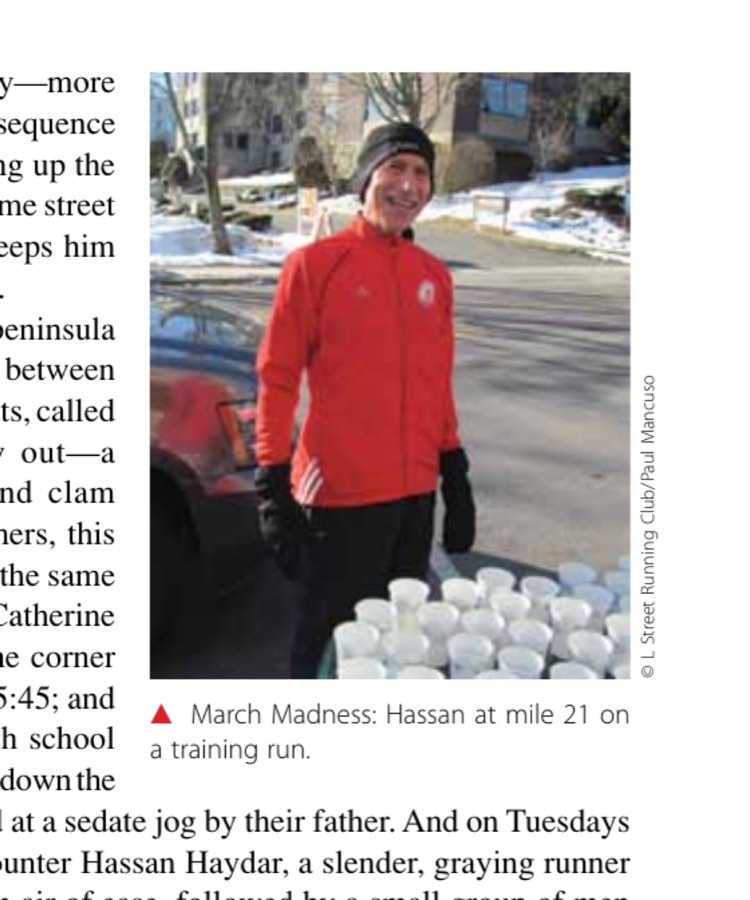
I live and run on a small peninsula jutting out into Dorchester Bay between Boston and Quincy, Massachusetts, called Squantum. Ain’t but one way out—a causeway through wetlands and clam flats. For the neighborhood runners, this means the same faces passing at the same times on their respective runs: Catherine at 5:30 a.m.; George as I turn the corner into the Marina Bay complex at 5:45; and ▲ March Madness: Hassan at mile 21 on the swift teenage twin girls, high school a training run. track stars, on Wednesdays, flying down the causeway in formation, followed at a sedate jog by their father. And on Tuesdays and Thursdays, 6:15 a.m., I encounter Hassan Haydar, a slender, graying runner with an economical stride and an air of ease, followed by a small group of men from the L Street Running Club.
Like all fellow travelers, we nod and exchange greetings. Over the years, each of our names appears on the various running websites and local papers, reporting races run, times, awards, and the various metrics of our sport. I know Hassan Haydar by reputation. He is the fastest local runner in his age group. He’s in the lead pack in every local race. He has run Boston out and back a couple of times. He is a stalwart member of the formidable L Street Running Club. He’s the reason my friend Marty will never win his age group. Year after year, during
my morning runs, at races, and water stops, I say hello. I yell, “Go, Hassan.” Yet we don’t know each other. We meet often, but we’ve never met. This spring, the post-2013 Boston Marathon ritual greeting of all local runners is, “Are you OK?” “Where were you?” On a late-April morning I encountered Hassan on a sidewalk as I strode by. We exchanged the greeting: “Where were you?” He told me that he had finished the marathon an hour before the bombings and that Boston 2013 would be his last marathon—a decision made long before the bombs went off.
My favorite question for any runner—or for any obsessive, for that matter—is not “why” but “how.” “Why” is an overrated question. “How”—how did you fall in love with running. How do you keep the magic? On a whim as we stood on the deserted street in the predawn, I heard myself ask: “May I interview you?” I had no idea what I wanted to ask. I later realized that I wanted to hear his love story, his “how.” I found myself this spring struggling with my running “career,” stalled and lacking in the sense of wonder and freedom that keeps me heading out the door each morning. Was I out of love with running?
It turns out I asked the right person the right question at the right time. Hassan Haydar is the best kind of local running legend: an everyday legend, a quotidian hero living and running past me most mornings. He’s both proud and humble about his many accomplishments. Usually tales of a local running hero leave me vaguely envious and discontented with myself. Sitting down with Hassan and hearing his story, I reconnected with the everyday legend in me and in each runner I pass.
Like every good interviewer, I did a Google search and a marathonguide.com search. Hassan’s stats are impressive: marathons: 34 in 13 years; personal best, 3:10; Boston out-and-backs, two. And wait—something called 26 for 26 at 62, a weekly running of the Boston Marathon course from April 2012 through October 2012. And then there are the local races—the weekly 10Ks, 5-milers, and 5Ks that abound in the Boston area. If you’re 60 or over, you’re not going to place first in your age group anytime soon.
Beirut to Boston, 1997-2001 Hassan Haydar was born in Lebanon in 1950. He played soccer as a child and spent his summers with his grandparents in the rural hills outside of Beirut. He came to the United States with his wife, Warde, in 1977, escaping the civil war that had been raging in Lebanon since 1975. He arrived in Massachusetts at the height of the first running boom, but he was not yet a runner. The Haydar family settled in Quincy, Massachusetts, a small city just south of Boston. Quincy embraced the Haydar family, and he and Warde threw themselves into making a life. In 1978 Hassan watched his first Boston Marathon. Like many people, he thought, Someday I’m going to do that.
And so the seed was sown, although it lay fallow for a long time. Hassan wanted to “be a runner” but did not know how. He ran occasionally with his daughter in the early 1990s, trailing along on her junior high track runs. In 1999, at the age of 49, Hassan saw an acquaintance, Paul Fucile, running along a long stretch of beach. On a whim, Hassan asked Paul how he could start running. Paul suggested that he join the L Street Running Club in South Boston. “If you make it there, you’ll go to heaven.” Hassan joined, but on paper only. He didn’t start running with the club until a year later.
The L Street Running Club has a tradition of starting training for the Boston Marathon in early January each year. Like all South Boston traditions, it’s steeped in ritual and usually covered by the local news. It’s marathon season kickoff, as surely as opening day at Fenway heralds baseball season. Hassan showed up for the first long run of the season in January 2001. He stood alone in the crowd of runners in a room at the L Street bathhouse, afraid, 50 years old. He had never run more than the two miles or so he covered with his daughter. He stood behind another first-time runner, a middle-aged woman. He looked around at the collection of runners of all shapes and sizes, some experienced, some there for the very first time. Why can’t I do it too? he thought.
That first run was eight to 10 miles, and it was love at first footfall. He came back so proud—then went home and promptly fell deeply asleep. He hasn’t missed a Sunday run since. Hassan says that he “got lucky” joining L Street. His pace went up steadily. His first race was as a charity runner in the 2001 Boston Marathon, where he ran just under four hours (3:58). Hassan describes his first marathon as a “very painful experience. I hit the Wall at mile 10.” He went home and told Warde, “If I ever say ‘marathon’ again, just hit me.” He couldn’t walk right for two weeks. But he was in love.
He kept showing up for the weekly L Street runs. And he learned the traditional question asked of every marathoner after their first marathon: “Are you running a fall marathon?” Hassan did not know what they meant. He was soon to find out.
The magic of running is simple Between April 2001 and April 2013, at an age when most folks are receiving their first AARP cards, Hassan ran 34 “official” marathons and 61 total marathons. His official times ranged from that first 3:58 to a best time of 3:10. In between, he amassed thousands of miles in training and smaller races, from the B.A.A. Half to the local Bill Dunn 5-Miler, always at or near the front of the pack. As always, though, the numbers do not tell the story. Hassan says that running has made him a better person. I asked how. “It’s simple,” he said. “It’s made me grateful. I’m part of a community.” Hassan credits the L Street Running Club
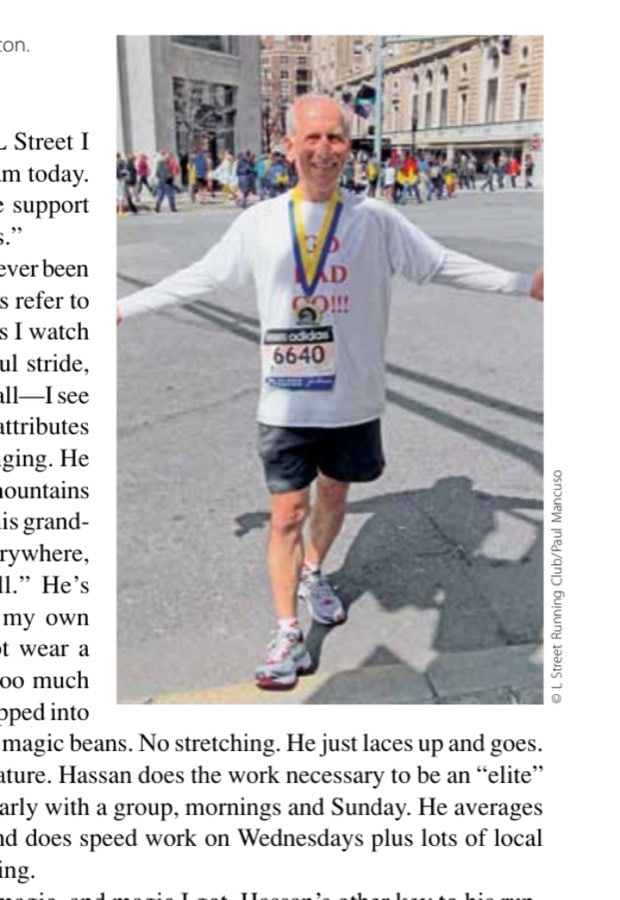
for his success. “Without L Street I would not be the runner I am today. It’s knowing that you have support and that you support others.” Incredibly, Hassan has never been injured. His L Street friends refer to him as the “cyborg.” And as I watch him run—his short, graceful stride, he hardly seems to move at all—I see what they mean. Hassan attributes his mechanics to his upbringing. He spent every summer in the mountains of Lebanon on a farm with his grandparents. “Run and walk everywhere, usually with a soccer ball.” He’s a minimalist, a man after my own running heart. He does not wear a watch. He thinks there is too much water at races. He’s not strapped into bandoliers of Gatorade and magic beans. No stretching. He just laces up and goes.
But running is not all nature. Hassan does the work necessary to be an “elite” local runner: He runs regularly with a group, mornings and Sunday. He averages 50 to 60 miles per week and does speed work on Wednesdays plus lots of local races to keep the legs moving.
Sigh. I was hoping for magic, and magic I got. Hassan’s other key to his running success: “Thinking positive while you run—it becomes a habit. I’m happy and grateful while I run.” So are you a saint? Do you compare yourself to other runners? Do you have a nemesis? Thankfully, Hassan is not a saint. He has a nemesis—unnamed, despite my prodding. And he does compare himself to others in races—stomach butterflies, self-doubt, and all that go with a race of any length.
Hassan does not like to travel to marathons. His 34 official marathons are all, with one notable exception, within 100 miles of his home. I asked him what I ask most local runners: don’t you get tired of the Boston course? Has it lost its mystery? Hassan says no, never. “It was the first marathon in this country. Think of the hundreds of thousands of runners who have come here. You run through the cities and towns and the history is all around you. At the end, the crowds make you finish. I get goose bumps when I hear them in Boston. It is a tunnel of inspiration.”
© L Street Running Club/Paul Mancuso
▲
Hassan finishes another Boston.
He loves the course so much he has run it twice as a double. In 2006 and 2010, Hassan ran Boston out and back. He started in Boston, ran to Hopkinton, toed the starting line, and ran back to Boston, 52.4 miles in under eight hours each time. Hassan points out that the crowd support is much different on the way out to Hopkinton: “You’re going the wrong way!”
Yet the humble, decidedly noninternational Lowell Bay State Marathon, in mid-October, is his favorite course and the site of his personal-best time of 3:10 (2011) at the age of 61. His highlight race? Cape Cod Marathon 2008. Windswept cliffs along the water on a beautiful fall day. Why is this his highlight? Hassan says it was that ineffable feeling—that state of being where you are running well for no particular reason. At mile 25, a 20-something young man said to him as Hassan ran by: “Man, you look good.” Everything clicked, and Hassan finished the difficult course in 3:15.
Lowlight? Bay State 2009. That ineffable feeling where nothing is going well for no particular reason. His time was good (3:14) but he was miserable throughout the race, shivering and uncomfortable. Favorite nonmarathon race? The Bill Dunn 5-Miler, a small local race run in the Houghs Neck section of Quincy. “It’s quietly beautiful, like Cape Cod.” Hassan is fiercely loyal to the Quincy community where he has made his home. He frequently comments on local affairs, runs every local race, and is a well-known local figure both on the roads and off. In a letter to the Patriot Ledger, the local daily newspaper, Hassan expressed his love for the city of Quincy. ”For us, we are so thankful that God made Quincy our home for the past 35 years. It has been an honor and a blessing. We have vowed not to leave our zip code.”
The year of running courageously: 2012 Any runner, even the most grateful, settles into a rut. How to shake things up? Run courageously, with joy and with a random, deeply personal goal. In 2012 Hassan made the decision to run 26 marathons in 26 weeks at age 62: random, yet deeply personal. Why? For his daughter, a doctor, who was having difficulties with a move to San Diego. He decided to do the run as a form of prayer and thanksgiving. “Please God, lift this burden from my daughter.”
The goal of 26 for 26 was to commit to running a marathon a week and to share that experience. Hassan recruited his friend and fellow L Street runner, Bill McCabe, age 61, to join him. Why: “Bill’s crazy. He’s up for anything. I knew he’d do it.” The website, 26for26.com, set forth the mission and extended the invitation:
Welcome to 26for26.com. The concept here is pretty straightforward: make a commitment to run a specific distance for 26 weeks consecutively. This is not for a medal or a trophy but for that feeling of accomplishment that
can be felt only when you have pushed yourself and succeeded. So don’t
▲
2012: The challenge awaits.

be shy, don’t be afraid, leave the baggage behind, grab your running shoes, and meet me along the Boston Marathon route this summer and let running do for you what it has done for me. The 26-for-26 invitation was for all runners, of all abilities, to join Hassan and Bill for all or part of the course on all or any Sundays, from April to October. As any New England runner can attest, there are reasons that no local marathons are scheduled in July and August in New England. The 26-for-26 challenge would take the runners through the hottest, soupiest days of the year.
The first 26.2 was the 2012 Boston Marathon on April 16, a glorious day complete with a tail wind and approximately 25,000 fellow runners. The final 26.2 consisted of Hassan, Bill, and a few stalwart friends on October 6, 2012. Weekly blog posts documented their weekly progress, listing participants, weather, and times. They kept close to a nine-minute-per-mile pace. Various L Street members and other curious runners joined them along the way. Warde, Hassan’s wife, joined in from time to time along with Bill’s sons and grandsons. Hassan even invited Alberto Salazar to join them (he did not hear back from Alberto).
Hassan’s final blog post describes the last run in Thoreau-like terms: But before we concluded the run, we had to begin once more in Hopkinton to make sure we saw the final 26.2 miles through. Bill McCabe brought
his grandson, Kyle, with him this morning and the three of us were once again driven to the starting line by Chris Baker, our dedicated and loyal driver for these past six months. There was an elevated level of excitement
and enthusiasm in the air, and Bill and I paused to offer a prayer before we took off full of determination and hope with the end in sight. The sun peaked as we ran, revealing in its splendor magnificent New England
fall weather and shades of yellow, orange, and deep red as we journeyed through Hopkinton, Ashland, Framingham, and Natick. As we were departing Wellesley and descending into the Newton Lower Falls area, Pecharo
Mede joined us, and a couple of miles later, our good friend, George Cataldo, got in the act as well. The total was 681.2 miles in 26 weeks, a six-month prayer and party and in large part a tale of two runners: Hassan, the cyborg, uninjured, and Bill, the selfdescribed average guy, hobbled with foot injuries and unable to walk—he could only run. Bill says he did the run to show that “anyone can do it. I did it to show my grandkids that they can do anything.” Family and friends gathered at the finish line to watch Hassan and Bill finish what they started: no fanfare, no press, no medals, no tinfoil blanket, no oval bumper sticker proclaiming “681.2.” There was just the essence of what running is and does, distilled into one random quest.
Postscript: October 2012—a few more miles for good measure When one quest ends, fall marathon season begins. Two weeks after the final 26for-26 run, on October 21, 2012, Hassan laced up and ran the Bay State Marathon in Lowell, Massachusetts, finishing in 3:14. A week later he ran a little something called the Chowder Challenge on the challenging Cape Cod marathon course, a Saturday half-marathon followed by a Sunday full marathon. He won his age group on both days with a 3:26 marathon time.
November homecoming—Beirut 2012 The final marathon of 2012 took Hassan home to Beirut. Hassan received an invitation from the race director to run the Beirut Marathon on November 4, 2012. It would be his first trip home in 10 years and his first time running a race in the country of his birth. It would be his first “away” marathon. Due to civil unrest, the marathon was postponed. On November 12, 2012, Hassan joined 33,000 runners from the Middle East and all over the world at the starting line in Beirut. His family and friends lined the course to support him.
Hassan ran through what had become for him an unfamiliar city located in familiar terrain. He hardly recognized the city of his birth, built up to 21st-century proportions and scarred by war. He won his age group in a time of 3:27.
One step at a time, one race at a time, Hassan traveled thousands of miles in 2012, not all of them in races. He ran 29 marathons in 2012, some official events
covered in glory and empty cups and some quiet slogs through an August Sunday in suburban Boston. And between runs, Hassan arose each morning at 5:00 to go to his demanding six-day-per-week day job as the property manager for the Marina Bay complex, a large multiuse commercial, residential, and marine property in Quincy.
Long before the bombs shattered the tumultuous peace of the Boston Marathon finish line, Hassan decided that 2013 would be his last marathon. He would still run long and run marathon distances, but not as a race. He quotes Greg Meyer, the last American runner to win Boston (1983): Meyer claims that the human body has about 15 to 20 years of running marathons in it. Injury free at year 13, Hassan decided it was time to step away, at least from racing the marathon distance. He was relieved to make that decision.
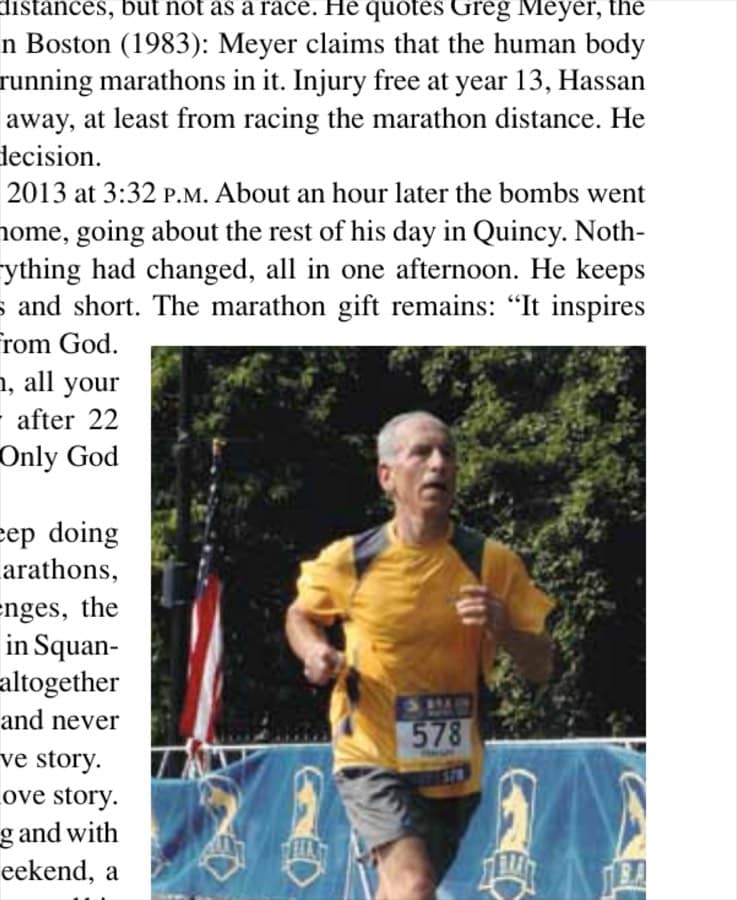
Hassan finished Boston 2013 at 3:32 p.m. About an hour later the bombs went off. Hassan was already at home, going about the rest of his day in Quincy. Nothing had changed, and everything had changed, all in one afternoon. He keeps on running, long distances and short. The marathon gift remains: “It inspires my belief in the blessings from God. In every marathon I’ve run, all your plans go out the window after 22 miles. You hurt too much. Only God lets you finish.”
Hassan’s plan is to keep doing what he’s doing—half-marathons, local races, special challenges, the twice-weekly morning runs in Squantum. He may give up racing altogether one day but never running and never the Boston course. It’s a love story.
And I’m a sucker for a love story. I’m back in love with running and with the Boston course. This weekend, a perfect September day, Hassan and his friends ran the Boston course, purely for love and joy. They’ll do it again from time to time. They’ve invited me, and I plan to follow, medalless and free. ▲
Hassan competes in the B.A.A. 10K.
Courtesy of the B.A.A.
The last dance—Boston 2013
This article originally appeared in Marathon & Beyond, Vol. 18, No. 2 (2014).
← Browse the full M&B ArchiveMore like this
1,000+ stories from 19 years of Marathon & Beyond
The complete archive of the legendary long-distance journal — digitized and free to read.
