

Hate Runs
The great herd of college students had long since migrated, and with the majority of native Bostonians either down on the Cape or up hugging some warm New Hampshire shoreline, it was on weekends that the city sank deepest into its long summer torpor. In Cleveland Circle, only the Green Line trolley cut through the sludge of the afternoon hours, its trains pulling vacantly into their yard with the screech of forged wheels over curved rails, there to await their next run east down Beacon into town.
Across the way in a small running shop on Chestnut Hill Avenue, the assistant manager sat folded on the stairs between the store’s two levels, his long, bearded face hanging in solid features framed by a mane of lank, sandy hair. “
It’s brutal being polite to people all day,” he muttered to one of his three-man crew. “In fact, it’s not healthy. You’re not being honest.” The clock over the register seemed frozen at three till the closing hour when a woman with her young son in tow entered with a flurry of shopping bags. “
I know you must be near closing,” she began breathlessly, walking straight up to the assistant manager. “But he’s been playing baseball for two years, and you know, I thought it might help if he runs a little. And we were passing, and I saw the door propped open. His coach said it would help—running, that is. Besides, his dad has done two 10K races already, and with a little more practice—do they call it practice? I always forget, but whichever he—”
Unhinging slowly to his full 6-foot-5-inch height, the assistant manager halted the woman’s onslaught with an outstretched palm while arching his back in final resignation. “Yeah,” he exhaled. “I get the point.”
He reached back to the display wall of shoes where he lifted the first one his hand brushed up against. “Here.” He swung it into view. “The Osaga Windchime. I’ll go see what we’ve got in back.” And off he trudged without even the pretense of engagement.
The woman stood in a vacant glaze, attempting to process this breach in fundamental retail etiquette. But such were the times, and the power of the running
boom, that even this exaggerated sales malfeasance passed without consequence. In fact, the mother and son left the store with his new shoes in hand not four minutes later as the store’s lights were dimmed and cash totals finalized. Thus ended another grinding week in retail, and at long last the boys changed into their running gear out back as street clothes were hung on hooks along the white walls of the shower room. It was the final stage in their transformation from public servants to private avengers in search of a cleansing purge.
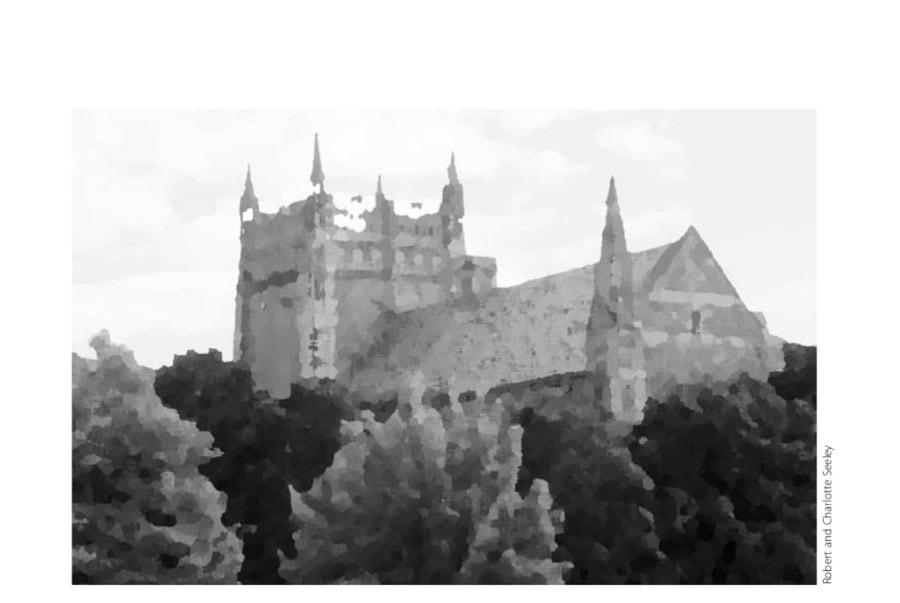
Just west of Cleveland Circle, the Chestnut Hill Reservoir created a natural break between the city’s noisy pavement and the leafy Boston College campus. Situated as it was, the Rez had long been one of the area’s most popular running routes with its two waterworks buildings posing like art museums along the rim of its southern shore. Many of the Saturday-afternoon regulars would loop the mile and three-quarter path around the Rez as either a warm-up or cool-down in their daily training.
But on Saturday afternoons, it was no more than a link in a much longer span, as this was more than just another training run. For most it took on the importance once reserved for religious observation, a service-at-speed to reawaken, as well as reform, a deeply felt connection to a more visceral set of truths than could be found between the covers of any hymnal or hard upon the pew fronting any altar.
The first few miles were for bringing systems to speed, monitoring past stresses, and initiating a rhythm. Minor key exchanges accompanied those minutes, nothing serious, certainly nothing to point to the coming savagery. That it would come was enough. To speak of it was to corrupt it, like ballplayers discussing an impending no-hitter. So in the beginning, in the pregnancy of anticipation with over 11 1/2 miles shimmering in the distance before them, the pack remained little more than a moving meritocracy, leaders and followers as one, poignant potentials of past strengths and weaknesses, each a willing celebrant to the ritual’s paced liturgy ahead.
Though many of the group worked at the store, a revolving number of irregulars
Brighton-Alston Historical Society
The Journey West
also came and went based on schedules, fitness, or lack of injury. Some were lawyers, others doormen, cab drivers, doctors, teachers—you name it. Though disparate in their life pursuits, running in all its simplicity was the common thread that wove them together.
But for the core of this small congregation, as for so many of their generation who had been bequeathed the tools for success, there remained a conflict about striving for it as it was defined by their parents’ age. This resistance was a holdover from their protest years on campus and became the focal point for the rebellion they carried forward into and through their running. From their carefree heads of hair, to their couldn’t-care-less cast of clothing, it all bore an adult inflection of coming of age in the ’60s.
Even their name for this exercise, “hate runs,” had been born out of one ironist’s reflection on the vicious incoherence of one particularly strenuous Saturday run a few years back. But though christened in a moment of sardonic humor, the significance of “hate runs” had immediately been recognized and embraced as the essence of their discipline’s pursuit, as through them they had discovered an antidote to the enervating venoms of daily routine.
By the time they crested Hammond Street beneath the spires of Boston College, nearly two miles lay behind. And though they remained in loose formation, each had powered up his warning system and adjusted his transmission as well, for a serious move could arrive at any moment, and each man now existed on an edge that could answer, yet not instigate, its searing call.
More often than not, it was the minister’s son who initiated the game, moving out to a two-stride lead as the road curved right heading down into Newton, the first of Boston’s tony western suburbs. The most responsible of the group, with a wife, two children, and a mortgage he couldn’t afford, the minister’s son was also the craziest, the most in need of release, having been tortured by conformity since before the ontology of Clapton. He most truly came alive set free in the escapist miasma of pure effort. He couldn’t wait, and everybody knew it. In fact, he had already done a six-miler that morning, just to burn off his fill.
Sweeping to the front, he baited the pace out before them, his surfer-blond hair dancing atop a stubble-bearded face slack with the grace of concentration conserved. With hips slung low, he tried vainly to pull the group into a higher rate, testing to see who would rise to the offer, always tempting, always luring, always pushing, always seeking, always, always. Even his protestations to the contrary were appreciated as artifice of a radical beauty. Unleashed intensity was his truest calling and fondest wish. Running alongside him was like throwing gasoline on an open flame. So the others mocked him with a flammable disregard.
In spite of his urgings, the initial delving into pace wasn’t so much a surge as a foretelling of one, an increase in tempo to find a more sympathetic gear down a freeing grade, or perhaps a quick spurt to beat a traffic light’s crossing. But
Robert and Charlotte Seeley
even these increases would cause the group’s antenna to twitch as all possibilities passed through analysis. Nothing meant nothing any longer. Stripped to the waist, their skin glistened beneath thin slicks of sweat as wet, tangled hair flopped in silent counterpoint to the slap of footfalls along the tree-lined sidewalks. As they coursed through Newton Center, the windows of commerce reflected their form in flashes of reverse-angled symmetry while shoppers’ necks craned in the rush of their headlong passing. But as the minutes vanished into miles and the street narrowed heading west into the sun-dappled Waban neighborhood, inevitably someone would relieve the minister’s son of his aching need by drawing up alongside, affixing himself to the stride that was the clean, natural gait of a lifelong runner. In that instant of engagement, they all fell into place, one a drop shadow of another, while the sound of their breathing and footfalls, once a dissonance of unmatched rhythms and rhymes, now suddenly synched up into a felicitous chorus of reasoned intent.
Opening their strides and untethering their hearts, they gave themselves over, thought and action in eloquent consonance, only instinct and reaction caught up in a sinuous tangle with gravity’s demands. Like unspoken truth, propensity, temperament, character, and surprise sounded against a rough and surly world, carried at such a pitch that to try to describe it would be to diminish it. No longer a device with which to communicate, in these throes language would serve only to adulterate the passing of information. So like cabalists from a time long ago, they proclaimed along a common telepathy, senses replacing words, height, weight, sex, age, all utterly irrelevant. If you could do this, this is what you were, no more, no less.
They accelerated beyond reason, the static world a dopplered blur along the edge of rationality, the trees overhead bending like supplicants to a preacher’s fevered call. The whole purpose of life had been reduced to forward motion— thrust! counter thrust! move and cover!—until the world beyond simply dimmed, shielded by the hammering of hearts and the bellow of lungs. “
You guys are crazy,” came the assessment of more than one novice shocked by the brutality of their initial exchange. But disbelievers never shared the true spirit, no matter the speed achieved elsewhere. And to those who would occasionally join in but not find it within themselves to get lost in the abandon, the less free the others knew them to be. For in clinging to the sanctuary of self, all one did was hinder its full explication. Those unable to dissociate from the appearance seemed trapped in the compromising duality of thought separate from act. Even if they could run faster still, they missed the point of training as fun, of synergy in search of release, of bonding at the point of breaking, the roads as vehicle, as well as the way. This was about the cleansing hand of abandon. If you love someone, went the lyric, set them free. And this was the love of utter surrender, speed work for the soul, blues running: the gut-knifing pain, the bittersweet joy, the reckless abdication. And to accomplish that meant to let “what matters” fall away.
For this assembly of alienists, the regimens and rewards of running had filled many a personal vacuum, and when conducted in union among kindred souls held the capacity of lifting them into realms well beyond the prosaic. So, too, did hate running’s free-form expression transcend the stilted regimentation of an organized race, with its controlling numbers, fixed route, and forgotten rewards. Here the prize was in the doing alone, and in that doing lay the wild, unpredictable forces of the spirit set free. It was to that Emersonian canon that they pledged their undying allegiance.
They may have poked fun at the minister’s son, but they also thought enormously of his willingness to explore, as by their charge, failure to engage was as reviled as saving oneself for some following day’s race. So it was that arbiters of a shared disregard held the reigns of authenticity in this shrunken world. And the minister’s son held precious the tenets they each embraced as canonical.
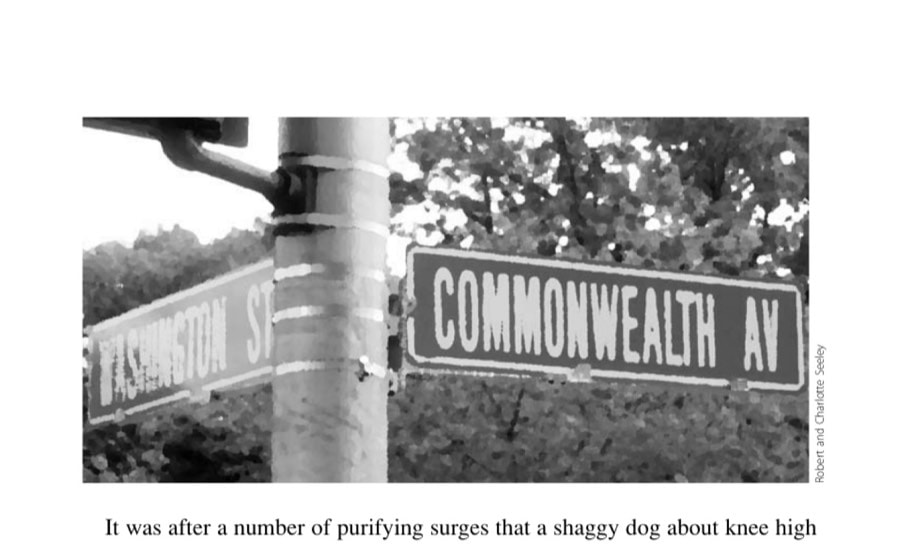
The Dog The initial leg of the “hate run” course measured just over six miles out Beacon Street before turning right onto Washington Street where it joined the Boston Marathon course at its 17-mile mark. A break for water at the fire station on the corner of Commonwealth Avenue three-quarters of a mile down the way cut their run into two distinct segments. The five-mile return to Cleveland Circle would traverse the most famous stretch of road in their sport, the hills along Commonwealth Avenue that defined the Boston Marathon, including the rise over celebrated Heartbreak Hill.
Robert and Charlotte Seeley
It was after a number of purifying surges that a shaggy dog about knee high and 30 pounds picked up on their recovery pace. At first they gave it no heed, but as they continued past the quiet spread of republican lawns, the dog continued to match their two-legged stroke with its four. A fringe-muzzled mutt with a textured brown coat and an easy, loose-footed shuffle, its tongue flopped out the side of its mouth in imitation of a smile. Minutes went by, well outside a territorial imperative, yet the dog remained comfortably affixed to their perimeter, and in so doing entered their realm.
Turning right off Beacon, the pavement angled down along Washington with the Newton-Wellesley Hospital passing to their right. Each April, patients would line the curtained windows as the Boston marathoners streamed out before them in the fullness of health.
Traversing this historic route each weekend, they could all but hear the fullthroated roar that created rolling swells of persuasion along this stretch for generations past each Patriots’ Day, mounting waves of sound, which when mingled with the drumbeat of your own heart could carry you on a good day but conversely turned into a din that could overwhelm you on the bad.
The dog’s tongue had already dipped low as the distance piled on, and his stride length had tapered as well. Even so, in full recognition of their intent, he kicked up his own tempo. Sensing that the game was on, the men in front shifted into a higher gear as the suggestion sped through the pack as on the charge of an electric current: let’s try to drop the dog! But guile was unnecessary except for the run’s initial surge. Deep into it, moves were as subtle as a scalpel entering flesh. * * * They were going only to the firehouse before stopping for water, but this had become a mission. The dog knew that they knew that he knew that they knew. That was the game, and the information rode unimpeached upon every foot strike, car108 l MARATHON & BEYOND l Nov/Dec 2008
Herein lies wisdom, beauty, and increase; Without this, folly, age, and cold decay… The minister’s son’s cheekbones, like gun sights, fixed his eyes to his target ahead, his entire sensory system reduced to no more than awareness, pure will atop curved lasts. As leader he was stripped to essential being, what I am and what I’m doing fused into the same thundering moment, hopeful beyond regret as the dream came to life illumined by the cast of his glow in the full light of day.
Overhead birds fluttered by on oblivious wings assuaging a natural order. But below, under seige, all laws had been sundered and edicts decried. No longer a Cartesian plane, the world reeled underfoot, as through their descent they resurrected a reordering so affecting that what were once interconnected truths revealed themselves anew as blandishments of God’s restless humor.
It had become, as it always had, a blistering screed against all the inequities that led them to this fugitive state, inequities that had long ago molded their
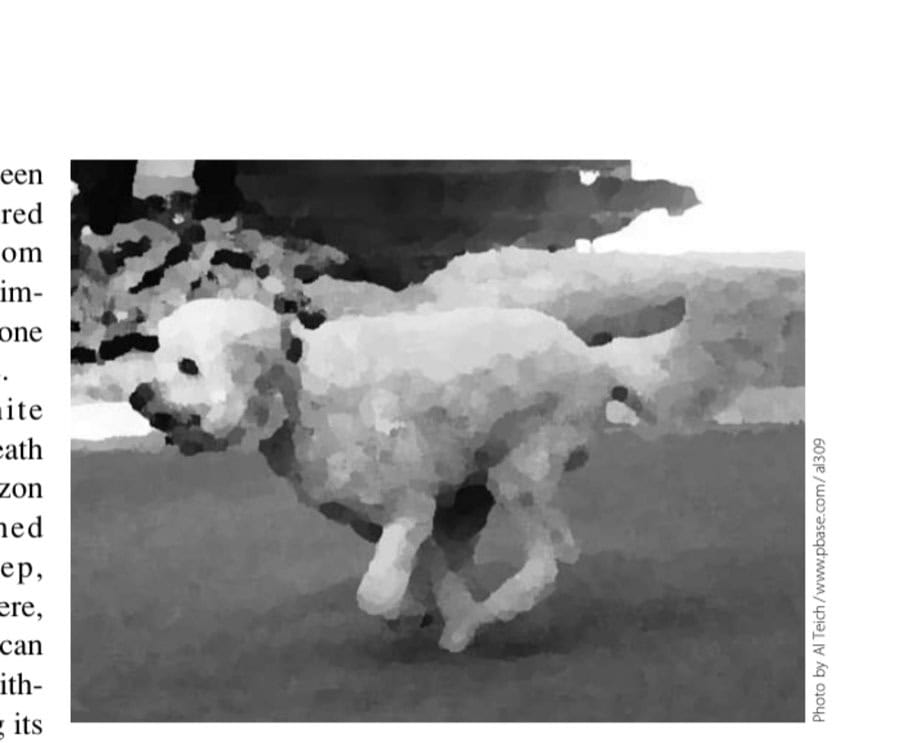
Photo by Al Teich / www.pbase.com / al309
ried along the unseen ganglia that flared like tendrils from heads held high, imprisoned to the tone of each response. Broken white lines zipped beneath them as the horizon ahead beseeched their every step, there but not there, for that frontier can never be met without relinquishing its name. Yet toward it they rushed, redefining as they went, lustful in their want, their want of freedom, freedom from the others. In their beckoning, they transformed into elementary beings wresting Darwinian epochs out of minutes, new galaxies out of miles, deluded by their flight into believing that death was for others, the wind whispering the same illusion to one as to them all, theirs would be the endless road, even as the simple task of wiping one’s brow was now beyond the doing.
Sweat poured from their faces, gleaming beads to cleanse the sins of their previous ways, fleeing in terror from prisons of flesh engulfed in the flow of a coursing ambition. Forgotten in their fever were the keening reminders of potential ruin, coherent respect for sanity’s counter, theirs but an unwinding sonnet to freedom’s sweet passing.
worldview. Not real inequities, mind you, the ones God had sanctioned on other nations, other peoples—they weren’t so blind as to believe that they were in such company. But the small injustices of any life one chooses to amplify, to fixate on in order to dredge up the requisites necessary as fuel.
Some of it was about the war they had never fought, the promise they had never reached, the chances they had never taken. Maybe some about the loves they had lost and the stories they had told to rationalize why. It wasn’t even conscious, but it did exist, tucked away in the dark, narrow recesses of private, nocturnal thoughts. But in this company, privacy remained an act of friendship, and thus did the details remain submerged, banished beneath their rough act of running, the very intensity a testament to the value it was accorded. But no matter the distance that separated them, together their bond transcended the irregularity of space and time. And the dog, in dogged determination, fighting the urge to stop, maintained devotion to the cause.
As it played out along the grind of talent and fitness, one by one they began to succumb, damaged by the flush of waste through ravaged systems. The disappointment of being gapped fell hard upon the assistant manager, who at 6 feet, 5 inches tall, wasn’t born for distances, but rather found in their hold substantiation beyond the aspects of lineage and bent. His eyes stared vacant and hollow, wet with the toil of ineffable struggle, his lungs drawing one shuddering breath after another to fuel the savage task even as the others pulled away as in a dream, though ambition still pinged like radar from the bright nylon colors fixed as the target of his impassioned resolve.
Up ahead the minister’s son broke free, released in an epiphany of form, the last man left upon high, hallowed ground. In this liberation, he soared, unburdened, free soloing in a willowy manifestation of benediction and grace. Within that emancipation, he no longer needed to push, rather laid out a line of want to the edge of need, plunging through air weightless and free with hope, a casualty consumed in his wake.
Behind, the others broke off into deltaic streams, working their way along deeply corrupted channels, each proceeding in the humbling recognition that the excavation of inner space is not without cost. And there, in that trough they would remain, galvanized into a familiar reckoning that spoke once more of man as one with being. * * * Though caught in the initial unwinding, the dog had never relented and somehow began to move up as feelings of misery and doubt were recast into lightness and lift. As he passed each dying member of the group, he devoured their spent strength like meaty bones and converted them into a mystical fuel. The remaining runner between him and the minister’s son became no more than a marker in the road,
an integer to measure progress. The dog moved by without sound, never sharing a stride nor moment of union. Up ahead the minister’s son was in his own rhythm, loose and easy, almost jangly about the wrists. His arms and shoulders, meatless from months of uninterrupted training, carved the air with the frame they barely concealed. All muscle lay beneath the waist, his stride tucked low above bundled hamstrings. No way could he sprint from a base like that, but, boy, could he ever pull through the miles, chewing off distances in big, raw chunks as long, deep cuts dividing the front of his legs from the rear deepened with each stride as he caught and released the ground, unwinding pavement in a ribbon of gray.
Moving with an inexorable flow, the dog arrived alongside upon a river of pace. Like a channel squeezing in, exertion amplified everything, footfalls to heartbeats, exhalations to desires, now fully expressed in a blaze of menaced intent. Together as one, they pushed without relent until they strode into the very belly of pain, no longer in fear, but in full embrace, adjutants to misery’s lament. Rushing with a feral ardor, their agony became indistinguishable from harmony, their torment unleashed like a red jackal’s wail, heaven bound like Calvary’s own anguish, sung on a note of such purity and pitch that the angels themselves succumbed to its call.
In full overload, their systems cried out for pardon. But deaf to the pleas of the flesh, they heeded only to the effort, the willingness to press more deeply into the dark, raging corridors within, each a piece of the other, alive in this blackened vessel of full extension.
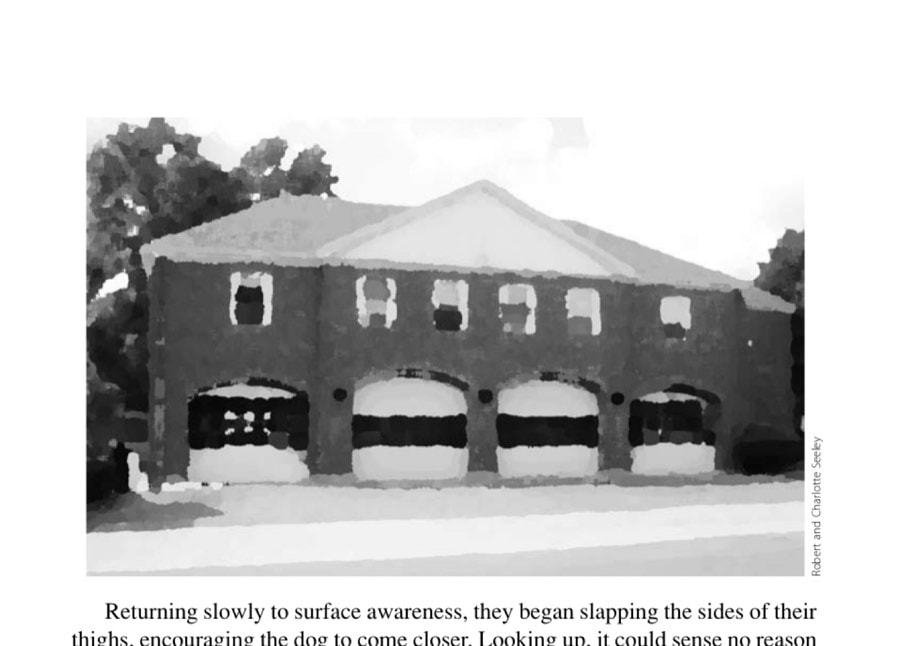
Valiant to the end, the dog and the minister’s son strained against manifest limitations, their mouths peeled back into open wounds from which no utterance of deceit, abuse, or malice could issue, even as they began to surrender, losing cohesion and drifting once more into component parts, consumed in the crucible of all systems coming under fire. * * * Coming into view was the Newton fire station number two, standing imposingly on the corner of Washington Street and Commonwealth Avenue, its two-story, brick Georgian design dovetailing with the tree-lined neighborhood it protected. But for the runners in the area, the firehouse was both a landmark and a watering hole, announcing the beginning of the stretch of hills along the marathon course.
As the gradient spilled out, they passed a sign announcing “Mass Turn Pike Entrance, One Mile.” Straightening and shifting into lower, less-taxing gears, their breathing remained coarse, throats and lungs raked by the intensity of their effort. Then, as the battle lines receded along their fragmented length, the pack duly reformed, unsure of what had just happened or might just happen again. Eyes remained furtive, senses on hold, sweat like a christening oil anointing every form.
Robert and Charlotte Seeley
Returning slowly to surface awareness, they began slapping the sides of their thighs, encouraging the dog to come closer. Looking up, it could sense no reason to shy, and so, tongue panting low to the ground, a fine, white froth lathering his jowls, it neared, eyes ablaze beneath its swirling brown coat. And this time there was no mistake, he was grinning, ear to folded-back ear. His stride pranced gaily, too, tail standing on high, a telltale flag announcing his newfound status. Here was one of the boys. * * * Five miles still remained before them, hilly demanding miles at that, most of which would prove as provocative as those already traversed. Along the way, the dog finally angled off toward home as they passed the periphery of his territory— though it would forever remain affixed to their group in ways beyond telling.
But when it was over, and with heads bowed low they reentered the store in Cleveland Circle, the experience hung over them like the sweet smell of ozone in the passing of a storm, their every day once again emerging cleansed and restructured, all potential and promise once more.
Such were their glories when each week they became defiers of gravity, enthralled in their wit afoot. For it was through these shared communions that they could evoke a stillness that held the essential truths long forsaken by a world of secular yields. Together they sought emancipation in this covenant, release through this bond, compressing time into a trembling extension of the eternal where like Eden before Adam all darkness and sorrow were unknown, callousness and corruptions unheard, tears and perversions unseen. They ran until the wind was forever to their face, and the world was reclaimed by an unbiased God.
This article originally appeared in Marathon & Beyond, Vol. 12, No. 6 (2008).
← Browse the full M&B ArchiveMore like this
1,000+ stories from 19 years of Marathon & Beyond
The complete archive of the legendary long-distance journal — digitized and free to read.
