

Hatfield-Mccoy Marathon
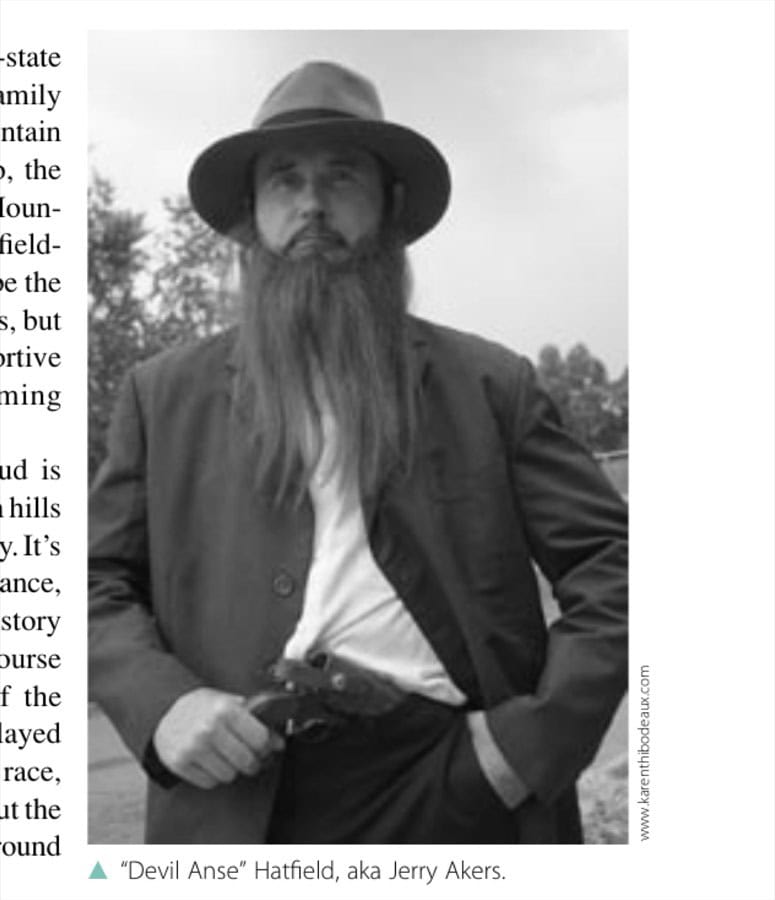
ake a challenging, two-state course, add an historic family feud, a few goats, small mountain children, a stray dog or two, the charm of the Appalachian Mountains, and you’ve got the HatfieldMcCoy Marathon. It might be the quirkiness that draws runners, but the organized race and supportive volunteers keep them coming back. The Hatfield-McCoy feud is legendary in the Appalachian hills of West Virginia and Kentucky. It’s a legend of tragedy and vengeance, with a Romeo and Juliet love story thrown in. The marathon course takes runners past some of the many spots where the feud played out. To really appreciate the race, you have to know a little about the famous feud that took place around ▲ “Devil Anse” Hatfield, aka Jerry Akers. these here parts. The Hatfields lived on the West Virginia side of the Tug River, and the McCoys lived on the Kentucky side. The patriarchs of the two families were Anderson “Devil Anse” Hatfield and Randolph “Old Ranel” McCoy.
Devil Anse was a guerilla leader in the Civil War. He was known as the best horseman and marksman in the valley. Although he could not read or write, he owned a lot of land and ran a lumber operation.
www.karenthibodeaux.com
Twww.karenthibodeaux.com
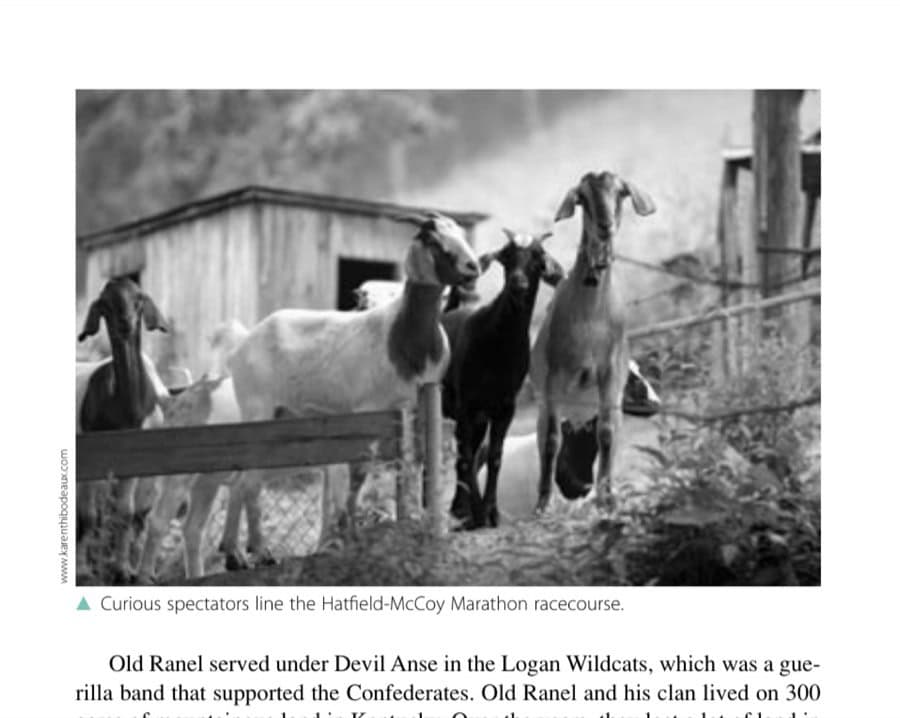
▲ Curious spectators line the Hatfield-McCoy Marathon racecourse.
Old Ranel served under Devil Anse in the Logan Wildcats, which was a guerilla band that supported the Confederates. Old Ranel and his clan lived on 300 acres of mountainous land in Kentucky. Over the years, they lost a lot of land in timber disputes. Because of that, they were suspicious and resentful of those in the lumber business.
A DISPUTE OVER THE CAUSE OF THE DISPUTE The feud began sometime in the mid-1800s. But more than 100 years later there is still some dispute over what actually started all the fussin’. Even the executive
director of the Tug Valley Chamber of Commerce says there are a couple of versions, and he ought to know, ’cause he’s Cecil Hatfield, a direct descendant of one side of the feudin’ families. Some historians say the feud dates back to the Civil War in 1865 when Old
Ranel McCoy’s brother, a Union sympathizer, was shot. The main suspect was Jim Vance, kin to the Hatfields. Others say the feud started over property. Old Ranel McCoy accused Floyd Hatfield of stealing his hogs. Old Ranel pressed charges, and Floyd Hatfield had to appear before a jury of six Hatfields and six
McCoys. In what has come to be known as the famous Hog Trial, Floyd Hatfield was found not guilty, to the obvious dismay of the McCoys. Whatever sparked the ultimate feud, bad blood existed between the families for
years, with shootings, raids, and killings on both sides. On Election Day in 1882,
a fight broke out between Ellison Hatfield and three McCoy brothers: Tolbert, Randolph Jr., and Pharmer. In the ensuing melee, Ellison Hatfield was stabbed to death. In retaliation, the Hatfield clan captured the McCoy brothers, tied them to pawpaw bushes, and shot them.
In the midst of the deadly chaos, a love story unfolded. The 21-year-old son of Devil Anse and the 18-year-old daughter of Old Ranel fell in love. Rosanna McCoy moved in with the Hatfield family to be with her love, Johnse. But even though Rosanna was pregnant, neither father would allow the couple to marry. Rosanna was not welcome back into her father’s home, so she went to live with an aunt, at whose house she delivered her baby girl. The little girl later died of measles. Rosanna’s devotion to Johnse remained. During a planned raid on the Hatfields, Rosanna rode on horseback through the valley to warn him of the plan, and that may have saved his life. But since Johnse knew he and his love could never be together, in less than a year, he married Rosanna’s 16-year-old cousin.
HEADED FOR A BAD END Toward the end of the century, raids and attacks increased dramatically. On New Year’s Day in 1888, a group of Hatfields surrounded the McCoy homesite. The home was set on fire, and two of Old Ranel’s children were killed. Following the deadly raid, a court handed down life sentences to a number of Hatfields. One Hatfield received the ultimate sentence. Cotton Top Hatfield was sent to the gallows, marking the area’s last public hanging. For years, many predicted Devil Anse would retaliate, but he did not, and it appeared the violence had finally come to an end.
While the bloodshed was over, the feud continued to be sensationalized by journalists across the country. Even today, the folklore of the feud is one of the reasons runners from across the country make the trip to the hills of West Virginia for the Hatfield-McCoy Marathon.
The race director knows a thing or two about the course, running, and the feud. He’s president of the Tug Valley Road Runners Club, and he grew up in the area. In fact, he lives at the foot of Blackberry Mountain. His name is David Hatfield—that’s right, a direct descendant of the Hatfields. Not only did he organize the race and host the pasta party the night before, but he was dressed in his shorts and sneakers at the starting line with everyone else.
At the pasta party, David warned everyone this is not a certified course, but it’s somewhat accurate. It was officially measured by David, using “the most modern form of measurement known to us at this time, the speed-o-meter of his new pickem up truck.” He also warned runners to stay on the course or they could get “lost in them thar hills and never be heard from again!”
THROUGH HILLBILLY HEAVEN The race starts in Pike County, Kentucky, and takes runners through the coal camps of Hardy, Kentucky. The small homes are typical of a coal town that has seen its share of hardship through the mercurial business end of the mining industry. Runners then travel through the heart of “Feud Country” following big blue hillbilly footprints painted on the pavement. For the entire 26.2 miles, there is something to please every runner. There are mountain streams, hills, and valleys. The landscape is beautiful, and if it doesn’t make you realize you’re in the country, the goats and roosters along the way will definitely convince you that you’re a long, long way from the suburbs. There are also plenty of historical sites along the way, as the course traces the famous feud back and forth across state lines.
Early on, the route passes the home of Old Ranel McCoy and the cemetery where Tolbert, Randolph Jr., and Pharmer are buried. During these first six miles or so, it’s a gradual incline, but just past the 10K mark, the climb up Blackberry Mountain begins. It’s about a mile long and steep. At the top, the downhill may seem like a welcome relief, but it eventually turns into one of those long, steep downhills that leaves the quads screaming for mercy the next day when you try to get out of bed.
At the foot of the mountain, the course passes Rev. Anderson Hatfield’s home. This is where the Hog Trial took place. Runners make their way along Blackberry Creek to the Tug River in Buskirk, Kentucky, to the site where the three McCoy brothers were tied to pawpaw bushes and executed.
Soon, runners cross the border into Matewan, West Virginia. The finish line for the half-marathon is here. The town is the site of the 1920 Matewan massacre, a deadly gunfight between miners and agents brought in by the coal companies to prevent the union from moving in. This doesn’t have anything to do with the Hatfield-McCoy Feud, but it played a major role in the region’s history.
Marathon runners circle through the small town of Matewan and head back out, crossing back over the Tug River and back into Kentucky. The pavement ends, and runners head down a tractor path that is somewhat rocky and somewhat muddy but shady. Soon runners pop out of the trail and step on to a golf-cart path as they cruise through the lovely Tug Valley Country Club and over a unique swinging bridge—or as the race director calls it, a “swangin’ bridge”—as they weave their way back into West Virginia.
AN END IS IN SIGHT For the next few miles, runners pass more homesites and feud landmarks and one final, rather steep hill around mile 23. This is much shorter than Blackberry Mountain, but at mile 23 any hill can seem long and steep. Finally, the course runs a few miles into the town of Williamson, West Virginia, to the finish line in
www.karenthibodeaux.com
▲
The “swangin’ ” bridge, part of the racecourse.
front of the Coal House. This is pretty much what it sounds like: a building made out of coal, 65 tons of it. It houses the Tug Valley Chamber of Commerce. Without a doubt, the event has the fastest race
tabulations of all time. Cross the finish line, and by the time someone helps take your timing chip off, the race director is handing you a trophy. David Hatfield ran the half-marathon so he could hand out awards at the end of
that race and then skedaddle over to the marathon finish to be there to welcome the runners in. At the inaugural Hatfield-McCoy Marathon in 2000, there were just 31 participants; 20 of them ran the full marathon. In just six years, the race has grown to somewhere around 300
runners, with about 200 of them registered for the full 26.2. “Basically the race has taken on a life of its own. We get a lot of runners from the 50 States Marathon Club and the 50 States & D.C. Marathon Group. Since the race meanders
its way back and forth through Kentucky and West Virginia, it counts as either state,” says Hatfield. For a small marathon, the race is incredibly well supported by volunteers along the course. Can’t really say there were many spectators, but there were just
about as many volunteers along the course as there were runners. Aid stations were posted every mile, maybe more. The volunteers not only handed out fluids and food, but some dressed for the occasion, and all were enthusiastic, helpful,
and encouraging. Some aid stations were even decorated with outhouses and old moonshine stills.
The race entry fee was $45, and that was late registration! For the money, the prerace and postrace parties were exceptional. The pasta party the night before was free, with plenty of food. In addition to the pasta, there was a skit. Devil Anse and Old Ranel (or look-alikes) gave a dramatic presentation about the world-famous feud. The postrace party was a pig fest: “pig fixed just about any way you’d want it.” Not the typical postmarathon menu, but hey, when in the hills of West Virginia . . .
IT’S ALL PART OF THE FESTIVAL The marathon coincides with a four-day Hatfield & McCoy Festival. The festival actually takes place in three towns: Matewan and Williamson, both in West Virginia, and Pikeville, Kentucky. That’s just to make sure all the Hatfield and all the McCoy turf is covered. There are ATV races and poker runs on one of the largest networks of trails east of the Mississippi. The trails take riders through the stompin’ grounds of
ad
www.karenthibodeaux.com
▲
Just a country boy workin’ a waterstop during the race.
the Hatfields and McCoys. There are also a 28-mile yard sale and a Tug-of-War where descendants of the two feuding families are at it again, but this time using strength and endurance instead of shootin’ irons.
Cecil from the Chamber of Commerce says that for many years after the feud ended, no one talked about it much. “Our parents and our grandparents thought it was more of an embarrassment. They wanted to forget about it . . .
let bygones be bygones. But us young guys, and I’m in my 60s, don’t mind talking about it that much. That’s why it’s only been recent that the festival started.” Now the whole town seems to get involved in one way or another.
Most people who live here are descendants of the Hatfields or the McCoys. Many of them play parts in the reenactments that are set up for the festival.
A SEARCH FOR FAMILY ROOTS Now that the marathon has grown over the years, it’s one of the biggest draws during the festival. But people also come to check out their roots. “It’s a historical trip for many who want to come here and trace their genealogy. All those who are somehow related to the famous McCoys or Hatfields,” says Cecil.
Speaking of family, everyone who registers for the marathon or the half automatically becomes a “country cousin.” Whoever isn’t already a true Hatfield or McCoy by birth is appointed to one family or the other. You see, while the feud
is over, the competition is still going on. However, now it’s a race between the Hatfield runners and the McCoy runners. The family with the lowest cumulative time wins braggin’ rights for a whole year. In the wake of the 2005 event, the score is 4 to 2, Hatfields. Y’all can bet the McCoys will be back with a vengeance this year!
This article originally appeared in Marathon & Beyond, Vol. 10, No. 2 (2006).
← Browse the full M&B ArchiveMore like this
1,000+ stories from 19 years of Marathon & Beyond
The complete archive of the legendary long-distance journal — digitized and free to read.
