

Heart Of Awarrior
The official title of what is commonly called the “Baker to Vegas Relay” is “The Challenge Cup Relay,” which has been running since 1985. The event began with two Los Angeles police officers who were the general manager and the athletic director of the LAPD Athletic Club, with the purpose of serving as incentive for law enforcement officers to maintain physical fitness. The race has grown from its initial 14 teams in the early years to today’s maximum of 270 teams. Each team consists of 20 members, who run one leg of the relay each. Over the years, the course’s starting line, finish line, and route have changed or have been interrupted by an occasional blizzard, but the theme of the event remains focused on “teamwork, camaraderie, physical fitness, and competition.” The current categories of participants have expanded beyond law enforcement officers to include probation officers, district attorneys, US attorneys, and civilian police personnel.
Basically, the course runs from the vicinity of Baker, California, to Las Vegas, Nevada, through more than a hundred miles of desert. The start at Baker intersects with Interstate 15 and then follows local highways to Las Vegas, where I-15 intersects with Interstate 215 and Interstate 515.
The course elevation ranges from 500 feet to more than 5,000 feet in the latter stages. Each relay leg ranges from four miles to 10.7 miles. The official distance totals 120 miles, this year starting 25 miles north of Baker, going through Pahrump, Nevada, at the approximate midpoint, and finishing at the Hilton Hotel in Las Vegas. There the awards ceremony convened with 6,000 runners and support crew, several thousand friends and family members, and 1,000 volunteers.
Only within the past six years did it occur to Brian Keltner, a 25-year law enforcement veteran, that he might be capable of participating. Six years ago, he was a self-proclaimed couch potato. The only running he did was in basic training for the Army and again when he entered law enforcement. Each time was pure torture for him.
Brian was inspired to challenge himself by his younger son, Aidan, who was born with lobar holoprosencephaly and is developmentally delayed as a result. Holoprosencephaly (HPE) is a common birth defect in the brain structure, affect-
ing characteristic facial features. Lobar HPE is the least severe form, and not all individuals are affected to the same degree. In addition, Aidan has diabetes insipidus. Diabetes insipidus is unrelated to the more commonly occurring diabetes mellitus (the familiar type 1 and type 2), although they can have similar symptoms, such as excessive thirst and excessive urination. In diabetes insipidus, the hormone (ADH) that regulates the kidneys’ ability to make more or less urine malfunctions.
Brian’s son faces daily challenges with a positive attitude and heart, and his disposition is what motivated Brian to work himself into good physical fitness, incorporating the same attitude. Brian eventually challenged himself to run a marathon and even an Ironman triathlon.
When asked by his colleagues in law enforcement if and when he would join the relay, a little voice inside of Brian said, Sure, when I’m ready to run the whole distance myself. And remarkably he did, at 46 years of age.
He dedicated his efforts to his newly chartered foundation, “Warrior Hearted Special Children’s Foundation.” Its goal is to bridge the gap between the parents of special-needs children and the resources and therapies that could and should be available to them but that are often difficult to obtain.
Here is Brian’s story from couch potato to ultrarunner. Q: Where did you go to high school? A: Bell Gardens (Bell Gardens High School is about 10 miles from downtown Los Angeles, or 30 miles east of Los International Airport, in the Montebello Unified School District).
© Judith Keltner
Q: Did you participate in sports in high school? A: Wrestling and swimming; I lettered in both. I tried to do track and field, but I got shin splints really bad. I wasn’t very fast. I had the wrong shoes. There wasn’t really any coaching, so I wasn’t doing any
▲
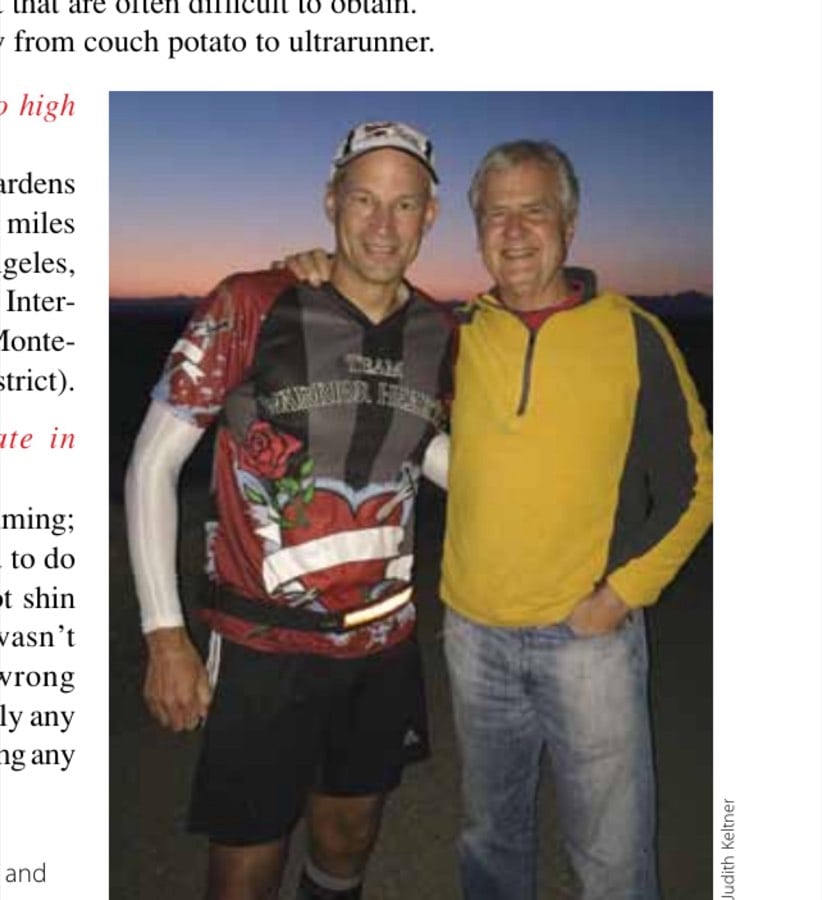
Brian Keltner with coach and mentor Bill Lockton.
of the running aspects of track and field. I tried shot put, javelin, and pole vault looked like fun, until I saw someone break the pole, so that didn’t look like fun. Q: But you had good coaching in wrestling and swimming. A: Not in swimming—I already knew how to swim—but I had a great coach in wrestling. Q: When did you graduate from high school? A: 1985. Q: Where did you go to college? A: Long Beach City College and then University of West Los Angeles. Q: Did you continue in sports in college? A: No organized sports, just PE classes. I never did really well in team sports, so I did individual sports: fencing, racquetball, archery, and tennis. Q: When did you decide to take up running? A: I was kind of forced to run after college, when I went into the military (Army). All the way through basic training I dealt with shin splints. They called me in and they wanted to restart me, put me in the next class, but I thought, I do not want to go through this again. They asked, “How are you going to do it?” and I said, “I’ll have to grin and bear it.” I talked them into it, and they let me stay. I had stress fractures and blisters all of the time. I was not used to wearing boots, and I had to go and run in them. It was a nightmarish thing for my legs. But I made it through. Later on, I got a job in law enforcement, and they made me run too. Q: So you weren’t really having a love affair with running? A: No, no. I made friends with pain. I was never very fast. Ran completely wrong. I remember being taught wrong—land on your heel and push off your toes. So I had problems there. Q: I can see why. You weren’t taught good form. A: Bad form. The police academy was no different. They also wanted to restart me. Q: But you just had to pass, and you didn’t have to keep it up, did you? When you were done, that was it? A: No, once I graduated—whether it’s basic training boot camp or officer training or police academy—you don’t have to do it again. You were expected to keep your fitness level but I didn’t have to run. Q: If you chose never to run again, I would understand it, but you did! A: I did. But first, I had become kind of a couch potato. I was partying, and later I started raising a family. When my youngest came along, he took up a lot of my time. Since I spent most of my time worrying about him, I didn’t know what to do with myself.
Q: So your youngest child inspired you to take up running again? A: For the most part, yes. I saw all he had to go through. My stress level was high. My weight was out of control. I realized I needed to make some changes. I had a treadmill at home, but I didn’t want to run, didn’t feel I could run, not even a mile. I thought it would be too painful. I started walking, started with a small goal. I was weighing 235 pounds at 6 foot 1. Q: Your boss didn’t say, “Hey, you are out of shape”? A: No, once you’re in for a while, they may jive you a little bit, but no one calls you on it, and there are some really big guys around, bigger than me. Then you start looking at pictures of yourself and wondering, Wow, am I really that big? And your pants start fitting too tight, and you’re going up one size and another size.
© Judith Keltner
Q: When did you get around to going from walking to running? A: At about 39 years old, I wondered if I could set a small goal of walking 20 minutes three times a week. Can I at least do that? Small things, like getting up between TV commercials to go outside and walk around. I kept increasing that little by little. I got a heart rate monitor, and I used the treadmill. I started at 12-minute-per-mile pace. I could do that without limping too much, and then the next day I’d walk. In six months I worked up to five days per week and eventually took it outside. I worked up to three miles, still at 12-minute pace. I thought I was ready for a 5K, but that made me throw up. I’d lost maybe 20 pounds and started to change my eating habits. I went from the 5K to a 10K. I thought if I can do a 10K, then I can do a halfmarathon. I had a heart monitor, but it didn’t have a GPS, and I ran up and down a bike path, guesstimating it was a 12-mile trip I was taking, in preparation for the half-marathon. I ran that about a week before the half.
▲
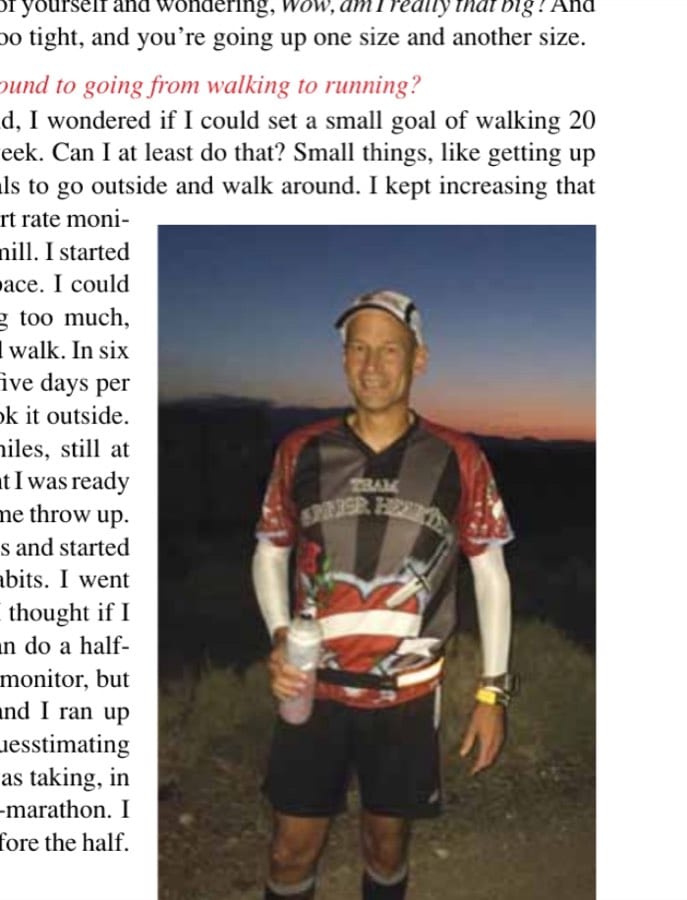
Brian poses for a prerace photo outside Baker, California, at 5:15 a.m.
I went to San Diego and wasn’t expecting it to be so hilly. I ran two hours and fifteen minutes. Again, I got sick and it took hours before my stomach calmed down. Later on, I realized that stretch I’d been running was really only eight miles, not 12, so it was a big jump to the half-marathon. Q: You were undertrained. A: The theme of stomach issues haunted me throughout. In the military at age 24, I had to do fitness tests. I had to do a two-mile run in about 8:15 pace, and even at that, I barely made it, and I would throw up at the end. It was terrible. Q: I think that’s what happens when you are running over your head, and it’s the breathing you can’t keep up with. If you’re not ready, your diaphragm will spasm. So by then, you’re in your 40s? A: I just turned 40. I ran the LA Marathon next, after the half. My colleagues were wondering what I was doing. They said, “You know you’re not a runner, what are you doing?” I would limp into work, and they said, “You are running again, aren’t you?” Q: You were obviously self-motivated, and all those negative experiences didn’t turn you against it? A: There’s a bumper sticker that says something like: sometimes the only thing that hurts on my run is my backside dragging on the concrete. Gotta get up and get moving. Make friends with the pain. That’s just what it is; it hurts. If only I knew then what I know now. Q: Like no pain, no gain? I have a saying that there doesn’t have to be a Wall if you’re ready. A: And I wasn’t ready when I ran the LA Marathon a couple of months after the half-marathon. I took off, and in LA the great part is that my wife could use the subway and pop up to see me in a lot of places on the course. She caught up with me just before 20 miles, and I thought, This is going great. I’m thinking I’m right on time, maybe 4 hours, 30 minutes, maybe better. But after that my knee goes out just around mile 20 (torn meniscus) along with everything else that can happen at 20. It took me as long to do the last six as the previous 20. I equate it to the car going down the road with a flat tire, ker-thump, ker-thump. But there was no doubt in my mind that I was going to finish. It was not a pleasant time, and I think it took me five or six hours overall; I would have to look it up, I don’t remember. I made the mistake of sitting down at the finish, and I couldn’t get back up, and it took me an hour to get to my car that was only really a 10-minute walk away. Q: So how long did it take you to even think of running again? A: Well, I realized that if I was going to keep doing this, I should have the knee checked out. If I can’t get this fixed, I am hanging it up right now. So I saw an
orthopedic; it was a torn meniscus, and I asked what the physical therapy would be afterward. I learned some great exercises and prepared for surgery doing the exercises for three weeks before surgery. At this time, I’m feeling pretty good about myself, my size, my physical self, and I’m a marathoner now. After surgery the doctor said the meniscus had reattached, and he’d never seen that happen before. I told him about the exercises, and he said it made sense. The therapy must’ve held things together, and it worked. Q: Did you have any other surgeries or was the knee ever a problem again? A: Not really; if it flared up, I just made sure to do my therapy to tighten up the muscles that support the knee. Most of the time I forget about it. Q: We all do that. We all get bored with stretching. A: My shin splints weren’t a problem again, as long as I did my pace and not someone else’s pace. I am sure I had some stress fractures, but that’s common, I think. Q: So how many marathons would you say you’ve done? A: Less than 20, more than 15. My best was just at four hours. Q: I assume you did a lot of 5K, 10K, half-marathon races after that? A: No, not really. I never did another half. I went right into triathlons, and I did a lot of cross-training—four years ago. Started with “sprints” (triathlons). It’s kind of fun, but you have to put in so much time during the week. I worked out twice a day for the most part. Up early to beat traffic. Eat at lunch. After work, do another workout. We had a weight room at work, too. Q: You were a swimmer and you became a runner, so was the cycling the toughest part to learn? A: Yes, you think as a kid, everyone rides a bike. But you don’t really learn how to ride. Just being saddle sore alone was hard, and then, the first time buying toe clips, I fell down twice in the same spot and a guy driving a car asked, “Are you all right?” I felt like a complete idiot. Someone at work told me it’s not a matter of “if” but “when” you are going to fall. Once I got the hang of it, I haven’t fallen since. Q: You competed and you excelled at this. You moved from sprints to Olympicdistance (triathlons)? A: Yes. My favorite race is Wildflower, a major challenging course. I love camping. So much fun, in a huge group. I love doing these. I went out to Bonelli Park for a series of triathlons and looked at the duck pond with scum covering it that we had to swim in. I thought I couldn’t do it. But the whistle goes off and I’m pushing people out of the way to get in the water first. I’m halfway through my swim saying to myself, I can’t believe I’m doing this. Who is this guy?
© Judith Keltner
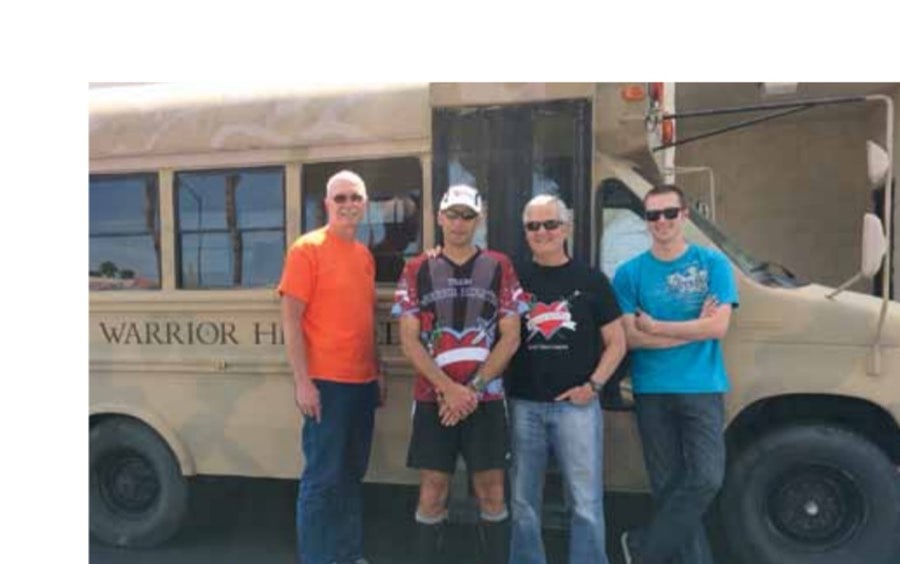
▲ Fifteen miles from finishing, Brian stops to pose with Team Warrior Hearted. From left to right: Richard White, Brian Keltner, Coach Bill Lockton, and Garrett White. Not pictured: Judith Keltner and Steve Young.
Q: Did you get new injuries (confessing that I swam for only five years and have three rotator-cuff surgeries to my credit)? A: Nothing from swimming. I’ve crashed a couple of times on my bike in the races. I cut a couple of corners too tight, landed in brush and rocks, and caught branches in my bike gears—hoping I didn’t mess up my bike too much, when I fell, hoping that I don’t bleed out too much energy so I can finish the race. Those were my thoughts. Q: Spoken like a true competitor! A: You do a quick survey, pick the rocks out of your skin, brush it off, and keep going. I fell on a simple training ride, when the wheel rubber came off my back wheel and the bike slides out from underneath me; then I go down in a slide like a baseball player. I had a huge road rash on one side and broken ribs. I was out for about a month and I couldn’t be on a bike for a while so thought I’d try to go back to swim ’cause I couldn’t run, but I tried to pull the water once and found the pain excruciating. Q: Oh, yeah. Broken ribs: can’t cough, can’t sneeze, can’t laugh, and certainly can’t reach with your arm. I don’t think you’re crazy. Sounds familiar. Like at
the ER room with a torn rotator cuff, thinking, This is going to put a cramp in tomorrow’s swim workout. A: (Laughing) Swim workout tomorrow, but I’m in traction. Yeah, what’s my bike look like? Q: Or like the time I woke up with hypothermia—and I asked, “Did I finish?” I understand completely! A: Yeah, so does my buddy; he comes back and I kind of pulled myself out of the street. He said, “Don’t worry, I got your bike, I got your bike.” I thought, How did he know I was worried about my bike? I can’t breathe, but he takes the bike and he’s showing me: “Your wheel’s gone; forget about your wheel.” He’s giving me a triage about the bike. I’m breathing with Darth Vader breaths. Q: I love this; your training partner is just like you, not checking your anatomy, but he’s got the bike. And all this time, you are self-coached. A: All the time I was self-coached. The theme through all of this was, “Can I?” Can I do more? My son has come so far, has done so much, and he claims, for example, “I did it!” such as buttoning his pants for the first time. My improvement is about as fast as his.
© Melody “Auntie Poppit” Policastro
Q: Tell me about the foundation you started. A: The foundation has been in the making over a year now, fighting for the rights of a child with special needs. It became apparent that parents need advocates to help ask the right questions, fighting a system that you don’t know how to navigate. Advocates can speak the language, know the rules, know the rights, and they have your best interest [at heart]. I said to Judith (Brian’s wife), “I’m thinking about doing this.” She said without hesitation, “I think you should.”
▲
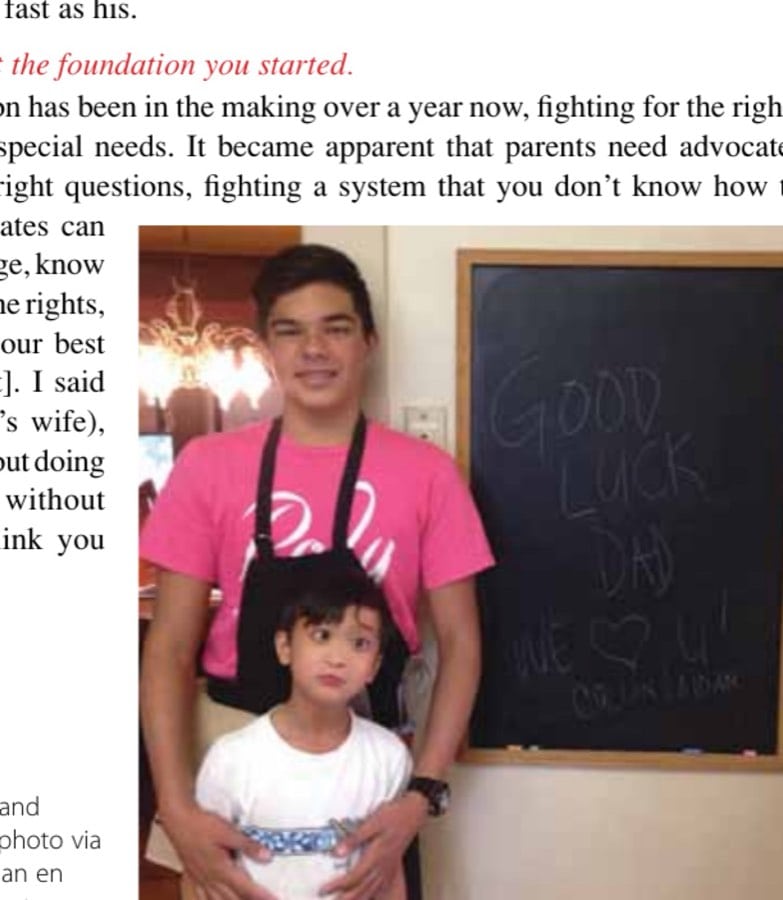
Sons Collin (14) and Aidan (9) sent this photo via text message to Brian en route to the race start.
The foundation, “Warrior Hearted,” is based on two objectives: 1. Parents need an education to be their own advocates, or at least know the importance of advocacy. 2. There are a lot of services available, but they [parents] are told “no” or
are not getting covered by insurance companies, or they’re substandard in the school setting. It takes money to fill the gaps. We provide grants to the service providers on behalf of the child. That’s the objective. I’ve got great people on the team, and we are pending a nonprofit status. Q: You had only done one ultra before doing the Baker/Vegas solo? A: I did Santa Cruz, a 50K, about three years ago. I was the very last one across the line. I didn’t anticipate the mountains. It wasn’t pretty, but I got it done. Q: At what point did you decide you were serious about doing Baker to Vegas and you needed a coach? A: I had some friends who had done long runs before (like the “century” range). I was doing about 40 miles a week. I started meeting coaches through my distance friends. Some were good coaches but hadn’t run that far before. I couldn’t nail down what it was going to take. Others who have run that far told me I didn’t have time to do this (train for a race this far). Q: You were giving them short notice, less than a year? A: I was six months out. I wanted a road map of how I would get from here to there. I was at about 60 miles a week when I was introduced to Bill Lockton. We talked; he gave me his background. He had run Badwater and done very well, so he definitely knew what it took. I realized that I’m getting older now, at 46, but I’m just a “young pup” at ultrarunning. But talking to Bill, his attitude was,“Yes, we can do this.” But early on, I found myself limping. I thought I couldn’t do this. I called my doctor. My doctor thought perhaps I had compartment syndrome of the shins. I told her what I was doing. She told me to stop what I was doing; you need to heal up or you are going to need surgery. Q: You were increasing too much, too fast? A: Short answer, yes. Q: What did your coach say to do? A: Bill was aggressively quiet on the subject. He said you have to get this fixed first. Do what you can do. I was still doing some cross-training, so I kept up with swimming, weights, and biking (in lieu of running, I kept up the biking) and took the doctor’s treatments. The doctor used deep-tissue massage to break up the knots and the scar tissue, and then she pulled out the tools on top of that. It was painful.
Q: What was this due to? A: Lack of stretching, poor running habits, neglect of proper form, whatever. But I kept up with the therapy and was able to add more and more running. Q: You got through the first phase. A: I got through it; my new coach taught me better running form and technique. It was very beneficial. But I was sore from the injury but more painful from the therapy, and then using new running form with new muscles, and it all really hurt. I asked if it was “normal” pain, because I could push through “normal” pain. He assured me, “Yes it is; you’re OK.” Later he confessed he wasn’t sure I’d even be able to do this run or not. Q: Earlier you said you made “friends with pain.” I say we all become connoisseurs of pain. Is it pain I need to push through, or is it pain I should stop and address? A: You hope you make the right judgment. There’s a little voice telling you to stop but also to break through. Q: What was the longest run? What was a typical week like? Was there a pattern to your training? Did you even bother with speed work? Is it all about endurance? A: I kept thinking in the beginning, I had to learn the language Bill used. First it was base-building. Looking back, there was nothing that said “this” is when the real coaching began. Everything was in increments. He knew what he was doing. We finally found a mutual “language” to communicate the coaching. We went from base-building, adding more and more miles. Eventually I dropped the cross-training, just made it workouts. Monday through Friday, I was running morning and afternoon workouts, two a day. Three days of speed workouts and one tempo run. Q: What was your longest “long run”? A: I never went above 20 miles. We built up to 120 miles a week: 11 miles in the morning, five in the afternoon. Saturday, 20 in the morning, five in the afternoon. Sunday another 20. Q: You basically did marathon training. Did you race during training? A: I did marathon training, and no, I did not do any racing. I maintained the same therapy from the first injury, throughout. Q: What about nutrition? Did you do anything different in training? A: Two years ago I was coached by Cherie G. (in triathlons). We ended up working with Fitzgerald’s book Racing Weight, which became my study guide for nutrition, to figure out my race weight and what I should be taking in. Tried to keep my weight at about 180. What changed this time were the higher miles, and some hill work was included. Also for the past four years, I started taking a whole lot of supplements.
Q: How did you prepare for eating in the race? A: Bill said, OK, let’s talk about your nutrition, about two weeks out, asking me what’s your plan? I told him, I take about a GU an hour. He said he takes just half at a time, so I experimented with that. He also suggested getting calories in with something like Slimfast. I tried a bunch of them and liked Boost for the highest caloric intake, taking it half at a time, keep them chilled, and sticking with chocolate. I’m not picky, and I just wanted to keep it consistent. Took some Gatorade along the way and had a couple of bananas and peanut-butter-filled salted pretzels. I ended up taking no bars, no gels, just the liquid for supplement. It was the perfect food supplement. Never felt bloated, no indigestion. Took a lot of water. I also took some salt pills, especially when it got really hot. Q: What was the hardest part? A: Physically, I felt if my whole run was flat, it would be no problem. I told Bill I was kind of scared, that I’d never done this before. Q: Even I did a 40-miler before my 50-miler. A: I know! I told him I don’t know what my body is going to respond like. He told me that with the amount of training I was doing, this is going to be easy for you. I told him I knew he was trying to make me feel better, but I am not believing you! Around mile 80, I thought, Bill is right; this is easy for me. But then, there was this hill. It was a 3 to 4 percent hill for 11 miles. About mile five, I developed some major blisters. The shoes weren’t right. I just kept going. Then it turns out that there’s another hill, so it goes on for five more miles, more of a grade 3 to 4 and even 6 percent for a total of 16 miles. It’s in the desert, it’s 2 to 3 o’clock in the morning. Coming into that from the sunshine, it’s 48 degrees, the wind is just howling, I was just so cold. I was sort of sleepwalking some of the
© Judith Keltner
▲
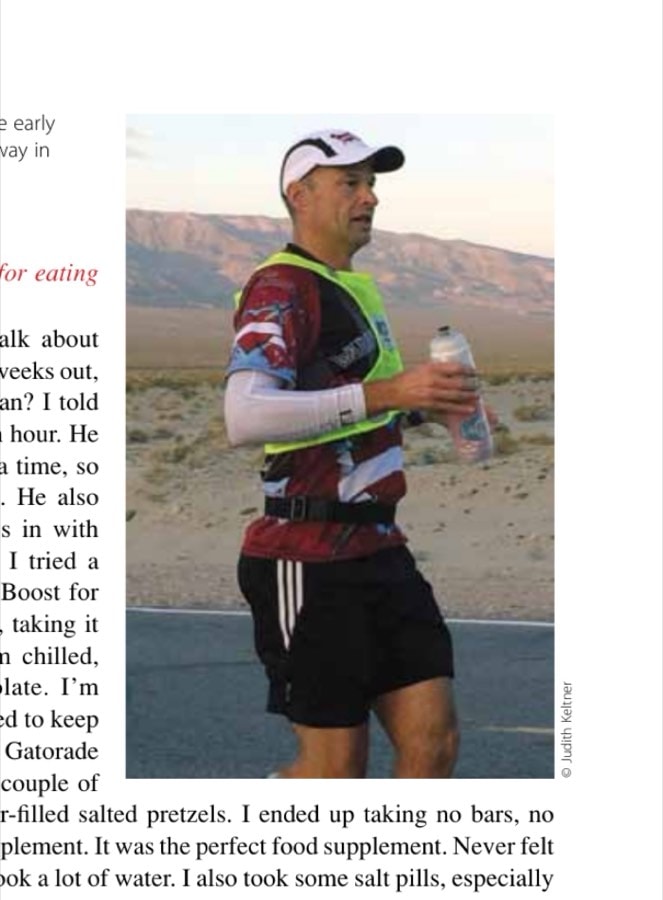
Brian is a lone runner in the early morning down a desert highway in Death Valley.
time, and then I’d wake up and start running again. The bottoms of my feet were soaked from the blisters ripping open. I knew I was losing toenails at this point. Q: Continuous running, with some walking, no resting, no stopping? A: No breaks. Bill asked me throughout for two numbers: physically, on a scale of one to 10. Psychologically, one to 10, worst and best day of my life. I answered eights, sevens and nines, as I wasn’t feeling much pain. Mile 80, still above average. Then a couple of miles from the top, Coach asked, “How ya doin?’” and I was hurting, so I said four and four, even though it was getting so bad I should’ve said two and two. That was about 95 miles and still had more hills to climb. He got out of the car and walked up next to me, keeping up a fast pace. I knew what he was doing. He even told me the story about someone who did this for him and it helped. I just didn’t care. But I thought I needed someone to talk to anyway. He started asking me things like whether I knew who Humphrey Bogart is. I said, “Of course,” and started talking about old movies. In between conversation, I kept thinking, My feet are hurting, but it’s temporary. I’m tired. Not so much worn-out-from-exercise tired, kind of I-want-to-take-a-nap tired. I’m freezing cold, shivering, still hating Bill for walking so fast. The conversation in my head is going, What am I doing, and what am I doing out here? Still popping up conversations about one of my favorite scenes in The Caine Mutiny: Bogart spins the marbles between his hands. Everyone’s witnessing him falling apart psychologically on the stand. I realize that a great man falls at that moment. Between thinking about that and why am I out here, I started thinking about my son. Some of the fantasies before running you have about winning. Some of those come true for some of us, but the idea to “podium” is not a realization some of us will ever see. But getting out there and having some of that spirit is still out there. I think about that. This is why I call the foundation Warrior Hearted. You see these kids, and they are never going to podium in a typical race, but they go into the race with that same spirit of pushing and giving it all, and so I think that’s me. Q: That’s a great analogy: going with
the heart of a warrior. A: The heart of a warrior. Q: And that got you through? A: (Laughing) That got me to the top. Q: Did your coach leave you alone then? A: The car pulled up and was waiting, so I said, “Bill,” and I’m trying to say it without my voice shaking ’cause I’m shivering, “can I just get in the car a moment to warm up?“ He said we’re not on a time frame, and you can take all the time you want. Do you want to sleep? I don’t want a nap; I just want the warmth. I’m still shivering. They crank up the seat warmer and crank up the heat. I’m thinking, I don’t want to sleep, but I do want to warm up. And I hear in the backseat, “Is he
going to turn that heater off?” But I’m still cold even after 10 minutes, so the car is getting hotter. The driver came back from a restroom break, opens the door, the hot air goes out, he said, “Whoa” and the cold air came in. I jumped out my door before I could go into that deep sleep. I picked it up. Now I’m running downhill. I got my second wind and was sprinting down that hill. The driver got a look on his face, eyes wide open, like where did that come from in that 10-minute rest? Q: And your crew, they’re not sleeping either? A: Just catnaps here and there, one at a time. Downhill, my knees were swollen. By the time I was done, I was barely able to walk. I was shaking so bad. Running was out of the question. Kind of a waddle. The swelling in my ankles, you couldn’t see my bones. Bill taped my nails back on my toes. At the end, one of the guys in the crew pulled out his camera, ran up, and took my picture, asking: “Brian Keltner, you just ran Baker to Vegas, 120 miles, what’re you going to do next?” Everyone’s anticipating the answer. I took a deep breath and said, “I am going to go to sleep.” Q: How long did it take you to recover to take your first run? I know you and I walked together just one week later. A: I think I sat out two to three weeks. I went out for a light four-mile run. A half mile out, I could feel it in my feet, my toes, my ankle, and my knees. So I cut it to a mile out and one mile back.
© Judith Keltner
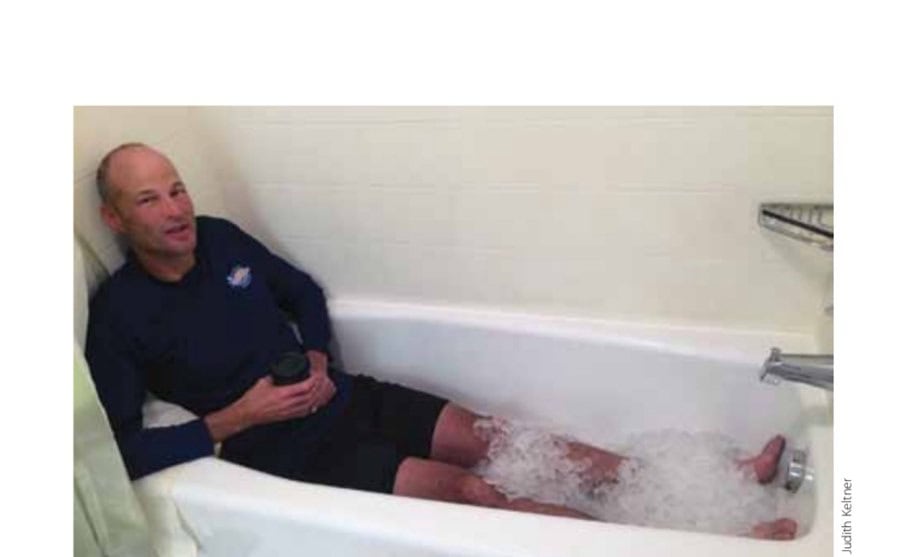
▲ The morning after, Brian enjoys his coffee and a refreshing ice bath.
Q: Where are you at now? (approximately five weeks later) A: I am now very awkward and slow. I’ll do five miles at lunch, and it feels closer to 10. I put away the heart monitor and GPS and just run how I feel. On the weekend I shot for 20 and ended with 15. It’s been about a month. Q: I always say take a day per mile to recover, not that you don’t run, but do what you feel like, listening to your body. Every little ache and pain could flare up into an injury if you push it. Are you doing that? A: I have been doing that. Unfortunately, I have been listening to—and I think it’s justifying all those things I haven’t been eating—they’re out the window. I’m listening to my body and it’s demanding more energy: King Taco, burritos, pizzas. I ate a whole container of ice cream at one sitting. It wasn’t so much “I deserve it,” but it’s the structure and the self-control is gone now. I’m not “heading” anywhere now, so sure, everything looks good. Q: I thought one of the stupidest headlines ever, after one of my races (well, after I won Boston, actually), was in answer to a question, what’re you going to do now, what are you going to celebrate to eat? I thought, I’m breaking training. I said pizza and a root beer freeze. I actually said a pepperoni pizza and a root beer freeze. And that made headlines. They thought that was really clever. I thought it was one of the stupidest things I ever said. You hope for your 15 minutes of fame you’d say something intelligent and something inspiring. But no, I went there. Junk food! Pepperoni pizza and root beer freeze, which is not all that decadent. But under that controlled diet . . .
Brian: You want to cut loose just a little bit. Me: And I was counting on it. Brian: The things you look forward to. Me: It came right off the tip of my tongue. Brian: I ended up having a chicken sandwich, because that was available. I did not have an appetite for anything. It took me a couple of days and all of a sudden, within this month, I’ve had three beef burritos, three or four hamburgers, at least two pizzas, three or four times fish and chips. But this morning, I’ve pulled myself back, I’ve had it. I gained 10 pounds back. Now I’m going to make smart choices again. Q: Do you feel like you are phasing training back in? Like you phased into ultra training and then you phased out? Do you have a goal? A: My goal is very short term. My goal is to get back into my physical routine, and that consists of two workouts a day and [a] long run or bike on Sunday. I’m also starting to make better choices in my eating. I don’t have a weight goal or body-fat percentage goal, just making smarter choices. Two things that are on my plate right now, both sports related: one is a golf tournament fund-raiser for my foundation. The other is a miniature-golf tournament for my special-needs children, paired up with a buddy along the way. I think the kids will have a blast. It falls in line with our goal to reach out to the parents, to know they can trust us, helping bridge that with parents and kids. I’d like to get the buddies, volunteers, who are providing some of the services already, to be there to help out. We’re targeting one in July and one in October. As far as my sports, I don’t want to make a commitment now, but Judith made it real simple: see if you can go to Boston next year. It’s been a dream of mine. You aren’t really a marathoner unless you go to Boston. It would be my podium just to make the qualifier for Boston.
The coach: Bill Lockton Bill Lockton is a distance-running coach and the owner of the Locked on Health company. He once finished sixth at the Badwater 135 and eighth at the 2007 24-Hour National Championship, which was among the top American performances in the country that year in the 24-Hour Run. Coach Lockton does not subscribe to the theory that a coach has to literally walk a mile in the athlete’s shoes in order to coach him. However, it was an important factor to Brian that his coach had experienced what he, Brian, was attempting. Brian was impressed that Bill had not only
run Badwater but had done very well. That, combined with the fact that Lockton had coached himself and, in turn, had successfully coached others, was all the proof Brian needed to sign up with Bill. There is the science of coaching and then the art of coaching. Coach
Lockton’s profession is in math and science; therefore, it’s logical that he would approach training from a scientist’s point of view. This approach is, however, balanced with a positive coaching philosophy, respect for the
psychology of sport, and the knowledge that his athlete’s self-confidence is as important as the physical preparation in training (providing, of course, that the physical preparedness is in place). As for Brian’s physical ability, Lockton said he was blessed to work
with a self-motivated athlete who arrived with a good base of mileage, at 60 miles per week. The fact that Brian also arrived with an injury was just something to be dealt with, and fortunately for both of them, it was
resolved in a timely manner without a major interruption of training. If Lockton’s impressive credentials added to Brian’s confidence level, so be it. Coach carried out the training with a certain amount of flexibility
to ensure that Brian could see the training through to completion. This must have been challenging, given Brian’s schedule: a full-time job in law enforcement, home duties shared with his wife (a full-time teacher), and
being parents to two sons, one with special needs. The weekly schedule included a cross-training or rest day as well. Coach Lockton prescribed high-quality mileage as opposed to quantity because he believes it is better to “train hard, race easy,” and he does
not subscribe to what runners refer to as LSD (long slow distance). Therefore, Brian never ran more than 20 miles in a single run. Having said that, he would sometimes run back-to-back 20-milers with an easy
recovery run in between. The weekly mileage grew to as much as 120 miles per week. This contributed to Brian’s confidence in himself, but as he said, the fact that Bill had no doubt in his mind about his ability
to finish gave Brian all the confidence he needed. This became important when, in the race, the going got tough, and as it’s said, the tough got going. Brian responded to the gentle walk and talk from his coach; he seemed to need his coach’s permission to take
that break to warm up again; then he was able to finish confidently, with the heart of a warrior.
This article originally appeared in Marathon & Beyond, Vol. 18, No. 6 (2014).
← Browse the full M&B ArchiveMore like this
1,000+ stories from 19 years of Marathon & Beyond
The complete archive of the legendary long-distance journal — digitized and free to read.
