

Hitting the Gym
Ihope no one tracks how many people actually read any single article in Marathon & Beyond, because I might be setting a new record for intentional avoidance with this one. If writing about strength training in a running publication is playing with fire, then putting the word “gym” in the title is like lighting up a cigar at the gas pump—disaster.
It’s no mystery why: no one gets into marathoning in order to spend more time indoors. Given a choice, even runners who don’t hate the gym would still rather spend more time on the roads than pumping iron. No doubt about it—I’ve got an uphill battle here. But I like a good challenge, and besides, you’ve already read this far, so I’ll make you a deal: read this article all the way through and if, by the end, you don’t believe that it would be worthwhile and feasible to add strength training to your routine, I promise to never bring this up again. Scout’s honor.
Why you need to do this I’m well aware that you’re probably reading this article not so much out of interest as out of guilt. More likely than not, you already know that you should be doing some kind of strength training, even if you’re not sure exactly what that should include. You’ve read about it, heard it discussed, or were told to start doing it by your chiro, ortho, or other doctor of last resort.
They were right, and here’s why: when most runners think about their bodies, they think mostly about their legs. That does make some sense, since these parts of the body have to generate power and make contact with the ground, forming a drive chain that transfers power from the big muscles of the backside and hamstrings down to the feet. When that power hits the ground, the result is forward motion, and we fly down the road toward the finish line.
But it’s a mistake to think that running involves only the legs. In a lot of ways, that’s like believing that driving involves only a car’s wheels. Running is a total-
body exercise. The arms help drive leg turnover, powered by the shoulders, chest, and back, which together generate force and momentum, helping us to maintain balance as we move through space. If you have a weakness anywhere among these muscle groups, your running motion will be compromised. The result will be reduced running economy, inefficiency, slower times, and possibly injury caused by the overcompensation of the other muscle groups.
Here’s an example. Running involves moving in one direction—forward. In this sense it differs from most other sports, like soccer and basketball, which involve some lateral movement. But while your body might be moving forward when you run, forces are pulling it sideways because of the destabilization that running causes.
That’s because every time you touch the ground while running, you do so only on one foot. Your other leg—which usually provides the crucial second support for your body weight—is up in the air. And then the legs quickly switch places. This puts outward pressure on your planted leg, as your body weight shifts over the planted foot for stability.
Here’s where your gluteus medius comes into play. A thick muscle that lies just behind the bony protrusion on the outside of your hip, the gluteus medius pushes back against any lateral stress and holds the hips in alignment. A strong gluteus medius absorbs the outward push that comes from running and pushes right back.
But if your gluteus medius isn’t up to the job, then your hip collapses outward, or your upper body sways in the opposite direction. This, in turn, tugs on your iliotibial band, that thick strap of connective tissue that runs along the outside of your upper leg, causing tightness and irritation.
The solution? Strengthen the outer hips. There are plenty of similar examples of how weakness above the legs can translate into running problems, from a slumping upper back late in a marathon that causes lower back pain to shoulders that cramp and arms that fatigue. All of these problems compromise running form and stress other muscle groups.
Weakness in the core muscles in particular can be dangerous for a runner. Dr. Kevin Maggs, a chiropractor who is also an Ironman triathlete and marathoner, reports that among athletes who come to him with running injuries, easily 90 percent can trace their problems to insufficient core strength.
In order to improve as a runner, then, you need to do more than just run. You need to get stronger throughout your entire body. Weightlifting can perform another crucial function for runners: it helps to increase and maintain bone density. Bones are living tissue; they react to stress just as muscles do, by either adapting or breaking down. Application of appropriate stress triggers the body to resculpt the bones so that they’re capable of handling bigger loads, but running alone can’t deliver the right amount of stress to the
bones to trigger this adaptation. That’s one reason why so many runners suffer stress fractures at some point in their careers. Strength training—and weightlifting in particular—can solve this problem. Even a minimal amount of regular strength training can help prevent the onset of stress fractures in the short term as well as the onset of osteoporosis and loss of muscle mass in the long term. This is supported by research from the American College of Sports Medicine (ACSM), perhaps the most respected exercise information clearinghouse and teaching organization in the country. ACSM recommends that everyone perform some basic strength movements at least twice a week.1
But despite these reasons, I can still imagine your objections to getting into the gym. Let’s see if I’m right, and whether I’ve got an answer for them. But I can’t fit more training into my schedule!
All this is science, but it’s not rocket science. It should intuitively make sense. But that still might not be enough to persuade you to take up strength training. “There are only so many hours in a day,” you would say to me, “and I can hardly get in time for training as things already are.”
Don’t worry. You don’t have to spend hours in a gym to get results. All that I ask of you is a commitment to doing your strength training. As you’ll see by the end of this article, these workouts really won’t take much of your time. I’ll explain below how you could cut your expected gym time in half. That lowers your commitment to just two 30-minute sessions in the gym every week, which will be enough to make you a stronger, faster, more injury-resistant runner.
But just because you won’t be spending hours getting through each session doesn’t mean they’re less important than your other training sessions. Once you see and feel how strength training makes you not just a better runner but a healthier athlete overall, I’m betting that you’ll agree that they’re worth your time and effort and that you’ll make them a cornerstone of your program. I don’t belong to a gym now and I don’t want to
A gym is the best place to go for strength training because a good gym can offer a wide range of equipment, which is important for your routine, as you’ll see below. But going to the gym involves expense and extra time, which can be burdensome. No problem; you can still get a great workout in your own home. You’ll have to be a bit more creative, but you can make this work.
Folks who work out at home often face an unexpected challenge, however: the many distractions that invade your limited workout space. Spouses and kids 1 Haskell, W., et al. 2007. Physical activity and public health: Updated recommendation for adults from the American College of Sports Medicine and the American Heart Association. Medicine & Science in Sports & Exercise 39(8):1423-34.
demand your attention, the TV or stereo blares, or the computer tells you that you’ve got mail and your phone keeps buzzing. With all that going on, it can be almost impossible to concentrate on your routine. But you can solve that problem; after all, you manage to squeeze your running time into your life, so you can manage an hour per week of strength training as well. Invite your family to join you, take over a room and bolt the door, or shut off the sound on every appliance and piece of media equipment in the house. Do whatever you need to do; once you establish the habit, it will only get easier. But won’t I get big? I don’t want to get big
You don’t want to add muscle mass to your body, and there is no reason you should. You’re a runner, not a bodybuilder; you don’t get a PR by hauling around pounds of muscle that don’t help you move faster. This is why some running coaches believe that weightlifting should not be a part of a running program. They believe that to become a better runner, an athlete’s first and only priority is to run. But doing strength training won’t automatically turn you into Arnold Schwarzenegger. For many people—especially lean runners—it would be hard to put on much bulk even if that were the goal. That’s especially true if you use a high-repetition/low-resistance program, such as I recommend here.
ad
Our approach to strength training can be summed up in a single phrase: work the movement, not the muscle. As a runner, you probably don’t care how big your biceps or pecs are—you just care about performance. The workout you’ll be doing to build strength should and will reflect these priorities. This makes strength training completely appropriate for endurance athletes.
In view of all this, a growing number of coaches have come to realize, as I have, that strength training is not only crucial to overall health and fitness but also the cornerstone to making progress as a runner.
Champion marathoner Lornah Kiplagat would agree. Her High Altitude Training Center in Kenya boasts a fully stocked weightlifting area that is comparable to what you would find in a large gym in the United States. While I never recommend that anyone should automatically mimic the training routines of elite runners, we can and should consider all possible programs and decide for ourselves what makes sense. Lornah’s commitment to strength training is certainly something to consider.
So now that you know why you should do strength training and that it won’t make major demands on your time, let’s talk about what body parts you’ll be working. As you set up your routine and begin doing your exercises, it’s crucial that you know what muscles you’re working and establish an awareness of what it feels like to get those muscles moving.
Your target muscle groups We’ll start with the core. Many people think six-pack abs when they think of the core, but those muscles—the rectus abdominus—are just one of the muscle groups that make up the core, and they’re not even the most important group, anyway.
So what is the core? Let’s begin with a general definition: The core encompasses all the muscles from the midthigh up to the lower ribcage, front, back, and sides. These are the muscles that control your body as it moves in space, helping to establish balance and providing the power for most major movements, including running. •
Gluteus maximus. This is the big muscle group we call our backside. It forcefully extends the hip and pulls the leg back. This muscle group separates us from the apes, which don’t have it, and it helps us conquer
every badly nicknamed hill in every race you’ve ever run. • Gluteus medius. This is the lesser-known glute muscle, which we discussed already. It helps you maintain lateral hip position, especially when you’re off balance. •
Adductors and abductors. These muscles of your inner and outer thigh move your leg from side to side. Remember which is which by recalling
that adductors add your legs together, while the abductors spread them apart. These muscles help stabilize and power the front-and-back motion of your legs during running. • Rectus abdominus. This is your six-pack. It shortens the torso in spinal
flexion, as when you curl up in a ball. Since that motion isn’t a big part of running, this muscle group’s main function is to help you get out of bed in the morning for your long run. • Obliques. These are the love handles, which facilitate lateral movement and twisting. •
Erector spinae. These are the muscles of the lumbar region of your lower back. They help keep your body erect and absorb impact stress. • Transverse abdominus. This is the deepest layer of abdominal muscle.
It circles your torso like a girdle, providing stability to your spine and pelvis, balance to your body, and support for your vertebrae during intense exercise. Of all your core muscles, this one may be the most important. •
Hip flexors. These muscles are located in the front of the body near the crease of the hip and include the psoas muscles. Together, these muscles pull your legs forward in hip flexion during running.
Now let’s talk a bit about the other major muscle groups you’ll be working: • Latissimus dorsi (lats). These are the big muscles of the upper back. They’re used to power almost all pulling motions. •
Rhomboids. These muscles line the spine between your shoulder blades. They help pull your shoulder blades back, as when you pull your arms back behind you. • Trapezius. This is a large triangular muscle that straddles the spine from
the base of the neck to the lower back. This muscle group helps power and stabilize most movements of the upper back. • Pectoralis major and minor. Together, these are the chest muscles, which power most of your pushing movements. •
Deltoids. This group is made up of three major muscles: the anterior deltoid in front, the medial deltoids in the middle, and the posterior deltoids in the rear. Together, these muscles facilitate movement of the arms in almost
all directions. • Quadriceps. These are four muscles on the front of the upper leg that power knee extensions. They also help hold the kneecap in proper position during running.
▲
Here are the upper back muscles that help you move smoothly and maintain proper posture: on the left is the trapezius, and on the right are the underlying rhomboid muscle and the levator scapula, which helps stabilize the head during running.
• Hamstrings. These are three muscles on the back of the upper leg that together power knee flexion, as during the push-off phase of running.
Necessary equipment As I mentioned earlier, I recommend joining a fitness center to have access to treadmills, steppers, stationary bikes, cables, dumbbells, and strength-training machines. But as I promised, you can get a great workout at home using just a few pieces of equipment, which are relatively cheap and easy to store. •
BOSU. Named for the acronym “both sides up,” this looks like a half-dome, with one hard, flat side, and a soft, inflated round side. Flip the BOSU on either side and stand on it to work on balance and stability. •
Stability ball. You’ve probably seen this; it’s a large inflated ball that comes in a variety of sizes. Some are loaded with sand to increase resistance during lifting. Any will work. • Medicine ball. This weighted, rubberized ball is found in most sporting
goods stores. Get one that weighs 8 to 12 pounds. • Resistance system. Whether it’s a set of dumbbells, a pair of adjustable dumbbells, or a series of resistance bands, you’ll need something that
fights against you during your exercises. Before you invest a lot of money in this, take a look at online classifieds for used equipment that might be on sale. There is often a lot of buyer’s regret out there among people who have purchased at-home fitness equipment; buying used equipment is one way to make strength training more practical overall.
Types of exercises Let’s simplify some things. If you’re a member of a large fitness center or have just visited one lately, you know that it can be a confusing, intimidating place. There are dozens of different workout stations and pieces of equipment, and every year brings a flood of new, trendy workout routines and gear. It can seem hard to figure out what you need to use and when.
In reality, it’s not complex at all. Your body can move in only a finite number of ways, which, for our purposes, roughly involve pushing, pulling, and rotating. While these stations and exercises will work different muscle groups in different ways, they all boil down to those basic movements.
Similarly, there are only four types of strength-training exercises to challenge these movements: body weight, free weights, cables, and machines. • Body-weight exercises use your own body as the resistance you work
against, including such classic exercises as push-ups and pull-ups as well as balancing exercises and core work. These are generally safe, although you can still push a joint too far and get injured if you’re not careful. As
a rule of thumb, keep in mind that there is no danger in having a limited range of motion while training. One drawback of this mode of training is that it’s hard to change the resistance levels as your fitness improves.
Some of these exercises can be made more difficult by altering your position or the speed of the repetitions, but there still are absolute limits, as established by your own body weight. • Free-weight exercises involve lifting dumbbells and barbells—the classic
image of weightlifting. Using free weights—especially dumbbells—works the core because you’ll need to balance the weights in space (which is why these are often referred to as open-chain exercises). They also allow
for quick changes in resistance, since you can simply grab a different set of dumbbells. Perhaps the best feature of free weights, however, is that their ease of movement allows for great creativity. You could do a great many exercises
and even invent some of your own. But the downside of this freedom is that if you’re not careful to use proper form, you can easily hurt yourself.
• Cable exercises involve pulling or pushing a handle tethered to a weight stack. This mode allows for easy changes in resistance, as you simply move a pin to increase or decrease the portion of the weight stack you’re
using. Cables provide nearly the same amount of freedom of movement and opportunity for creativity as free weights and also tend to work the core. But while cables are marginally safer to use than free weights because
they can be picked up and put down more easily, you still need to focus on using proper form. • Machines, on the other hand, provide a very safe environment in which to exercise. As long as you keep your body on the pads and do the exercise
as intended, it’s fairly hard to get injured. Also, changing resistance is usually as easy as moving a pin, just as with cable stations. One downside to working on machines, though, is the lack of room for creativity. Most
machines can move only in a single way, facilitating one or two movements. Another drawback is the lack of core engagement, since no balancing is involved.
▲ Doing dumbbell presses on a stability ball not only works the chest, shoulders, and arms but also involves the stabilizing muscles of the core.
Now that you understand these guiding principles, you can see that even big fitness centers are actually surprisingly simple places. Most of them are loaded with redundancy; it’s often possible to perform the same exercise in many ways.
Consider a rowing motion, for example. This exercise works the lats, rhomboids, and biceps by pulling against resistance. In a typical gym, there might be anywhere from three to six ways to do this movement. You could hold onto a stationary bar or strap system and pull yourself forward (which is a body-weight exercise), use a seated rowing station (a machine exercise), put a knee and a hand on a bench and do a dumbbell row (a free-weight exercise), or do one- or two-handed cable rows (a cable exercise). You wouldn’t need to do all of these exercises in any given workout; you could choose just one to check off your rowing exercise.
That doesn’t mean that all exercises are exactly the same, however. Each provides a slightly different benefit and also harbors some small drawback, as we discussed above. Viewed that way, all of these training modes are complementary. Our goal, then, will not be to choose between these exercises but instead to cycle through them with the target of doing them all over the course of several workouts. That way you can get all of the benefits from each while minimizing their downsides, resulting in a stronger, healthier body that can more easily handle the stresses of high-intensity training with fewer injuries, while delivering speed on race day.
Putting together a workout routine, then, becomes a matter of simply matching your basic body movements—pushing, pulling, twisting—to one or more of these modes of training. That doesn’t sound so hard, right?
Now that we know a bit about what your options are in the gym, let’s take a look at how this would play out.
Guiding principles As the old saying goes, if you give a man a fish, you’ve fed him for a meal, but if you teach him how to fish, you’ve fed him for a lifetime. We’re going to apply that wisdom here. Instead of laying out specific exercise routines, we’re going to talk about general concepts that you can use to put together your own program. With these principles as a foundation, you can make informed changes in your routine if you get bored or alter your workout to match the equipment available in any facility that you visit. Alternate body parts
As runners, we work in the aerobic zone using oxygen, stored fat, and glycogen to fuel our movement. If we fail to train or race appropriately, we mismanage this fuel supply and hit the dreaded Wall.
Strength training, however, works the anaerobic system, where muscle failure looks quite different. The fuel for explosive anaerobic exercise is adenosine triphosphate (ATP), a compound stored in limited amounts in the mitochondria of each muscle cell. When you call upon a muscle to move quickly, the mitochondria in that muscle breaks down ATP into adenosine diphosphate, plus the released phosphate molecule, plus energy. There isn’t very much ATP available in each cell, so when you’ve exhausted your supply—which can happen within a minute or so of intense work—you’re done.
But as opposed to hitting The Wall during aerobic exercise, fuel used in anaerobic exercise can be replenished quickly after temporary muscle failure occurs. In fact, it can take place in just 30 seconds to a minute or so, depending on how hard you’ve worked.
Of course, this can’t go on indefinitely; microdamage occurs to the muscle fibers as you work hard, which will eventually compromise the cell and bring work to a halt. That’s a crucial part of the process, since the body responds to that damage by resculpting itself to handle those heavy loads, which is the entire point behind strength training.
This is why weightlifters break up their workouts into sets. Each hard set can last about a minute before deep fatigue sets in, which requires rest. If you look
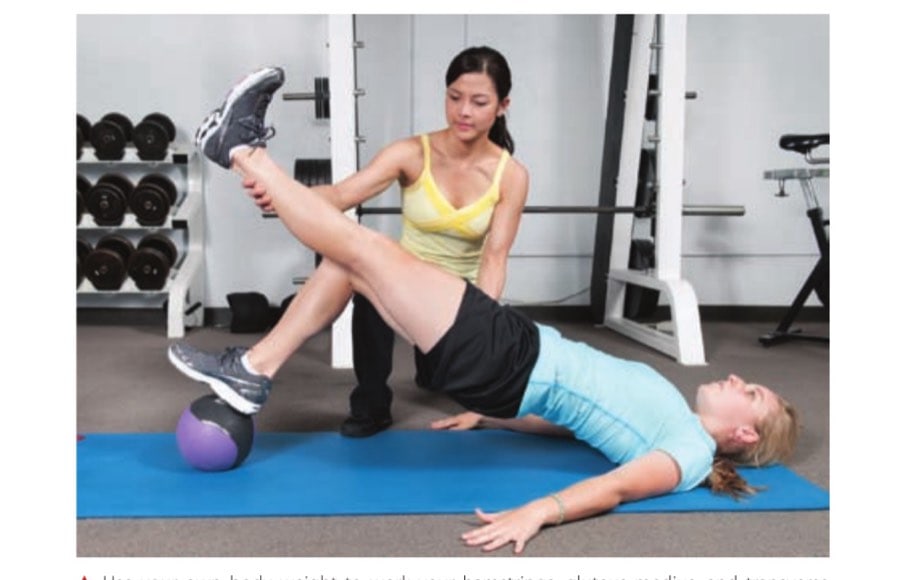
▲ Use your own body weight to work your hamstrings, gluteus medius, and transverse abdominis by doing one-legged hip raises with one foot on a medicine ball.
around the average gym training floor, you’ll rarely see more than 10 percent of the people actually doing an exercise at any given moment. Most people are sitting around waiting to recover from their last set. But after a minute or so, the weightlifter can get right back to work.
This kind of workout—lift, rest, lift, rest—can result in a long, slow workout. For bodybuilders or power lifters, it has to be this way, because they are striving to push their muscles as far as possible in their gym workouts in order to trigger major mass-building adaptations. But as a runner, you don’t need to push every major muscle so far; you just want to make sure all of them are strong enough to do their job adequately. For you, another approach is possible.
The human body is actually much like Noah’s ark, with everything laid out in pairs. For every moving muscle, there’s another muscle that opposes and supports it. Call these the agonist and antagonist. Whenever one muscle is working, its opposing number is resting.
This leads to a key insight: rest and work among different muscle groups can take place at the same time. If we alternate the body parts being worked, we can work out continuously, giving each muscle group a chance to rest while the opposing group is working, so no downtime is necessary. Even though some muscles might be tired, there are always others that are ready to go. Keeping busy by alternating the targeted muscle groups will cut 50 percent off your gym time. Twos are wild
Generally, two sets of an exercise deliver the best bang for your fitness buck. After two sets, you’ve achieved most of the stimulus your muscles need to improve. At that point, you would be better off doing a different exercise rather than pressing ahead for a third or fourth set. That’s because different exercises for the same muscle group work different cells within that muscle, so the greater variety of exercises that you do for a muscle, the more complete and balanced the muscle’s development will be.
The result of limiting the number of sets that you do will be not only a shorter overall workout but also a more effective one, as you won’t be consciously or subconsciously pacing yourself for set after set of an exercise. I tell my clients to work out as if the gym were about to close in 10 minutes—get in as much as you can as effectively and quickly as you can, and then leave. Watch your numbers
Fewer repetitions of high-resistance exercise trigger an increase in muscle mass and power, while more repetitions of less resistance help build muscle endurance and tone. As a runner, you should aim for a high-rep/low-resistance workout. Aim to do sets of 14 to 20 reps. If you don’t feel fatigued after 20 reps, it’s time to increase the resistance, but only enough to bring you to 14 reps.
Do complex movements instead of simple movements
Movement requires muscle work. For every joint to bend or straighten, some muscle contraction must be involved. The more joints you can get working in any exercise, the greater the number of muscles you’ll have called into action and the greater the impact of the exercise.
Thus, the most efficient workouts focus mostly on multijoint movements instead of single-joint movements. Aim to get as many joints involved in each exercise as possible. Choose cable rowing over simple barbell curls, and choose squats instead of leg extensions—not that there’s anything wrong with single-joint exercises that target single muscle groups, like doing arm curls to work biceps. But the point of this workout is to do what you need to do and get back out on the roads, so keep your exercises complex. Destabilize yourself
Try this: stand on one leg for 30 seconds and then switch. Now try it with your eyes closed. If you made it all the way through, you’re one of the very few who can. This simple test highlights the importance and effectiveness of your proprioceptors, the muscle-nerve connections that create an awareness of our bodies in space. When you put your body in an awkward position, proprioceptors make
ad
tiny adjustments to help the body maintain balance. This is what keeps you from falling flat on your face when you unexpectedly step on a crack in the sidewalk or a root on a trail. For runners, a strong network of proprioceptors is especially important. The entire running motion is spent either in the air or balanced on one foot. Even under the best terrain and weather conditions, this presents a formidable challenge to your body.
Balance exercises help prepare your body for this and help reduce the risk of a sprain, strain, or other injury. But the benefits of doing balance work go beyond your running goals. As you age, your ability to balance can decrease dramatically. This not only compromises your quality of life but also increases your chances of experiencing a debilitating fall. By getting in the habit of doing balance work, you can reduce your chances of having these problems later in life.
Any time you have to struggle to stay balanced, you work your core muscles. To get the most benefit from every exercise, then, look for ways to destabilize your base. If an exercise calls for you to sit or lie down on a bench, use a stability ball instead, if you can. If you’re supposed to stand during an exercise, stand on one leg for half the set and then switch to the other, or stand on either side of a BOSU. Be creative, and do whatever you can to safely shake things up. Add variety
The human body responds to any challenging exercise by improving its capacity to handle that kind of challenge. As a long-distance runner, you’ve already experienced this adaptation effect. But once the body makes those adaptations, little significant change will come from maintaining that same program. That isn’t to say that there’s no value to keeping a regular, predictable workout routine; after all, that’s the cornerstone of a healthy lifestyle. But if you want to improve or reduce the occurrence of injury, you need to break out of your routine.
This is especially true in strength training. The more you can vary the kinds of exercises that you do and the ways in which you do them, the more you’ll stimulate the body to resculpt itself into a leaner, stronger machine. So try to avoid doing the same workout two times in a row. Alternate the modes used—from body weight to free weights to cables to machines—and vary the number of sets and repetitions that you do, the resistance levels, and the order in which you do them. Keep the body guessing what you’ll be doing next, and you’ll not only have a more productive workout, but you’ll also have more fun doing it.
Where to go from here By now I hope I’ve persuaded you to give strength training a try. You understand how it will help you increase your fitness and achieve your racing goals, and you
know the principles you should apply when putting together a strength-training routine. Maybe you’ve even joined a gym or set aside an open space in your home with some basic equipment and have carved out a little time in your schedule to add a strength-training routine. Now what? Do what you know
If I were asked to sum up the key to effective strength training in one short sentence, it would be to make sure you are challenging yourself while doing exercises correctly. This assumes that you know what that correct way is. In a gym, many workout stations come with information displays explaining how the machines are to be used and which muscles they work. That’s a good place to start. But if you’re unsure about how to do something, then don’t do it. This program is supposed to be about getting healthier and stronger, not about finding new ways to get injured.
A basic place to start is to alternate pushing, pulling, and twisting exercises, which will help you stick to your goal of alternating body parts. Pushing exercises will work your chest, shoulders, and triceps, while pulling exercises will work your lats, rhomboids, and biceps. Twisting will work your hips, transverse abdominus, and obliques and, depending on which exercises you choose to do, the erector spinae and other muscles of the core. Invest in your education
If you’re not familiar with workout equipment or particular exercises, consider hiring a personal trainer to show you the ropes. Spending money on a trainer is usually cheaper in the long run than spending it on doctors, and even if you’re familiar with many exercises already, a trainer can expand your repertoire and check your form.
To find a good trainer, rely first on word of mouth, since nothing beats a personal recommendation. Ask about certifications and experience; most trainers have undergone formal instruction and testing and should be happy to tell you about it.
Finally, if you’re interested in learning more about the program I propose here, be sure to look for my forthcoming book (out this fall), Smart Training: How to Run Your Best Without Running Yourself Ragged (Velo Press).
Now it’s up to you If I’ve held up my end of our bargain, it’s time for you to hold up yours. Get into the gym, and become the runner you were meant to be.
This article originally appeared in Marathon & Beyond, Vol. 15, No. 3 (2011).
← Browse the full M&B ArchiveMore like this
1,000+ stories from 19 years of Marathon & Beyond
The complete archive of the legendary long-distance journal — digitized and free to read.
