

How Runners Talk
I WATCH runners, and I listen to runners. I go to races, too, mostly because one of my children is running that day. I’ve had a child, at least one child, in the race for almost 10 years now. I also go to races because after all these years of watching, I don’t want to stay away.
I love to see packs of runners moving across worn courses, lines of solitary runners moving through dense rolls of early-morning fog. Sometimes I photograph the runners, their bodies dripping with effort, etched against blurred trees and lines of spectators.
I’ve learned certain things about the race after all these years. I’ve learned that the faces at races never change. The race never changes either. I’m not a runner. I’m a mother who thinks a lot about the race. I watch runners, and I listen to runners talk.
* * *
Every race tells the same story. The race is drama. The audience wants a hero. Today they are the heroes. The coach asks me to take the team picture. The eight young men, smiling in their pristine navy-and-white Reebok warm-ups, proudly hold up the plaque that proclaims them central Illinois’s Regional Cross-Country Champions for 1999. They are 15, 16, 17 years old. My youngest son is the captain, and he led the team today, placing third overall.
The coach, a 6’4″ former football player, is emotional, humbled, moved almost to tears by the team’s performance. “I can hardly talk,” he admits. His eyes are moist. His voice is close to breaking as he speaks to the parents gathered around the team. “I think we really have a shot at going to State.” He almost whispers this last part. To say it too loud might tempt the running gods. He hasn’t taken a team to State in nine years.
Last week’s conference race was a different story, a tragedy in the all-or-nothing world of the race. The team placed third overall. Times were lousy. My son was sick the day before the race, and he lost his confidence, worrying himself into an 11th-place finish. The rest of the team picked up on his self-doubt. The coach was merciless after the race, calling them “gutless.”
There was no trophy last week. The boys were angry and ashamed. No one wanted a team photo. No one wanted to remember the day they were losers.
* * *
This is how runners talk.
“You can do it. You’re the smartest kid out there,” my oldest son tells my youngest son. My oldest son is a runner, too. It’s the race postmortem. Every race has this dissection.
“Whoever wins at State is the guy who has the best head on his shoulders that day. Write on a piece of paper: I believe in myself. Over and over. Hang it up. Just look at it. You’ve got to internalize this. You. For yourself.
“Remember that article in the paper last week about Peterson from South High saying he wasn’t ready for the race because he was thinking about homecoming? What a jerk! More than looking like a jackass, that comment tells you he doesn’t have a head. Peterson—you’ve got him in the head. Chew him up and spit him out like a bad habit.
“You can be a stud if you want to. People will forfeit to you at the starting line. You’ve got the capability of being a monster. A monster. You can be a monster. Just stop being a head case. At the end of the race, whose head is on?”
* * *
“I thought he was toast,” my younger son said. He figured he had second place nailed down, thought he had overtaken the runner in red. Said he didn’t realize that just yards short of the finish line when the crowd was going wild, the red runner had come back and was closing in on him, determined to reclaim his second place. “They tell you a runner shouldn’t look back. So I didn’t know he was coming. I thought he was toast.“
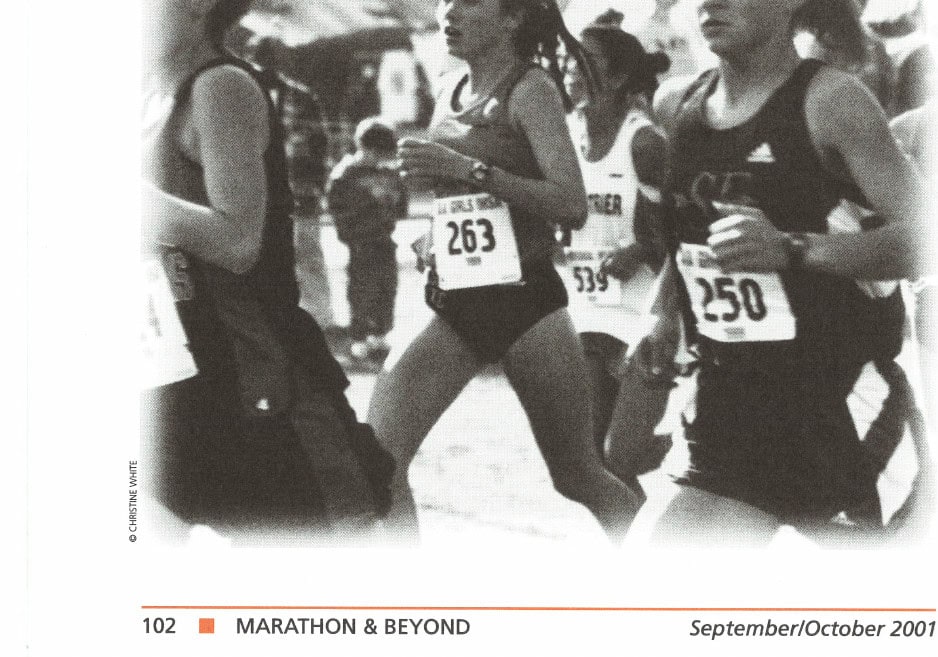
When my oldest son started running 10 years ago, I stayed on the race sidelines and tried not to get too close to the runners. I couldn’t stand to see their exhaustion and the pain of it all. I used to cry as I saw the runners come into the final stretch. The runners were staggering and vomiting, sometimes fainting. The spectacle of this all-out effort frightened me. I had never seen races before.
* * *
Often I arrive at the racecourse early, before the crowds gather. My mind races in the silence. The teams warming up are a panoply of color: red and white runners to the east, purple runners ahead of me, white to my left at the one-mile mark. Officials string rope along the entrance to the chute and hang flags to mark the beginning of the final stretch.
Going to the race helps me orient myself and analyze the course and direction of my life’s race. I have to figure out my splits. If I live to be 80, I’m at about the two-mile mark today. Now that all the runners I have raised are grown, how do I approach mile three? What should my strategy be? How do I use my experience when younger runners have much more vigor? Where do I want to be at the finish?
With each race, the run in my head is different. But the runners are always here: red, purple, white.
* * *
Even high school racers sport an entourage of parents, friends, well-wishers. Mothers carry the Gatorade and usually hang with other mothers. Mothers take pictures of the team once the race is over. Most mothers aren’t comfortable with the race, it seems to me. The mothers’ faces are tense, and they don’t talk much about race strategy.
Mothers say, the doctor thinks she has a stress fracture and do you think this rain is going to turn to sleet? Someone might slip if the course gets icy and that poor girl with that asthma cough—she just fell down and had to crawl to the side of the course. Mothers don’t look the runners straight in the face. Mothers don’t like to hug their sons when at the race’s end, the boys are glistening with sweat and stumble out of the chute, drooling and panting like heat-crazed dogs.
Even if they understand the race, most mothers, at heart, don’t want their children to run this hard.
Fathers take races very seriously. Fathers look grim during races. Fathers want their kids to win or at least make a PR. Fathers hate to see their sons give up or succumb to pain. Don’t quit, they warn. Fathers don’t cut boys any slack, especially if the fathers themselves were runners once. If sons have a bad race, fathers say things like he disgraced himself out there today. He fucking gave up.
I’ve never heard a father say that about his daughter, though. Fathers are dazzled by the sight of their girls running the race. Good job, they yell. You can
do it! You can do it! Nice run, they say after the race to their girls. Even if the girl comes in last, the father will smile and say, nice run.
* * *
Aristotle defined motion as “the mode in which the future belongs to the present . . . the joint presence of potentiality and actuality.” Surely he was describing a cross-country race.
On this late fall morning, the trees drizzle their orange and yellow leaves onto the racecourse as streams of young men and women surge and fall back, enacting an ancient ritual that has as much to do with time, and time running out, as it does with the time it takes a runner to finish the race.
The race is called by the elders, and the elders have come, as they always do, lining the course in an attempt to push age back one more day. In the passing runners, the spectators see themselves again, young and strong and swift, an apparition conjured up for this moment.
Spectators press around the runners before the race, wanting—no, needing—to make some contact. Good luck, they say. Messages are delivered. Aunt Mary couldn’t make it but she says good luck. It reminds me of some medieval spectacle like the Palio in Siena, where riders on horseback race around the plaza. Each rider carries the colors of his family. He races his horse for all of them, just as these runners race for all the well-wishers who pat their shoulders and say good luck.
Everyone’s a coach. Everyone thinks he knows what it takes to win the race. The runners tear by, and spectators scream out advice.
“Know where you’re goin’! Know where you’re GOIN’!” someone lugging a camera tells a stream of girls who are close to the one-mile mark. “Reel ’em in!” a fat man calls to the lead runner. The metaphor dangles like an empty fishing line. Who’s the fisherman at a race, I wonder?
“Keep your focus! Keep your fo-CUSS!” yells a real coach to his team’s lead runner.
I run back and forth across the field, trying to meet my son several times on his loop around the park. My son is starting to tire. I can see it in the droop of his upper body.
“Arms! Arms!” I yell. “Work those ARMS!”
I hear myself and wonder what I’ve become. Or what part of me the race has revealed.
* * *
I see in the race my struggle as a mother. I want my kids to be winners, in all that term naively suggests, but I don’t want them to know the pain or self-doubt or frequent defeat that inescapably mingles with their occasional victories.
My children race by me, and I fear I’ve tossed them away, thrown them too soon to a crowd that values them only by the minutes and seconds of their time for that day’s race. I stifle a cry when a runner stumbles, or worse, falls down, hoping that my encouragement of the race doesn’t put my children in danger. They’re too young, I decide, to be left alone to strategize in the midst of all this running fury.
But then my son surges into second place, intent on overtaking the lead runner, and I realize I’m in this race, too, counting my own minutes and seconds, and I yell, “Run faster! You can take him! Dammit! Run faster!”
Another mother, whose son is new to racing, said to me last week, “I love to watch you at races.”
I had never known a woman professional runner before I met Lorraine Moller. Running had been Lorraine’s life for over 25 years. One of the outstanding New Zealand runners who emerged in the 1960s, Lorraine ran in all four Olympic women’s marathons between 1984 and 1996 and won a bronze medal in Barcelona in 1992, even though she was the oldest entrant in the field.
I’m a few years older than Lorraine; she says she never allowed age to be a factor in her races. I asked Lorraine how she became a runner, wondering what she knows that I must learn for myself.
“Running was my destiny. I didn’t plan it. As a young girl there was little support for women runners. Girls were limited to short distances like the 60-meter dash. My teachers told me that if I did too much running, I would become masculine, like the Russian women athletes. Others warned me that if I ran too far, my uterus might fall out. I imagined something slippery would fall onto the ground one day, and I would say, ‘Oh, what was that?'”
* * *
Only serious lightning will cancel a race. Otherwise, the race doesn’t slow down or stop for weather. Once I went to a race in the fog. Heavy gray-white clouds hung over the racecourse. The park’s towering pine trees peeked out here and there. The runners had to keep each other in sight or they would lose their direction. Packs of runners, coming and going through the mist. Someone rang a cow bell to help the runners stay on track.
* * *
The lines of disappearing young runners are not a vision unique to me and to my time and place. Willa Cather writes in Death Comes for the Archbishop of seeing Pueblo runners in the desert. “They coursed over the sand with the fleetness of young antelope, their bodies disappearing and reappearing among the sand dunes like the shadows that eagles cast in their strong, unhurried flight.”
Running is as ancient as the sand in Cather’s dunes. Myths tell us how running affected the cosmos, that the Sun once ran. Running became a link between man’s world and the spirit world. For some ancient peoples, running meant even more. Running meant participating in the motion that is the life force itself.
Myths also tell how the gods and animals were the first runners. The gods told the people to run. Races decided the characteristics of animals and helped decide an animal’s status in the world. Hawk won the determining race in Cheyenne mythology, and after that, the bravest Cheyenne warriors were named Hawk soldiers.
Is it coincidence or conspiracy that today, as the teams gather in the box area, a red-tailed hawk swoops over and watches from a nearby tree? The tree’s branches are bare, so I see Hawk clearly, watching the race, issuing his challenge, bestowing his blessing.
* * *
This is how runners talk.
“It’s always that push to become more, the life force expressing itself.” Lorraine says that’s why runners are willing to race. “I chose never to look at my races in terms of success or failure. I went back to the race week after week and learned something about myself. So no matter what I did, I could always walk away feeling that I had done something rather than having done nothing.”
Doing something rather than nothing. That answers my question. I used to shake my head at the hopeless cases, the ones who came back week after week, the out-of-shape flopping stragglers at the end of the pack, the ones getting lapped, who know they’ll never win, and I used to think to myself, Why are you doing this?
* * *
Some people define themselves through running. Their whole identity comes from the race. But sometimes a person goes beyond self as runner and assumes a second identity who, in turn, becomes a runner.
I’ve watched a man who, by some ripple of fate, looks just like rock star Rod Stewart. He has a long blond mane, Rod Stewart’s nose. He wore an earring before most men here wore earrings. Some say he speaks in a British accent. The local Rod runs. He enters the citywide races, and dressed in a red, white, and blue singlet and shorts that sport the British Union Jack, he races through the downtown and along the riverfront as Rod Stewart. Rod Stewart racing.
Rod was watching the high school race today, and I hung out near him. He was talking to another man about his job and then about today’s race. There was no accent, just bright yellow hair and that look-alike face. The race has changed his life, I think, and watching him has changed me. I admire the imagination of this man, this runner cum rock star. I love his bravura. His glitter. The race needs more runners like him.
* * *
The race simplifies and clarifies things. A few weeks ago, my son had a very good race, and afterward a newspaper reporter asked him what he had learned from his previous race that helped him win this race. “I learned I had to run faster,” he answered.
She dutifully wrote that down and quoted him in the paper the next day.
* * *
In some traditions, the qualities of a strong runner—strength for long distances, spurts for shorter distances, breath control, transcending self—are learned by observing the animals, stars, and other natural elements like the wind. The lessons from these natural elements bring a runner victory. “For the tree, the wind is a reminder to get exercise,” say the Pueblo. And from the Arapaho: “Our Father, the Whirlwind, by its aid I am running swiftly.”
* * *
Some of my friends think races are boring, but how could it be boring to watch someone run three miles in 14:20? I wonder if I could have gotten that good at something, maybe writing, if I had concentrated on writing as doggedly as the best of these runners have committed themselves to the race. I never concentrated on only one thing. I was sidetracked with diapers and carpools and trying to match up my runners’ tube socks. I didn’t hear the starter’s gun. I see my children racing and watch my dreams and faded ambitions pass by. These runners, I think, have run away with my dreams.
Sometimes I dream about the race. In one dream, I’m running and I finally win, but there’s no tape at the finish line. I hear that sometimes happens. What then, if there’s no tape? Do I keep running? Who says when the race is over, anyway?
My other dream about the race—well, maybe I can play this scene out some day when I’m awake. The race is over, and the crowd is cheering. I walk up to accept my award, and I look out over all the spectators and think, “Today it’s my turn. I won!”
* * *
I’m drawn to the race. At the same time, I shrink back. Lorraine studies mythology and believes that Hera, the archetype of woman as mother, and Artemis, the archetype of woman as athlete, are struggling inside me. The attraction I feel for the race, she says, is really a calling for me to find those qualities within myself.
“When an archetype comes into your life, when a god or a goddess enters your life, you can’t ignore it,” she told me one day over breakfast. “The gods are much greater than you. If you’re in the clutches of Artemis, you’ve got to go with it.”
* * *
As I watch the girls who race, I remember that the Navajo, who have a long tradition of running, encourage their young girls to run and have built running into the Navajo girl’s puberty ceremony called Kinaalda. The massaging and running parts of the ceremony are meant to symbolically bring strength and beauty to the young woman, who begins her ceremonial runs just as dawn breaks the night’s darkness. The length of her runs, it is said, determines how long she will live. Songs encourage the girl as she runs. One song’s refrain is this: “The breeze coming from her as she runs is beautiful.”
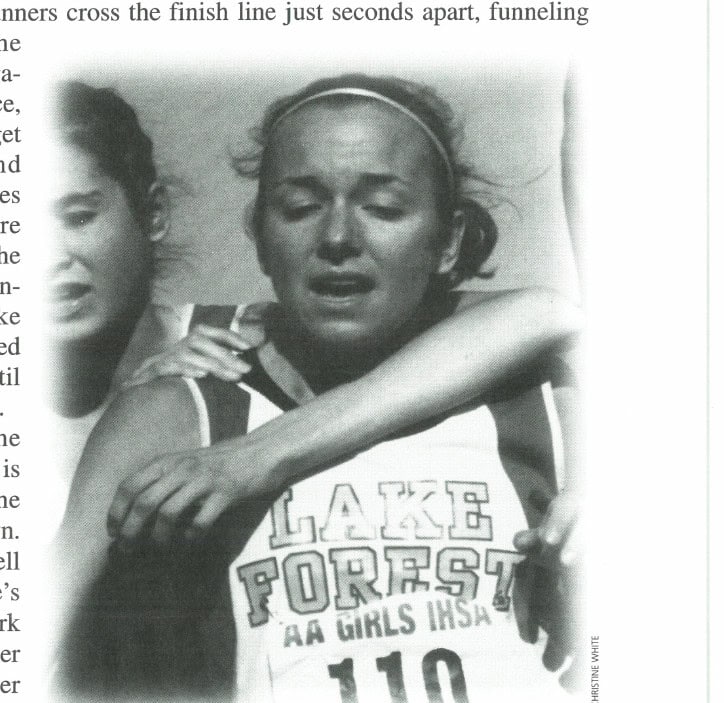
The race changes how we perceive beauty. I listen to three men who are intently following the AA Girls State Cross-Country race. The lead girls are just finishing and are staggering through the chute. The girls are sick from their efforts. The men watch.
“I love it when girls spit,” one man says.
If I run east, away from the sun, could I outrun my shadow? This is my koan.
* * *
Are we running toward the light or away from darkness? A famous triathlete hoots when I tell her that I admire runners.
“They’re all psychopaths!” she insists. Then, thinking perhaps she has overstated her point, she recants. “You have to be at least a little crazy to race. I think we’re all trying to prove something or win someone’s approval.”
* * *
There is a mystique about the race. Conventional wisdom says that the race peels away the shallow layers of personality that hide who we really are. The race itself is supposed to be a clean-cut, unsullied affair. That’s part of its appeal, this chance for men and women of virtue to come together and test themselves. But the race doesn’t always escape the fray.
Several weeks ago, as I was waiting for the race results to be announced, two men, both spectators, got involved in a shouting match.
“Fucking wife beater! He’s a fucking wife beater!” screamed the first man as a woman pulled on his jacket and tried to move him through the crowd. “He’s not supposed to be here!”
The second man was quick to respond. “I’m allowed to watch my daughter race!”
For an instant the crowd was silent, stunned by this ugly intrusion.
Several coaches moved in. The principal of the sponsoring school stepped between the men.
“You can’t talk like that in front of these kids,” the principal said. “We’re trying to have an awards ceremony here.”
* * *
The next week, at the end of the junior varsity race, I overheard one runner say this to the boy ahead of him in the chute. “Am I that much better than you that you had to cheat? I’ll get you back. I have your number. I know who you are.”
* * *
I always make sure I can see the runners kick in the final stretch. Some have a strong kick, and others have used up all their energy and have nothing left to kick with. That’s something I don’t understand. Some runners who are way back in the pack, maybe in the last third even, all of a sudden come on with this huge kick as they approach the chute.
If a runner has all that energy still inside, why doesn’t he run faster in the first place? Is there really such a big difference between 47th and 50th place? Is the kick just for show?
A friend of mine who runs every day, a woman in middle age, says her kick means this: “I can do a lot of shit; and I’m not dead yet.”
* * *
Here’s a story about Billy Mills. Billy Mills is a Sioux who when he finally decided to commit himself to his running, was incredible. I met him once, several years ago, and I’ve never forgotten him. I was surprised that a runner of his ferocity could be, off the course, so gentle and soft-spoken.
Mills said he was willing to take risks in his distance running, and he proved it the day he won the 10,000 meters at the 1964 Tokyo Olympics with a 46-second PR. He tore down the final stretch. Mills’s win was so unexpected that when he came through the finish line, a Japanese official asked him, “Who are you?”
Picture that: You win at the Olympics and they ask, “Who are you? Who are you?“
What does it mean to win the race and have people ask, “Who are you?” Does it mean you’ve lived your life saving so much of your energy for the kick that your ability and talent are unknown and largely untapped? Or does it mean that you’ve finally, finally found the determination to become a monster, to pull out nonstop everything inside you for one magnificent run?
Could be either, I suppose. Or both.
There are monsters everywhere in the race. The stream of runners, winding along the course, writhes at times like a brightly colored serpent. The runners together are a thundering herd, a force of destruction that tears up the landscape. The really determined runners are monstrous in their attack, methodically planning, picking the weaker ones off one by one.
The inspired runners might imagine themselves pursued by the fire breath of dragons—they pass me that fast. What monsters are in their heads? Do they still fear lions and bears under their beds?
Muslims say this about the Angel of Death, who just might be chasing the runners now, the lead runner is flying so. “When the Angel of Death approaches, he is terrible. When he reaches you, it is bliss.”
* * *
I’m a chute runner today. I run ahead of a group of girls who have just entered the chute, the organized exit path for runners who have crossed the finish line. Since runners cross the finish line just seconds apart, funneling runners through the chute brings an organized finish to the race, making it easier to get accurate times and placings. If the chutes back up, runners are delayed in crossing the finish line. Chute runners, volunteers like me, keep the exhausted runners moving until they leave the chute.
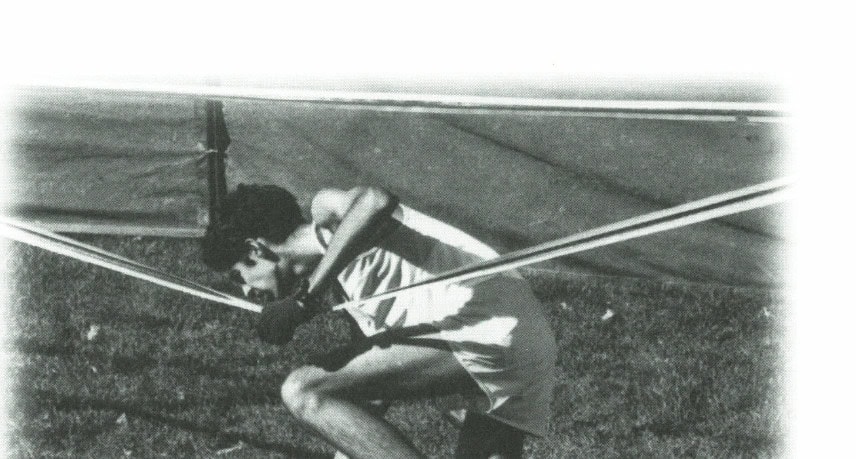
Number 222, the winner of the race, is the first girl into the chute. She slows down. I wave her ahead, tell her to follow me. She’s tall and thin. Her dark hair clings wildly to her damp ashen face. Her head cocks to one side, and her arms grab the clothesline chute ropes for support. Her brain tells her the race is over, and her legs quit moving.
Runners fall against number 222 from behind. Everyone’s cramping up. The first girl’s knees are now buckling, but she keeps staggering toward me.
“If you’re cramping, raise your arms. Just keep moving!” someone yells. Runners are bending over, gagging and retching.
“Soup’s up today,” one official says under his breath.
Number 222 is almost sitting down.
“Get her out! Get her out!“
I grab her arms and push number 222 under the ropes and out of the chute before she becomes total dead weight, ripping her number from her singlet as I drop her to the ground. Then I take her place in the chute, running with her number, as I lead the girls through.
At the end of the chute, I turn in the winning girl’s number. She watches me from her spot on the grass next to the chute.
“I’m 222,” I tell the mother collecting numbers.
* * *
I’m drawn to runners’ pained faces with their glazed eyes that see nothing but the course ahead. When questioned about the agonized look on his face while he raced, Emil Zatopek, the Czech runner who won three gold medals at the 1952 Helsinki Olympics, answered, “It is not gymnastics or ice skating, you know.”
I think it was Dostoevsky who said that suffering is the sole origin of consciousness. He probably would have made a good runner.
* * *
It’s the pain that gets you in a race even though pain, and working through it, is the key to being a faster runner. This is how my racing sons talk about pain:
“They hurt just as much as you hurt in the second mile! The kid who was 120th hurt just as much as you.” My older son was talking again to his brother. “What’s the difference? How you react.
“You know what it feels like in the mile when your legs get heavy and there’s a burn in your thighs and the burn works up your legs. You have to figure out the third mile. You haven’t proved to yourself that you can do it. You’ve just got to run through it, man, and once you’ve got through it, it will never bother you like that again.”
At races, I can’t stay away from the finish line. All kinds of people wait at the finish line. Once I saw a woman reading a book there. She was oblivious to the race and the cheering and the exhausted runners. She just kept reading her book.
This season there’s been a woman in a wheelchair at every race’s finish. She must have a son in the race. She slumps down in the wheelchair, but her eyes
follow the finish carefully. She doesn’t cheer, but I sense she knows exactly what the race is all about. She doesn’t read a book at the finish line.
* * *
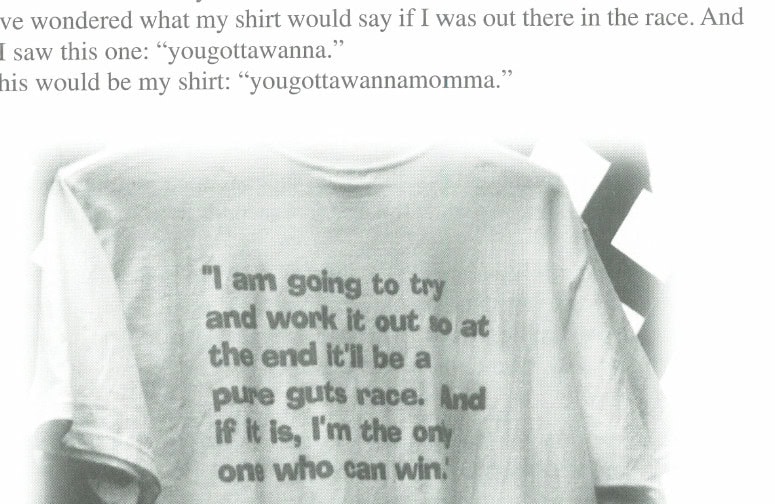
I love the shirts with sayings on the back that runners wear: “If you’re not the lead dog, the scenery never changes.” “No limits.” “It’s rude to count the people you pass—out loud.” Some girls told me their favorite was “We work ours off so we can kick yours.”
I’ve wondered what my shirt would say if I was out there in the race. And then I saw this one: “yougottawanna.”
This would be my shirt: “yougottawannamomma.”
* * *
I tell my older son that I’m writing about running and about racing. He doesn’t understand that I’m really writing about my soul, so he’s skeptical, almost derisive in the way a 22-year-old can be. He thinks he knows all about the race just because he’s been there, winning over and over.
“You’ve never run a race in your life,” he tells me. “What do you know about racing? You’re not an athlete.”
I say, “But that’s the point. That’s what I’m writing about. There are many races out there, many ways to run.”
He thinks about this for a few seconds.
“No,” he responds. “There is only the race.”
This is how runners talk.
The race is like truth serum. The race tests you to the core of your intent. That’s what racing legend Mark Allen believes, according to a 1998 interview in Triathlete magazine. Allen won the Hawaii Ironman triathlon six times, the last time in 1995, and speaks of the race and what it takes to win in almost spiritual terms. In his final Ironman, Allen prepared himself on every possible level, but at the crucial moment, pursued by the much younger Thomas Hellreigel, he almost gave up.
“But then I realized . . . I was holding back, just a little bit, because I wanted . . . essentially I wanted some billboard to come out of the lava and say, ‘If you give 100 percent, you will catch Hellreigel, and you will win.’
“It was like a safety valve. If I gave only 97 percent, I could say, ‘Well, if I don’t catch him, I probably could have done it.’ One thing was certain: If I didn’t give it 100 percent, I definitely wasn’t going to win. And I knew that I had to give 100 percent and that there was no guarantee. It might mean that I catch him, it might mean that he finishes five seconds in front of me, but that’s what I had to do.”
Every race is really a leap into the unknown, which makes the racer a very brave thing. When you stand on the line, you put it on the line. Literally. The race becomes a learning school. At least that’s one way to look at it. Otherwise, it all seems so silly. Lorraine told me this.
* * *
If the race is really a learning school for life, then a runner must surrender to the race and understand one fundamental thing:
“The race doesn’t really give a damn if you’re a lawyer or a bricklayer . . . or if you didn’t get enough sleep. The race doesn’t care,” says Allen. “The race is there to be finished.”
The race is always greater than the runner. The runner must believe in the race as a process. “You can do what you can do, but you also trust that the universe is conspiring to teach you what you need to know,” says Lorraine. The race requires runners to walk the line between fear and desire.
This is how runners talk.
“You can be a stud if you want to. People will forfeit to you at the starting line. You’ve got the capability of being a monster. A monster. You can be a monster. Just stop being a head case. At the end of the race, whose head is on?”
table” accounts by the same author of the same race—and the guy hasn’t even finished it yet.
But how can you have a “most unforgettable ultramarathon” twice, you ask? Can you, for example, partially forget some of a race so the second time the rest of the race is more memorable? Or can you remember a race unforgettably in one way one year and then come back a year later having forgotten most everything you thought you remembered to do better the next time—only then to discover your previous experience didn’t prepare you anyway because now you’re running the course backward?
Is that twice memorable, or what? In any case, it’s what happened to me.
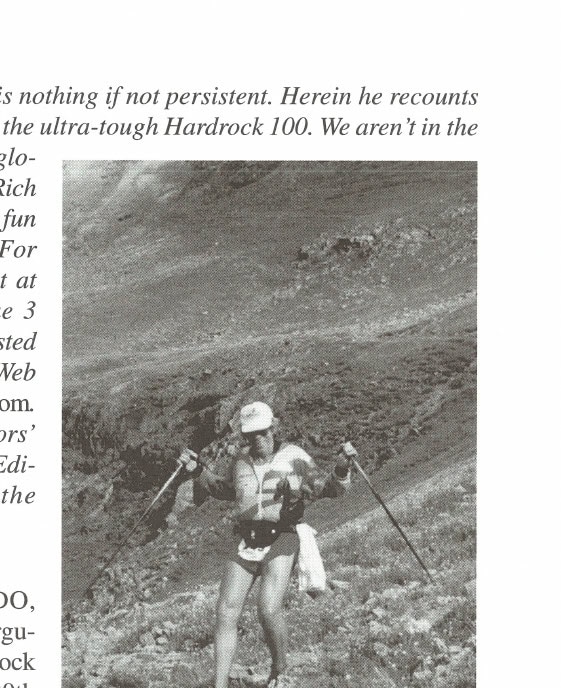
The Hardrock 100-Mile Endurance Run, high atop the San Juan Range of the Rocky Mountains in southwestern Colorado, is like that. If you’re going to attempt it, you will be breaking new ground. And if you’re a magazine planning to publish one story once about the experience, you’d better think twice. Many, if not most, ultrarunners cannot finish Hardrock their first time, so how could any self-respecting ultrawriter cover his experience in a single article? Well, it can’t be done; besides, my first piece covered only half the course. So, read on for my searing, brain-branded memories of the second half.
EVERYTHING YOU KNOW IS WRONG
Last time, if you’ll recall, I solemnly assured everyone hoping to finish Hardrock that hiking poles and crampons are absolutely necessary. (Crampons, for the uninitiated, are strap-on spikes.) Well, that’s what I thought then, but as it turns out, everything I thought I knew was wrong.
As example #1, when I showed up at Charlie Thorn’s house in Silverton to volunteer for his trail-marking “army,” everyone asked what I had in my backpack. They died laughing when I told them. “You won’t need crampons this year!” they roared. “There’s no snow!”
But, hold on. On the trail-marking expedition just before raceday, I was privileged to meet and befriend a wonderful gentleman and ultrarunner by the name of Hans-Dieter Weisshaar (who in 2000, by the way, broke Jose Wilkie’s record for the number of 100-milers finished in one year). Hans is from Germany, where he surely hikes the snow-covered Alps, so of course he knows about crampons. Indeed, when our little army finally arrived at the base of Virginius Pass, the steepest ice-wall climb of this race (and perhaps of any other race), I righteously took note when Hans sat down to strap on his crampons. But, just as I was about to point this out to all who had laughed, Hans said, “You really won’t need these for a little climb like this, Rich. I’m just putting these on because you brought yours.”
Didn’t I say he was a gentleman?
As example #2, I had thought I’d be doing this race with my Illinois coach and mentor, Chuck Bundy. Chuck—who, by the way, is a bona fide hero, as he was a frogman (now called a Navy Seal) and Korean War vet—and I had planned for a year that we would make this second assault on Hardrock together. (He too had DNF’d the first time.) But right before we were to leave, Chuck was hit with an emergency and could not make the trip.
In my moment of greatest need, Larry Ridgeway came to the rescue, fetching me at Denver’s airport and driving me to Silverton, where we camped in the RV park by the riverside. Larry, incidentally, is another hero, and not just for helping me. He’s a Vietnam vet who got his start rescuing people by piloting choppers for the Marine Corps. I told him he probably saved the life of one of my old high school buddies over there.
But even after I laid on the flattery, Larry still had the nerve to laugh at me and my crampons.
I tell you all this because, number one, you should ignore Hans and Larry and everyone else and go out and buy yourself some crampons. Number two, if you do show up for Hardrock, you should know the caliber of folks you’re likely to meet. These people really are heroes.
I learned something else from Ginny LaForme that I had all wrong in my first article. I had theorized that all the red I saw in the butt-slide chute on Virginius Pass was blood scraped from the exposed skin of runners in front of me. But Ginny (who well deserves her nickname “Mom”) set me straight.
“Nah,” she said. “It’s red algae. It grows in the snow here.”
ONCE ATTENDED, TWICE BEFRIENDED
You cannot enter, prepare for, travel to, endure, and return from an epic event like the Hardrock Hundred without making a whole valley full of new friends. This is one reason why it’s getting tougher and tougher for newcomers to get in. Hardrock’s “clan” is the first to fill out the paperwork and lick their stamps. It’s not so much a race or a war or a test of survival as it is a family reunion.
If so, Carolyn Erdman must be the matriarch. She did, in fact, receive the 1999 “Mother Lode” award, which the race booklet tells you is the highest award the Hardrock gives. The booklet also says, “Carolyn has welcomed many a runner to the San Juans. Her enthusiasm and caring spirit epitomize what ultrarunning is all about.”
Of course, you wouldn’t expect the booklet to mention that she and her husband Eric have a home there, that he is one of the standout local theater actors, and that Carolyn was the first person Larry and I looked up when we got to town. The booklet also neglects to disclose that Carolyn promised me a great big hug at the finish line (if we both finished the race).
This article originally appeared in Marathon & Beyond, Vol. 5, No. 5 (2001).
← Browse the full M&B ArchiveMore like this
1,000+ stories from 19 years of Marathon & Beyond
The complete archive of the legendary long-distance journal — digitized and free to read.
