

How to Better Televise a Marathon
Ithink it was right about the time that Olympic gold medalist Sammy Wanjiru was bursting through the tunnel leading into the Bird’s Nest that I was pretty much hitting the wall. No, I wasn’t competing in the men’s marathon at the 2008 Beijing Games and, no, I wasn’t operating on depleted energy stores (although, after sitting through about 496 hours of Olympics television coverage, it sure felt like it). But I was, in fact, hitting the wall—with my fist, I mean.
They come along only once every four years, the Olympics, and it’s inevitable that those in charge of televising the men’s and women’s marathons muck it up. The good news for fans of distance running was that both races were pretty much covered in their entirety and during valuable, prime time coverage to boot. But the bad news was that NBC again wasted a perfectly good opportunity not only to educate the general public about the allure of this unique sport but also to help inspire young runners back in the United States to one day want to become marathon champions.
To be fair, it isn’t just the peacock network that seems to botch these things, and it’s not just the Olympic Games marathon that receives poor coverage. I find myself losing interest just about every time I watch a live marathon telecast, whether it’s from Boston, London, or New York. And that’s me—a tremendous supporter of the sport. I can only imagine how those who know nothing about this stuff must feel.
So in the interests of doing my small part in helping to push the sport forward, I’ve prepared a list of suggestions for Dick Ebersol, chairman of NBC Universal Sports & Olympics, and any other television producer or executive in charge of putting these marathon telecasts together. The list, from my perspective, is in order of relevance; readers may feel otherwise. And while some of these ideas may be easier to implement than others, I’m convinced that adopting any of them would greatly enhance the marathon viewing experience.
Country: Age: Height: Weight: Coach:
Samuel Kamau WANJIRU
© Victah/ www.PhotoRun.net
© Victah/ www.PhotoRun.net
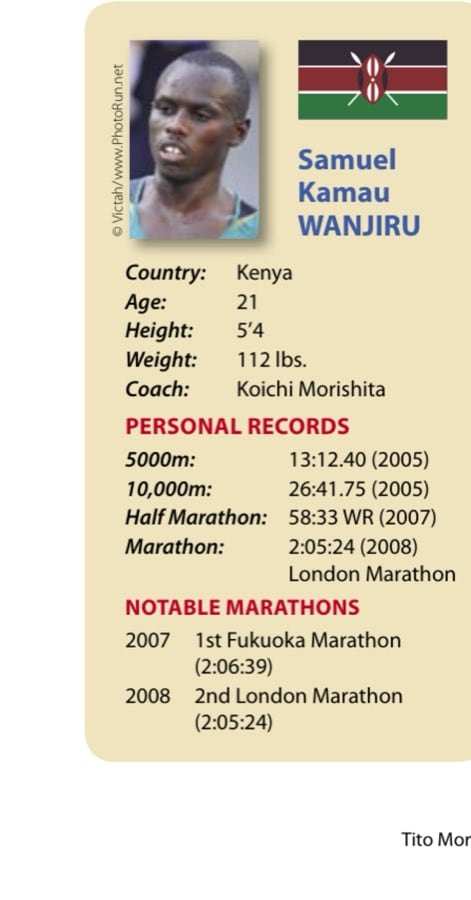
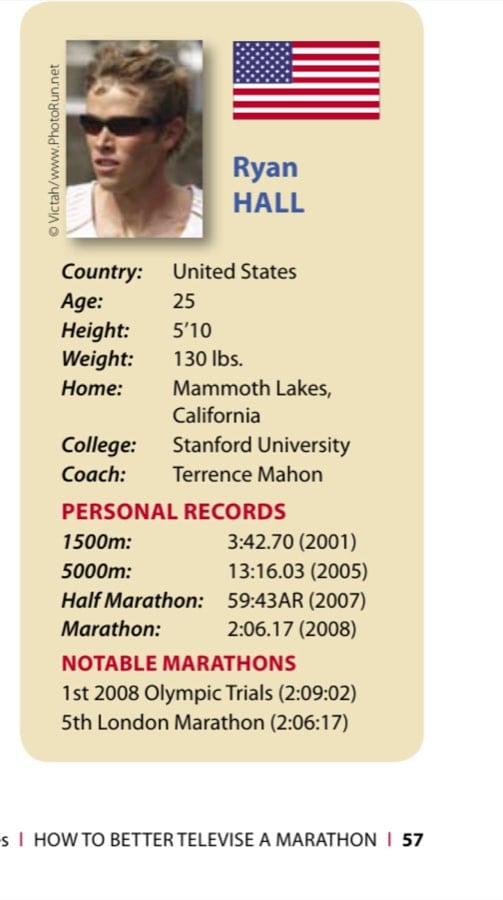
1. Create Athlete Profiles. Imagine watching a televised golf tournament and, aside from Tiger Woods, not being able to distinguish one player from another. That’s essentially what marathon television viewers are being asked to do. These races pretty much always unfold the same way. A group of leaders breaks away from the main field and then, one by one, the runners in that group fall off the pace until the champion crosses the line first. In most major marathons, the lead group, which almost always consists of several athletes, remains intact for a lengthy period of time. In the women’s marathon in Beijing, for instance, a group of a dozen women ran together for over an hour. Aside from Paula Radcliffe, Catherine Ndereba, and Constantina Tomescu-Dita, though, broadcasters made little or no attempt to identify the remainder of the runners. In the men’s race, a similar group of eight runners ran tightly together through the first 10 kilometers. Again, not enough of an effort was made to inform the audience of these runners’ identities.
It wouldn’t take much for a graphic arts team to compile a collection of profiles such as the two below. Each of the prerace favorites should have one of these thumbnail sketches, as should all of our highest-seeded American runners (more
Ryan Hall
Country: Age: Height: Weight: Home:
Kenya 21 5’4 112 lbs. Koichi Morishita
Personal Records 5000m: 13:12.40 (2005) 10,000m: 26:41.75 (2005) Half Marathon: 58:33 WR (2007) Marathon: 2:05:24 (2008) London Marathon Notable Marathons 2007 1st Fukuoka Marathon (2:06:39) 2008 2nd London Marathon (2:05:24)
United States 25 5’10 130 lbs. Mammoth Lakes, California College: Stanford University Coach: Terrence Mahon
Personal Records 1500m: 5000m: Half Marathon: Marathon:
3:42.70 (2001) 13:16.03 (2005) 59:43AR (2007) 2:06.17 (2008)
Notable Marathons 1st 2008 Olympic Trials (2:09:02) 5th London Marathon (2:06:17)
on these folks later). Additionally, borrowing a page from coverage of the Ironman World Triathlon Championship, all big-city marathons should include at least one profile (and story line) involving a middle-of-the-pack runner. It could be someone trying to complete a first marathon or someone trying to reach a Boston qualifier after many previous attempts. Featuring a nonelite or two will paint the marathon with broader brush strokes. Quite simply, broadcasters should be doing a much better job of setting up the athletes’ story lines and then sticking with them.
Progress along these lines was made at the 2009 ING New York City Marathon where six female and male elite athletes were briefly introduced at the start line prior to the race. Once the competition got underway, though, viewers were left to their own devices to recall who was who out on the course.
2. Incorporate More Athlete Interviews. Another way to help spice up the proceedings would be to create more recorded one-on-one interviews that can be juxtaposed throughout the telecast. Since one of the marathon’s best attributes is that it truly is an international affair, these interviews must also include nonEnglish-speaking athletes. Foreign marathoners either always travel with a translator or have one provided by race organizers. Wanjiru, for example, was one of the prerace favorites in Beijing. I found his story—he was born into poverty, moved to Japan as a young teenager, and eventually became Kenya’s first Olympic gold medalist in the marathon—to be fascinating. Why couldn’t we have heard from him during the race? We watched him run for over two hours, and at the end of the day we knew little or nothing about him. These interviews, by the way, should not focus simply on running. I would love to know, for example, how Wanjiru adapted to Japanese cuisine after his move there. Does he like sushi? Has he ever been to a sumo wrestling match? Making our sport’s top athletes more accessible will go far toward boosting the marathon’s entertainment value.
3. Utilize More Moto Cameras. I’ve often wondered why coverage of the Tour de France is so much livelier than coverage of any major marathon. One of the biggest reasons is the use of multiple camera angles. Marathons have historically been covered using a single shot from a camera perched on the rear of a media vehicle. But simply focusing on the leader or the lead group from that vantage point creates a one-dimensional, monotonous viewing experience. No one in his right mind would dare cover an entire baseball game from one camera in the outfield or a football game from one camera positioned in the end zone.
I’m not sure how they do it, but producers of the Tour always seem to have as many cameras covering the race as cyclists competing in it (in actuality, about five cameras create this illusion). The motorcyclists providing these astonishing images are the absolute best in the business. It’s a tandem effort, really. The driver guides the motorcycle from one side of the road to the other, weaving in
and around not only the cyclists but also the teams’ support vehicles. The camera operators, who must put complete faith in the driving abilities of their partners, sit perched atop the back of the motorcycle zooming in on taut faces, heaving chests, bicycle gears, spokes, water bottles, and just about every other minuscule detail associated with the race. From the side of the road, it must all surely look like organized chaos. But this is highly choreographed stuff, and the result is positively exhilarating. Viewers feel as if they are in the epicenter of the race, zipping around a roundabout in a small town in Provence or screaming down a zigzaggy mountain road in the heart of the Pyrenees.
Yes, adding more vehicles on the course would create more potential hazards. But if elite cyclists can share the road with the media, I see no reason why runners who are traveling at a much slower speed can’t. It’s worth a try. The country roads throughout France, for instance, are no wider than Route 135, which makes up a big chunk of the Boston Marathon. Besides, the runners themselves will surely be thrilled that efforts are being made to better showcase not only their abilities but also the sport in general.
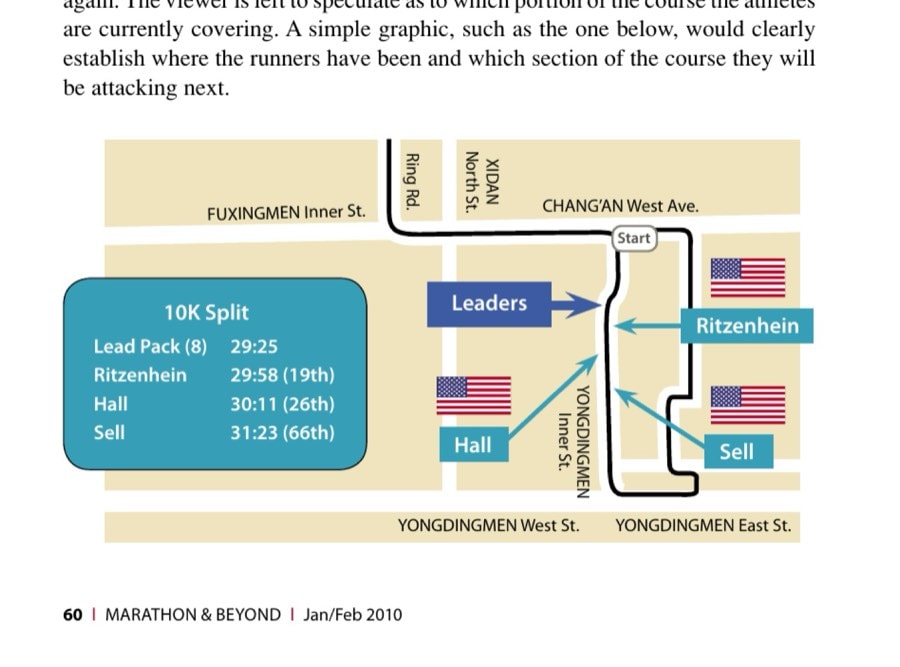
4. GPS Athlete Updates. Since many big-city marathons now offer GPS athlete-tracking features over the Internet, why hasn’t television incorporated this feature into its broadcasts? The modus operandi for covering world championship marathons, for instance, generally seems to be showing a course map, including some topography, at the outset of the race, and then never showing this graphic again. The viewer is left to speculate as to which portion of the course the athletes are currently covering. A simple graphic, such as the one below, would clearly establish where the runners have been and which section of the course they will be attacking next. XIDAN North St.
Ring Rd.
FUXINGMEN Inner St.
CHANG’AN West Ave. Start
Leaders
10K Split 29:25 29:58 (19th) 30:11 (26th) 31:23 (66th)
Hall
Ritzenhein YONGDINGMEN Inner St.
Lead Pack (8) Ritzenhein Hall Sell
YONGDINGMEN West St.
Sell YONGDINGMEN East St.
5. Ticker Tape Athlete Updates. This feature, which has been used for years on major sports broadcasts to provide viewers with the most current news and scores, is finally making its way into the world of marathon telecasts. The idea makes sense, and since all of the athletes wear timing chips and cross over timing pads multiple times during the course of a race, it seems like a no-brainer to continually give viewers at home a sense of where their favorite athlete is positioned. At the recent ING New York City Marathon, a ticker tape graphic revealed the top ten athletes in both the women’s and men’s races. But why stop there? There’s no reason why the graphic couldn’t have captured the top 20 or 25 athletes. Additionally, it would have been helpful if the graphic included the time gap between the lead group and the chase pack, as well as the athletes’ projected finishing times.
6. Isolate the Top American Athlete. Show us the top American in each and every ▲
Ticker tape graphics offer invaluable, up-to-the-minute details.
© Victah/ www.PhotoRun.net
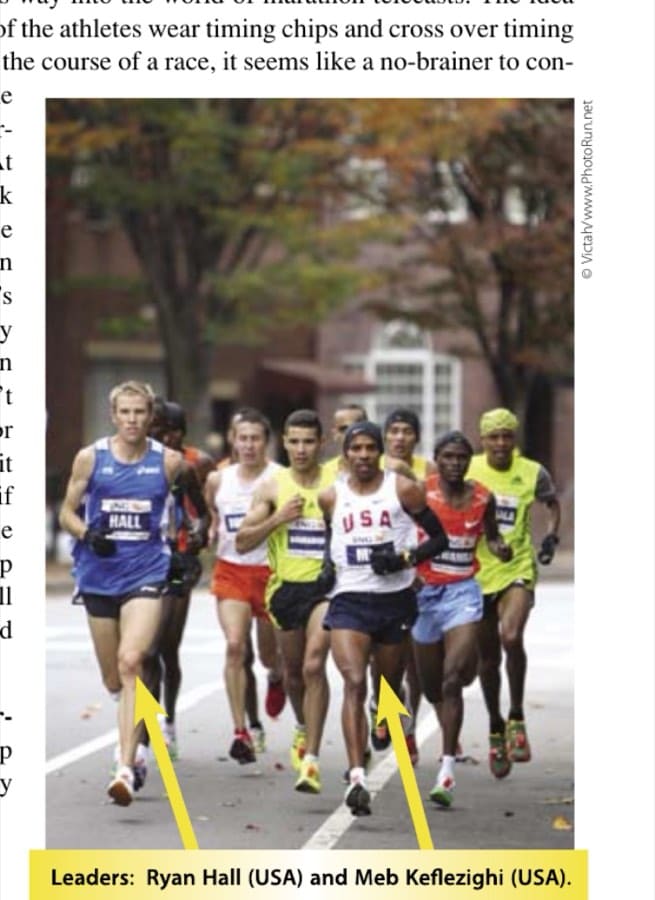
Along those lines, since wristwatches such as the Garmin have become so advanced in recent years that runners know at a glance their current and average pace and distance covered, I’m hopeful that this same technology will soon be married into the timing chips worn by the athletes. At this point, such a chip would probably be too cumbersome. But after watching what Apple has done with its portable music players over the last few years, I’m crossing my fingers that timing chips will become smaller yet more robust. How great would it be, in other words, to know immediately by a graphic in the lower corner of the screen that Paula Radcliffe has slowed to a 5:45 pace while Kara Goucher has sped up to a 5:25 pace?
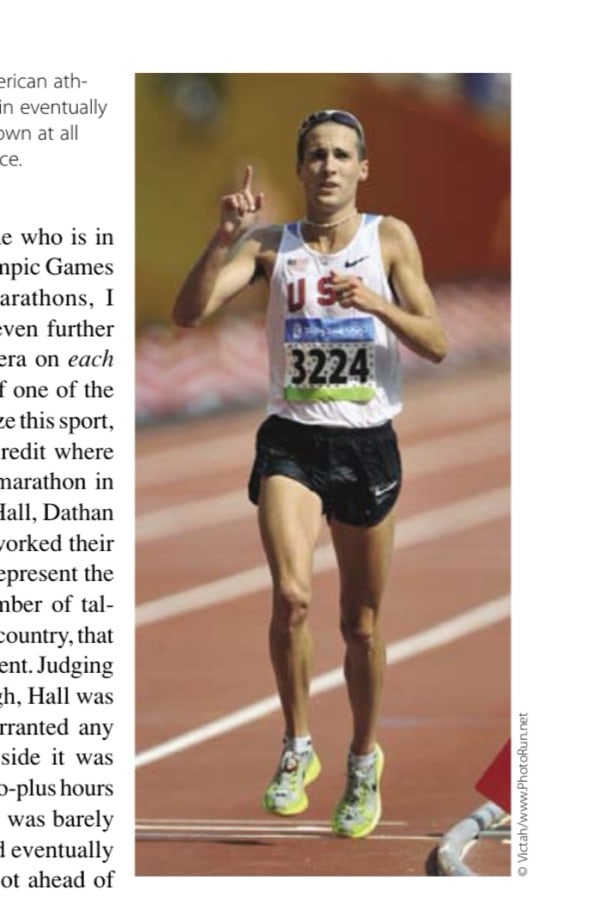
televised marathon, even one who is in 123rd place. During the Olympic Games or world championship marathons, I propose taking this notion even further by placing a dedicated camera on each of the Team USA runners. If one of the objectives is to help popularize this sport, we need to start by giving credit where credit is due. In the men’s marathon in Beijing, for example, Ryan Hall, Dathan Ritzenhein, and Brian Sell worked their tails off to earn the right to represent the United States. With the number of talented runners we have in this country, that is a tremendous accomplishment. Judging from NBC’s coverage, though, Hall was the only American who warranted any attention (on the women’s side it was Deena Kastor). During the two-plus hours of live coverage, Ritzenhein was barely shown even though he would eventually finish in ninth place, one spot ahead of Hall, and Sell scarcely received acknowledgment that he was in the field even though he would cross the line in 22nd place out of 95 starters. Once Hall slipped farther behind the lead group (and by only a few minutes, mind you), even his race was treated as a complete afterthought.
Do the NBA and NFL restrict their coverage to their top three teams? Of course not. And Major League Baseball certainly doesn’t discriminate against hitters who are batting only .220; those players receive more than their fair share of coverage. Besides, young runners at home, in particular—those whom we want to embrace the sport and one day become marathoners themselves—are much more likely to be inspired by Dathan Ritzenhein’s ninth-place performance than they ever will be by Jaouad Gharib’s and Tsegay Kebede’s second- and third-place finishes.
Americans watching at home want to cheer for fellow Americans. Only the most die-hard of running aficionados, in fact, can even separate Kenya’s Wanjiru from Martin Lel or Ethiopia’s Tsegay Kebede from Deriba Merga. No, it’s
© Victah/ www.PhotoRun.net
▲
Always showcase the top American athletes. In Beijing, Dathan Ritzenhein eventually finished ninth but was barely shown at all during the TV coverage of the race.
not that I’ve been infected with homerism. One of my biggest gripes about the Olympics, in fact, is that we don’t get an opportunity to see enough athletes from other countries performing and celebrating their triumphs. But when it comes to the marathon, American audiences are simply going to lose interest if there is no story line involving American athletes.
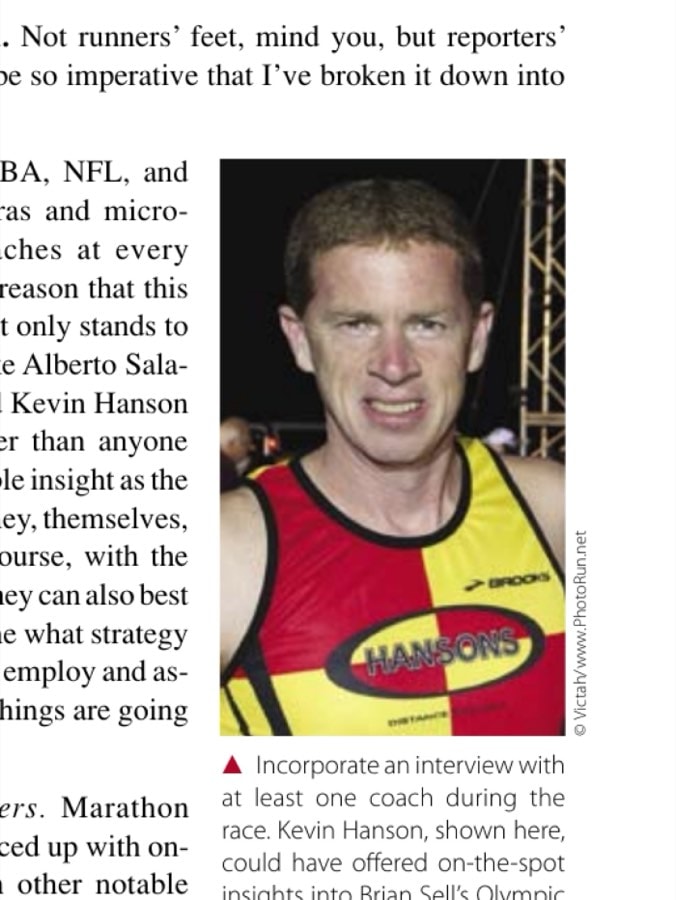
a. Coaching Cams. The NBA, NFL, and MLB are placing cameras and microphones in front of coaches at every opportunity. There is no reason that this sport can’t do the same. It only stands to reason that since guys like Alberto Salazar, Terrence Mahon, and Kevin Hanson know their athletes better than anyone else, they can offer valuable insight as the race is unfolding. Since they, themselves, are already out on the course, with the proverbial ringside seat, they can also best explain to viewers at home what strategy their athletes are trying to employ and assess at a glance whether things are going according to plan.
© Victah/ www.PhotoRun.net
7. More Feet on the Ground. Not runners’ feet, mind you, but reporters’ feet. I consider this suggestion to be so imperative that I’ve broken it down into distinct categories:
▲ Incorporate an interview with at least one coach during the race. Kevin Hanson, shown here, could have offered on-the-spot insights into Brian Sell’s Olympic Marathon race.
b. Interview Notable Others. Marathon telecasts can also be spruced up with onthe-spot interviews with other notable bystanders. One potential interviewee can be the race director. Audiences would be
stunned to hear about the number of volunteers it takes to stage a major marathon and the amount of water that is expected to be consumed during the event. But there are plenty of other notable bystanders to choose
from. The 2009 ING New York City Marathon, for instance, presented an ideal opportunity for viewers to hear from running star Sara Hall about her husband, Ryan’s, marathon preparations. Or why couldn’t
we have heard from Yordanos Asgedom, Meb Keflezighi’s wife, about her husband’s long, arduous road to regain his running fitness after a series of devastating setbacks? Take advantage of the fact that major
marathons always draw many of the sport’s luminaries. Which former
© Victah/ www.PhotoRun.net
▲
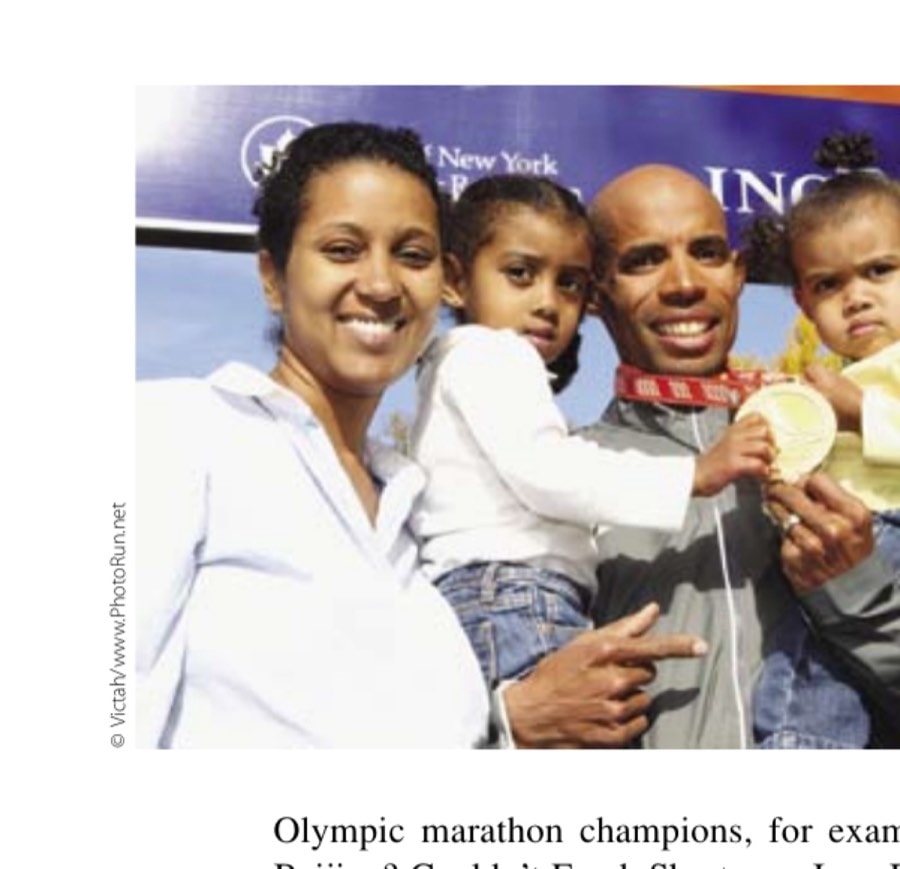
Interviewing Meb Keflezighi’s wife, Yordanos Asgedom (shown here with Meb and their daughters after the race), during the race would have given viewers a sense of his journey back from devastating setbacks.
Olympic marathon champions, for example, were in attendance in Beijing? Couldn’t Frank Shorter or Joan Benoit Samuelson have been interviewed about their experiences in the Olympic Games? c. Crowd Interviews. In Boston, upward of a million fans line the course
each and every year. Some of them have been watching the marathon for decades. A reporter should seek to get a sense of why they are out there. Who is their favorite athlete? What do they remember most about
marathons from years past? This would not only give television viewers a sense of the importance of the race to the local community, but it would also shed light on why so many people are attracted to this
endurance event. d. Recruit Fans of the Sport to Assist. Consider posting a telephone number or Twitter account where marathon aficionados on the course can provide race updates either orally over a cell phone or using text messaging. Make
the race more of an interactive experience. Runner’s World has been covering important marathons using text messaging/on-the-spot blogs for years. It only makes sense that the next step would be for television
to somehow incorporate this same feature. In a 26.2-mile affair, there is no way that there will be enough cameras to capture each and every detail. A fan on the course near Boston College who happens to see Gete
Wami step off the course to stretch a cramping calf, for instance, can alert race announcers of the development instantaneously. 8. Don’t Forget to Connect the Dots. We can thank folks like Pheidippides,
Spiridon Louis, and Abebe Bikila for the marathon’s undying allure, and I’m a firm
believer that this event’s rich historical, traditional, and mythological genealogy can’t be emphasized enough. This footrace, in fact, was one of the centerpiece competitions when Baron de Coubertin drew up plans for the creation of the modern Games in 1896. Provide some of the numbers. For instance, Boston, at 113 years old, is the world’s oldest annually contested marathon. It’s 70 years older than professional football’s first Super Bowl (1967), 50 years older than the first NBA championship (1947), and even six years older than baseball’s World Series (1903). In 1976, an estimated 25,000 Americans completed a marathon. By 2007, that number had risen to 412,000. What accounts for the growth in popularity? In 1897, John J. McDermott won the first Boston Marathon in a time of 2:55:10. In 2008, Robert K. Cheruiyot won the same race in 2:07:46. How has the winning time improved so dramatically? These are the types of questions and answers that I would like to see announcers mix into the conversation. The general public would appreciate learning about the intricacies of the sport.
9. Better Showcase the City’s Environs and Landmarks. Race organizers in Beijing probably spent weeks, if not months, designing a course that would highlight as many of the city’s historic and cultural landmarks as possible. In fact, when cities such as Beijing, London, and Rio de Janeiro are weighing the pros and cons of hosting the Olympic Games, one of the selling points to get everyone on board is the prospect of generating tens of millions of dollars in future tourism. In this regard, the marathon is a crown jewel attraction. Unlike other Olympic events, which are tethered to the inside of a natatorium, stadium, or athletic center, the marathon competition takes place on picturesque city streets. In the recent Olympiad, images, both aerial and otherwise, of such monuments as the Forbidden City, the Temple of Heaven, and the Summer Palace were breathtaking. Broadcasters covering the marathon, however, seemed to give the structures merely passing mention. How much livelier could the coverage have been had Joshua Cooper Ramo, the correspondent with China expertise who sat in with Bob Costas during the opening and closing ceremonies, been in the booth offering historical anecdotes of the monuments that the athletes were passing? The danger, of course, would be tipping the scale the wrong direction and having the focus drift too far off the race itself, but I believe that it’s worth a try. When it comes to Boston, commission a longtime New Englander to offer insight about the historic towns of Natwick and Brookline. Ditto with the New York or Chicago marathons. The 2009 ING New York City Marathon offered a few ticker tape facts about some of the city’s five Burroughs as the athletes ran from one part of the course to the other. It’s a start, but there is so much more potential to make the link between the race and the community during two to three hours worth of coverage.
10. Minimize the Role of the Canary. We’ve all seen them, the color commentators who have either been positioned on the media truck or who have been
precariously perched atop a motorbike. Nine times out of ten, it seems, the audio signal is lost, which leads to the usual disconcerting dead-air time, uneasy banter and laughter, and strained apologies from the in‑studio hosts about “technical difficulties.” On that rare occasion when the audio signal is a success, it’s inevitable that the on-the-spot commentator’s report will be garbled and swallowed up by background noise. Stick to description by the in-studio hosts who are constantly being provided with the best images and audio updates from colleagues along the course.
11. Slow-Motion Replays/Freeze Frames. Returning to the world of golf for a moment, it has become commonplace for a telecast to include slow-motion replays and freeze frames for expert analysis of some of the competitors’ swings. There is no reason why the same technology can’t be adopted by those broadcasting a marathon. Explain to the layman at home, in detail, what allows Deena Kastor to run as fast as she does. Feel free to use a Telestrator for further clarification. The technology can also be used to place two runners side by side, split-screen fashion, so that the audience can see differences in running style. And wouldn’t it be interesting to compare Paula Radcliffe’s form during mile five and her form during mile 22 side by side?
12. Highlight an Aid Station or Two. Is it just me, or is there always a sense of heightened drama when it comes to aid stations, particularly when a large pack of runners is involved? Why can’t a camera be dedicated to capturing one or two? Don’t get me wrong. It’s not the collision-waiting-to-happen factor that intrigues me, but rather the convergence of a variety of sport-specific details: the athletes jockeying for position as they approach the station, their concentration suddenly shifting from the road ahead to the almost festive-looking tables that display each athlete’s uniquely marked bottles; the volunteers poised, like matadors, to offer additional water and endurance drinks; hands reach, feet shuffle, mouths gape, water poured atop heads, water spilling down chins . . . this all needs to be captured on film. Additionally, it is often near the course’s final aid stations where the biggest strategic moves are made. Producers of car racing make a huge spectacle out of each and every pit stop. Triathlons, too, have elevated “transitions” into veritable events. The sport of marathoning should be able to borrow at least some of the drama for its own version.
So there you have it. My battered and bruised knuckles are already feeling better just airing some of these suggestions. Other fans of the sport probably have even more ideas. The important thing is to create a dialogue. The marathon has evolved quite a bit over the years. It’s time that television coverage of the event began to do the same.
This article originally appeared in Marathon & Beyond, Vol. 14, No. 1 (2010).
← Browse the full M&B ArchiveMore like this
1,000+ stories from 19 years of Marathon & Beyond
The complete archive of the legendary long-distance journal — digitized and free to read.
