

How to Host a Hundred
You’ve run a marathon? That’s great! Under three hours? Impressive. You’ve finished 50-kilometer and 50-mile runs? You’re one tough cookie. You’ve conquered 100-kilometer and 100-mile runs? Wow! You did Badwater? Holy guacamole!
You’ve run Badwater twice in one run: out, back, and summiting Mount Whitney? You are a legend—at least to the tiny, elite fraction of a percent of the U.S. population comprising marathoners and ultrarunners.
But have you ever put on a race of 100 kilometers, 100 miles, or longer? Have you ever hosted a hundred? Have you ever tasted the satisfaction of opening the door for dozens or even hundreds of men and women to get to that life-changing, transcendent place—the finish line of a hundred or hundred-plus?
If not, then there is an elite group in the world of ultramarathons whose ranks you’ve not attained. There are challenges in the world of ultras you’ve not faced and sublime thrills you haven’t savored.
But not to worry! You still can. America’s appetite for the long runs is growing steadily, says 100-mile runner and race authority Stan Jensen, creator of the popular1 “Run 100s” Web site (www. run100s.com). From a mere two 100-mile races in the United States in 1979, the menu has grown to 50 in the U.S. and Canada. “
I’d say the field is growing at a steady 5 to 10 percent annually,” Jensen says. “There are new ones every year. Older ones are selling out and need lotteries.” And that doesn’t count the countless 100-kilometer races like Wisconsin’s Kettle Moraine 100K, the Free State Ultras 100K in Kansas, or the Bandera 100K in Texas. Nor does it include the hundred-mile-plus races like California’s Badwater Ultramarathon or the McNaughton Park 150-Mile Trail Run in Pekin, Illinois.
A Changing of the Guard The old races are sticking around, too, as popular as ever—even though directors change. The Old Dominion 100-Mile Endurance Run in Woodstock, Virginia—the oldest hundred east of the Rockies—marked 2008 as its 30th year. The founders of the Old Dominion Endurance 100, Wayne and Pat Botts, handed directorship over to their daughter Wynne and her husband, Ray Waldron, in 1994.
California’s Western States 100-Mile Endurance Run, the nation’s first 100-miler, started in 1974 with one runner and a field of horseback riders! In 2008, Western States organizers selected 375 competitors from 1,351 applicants almost exclusively by lottery, according to race director Greg Soderlund. Soderlund, also a second-generation race director, succeeded Norman Klein in 1997.
By all accounts, hundreds are here to stay and getting more popular all the time. It’s a pretty good bet, Jensen says, that if you offer one, someone will drop by to run it. Up for a thrill? Here’s how to host a hundred, in 10 easy steps.
1. Choose a course and a name Cynics may believe that race directors choose courses with the sole purpose of tormenting runners. Why else would you find a double ascent of 12,600-foot Hope Pass right in the middle of the Leadville Trail 100? Why else would you have “Ridgeline” 30 miles into the Kansas Heartland 100? It’s a section of seemingly endless miles of straight dirt-and-gravel road and slight uphill grade that narrows to a point on the horizon surrounded by featureless, infinite emptiness so that you run and run, under the impression that you haven’t moved. In reality, it’s only six miles.
But torment is absolutely not the case, says Heartland 100 race director Randy Albrecht. “We just want to show off the unique scenery of the Flint Hills. After that, our main considerations are runner safety and crew access.”
Torment absolutely is the case, according to Joe Prusaitis, founder of the Bandera 100K, 50 miles west of San Antonio in the Hill Country State Natural Area near Bandera, Texas. “It’s the most difficult course I could find in Texas that’s not impossible,” says Prusaitis. Prusaitis is also the second-generation race director for the Rocky Raccoon 100-Mile Trail Run near Huntsville, Texas. “Bandera’s rough, rugged, and technical, with enough up and down and mess to suit most veteran trail runners like me,” Prusaitis said.
Bandera has a 24-hour cutoff, Prusaitis’s sole concession to human frailty. Once you’ve chosen a course, whether the torment is on purpose or not, you’ll need to name it. Place names like “Leadville,” “Vermont,” and “Massanutten” are popular. Names that describe the course or experience, like Hawaii’s H.U.R.T., are also options.
The Cascade Running Club’s Plain 100 reflects both. Located near the tiny town of Plain, Washington, in the eastern foothills of the Cascade Mountains, the self-supported race has one crew access and drop-bag point at 55 miles, no volunteers, no course markings, no awards, no T-shirts, and no buckles.
Entrants get written directions, a bandanna with the course map on it, and a souvenir rock with “Plain 100” painted on it. You get dinner before the race, breakfast after, and a shot at completing what race director Tom Ripley calls a “graduate-level” race.
In 2007, the no-frills Plain boasted one of its highest finishing rates: 14 of 29 starters. “We got lucky with the name,” Ripley says. “I don’t know what we’d have called it if the nearest town was Centerville or something like that.”
Don’t feel limited with names. Beatles fan Mickey Rollins, founder of the Rocky Raccoon 100 Mile Trail Run, named the race after the Beatles song of the same name, just because he liked it2.
2. Recruit helpers Volunteers come in handy for everything from marking the course to manning the aid stations to cleaning up afterward. The important thing, says Western States’s Soderlund, is to get good ones. More than any other feature of the race, he says, runners will go home remembering—and talking and writing about—how they were treated by your volunteers. Soderlund should know about volunteers. Western States averages 1,500. Local running clubs are a prime source. The Kansas Ultrarunning Society and the Kansas City Trail Nerds have both run aid stations at each other’s hundreds.
© Rick Kent
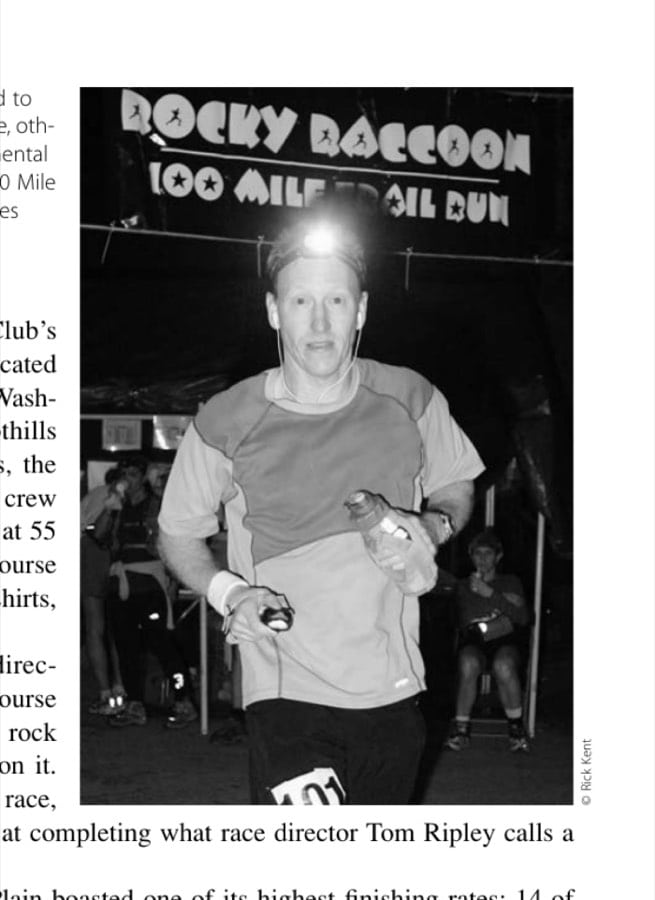
While some races are named to reflect the experience or course, others are chosen for more sentimental reasons. The Rocky Raccoon 100 Mile Trail Run is named after a Beatles song.
© Brian Kuhn
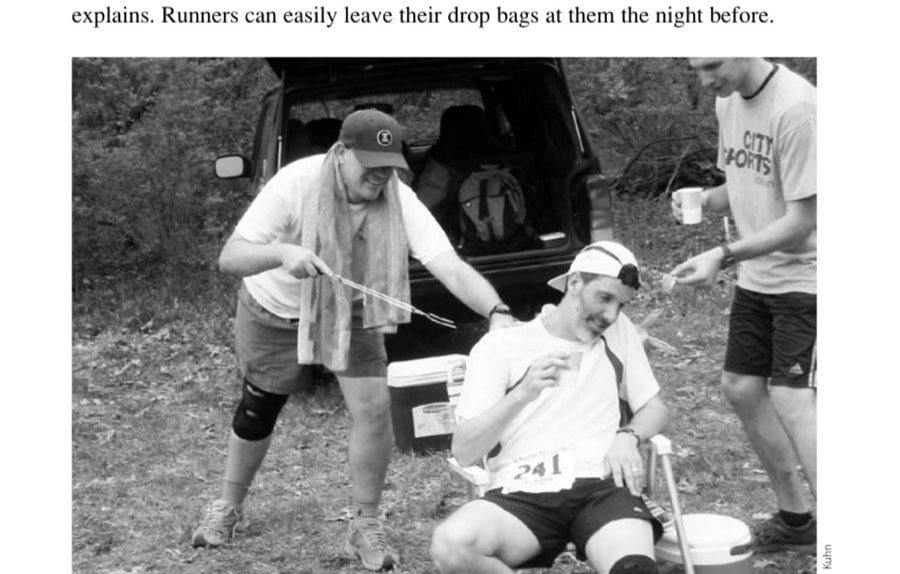
“We’ve got good grass-roots groups here who like to be involved,” says Free State Ultras race director Ben Holmes. An experienced host of trail races up to 50K, Holmes made his first foray into the land of the hundreds with the Free State 100K in April 2007.
You can get help from outside the running world as well, says Albrecht, but be ready for the usual excuses—“my job, my family”—and some strange looks when you mention the race length. Look for volunteers who are up for a challenge, advises Old Dominion Endurance 100’s Ray and Wynne Waldron. Their volunteers have included local civic groups, like the Vietnam Veterans of America, Shenandoah Chapter; a Cub Scout troop from (relatively) nearby Richmond; and family members.
More people make things easier, says Prusaitis. “Talking them into it can be like selling a car. ‘You do my race, and I’ll do yours,’ ‘If you do this race, I’ll comp your entry into my other race’.” Don’t let a lack of volunteers stop you. Prusaitis’s Cactus Rose 100-Mile Trail Run, first held in November 2007 on the Bandera course, had 100 percent unmanned aid stations. Every aid station is accessible during a 30-minute drive, Prusaitis explains. Runners can easily leave their drop bags at them the night before.
Volunteers at the “Heaven’s Gate” aid station at the McNaughton Park 100/150 are known for their friendliness as well as for motivating tired runners to keep moving, no matter what it takes!
“There’ll be one volunteer patrolling the course to make sure the aid stations haven’t blown away,” Prusaitis says. “That’ll be me. Some of us veteran runners don’t necessarily like being mobbed by volunteers at every aid station,” he says.
And while the Plain 100 doesn’t have volunteers other than race directors Ripley and Christina Ralph, local search-and-rescue professionals are out patrolling the course. “That’s their idea of fun,” Ralph says.
In addition, members of the Cascade Runners Club have taken to partying during the Plain at the picnic table at the 55-mile point, Ripley said. That means food and friendly faces midway, but it’s informal and not an official part of the race.
In a perfect world, runners finish races and become the volunteers. At the 2007 Free State Ultras, local runner and Kansas City Trail Nerd Kyle Amos won the 100K in 10:02:34, and then went to an aid station to help the volunteers and cheer on his fellow competitors.
As night advanced, Amos was back out on the heavily wooded course, making sure the last 100K runner got safely in, 13 minutes before cutoff—much to the relief of that last runner’s semi frantic spouse.
But the load they carry isn’t the only thing that makes volunteers precious to a race director. “Working with good volunteers is one of the great pleasures of putting on a race,” says Free State’s Holmes. “I really enjoy seeing them have fun and working together to get the runners through,” he said.
3. R & D race literature You might think R & D stands for “research and develop.” It doesn’t. “Rip off and duplicate is the best way to do your race literature,” Albrecht advises. “It’s all been done before. Why reinvent the wheel?”
Albrecht’s inspiration for Heartland 100 literature—applications, information sheets, and liability language—is the Leadville Trail 100’s information packet. “They do a great job,” he says. “And I’ve always had a soft spot for Leadville. It was the first hundred I ever ran.”
The Bear 100, a 36-hour ramble through the Wasatch/Bear River Range near Prescott, Idaho, requires eight hours of certified volunteer trail work or eight hours supporting a race (not pacing) for entry. “
I copied that from Wasatch3,” race director Leland Barker admits.
4. Set a date This can be tricky. You don’t want to steal runners away from already-established races if you can help it, Albrecht says. That’s not nice. And, in Kansas, at least, you have to be concerned with the weather. Summer and winter are both bad times to be out on the plains exposed to the weather.
Spring in Kansas is pleasant, but thunderstorms are severe. Runners are prime lightning-strike targets. That leaves fall. The beginning of October usually has the best weather, but the relatively close Arkansas Traveler 100 Miler is set for the first weekend.
So Albrecht took the second weekend in October for Heartland. The Bear 100’s Barker wanted September to show off the red maples and golden aspens that decorate his course. Though the first weekend after Labor Day usually has some of the year’s best weather, he didn’t take it because that’s the same weekend as the Wasatch Front 100-Mile Endurance Run in Utah.
Instead, Barker scheduled for the last weekend in September. It was the courteous thing to do, but that’s not why Barker did it. “I like running Wasatch myself,” he admitted.4
5. Publicize the event “I don’t spend a dime,” says Prusaitis. “It’s all by word of mouth or the Internet. Maybe it’s because the races are all big enough as is.” “Ads in the ultrarunning magazines are helpful,” says Wynne Waldron, “but putting on a good race is the best way to get publicity.”
6. Get the gear, insurance, and permissions Unless your race is self-supported like the Plain 100, you’re going to need some stuff. Exactly what depends on what kind of race you’re putting on and where it’s located.
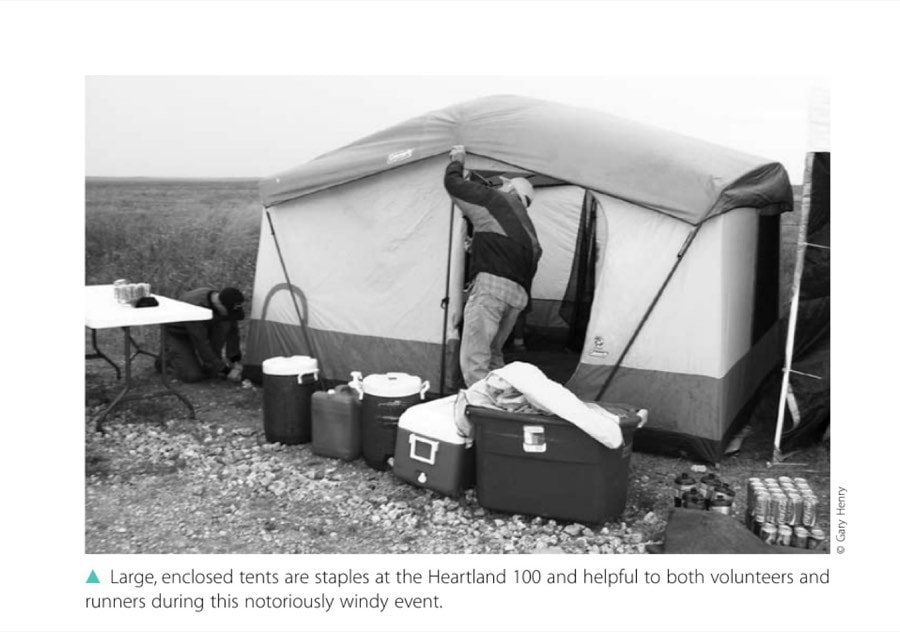
A fleet of trucks will come in handy if your event is on the scale of Western States. The Heartland 100’s seven manned aid stations each consists of a large enclosed tent for food and the occasional hypothermic runner. The tent has to be enclosed because of the wind, which hasn’t stopped blowing on that course since wind was invented.
Heartland also has open-faced tents for drop bags. There are numerous coolers and jugs for food and drinks, along with tables, chairs, stoves, and generator- and gas-powered lights. If your volunteers are experienced pros like those at the Old Dominion Endurance 100, they’ll bring their own gear, and all you have to do is give them the aid station food and drink the night before (see step 8).
If your course, like most of them, goes through public or private land, you have to get permission to run your race there. Sometimes that means getting approval from several jurisdictions, Holmes says. He had to get the OK for Free State from the Army Corps of Engineers and the Kansas Department of Parks and Wildlife.
Both are great groups, he says. Both are eager to have the parks used constructively by the public. Working with people like that just makes the whole thing
© Gary Henry
Large, enclosed tents are staples at the Heartland 100 and helpful to both volunteers and runners during this notoriously windy event.
more fun, he said. Of course, the opposite is also true, Holmes added darkly and with little elaboration. No matter how nice anyone is, you won’t get permission without insurance. Road Runners Club of America (RRCA) offers liability insurance to member clubs, so you can host your hundred with no worries about a lawsuit.
7. Mark the course Always wear your race T-shirt when doing this, advises Wynne Waldron. Otherwise, people think you’re developers. And no matter how well you mark the course, says Prusaitis, don’t ever flatter yourself that it’s foolproof. Vandals, weather, miles, darkness, speed, and exhaustion can all contribute to turning the best-marked course into a path straight to the Twilight Zone.
8. Set up the aid stations Albrecht and Heartland 100 co-race director Jim Davis hit the country roads with truck and trailer shortly after the 6:00 a.m. start to meet the volunteers at each stop and set up the stations. It’s different at the Old Dominion Endurance 100. “We leave all that to our aid station leaders,” says Ray Waldron of his course’s 20-plus stations. “We brief them and give them the supplies the night before, and they take care of the rest.”
© Wynne Waldron
The Old Dominion Endurance 100 traditionally has experienced aid station captains and volunteers, easing the work of the race directors. Their volunteers have included several local civic groups, as well as family.
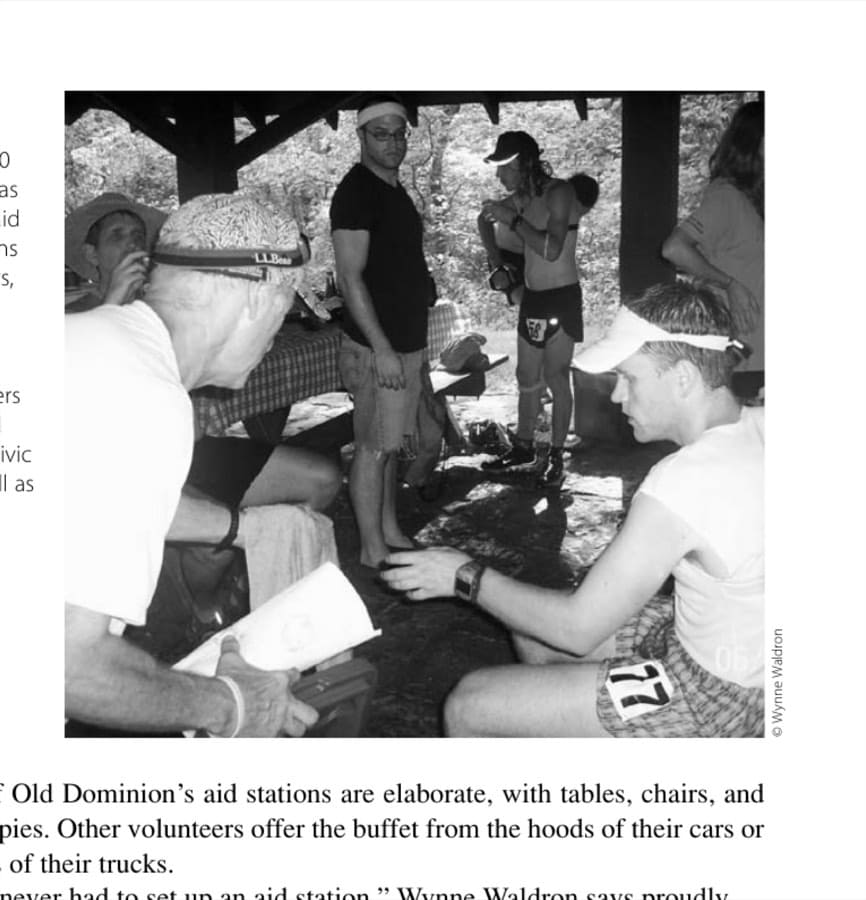
Some of Old Dominion’s aid stations are elaborate, with tables, chairs, and dining canopies. Other volunteers offer the buffet from the hoods of their cars or the tailgates of their trucks. “We’ve never had to set up an aid station,” Wynne Waldron says proudly. Obviously, aid-station setup is not an issue at the Plain 100.
9. Monitor the race This stage of the game ranges anywhere between 18 hours (Free State Ultras 100K) and 60 hours (Badwater) or more. Some race directors like to be at the finish line through the whole race. Others like to be out and about on the course.
The one constant is—be ready for anything. At Western States, during a race in the early ’90s, Soderlund recalls, runners and volunteers reported that old familiar smell along the second half of the course. One of the runners was strolling along, smoking a joint. In what might seem a true California moment, the runner was pulled from the race at the Foresthill School aid station—not for illegal drug use, but for smoking on the course.
The fact is that smoking poses a danger. In 2002, a lit cigarette at Western States caused a fire that burned its way to within a half mile of the runners in the last 10 miles of the race. Smoke was so bad that authorities closed Highway 49, the only way in and out for crews and volunteers (of course, this was only a preview of the events of 2008).
“We were trying to figure out how to reroute the course,” Soderlund said. “Our plan was to move it south of the fire along the Auburn Lake Trails. Volunteers were ready to move aid stations and direct runners on to alternate trails. “
Fortunately, firefighters from Auburn got the fire under control,” he said. “We didn’t have to reroute the race. You have to know the area, though, and have alternate course contingencies.” When 6 to 8 inches of snow hit the Bear 100 course shortly before the start in 2006, Barker was ready with plan B. “
I just had a hunch this was our year for snow,” Barker said. “I worried about it all year. I spent most of the summer planning an alternate course.” Renamed the “Polar Bear 100,” the 2006 course sent runners through a mere 2 to 4 inches of snow at lower elevations. Most of that melted off as the 36-hour cutoff approached. “
It would’ve been miserable to run through that deep stuff,” Barker said. “But my main concern was how we’d get the aid stations in.” Lost, off-course runners are a concern for every race director. In the 2006 Heartland 100, Albrecht got a 4:00 a.m. notification by cell phone at the finish line of a runner unaccounted for. The runner had made a wrong turn in the dark on hilly dirt roads at about 70 miles, after vandals stole course markings and glow sticks. “
There was still a big flour arrow in the middle of the road pointing the right way,” Albrecht said, “but at 2:00 or 3:00 a.m., after 70 miles, you might not be seeing too well.” Albrecht found the runner about 5:00 a.m., close to eight miles off course, backtracking and unhappy. “
He was upset he’d gone wrong,” Albrecht said. “But I was very relieved. I was 99 percent certain, by doing the math, where he would have to be, though when you’ve been up running around monitoring the race for 30 hours, sometimes the math doesn’t work right.”
In one edition of the Bear (Barker won’t say which), a pacer (Barker won’t say who) flipped out. He shed his clothes and, naked as the truth, burst into the restaurant at the course finish—the Deer Cliff Inn—about 9:00 or 10:00 p.m., hollering for Barker. It took two big policemen to get the agitated birthday-suited pacer under control and put some clothes on him. They took him away but later let him go back to his camp. “
Evidently the guy just lost his mind, tore off all his clothes, and came looking for me,” Barker said. “To this day, I have no idea why. All I can figure is that he had a problem and decided that the race director is supposed to fix all the problems. “
I was out on the course and never even heard about it until it was all over,” he added. “That was before we got our ham radios.”
The runner that the naked man was there to pace wound up finishing with a good time, Barker said, and apologized for the pacer immediately. The guy was evidently distraught because he had just broken up with his girlfriend. The runner returned the following year and reported that the pacer was in counseling and doing well. “I get a lot of jokes about that now,” Barker said. “Bear 100? Just how do you spell that?”
10. Have fun, and don’t forget to pick up after
© Josh Dillingham
“With all the work involved, I’m always amazed when I see someone putting on a hundred for a second time,” says Soderlund, who returned for his own 11th helping of Western States in 2008—only to experience the bitter disappointment of having to cancel the race two days before the start because of widespread wildfires near the course and throughout Northern California.
But if you like dealing with the unknown; testing your ability to prepare against the ability of people, gear, and nature to throw you curves; and making last-second emergency decisions while staying up all day and night, you may find hosting hundreds irresistible. “
It’s stressful at times, but that just makes it more fun,” says Holmes, who hosted a second edition of the Free State Ultras 100K in April. He said he also may host a 100-miler on nearby woodland trails.
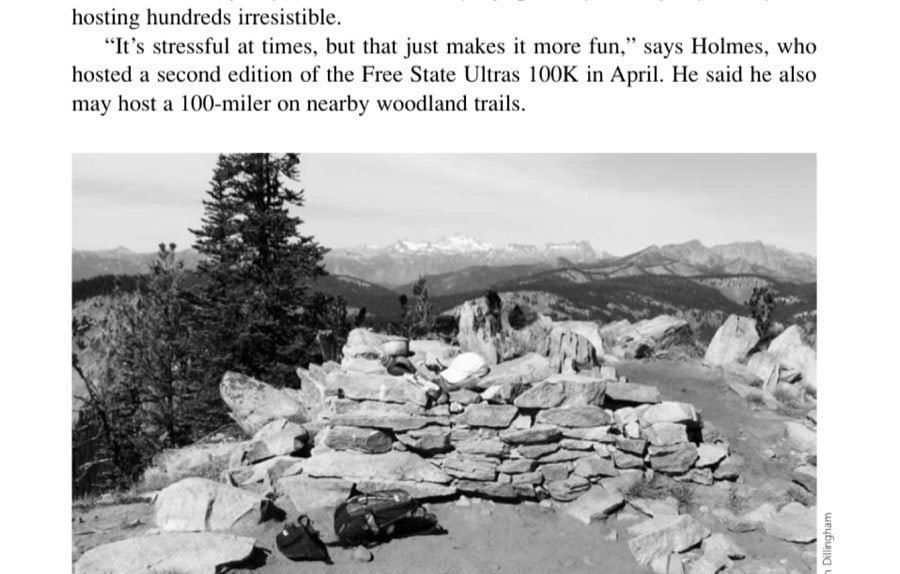
Klone Peak (elevation 6,900 feet), part of the Plain 100, a no-frills, self-supported race in which entrants carry their own aid and gear. There were 14 finishers this year, making a total of 47 in its 11-year history.
Many hundred and hundred-plus race directors, including most of those telling their stories here, are accomplished ultrarunners themselves. They host races to give back to the ultrarunning community. They know what finishing the long races can do for runners, having finished 100s themselves. “
Payback is definitely part of it,” says Plain 100’s Ripley. “I mean that in a positive way.” The greatest pleasure, though, according to every race director interviewed for this story, is found at the finish line.
Sometimes it takes several years for a runner to get to the finish. Some battle age or infirmity. Some make it with only minutes or seconds to spare. All fight time, terrain, weather, and their own limits. “
It’s rewarding every time,” says Ripley. “It’s really special to have the chance to make that possible for someone.” “Watching the people come in, that’s my favorite part,” says Western States’s Soderlund. “For half of them, it’s their first time. It’s a dream realized. It’s a lifechanging accomplishment. It’s my 11th time putting on the race,” he said. “I’m still not tired of it.”
Notes The number of daily hits at www.run100s.com ranges from 10,000 to 25,000. Footprints, October-November 2002, www.hillcountrytrailrunners.com/docs/RRhistory.pdf. 3 Wasatch Front 100-Mile Endurance Run, Layton, Utah. 4 Leland Barker won the 2001 Wasatch Front 100, finishing in 21:44:38. 1 2
Calendar of North American 100Ks and 100 Milers by Stan Jensen, www.Run100.com 100K
1/5/08 Bandera Bandera, TX http://www.TejasTrails.com/Bandera.html
100K
1/19/08
H.U.R.T. Trail Honolulu, HI http://www.hurt100trailrace.com/
100M
1/19/08
H.U.R.T. Trail Honolulu, HI http://www.hurt100trailrace.com/
100M
2/2/08 Rocky Raccoon Huntsville, TX http://www.TejasTrails.com/Rocky.html
100M
2/9/08 Yukon Arctic Ultra Whitehorse, YT http://www.arcticultra.de/en.php
100M
2/16/08 Susitna 100 Big Lake, AK http://www.Susitna100.com/
100K
2/16/08 Orange Curtain Long Beach, CA http://www.oc100k.com/
100K
3/1/08 Iron Horse Orange Park, FL http://www.IronHorse100kmclub.com/
100M
3/1/08 Iron Horse Orange Park, FL http://www.IronHorse100kmclub.com/
100K
3/21/08 Coyote Two Moon Ojai, CA http://www.ZombieRunner.com/events/zombierunner_sponsored/coyote_two_moon_ultras/
100M
3/21/08 Coyote Two Moon Ojai, CA http://www.ZombieRunner.com/events/zombierunner_sponsored/coyote_two_moon_ultras/
100M
3/29/08
Moab 100 Moab, UT http://www.geminiadventures.com/
100M
4/5/08 Umstead Raleigh, NC http://www.Umstead100.org/
100K
4/12/08
Mad City Madison, WI http://www.madcity100k.com/
100M
4/12/08
McNaughton Park Pekin, IL http://www.McNaughtonParkTrailRuns.com/
100K
4/19/08 Ruth Anderson San Francisco, CA http://www.Run100s.com/ra.htm
100K
4/20/08 WSU Pullman, WA http://www.PalouseRoadRunners.org/
100K
4/20/08
100K
4/26/08 Free State Trail Runs Lawrence, KS http://www.PsychoWyco.com/id1.html
100K
5/3/08
Miwok Marin Headlands, CA http://www.Run100s.com/miwok/
100K
5/3/08
Harriers Elk/Beaver Victoria, BC http://www.pih.bc.ca/elk-beaver-ultra.html
100K
5/3/08 Toronto Ultra Toronto, ON http://ouser.org/races/toro.htm
Lake Waramaug New Preston, CT http://www.roadntracksports.com/LWUM/
100K
5/10/08
Dances With Dirt Gnaw Bone Nashville, IN http://www.DancesWithDirt.com/
100M
5/17/08
Massanutten Mountain Trail Front Royal, VA http://www.vhtrc.org/mmt/
100K
5/17/08
Pony Express Cameron Park, CA http://www.UltraRunner.net/
100M
5/24/08
Keys Ultras Key Largo, FL http://www.Keys100.com/
100M
5/24/08
Holy Jim 100 Lake Elsinore, CA http://trailrunning.dirtyfeet.us/100m.html
100K
5/24/08 Blackfoot Ultra Edmonton, AB http://www.BlackfootUltra.com/
100M
5/24/08 Sulphur Springs Trail Run Ancaster, ON http://ouser.org/races/sulp.htm
100M
5/25/08 Wickham Park Melbourne, FL http://mattmahoney.net/wickham/
100M
6/7/08 San Diego 100 Lake Morena, CA http://www.members.cox.net/sandiego100/
100K
6/7/08 Vancouver 100 North Vancouver, BC http://www.clubfatass.com/events/Vancouver100
100K
6/7/08
Kettle Moraine La Grange, WI http://www.Kettle100.com/
100M
6/7/08
Kettle Moraine La Grange, WI http://www.Kettle100.com/
100M
6/7/08 Old Dominion Woodstock, VA http://www.OldDominionRun.org/
100M
6/14/08 Adventure Xstream Durango Durango, CO http://www.GravityPlay.com/
100M
6/20/08 Bighorn Trail 100 Dayton, WY http://www.BighornTrailRun.com/
100K
6/21/08
100M
6/21/08 Bucks County Outfitter Cradle Of Liberty Jim Thorpe, PA http://www.goalsara.org
100M
6/21/08
100M
6/28/08 Western States Squaw Valley, CA http://www.WS100.com/
100M
6/28/08 Laramie 100 Laramie, WY http://www.GeminiAdventures.com/
100M
7/11/08
100K
7/19/08 Race the Rockies Golden, BC http://www.racetherockies.com/
100M
7/19/08 Vermont West Windsor, VT http://www.Vermont100.com/
100M
7/19/08
100M
7/26/08 Adventure Xstream Summit County Summit County, CO http://www.GravityPlay. com/
100K
8/2/08
100M
8/2/08 Burning River Willoughby Hills, OH http://www.BurningRiver100.org
Mason Dixon Longest Day 100K Trail Run Havre de Grace, MD http://www. traildawgs.org Mohican Trail 100 Mile Loudonville, OH http://www.Mohican100.org/
Hardrock Silverton, CO http://www.Hardrock100.com/
Tahoe Rim Trail 100 Lake Tahoe, NV http://www.TahoeMtnMilers.org/trt50/
Kat’cina Mosa 100K Mountain Challenge Run Springville, UT http://www.squawpeak50.com
100M
8/8/08 Stormy Squamish, BC http://www.stormytrailrace.ca/
100M
8/9/08
Viaduct Trail Thompson, PA http://www.geocities.com/viaduct_trail_ultramarathon/
100M
8/9/08
100K
8/16/08 Where’s Waldo Willamette Pass, OR http://www.wpsp.org/ww100k
Headlands Hundred Sausalito, CA http://www.pctrailruns.com/
100M
8/16/08 Leadville Trail Leadville, CO http://www.LeadvilleTrail100.com/
100K
8/23/08
Wildest Run in the West French Meadows, CA http://www.WildestRun.com/
100M
8/23/08 Cascade Crest Endurance Run Easton, WA http://www.CascadeCrest100.com/
100M
8/23/08 Lean Horse Hundred Hot Springs, SD http://www.Leanhorse.com/
100K
8/24/08
Green Lakes Endurance Runs Fayetteville, NY http://www.gleruns.org/
100M
8/30/08
Grand Teton Races Alta, WY http://www.TetonRaces.com/
100M
9/5/08 Superior Sawtooth Lutsen, MN http://uppermidwesttrailrunners.com/superior/
100K
9/6/08 Dances with Dirt Ultra Hell, MI http://www.DancesWithDirt.com/
100M
9/6/08
100M
9/6/08 Wasatch Front Kaysville, UT http://www.Wasatch100.com/
Haliburton Forest Trail Race West Guildford, ON http://www.ouser.org/races//hali. htm
100K
9/12/08 Lost Soul Ultra Lethbridge, AB http://www.LostSoulUltra.com/
100M
9/12/08 Lost Soul Ultra Lethbridge, AB http://www.LostSoulUltra.com/
100M
9/13/08 Angeles Crest Endurance Run Wrightwood, CA http://www.AC100.com/
100M
9/13/08
100M
9/20/08 Delaware Newark, DE http://ccarl27.home.comcast.net/DE100miler/de100info.htm
100M
9/20/08 Iroquois Trails Ithaca, NY http://www.IroquoisTrails100.com/
100M
9/26/09
100M
9/26/08 The Bear Preston, ID http://www.Bear100.com/
100M
9/27/08 Rio del Lago Granite Bay, CA http://www.ultrarunner.net/raceseries/rio_del_ lago100.html
100K
9/27/08
Great Eastern Endurance Run Charlottesville, VA http://www.badtothebone.biz
100M
10/3/08
Grindstone Swoope, VA http://www.eco-xsports.com/grindstone.php
100M
10/4/08 Arkansas Traveler Perryville, AR http://www.RunArkansas.com/AT100.htm
100M
10/11/08 Heartland Cassoday, KS http://www.ksultrarunners.org/
100M
10/24/08 Rock Cut Rendevous Rockford, IL http://www.rockcuttrails.org
100M
10/25/08 Boulder 100 Boulder, CO http://www.GeminiAdventures.com/
Plain Endurance Run Plain, WA http://www.cascaderunningclub.com/
PCT Ultra Timothy Lake, OR http://www.pctultra.com/100/
100M
11/1/08 New England Ultras Pittsfield, VT http://www.NewEnglandUltras.com/
100M
11/1/08 Cactus Rose Bandera, TX http://www.TejasTrails.com/CactusRose.html
100K
11/8/08
Haney to Harrison Haney, BC http://www.bcathletics.org/H2H/
100M
11/8/08
Pinhoti Sylacauga, AL http://www.Pinhoti100.com/
100M
11/8/08
Mother Road Arcadia, OK http://www.MotherRoad100.com/
100M
11/15/08 Javelina Jundred Fountain Hills, AZ http://www.JavelinaJundred.com/
100M
12/6/08 Ancient Oaks Titusville, FL
100K
12/13/08 Hellgate Fincastle, VA http://www.ExtremeUltraRunning.com/
100M
12/27/08 The Burrito Run San Francisco, CA http://www.Run100s.com/br100.htm
http://www.Run100s.com is a web portal for the ultrarunning community. It was started around 1995 by Stan Jensen as a source for those looking for information on the various ultras (when, where, etc.). The site averages between 10,000 to 25,000 page hits daily, which often makes Stan wonder who’s actually out running!

This article originally appeared in Marathon & Beyond, Vol. 12, No. 6 (2008).
← Browse the full M&B ArchiveMore like this
1,000+ stories from 19 years of Marathon & Beyond
The complete archive of the legendary long-distance journal — digitized and free to read.
