

Humboldt Redwoods Marathon
Arrive in the Weott, California, area a few days before the Humboldt Redwoods Marathon to give the veneer of civilization an opportunity to slough off like a bad case of sunburn. Sleep in. Then drive to the Dyerville Bridge and park the car at the picnic lot along the east side of the road paralleling the highway above the Eel River. Walk across the bridge, just beyond the far side, where there’s an intersection. On the right is a tall, thin pole with a mark far above your head where the flood waters of December 1964 reached. Take the left turn at this intersection. When you reach the little parking lot ahead, take the path off the right side of the road to the Founder’s Tree. Pick up a brochure at the little self-serve dispenser. Leave 50 cents or a dollar in the box to help replenish the supply.
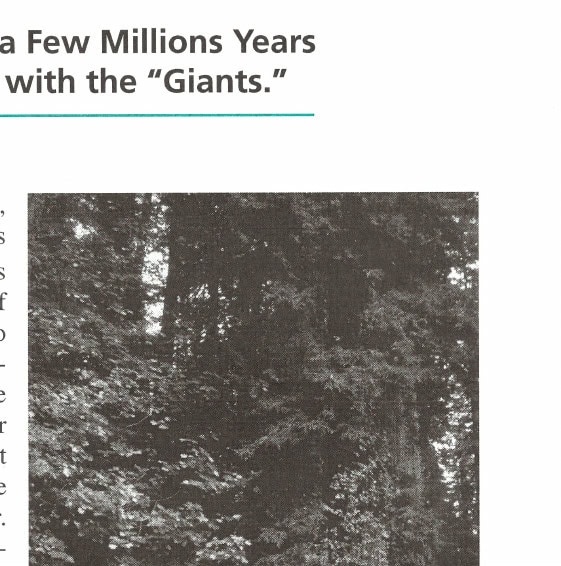
Stepping Back in Time
Now follow the trail around the Founder’s Tree and off into the forest. The farther in you go, the more the great boughs of the redwoods muffle the grating sound of the logging trucks and RVs laboring along Highway 101 half a mile away. Walk a step and listen. With each step, the sounds of civilization retreat until they are gone.
Everything is both muffled and expanded: muffled by the ground covered by centuries of redwood needles and expanded by the outrageous size of the trees, of the contrasting light green ferns. The ground under the redwoods boasts seven times the biomass found in a tropical rainforest. The redwoods stand impossibly straight, like an army of silent sentinels. Occasionally among them there is a fallen comrade, fallen but even more impressive in death for its heft and its length. It goes off into the distance like an expired whale on steroids, its rough yet soft skin not unlike a whale’s.
It’s difficult to appreciate the redwoods while they’re standing. They’re too tall, and we’re too puny. The Dyerville Giant, a 1,600-year-old redwood, fell on March 24, 1991; it is 362 feet long and 17 feet in diameter. To appreciate the size of a redwood, we must find those that have fallen to our level, those felled by an old age that predates the birth of Christ (several redwoods are 2,200 years old), those that were finally felled by a strong wind and arthritic roots. The upturned roots themselves are as large as an entrance to the Holland Tunnel. The roots are triply impressive by how shallow they are.
Redwoods are ancient trees used to sopping up ground moisture that their branches comb out of the fog-saturated ocean breezes and have no tap root to burrow deep into the earth. The roots are shallow and interconnected with the roots of their companions. The impossibly tall redwoods continue to stand by interlocking their roots, the ultimate interdependent colony.
Their serenity is manifest both in their interconnectedness and in their unassuming nature. Fallen giants, which will take hundreds of years to decay, are known as “nurse” trees. From their decaying bodies, new redwoods feed and grow. And their size is in direct proportion to their modesty: the redwood seed cone is the diameter of a nickel, the seed itself the size of a grain of rice.
With the drone of traffic gone, surrounded by the giants, one’s vivid imagination can picture dinosaurs grazing between the great trees, the greatest dinosaur dwarfed by comparison.
The runner who is seeking a benign little loop on which to release a little pent-up steam before the marathon couldn’t invent a more perfect environment. The trail is well marked, the footing is good, the ground is forgiving, and the setting is well experienced in decompressing blood pressure. Welcome to the Humboldt Redwoods State Park, through which winds the “scenic alternative” to Highway 101, the Avenue of the Giants.
Race/Course History
The Humboldt Redwoods Marathon, the younger sibling of the famed
| Humboldt Redwoods Marathon P.O. Box 4989 Arcata, CA 95518-4989 |
|
| PHONE: | 707/443–1220 (not for travel and accommodations) |
| RACE DIRECTOR: | Sharon Powers |
| YEAR ESTABLISHED: | 1979 |
| SANCTION: | USATF |
| CERTIFIED: | USATF |
| START TIME: | 9:00 a.m. |
| COURSE CLOSES: | 3:00 p.m. |
| RACE RECORD HOLDERS: | |
| Open men: | Jim Bowers, Santa Rosa, 2:22:23 (1980) |
| Open women: | Kimberly Bruyn, South Lake Tahoe, 2:46:16 (1991) |
| Masters men: | Jim Bowers, Santa Rosa, 2:22:23 (1980) |
| Masters women: | Cheryl Allen, Huntington Beach, 3:06:25 (1986) |
| PRIZE MONEY: | Only for half-marathon USATF championship (for Pacific Association members only) |
| TIE-IN EVENT: | half-marathon |
| NO. VOLUNTEERS: | 150 |
| MARATHON FINISHERS IN ’97: | 360 (1,075 half-marathon finishers) |
| PROPORTION MALE/FEMALE FINISHERS: | 62.1% male; 37.9% female |
| COURSE MARKING: | every mile |
| NO. AID STATIONS: | start/finish, eight along course |
| FUTURE RACE DATES: | 18OCT98 (20th running), 17OCT99 |
| ENTRY COST FOR 1998 EDITION: | $30 before 30SEPT98, $40 after |
| AREA HOTELS: | Entry form lists dozens. Prime hotels (must book early) are Scotia Inn (707/764–5683), 15 miles from start, and Hotel Carter (707/444–8062), 40 miles from start. Campgrounds abound, as do RV facilities; again, see the entry form for lists. |
Avenue of the Giants Marathon, has been run every October since 1979, when it was created as a spillover event for those eager marathoners who were not fortunate enough to make the lottery cut of 2,000 runners for the early-May Avenue of the Giants Marathon, and for some of those who had. For its first 16 years, the Humboldt Redwoods Marathon was, ironically, more the Avenue of the Giants Marathon than the Avenue of the Giants Marathon was. With an out-and-back course from the Dyerville Bridge to the village of Miranda, the Humboldt Redwoods was run entirely on the Avenue of the Giants, while the Avenue of the Giants Marathon ran its first 14-mile out-and-back on Bull Creek Road, toward the Rockefeller Grove, before doing its second 12-mile out-and-back on the Avenue.
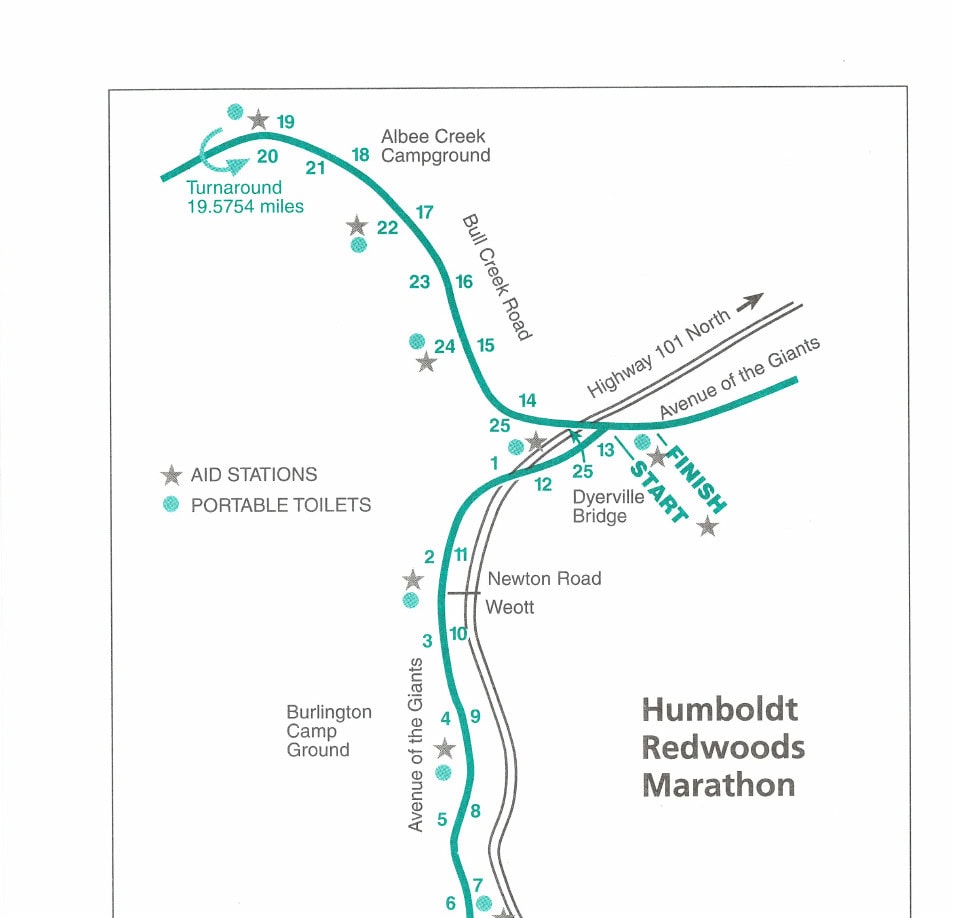
Today’s Humboldt Redwoods Marathon course essentially runs the Avenue course backwards: a 13.1-mile out-and-back south on the Avenue followed by a 13.1-mile westward jaunt on Bull Creek Road.
The altitude of the course is roughly 200 feet above sea level. The first half of the course (on the “Avenue”) is very gently rolling. The second part, the out-and-back on Bull Creek Road, gradually climbs to just under 400 feet between 15 and 20 miles, where it turns and descends to the finish. Ninety percent of the course is run under the canopy of the redwoods, which provides shelter from the sun at one extreme and from misting at the other extreme. The early morning (roughly 8:00 A.M.) temperature is usually in the 40s with temps rising to the 60s by noon. It would be difficult to encounter a truly bad weather raceday, although it can occasionally rain.
Start time is 9:00 A.M., a civilized contrast to the early years of the race, when it started at 7:00 A.M.
It’s been a long time since either Humboldt or Avenue of the Giants has seen 2,000 runners. In 1982 the Humboldt Redwoods took up some of the slack by adding a half-marathon, which has been the USATF Pacific Association half-marathon championship in all divisions, except in 1991 when it was a masters-only championship.
Everything Megamarathons Aren’t
The Humboldt Redwoods Marathon is everything the megamarathons aren’t. The largest town in the area is Eureka, a logging and fishing town 40 miles north. On the way to Eureka are little towns with distinct personalities: Scotia, the home of Pacific Lumber, a well-maintained “company town”; across the bridge is Rio Dell, the poor stepchild of Scotia; then comes Fortuna, a blue-collar town that’s been improving itself annually; and a few miles north and across the river is Victorian Ferndale, a combination dairy and artists’ town featured in the film Outbreak.
Must See/Must Avoid
GO SEE IT
Founders Grove. Just across the Dyerville Bridge, the grove features a self-guided, half-mile loop that will acquaint the visitor with the vast life inside an old-growth redwood forest. Thanks to the Save-the-Redwoods League, some 250,000 acres of redwood land is protected within the borders of California. Especially worth seeing on the loop is the recently fallen Dyerville Giant, which, while it stood, was 200 feet taller than Niagara Falls.
Victorian Ferndale. Featured as the little town threatened by berserker germs in the film Outbreak, Ferndale is a delightful town with carefully restored and tenderly maintained Victorian homes. The town is five miles off Highway 101 to the west.
Bed & Breakfast Inns in Ferndale. If you call early enough, you might be able to book a room at one of Ferndale’s beautifully restored bed & breakfast inns, which are worth a half roll of film: The Gingerbread Mansion (800/952–4136), Grandmother’s House (707/786–9704), or The Shaw House (800/557–7429). The Victorian Inn (800/576–5949), an historic hotel, has recently been reopened.
Ferndale’s Golden Gait Mercantile. The mercantile on Main Street is open at the whim of the soon-to-retire owners, and shopping there is like stepping back in time. Try the chocolate licorice.
Hobart Galleries. Also on Ferndale’s Main Street, Hobart Brown’s art gallery is worth a visit. Hobart gives the term “whimsical” new meaning with his outrageous sculptures. Hobart is also the founder of the world-famous Memorial Day Arcata-to-Ferndale Kinetic Sculpture Race. The Kinetic Sculpture Museum (also on Main Street) is worth a visit if you have a whimsical side.
Downtown Eureka. Eureka (40 miles north of the start/finish line) is the largest city in the area. The downtown has been extensively restored and features more antique shops per block than most any place in California. Make a point of checking out the Carson Mansion, where you’ll want to use up the remaining half roll of film after staying at a bed & breakfast inn in Ferndale. The Eureka Inn, a wonderful old hotel, is also worth a visit or a stay (707/442–6441).
Somoa. Across the bridge from Eureka is the island of Somoa. During late 1997, early 1998, the whole island was for sale. If you’ve got a hearty appetite, a visit to the Somoa Cookhouse, one of the few surviving lumberjack cookhouses in the area, is a memorable experience. Not for those looking for a light lunch.
AVOID IT
Unmarked Roads. Don’t go wandering down unmarked, overgrown roads in Humboldt County. Illegal pot growers tend to be rather proprietary about their groves. Every fall there are reports of shootouts, as pot growers attempt to hold their plots against real or imagined invaders.
The region is home to the ongoing Headwater Forest controversy, while north of Eureka is Arcata and Humboldt State, which is known as the Berkeley of the North. From Arcata radiates much of the activity behind the race-sponsoring Six Rivers Running Club.
Of course, most of the entrants for the marathon come from the San Francisco Bay Area to the south and take over towns like Redway and the hippie throwback town of Garberville, south of the course. In Garberville children are still named Rainbow and Sunbeam and Butterfly, and mothers still shop in peasant dresses and tie-dye. Besides logging, the area is noted for producing some of the world’s best marijuana. It is Humboldt County’s largest cash crop.
Well Laid-Back
The Humboldt Redwoods Marathon is about as laid-back a race as they come. Race headquarters is the Burlington Campground Visitor’s Center (roughly Mile 5 and 8 on the course), where you can pull up, walk to the porch, pick up your number and some race and visitor information. At 4:00 P.M. on Saturday, you can attend a course talk and slide show.
You can pick up your beautiful T-shirt at the start area on Sunday by presenting your race number. For the last 13 years, the race shirt has featured an indigenous bird beautifully rendered by Jeff Jordan (1998’s bird will be the American Kestrel), a stark contrast to the first three years (1979–81) when the same undated T-shirt with several crudely drawn redwoods was used.
The Visitor’s Center is open for business, if you’ve got a few minutes. It offers scads of information about the redwood forests. There is a cross-section of a redwood out in front with historic events marked on the concentric-age circles: Columbus “discovers” America, signing of the Magna Carta, and so on.
There is no race expo to speak of, and there’s no central gathering of
| HIGHS | LOWS |
|---|---|
| Serenity | No easy way to get there |
| Magnificent trees | Hill in second half of course |
| Lovely course | Scattered accommodations |
| Laid-back, well-run race organization | No expo or central gathering place |
| Beautiful T-shirt | |
| Ferndale |
runners. Folks socialize a bit as they pick up their numbers, make plans to get together for dinner in groups of four or six or eight, and wander off.
ACCOMMODATIONS
For accommodation, the entire spectrum is available, from campgrounds in the park to the Scotia Inn and Carter House Victorian Inns (in Eureka).
Parking is accommodated primarily on an open plain along the Eel River, with the overflow parking along the Avenue of the Giants north of the start line. It’s a good idea to arrive an hour before the start to find a convenient parking place.
The start/finish area just north of the Dyerville Bridge is convenient and festive. Half-marathoners often finish their race, enjoy a free juice and ice cream, and then hike back along Bull Creek Road to cheer on their friends who are doing the marathon. In nice weather, a fair number of runners and their families lounge in the sun around the finish area or bolt to spend the rest of the day shopping in Ferndale before starting home.
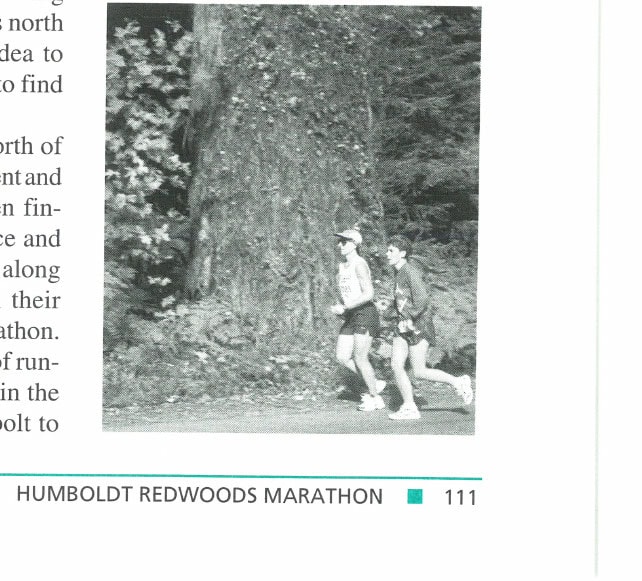
The Humboldt Redwoods Marathon (along with Napa and Big Sur) is one of the reasons Northern California runners can justifiably claim they have the most beautiful 26.2-mile courses in the world. Running through and under the coastal redwoods is an inspiring, revivifying, unforgettable experience unique to Humboldt County. No runner who has ever experienced it ever forgets it.
The Bottom Line
We have weighed various aspects of a marathon within a 1,000-point scoring grid. Besides the author of the article, a dozen runners at the race were randomly chosen to score the race for us. (HRM = Humboldt Redwoods Marathon.) The results follow:
1. HISTORY/TRADITION
Evaluate the race’s sense of history and tradition.
[Possible points: 30 HRM score: 25]
2. ENTRY FORM
Is the race entry form clear, concise, attractive, complete, and easy to fill out?
[Possible points: 20 HRM score: 19]
3. ENTRY COST
For most races, the entry fee covers between 30 and 50 percent of the cost of putting on the event. Rate the value of your dollar relative to this race.
[Possible points: 30 HRM score: 30]
4. LOCALE/SCENICS
Is the race held in an area that is easy to get to and scenic, offers adequate food and housing services, and nonrace activities for family and friends?
[Possible points: 50 HRM score: 49]
5. REGISTRATION
Is registration well-organized and efficient? Does it bog down unnecessarily?
[Possible points: 20 HRM score: 15]
6. PRERACE ACTIVITIES
Evaluate activities such as pasta feeds, parties, and so on, during the days before the race.
[Possible points: 50 HRM score: 18]
7. EXPO
Does the expo offer a fair number and variety of booths relative to the race’s size? Are there quality exhibitors and good guest speaker(s)?
[Possible points: 50 HRM score: 1]
8. COURSE
Take into consideration the following: degree of difficulty, certified, sanctioned, quality of road or trail surface, adequate mileage and directional markers, aid stations, medical coverage, race communications, accessibility to course for friends and family, typical weather, and so on.
[Possible points: 400 HRM score: 360]
9. RACE AMENITIES
This category includes race T-shirt, finisher’s medal, finisher’s certificate, adequate and efficient finish area, ease of sweatbag retrieval, showers, postrace refreshments, awards ceremony, raffles, results postcard, results book, and so on.
[Possible points: 250 HRM score: 211]
10. VOLUNTEERS
Are the volunteers experienced and adequate in number?
[Possible points: 100 HRM score: 81]
TOTAL SCORE FOR HUMBOLDT REDWOODS MARATHON:
809 points (out of 1,000)
This article originally appeared in Marathon & Beyond, Vol. 2, No. 3 (1998).
← Browse the full M&B ArchiveMore like this
1,000+ stories from 19 years of Marathon & Beyond
The complete archive of the legendary long-distance journal — digitized and free to read.
