

In Praise Of Small-Town Races
Ihave to be honest with you. I’m a New Yorker at heart, born and bred in the five boroughs. I was schooled to have a very myopic view of the world: there is New York City, and then there are the sticks, the everywhere else. Moving out of New York has moderated this view only partially; although I now live in Washington, D.C., I still have a big-city view of how things ought to be. Naturally, being a runner, my bias slips over into my view of marathons as well. A proper marathon is not just a 26.2-mile race; it is an event. Streets are closed, runners come from all across the world to participate, there is major media coverage, and there is a sea of participants at the start. That is how things are.
But not in Ashton, Idaho, and especially not in the Mesa Falls Marathon. The race Web site states that when the race was born in 1997, it had only 11 participants and that this number grew only to 40 the following year. Looking around at the starting line in August 2004, it seemed to me that the race hadn’t grown very much since then. I saw only a few hundred runners, apparently no media representatives whatsoever, and precious few spectators. Good lord, there weren’t even any buildings around us, let alone skyscrapers. I had to wonder how I had ended up here.
I didn’t need Sherlock Holmes to unearth the answer. Nearly a decade earlier I had committed to running a marathon in every state, and I was now down to my final six. Although I knew when I first declared my goal that my quixotic quest would take me to some remote places—at least by New Yorker standards—I hadn’t fully considered the consequences of pursuing my dream. And then suddenly, standing at the race start line outside of Ashton, I realized that I would have plenty of time to think about it. Twenty-six-point-two miles worth of time, to be exact. Better late than never, I suppose. Having experienced some of the world’s biggest and most prestigious races, including New York, Honolulu, Berlin, Chicago, and Boston, I was in a good position to do a proper taste test: I would put my past marathoning experiences side by side with the Mesa Falls Marathon
to see which comes out on top: the big-city races or their country cousins. If you were running the race with me, you would have gotten a steady stream of comments and observations, but I’ll give you an only slightly abridged version in the following pages. OK, here we go.
GETTING THERE IS ONLY HALF THE FUN Whoever said that it’s the journey that matters, not the destination, never spent a lot of time waiting around in an airport. As soon as I went online to book my flights for the race, I realized that things would not be as simple as I had expected. There weren’t any direct flights from D.C. to Ashton, and among the circuitous routes that were available, there were precious few choices about what days and times I could travel. Apparently the need for an hourly shuttle had not spread from the East Coast to the heartland. But that was OK; I had not expected booking my flights to be a run in the park, so I wasn’t so easily deterred. Ultimately, the flights I chose landed me in Idaho well past sunset on the day before the race. No problem; I could handle that. I also found out, however, that there was no commercial airport in Ashton, which meant that I would have to rent a car in Idaho Falls and drive an hour to get to my destination. Still not a problem; I’ve had to do that before in other big-city races, so no demerits assessed. That would mean that I would have to miss the prerace pasta dinner, though, which is usually a great place to pick up some local flavor, literally and figuratively. I would just have to try to talk to more folks later on race day.
After spending nearly the entire day outbound waiting for flights and making connections, I finally arrived in Idaho Falls. It was a small airport—minuscule in comparison with JFK International—but that was a good thing, since there was no need to take an airport shuttle to an off-site baggage claim area. All I needed to do was step down onto the tarmac, walk into the terminal, get my rental car, and go. It was then that I learned that despite having made a car-rental reservation, no one was available at the off-site office to set me up with a vehicle. But quicker than I could say “Grrrrrrrr,” I was able to rent another car from a friendly woman at a competitor’s sales desk, and I was soon speeding toward Ashton. I had averted a major disaster, but I knew that all of these transportation problems would never happen in Boston, Chicago, or New York. Advantage: big-city marathon.
TO SLEEP, PERCHANCE TO DREAM An hour later, I was driving down Idaho 47 in Ashton, Idaho, also known more simply as Main Street. I was glad for the sign postings, because I easily could have missed it. With a population of 1,129, there wasn’t going to be a lot of street life anyway, but especially not near midnight, which is when I arrived. The marathon Web site had listed available lodging, and I opted to book a room at
the Four Seasons Motel, which was near to the pickup spot for bus transportation to the race start. When I booked the room a few weeks earlier over the phone, the clerk told me almost apologetically that the price would be $45 per night. I magnanimously told him that would be perfectly fine. I had to admit to myself that $45 wouldn’t get me in the door at almost any New York hotel.
I found the motel; it was one of those wayside-type inns with parking spots in front of each room. There was a note affixed to the front door of the office addressed to me, letting me know which room was mine and that the door was left open for me. OK, this would never happen in New York, not even anywhere within 100 miles of New York.
I ambled over to the designated room, swung the door open, and found . . . pretty much just a room. It was nothing fancy, but it was certainly serviceable. A clean bed, a TV, and hot and cold running water. Gazing out the door, I realized that the local high school’s parking lot, which is where buses would line up in a few hours to begin transporting runners to the race start, was literally right across the street. My fears about getting to bed so late on the night before a race were allayed by the fact that I could sleep to the very last moment and needed only to make sure I had all my running gear on as I stumbled out the door and onto the waiting bus. Advantage: smalltown marathon.
THE BIG DAY The alarm awoke me from a deep slumber, and I looked out the window. Still dark. Nothing unusual, since
© Ron Burruss
▲
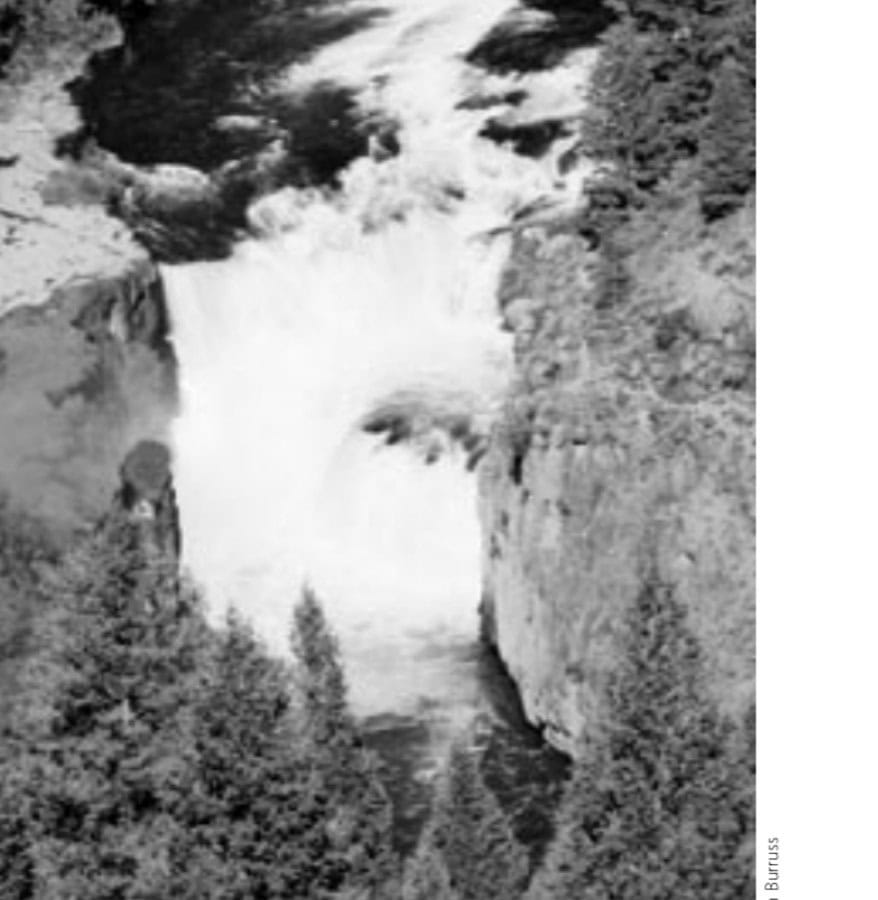
The Lower Mesa Falls—how can you run past and not stop to look?
many races have a predawn starting time. Looking out the window, I saw that two school buses were already idling in the parking lot, with a handful of runners milling about. I don’t think I had ever before had such a comforting moment; I had had some close calls in the past regarding getting on the bus or to the starting line in time, but today would not be one of those days.
Fifteen minutes later, I was identifying constellations in the clear sky as I walked up to the foldable table that had been set up nearby for the race-day packet pickup. The temperature was in the upper 30s, although warmer weather was predicted for later in the day. Race Director Dave Jacobson checked my name off the list and handed me my packet and a smart-looking polo shirt, on which was embroidered the race logo. Dave told me that I was the first person from Washington, D.C., to run the Mesa Falls Marathon. Woohoo! That meant I would hold the course record for a D.C. marathoner just for crossing the finish line. You certainly can’t get that kind of guarantee in the major cities! I mentally began composing my statement to the press as I trotted back across the street to my motel room to drop off my shirt and goody bag and then returned to the buses.
Climbing aboard one of the tour buses, I peered toward the back for the one thing worth its weight in gold to a runner before a race: a bathroom. And there it was, tucked away in the corner. Thus reassured, I settled into one of the plush seats and felt the warmth flowing upward from the bus’s heaters. This was much better than the old school buses that are usually used to transport runners in the big-city races. I unwrapped my “breakfast of champions”—two energy bars and a sports drink. The cabin was buzzing with conversation, and soon I met all the runners who were seated around me. There were a father-daughter team and quite a few out-of-town runners. As it turned out, though, no one had traveled as far as I had. More than one person wore confused expressions when they found out where I was from; they seemed to find it hard to believe that anyone would come so far for such a small race. Politeness ruled, however, and no one actually asked me that question. That was a good thing, as I myself wasn’t quite sure of an answer at that moment
As I sat talking with my new neighbors, I realized that very few of them were first-time marathoners. In fact, several runners present had already completed over 100 marathons and one runner had completed over 200 marathons. I also saw several 50 States & D.C. Marathon Group shirts, indicating membership in a club for runners who aspire to complete a marathon in every state, plus D.C., as I was attempting—or who have already done so. Apparently I was no longer the craziest person in the room. This highlighted a characteristic of this race that I soon came to appreciate; although there were relatively few participants in this race, there seemed to be a greater average depth of experience among them than you would find in the average big-city marathon. Throughout the day I was able to compare notes about different marathons around the country with the runners
around me and, more important, get valuable information about upcoming features of the marathon course from people who had run this race before. As the bus pulled out of the parking lot and began the 45-minute ride to the race start, I settled in for a little power nap, thinking about the high level of collective running wisdom of this small group of racers. I had to admit to myself that this had turned out to be as relaxing as a predawn race start could be. Advantage: small-town marathon.
THE RACE BEGINS!
© Ron Burruss
The bus groaned through a turn, and my eyes fluttered open. The sky was slowly beginning to brighten, and the bus, having left the highway, was coming to a stop next to, well, next to nothing, really. We were in the middle of nowhere. There was no building or man-made structure to be seen anywhere, apart from the road we drove in on. I didn’t know it at the time, but we were in Targhee National Forest, by the Island Park caldera.
We were at an altitude of 6,142 feet, more than one mile above sea level. The air felt crisp and clean as I left the bus and moved toward the impromptu starting line along with the rest of the runners. In New York, sheer luck gets you close to the front of the pack; in Boston, it’s talent that will get you there. In the Mesa
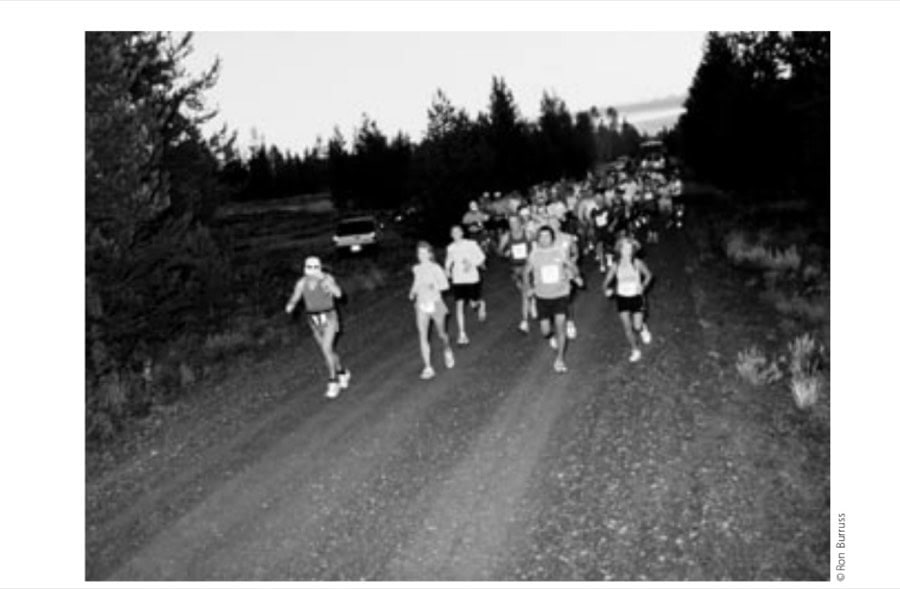
▲ The predawn start. Don’t let the howling in the distance worry you.
Falls Marathon, however, all you need to do is step forward and pick your spot. I chose to stand behind some of the faster-looking runners, close enough to feel the excitement of seeing open road ahead when the race begins, but not so close as to give myself illusions of being an elite racer. Race Director Dave Jacobson led us through the traditional prerace remarks, and then, suddenly, the race was on!
This small phalanx of runners moved briskly along the asphalt as snippets of conversation broke out here and there among them. At that altitude, I knew I would be laboring to maintain my usual pace, so I tried to rein in my legs, which were feeling particularly bouncy that morning. The course was supposed to eventually bring us down to an elevation of 5,260 feet, for a net drop of 882 feet, so I wasn’t worried about keeping things easy in the early going; I would have plenty of opportunity to pick up the pace later on.
I followed the pack through a left turn and found myself on a wide, hardpacked dirt road, heading deeper into the wilderness. We were in full daybreak now, and the views were, I must admit, inspiring. There were rolling hills on both sides, covered in brush and short trees, and soft dirt underfoot. Up ahead, I was told, would be wonderful views of the Grand Teton mountain range. As we ran farther and farther from the main road, I knew that there wouldn’t be many spectators cheering us on in the coming miles, but I was starting to think that they might not be missed.
Then I realized that we were not quite as alone as I had thought. I became aware of some strange noises being made off in the distance, and I slowly began to realize the obvious; wild animals were out there howling at us. Another runner told me that he saw a moose in the first mile of the race. Despite its great size, the beast disappeared soundlessly into the brush. These other animals, however, were not so shy about being heard. At mile eight was a water stop, and the volunteer there told me that he had seen coyotes and wolves earlier in the morning giving him the eye as he set up our refreshments. I felt an instinctual moment of panic, but then I realized that these animals were probably more afraid of us—a loud group of colorful runners—than we were of them.
As long as I didn’t drift so far back of the pack that I would seem separated from the herd, I knew I would be safe. That thought calmed me, and as if on cue, the howling subsided. And just in time, too, because the Tetons came into view up ahead, and they were indeed magnificent, bathed in bright morning sunlight. We were too far away to fully appreciate their sculpted beauty, but it was a treat nonetheless. Unfortunately, the treat was short lived, as they were quickly hidden by the hillside and a turn in the road.
Soon there would be another visual treat, however: views of the race’s namesake, the Lower Mesa Falls. After passing visitor bathroom facilities, I emerged from a stand of trees onto a small scenic overlook, enclosed by steel rails. Looking ahead, I saw that the racecourse quickly turned away from this view and plunged
▲
Near the half-way point at Bear Claw Junction.
© Ron Burruss
back into the woods, so I paused a moment to take in the view. It was truly breathtaking. Hundreds of feet below me and perhaps a half mile or so away, the Snake River plunged off what appeared to be a wide, stone tabletop. After taking a mental snapshot, I turned away and continued on the race path. I had paused for perhaps only 30 seconds or so, but the view made an indelible impression on me. Advantage: small-town marathon. I know there are a lot of great moments in big-city races, but few of them are as unique as this.
MATT’S VERY OWN PERSONAL SPECTATORS It was about this time that I fell into a conversation with Matt, whose race turned out to be a family effort. Matt’s sisters and cousins were providing support from a van—“support” in the sense of screaming and yelling from the open van door during a slow drive-by. “Know those folks?” I joked. “Yeah,” he admitted sheepishly. “My brother and cousin are out here also somewhere, running their first marathon.” Matt already had some marathon experience, having run another local race. “Now that was a small race,” he told me. “Just 22 runners.” I guess he had entered the Mesa Falls Marathon to see what it would be like to do a big race. To paraphrase the old saying, a marathon is in the eye of the beholder.
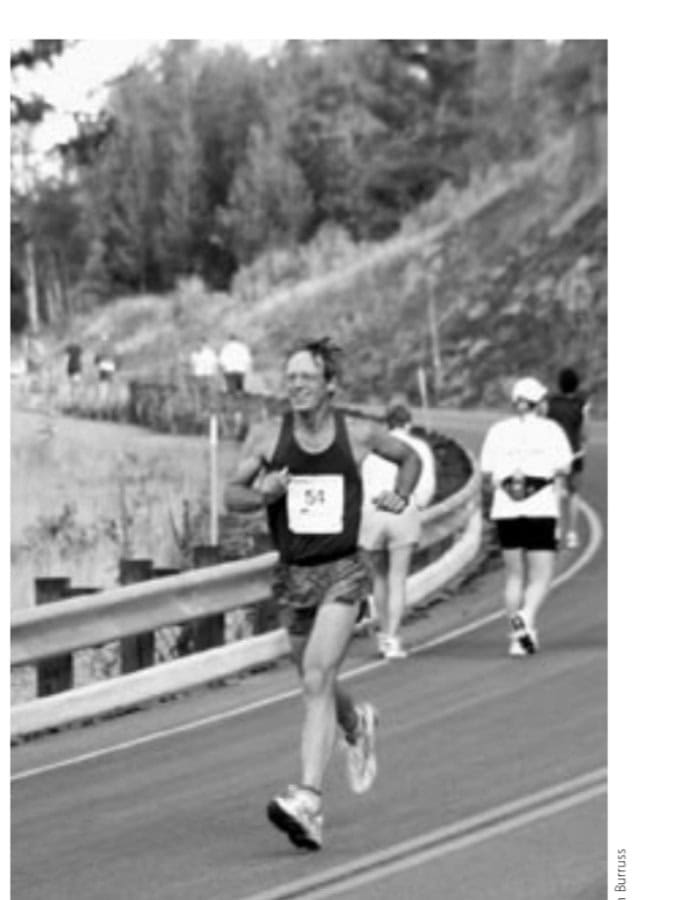
At mile 13, we came to a short stretch of paved road that led us to Bear Claw Junction, which was the starting point for the half-marathoners. I know that some racers don’t like having fresh legs suddenly thrown into their race at the midpoint, presumably because it throws off their pacing. As for me, in this marathon at
least, I was glad to have a little more company on the trail as we descended into the brush and found ourselves once again on a dirt trail. The path we were now running was narrower than the road on which the race had started, but it soon revealed itself to me as one of the most scenic stretches of any marathon I’ve ever run: four beautiful miles along Idaho’s Warm River. Our trail was halfway up the side of a valley, providing commanding views of the river below and the valley around us. The weather had warmed, the sun was shining, the trees and bushes were lush and green, and the river was an inviting blue. Matt told me that there was no truth to the river’s name, however; the Warm River was frigid this time of year. No matter; it looked inviting. I found myself gliding along the path, lost in runner’s nirvana. I assured Matt that even though this was just his second marathon, nature and the race director had conspired to give him a grand treat. He would see many wonderful scenes if he continued racing, but there might never be another moment as perfect as this one. I’ve seen some incredible sights in my years of marathoning—Tiananmen Square, the Coliseum in Rome, windmills in Amsterdam, the skyscrapers of New York City—but I’ve never enjoyed a racing moment more than I enjoyed that one. Advantage: smalltown marathon.
And suddenly, just like that, it was gone. We came off the trail and returned to asphalt roads, rolling through rich Idaho farmland. The views here were less spectacular, but no less interesting, at least for this city boy. I had been warned by several runners, though, that a big hill would be coming up shortly at about mile 18, so I set my jaw in determination and prepared for the worst. There was a hill, all right, but it was not a heartbreaker, at least not in the Boston mold. I threw my mental lasso around the runner in front of me—fitting imagery for this neck of the woods—and labored up to the crest. With that behind me, I settled in to a steady pace and started to think more about the finish line.
POSTRACE PARTY, ASHTON STYLE Eventually, more houses appeared alongside the road, farmland gave way to stores and short buildings, and I realized that I was on the outskirts of Ashton and nearing the finish line. The streets were quiet as I passed an auto-parts store and a thrift shop. Up ahead on my right were grain silos, and I knew the end was at hand. Some spectators were cheering now, and a volunteer steered me through a right turn and toward Ashton City Park. As I crossed the finish line, right at 4 hours, I heard my name being announced—always a nice touch. And for my troubles, I was awarded a ribbon from which hung a patch of cloth bearing an embroidered race logo stretched across a small, round wooden frame. Not your typical finisher’s medal.
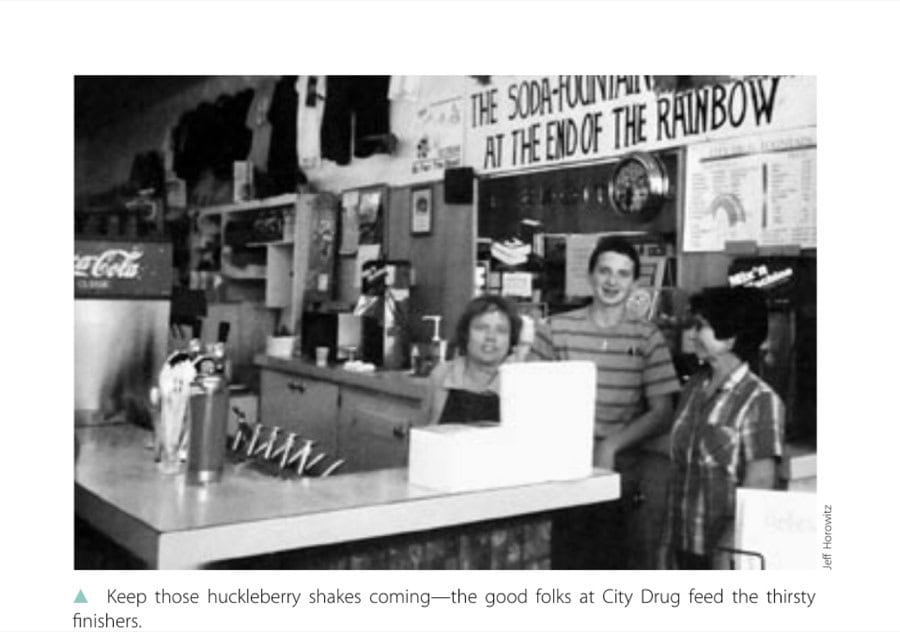
But the best was yet to come. In our goody bags was a coupon, redeemable after the race, for a huckleberry shake from City Drug. I walked past the waiting
families and the other race finishers and over to my hotel room, marveling again at its wonderful proximity. I fished the coupon from my goody bag and eagerly set off for my swag. Along the way, I passed other racers who had claimed their prize, and their smiles quickened my step. City Drug was only a few short blocks away, as it turned out, but it also seemed to be a half century old, or more. It was a small storefront shop, featuring a soda-jerk counter with stools. An older woman gave me a smile as I came in, and a young boy reached down below the counter and produced a genuine, prepoured huckleberry shake. I guess it was pretty obvious why I had come.
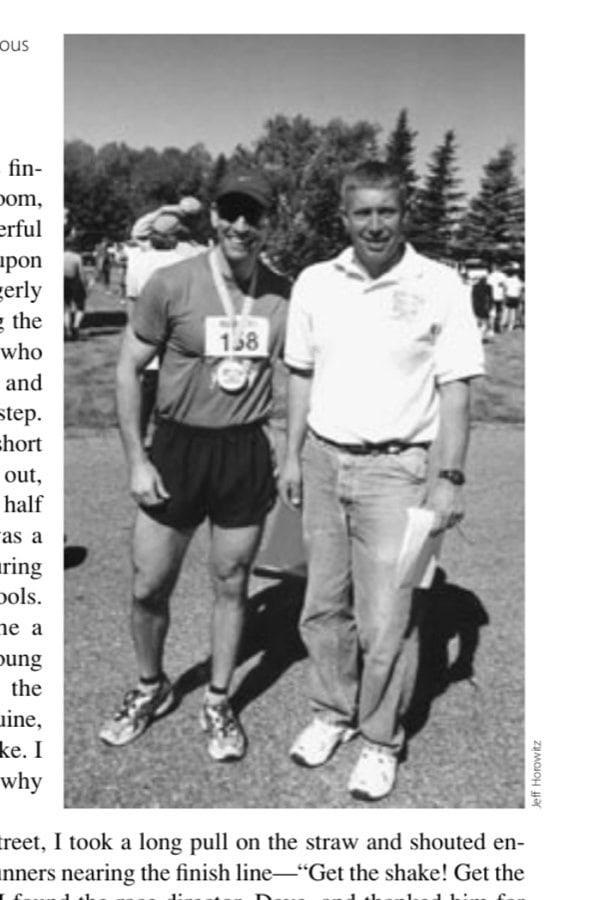
Stepping out into the street, I took a long pull on the straw and shouted encouragement to the other runners nearing the finish line—“Get the shake! Get the shake!” Back at the park, I found the race director, Dave, and thanked him for a top-notch marathon. The last runners were still more than an hour away from finishing—there would be 120 finishers in all—but Dave was already looking to the future. Heady with success, he was hoping to expand the race. “We can accommodate about 500 runners before we have to have any restrictions,” he told me. That would still just amount to a small 5K field back home, but out there in Ashton, Idaho, I nodded in excited anticipation.
I picked an inviting patch of sunlit grass near the covered picnic area and settled down for the awards ceremony. The men’s winner was Jeff Horsley, from Soda Springs, Idaho, who finished in 2:51:12. The women’s winner was Jenny Wolfe, who was listed as being from Yellowstone National Park, Wyoming. I didn’t know anyone could actually live in the park. I wondered whether she was raised by wolves, but I was smart enough not to ask her. Anyway, her time was
Jeff Horowitz
▲
The author (left) with ambitious race director Dave Jacobson.
Jeff Horowitz
▲ Keep those huckleberry shakes coming—the good folks at City Drug feed the thirsty finishers.
3:12:27. Both of these numbers were very respectable, but they didn’t have that otherworldly sound of a Paula Radcliffe or Paul Tergat finishing time. That made them seem more real to me. My own finishing time left me well behind the leaders, but as I watched them claim their prizes, I felt that we were still members of the same species. Advantage: small-town marathon.
As the winners of the various age categories were honored and random prizes distributed—everything from a heart rate monitor to beef jerky—it seemed to me that many of these people knew each other and had probably known each other for years. The camaraderie among them was palpable. It made me wish for a moment that I had lived here, trained here, and raced here so I could share in their good-humored joking and congratulating.
Lying back on the grass, basking in the warmth of the late August sun, I decided to call the competition a draw. I could never give up the big-city races, but I had come to appreciate the Mesa Falls Marathon just as much. Slowly the thought crept over me that probably dozens of equally satisfying small-town races are scattered across the country. When I got home, I would have to start looking. Meanwhile, if Dave’s wish is granted and the marathon balloons to 500 runners, I wouldn’t mind it at all. It would take a lot more than that to erase the small-town charm from this race. For more information about the Mesa Falls Marathon, visit www.mesafallsmarathon.com.
This article originally appeared in Marathon & Beyond, Vol. 11, No. 3 (2007).
← Browse the full M&B ArchiveMore like this
1,000+ stories from 19 years of Marathon & Beyond
The complete archive of the legendary long-distance journal — digitized and free to read.
