

In Pursuit of Ghosts and Unicorns
“It may be springtime in the Rockies, but it’s Marathon time out here…” —from a poem by Bertha Kelley, mother of Johnny “The Elder” Kelley
Ah, yes, marathon Monday in Massachusetts, according to the governor’s proclamation, approaches once again. Time to chase ghosts and unicorns, urges the whimsical mind of many marathoners. “Bricklayer” Bill Kennedy, who won the 1917 edition of the B.A.A. Boston Marathon and ran it a few dozen more times, accurately captured the thoughts of his fellow runners obsessed with the annual trek from Hopkinton to Boston. In a 1932 letter to John Halloran of the Boston Globe, he philosophized, “The lure of the Boston race, Johnnie, is far greater than any in the country and, to me, the world. I can only speak of my own thoughts; but I have been close enough to runners for 30 years that I also know their thoughts, hopes and chances—to win the Boston Marathon, that is the dream of every runner. Sometimes I hardly believe I realized that hope 15 years ago; I am still dreaming, still building castles, and actually believe I am going to win again. “
All marathon runners are dreamers; we are not practical. The hours we spend every day, every year! The strength we expend over long lonesome roads and the pot of gold we aspire to receive for it all! The end of the rainbow, Johnnie, is a survivor’s medal.”
My pursuit of my ninth “survivor’s medal” this year begins, as always, when I arrive at my room at the old brownstone at 463 Beacon Street. Back of the house, third floor, and if I had arrived 50-odd years earlier, I could have leaned out the window and waved to my third-floor neighbors at 477 Beacon Street, 1957 Boston champ Johnny “The Younger” Kelley and his new wife, Jessie. Remember, marathoners are dreamers.
Alberto Salazar, philosopher The dreams often run wild with optimism at the start in Hopkinton. The 1982 champ, Alberto Salazar, once said, “On the starting line, we are all cowards.” But it is a healthy fear, fueled by the desire to run well, for the months of training to
pay off. A dream of running the perfect marathon, capturing the unicorn. As I ran the first mile of the 2007 Boston with my friend Craig from Portland, Oregon, those dreams and the resilience of the human spirit were in full bloom
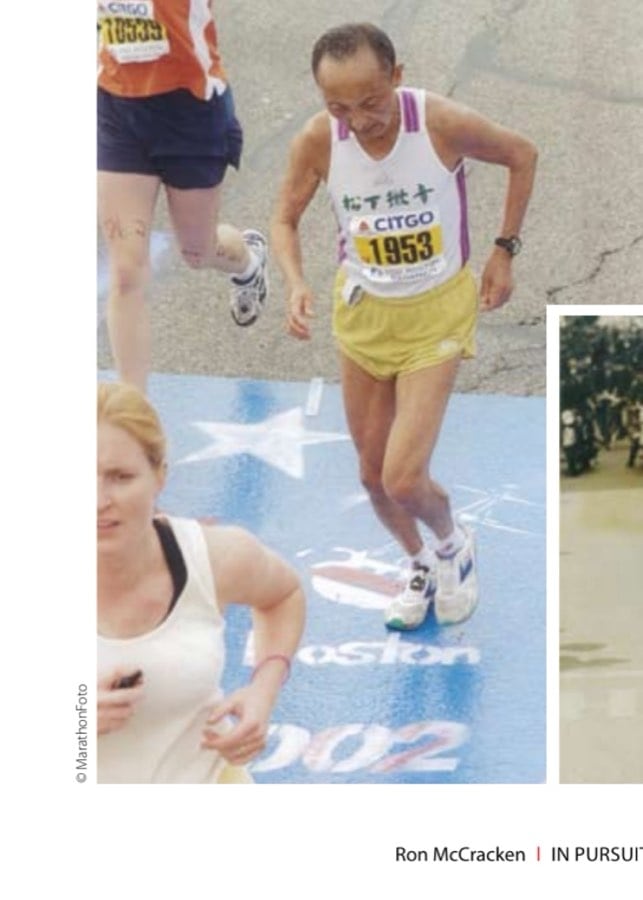
in the form of Keizo Yamada of Japan. Though he was wrapped in layers to protect himself from the nor’easter that pounded us that year, I could feel Yamada’s energy, his life force, as we passed him. I relayed an awestruck greeting to the
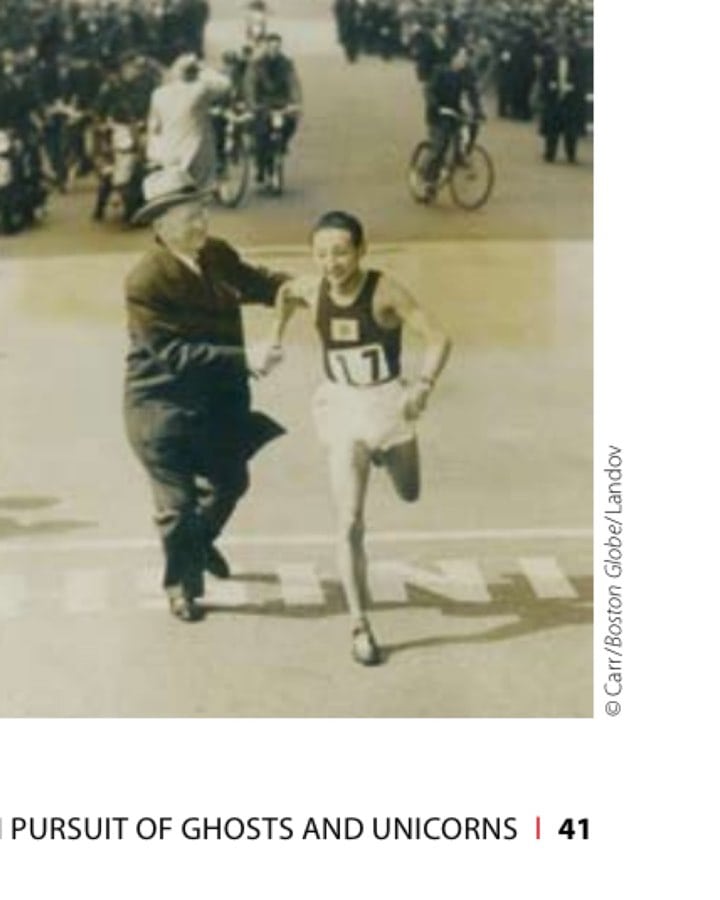
78-year-old champion, then asked Craig if he knew who that was. Craig was astonished when I informed him that Yamada won this very race 54 years before. “My God, that’s 20 years longer than I’ve been alive,” Craig said.
Perseverance, thy name is Keizo Yamada. His castle must be 100 stories high by now.
© MarathonFoto
© Carr / Boston Globe / Landov
▲
Keizo Yamada (left) of Japan, age 79, continues to run Boston 55 years after his 1953 triumph (inset photo). A doctor told him before the 1953 race that he was “too frail” to run marathons.
Framingham, famous for trains As we pass into Framingham, the throngs of spectators thin out for a few miles until we approach the historic Framingham train station. The first major checkpoint in the early decades of the race, it is always a welcome sight. The crowds get thick and loud again, and I envision a photo from Tom Derderian’s definitive Boston book Boston: The First Century of the World’s Premier Running Event. The picture stuck in my head shows a well-muscled Paul de Bruyn on his way to winning the 1932 race. The muscles were earned at his job in the basement of
B.A.A. Photo
A mile or so later, we pass the spot in Ashland where Kathrine Switzer, a very proper college girl who became an unintentional rabble-rouser, ignited the women’s running movement by having the nerve to interlope with an official number into Jock Semple’s race in 1967. Semple’s overreaction drew a firestorm of attention to what otherwise might have become a trivia question.
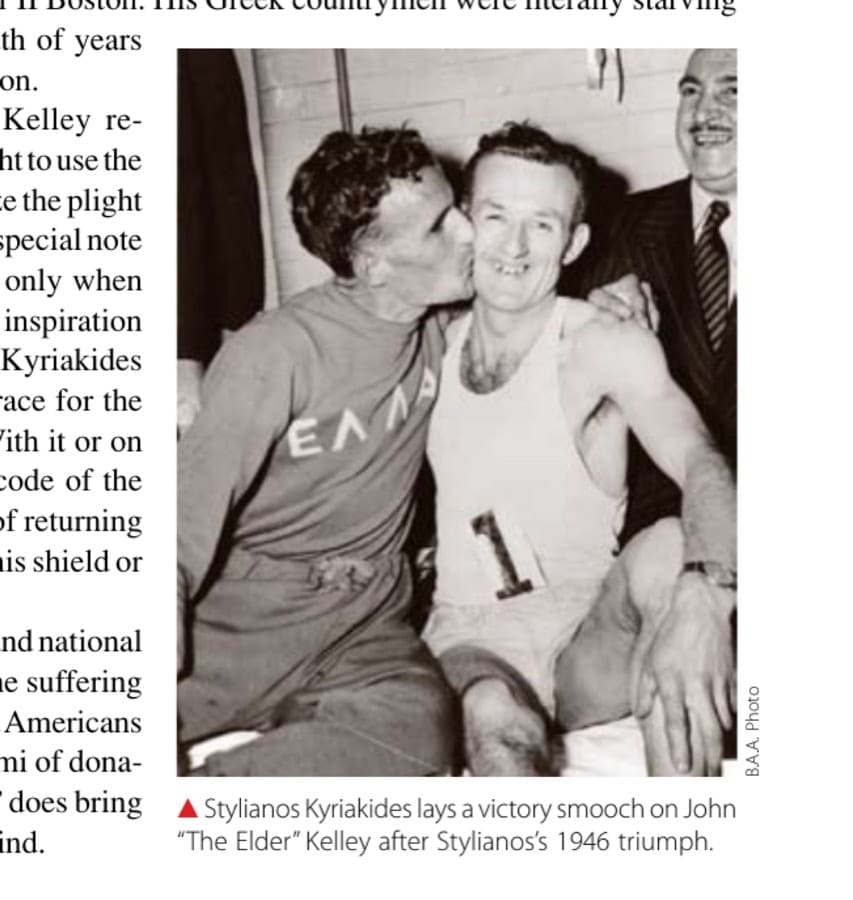
A passing glance at the nearby statue of 1946 winner Stylianos Kyriakides reminds us of things far more important than “the Boston,” as everyman running philosopher Dr. George Sheehan called the race. Kyriakides was a man on a mission when he toed the line against defending champ John “The Elder” Kelley in the first post-World War II Boston. His Greek countrymen were literally starving to death in the aftermath of years of brutal Nazi occupation. “
Stanley,” as Old Kelley referred to his friend, sought to use the Boston stage to publicize the plight of Greece. He carried a special note in his hand, to be read only when he finished. Running on inspiration a unicorn would envy, Kyriakides outdueled Kelley in a race for the ages. The note read “With it or on it,” a reference to the code of the ancient Greek warrior of returning from battle either with his shield or dead on his shield.
The Boston papers and national wire services relayed the suffering of the Greek people, and Americans responded with a tsunami of donations. Yes, “the Boston” does bring ▲ Stylianos Kyriakides lays a victory smooch on John “The Elder” Kelley after Stylianos’s 1946 triumph. out the best in humankind.
the Wellington Hotel in New York City, where the German shoveled coal into a furnace all night long. De Bruyn exemplified sportsmanship, evidenced in a photo of Gerard Cote and John Kelley in the Yonkers Marathon. The German champ, who later became an American citizen, is running alongside his rivals in long pants and dress shirt, handing them cups of water to aid their efforts. “
Bricklayer” Bill’s letter conveys the importance of these friendships forged on the field of battle. Kennedy asserts, “The handshakes and then oblivion. All we have are the good friends we make.” It seems that every year by the time the pack reaches Framingham, I have new friends and unite with old pals not seen since the last Patriots’ Day.
Crossing the train tracks in Framingham, I laugh about the 1907 Boston, won by Tom Longboat, an Onondaga Indian from Canada. Derderian’s book describes Longboat and a lead pack of 10 narrowly beating an oncoming freight train that cut off the rest of the field for a few critical moments. “I heard it behind me and had to chuckle when I thought of the others getting shut off,” Longboat told reporters.
It’s almost guaranteed that the train won’t disrupt the event these days, so we pass into Natick unimpeded. This scenic stretch of the course features Lake
ad
© Victah / www.PhotoRun.net
Cochituate on the left and Fiske Pond on the right, where legend has it that Ellison “Tarzan” Brown jumped into it for relief from one of Boston’s hotter days. A Narragansett Indian from Rhode Island, Brown triumphed in 1936 and 1939. His friendship with John Kelley didn’t prevent “Deerfoot” from breaking Kelley’s heart on Boston’s most famous hill on the way to his first Boston victory.
More than once on Patriots’ Day and at other races, Brown’s running buddies paid the entry fee for the Indian, who Kelley often said was the greatest runner of that era. Brown lived much of his life in dire poverty, illustrated in his first Boston race in 1934. Tarzan’s shoes literally fell apart with nearly six miles to go, leaving him no alternative but to run barefoot to the finish.
Another legendary barefoot runner, Abebe Bikila of Ethiopia, had less success on the course. The two-time Olympic marathon gold-medalist led through Wellesley. His lead shrank to nothing as Boston’s downhills chewed him up and spit him out as he faded to fifth place, six minutes behind winner Aurele Vandendriessche of Belgium.
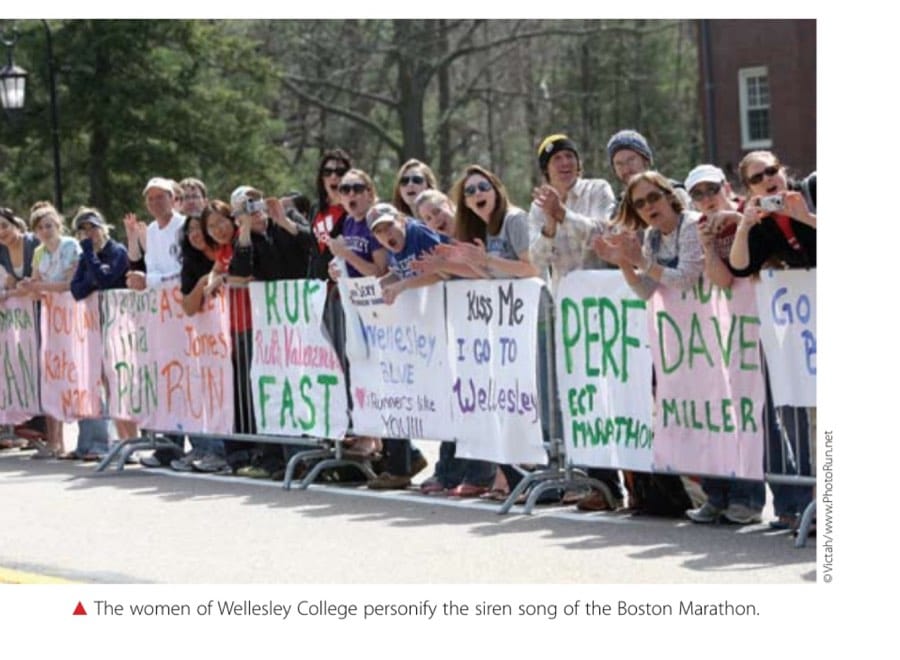
The siren song of the Boston is personified at our next checkpoint. At mile 12 of my first Boston, I heard a high-pitched noise in the distance and told a friend, “Man, it’s awfully early in the race for an ambulance.” As we rounded the bend, I saw and heard how wrong I was. The girls of Wellesley College were screaming
▲ The women of Wellesley College personify the siren song of the Boston Marathon.
ad
at full volume that day, as they are every time. The guitarist in the rockumentary This Is Spinal Tap would probably say they “go up to 11” on the volume knob.
Silencing Wellesley . . . maybe A 1991 photo shows Ibrahim Hussein of Kenya jokingly putting his fingers in his ears as he passes the coeds with the . . . um . . . healthy voices. Truthfully, they are as loud as an AC/DC concert, but it is a joyful noise.
Hussein became the race’s first African champion in 1988 and repeated the feat in 1991 and ’92. Blame it on the girls. Legend has it that the Wellesley women went absolutely crazy when Roberta Gibb passed through in 1966. After training as much as 40 miles per day, the California girl hid in some forsythia bushes near the start in Hopkinton before joining the Patriots’ Day dash and becoming Boston’s first unofficial female runner.
Gibb, like Switzer, “hadn’t intended to make a feminist statement,” she wrote in Runner’s World in June 1978. “I only wanted to do what I love to do and what challenged me.” Nearing the halfway point in Wellesley Center, the love fest between runners and spectators continues, a much-needed boost at this point of the race. Amby Burfoot, the 1968 Boston champ, perfectly described this life-force enhancer.
“Every runner loves the crowds at Boston, and the crowds seem to love every runner.” Heading out of Wellesley Hills and approaching the ski-slope downhill into Newton Lower Falls, I think of my first Boston in 2001 and the warnings Burfoot generously gave me about the course and the downhills in particular. “It just chews people up, Ron,” he told me via phone and e-mail.
According to topographical maps, the descent into Newton Center doesn’t look like much: 951 meters long, dropping from 167 feet above sea level to 49 feet with its steepest grade measured at 5.6 percent. But as I careened down it at that first Boston, I knew I wasn’t in Kansas anymore, Toto. The sea of people swarming the town square formed a wall of noise and positive karma that reminded me of the iconic status of this event and why we chase ghosts and unicorns.
Burfoot’s college roommate at Wesleyan, “Boston Billy” Rodgers, turned on the jets and fired up the furnace at this very spot in 1975, the first of his four Boston victories. Rodgers was a crazily gifted downhill runner, and this course was tailor-made for him.
The interconnectedness of all things Boston seems to intersect here. John “The Younger” Kelley, Burfoot’s high school coach, remembered this patch of macadam on his way to victory in 1957: “For the past several checkpoints, the accompanying press bus had been unable to disgorge its passengers before the leaders ran through. Jock [Semple, race director] occupied a rear seat on that bus, unable to get me the sponges and oranges he had filled his pockets with,” Kelley wrote in Just Call Me Jock. “
At Newton Lower Falls, 16 miles, he leapt from the still-moving vehicle. “‘Johnny! How are you feelin’?’” “‘Terrific, Jock! I can’t believe it!’” “‘Here, mop yer brow.’” “I caught the water-soaked sponge. “
Jock paced me while I traded the sponge for an orange slice.” A few miles down the road in 1975, Semple’s Scottish brogue was heard loud and clear, cheering Rodgers to his then-American and course record of 2:09:55. “Git goin’ lad, yeev got a chance for the rrrrrrecorrrrd!”
Some sage advice for Amby Burfoot’s march to victory was buoyed by the same voice as he topped Heartbreak Hill in 1968, ready to drop into Cleveland Circle. “Give it hell down the hills!” Semple bellowed. “Give it hell down the hills!” Amby later wrote, “Semple’s blustery words renewed me.” As we ascend the Route 128 overpass on our approach to the Newton fire station, it helps to remember the struggles that these men, and later the women,
endured just to get to the start line of the Boston Marathon. Semple hitchhiked from Philadelphia to Boston to run his first in 1930, arriving in South Boston the night before. Johnny D. Semple finished seventh in 2:44:29, just under 10 minutes behind Clarence H. DeMar of Melrose, Massachusetts.
At age 41, “Mr. DeMarathon” was clinching his seventh Boston victory. DeMar worked the night shift on the printing press at the Boston Herald, often setting the type for the headlines on his own victories. It obviously didn’t bother him to stand all night at his job, take the morning train to the start line, and go back to work just hours after his victory.
Bill Kennedy rode the rails from New York City to Boston as a stowaway on a freight train the day before his 1917 victory, a common practice of out-of-town runners in those days. He slept on a pool table in Boston’s South End the night before his golden moment.
Message to today’s runners: we can’t complain about the plane flight or a hotel bed that isn’t just perfect. These guys were as tough as nails. For my money, the toughest of them all was John “The Elder” Kelley, who often gave credit to DeMar for some sage training advice. “Clarence DeMar once told me that you have to do 20-milers when training for the marathon, but the trick is not to do too many of them.”
The elder Kelley finished 58 Boston Marathons, winning in 1935 and ’45, finishing second seven times and in the top 10 an amazing 17 times—all this on an average of 35 to 40 miles per week, never more than 60 miles. Bill Rodgers once aptly described the difficulty in comprehending Kelley’s 58 finishes: “It’s like counting to a million.”
Kelley’s battles with Tarzan Brown, Les Pawson, Gerard Cote, and others often climaxed in the Newton Hills. Taking a sharp right at the fire station, we hit the first of three Commonwealth Avenue climbs. Regardless of the day I’m having, the first one always feels like a sucker punch to me, 450 meters long with its steepest grade at 6 percent: kind of a love tap to warn you of the beating to come. Ouch.
The second rise is longer (625 meters) but not as steep (5.1 percent). When I ran the 2006 Boston with a full-blown migraine headache, it was on this hill that I downed a GU with a huge swig of Cytomax and slammed the bottle to the ground, vowing not to walk anymore on my way to the finish.
Then we hit the most famous 600 meters of asphalt in the entire history of running: Heartbreak Hill. At its steepest grade of 4.8 percent, the hill itself is not frightening or even daunting. Some self-satisfied runners even call it easy. Writer Jerry Nason allegedly coined the term in 1936 when he described Tarzan Brown leaving Kelley in the dust on the rise to the top.
Kelley caught “the Tarz” here after mounting a furious charge up Commonwealth. Some say Kelley gave Brown a quick tap on the rear as if to say, “Nice try, kid. I’ll take it from here.” The Narragansett surged away to his first victory.
Kelley always denied any showmanship, recalling that he often tapped competitors as he passed them “as a sign of respect.” After the race he told Nason, “It’s heartbreaking, Jerry, just heartbreaking.”
Energized by the fans on Heartbreak
▲
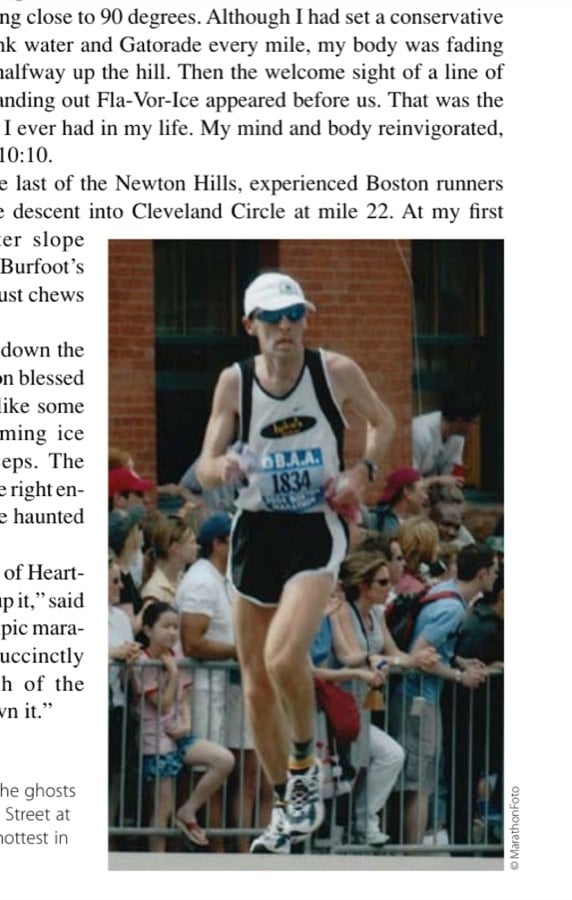
Ron McCracken follows the ghosts and unicorns onto Boylston Street at the 2004 Boston, the third hottest in the race’s history.
© MarathonFoto
The fans on Heartbreak always warm the heart of every runner. “Every runner loves the crowds at Boston, and the crowds seem to love every runner,” as Amby said, and it deserves to be said again and again.
I’ll never forget the spectators here at the 2004 Boston, when we ran in a cloudless inferno reaching close to 90 degrees. Although I had set a conservative pace and diligently drank water and Gatorade every mile, my body was fading and my spirit flagging halfway up the hill. Then the welcome sight of a line of a dozen or more kids handing out Fla-Vor-Ice appeared before us. That was the best-tasting Fla-Vor-Ice I ever had in my life. My mind and body reinvigorated, I finished strongly in 3:10:10.
After conquering the last of the Newton Hills, experienced Boston runners steel themselves for the descent into Cleveland Circle at mile 22. At my first Boston, this 726-meter slope rudely reminded me of Burfoot’s warning: “That course just chews people up.”
From my first steps down the hill that year to my last on blessed Boylston Street, it felt like some crazed ghost was jamming ice picks into my quadriceps. The beautiful cemetery on the right enhances the vision of “the haunted mile.” “
The great mystique of Heartbreak Hill is not getting up it,” said John Treacy, 1984 Olympic marathon silver-medalist, succinctly describing this stretch of the course. “It’s getting down it.”
Cleveland Circle has its own brand of madness, with overflowing crowds, trolley tracks, and a police horse that nearly knocked down Patti Catalano Dillon in 1979 on her way to the first of three consecutive second-place finishes. Dillon broke the previous course record each time, only to be outdone by Joan Benoit, Jacqueline Gareau, and Allison Roe on their way to new course records, following in the footsteps of Bobbi Gibb and Kathrine Switzer, while paving the way for future stars like Uta Pippig and Catherine Ndereba.
The last few miles on Beacon Street always seem to zoom by, painful or not. When I set my Boston PR of 2:56 in 2002, I remember the crowds ahead going crazy for a man pushing his son in a wheelchair. I was moving along at a pretty good clip, feeling strong, and having a devil of a time catching these guys.
What the hell? I thought. Why can’t I catch these two, and why are the fans going bonkers for them? Finally catching them at Coolidge Corner, I ran alongside Dick and Rick Hoyt for a few moments before finding my next gear and finally leaving them behind.
That same year I fought a similar battle with some “old Russian guy” and busted a gut putting space between us. In 2008, I finally met Yuri Laptev, one of the running greats of the Soviet Union in the 1970s and ’80s. Yuri ran a 2:58 at age 59, smoking me by seven minutes. The next day we became drinking buddies with a common love of the Boston Marathon.
Two miles to go this year and I spot in the crowd Jason Kehoe, Rodgers’s lifelong friend who was “the guy on the bike” in photos of Boston Billy’s 1975 triumph. The karmic moment energizes me and I finish in 3:05:01, my fastest Boston in six years.
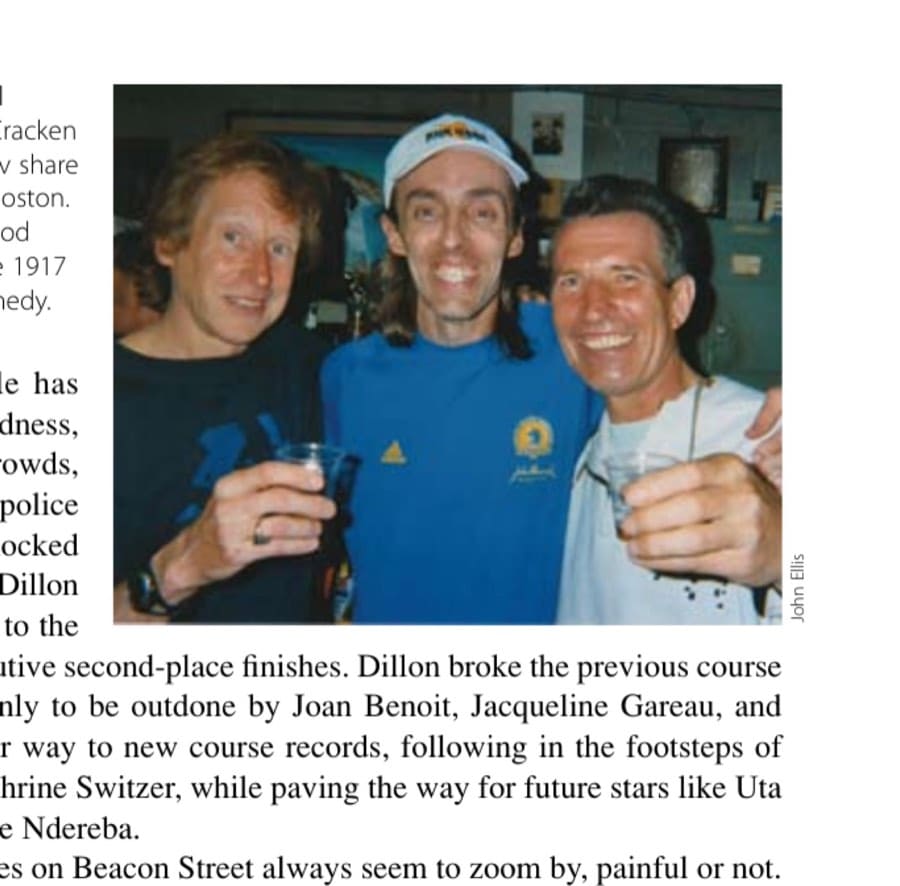
Sharing a toast with Jason, Bill, Charlie Rodgers, Yuri, and other members of the running tribe the next day brings me back to thoughts of “Bricklayer” Bill Kennedy. “The handshakes and then oblivion. All we have are the good friends we make.” That is what happens while chasing ghosts and unicorns.
John Ellis
▲
Four-time champ Bill Rodgers (left), Ron McCracken (center), and Yuri Laptev share a toast after the 2008 Boston. “All we have are the good friends we make,” wrote 1917 Boston winner Bill Kennedy.
This article originally appeared in Marathon & Beyond, Vol. 13, No. 2 (2009).
← Browse the full M&B ArchiveMore like this
1,000+ stories from 19 years of Marathon & Beyond
The complete archive of the legendary long-distance journal — digitized and free to read.
