

In Your Dreams
He is now a full-fledged long-distance runner and shows great promise, having become one of the best 50-year-olds in his club. Just one month before Turin, he had run a new PR at the London Marathon in 3:05:40 and was hoping to go under three hours today.
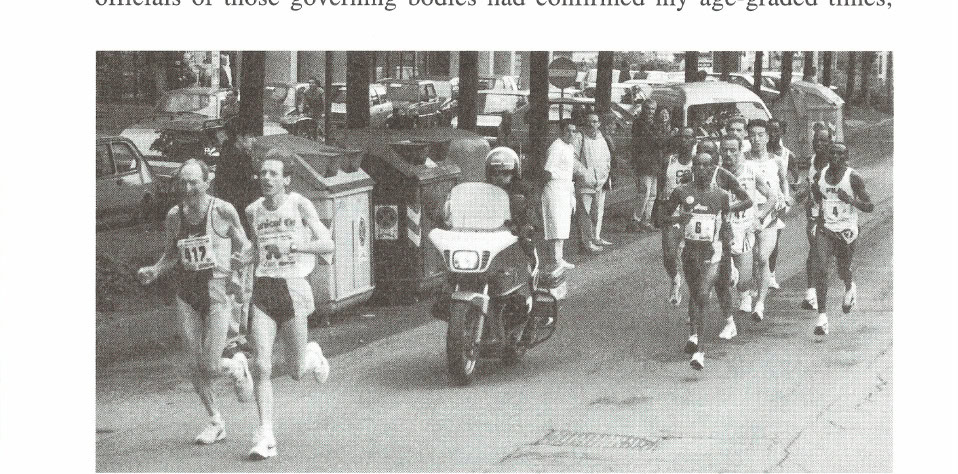
My thoughts returned to the elite runners who had just passed us and were drawing steadily away, their elegant figures becoming more diminutive as our contrary paces separated us. If only I were 50 years younger, I might very well be with these extraordinary athletes, I said to myself.
I was running the centennial Turin Marathon in northern Italy, on May 11 (Mother’s Day), 1997. The race had started in the town of Avigliana, some 25 kilometers northwest of Turin. I was not fooling myself about my potential to be running with these fellows were I 22 years of age. In February 1997 at age 72 I had run the first of a series of age-graded races in Las Vegas sponsored by Indianapolis Life Insurance Company and USA Track & Field and had been declared overall age-graded winner of the half-marathon with an adjusted time of 1:02:10. My actual time was 1:25:24. Just nine days before the Turin Marathon, I had run the Indianapolis Mini 500, another USATF age-graded half-marathon, completing it in 1:27:44, with an adjusted time of 1:03:53, gaining second place overall and placing, age-graded, ahead of great runners such as Bill Rodgers, Steve Plasencia, and others, so I was confident that I might very well be in a Turin Marathon lead pack were I in their age category. The World Association of Veteran Athletes (WAVA) and USATF age-graded tables and the officials of those governing bodies had confirmed my age-graded times,
making me an official world-class athlete. You can imagine how thrilled I was to be thought of as “world-class.”
A CENTURY-OLD TRADITION
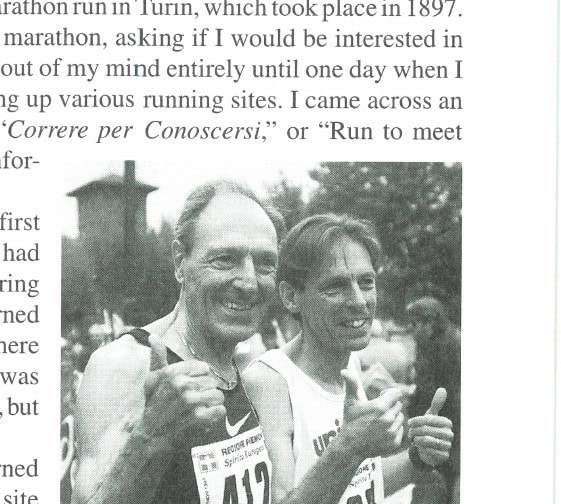
It was because of that world-class status that I found myself here, running the 100-year-old Turin Marathon. Technically, this was not the 100th running, but rather a celebration of the first marathon run in Turin, which took place in 1897. Anthony had told me about this marathon, asking if I would be interested in doing it with him. It had slipped out of my mind entirely until one day when I was browsing the Internet looking up various running sites. I came across an intriguing little line of Italian, “Correre per Conoscersi,” or “Run to meet others,” and began to read the information.
I am fluent in Italian as my first wife, Anthony’s mother, whom I had met while serving in the RAF during World War II, is Italian, and I learned to converse in that language. There was no information in the text I was reading about the Turin Marathon, but there was an e-mail address.
“Correre per Conoscersi” turned out to be an Italian running Web site where runners could meet others to run with when visiting other cities in that country. Composing a letter of inquiry in my best Italian about the Turin Marathon, I sent the e-mail and soon received a reply from the editor of Podismo, a running magazine.
When we spoke on the telephone, Mr. Indro Neri said he had already spoken to the race director of the Turin Marathon, given him my running stats, records, phone number, and so on, and said that I should be hearing from them very quickly. Within a week I had been contacted and invited, and I confirmed that I would run the Turin Marathon.
By this time, Anthony had already registered. I sent a running resumé, photos, and news articles for prerace publicity. I had a formidable racing schedule planned before Turin, as I had elected to run several USATF age-graded masters races around the United States. I continued my practice regimen, hoping I would stay well and be able to accomplish my goals.
ON TO SESTRIERE
My wife Anne and I arrived in Milan on Sunday, May 4, late afternoon, having left Indianapolis 50 hours before. We had spent a long and tiring journey from the United States because of plane cancellations and delays. We picked up our rental car and drove to the Italian Alps to the town of Sestriere, site of the 1997 World Downhill Skiing Championships.
We arrived at 9:30 p.m. and found the office of our exchange condominium closed. Most of the town had shut down because ski season in this beautiful resort area had ended three weeks before. We were at more than 7,000 feet, inhaling pristine air, absorbing stunning scenery, which had enchanted us on the drive from Milan, but we were fast becoming jaded—and cold.
We encountered a kindly Italian gentleman, a local resident, who was incensed that the office staff had left us with no means of access to our condo. He used his cell phone to call around for a janitor or doorkeeper to bring us a key. The local carabiniere had no knowledge of where we might find an official of the time-share, ironically called “Palace Two,” but having no resemblance to any palace I had ever seen, either first- or second-class. Our new Italian friend ascertained that there was only one hotel open of the 40 or more available during ski season. We spent that night at an alternate abode and then transferred to our apartment in the east wing of the “Palace” the next morning.
Light training was my immediate goal. The marathon was just six days away, and here I was at 7,000 feet feeling the effects of the rarified air. Through the Italian Alps from Sestriere, it is possible to walk, jog, or run innumerable miles, into France or Switzerland, with the most beautiful scenery imaginable, made more enjoyable and comfortable by an asphalt trail wide enough for two pedestrians.
Feeling no need to train at other than a moderate pace, I took my first walk on this pathway just minutes from the “Palace.” It was uphill, a medium gradient at first, getting steeper in parts. What I thought would be a very easy walk felt like an 80-percent running effort and produced some healthy panting. I only managed three miles on this first outing.
The next day, Tuesday, I returned to the trail, pushing my effort to a slow run of intervals with short walks between. The effects of altitude made the going hard, but I consoled myself, imagining my body producing more red blood cells to carry more oxygen to my muscles when I would run the Turin Marathon next Sunday. Acclimation doesn’t work that way, of course. One needs months of altitude training to benefit from it.
The scenery, however, was more than therapeutic. It was positively a calming, deeply spiritual experience that I shall cherish forever. It didn’t matter that I was expected by my Turin Marathon hosts to try to break my own world record for the marathon. They had assured me that they were delighted just to have me running the race as the oldest world record holder ever to do so.
I would enjoy every minute of this final preparation for the Turin Marathon. The air was cool and brisk, but the sun warmed my body as I ran on the sky-high trail. I had only once in my lifetime ever seen a sky as blue. It was 54 years earlier, in 1943, while sailing in convoy across the Atlantic during World War II with my RAF squadron on our circuitous route to the Middle East to serve as air support for Montgomery’s campaign against Rommel.
Now the sky above the Italian Alps, speckled with clouds and distant cumulus nimbus, the brilliant blue, the corrugated, sometimes jagged snow-covered peaks that stretched beyond the beyond gave me a sense of being an innocent in a newly-created world. Unlike any other feeling I had ever had, I capitulated totally to the moment, enjoying every forward step, fairly floating back to my lodgings. The experience made even the “Palace” look more regal.
Everybody’s Friend, Carlos
Everyday it had become our habit to visit the best of the two grocery stores open in the otherwise deserted town of Sestriere to secure our daily baguettes and other alimentary supplies. There we met Carlos, the ebullient, vociferous son of the owner, who was a fountain of information regarding local folklore, gossip, and history.
He was a self-styled friendship agent. Through Carlos you could meet and be immediately accepted by any of the remaining residents of Sestriere. Carlos introduced me to Giuseppe, his brother-in-law, a distance runner who had been a fine athlete in his high school years. Giuseppe ran almost every day and was delighted to run with me, showing me his special trails. I spent three very pleasant days working out with Giuseppe.
For one of our workouts we made illegal entry to the local running track, which Giuseppe assured me was perfectly acceptable to any of the officials accountable for the privacy and maintenance of the facility. There we ran some 400-meter intervals. I found them much more difficult than usual due to the altitude. I appreciated this brief friendship and camaraderie. It is very special what we are able to communicate through our love of running.
ON TO TURIN
On Friday, Anne and I left Sestriere, traveling 70 miles to Turin. The race director had arranged for a two-night stay at the United Nations Education Center, where there was special housing for international students. We went first to a large building called “Palavela,” a former, somewhat aged, covered
sports arena that was being used for marathon registration, the expo, the prerace conference center, and a general meeting place.
At the registration table for the Turin Marathon I was greeted by an enthusiastic group of volunteers who were expecting me and made me feel special immediately. Christiana Rossi, the Girl Friday to the race director, introduced herself and others, and then assigned two pleasant young ladies to escort us to our hotel, a short distance away. The expo was surprisingly impressive for a registration of only 2,000 runners. It covered many aspects of long-distance running, from basic equipment to the most sophisticated physical and ergonomic aids for runners. One could also register there for many other marathons scheduled for scenic Italian cities.
At the Saturday morning press conference, I was introduced to and interviewed by members of the print and TV media. I attempted to answer all questions in my good though somewhat rusty Italian. The most common question, of course, dealt with whether or not I would break my world record.
My riposte was, “Sarebbe un miracolo se lo faccio,” which translates to “It will be a miracle if I do it.”
And indeed, I was aware that I would be expecting more than I truly felt capable of at this time. My whole normal routine had drastically changed: food, climate, sleep patterns. And I was still feeling tired from the half-marathon effort in Indianapolis and the difficult journey to Italy. After the marathon, an Italian long-distance running coach told me that he would never have allowed me to race, since I had run a hard half-marathon nine days earlier, even without all the traveling.
I’ve never had a formal coach, so I’ve gleaned most of my training regimens and techniques from running publications. Unfortunately, I’ve paid with a few minor injuries and setbacks because I’ve practiced to the letter various training recommendations that might have been fine for the younger and more supple athlete but didn’t always work for my old bones. I’ve learned to discipline myself better and have improved considerably, taking more recovery time from hard efforts with walking, rather than easy running days.
Anthony arrived later in the afternoon. We spent the rest of the day relaxing and carbo-loading. He visited us in our tiny student room, which provided the bare essentials for hygiene, study, and sleep. He assured us that his room was even smaller, and his bed, on a lofty ledge above the study desk and accessed by a narrow ladder, looked scary to me. Our room looked onto a balcony overlooking the gardens below. The balcony ran the length of the building, allowing access for all of the other rooms.
A gentleman from next door joined us. We began conversing and “No,” he said, he was not there to run the race. He was dressed ready to go to a prerace dinner where he was to speak. Anthony and I were charmed by his affability and his kindly and gentle demeanor. He was an elegant, lithesome, obviously athletic man, and I asked his name.
“Lasse Viren,” he replied. The Flying Finn, my brain’s computer flashed. I was quietly awed to be speaking with one of the giants of our sport. His wife called from within that it was time to go; graciously he introduced her and left. It is serendipitous events like our meeting with Lasse Viren that make our sport so special.
TIME TO RACE
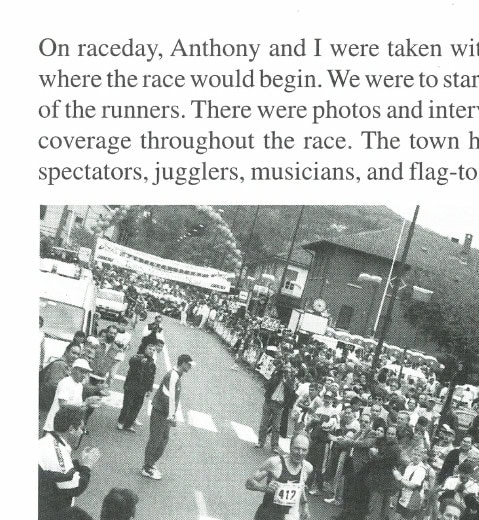
On raceday, Anthony and I were taken with other elite runners to Avigliana, where the race would begin. We were to start the race 20 minutes before the rest of the runners. There were photos and interviews before the start as well as TV coverage throughout the race. The town had a festive air with thousands of spectators, jugglers, musicians, and flag-tossing youths in medieval costumes lining the streets and piazzas.
I was introduced to the mayor of the town who greeted us warmly, patting both Anthony and me on the back, telling us “in boca lupo,” or “in the mouth of the wolf,” a traditional Italian good luck greeting.
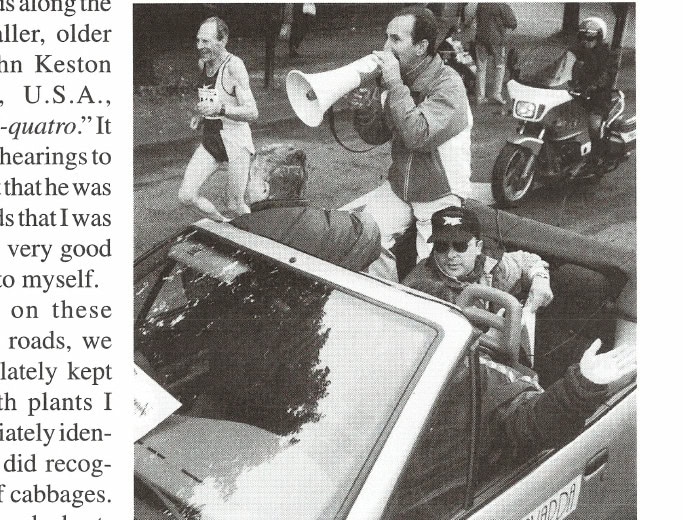
The weather was almost perfect, 56 degrees at the start. When the race started, we left with two police motorcycle escorts, one in front, the other behind us, as well as a police car, the lead race vehicle, and three additional motorcycles, one with a television cameraman. I had had a similar experience in Valencia, Spain, 18 months before when running in the world’s first age-graded marathon in which I finished second overall with an adjusted time of 2:16:40. [See Marathon & Beyond, January/February 1997.] I marveled at the generosity and veneration afforded me by the people here in Turin. It seemed old age commanded great respect in both nations, and the recognition of what I was attempting had been elevated in status.
We could still hear the cheers and live music as we came to the outskirts of Avigliana and were directed onto tree-lined country roads that shaded 75 percent of the marathon course. Crowds of people along the route were encouraging Anthony and me with their cheers, bravos, and forzas, and it was still the early stages of the race.
I had begun feeling strong and running well. We were maintaining an even pace, 4:15 per kilometer, 6:50 per mile. The race director in the lead car was telling the crowds along the way that the taller, older runner was John Keston from Oregon, U.S.A., “categoria venti-quatro.” It took me several hearings to finally figure out that he was telling the crowds that I was born in 1924. A very good year, I thought to myself.
As we ran on these shaded country roads, we passed immaculately kept farm fields with plants I couldn’t immediately identify, although I did recognize one field of cabbages. There were almond, chestnut, and cherry orchards along the way. This area of Piemonte is famous for cherries. In fact, the Turin Marathon logo is a single red cherry on a stalk, bearing also a single cherry leaf. It is a unique, artistic, and very attractive logo.
Again along the route we passed vineyards all beautifully tended. Piemonte reputedly produces the finest Italian wines.
Flat and Fast
The kilometers clicked by easily at first. I was enjoying the scenic, flat course, the accompaniment of police escorts, and the crowds cheering us on; it motivated us to run tall.
Every so often I would hear, “Eco lo, ‘e lui il vecchio, ma credi che ha setantadue anni?” “Bravo, bravo!” “There he is, it’s him, but can you believe he’s 72?”
I was caught up in the excitement and pressure to run well. By my side, Anthony was running easily. I was very proud to have him there. He’s the picture of a top-class distance runner, 5’10” tall, lean, weighing in at 122 pounds. Several running friends had told me that he looks like Bill Rodgers, with a similar running style. At 50 years of age, he is showing the potential for some excellent race times a couple more years down the road. His running career is similar to mine, in that it was begun later in life.
I’ve observed that no matter when a person starts running, there appears to be a 15-year period of improvement and then a falling off in performance. This modest decline doesn’t detract from the enjoyment of running, but rather makes it a better time to appreciate how special our sport is. No matter where we are in the world, we can put on our running shoes, go out the door, and explore.
We had now entered the suburbs of Turin, and it was here that the lead pack passed us. The temperature had risen to what I guessed would be 70+ degrees Fahrenheit, and I was feeling more tired and hotter than I had expected to at this point. The effects of my long journey and my recent hard half-marathon begun to catch up with me. Farther along the route, Anthony said, “We’re off pace, Dad. The last mile was 7:10, which puts us about 30 seconds off a sub-3:00 finish. We should try to pick it up.”
I knew I was slowing down considerably and would not be able to sustain even the current pace. We were at kilometer 28 by now, with 14-plus to go. Several other packs of runners had passed us, and a steady stream of runners were catching us as our pace decreased. Anthony still looked very strong, his gait energetic and relaxed. I told him he should go ahead and try to accomplish his personal goal of going under three hours.
We had continued through the streets of Turin to the encouragement of all the good citizens who had turned out to support us. I noticed many elderly folk among them and heard over and over again, “‘e lui,” “It’s him.” They recognized me from prerace publicity, I assumed, and it was comforting to have oldies of my generation urging me on.
The pace car had gone ahead with the lead pack, but I still had two motorcycle policemen accompanying me, one ahead and one behind. They stayed with me until the finish. I later learned from the race director that they were instructed to stay with me for my personal safety throughout the event, no matter how long I might take to complete the course. This consideration for my well being impressed and moved me deeply, although what danger they were protecting me from, I’m not certain.
The Dizzies Arrive
I began feeling dizzy just before Anthony left me. Light-headed, I was unable to focus clearly on any object either ahead or close by. My hearing also seemed to be distant, as if all I was hearing were echoes. I drank at every opportunity, but there was only water available; there had been no sports drinks offered along the course.
I was having difficulty getting enough air, and my chest felt tight, which made it difficult to breathe, and was accompanied by a hint of pain. These symptoms concerned me only slightly since I was diagnosing them as hypoglycemia. Why I didn’t stop and ask one of the good folk along the way for a pop or other confection, I cannot now say. I was determined to finish the race in a respectable time, so I decided to jog, walk, run, walk, whatever would get me to the finish line.
It was obvious that I had not had enough rest to perform at my best. If I were hypoglycemic, then I should have heeded the advice of Domingos Castro, who at breakfast had told me I that should eat some bread and jam. I explained to him that I had never eaten much of anything before racing and had always felt I raced better on an empty stomach. This morning I had only ingested sweetened tea with milk. I should have done as Castro said! He had just won the Rotterdam Marathon in 2:07. “He ought to know,” I said, chastising myself later that day while Anthony and I analyzed our performances. Domingos was not running the Turin Marathon, but was there to support his twin brother, Dionisio, also an elite marathoner. Dionisio finished in 2:25:19.
For the next 12K I struggled to keep a clear head and maintain a respectable pace. Onlookers continued to encourage me. I could still enjoy their cheers and was also able to appreciate the neighborhoods through which I ran. A narrow cobblestoned street became a moderate obstacle, the footing lumpy and unstable. This opened onto a large granite flagstoned piazza with impressive buildings, statuary of ancient military heroes on horseback, and on two sides of the cordoned-off course, open-air cafes where Torinese folk sat drinking their capucinni with rum babas, watching the parade of marathoners. Several times I heard church bells ringing as we came closer to the center of town.
Already I had been charmed at the prettily dressed children on their way with Mom and Dad to their local churches. Carabiniere at every intersection saluted us as we ran by. Perhaps they were acknowledging my motorcycle escort, to whom I had become very attached.
I exchanged words several times with them and told the one officer that I wished to be photographed with them at race’s end. I was disappointed that they peeled off 300 meters from the finish line and I never saw them again.
Close to the end of the course there was a group of local school children and their teachers who were supporting Anthony. When they recognized me, I received extra special shouts of encouragement. This Turin elementary school was an exchange group with the elementary school in Bicester, Oxfordshire, England, where Anthony teaches. Anthony was running for UNICEF, and the children from both schools had received pledges for that charity.
The Finish Nears
The last 5K was extremely difficult. Crossing a bridge over the Po River, which runs through Turin, I could hardly walk straight up the initial incline and was glad to make it to the halfway point, coasting the downhill. Even with the extreme fatigue I was feeling and the dizziness that persisted, I never had any thought of dropping out. I was struggling to keep my legs turning over, now walking two or three times per kilometer and jogging as best I could. It was necessary to cross the Po once more, this time on a pedestrian bridge with uneven boards laying crosswise and covered with a green felt cloth that rucked up in parts. I negotiated this without mishap but then had to run a double spiral, narrow ramp down off the bridge, which didn’t help my dizziness!
Running a short distance more along the river, we crossed a four-lane highway. The traffic was diverted to accommodate the race. The final leg and another downhill ramp, covered this time with blue felt, led to the finish line at Palavela.
A young Italian runner had caught up to me and had been egging me on during the last 500 meters. Somehow I summoned a final spurt of energy to match his speed, and we crossed the finish line together to a great reception.
The cheers and applause were almost embarrassing. Finish line spectators had been following my progress throughout the race on an immense television screen. I had truly been made Turin’s hero of the day, finishing in 3:20:01. Congratulations from reporters, race officials, and spectators engaged me for several minutes until Anne, my other son, Michael, and his wife Joanna, our two grandchildren, and Anthony found me and gave me recovery drinks, candy bars, pasta, and other tidbits. Race director Luigi Chiabrera gave me a big hug, telling me that I was “il uomo del giorno,” man of the day. It took four hours for the dizziness to pass, but I felt better later and set to some serious carboreloading.
Joseph Chebet of Kenya was the open winner with 2:08:23, his time confirming just how fast the Turin Marathon course is. The women’s winner was Janis Salumae of Estonia, who ran 2:27:04.
At the awards ceremony I received a spectacular plaque from the city of Turin. It is a silver rectangle with two gold medals inset on either side, one depicting the ancient Roman walls of the city and the other a map of 17th century Turin. It is housed in a plush black presentation case, and I value this highly, as it represents not just the Turin Marathon, but the camaraderie, hospitality, fellowship of running, and the good friends made in Italy.
Two months after the marathon I received my first-place age-category award, a real gold medal, bigger than one inch in diameter, quite thin but bearing the Turin Marathon logo embossed in colored enamel. It is a beautiful work of art and the only real gold medal I’ve won in 17 years of running.
The evening after the race, the family went to supper at a country inn with Italian friends of Anthony’s. We dined heartily, drank fine Piemonte wine, and enjoyed the banter of our Italian friends, who thought Anthony and I were crazy to have subjected ourselves to the tortures of 42,195 meters. Anthony had bettered his London Marathon time by three minutes, finishing in 3:02:40. We parted company after dinner. Michael and his family returned with Anne and me for a few more days back in Sestriere. Anthony would leave for England the next day, so he stayed with friends in Turin.
Back to Sestriere
The Monday after the marathon, back in Sestriere, I went by the grocery to pick up a baguette, and Carlos was effusive about the TV coverage I had received. “Piu dei Kenyans,” “More than the Kenyans,” he told me. Many of the villagers had seen l’americano on TV. I had impressed the community, and I was toasted in the grocery store with “Grappa.” Giuseppe’s wife had recorded the event on videotape. Along with a bottle of homemade wine, the tape was presented to Anne and me by Giuseppe as a parting gift. Pictures were taken of us with Giuseppe and Carlo, I sporting aloft my treasured bottle of homemade wine. Michael and his family left for England a few days later, and Anne and I left Sestriere at the same time for a three-day driving tour of Pisa, Florence, and Milan.
Perhaps the most gratifying event of our tour culminated in our flight from Milan back to Manchester, England. We were informed at the British Airways ticket counter that we had been upgraded to cabin class. The captain, my son, Michael, had so ordered it. I was going to fly with him for the first time in his 20 years of service. I was given a seat on the flight deck for both takeoff and landing. Anne was also invited to the flight deck where landmarks in Switzerland, France, and England were pointed out. It was an extra-special flight.
Upon landing, Michael drove us to his home where we spent the next several days recuperating and enjoying family before returning to the United States. This had surely been one of our most treasured trips ever.
This article originally appeared in Marathon & Beyond, Vol. 2, No. 2 (1998).
← Browse the full M&B ArchiveMore like this
1,000+ stories from 19 years of Marathon & Beyond
The complete archive of the legendary long-distance journal — digitized and free to read.
