

Inside The Flying Pig Marathon
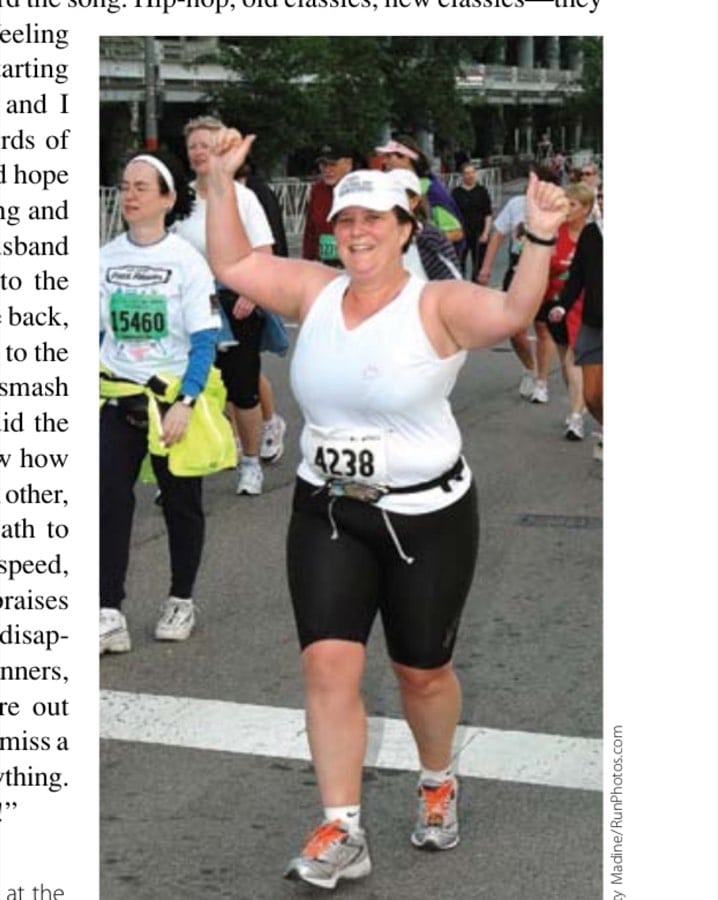
Feeling good, feeling groovy at the Flying Pig Marathon.
© Katy Madine / RunPhotos.com
Standing fitfully at the start line, I realized that every song being played on the loudspeaker felt perfect, a favorite. It didn’t matter whether I knew the words or had ever heard the song. Hip-hop, old classics, new classics—they all had a strong beat and a feeling of victory. I was at the starting line of a 26.2-mile party, and I felt ready to take these words of strength, determination, and hope with me as I ran. I felt strong and ready. When I kissed my husband good-bye so he could go to the front of the pack and I to the back, I wished him luck. I prayed to the running gods that he would smash his personal best, and he did the same for me. We both know how important this day is for each other, hours apart on the same path to a PR. I am in awe of his speed, strength, and grace, and he praises my endurance. Before he disappeared into the crowd of runners, he pleaded, “When you are out there, don’t freak out if you miss a split, get tired, leg cramp, anything. Enjoy it, and keep pushing!”
“I promise” to try, I assured him and myself. When people identify slow runners as those in the back of the pack, I have found that the description is actually a comparison to their own competition. Which pack? My husband is at the back of the lead pack (or the front of the pack, depending on the size of the race and the prize money offered). My best friend runs a 10- to 11-minute mile and proclaims that she is a back-of- the-pack runner. I would say that she is in the back of the middle pack, with my sister a minute or so ahead of her. She in turn is in the back of the pack of her friends (who are a minute or two ahead of her). I am in the back of the pack of the race, although even that is not accurate since only once have I actually come in last. And so that is where I start. I try to back up as the area fills, checking out who I think should be ahead of me. I know that my husband would wince if he saw me rating myself against these runners and constantly retreating. And so I stop the retreat. I find a spot in the crowd and ignore those around me. I listen to the beat.
I am not at the back because I am content to be there or because I am not in fierce competition. I am there because it is where I start my journey, and I am neither content nor ready to allow my competition (myself) to pass me. I have my goal of being at the front of the back of the pack, maybe always behind my husband, sister, best friend, and thousands of others. For now my sister and friend are hundreds of miles away (and probably sleeping) as I finally start!
Within three minutes of crossing the start line, I have a cramp in my calf. I have to stop and stretch. Don’t freak out. I promised. I pull over to the side and watch the runners and walkers pass me as I find a curb and stretch. “No panic,” I repeat as my heart beats faster. I feel better and I am out again on the course, now passing those people who had run by. I find a woman about my age who walks and runs and walks and runs. I keep her in sight. She stays ahead of me when she runs and falls behind when she walks. I know that is a better way to do it. I could be faster if I did, but I want it my way. I will walk at the water stops. I will drink water and Gatorade and pour more water on my head. I will stay hydrated and cool in this warm weather. I have learned my lessons before on shorter races than this one.
Lessons from the ultra world It was from ultra stories and magazines that we realized why I was crashing at the end of my races. No matter the distance, my speed slowed to a crawl and I felt nauseous and heavy. I had my heart checked and my lungs checked, and the only thing my doctors were worried about was my knees (which did not hurt). It was through reading the stories of ultras that we realized that I was dehydrating myself. In utter fear from all the stories on overhydration, I would take the least amount of liquid possible. I am a slow runner, and that’s who is warned. But apparently I am a slow runner who sweats a lot. I started weighing myself before
and after short and long runs and realized that I was losing a lot of weight. This meant new water bottles and a CamelBak, bringing more liquids, and my husband meeting me at the halfway point of long runs to refill. All of a sudden, my finishes were no longer death marches but some of my fastest miles. Today, it was warm, my worst fear, and I knew that I had to hydrate all I could.
Mile one, even with my stretch break, was 15 minutes, 5 seconds. The plan was to stay between 14:45 and 15:15. As we went up a bridge into Kentucky, a band on the bridge was playing music so loudly that I forgot we were on an incline. I clapped for the musicians, up at the crack of dawn to play for us. I knew this would be fun. The next two miles were on schedule. I was a gazelle. I felt strong, maybe even a bit invincible. I panicked at mile four when I looked down at my watch and it said 18 minutes. A woman walking next to me had asked if this was my first Flying Pig, and now I needed to ask if I had missed a mile marker. She said I had, and there was a collective “phew” all around me. Everyone started talking about how they had missed it. I wondered if this walker really saw it or saw the panic on my face. Either way, I was not going to let this get me. I knew that every step was closer to the hill.
I was not a child athlete. I shunned health growing up during the ’80s, with the Cold War and the dangerous world where it seemed just as likely that I could live a long life smoking a pack a day as being wasted by disease (Hey, isn’t that what Marlboro explained?). Then I found myself approaching 30 and smoking, out of shape and overweight, and feeling physically old (although the way I was acting, I was definitely mentally young). My sister had run off and on and raved about how she felt. She believed that anyone could do it. That summer, my husband played soccer inside a running track, and I watched the runners go round and round. I read an article extolling that “Running makes you smarter.” It seemed the world was sending me a message. I listened.
I started with running a quarter of a mile on the track . . . OK, surviving is more like it. My smoke-filled lungs choked on every breath and the track was made of quicksand, pulling me under, leaving me unable to lift my lifeless, dead-weight legs. The loop looked so short before I started, watching from the bleachers, and now it stretched forever. Dramatic enough? I thought I would die. However painful the five minutes were, I survived but knew that I would never go back unless I had a big goal, one that was impossible and insurmountable, one that only a hero in the movies would accomplish.
Time to formulate a goal Slowly walking back to my apartment, I came up with a plan. My husband, naturally fit although not yet a runner, sitting on the couch with his beer and baseball, asked how my “run” was.
“I am going to run the New York City Marathon in three years,” I said. “How long did you run out there?” “One loop, but trust me, it will happen.” Three years later, I ran the marathon and I have never looked back to that 29-year-old girl (OK, woman) with a cigarette and a beer (and neither has my husband).
Hills and I have a special relationship (kind of like speed workouts, except that I actually have walked away happy about a hill workout). Some days they help me fly, using different muscles and changing form, and some days they pull me down like waves in an ocean hitting a small, bobbing boat. I had done a lot of hills in the beginning of my training (too many?), but sometimes the waves would crash and force me to walk the hills.
When I was reading about the Flying Pig Marathon, I knew there was a hill to prepare for (or fear). Now I was into that hill that led from mile five to mile eight. I should have walked this hill, but I felt invincible. The three-mile hill slowed me, hobbled me, held me down, and made me question my ability and goals. It wasn’t that steep (until the end). It was just long and slow, and later my husband would ask whether I saw the beautiful view. I laughed hard: “No.” I saw the road in front of me, running small goals of one tree or light post to the next up the never-ending serpent. He had seen the view and said it was beautiful.
ad
At the top, on the right, after the serpent, there was a church with two people passing out orange slices. I grabbed two. They yelled, “Presbyterian oranges,” to which the only response that I could think of was “God bless.” My hands sticky and my throat quenched, I was in awe that the whole neighborhood was still out for us. It had been hours since the start and since the front-runners had passed.
At about the 8.5-mile mark, the course split. To the right were the marathoners and to the left the half-marathoners for a nice downhill home. We had seen the halfers on that downhill while trudging up the hill. The race had a large flashing sign like the one used at a construction site to warn cars to move to a different lane. Big arrows bobbed back and forth directing us in the correct direction. I had been wary of this point, since the manual given at the expo had said that if we didn’t make it to this point by 9:20, we should consider finishing the half. I had fears of volunteers standing there trying to get us to go to the left. I knew that I was five minutes from the “consideration” time, but it also scared me to think that everyone behind me would have to consider this choice. As it turned out, there were no imposing volunteers to strong-arm our decision. When I moved into the right lane, I heard cheers of “You go, girl” and “Looking strong.” I had also feared this point because I thought that I would lose everyone on the course. I would alone go to the right, and the half-marathoners would go to the left.
We had picked this marathon for me, the slow runner. After law school, we went to Huntington, West Virginia, for a clerkship, and it was there, away from my crowded New York City races, that I realized how lonely it could be at the back of the pack. In Huntington, I ran the local half-marathon while my husband ran (and won) the full. I spent most of the race running alone on back streets with no one in sight, either ahead or behind. It was miserable. It was lonely and hard, not because of the hills or the distance or the heat but because of the loneliness
© www.Brightroom.com
▲
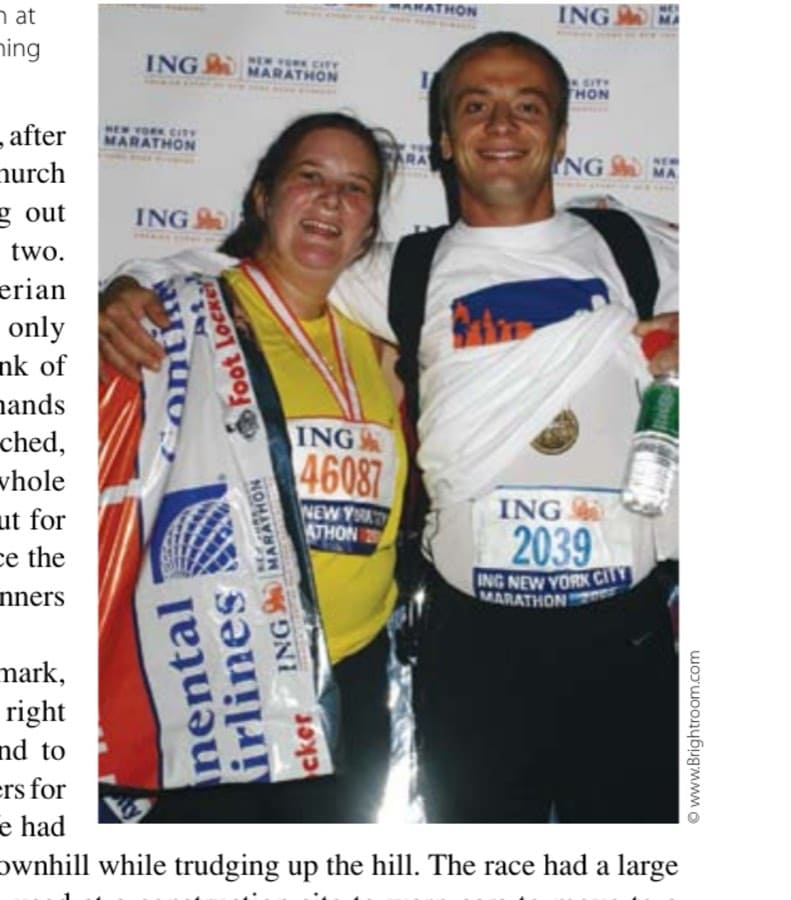
With a first marathon finish at New York, I was already planning my next marathon.
that somehow overwhelmed the flat, cool race. I knew that my next marathon had to be set up to support the back-of-the-pack runners. I needed the energy of the other runners and walkers, water stations that were still open, and a course where I could watch the scenery change. My husband was up for anything.
We searched for my perfect race and found it. Cincinnati’s Flying Pig Marathon was continually rated as being good for the back-of-the-packer. It had a generous cutoff time of eight hours. In the 26 days leading up to the race, the organizers sent e-mails telling us about the course and the race. We were jazzed. At the expo, I was excited when I saw a booth for Marathon & Beyond. Between my husband and me, there is fierce racing to see who can grab the magazine first when it arrives (even there I come in second). I went to see what was available and started grabbing old issues off the rack. We started talking to the women standing around, and I was immediately accepted. I was encouraged to try an ultradistance event. No one asked my speed or doubted my ability. It was suggested that I should try a timed ultra first. There is an eight-hour one in Illinois (Howl at the Moon) in the summer. Oh, I want to do it. I want to see those excited women again.
The marathon stretched through the different residential neighborhoods of Cincinnati. An out-andback section allowed the thinned support for the back of the pack to cheer us both ways and for us to twice enjoy the band playing. A team of supporters created signs with the “Top 10 Reasons to Run a Marathon,” and as the saying goes: everything is 10 times funnier when running. I anxiously awaited each sign (although I missed a few). My favorite was a sign that said it was a better per-mile ▲
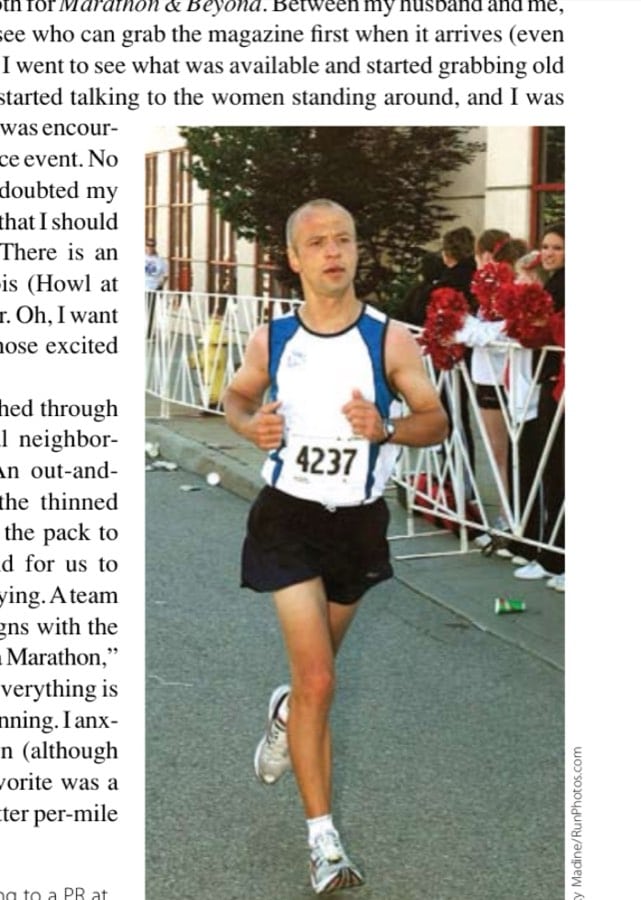
My husband, Andrei, flying to a PR at The Pig.
© Katy Madine / RunPhotos.com
In search of the perfect marathon
rate than the short races. A great deal! Children handed out Gummi Bears (which I realized that I liked on long treks between water stations) and Starbursts (I realized that I can’t get the wrapper off without tripping) as well as high fives.
One young girl asked her mother, “Why are some people so slow?” It was clear that they had been standing there waving for hours; her mother looked unprepared for the question. “Everyone is different, made different, and able to do different things, but all of them are completing the distance as they can.” I yelled behind me, “Yes we are!”
The night before the marathon, my husband handed me a book called A Cold Clear Day by Frank Murphy. It was the story of Buddy Edelen (and if you have to ask “Who?” read the book). He had marked a chapter for me to read. The chapter was about Buddy’s run of the Yonkers Marathon to qualify for the Olympics. I questioned my husband’s choice of inspiration; shouldn’t I stay with the slow runners’ words of inspiration? “No, he is running the same distance with the same obstacles.” That marathon for Buddy was intense and hot, his dream was on the line, and the words filled me with excitement and reminded me that I, too, am a runner. Like the people before me, in front of me, faster than me, I was working to be better than I had been before. The mother’s words to her child reminded me that I am like those fast marathoners, doing the same distance and fighting the same demons, just for a longer time.
During this race, I felt the friends and family who cheered me in the New York City Marathon, maybe even more than when I saw them on the streets of my hometown. During the New York City Marathon, I was unprepared for the distance. I remember thinking at mile three, This is long. I had done long runs but not long enough. Before I saw my best friend at the start of the Queensboro bridge (mile 15), I had hoped beyond hope that she would not be there. I had felt defeated by that point, even embarrassed. And then I saw her and another friend holding signs that read “Go Heather! Go Volik!” They were alone cheering, everyone else had left, and the street cleaners were starting their work. I had been ashamed of my pace and slow stagger and hoped they had given up on me, so they could remember me as that hero that I had hoped to be. But as soon as I saw them screaming, cheering, handing me salted soy nuts, and telling me how good I looked, I was reinvigorated, not ashamed, and even proud.
Spurred by a pleasant surprise Now, in a strange city going through the 16th mile, hoping that the rolling hills would actually end soon and my knees would stop screaming, I felt them cheering. I remembered my mother and sister at mile 17 with signs and my best friend who found me again to proclaim, “I am running a marathon next year!” I (weak, slow, and insecure) had actually inspired someone else!
The course in Cincinnati was filled with people and musicians who had been out there for many hours. The water stops were still full and vibrant, cheers and music filling the streets. The police waved as I passed, and when I thanked them for directing traffic, allowing us to take over the city for the day, they thanked me for being there. It was not only the warmth of the day but of the city that I was basking in. I found myself walking up more hills, hoping for a second wind. I longed for the last run where I had my mojo. Early in the training, I was strong up to 18 miles, kicking it up for the last three miles and even running most of the distance at my marathon-goal time. But after my first 18-miler in Central Park where I was able to tackle the loop three times with all the hills, I went into a slump—a slump where my times slowed, my hills became unbearably long, and my breathing became unbearably hard. My legs were logs. Since that major crash, I had taken time off, cut some of my midweek runs, decreased hills and speed workouts, and was back to 80 percent ©
Katy Madine/RunPhotos.com by the race. Right now, I longed for 100 percent. I longed for the feeling of invincibility that I had felt on the third loop of Central Park on the upper hills or at mile five today.
Knowing that my husband would find me after mile 22 and push me to the end, I kept trudging along with a smile. He would inspire me, and I was still feeling better than at my first attempt at the marathon. For a moment, I flash back to New York at mile 18 and telling my cheering career-services guru from my law school, “It is really long,” as she demanded a sweaty hug. She, always the optimist, replied “And you are really doing it.” I am doing it here. I am.
I was off my goal time, the one I had dreamed I would reach. But truthfully, and at mile 21 truth is all I spewed, I knew that my dream PR was going to be on a different day,
▲
My “duel in the sun!” What’s next?
cooler, maybe with some rain. I knew that I had to reorganize my goals, since I was getting down on myself, my training, my body, and my ability. This would not carry me through; this was irrational. Following Buddy Edelen, I had set up a series of goals before the race: first, finish in 6 hours, 32 minutes; second, finish in 6 hours, 45 minutes; third, finish under 7 hours; fourth, finish under 7 hours, 24 minutes (thus making it a PR); and fifth, just finish. At mile 21, I knew that I had lost first and had a precarious grip on second.
Halfway through mile 22 and 23, there was my husband walking against the foot traffic, moving forward. He looked strong and victorious, a personal best I was sure. He told me that I looked strong and tried to get me to move faster. He reminded me of New York at mile 24 and my professor waiting with her family at the entrance to Central Park and how I had never thought that I would make it that day. “Today is different.” He recounted his marathon as he walked and I ran. He pulled out a trophy from our carefully packed red backpack, since he placed second in his age group and eighth overall.
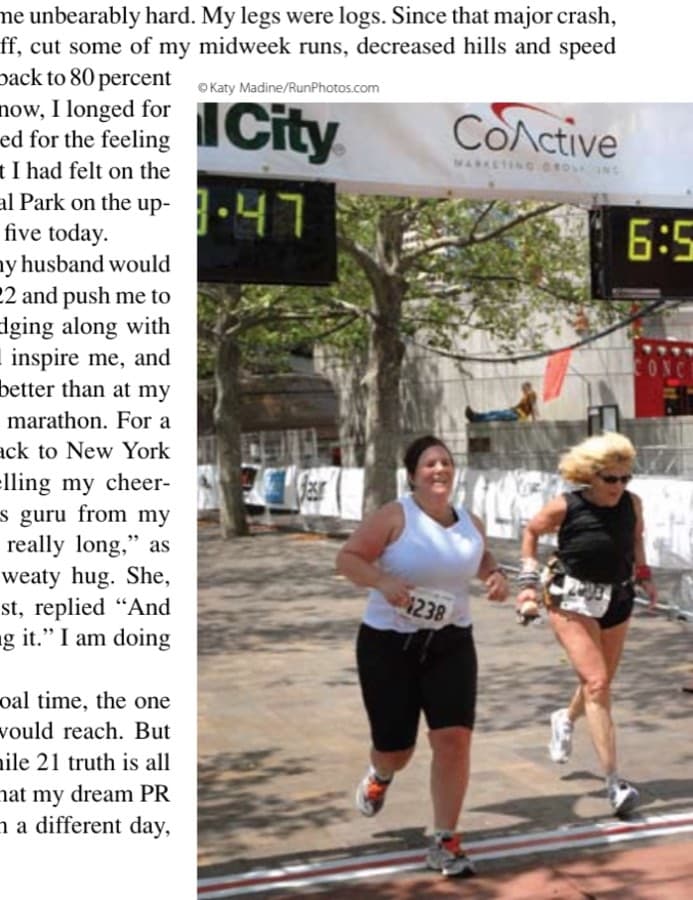
The finish in sight And before I knew it, we were circling around and getting closer and closer to the finish line. When we turned into the final chute, I started to pick up the pace. A woman was catching up to me as I (ungracefully) sprinted to the finish line, my husband yelling, “Hold her off” as if this was the “duel in the sun”— and for me, it was. I kept pushing until that finish line, thankful that there was someone to race. I finished in 6 hours, 53 minutes—a personal best. I had come so far, taking 31 minutes off my last marathon and feeling great. I called my sister from the finish line to tell her the news, my best friend before dinner (after an ice bath and a nap), and my mother before I drifted off to sleep. They were there all along—in spirit, they each had been next to me.
The race has finished and I have spent a week walking down stairs backward and reliving and recounting my hours on the course. I went out today to start running again, using those faithful muscles. I felt like that first day four years ago on the quarter-mile track, trudging along, ground like quicksand, unable to pull my legs up for the next step. Stop and stretch and walk. Run a bit, slowly, lift the legs. I am back where I started, my initial challenge in becoming a runner; I remember this feeling, this exhaustion. I feel like I am back at the beginning, but I know I am miles ahead of the woman I was and miles behind the runner I want to be.
I am reading all the articles I can about other marathons that are kind to my pack. Chicago had a large number of finishers over six hours, but were they supported? Honolulu is a dream (although it has to be run in a year I am not doing New York). Little Rock is on the radar, too, or maybe I will just try an ultra.
This article originally appeared in Marathon & Beyond, Vol. 13, No. 2 (2009).
← Browse the full M&B ArchiveMore like this
1,000+ stories from 19 years of Marathon & Beyond
The complete archive of the legendary long-distance journal — digitized and free to read.
