

Intimate Strangers
“H
ow’s the 3:10 group doing?” he asked over his shoulder, flashing us a grin. His words were greeted with a few muted chuckles. He was a young, good-looking kid who had been running nearly shoulder to shoulder with someone who I assumed was either his girlfriend or fiancee. She was slender and girlish—unbelievably girlish, as if she was barely out of high school. “
You’re holding a great pace,” I puffed from behind. “Keep it up.” I had first noticed them several miles earlier, the youthful couple. It was difficult not to notice them. We were running the Napa Valley Marathon, and for the first eight or nine miles, they looked so carefree that they might as well have been out for a recovery run. I watched as he periodically glanced over at her with a smile and posed what looked to be a “Still OK?” She would return his smile and follow it up with a gentle nod. For a great while, it seemed as if they were convinced that they were the only ones out on the course. Little did they realize how quickly that would change.
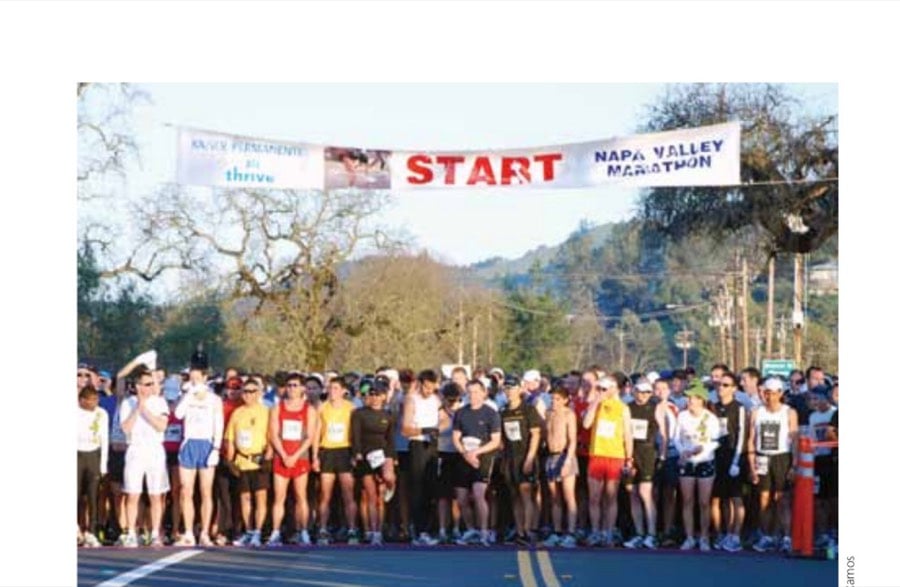
Napa is old-school racing at its best. It’s not one of those new-era, kid-gloves type of affairs designed to make your 26.2-mile experience as convivial and painless as possible. Sure, there are the requisite number of aid stations and porta-potties along the route. But the course was never intended to be pancake flat, there are no garage bands attempting to blow the lids off amplifier boxes, and there are certainly no organized pace groups. Once the gun goes off, it’s pretty much up to you to do your own math when it comes to getting from here to there.
So it came as some surprise, really, when I suddenly noticed that I was in the midst of some pretty fit company. As the youthful couple several hundred yards ahead of me had closed in on two more runners, a few others and I had closed in on them. And then, as if we’d all simultaneously emerged into a clearing from different directions, our universes converged into one.
© Arturo Ramos
Grapes on a vine When I look back at my history of long-distance races, most are marked by my encounters with intimate running strangers. There was the woman named Kathy who paced a lengthy trail race with me in Sycamore Canyon and the fellow with a buzz cut who ran closely with me for over a dozen miles at the Rock ’n’ Roll Marathon in San Diego. I ran beside a Japanese woman who sported a series of adhesive pain relievers trekking up the back of her legs during the LA Marathon, and I was one of a huge, rumbling herd of runners at the California International Marathon in Sacramento.
We never really learn much about these fellow combatants. Sometimes names are exchanged, mostly not. We instead come to know each other by hair color, running attire, body type, or gait. I’ve seen some runners strike up a conversation with one another and continue it throughout the duration of a race, almost as if they’re passengers in adjoining seats on an airline flight. But when you’re racing flat out, as I often am, there is little or no breath for grand formalities.
Psychologists probably have a term to explain why strangers in empty train cars or customers in uncrowded coffee shops invariably choose seats in close proximity to one another. Humans tend to opt for companionship, whether consciously or not. And this behavior is evidenced in marathons, too, where runners strung out along 26 miles of roadway always tend to clump together like grapes on a vine.
A collective consciousness
© Ken Lee
When our spontaneously assembled group first merged at Napa, we initially sized one another up in complete silence. Perhaps we were each going through internal system checks to ensure that the pace was indeed manageable. Or maybe we were trying to gauge whether the mingling thing was something we wanted to live with for the next few hours. But then, like tiles on a Scrabble rack suddenly revealing a seven-letter word, everything magically clicked into place and we found ourselves loping along the picturesque Silverado Trail like a pack of chummy schoolmates.
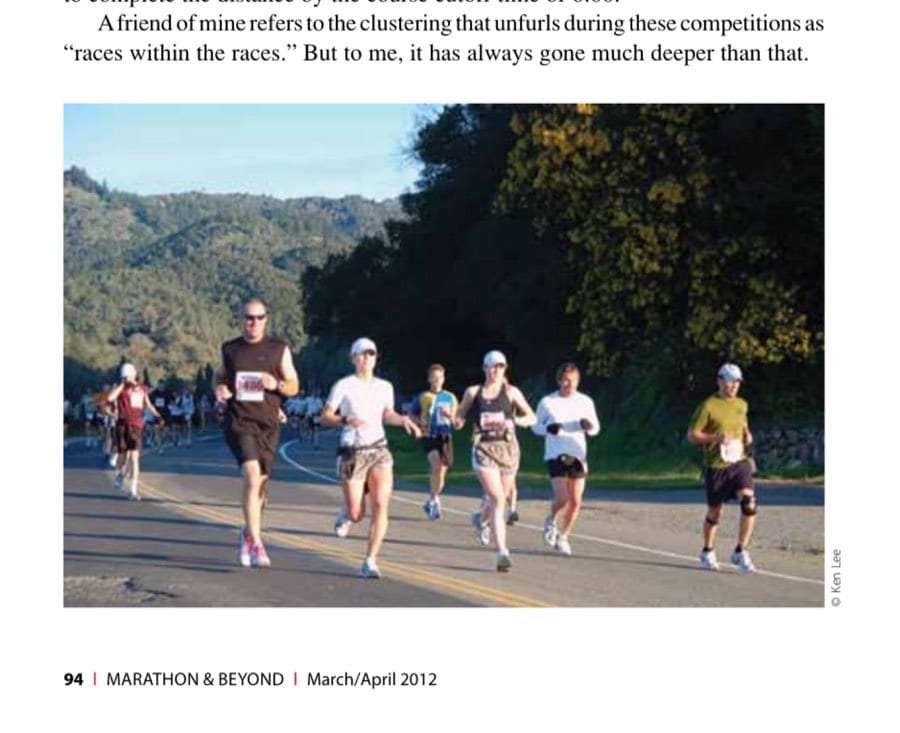
Our nominated leader, who I would later learn was named Joe, wasn’t hoisting one of those pace-group signs you see at some of the bigger marathons. He wasn’t wearing a special bib number, either. But it quickly became clear to all of us who had joined forces with him and his running partner, Kate, that he was the one controlling the tempo. If this were a jury room, we would have elected him our foreman. If we were a musical ensemble, he would be the conductor. As it turned out, he had unwittingly become the lead bird in a gaggle of marathoners.
Other groups, I knew, had formed or were forming along the entire course. Up ahead—many, many minutes ahead—the lead runners were pushing one another to achieve Olympic Trials qualifier times. Elsewhere, others were working together to break three, four, or five hours. And still others were pooling their resources to complete the distance by the course cutoff time of 6:00.
A friend of mine refers to the clustering that unfurls during these competitions as “races within the races.” But to me, it has always gone much deeper than that.
Marathons are traditionally viewed as intense, highly personal challenges. They’re introspective tests of fortitude. But having others within arm’s reach along the journey raises the experience to a whole different level. Racing with a troop of intimate strangers is like spawning a sort of collective consciousness. You can’t help but form a bond of respect with those around you, because based on your own experiences you have a darn good idea of how they’ve gotten here. The unspoken understanding is that I may not know who you are, but I know what you are—and since we’re all in this together, let’s see if we can’t help each other achieve our goals. Yes, there are always those who battle for top places and podium finishes. But until the finish line is in sight, the vast majority of us are mostly competing against ourselves and the distance.
As we seven tromped on toward the city of Napa, we began to occasionally converse between gasps and deep breaths. “Have you run this one before?” “Where’re you from?” “How’re you doing?” “What was our split on that last mile?” “There’s another hill coming up, right?”
Little of what is being discussed is either poignant or particularly memorable. But the fact that we runners, who have long been mischaracterized as loners and social misfits, are willing to engage one another at all in the midst of such an arduous, individualistic undertaking inspires me very much.
Living life inside out Racing, to me, has always been like trying to capture some of life’s precious hours, minutes, and seconds in a butterfly net—to be later mounted, framed, studied, and reflected upon. Butterflies are elusive creatures, and when you finally do manage to catch one, you never know how perfect or imperfect it will be until you peer into the netting. The walls of some marathoners’ dens are covered floor to ceiling with these colorful displays, each unique, and it’s easy to understand why. Few experiences, played out over such a condensed, dramatic timeline, bombard the soul with such a wide array of feelings. One moment we may be filled with anxiety or dread, but the next we’re hugging the challenge close to our breast. Another moment we’re feeling utterly invincible, certain that we can chase the horizon forever and never feel fatigued, but the next we’re numb with agony, convinced that any step could well be our very last.
Sometimes I wonder whether it isn’t just the simple act of movement that sharpens the senses and intensifies the passions. Others search for emotional spikes from the outside in. Sports fans, for example, are electrified by the ninth-inning rally, the slam dunk, or the timely quarterback sack. Art lovers find themselves being stirred at galleries and exhibitions, classical music aficionados at concert halls, moviegoers at theaters, literature readers within the pages of books, and the list goes on and on . . .
© Arturo Ramos
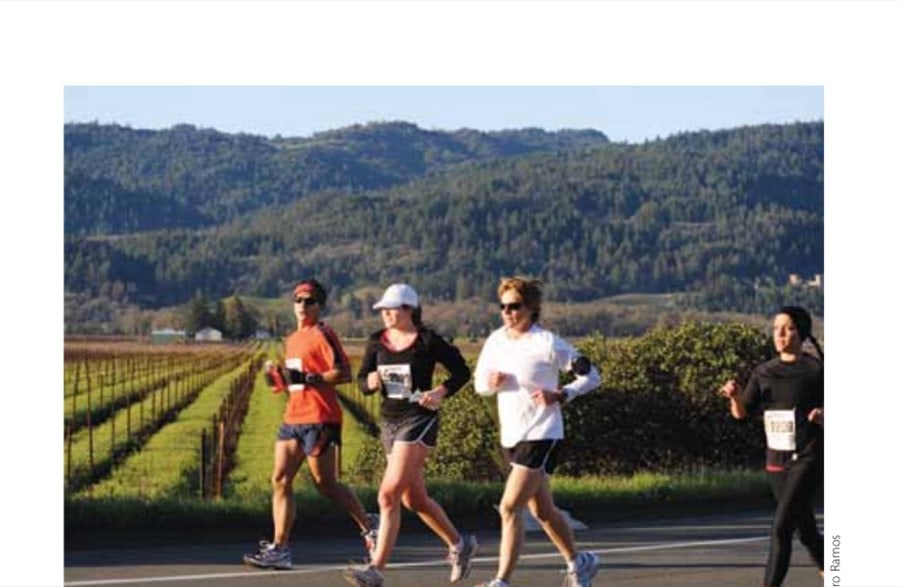
But we runners prefer to live life inside out. We embrace being in charge of our performances, and we understand that whether our name is Ryan Hall or Joe Shlabotnik, no one else is going to cover the distance for us. How curious it is, then, that while we’re in the throes of a marathon—and the air, blood, and emotions are coursing through our bodies—we often find ourselves sharing the powerful experience with complete strangers.
Developing respect My plan going into the race had been to run within myself through 19 miles, attack the last long hill that loomed in the recesses of my memory from the first time I had tackled the course, and then work the final 10K with whatever I had left. The fields with the neatly spaced rows of leafless grapevines and the vibrant yellow patches of mustard plants, the warmth of the morning sun as the sky continued to fill with light, the camber of the roadway as it snaked past centuries-old oak groves, the cheers of the shivering onlookers, and the jingle of their cowbells . . . Our group was soaking it all up as one—as one.
And then, before I knew it, we were there—at my moment of truth. Just past Yountville, as the road began to slope up, I took the initiative. I was more than happy to do my share of the pulling for a change. Up, up we climbed. But the hill seemed longer than I remembered, and by the time I had crested the summit and begun to drop down the backside, my quads were already beginning to falter.
© Arturo Ramos
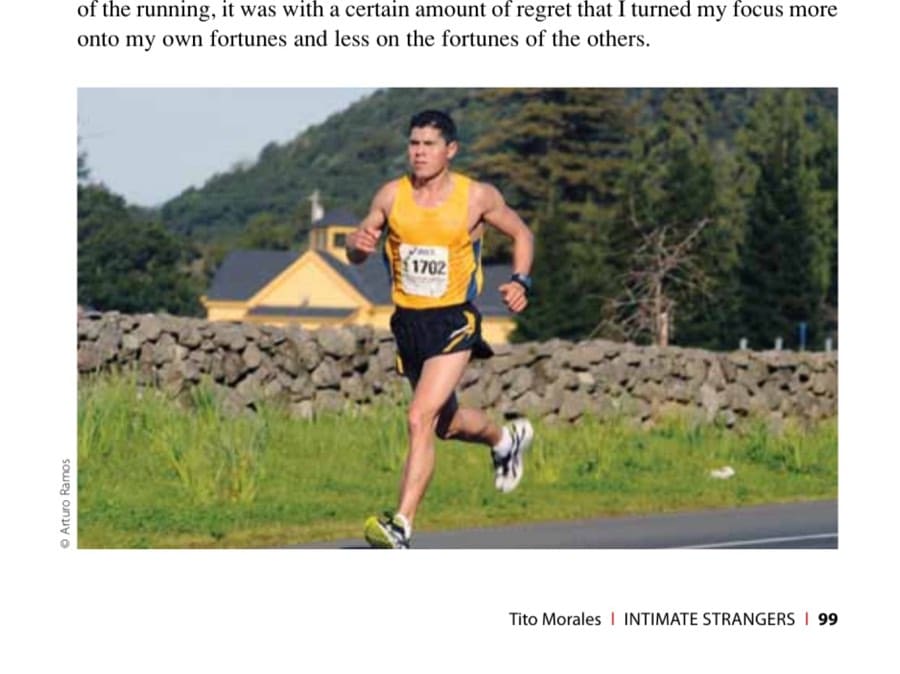
As any notions of a negative split began to dissipate with the strength in my legs and my pace slowed despite my best efforts, I braced myself for the group to push past me like a heavy gust. I could still feel them behind me, and a mile
later Joe sidled up just off my right shoulder and asked, “Think we’re gonna make it?” And it occurred to me only then that he must have been gunning for a Boston qualifier. “I don’t know,” I replied. “My legs are pretty shot.”
He ran there with me for a bit, and I assumed that Kate and the others were nearby also. The fatigue slowly enveloped me, and I continued to wait for the wind of my comrades to blow me into oblivion.
But, surprisingly, no one made a move. I heard an “Uh, oh” from nearby—was it from Joe?—and it occurred to me after another quarter mile, when neither he nor Kate nor anyone else assumed the lead, that they were all suffering much the
same way I was. It would be a struggle from here on out for the entire lot of us. It has often been said that by the time a pair of boxers reach the championship rounds of a prizefight, the shared experience that they have both endured trans
forms them from fierce rivals to good friends to loved ones. And so it is also, to a lesser degree, with marathon running. It is impossible not to feel an attachment with the intimate strangers who have battled alongside you for hours. Eventually
you have come to share the same air. Your hearts have begun to almost sync as one. And you can’t help but take a genuine interest in their well-being. But as we pushed forward and our group continued to crack under the strain
of the running, it was with a certain amount of regret that I turned my focus more onto my own fortunes and less on the fortunes of the others.
© Arturo Ramos
Parting ways When all was said and done, I stumbled across Joe and Kate in the high school gymnasium, where event organizers had arranged postrace massages. She was splayed across the hardwood floor, perspiring and spent and beaming. He was standing bent at the waist nearby, tentatively stretching his tightening hamstrings. I moved over to offer a congratulatory handshake and to commend them on their fine performances. His full name, I learned, was Joe Hyland, and hers was Kate Polizzotto. They had both traveled to Napa from Massachusetts. Joe had just completed his first marathon, and on little more than three weeks of training! Kate had run Boston the year before and had come out to Northern California in pursuit of a PR. Both were pleased with their efforts, although frustrated that they couldn’t hold their pace over the last few miles.
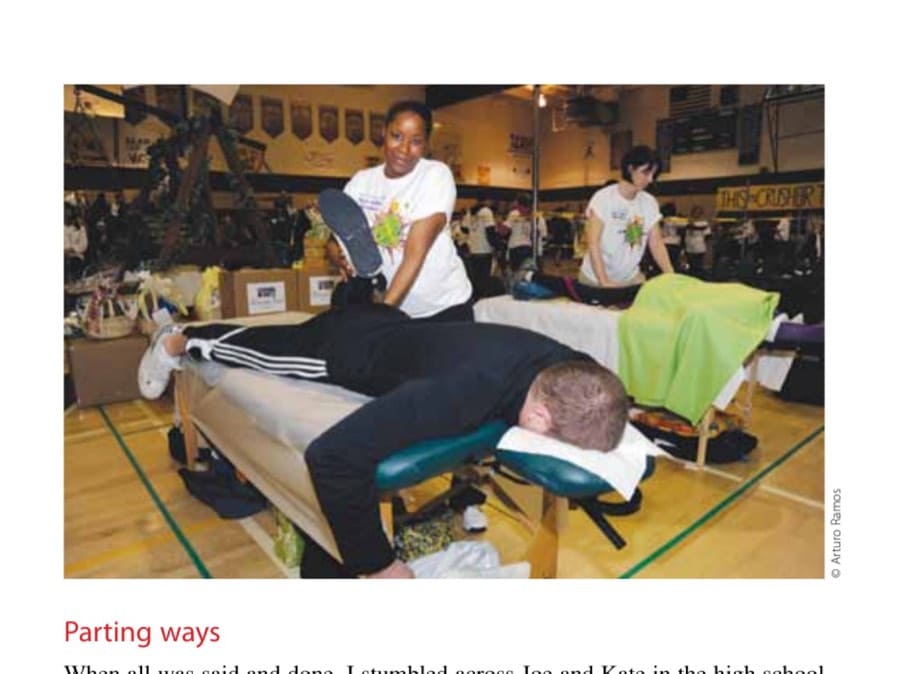
After exchanging some more small talk and commiserating with one another over the depth of our exhaustion and soreness, there really wasn’t much more to say. We had just shared what for each of us would surely be one of the calendar year’s handful of strikingly memorable days, yet now it was time to part ways.
We went off in different directions, and I knew that I would probably never see them again as long as I lived. That’s the way it is with intimate strangers. And while the sharp details of their faces and running forms have already faded with time, just like the colors on the wings of a mounted butterfly, I have no doubt that the memory of the intense, passionate time we spent together on that beautiful spring morning will linger deep inside me for many more years to come.
This article originally appeared in Marathon & Beyond, Vol. 16, No. 2 (2012).
← Browse the full M&B ArchiveMore like this
1,000+ stories from 19 years of Marathon & Beyond
The complete archive of the legendary long-distance journal — digitized and free to read.
