

Into the Maine Woods
Would you like to travel through time? Of course you would! So how about traveling back to 1981 and Chicago’s Lakefront to witness one of the greatest ultramarathons ever raced? But maybe even further back than that to, say, New England during August of 1846. You discover that’s when Henry David Thoreau went to Maine. You also discover that his surname, incredibly, isn’t pronounced Thor-ROW but THUR-oh as in “thorough.” So you decide you’d like to travel back to Maine in the mid19th century and visit your backwoodsy hero there.
Instead, through some glitch in the Southwest Airlines Time Machine, the new hero you find somewhere in the backwoods of western Maine isn’t H. D. Thoreau, visiting from Walden Pond, but B. Heinrich, residing full time next to a well. The hand-hewn log cabin, of course, is the same.
In fact, the very first question out of your mouth when approaching the University of Vermont biology professor emeritus—and world-famous ultrarunner—for the first time in your life is: “What year is this?”
Professor Heinrich appears to enjoy the inquiry. He doesn’t quite answer, however, so that must mean you’re in 1846. You’d left your rented wagon down below the hill and hiked, lugging all luggage, upward and northward until you felt like fainting dead away from the hunger and thirst and then meeting your maker. Instead, you meet Bernd Heinrich, PhD. You shake his hand and acknowledge his female partner (who prefers to remain nameless)—a human, not a quadruped as might be expected to accompany a famous erstwhile zoologist, whose own bipedal accomplishments are world famous as well—and they both direct you to set down your bags in the dooryard by the porch, come in, and sit a spell.
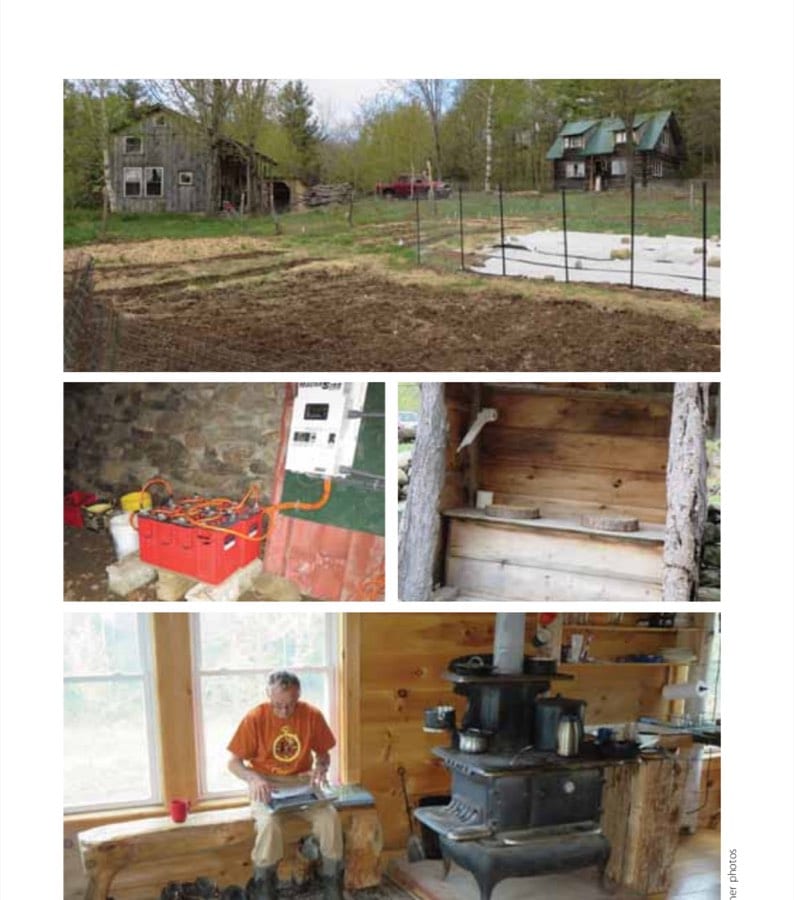
Soon the potbellied stove is blazing hot with a braised hen roasting within, and you’re invited to supper. You are gobsmacked. The privy lies beside and just beyond the garden near the fence, there’s a water pitcher indoors by the basin, and rare vintage is filling your flagon. This feast for a Saturday eve is superb.
You don’t ask, of course, why the good man left Walden; you ask him how he got to Chicago. You brace yourself for a railroad or wagon train story, but instead the famed athlete recounts how he trained—right here, back then, throughout all these woods.
He tells you he built the other cabin first, the one that now serves as a guesthouse, even while training for that now-legendary 100-kilometer “National Championship” hosted by the American Medical Joggers Association (AMJA) and the Chicago Area Runners Association (CARA).
Bernd Heinrich ran the living hell out of that 100K race, and the records he established there live on. You feel thrilled to be hearing about it from the horse’s mouth, as it were, right here, sitting on a log at the wooden table, quaffing wine, snarfing chicken and garden vegetables, next to a pantry packed to the ceiling with firewood, in the waning daylight, wondering what in the world will happen when it gets dark.
That’s easy. The clearing is equipped with a solar panel. It puts voltage into batteries sitting “down cellar” underneath the cabin, which is wired throughout with 120-volt, 60-amp electric outlets. You just plug in your bare bulb heavy-duty orange extension drop cord and have light! Right.
Power is needed to recharge the man’s laptop, so he can e-mail you through his own Wi-Fi network, and that’s how you arrange to visit Bernd “Henry David” Heinrich in the early 21st century. No phones! He has no telegraph either. Just e-mail. Hey, it’s Anno Domini 2015. What did you expect?
But first, it’s back to the early ’80s So why have you come? Why are you here? You’re here to see whatever happened to that famous “old” 100K record setter since he won it all in your hometown. You’ve signed on to do another “where are they now” feature about storied glory runners from days gone by.
It all happened one brisk October 4th, 1981, along the shore of Lake Michigan on the paved bike path, just a few miles south of where you used to live at Loyola Park Beach. The race, directed by Dr. Noel Nequin (with whom you’ve established a friendship), basically ran through Lincoln Park, from the North Avenue beach house on the south, to Foster at the north end, and back. Five miles each way for 10-mile loops, repeated five times for the 50-miler and six-plus times for the 100K. And you should’ve been there! (What the heck could possibly have been more important in 1981 that would excuse your absence?) So you’ve been kicking yourself ever since.
But here’s redemption. You’re inside the man’s cabin who won that day. You ask him questions about his past life, and he’s already written a book about it. He directs you to The Snoring Bird. Later, you follow that direction and read how basically—and how briefly—his training went from about May to October of that year, including a forced hiatus of about two weeks due a knee injured by ax
© R. Limacher photos
▲ Clockwise: “The Hill” Homestead (left to right): the home cabin, tool and wood shed, log pile to be cut into firewood, Bernd’s truck, the guesthouse cabin, and the vegetable garden in the foreground. The Hill’s infamous outhouse. Notice it’s a two-holer. And the reason it’s infamous is that there’s no door. Author and professor Heinrich hard at work. Note the laptop (which explains the need for solar/electric power) and the field biologist (which explains the need for boots). Voltage from the outdoor solar panel is stored in these batteries located in the cellar below the home cabin.
wielding. What you learn is that, collectively, his training, his log-cabin building, and his field study of bumblebees were all done over summer vacation. Professor Heinrich was then, at age 41, a full-time faculty member at the University of Vermont in Burlington.
You’re exhausted just reading about such a regimen: felling trees by hand, constructing, running two to three hours per day with no days off—each run, by the way, consisting of 20 miles or more!—and the whole time being a husband and father and field biologist trying to get 50 queen bumblebees “to build colonies in our boxes.” The queens, he wrote, “refused.”
Near the end of the book, while discussing his other famous study about ravens, Bernd says: “As with the bumblebees, I needed to identify individuals and also keep track of them for long periods of time. Ravens were rare, and I couldn’t even get within a quarter mile of one, if one had been located. But the lure was irresistible, and I decided to proceed as I had done with building the cabin and running 100 kilometers in 6 hours and 38 minutes and 20 seconds—one log and one step at a time—and asking myself every day if there was something else that could be done.”
And there you have it from the logging sawhorse’s mouth, as it were. That 6:38:20 established both a then-new world “masters” record and also an “absolute open” American record for the fastest 100K run on either track or road—which stood for 14 years and continues still as an American masters road record. Not only that, but his 50-mile split (5:10:12) en route to the 100K in Chicago was also a then-new world masters record that still stands as an American masters road record. Keep reading. This paragraph’s second sentence also refers to a track 100K time, which is described below in terms of yet another Heinrich record. The upshot is that Bernd Heinrich is the first and only American ever to hold both road and track records for the same ultra distance at the same exact time, which is, like, now.
You can’t help but to note also that Barney Klecker’s first place beat Bernd’s second place at that same 50-miler with his own time of 5:05:04, but he stopped. Bernd kept going. And also as far as American “open” records go, Dr. Heinrich still has one. Yes, nobody in America, young or old, male or female, human or animal, has beaten Bernd for 100 kilometers run on a track. His record time of 7:00:12 (at age 45!)—which he achieved on August 24, 1985, at a Rowdies’ (see below) race on the Bowdoin College track—remains unbroken to the present day, future time travel excluded.
A couple of shining relics housed in a cabin After supper Bernd and his partner send you on your way to the guesthouse to pick a spot to bed down for the night. Why? Because on the next day “the class”
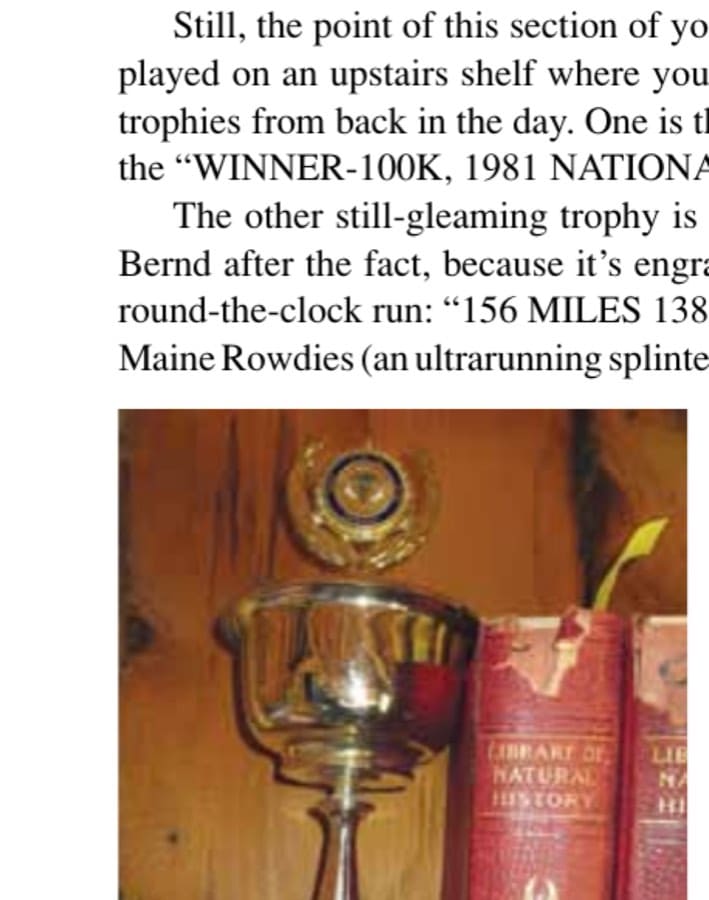
The championship trophy for that famous 1981 100K National Championship now sits on a Maine cabin’s bookshelf. ▲
© R. Limacher photo
shows up, and those students will pick out their own spots for each of the following three nights. You are here, after all, for two reasons: to get the champ’s ultra story and to observe how the good professor conducts his “Summer Ecology” course. Actually
the summer version isn’t a course at all, but the “Winter Ecology” full-week’s class in January is. It’s a true University of Vermont (UVM) credit course for 10—sometimes 12—specially qualified (which usually means graduate students)
budding young biologists to come live in the cabin and study the forest and its wildlife and how everybody survives the Maine snow and ice. It’s no small task, and scientific papers are due after the class’s conclusion, presumably after ev
erybody thaws out. The summer version is something like a “reward” for toughing out the winter one. Its atmosphere is relaxed, the hikes are delights of curiosity, and in the evening it’s party time. One of the biggest differences recognized right away by the class
is that now you can see everything that was hidden by last winter’s snow and ice. Still, the point of this section of your time-travel report is what you find displayed on an upstairs shelf where you’ve unrolled your bedroll: two still-shiny
trophies from back in the day. One is the “CARA CUP,” which was presented to the “WINNER-100K, 1981 NATIONAL CHAMPION.” The other still-gleaming trophy is a plaque that was obviously presented to Bernd after the fact, because it’s engraved with his American then-record for a
round-the-clock run: “156 MILES 1388 YDS.” It’s also a memento given by the Maine Rowdies (an ultrarunning splinter group from the Maine Track Club), which in 1983 and other years hosted the “Rowdy Ultimate 24-hour Ultra” in Brunswick,
during the August heat, for which this plaque honors Bernd’s first-place finish. Yes, and that record stood for seven years afterward. You find it interesting, later, that there is now such a thing as Bernd’s own award,
which is apparently given by UVM to some promising science undergraduate. It’s called the “Bernd Heinrich Award in Physiology or Evolution,” and the latest awardee named on the university’s website is Jordan A. Munger.
And then “the kids” show up for class Right away you know there are questions that must be answered. For instance, why in the world are students from Vermont showing up for class in the middle of the Maine woods?
And they’re all graduate students from the University of Vermont, which you’d think would be abbreviated “UV” but it’s not, and you’d think their teacher would be an active professor of biology at that school, but he’s not! No. The official abbreviation of that school (from its website http://www.uvm.edu/) is UVM—because of the Latin, of course. UVM stands for Universitas Viridis Montis, which means University of the Green Mountains.
You did not know this. Neither have you noticed that Professor Heinrich is no longer listed in the university’s directory as being in the Biology—or even Zoology—Department. No, he’s shown as a “temporary,” affiliated among the “emeriti faculty,” in the “Continuing Ed–Operations Department.” He is shown with a postal address, a telephone, and an e-mail address, all of which are wrong. You know this because you sent him mail there years before that he never got.
No, seriously, he lives and teaches in the woods. Apparently all of his students know that because this is where they happen to be showing up right now. And they are serious and respectful students because, as you learn later, they do not disturb your bags by the sleeping bag on the floor by the trophies, and neither do they abscond with the mattress underneath. This cabin is now, after all, a college dormitory.
It’s Sunday afternoon, and they’re showing up. You’d just spent the morning riding on the back of the Heinrich Pickup Chariot, picking up freshly felled and sawed trees. You and Bernd’s partner had ridden around and hoisted logs into the truck bed for conveying back to the Main Maine Heap. But there’s been improvement over the decades. Bernd now has a chainsaw. Zzzrrrrp! Zzzzzzing! Everything’s cut, retrieved, hauled, unloaded, and stacked in less time than it used to take him to run his daily dozen, no, 20 miles.
The “kids” that arrive, as you learn their names later, are Chloe Tremper, Bonnie Ricord, Sonia DeYoung, Sam Talbot, Ali Kosiba, and the owner of the longest pigtail braids you’ve ever seen in your life, Shelby Perry. Glenn Etter, as you learn, can’t get here until tomorrow. The “thing” that these Sunday show-ups seem to show up most with is food. So the thing you do mostly, after they’ve unpacked it from their (huge!) backpacks and cooked it awhile on the dorm’s potbellied stove, is help them eat it.
You soon learn how Summer Ecology class works. In a nutshell, you join your professor several times a day for nature hikes that cover various quadrants of the prof’s own woods until—by Wednesday—you’ve mainly covered them all. You’re all out there looking for things—say, for example, nutshells. You learn that, in the
main, native American chestnut trees have disappeared from America—except for this pristine little forest primeval tended by your Maine favorite ecologist. Chestnuts all over the ground here, you’re told, are shells only (and furry ugly shells at that) because “they weren’t pollinated last year. The trees leaf out too late in the season.” So, no nuts. You’d like to ask your teacher exactly how, then, shells with nuts in ’em can ever be pollinated in time to become, sure, “chestnuts roasting on an open fire,” but you don’t think of the question in time. The class has moved on.
And it soon becomes all too apparent that you haven’t kept up with your assignments or done your homework or passed all the prerequisite classes needed to enroll in this one. How do you know this? Because you’re the dumbest “kid” in the class. All the other students, for example, can identify “scat”: droppings from deer, porcupines, and even those from adult moose (yes, moose) as opposed to moose calves. You just think it’s all shit, and manage to step in it.
Morning and afternoon hikes are de rigueur. You tramp around all over the place. Listening to birds, looking for birds, for their holes in trees, identifying trees, and noting the ones your moose ate. One of the students points out a dead moose—well, one that’s been dead since probably Thoreau’s time. All that’s left is the spine and vertebrae. You also learn why it’s the professor who’s the teacher. He absolutely knows every tree, plant, animal, bird, every bird’s song and chirp, each flower, each bud, bark, nest, egg, and woodpecker’s home inside each tree.
He’s sharp enough to stop you before you step on a ground nest or a salamander. He quizzes you on where all the other nests are and asks you to ID the birdcalls. It becomes obvious that Professor Heinrich absolutely knows each and every single living thing in his woods, and all that have died here as well.
All the students outdo you, too. Chloe, for example, makes birdcalls herself, and knows how to clobber a tree trunk with a fallen branch in order to make whatever is living inside poke its head out. Bonnie finds frogs, Sam finds snakes, and Ali tells you the difference between “fiddlehead” plants you can eat and those that will kill you. Shelby passes the teacher’s next quiz as to who can find the next nest. Sonia picks for you a sprig of wintergreen, which you’ve never seen. Glenn teaches you the “fox walk.”
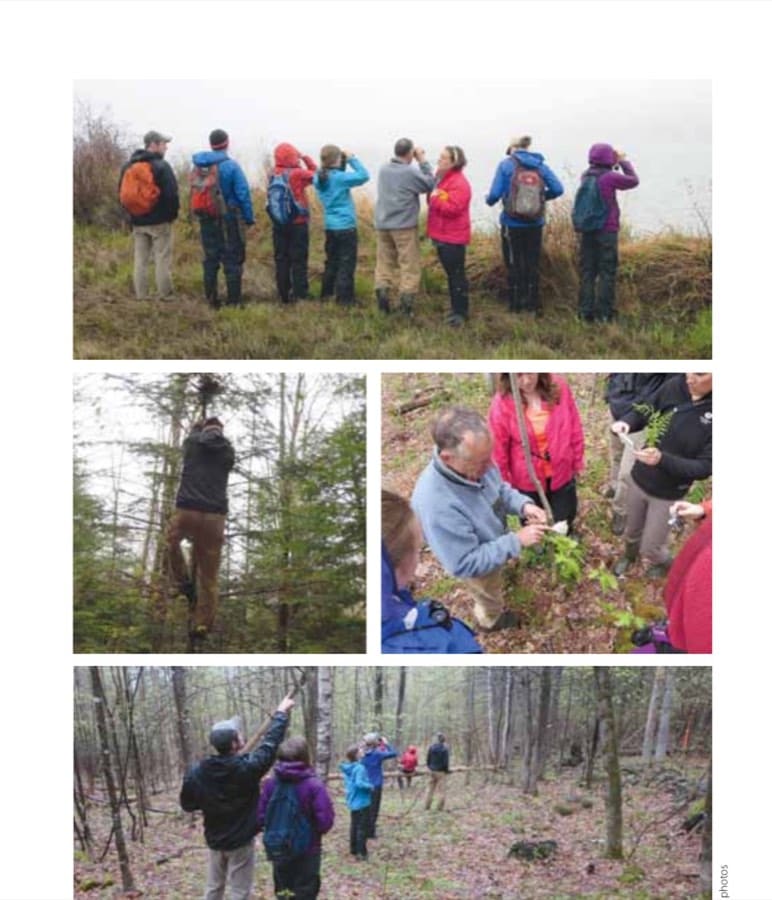
At one point, the professor quizzes you. “Do you know where you are?” he asks. “Could you find your way back?” You point in some vague direction. He grades your answer on the curve. At another point, you all gaze in wild wonder while he, at age 75, climbs a very skinny tree to peer inside a nest up top. No eggs. But he does find quite a few later. He finds one that’s cold and damaged and lying six feet away from its nest. Some predator, he says, probably raided that nest right before you got there.
© R. Limacher photos
▲ Clockwise: All the Summer Ecology “ducks” lined up in a row at a nearby lake, watching the biggest flock of loons that any of them—including their teacher—had ever seen in their lives. Professor Heinrich gives a lesson on hanging nests. Grad student Sam Talbot points to yet another discovery made during Professor Heinrich’s class. The biology professor demonstrates another “high”-tech method for studying bird nests.
Right on cue during one particularly hot Maine afternoon, your teacher guides the class right to the nearby babbling brook (except that it’s more like a small river), which is, of course, your old-fashioned “swimming hole.” And he plunges right in. Everybody follows except you. You’re basically scared scat-less of freezing to death. Later that evening your class basically parties all around a bonfire. Hot dogs and buns (a Chicago staple) comprise the bill of fare. Your professor leads you here, too. He’s the first one to toast a s’more.
“I don’t want to be a museum” Early in the morning before the bonfire party, everyone—now in the 21st century—hikes the half-mile driveway downhill to all the parked cars, climbs into several, and drives off for a closer look at the nearby lake Bernd used to run around while training for Chicago.
And it’s just like another world record! Because there, right before all of your disbelieving eyes, swims and flies a veritable navy of cruising loons. In the professor’s best estimate, there are at least 200. Neither he nor anyone in your class has ever seen so many. Biggest flock seen previously was, oh, maybe 15. You, though, have never seen even one. All you think you’re seeing are skinny ducks.
In scouting around the lake’s surrounding marshlands, your unofficial class nest-finder finds two more empty nests and retrieves them. These later are carefully placed in scrap plastic bags and carried “home” in your rental car’s trunk. When you get back to The Hill, you present them proudly to your professor, like some kind of audiovisual aid for a future “show and tell.”
Your teacher crushes you with his reaction. He does not want you to place them carefully inside the dormitory “dining room” like some kind of natural trophy. He wants you to throw them away. They’re old, he tells you, and they’re starting to decay.
You protest mildly that these nests will serve future students as good examples of the natural phenomena found in “your woods.” “I don’t want to be a museum,” he tells you. “I’m not excited about old nests; I’m excited about finding new ones. Let them [his future students] find their own.”
Which, when you come right down to it, is the essence of teaching, as well as parenting. The mama bird teaches the baby bird what’s necessary, then kicks the chick the hell out of the nest. Right off the end of the branch. [Push!] “Now go. You fly!”
That’s what Professor and Author Heinrich has done, too, basically for all of his adult life. “Turn in your final papers, then get the hell off my property!” is what you might imagine him saying. But he doesn’t, of course, because he’s too nice a guy.
And finally, Five Blinding Revelations It really is amazing what you can learn by asking. As well as by listening to what people are telling you, especially in person. So when you travel all the way to Maine, you expect a big takeaway.
You learn, for example, what amounts to the most unusual reason ever heard for why, for example, some great runner runs. Bernd Heinrich, long-distance record holder still in several disciplines, runs because of science. That’s right. He doesn’t run for glory, for trophies, for finisher medals, or even (gasp) for prize money. No, he runs because he is “an experiment of one.” He runs to see what his human body can do, to see if he can attain the performance that his hypotheses might theorize he is able to do. No other reason. If he sets a world or national record in so doing, so be it. But the most important thing is what he can find out for science.
You find this blindingly revelatory. Imagine Jack Nicklaus saying that his entire golfing life’s ambition was to discover the physics for attaining optimum driving distance off the tee. Or Nolan Ryan claiming to have developed his incredible pitching speed by doing scientific research.
And yet, in the world of big-league biology, Bernd Heinrich basically ran a laboratory and did field study on his own personal self. He says as much in his book Racing the Antelope. He also alludes to it in what amounts to his family’s autobiography, The Snoring Bird.
In his prologue to Racing the Antelope, Dr. Heinrich makes sure you understand he had every intention, dreamt about, and focused his training (a tremendous amount) specifically to race all out that Chicago National Championship 100K in 1981. In no way do you get that he intended only to jog or finish or check another distance off his bucket list. “I had to give chase,” he writes. “
As a zoologist by profession, it seemed only natural for me to look to other ‘endurance athlete’ species to see why and how it’s done, and for tips on how to train. However, I did not write this book as a training manual, nor did I write it to highlight my running exploits, which are puny relative to those of others. I wrote to show what is involved in running an ultramarathon race, and to pull together the race experience with the insights I gained from my studies of animals. My intent is to amalgamate the race experience with human biology to explore what makes us different from other animals, and in what ways we are the same.”
You don’t even see “I was going for the 100K record” in there. But he was, and he did set one that was best in the world for runners over 40. So ultimately, when you have the chance to ask him in person at his cabin in the Maine woods surrounded by his students and trophies, you want to know: “Bernd, do you consider yourself more of a scientist or a runner?”
His answer is surprising only in its hemming and hawing. If things in his life were different, he hems, he might have made a career out of running profession-
ally—like his partner has done. But then he haws about his papa and all that education and the birds and the bees and his teaching gigs, travels and field studies, and all the books he’s written; and you and even he has to admit: it’s science that ticks his clock. If he had to have lived without one or the other, his choice would have been not to run.
Blinding Revelation Number 2. You can try to force a choice between science or running, but now you learn that competing has always been a part of Ben. And that’s the other thing you learn. Growing up, his friends and acquaintances couldn’t pronounce Bernd, so they just called him Ben. Today his partner gives you the correction: Beh-rend she calls him.
She also provides a photo that proves his competitive nature. It seems he grew up not far from where they live now, and he worked at least one season for a nearby boys’ summer camp. In 1957 he won the camp sharpshooters contest. There’s a plaque in the dining hall with his name on it, and they even gave him a medal.
Blinding Revelation Number 3. Imagine this, fellow young students: Professor Heinrich digs rock ’n’ roll. Of course, it might be debatable whether today’s youth even “dig” it—what with rap and dweebs like Bieber on the radio; and are there still radios or does everyone have a playlist only on iPods? At any rate, decades ago there was a kind-of-a-rockin’ cat named Cat Stevens. You can’t say Bernd was Cat’s biggest fan, but you can say he sure did listen!
Although he can’t remember the tune’s exact title, Bernd does reveal to you what he was listening to—inside his head, because iPods didn’t exist in 1981—all the while he was chasing Barney Klecker along the Chi-Town Lakefront. “I had the whole song memorized,” he tells you. “In my head I was matching my footsteps to the drumbeats. Those drums!” he exclaims. “I remember a line—something about ‘waiting a long time, Ian’s come and gone,’” he says.
So you do a little online research afterward, bound and determined to find “Ian’s come and gone.” You offer a few possible songs to Bernd via e-mail, but nothing clicks until you somehow hit upon “Bitterblue” by Yusuf Islam. On top of all other vexations of the past several decades, Cat Stevens changed his name!
And talk about misperceptions and conflicts between what one speaks and another one hears! This is that lyric that Bernd spoke but you didn’t hear: Cause I’ve been waiting a long time Aeons been and gone—
Blinding Revelation Number 4 is that Professor Heinrich’s “kids” obviously love him, proved during the entire class’s first supper together, because they gave him the gift of a weatherproof motion-sensing game camera. Fully digitized and uploadable and equipped with night-vision technology. These things are costly!
Nevertheless—and only by sleeping there do you find this out—his loving students aren’t above amusing themselves with a late-night read-aloud, by flashlight, of certain angst-ridden passages from their prof’s latest book.
© R. Limacher photo
▲
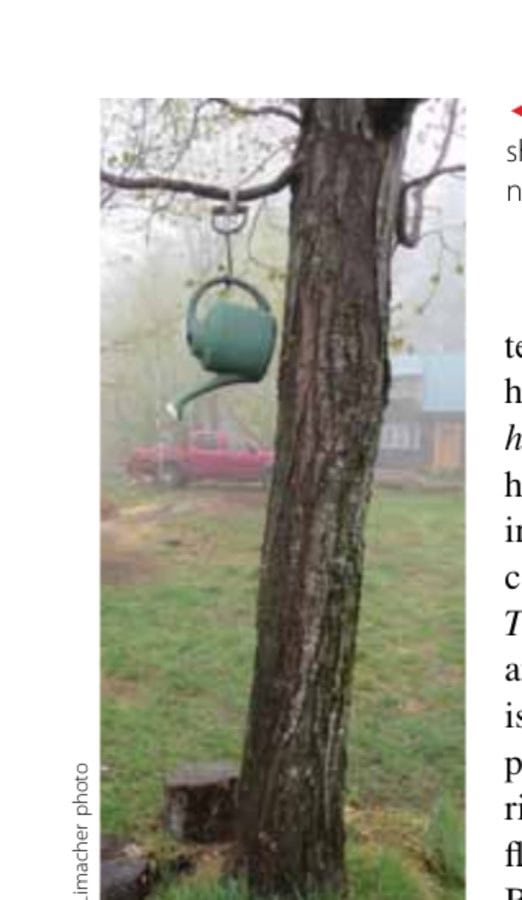
The not-so-famous Heinrich household’s “bathroom shower stall.” Notice that the stoops allow for varying the nozzle’s height, depending on how tall the showerer is.
Prior to nightfall Bernd explained that his biggest terror in life, so far, was a certain South American helicopter ride. And that’s all it took, because his kids had the book. So later in the dark down the dorm’s
hallway, you swear it’s Chloe reading, with infectious inflection and ribald commentary, Bernd’s chapter called “Home-Making in Suriname” in his 2014 book The Homing Instinct. The exercise in oration, as even
an ancient guest grandpa figure would have to agree, is hysterical. And the mirth builds to a crescendo when perhaps the biggest horror of the Amazon helicopter ride is revealed to be when this huge jungle bird just
flattens itself against the chopper’s windshield. SPLAT! Bernd thought he was about to crash and die; but all the kids you’re sleeping on the floor with, for the next 10 minutes solid, roll on the floor laughing their asses off. Yup, they ROTFLTAO!
Blinding Revelation Number 5. You mean, this whole darned adventure over the past several decades has been about Barney Klecker? Well, no, not really. But maybe just a little bit? You learn, for example, before leaving his homestead, that
what Bernd’s book, Racing the Antelope, and all his summer training during 1981 was really about was: racing Barney Klecker. Bernd tells you, practically on your way out the door, that that is what he
was thinking about (besides “Bitterblue”) and was totally focused upon. “Barney was the antelope,” he says, adding: “You can tell Barney that he was what I was thinking about.” And so of course, via e-mail, you do.
Barney Klecker then e-mails back: “Best regards! And Bernard Heinrich was a very good runner, but not at the level we were at!” (Barney’s another one who couldn’t pronounce Beh-rend.) “If you were at the race and witnessed,” Barney’s message continues, “I ran
a 2:19 marathon pace the first 20 miles to drop Don Paul (a 2:16 marathoner); Bernard was over the hill but running well for a masters runner.” He didn’t comment on the antelope angle. So of course, like every other vexation of the past several decades, the imagi
nary “Racing Barney Klecker” has been changed to a new book title: Why We Run. And maybe, just maybe, it’s been H. D. Thoreau who has been reincarnated, there in the Maine Woods, as B. Heinrich, PhD.
This article originally appeared in Marathon & Beyond, Vol. 19, No. 6 (2015).
← Browse the full M&B ArchiveMore like this
1,000+ stories from 19 years of Marathon & Beyond
The complete archive of the legendary long-distance journal — digitized and free to read.
