

Jay Aldous, Ultrarunner
© Michael Lebowitz/LongRun Pictures
Jay Aldous, 51, is that remarkable athlete who is much more successful at 50 than he was at 20. He first ran Western States as an 18-year-old, and three years later he ran the Wasatch Front 100 in 32:09. Twenty-six years later, as a 48-year-old, he ran Wasatch Front in 22:03:40. There are very few athletes—Meghan Arbogast comes to mind—whose performances are remarkably better 25 years after they began, who have two careers, if you will, the second installment of which far exceeds the first.
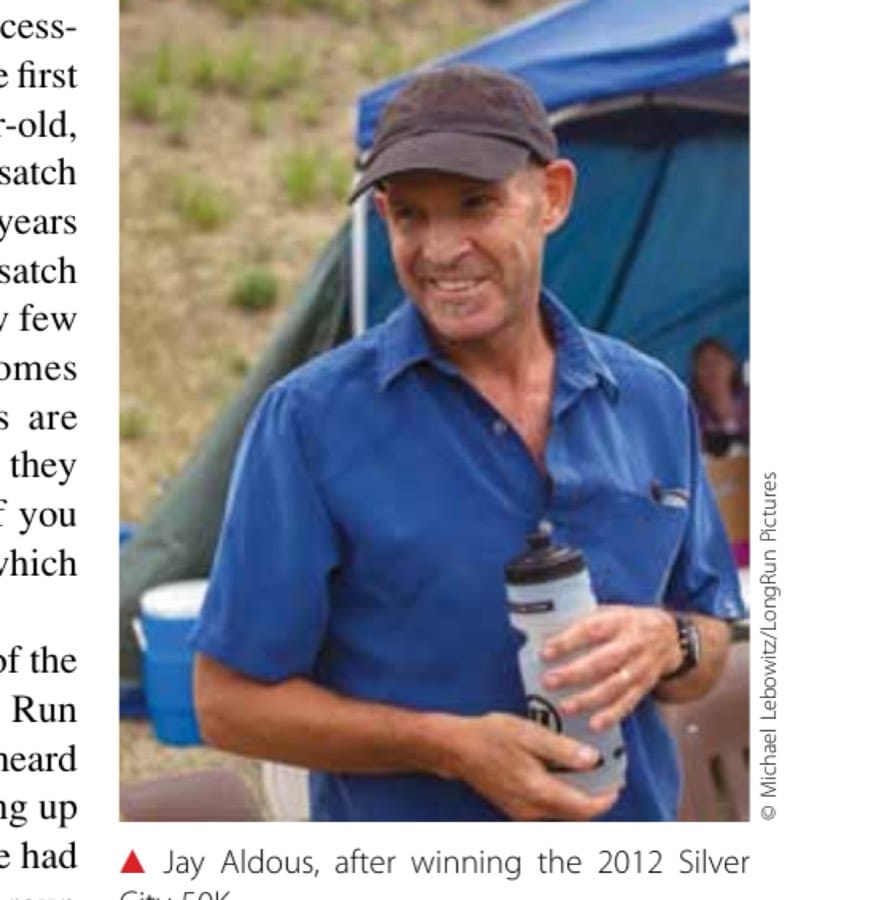
I met Jay Aldous at the start of the Salt Flats 100-Mile Endurance Run 2012. That is to say that I had heard about him during the days leading up to the race, that I had read that he had ▲ Jay Aldous, after winning the 2012 Silver set several sparkling 50-plus age-group City 50K. ultradistance records the previous fall (Javelina Jundred in 15:20:56 and Desert Solstice in 13:52:29, a world’s-best performance), and that he intended to run this course in under 15 hours. From the start, he took the lead. At 10 miles, there was no one in sight behind him. And so it was for the entire race. He finished in 15:04:45, due primarily to the Bonneville Speedway’s flat 3.5-mile dead-straight finish into a gusting head wind of up to 30 mph. His first words were, “Damn, 15:04, the wind, I guess.” This struck me as the essence of an elite long-distance runner: focus, strength of purpose, and an
acknowledgement of both victory and future effort in one sentence. He packed up and headed home. I met him again at Silver City, where he ran a very tough 50K course as a tuneup for the Leadville 100, another tough race two months later. In between Salt Flats and Silver City, he ran Zion 100 and Pocatello 50-Mile, finishing first and third, respectively. He seemed relaxed, happy, appreciative of the course and the race, supportive of the other finishers, a classic ultrarunner in a classic ultra moment: your race over, you wait for the others “out there” as you are all part of the experience, the tribe. He asked me if I would send him several photos from the day for his blog, I asked him if I might interview him for M&B, and he said he would be OK with that.
I am left with the impression that he has, in the classic words of Robert Frost, “promises to keep/and miles to go before he sleeps.” He represents, to me at least, the very best of ultrarunning, for its strength, compassion, engagement with the natural world, and the humility it teaches those who dare to challenge themselves in the struggle with time over distance, that most ancient of human pursuits. M&B: What’s with the button-up shirts during races? Aldous: Why would anyone not wear a button-up? Advantages include fun and interesting prints and patterns, a front pocket for garbage or a pace chart, and the ability to undo a button or two for more ventilation. I discovered the benefits quite by accident. One day shortly after I started running ultras, I went out for an evening run and was too lazy to change out of the button-up shirt I was wearing. On the run, I discovered that a button-up shirt can be more functional and comfortable than a tech shirt. And they’re only $2.99 at my local thrift store. My favorite shirt (generally saved for important races) is an Armani. It’s made out of a superthin and fine Egyptian cotton that you feel naked in. Plus, it looks sharp, and I’ve convinced myself that its Italian heritage makes it fast! Did I mention that I am confident a running-clothes manufacturer will soon come out with a button-up line? Traditional tech shirts are so yesterday. M&B: You have had great success at an age when many runners at any distance are falling off in performance. How do you account for that? Or do you? Aldous: I don’t really think about age when I race. Intellectually, at some level I know that I’m disadvantaged because of age. But when it’s time to race, I feel like one of the kids and consider myself fortunate that I can compete with and mix it up with the kids (people under 40). That said, I might need to pull the “age card” at some point when I need a good excuse for a poor performance—ha! In some ways, I relish being one of the older runners in any given race. People have low expectations of me. I certainly like being a dark horse. It’s nice to toe the line with no outside expectations that I run well or fast. Two of my running buddies shared
© Michael Lebowitz/LongRun Pictures
▲
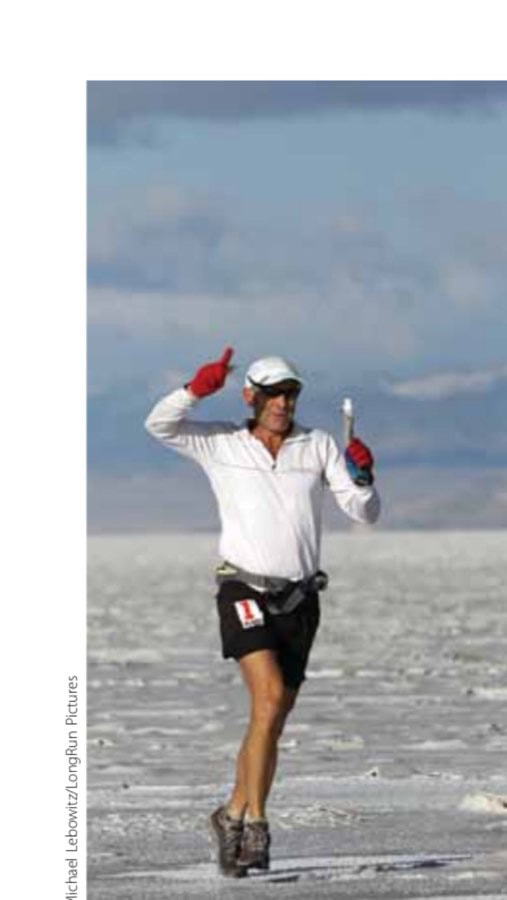
Jay, 10 miles into the Salt Flats 100. Note the intense focus even at the early stage of the race.
a story with me from a recent race that made me proud of my age (and my shirts). They were running in about fifth place in a group of three runners. As they crested a long climb, what appeared to be the girlfriend of the
other runners said to her boyfriend, “You need to rally and catch that old guy in the plaid shirt.” My buddies just smiled at each other, resisting the urge to say, “Good luck, dude!” M&B: You’ve had two ultra
lives. You once told me that you ran “a long time ago” (Western States in 1980, Wasatch 100 in 1983), then gave it up entirely for 25 years because “life happened,” and then you got back to it at age 47. Several questions.
Ultras were almost unknown in 1980, certainly a very different environment than they occupy now. What attracted you to States and Wasatch? What prompted you to be a pioneer for your age among pioneers for that distance?
Aldous: When I was about 17, I read an article in Outside magazine about the WS100 and how if you finished in under 24 hours you got this silver belt buckle. I decided that I wanted the buckle, so I entered.
M&B: What was the experience like then? Aldous: The idea of running 100 miles was completely new and foreign to me back then. I learned what I could from the few runners that had completed that distance. At that time there were no trail shoes, so we wore road trainers. Fanny
packs with Nalgene bottles were how we carried our fluids. There were no energy drinks then. I primarily drank defizzed Coke with ground-up aspirin in it. Despite not really knowing what I was doing, I was able to get the silver belt buckle!
M&B: Compared to today’s events? Aldous: For the most part, there are few differences. Many say the camaraderie and community spirit is being lost. I disagree. There is still something that draws us together as ultradistance runners that exists at most races. It is a special community. I think we are lucky in that we have so many choices for races now, and it truly is possible to race every weekend. How cool is that? M&B: Some of your runners back then have become legends in the sport. Bernd Heinrich for one, Gordon Ainsleigh for another. Do you keep in touch with those pioneers? Aldous: These dudes are in a completely different stratosphere of talent and contribution to the sport. I’ve never had the pleasure/honor of meeting them—though I would be honored to at some point. M&B: If it’s not too personal, why did you leave the sport for so long? Aldous: Family and career were my focus. Plus I didn’t consider myself to have much talent, so in my mind I wasn’t really missing out on anything. I was able to stay active and in the outdoors with skiing, hiking, travel, and other outside interests, so there I was, not [having] a sense of missing running. M&B: What prompted your return? Aldous: I was painting the garage one summer Saturday in 2008, which happens to be on the Wasatch 100 course. Over a period of about four hours, a number of runners who were clearly training for Wasatch went by. I thought to myself it would be fun to run another 100 for old times’ sake. I put in for Wasatch that fall and was selected for 2009. I ran a number of shorter races [Speedgoat and Katcina Mosa, referenced below] to prepare for Wasatch and found that I had a bit of talent. At Wasatch I surprised myself by placing fifth with a time of just over 22 hours. Since then it’s been a steady diet of races. M&B: Do you remember a time when you realized that you could run better than most of your peers? Was it a personal revelation/epiphany, if you will, about how far this ultrarunning could take you? Aldous: The breakthrough for me was when I was running the 2009 Speedgoat 50K, and I found myself in the lead with Erik Storheim. While Erik dusted me on the final descent, I placed second in what is considered one of the most difficult 50K courses in the country. Afterward, when I learned who Erik was and what an accomplished runner he is, I realized that maybe I had a knack for this sport. Somewhat bizarrely, or fortuitously, Erik and I ended up running the entire Katcina Mosa 100K together two weeks later, where we shared first place and a course record. Since then Erik and I have become good friends and regular running buddies.
M&B: Is it fun? Aldous: I love racing. I am excited in the weeks leading up to a race. I’m excited during the race. And I’m still excited and on a high after. I know I race too much. But I enjoy it so much that I’m willing to underperform my potential at a few select races in order to be able to race every two to four weeks. I rationalize this decision with the knowledge that I likely won’t be competitive too much longer, and I need to get all the races in while I’m still somewhat brisk. M&B: Do you have a goal time on a certain course that is the grail—reach that and you can hang it up? Aldous: Not really. Someone did bring to my attention that since I have turned 50 I have broken the 50-plus course record for each race I have entered (nine to date). In some way, that could be a goal—to try to extend that streak. And as I think about it, I would like to run Wasatch again and go under 20 hours. I live right on the Wasatch 100 course, so that race has special meaning for me, and I’d like to be able to do it again. I just need the race committee to decide that anyone who lives on the course gets an automatic entry—ha! I would also like to return to WS100 some day (lottery gods willing) and beat my time from more than 30 years ago. It would be fun to say I’m faster in my 50s than I was when I was 18. M&B: What motivates you to do the daily miles? Aldous: I’m not a big-mileage runner. In fact, I seldom run more than 60 miles a week unless I’m racing. That said, I do try to focus on quality runs that have a specific purpose/objective for whatever race I am preparing for. Unlike many runners, I don’t have a compulsion to run and don’t feel addicted. I do find great joy in running, and when I’m out I enjoy the time to think, to daydream and be with myself. I do find myself driven by racing and highly motivated to prepare for my next race. M&B: Are the solitude of the run and the recognition of community in the struggle important to you? Aldous: My running experience and motives are quite selfish. I run mostly for me. I seek the time by myself to think and reflect. I appreciate the benefits of good health and fitness at my age. I enjoy competing. Running has introduced me to some people whom I now consider to be my closest friends. I’m not particularly cerebral or contemplative about running. M&B: Does your work with Brighton Group, which helps nonprofits create strategies to increase public support, reflect the inherent values that you have found in ultradistance running? Is that why you do both of them? Are they complementary? Aldous: I think what ultrarunning has contributed to my professional work is an enhanced ability to “run through” the challenges, obstacles, and bullshit that comes with work. I can better keep my eye on the end outcome I am seeking and
▲
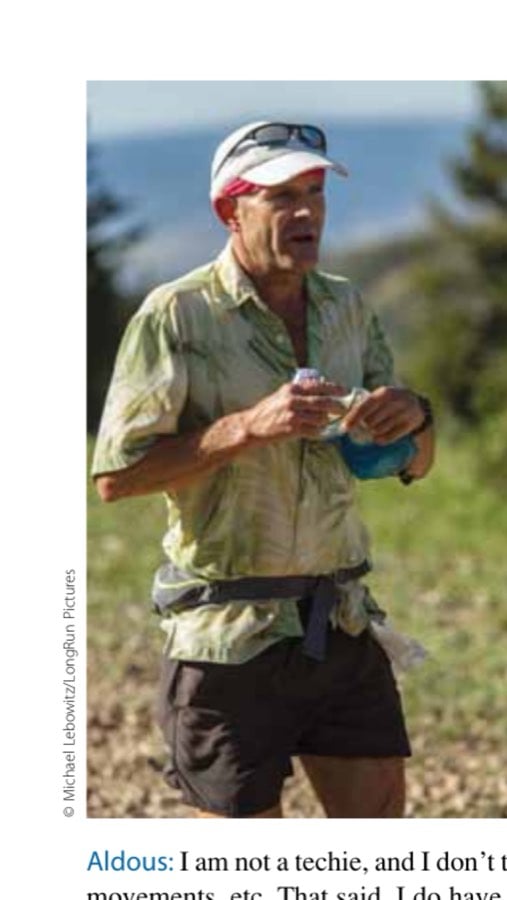
Jay at Hayden Saddle, mile 14 of the 2012 Silver City 50K.
not get distracted by personalities, competing agendas, politics, etc. along the way. Running has also reinforced that “this too shall pass” and that challenging situations are just temporary.
© Michael Lebowitz/LongRun Pictures
M&B: You don’t seem to be a “techie,” but some of your commentary indicates a very organized and structured approach to running. “A tempo run to warm up for Devil’s Backbone” was something you said about your intentions for
Silver City. This is not a comment from an intuitive, run-by-feel runner, or is it? Aldous: I am not a techie, and I don’t track heart rate, vertical, shoes worn, bowel movements, etc. That said, I do have an innate sense of what helps me run well
and helps me improve—and thus what I should focus on. For me, I try to have every run be a quality run with attention to tempo and speed. No garbage miles! My body doesn’t require high mileage. I have found that I do not recover as fast
as when I was younger and that I don’t have as high of a tolerance for miles as I did in my teens and 20s. In fact, I seldom run more than 60 miles a week unless I’m racing. I’m fortunate in that I run with a bunch of techies who willingly share
lots of good advice with me. It’s like I’ve got an informal coaching staff sharing their knowledge, experience, and wisdom with me. M&B: What does the future hold for you and your running? Aldous: My big race this summer is the Leadville 100. I think I’m well suited
for the course, and I hope to have a great run. After that, I’m going to try the North Coast 24-hour run in September. That will be a new experience for me. I’m curious if I have a knack for 24 hours. The duration, the distance, and the
surface (flat and paved) will all be new to me. If that goes well, I’d like to run the Desert Solstice Invitational in December and shoot for the national and perhaps the world 24-hour record.
M&B: Do you have any methods to sublimate pain and discomfort during a race? When you hit a dirty patch during a race, do you ever speed up your pace as a way of getting past it? Aldous: When it starts to hurt, I work hard on going to that “other place” where the pain is muted. Nothing like a good daydream to push back the pain and pass the time! M&B: You have said that running for you is quite selfish. You have said you run with a bunch of techies who give you lots of good advice in training. But most of your racing seems to be from the front of the pack. Does running alone make you tougher and more self-reliant? Aldous: I’m fortunate in that I have been adopted by a small group (the MRC) of knowledgeable, accomplished, and passionate runners: Christian Johnson, Erik Storheim, Peter Lindgren, and Greg Norrander. I run with some subset of the group on average twice a week where we share experiences and ideas, review races, critique runners, etc. It’s also not unusual for somebody to pass along a running book, share a link to a research study, or provide an introduction to someone in the know on a race, a route, or gear. We’re kind of this bizzaro combo of social club, study group, and training partners. I’m very lucky to have this group as
ad
teachers, mentors, and my biggest fans. Much of my success, I owe to this group. They saw some talent in me, adopted me into their group, taught me most of what I know, and now encourage and support me. M&B: On long workouts, do you ever dissociate—that is, drift from a laser focus on a workout to a more soft focus? Aldous: I dissociate and daydream all the time, both in training and in races. I work really hard to go to that “other place” in my head. Sometimes I’ll make a list of things to think and daydream about before a race. I can be in that other place yet at some conscious level be aware of the race, the tempo I want, nutrition and hydration, etc. Checking out while running may be my special gift. M&B: Focus is important to do well specifically and in general, hopefully, long term, doing better. Ultrarunning demands a kind of focus, almost a “practice,” to use a meditation term. You have said that you are not cerebral about running. What did you do to essentially improve an already good command of focusing? Aldous: I don’t think I’m good at focusing. I do think I’m good at adapting, staying flexible, and making adjustments during a race. Perhaps that compensates for focus. I had this funny mental conversation with myself yesterday at the Devil’s Backbone 50-Mile that is an example of this. I found myself keeping score—Jay versus adversity. I got off the trail for a bit, but quickly discovered my error and got back on track. Jay one, adversity zero. It was raining and I found my hydration pack rubbing my back raw. I completely readjusted the pack so it sat in a different position. Jay two, adversity zero. I lost a toenail and learned that if I squeezed my toe while running downhill, it didn’t hurt. Jay three, adversity zero. I had this conversation in my head for a good couple of hours and many miles during the race about how I was kicking adversity’s ass. This is how my head works and an example of one type of that “other place.” M&B: What do you do during the tapering phase to stay fresh and to refrain from wasting energy that is building up from the diminishment of mileage and effort? Or do you taper in the traditional sense of the term? Aldous: I wish I had enough control over life to be able to undertake the perfect taper. Tapering is often nothing more than knowing that work deadlines have been completed before a race, the garden watered before leaving, and the grounds emptied from the coffee maker so there won’t be a mold fest after returning home from a race. M&B: Do you attempt to play a race out in your mind in advance, or do you go into a race intent on reacting to circumstances around you? Aldous: I will think about a race in advance and how I want to feel: thinking about keeping a quick tempo, being light on my feet, moving efficiently, locking my
▲
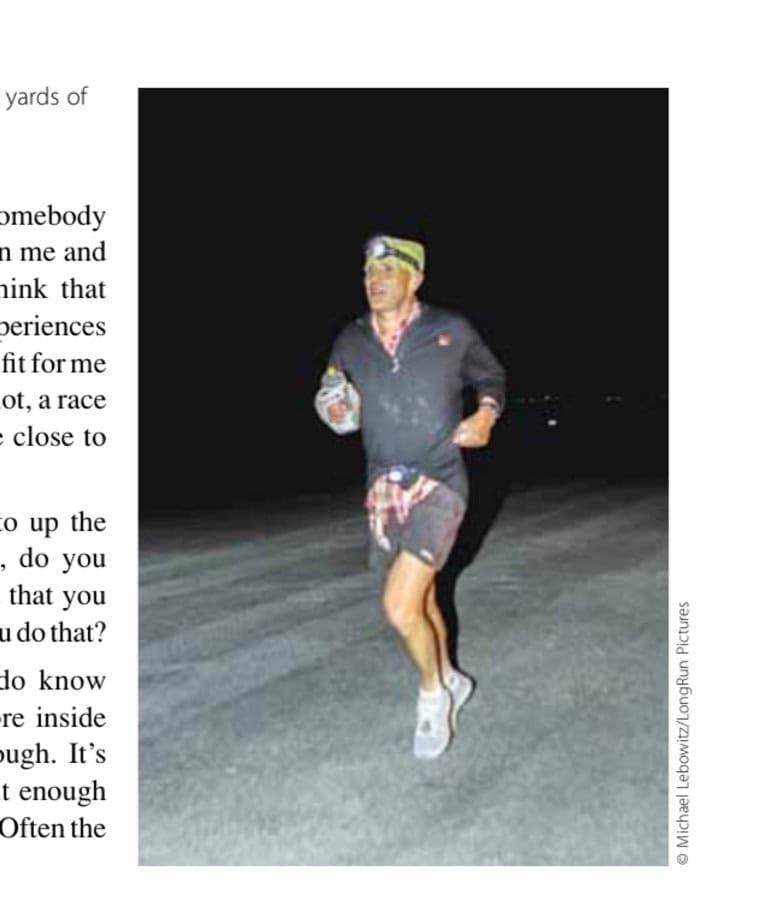
Jay finishing the last 100 yards of the Salt Flats 100K.
eyes on the shorts of somebody that I know is faster than me and staying with them. I think that imaging positive race experiences and outcomes has a benefit for me in that more often than not, a race will turn out to be quite close to what I imagined.
© Michael Lebowitz/LongRun Pictures
M&B: When you need to up the intensity during a race, do you have any sort of mantra that you bring into play to help you do that? Aldous: Not really. I do know that there is always more inside if one wants it bad enough. It’s just deciding if I want it enough to really suffer and hurt. Often the answer is no . . . M&B: Do you follow a nutrition plan in training or during a race? Aldous: I was diagnosed celiac about two years ago. This has required changing my diet considerably to avoid foods with gluten. I pretty much do not eat any processed foods (many/most processed foods have wheat) and must admit that I think eating well has made a big difference in my running. I’m fortunate in that my wife is a nutritionist specializing in digestive diseases, so I’ve had lots of good advice. I’m lucky in that I’ve got a good race stomach. I rarely have stomach issues. For races I try to get a good part of my nutrition from liquids (Perpetuum, Heed, Red Bull, Mountain Dew, Coke, etc., I’m not picky). For solids, I do gels, bananas, and dried mangos. I seldom stray from this menu, as it works well for me. M&B: How important is rest to your training program, and what have you found to be the best form of rest and relaxation? Aldous: It takes me much longer to recover from training/races than others. Just part of getting older, I guess. I try to take at least two days off a week from running and do something else like core strength work, cycling, wood-splitting, snow-shoveling, skate skiing, etc. I’m trying to experiment with even more rest. I’m quite sure that more rest for me will result in a higher level of performance than more training. Easy to say, hard to do.
This article originally appeared in Marathon & Beyond, Vol. 17, No. 2 (2013).
← Browse the full M&B ArchiveMore like this
1,000+ stories from 19 years of Marathon & Beyond
The complete archive of the legendary long-distance journal — digitized and free to read.
