

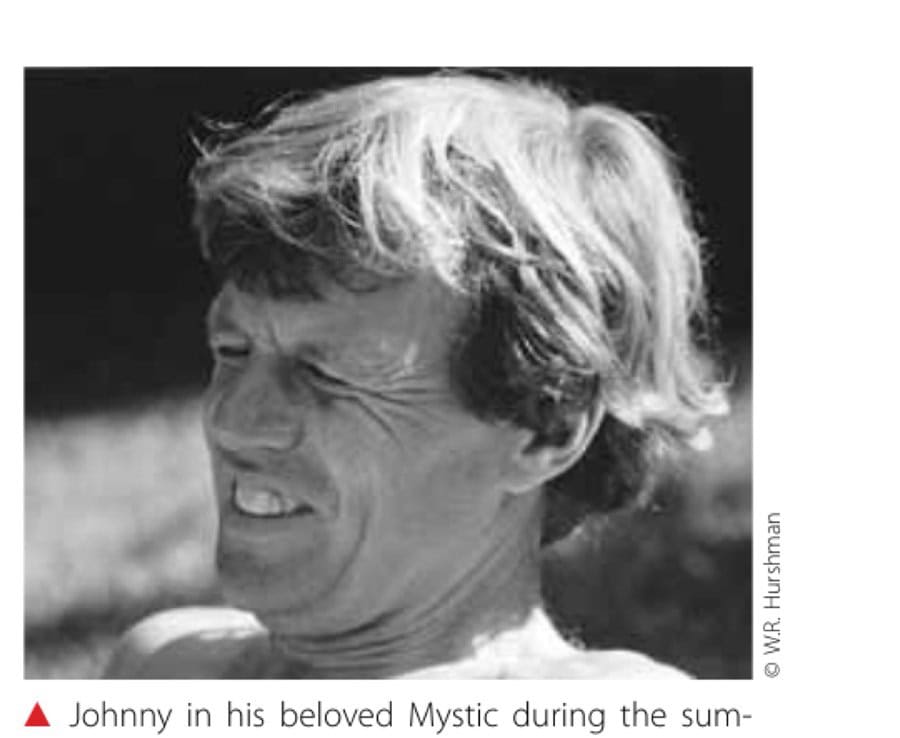
John Joseph Kelley, who died on August 21, 2011, was the first American to win the Boston Marathon since the end of World War II. He shared most of a name with the last American to win the race before him, John Adelbert Kelley, who won the 1945 race. J. A. Kelley was still a force in American distance running as John J. Kelley’s career was taking off, requiring those who followed the sport to devise a means ▲ Johnny in his beloved Mystic during the sumof distinguishing one Kelley from mer of 1980. the other. Thus, John A. Kelley became “John the Elder” and John J. Kelley became “Young” John Kelley.
When John A. Kelley died in 2004, a couple of veteran runners and followers of the sport wondered whether it would still be necessary to refer to John J. Kelley as “Young” John. That Kelley was still a focus of conversation four decades after his career peaked is a testament to his stature in the sport.
Amby Burfoot, the second American to win the Boston Marathon after World War II and a former executive editor for Runner’s World, called Kelley “the first modern runner.” It’s a description that invites contemplation.
Kelley’s best running years extended from the mid 1950s to the early ’60s, a modern era compared with say, the Renaissance, but one that seems prehistoric in comparison with the current sport of long-distance running. The majority of competitive American distance runners then were in either high school or college and raced
on the track. Very few continued to run after graduation, and many of those who did continue were elite enough to nurture realistic ambitions of making the Olympic team. They often would compete “until the next Games” and then quit once they had either fulfilled their ambition or given up on it. A very small number of them kept on with serious competition, racing mostly on the track or in cross-country races.
There also were a small number of road racers, probably fewer than 300 nationwide. The best of those aspired to run the marathon at the Olympics or Pan American Games. Most of the rest also ran marathons, but there were few opportunities to do so or to race at any other distance, for that matter. Road racing was nonexistent in much of the country, though there were a few hotbeds, New England being perhaps the hottest.
But even there, little about the sport would look familiar to a modern runner. Distances, aside from the marathon, were not standardized; generally, a course was selected because it went from a convenient starting point to a convenient finishing point and the race distance was however far that was. The number of entrants was minuscule by today’s standards. Triple-digit fields were unheard of outside of the Boston Marathon, which usually managed to creep into three digits—and races with fewer than 10 entrants were not unknown.
BT: Before tech Runners trained in tennis shoes, bowling shoes, Hush Puppies, and so on. The running shoe we know of was either nonexistent or hard to find. Many runners did have a specialized racing shoe but were likely to save it for races. Such shoes were usually made of leather or kangaroo hide with a hard, thin rubber sole. Winter gear was usually a cotton sweatsuit, though some trained in jeans or regular trousers, and no piece of fabric had even begun to think about wicking moisture away.
And of course, the sport was an amateur one. No matter how good an American runner was, he—there would be no “shes” for years to come—had to support himself through something other than running or anything related to it. He could not sell running shoes, give talks at prerace clinics (not that there were any), write articles about the sport and be paid, or coach for a fee or salary. A runner that Kelley coached, for free, once entered a race whose entry form asked for the name of the runner’s coach. The athlete put Kelley’s name in the blank. Kelley saw it, crossed out the word “coach,” and in its place wrote “advisor,” knowing that being identified as a coach might give the sport’s administrators the idea that he was being paid.
In this era, track runners were the thoroughbreds, both physically and intellectually. The best track runners in the United States had gone through the collegiate system, meaning that if they had a full scholarship for four years, they did not have to worry about supporting themselves during that time. If they kept running after graduation, they most likely had a white-collar job.
Kelley’s Training Sample (from Joe Henderson’s Road Racers and Their Training) Done about one month prior to his 1957 Boston win. Sunday—16 miles, including 15 220 yards in 35 seconds between miles nine and 13. Total time, 1:42 Monday—Seven miles in 50 minutes Tuesday—a.m., 11 miles in 1:17; p.m., six miles in 43 minutes Wednesday—10-plus miles in 1:08 Thursday—Eight-plus miles in 55 minutes including 2 440 yards in 65 seconds between six and 7 3/4 miles Friday—Four miles in 28 minutes Saturday—30K race in 1:44
Road runners were the workhorses. Few of them went to college. They mostly had blue-collar jobs. The elder Kelley worked as a janitor at an electric generating plant, Johnny Miles delivered groceries, Tony Medeiros drove a truck, and Clarence DeMar worked as a printer for a Boston newspaper. Most of them trained only a few days each week. In Joe Henderson’s Road Racers and Their Training, the Elder Kelley says that he ran three or four times a week and usually topped out at 45 miles. “I don’t think I ever ran 60 miles in a week in my life.” His training load was not unusual.
Their sport was a poor man’s sport. Many of them hitchhiked to races or hopped freight trains. Competition was almost always among local runners as travel costs were prohibitive, Boston again being sort of an exception as runners from all over the United States and Canada scrimped and scrounged throughout the year in order to afford a trip to compete in the one truly “national” racing field in the country.
Most road runners raced on the roads because they were not really fast enough to have much success on the track. “We were plodders,” Elder Kelley once admitted. It was rare for track runners to run the marathon. When they did, it was either because they were curious or because they wanted a “safety” event in which they could make an Olympic team should they fail to make it in their primary event.
This was the distance-running world that Young John Kelley encountered when he and George Terry, a friend who was on the track team at their high school,
traveled from their home in Connecticut to Boston in the late 1940s to watch the Boston Marathon. But that world was changing, and Young John would push that change along. John went out for high school track after watching the Boston Marathon, but unlike almost every other high school kid who goes out for track, he did so not so much to win a varsity letter, a league or state championship, or a college scholarship. He wanted to run the Boston Marathon one day and saw the track team as the starting point. Unlike other aspiring marathoners of the day, he was fast and successful on the track.
Just short of Zamperini
© W.R. Hurshman
“Louis Zamperini had the high school mile record then,” said Bill Squires, who coached Bill Rodgers, Dick Beardsley, Alberto Salazar, Bob Hodge, and several others who ran marathons in 2:10 or better. “John was a year older than me, and we were racing each other to see which of us would break that record. Neither of us did. We each came up a few tenths of a second short.” Kelley left high school in 1949 with a best mile of 4:21.8. It was the secondfastest mile ever run by a high schooler and would remain one of the fastest ever high school miles for over a decade. No high school miler would better 4:21 for 10 years. But Kelley’s success on the track did not change his interest in the
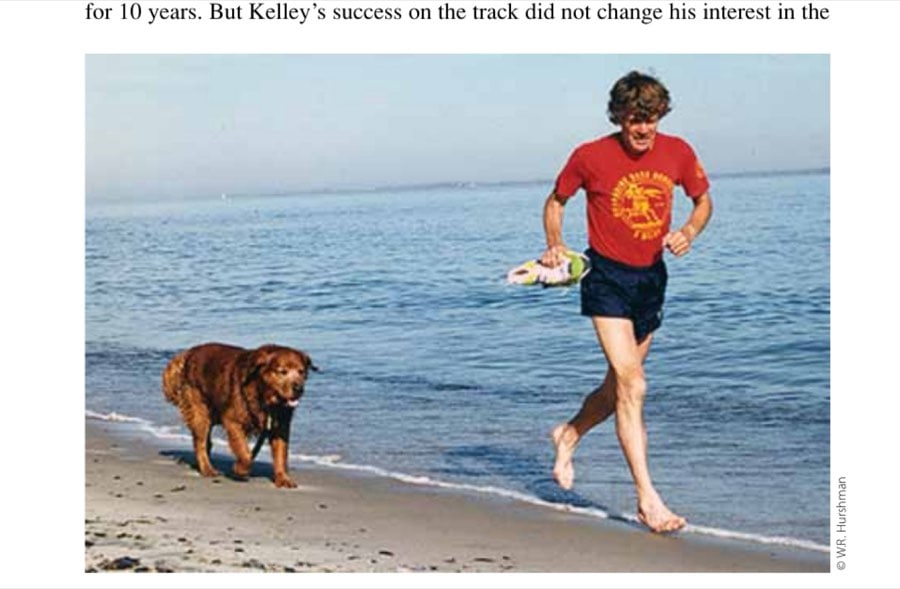
▲ Johnny and Brutus on the beach during the summer of 1993.
marathon. It was the event he wanted, and the year after he watched it, he went back to Boston and ran in it. A swollen knee forced him out around 13 miles, and his high school coach was so furious that he forced Kelley to race a mile on that bad knee the very next day.
But he kept on running road races as a high school runner. In 1948, while in 11th grade, he won the AAU (predecessor of USATF) Junior 25-kilometer national championship. (In those days, “junior” championships were not determined by age. A “junior” was anyone who had never won an AAU championship before.)
All of this was enough to earn Kelley a track scholarship to Boston University. It was, for him, perhaps the best of times and the worst of times. Kelley loved literature, reading, and education. Tom Derderian, in his book on the Boston Marathon, called Kelley “Henry David Thoreau at six minutes per mile.” The scholarship allowed him to get an education while simultaneously supporting himself. And it located him next to the Charles River and the footpath adjoining it. “
People called him ‘The River Rat,’” Squires relates. “There’s a 16-mile loop there, and Kelley was always running up and down the river on that loop.” But Kelley’s coach at Boston University, Doug Raymond, saw little benefit in 16-mile runs along the Charles for an athlete expected to race quickly on the track at distances of one to six miles. Raymond had been a 400-meter runner and was very fond of training distance runners by assigning seemingly endless numbers of repeats at that distance. (Raymond was not alone here. Both Emil Zatopek and Roger Bannister had tremendous success in those days on training that was essentially 400-meter repeats and not much else, and countless US coaches tried to re-create that success by imitating the training of these two athletes.)
Raymond was a successful and respected coach. Nick Costes, a grad student at BU, trained with Raymond and thrived on quarter-mile repeats. Costes and Kelley would make the 1956 Olympic team in the marathon, along with another BU student, Dean Thackeray. This was the only time that three runners attending the same school all made the Olympic team in the same event in the same year. Costes thrived on the interval work and went on to become a college coach who later wrote a booklet extolling the virtues of interval training that was published by Runner’s World. But what was sauce for Costes/Bannister/Zatopek was not sauce for Kelley. “
He hated intervals,” Squires relates, “just absolutely hated them.” Burfoot, the 1968 Boston winner, was coached by Kelley as a high school runner. “He never had us do an interval session,” Burfoot says. “We did ‘pickups,’ i.e., fartlek. I can’t ever recall him giving us an interval session.”
Kelley stands his ground Kelley’s name first appears in the B.A.A. Marathon’s results in 1953. He ran the race even though it took place at the heart of the college outdoor season. Raymond
© W.R. Hurshman
was no happier about that than Kelley’s high school coach had been. And Raymond was not happy with the way Kelley trained. A confrontation followed, and Kelley was told that he needed to train and race as the team did or Raymond would take away the scholarship. Kelley did not back down and instead left school, joined the Army, and then returned after his enlistment and used the GI Bill to pay for the rest of his schooling while running road races in the Boston area as well as the occasional college race. While in college, he also joined the Boston Athletic Association and represented it at road races in addition to running for Boston U.
He entered the B.A.A. Marathon in 1956 and was considered one of the favorites but could not beat Antti Viskari of Finland. Viskari ran 2:14:14. Kelley was 19 seconds back. Those were the two fastest marathon times ever at the time and prompted the B.A.A. to remeasure the course. Although the start and finish had been at the same spots for decades, it turned out that the course was 1,183 yards short. Road construction over the years had shortened it inadvertently.
In 1957, the course was restored to the proper length. It was Kelley’s year. He ran a bit off the lead for the first few miles but then stayed with the lead pack until 16 miles, when he began to pull away, winning by just under four minutes from Veikko Karvonen, another world-class Finn. In the process, Kelley became
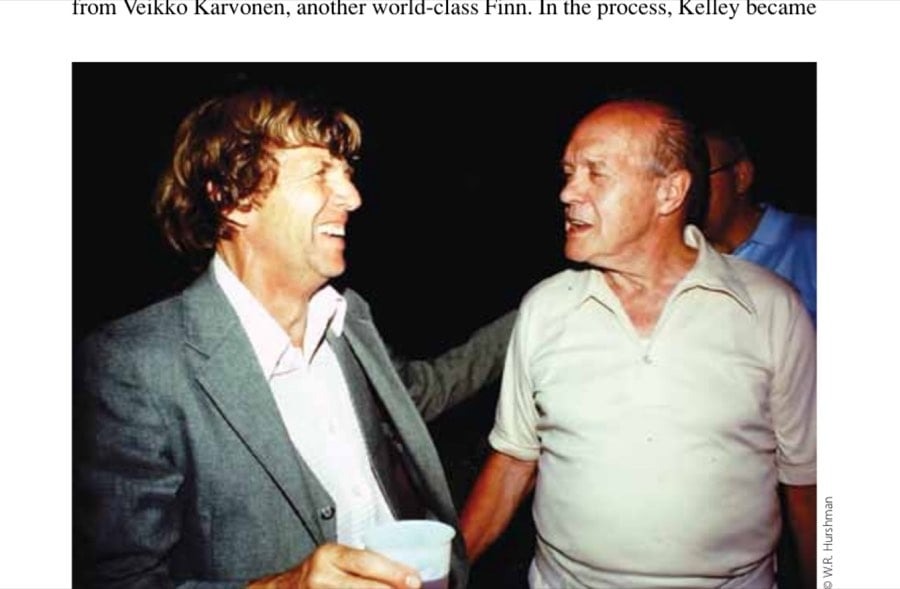
▲ Johnny and Jock Semple, forever joined in the annals of Boston Marathon history, at Johnny’s retirement (from teaching) party in 1980.
the only member of the sponsoring B.A.A. ever to win “its” race. It was a very warm day, 76 degrees Fahrenheit at the start and sunny. Kelley’s time of 2:20:05 on the newly certified course was automatically a course record, but it stood for six years, finally falling to Aurele Vandendriessche’s 2:18:58 in 1963. It was also the fastest marathon Kelley would ever run. Kelley never won the B.A.A. race again, coming in second in 1958, ’59, ’61, and ’63 and earning a fourth-place finish in 1962.
But Kelley’s successes extended beyond the B.A.A. Marathon. Prior to his 1957 win, he made the US Olympic team in the marathon in 1956. He needed to run two qualifying races, Boston in April and the AAU National Championship race in Yonkers, New York, roughly a month later. He was first American at Boston and overall winner at Yonkers.
He finished 21st in Melbourne. Jock Semple, director of the B.A.A. Marathon, was outraged that US runners had been forced to run two qualifying marathons and believed Kelley would have placed much higher if he had needed to run only one trial.
In 1960, Kelley was hurt and unable to run at Boston. The same qualifying procedures—two trial races—were in effect. Semple’s outrage had been wasted, and it looked as if Kelley might not qualify for the Rome Olympics. But he was healthy for the Yonkers race, and the USOC ruled that he could make the team by finishing in the top three at Yonkers. He won the race. There was some grumbling about favoritism but Kelley, an extremely humble man, was possibly more upset than anyone else at his good fortune. He seriously considered refusing his berth to allow someone who had run both races to go but eventually decided that he would accept the spot on the team after all. He improved by two spots at Rome. Along the way he won the marathon at the 1959 Pan American Games in Chicago with fellow New Englander Jim Green getting silver. Kelley’s win at Yonkers in 1956 started a streak of eight consecutive Yonkers wins and, with them, national championships.
Frank Shorter emerges In 1971, Frank Shorter, an international-level trackman, ran the AAU Championship Marathon (relocated from Yonkers to Eugene, Oregon), the Pan American Games Marathon, and the Fukuoka Marathon, at the time the de facto world championship. He finished second, first, and first respectively in those races. The next year, he won the Olympic Marathon. One of Shorter’s preferred tactics was to toss a couple of miles at 4:40 or better into the middle of a race and break away from the rest of the field. He could do that because of his trackman’s speed. Shorter culminated a process that Kelley had begun. Other runners with fast track times followed, creating the marathon as we know it today.
© W.R. Hurshman
▲
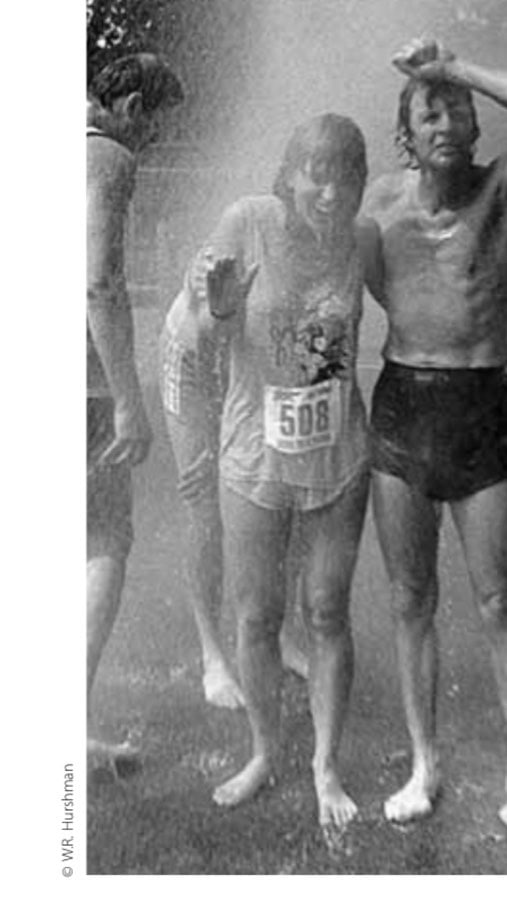
Johnny cools off after the race that bore his name, in August 1986.
In 1953, while still at Boston University, Kelley met and married Jacintha “Jesse” Braga. “She was just one of the nicest people you’d ever meet,” says Squires. Kelley graduated from BU with a degree in Eng
lish and eventually got a job as a high school English teacher in Groton, Connecticut. He also began to coach the crosscountry and track teams. He ran with his athletes. He took them away from the track onto roads,
beaches, and forest paths. Other local runners joined the runs. They gathered at Kelley’s house before and after runs chatting in the living room, drinking tea, and eating cookies that Jesse had prepared.
Burfoot was one of those runners, perhaps the most successful of all Kelley’s protégés. He trained away from the track and over long distances. After high school, Burfoot went to Wesleyan University. He ran 8:45
for two miles in an indoor meet. He broke away from the pack in the second half of the race at Boston in 1968 to run 2:22:17 and become the second American to win the race since World War II. Later that year, he went to Fukuoka and ran
2:14:28.8, missing the American marathon best by less than a second. Burfoot remembers the tea, cookies, and conversation at Kelley’s house, the long runs over all sorts of terrain that finished at very good paces, the conversa
tions about ’60s politics, analysis of Bob Dylan’s songs, discussions of novels and novelists, and the late arrivals to races that Kelley drove him to because Kelley’s sense of direction often led to some extraneous driving along the way.
Kelley was, Burfoot says, the first person he ever saw stop his car to allow a turtle to cross a road. Rather than throw away Christmas trees, Kelley planted them in his front yard. “It’s basically a forest now,” Burfoot says of the yard.
Another friend, Steve Fagin, recalls one of the tea-drinking sessions at Kelley’s house. Kelley was about to drop a spoonful of sugar into his tea when he saw an ant on the spoon. He gently picked the ant up and walked to the door, setting it on the ground outside. “
He may have gotten me my teaching job,” says Rick Bayko, owner of the Yankee Runner shop in Newburyport, Massachusetts, and one-time publisher of a magazine of the same name. “I listed some of my running accomplishments on my resume. The superintendent saw it and asked if I knew Kelley. [They’d taught together a few years earlier.] So we talked about the Boston Marathon and John Kelley for most of the interview. Then he said, ‘You’ve got the job.’”
By the mid-’60s, Kelley’s running star had begun to fade, albeit slowly. When protégé Burfoot won in 1968, Kelley hung with the lead pack through the early part of the race before fading to 15th. The year 1967 was the last time Kel finished in the top ten, and 1967 was the last time he ran under 2:30. But he ran the race far more often than not until 1992 and was still breaking three hours in 1984. His last B.A.A. race was in 1992, when he finished in 4:07:02.
Kelley’s approach to marathon training Kelley’s training was much more “modern” than was typical of many of his contemporaries. Where the previous generations of marathoners might train three or four times a week and did mostly steady runs, Kelley ran on six or seven days of the week, frequently trained twice a day, and did regular runs of 20 miles or so. “
Absolutely hated doing intervals,” Bill Squires reiterated. “I think he could have done 2:12 if he’d done some real speed work.” But Kelley did not completely ignore working on speed and pace. While he avoided the track, he regularly did “time” intervals, such as 20 x 35 seconds, 10 x 2:00, and so forth, on the roads.
And as modern runners would come to do, he stayed with the sport after leaving school, obviously not earning a living from it as today’s top runners do but finding a way to fit it in around the demands of work and family as an increasing number of runners would come to do in the 1960s and ’70s.
Initially, that involved teaching English to high school students. He was a thorough and a thought-provoking teacher. But, according to Burfoot, “He had not a fraction of the disciplinarian in him.” Teaching was evidently something of a struggle for him, and eventually he left the profession after a disagreement with his school’s principal seemed irresolvable. He drove a taxi and began writing for local newspapers, generally small ones. In the last few years, he drew on his memories of the sport for a New England Runner column called “Retro-running.”
None of this made him wealthy. Upon Kelley’s passing, Burfoot wrote that “Kelley departed the world with few possessions more than he had when he entered it.”
© W.R. Hurshman
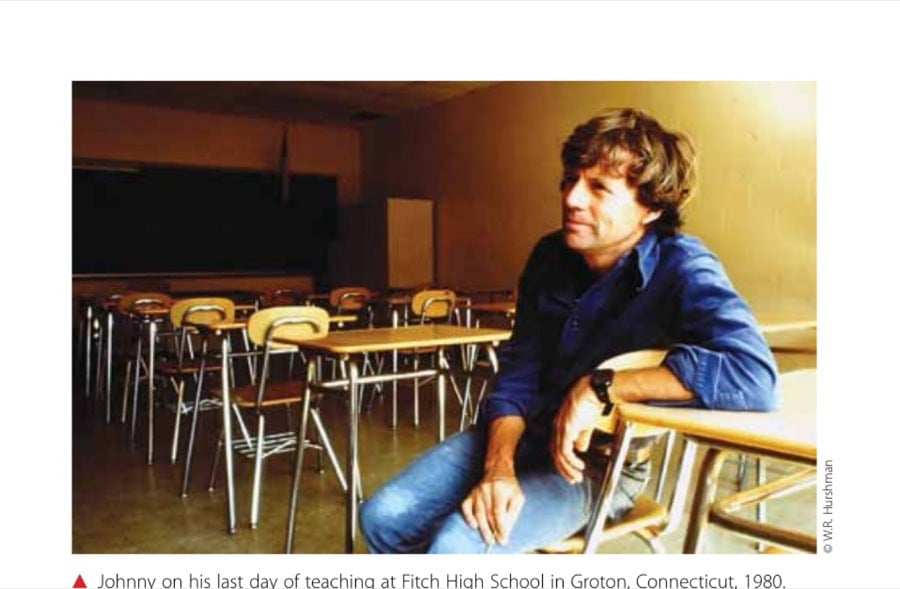
▲ Johnny on his last day of teaching at Fitch High School in Groton, Connecticut, 1980.
“He never made any money,” Rick Bayko relates. “I don’t think he cared about that at all.” He also never seemed to develop the self-assurance that success often brings. “I didn’t know him really well,” says Tom Osler, a three-time AAU road racing champion and contemporary of Kelley’s, “but I remember that he was always terribly nervous before races.” “
Yes. His nerves were awful,” Bill Squires affirms. “You see that with young guys who haven’t won anything yet or made their reputations. But you hardly ever see it with runners who have been successful for a while. They get confident and their nerves settle down. But that never happened for John.”
Browsing through issues of Long Distance Log, the publication that covered the sport of distance running during Kelley’s time, you see quotes from Kelley in which he claims he’s “finished, washed up,” and is pretty sure he will give the sport up.
That nervousness extended to his writing career as well. “He was a short guy, like me,” says Joe Henderson, a former Runner’s World editor and columnist for both Runner’s World and Marathon & Beyond. “My running heroes have always been short guys. I was at a clinic once, and he was there as well. I was a bit nervous at the prospect of meeting one of my heroes. Then one of the organizers of the clinic came to me and said that John Kelley really wanted to meet me, he liked my writing, but he was really nervous about meeting me.”
Establishing Kelley’s Pace Sometime toward the end of the last century, Jesse, his wife, opened a clothing shop. After a while, she began selling running shoes at the shop, eventually replacing the clothing with more running shoes and gear. The clothing shop became Kelley’s Pace, and it was sort of an attempt on Jesse’s part to make some money from her husband’s name and from the sport that was so much a part of his life. When she died, John inherited the shop, and it was profitable until money was embezzled on two separate occasions. Kelley was forced to sell most of the business but retained a small percentage of its ownership. He continued working in the shop until his final illness stopped him.
Employees at Kelley’s Pace noticed a cough in November 2010. “(A mutual friend) called me in June,” says Rick Bayko, “and told me that Kelley was really sick and probably had a couple months to live.” The prediction proved accurate, and John Joseph Kelley left the distance-running world in a somewhat different state than he had found it.
Other fast runners followed Kelley into the marathon. Billy Mills ran both the 10,000 and marathon in the Tokyo Olympics. George Young ran the steeplechase and marathon in Mexico City. Jack Bacheler, Kenny Moore, and Frank Shorter all had excellent times on the track when they ran the 1972 Olympic Marathon. Perhaps they would have found their way to the event without Kelley’s influence, but he
John Kelley’s Best Times (from John Lucas, sports historian at Penn State) 440—52 seconds
6 miles—29:50
880—1:57
10,000 meters—30:50
1,000 yards—2:19
15K—45:00
1,320 yards—3:10
10 miles—49:00
Mile—4:17
12 miles—1:00
2 miles—9:17
20K—1:02
3 miles—14:20
15 miles—1:17
4 miles (road)—19:20
25K—1:19
4 miles (cross-country)—19:40
30K—1:35
5 miles (road)—24:20
20 miles—1:48
5 miles (cross-country)—24:50
Marathon—2:20:05
was arguably the first US marathon runner who was fast enough to have been successful on the track despite his disdain for it. Other American runners have better records at Boston than Kelley did. Old John Kelley and Les Pawson each won the race twice, and Clarence DeMar won it seven times. But these runners were running a different event than Young John was. Before World War II, the Boston Marathon was essentially a regional race. Elder Kelley, Pawson, and DeMar were racing against runners from the northeastern United States, Ontario, Quebec, and the Canadian Maritimes. Young Kelley was racing Finns, Swedes, Japanese, and Yugoslavs as well as North Americans. It’s hard to imagine DeMar winning the race seven times against the sort of international fields Kelley faced. Only Bill Rodgers among Americans, with four wins at Boston against international fields, has won multiple titles against the sorts of fields Kelley raced. Kelley’s eight consecutive wins at the national championship marathon at Yonkers was achieved against fields comparable to Boston’s pre-World War II fields. Against that level of competition, Kelley was almost untouchable.
Orville Atkins, a contemporary of Kelley’s, recalls running his debut marathon in St. Hyacinthe, Quebec, on Labor Day weekend in 1961. On a humid, 92-degree day, Kelley won the race in 2:31. Only seventeen runners finished the race, and the second-place finisher was a half hour behind Kelley. He was really the US’s first international-class marathoner.
And he left a legacy. He coached Amby Burfoot to his 1968 Boston win. Burfoot’s college roommate at the time was Bill Rodgers, who learned a bit about long-distance training and racing from Burfoot, who learned from Kelley. Rest in peace, John, and thanks for the inspiration.
© W.R. Hurshman
▲
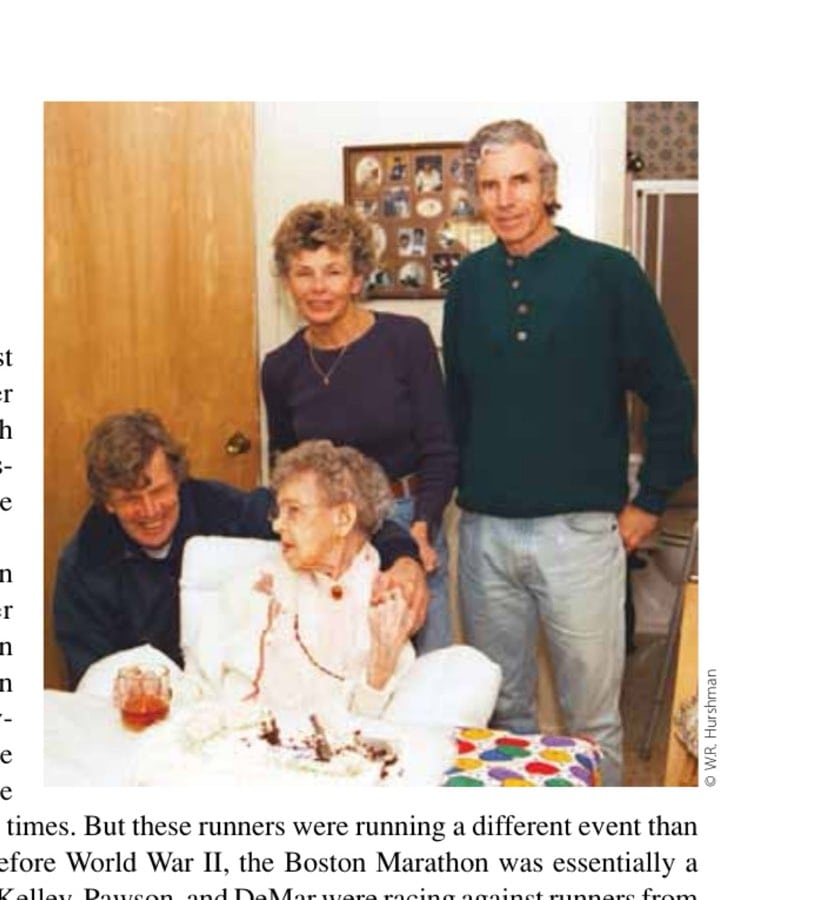
Johnny with his sister, Ellie, and brother, Bob, at their mother, Genevieve’s 100th birthday party in 1997.
This article originally appeared in Marathon & Beyond, Vol. 16, No. 1 (2012).
← Browse the full M&B ArchiveMore like this
1,000+ stories from 19 years of Marathon & Beyond
The complete archive of the legendary long-distance journal — digitized and free to read.
