

Just Call Me Jock
Chapters 1 through 4 appeared in the May/June and July/August issues.
CHAPTER 5
“Fear the man who comes to the race with his clothes in a paper bag,” he said. “That’s your real runner.”
Today a modern runner’s entire assortment of equipment weighs less than one of our old shoes.
I remember running Boston Marathons over dirt roads when the chiropodist’s station at the finish line in the front of the Lenox Hotel looked like a butcher shop.
We all had our own preferences for toughening our feet. I once met a man who had participated in Bernard McFadden’s much-hyped six-day runs. He mentioned that he used fish brine. Pickle brine worked, as did sea salt water, he said, but fish, though it smelled to high heaven, toughened feet the best without hardening them. I adopted the fish approach and today I am still astounded at the compassion displayed by my fellow boarders in the $10 a week rooming houses where I lived. Three nights a week I placed a pan of fish brine under a desk in my room while I sat down to write letters home and toughen my dogs. Either the Irishman, Poles, and Italians who bordered my room wore clothespins over their noses, as I was tempted to do, or they were fans.
Sam Ritchings, a local shoemaker, approached me one year and asked if I’d participate in an experiment. I was lying on a cot at the finish of the Boston Marathon when he asked to examine my feet. He said he had an idea to reduce friction and prevent blisters. I told him if he could do that he’d be everyone’s hero. Bob Campbell, the former National AAU long-distance chairman, tells the story of a guy who put a dollar bill in his shoes before the Boston Marathon. When the guy took his shoes off at the end, the bill had been changed into ten pieces. If Sam could save us that pain, I told him I’d gladly volunteer.
Over the next few months, I tested shoes Sam made for me, but they fell apart. Never one to quit, Sam, who wore a black cape and labored at night with his hands, redesigned the shoe and produced another pair. This time he used white buckskin. The white surface reflected the heat, whereas the standard black shoes we all wore absorbed the heat. Sam did a computation and estimated that white radiated 38 percent less heat than the black shoes. In addition, the white buckskin was more durable. He put elastic into the innersole to allow freer movement for the foot, and he left out the stiff heel counter to prevent abrasion. The sole was crepe and had a metacarpal pad. Importantly, he added perforation to the sides of the shoes, which allowed ventilation.
The shoes were a dream and soon I was the envy of all the other guys who lay on cots with bleeding feet. As Semple sauntered by in white dogs, many let out a howl. Soon everyone wanted a pair, and within weeks Sam was swamped with orders. Old John Kelley and DeMar received Sam’s second and third pair. By the mid-1930’s, every top marathon runner in America was wearing the “S.T.A.R. Streamlines.” Sam used his own initials: “Sam T.A. Ritchings.” To this he added “Streamline,” because that’s what the shoes were, sleek, the white bucks of the roads. Interestingly enough, Sam did not apply for a patent until a full year after introducing his shoe. He was in no hurry he said. It took him 16 hours to make one pair, for which he charged $7.50, but money did not matter to Sam. “Somebody may make a shoe that looks like mine,” Sam said. “But nobody could ever duplicate my S.T.A.R. Streamlines because there’s too much of me in my work.” When Sam died in 1937 at age 70 we all felt a great loss.
1932 proved to be my Olympic year that never was.
I had not run Boston in 1931. Smilin’ Jimmy Henigan won, which was fitting since Jimmy, like Old John Kelley after him, was a crowd favorite. The “Smiling” part was a misnomer, however. Jimmy only looked as if he was smiling when he ran. Actually, he told me once, “It’s agony they see on my face, Johnny.”
“Fear the man with the paper bag.” That was Jimmy’s favorite expression. He never was impressed by any dandies who came to Hopkinton in department store sweatsuits. “Fear the man who comes to the race with his clothes in a paper bag,” he said. “That’s your real runner.”
I got tenth at the Boston Marathon in 1932, while knocking a minute off my 1930 time. A month later I won the Pawtucket Marathon again and beat DeMar’s record with a 2:39:25 clocking. I was keyed now for the Olympic Trials scheduled for June in Washington, D.C., but almost instantly frustration begat frustration. It wouldn’t have bothered me so much to be left off the team, but I was clearly running well enough to make the Olympics.
I filed again for my citizenship, a process I had initiated in 1923, but I was told that a year I had spent in Scotland in 1928 made them void. I would have to reapply all over and wait five additional years before filing again.
No way. I got affidavits to prove that I had stayed home for a year because my mother was sick—which she was—but after much aggravation, a clerk showed me the small printing on the form that said, “After seven years void for all reasons.”
That shot my chances for the U.S. Olympic team; but there was always the Union Jack, or so I thought.
I wrote to England and learned that the British were taking two marathon runners instead of three to Los Angeles, Duncan Wright and the veteran Sam Ferris. I got very excited. This had become the other half of my life’s goal, to run on an Olympic team, and I believed I would be picked since I had proved that I was now one of Britain’s top three runners. Since Boston was halfway to California anyway, I wrote to the British telling them that my inclusion on the team wouldn’t cost them a dime. I offered to pay my own way, which meant I intended to hitch.
No thank you, they said.
Hoping to improve my chances I hitched up to Toronto for the Canadian qualifying marathon. I got a little training in on this venture and even spent a night in jail.
I never stood on the side of the road while hitching; instead I jogged. It kept me in shape and took me closer to my destination. I never bought food in restaurants either, since I had no money for anything except grapes and apples, which I kept in my pocket. I met more ten-second, 100-yard dash men in those days than the Boston Marathon has runners today. I nodded my head whenever the stories began, which invariably earned me a couple of extra miles in the car.
I got put in the cooler in upstate New York, but I was quite willing. It was late when I got left off in a small town in Cherry Valley. I told a policeman who stopped me that I was a runner going up to Canada to run a marathon. They had a drunk in the tank already, he said, but he offered me the cell next to the drunk’s if I wanted a cot to sleep on. Sure, I said, and I slept right through the night, even with the guy next to be banging on the bars with a tin cup. In the morning the police offered to give me a meal ticket to the local Y for breakfast, but I refused. I figured they had been charitable enough to me, and I still had some grapes in my pocket.
I made Toronto in two days at the cost of five cents, which would make my ancestors proud. I walked across the bridge from Niagara Falls and paid the nickel toll.
In Toronto I got in touch with Ernie Wyer, the brother of Canada’s great runner, Percy Wyer. Ernie put me up in the Y where I got a shower and a good night’s sleep before the marathon. “How do you like this?” Ernie said, as he showed me the race trophy before I bunked down.
“Gee, Ernie,” I said. “I always wanted to win a trophy with a lid on it.” A lid is a statue of a runner at the top of a trophy.
“Get a lid on that thing,” Ernie said as he turned to one of the officials. Then he turned back to me. “That should offer added incentive for you, Johnny.”
It did, but I didn’t win it. I was leading the pack when I got hit with the runs at 18 miles. I dashed into the woods and put myself back in order as quickly as possible, and I was still leading until Eddie Cudworth overtook me in the last three miles and nipped me for a spot on the team.
Later I wrote letters to the British, but my pleas did no good. I proved that I had beaten Eddie Cudworth earlier, that I had defeated Paul DeBruyn, the German Olympian and a Boston Marathon winner, beaten both Jimmy Henigan and Hans Oldag of the United States, defeated more than a dozen of the world’s best. But still, even though I offered to pay my own way to Los Angeles, still those old fogeys would not relent.
At this time one of the most significant developments in marathon history was occurring. Barely any mention of it was made in the Boston papers, except for a little box that appeared on the sports page, but Paavo Nurmi, the Finnish Olympian, ran a qualifying marathon for the Olympics—his first attempt at the distance—and not only made the Finnish team, but he shattered the world record by ten minutes. In 1932 when Pawson held the Boston record with a 2:31 clocking, Nurmi ran 2:21. That his feat received scant notice in the Boston papers indicated the low regard paid marathon runners in America. If you can imagine a totem pole representing the hierarchy of sports, we were the part that goes in the ground.
Subsequently Nurmi was suspended from the Finnish team for a spat involving expense money. He believed he was being short-changed and after he refused to compete in any more German Federation meets, he was barred from competing in the Olympics.
A group of Boston promoters sought to capitalize on the Nurmi fiasco. When the suspension held and Nurmi was forced to sit out the Olympics, the Boston Olympic Club conjured a promotion for Rockingham Park, a disused horse-racing track in Salem, New Hampshire. They announced that Nurmi, whose suspension they believed would soon be lifted, had agreed to compete in a “new” Olympic marathon at Rockingham Park. Juan Zabala of Argentina, who had just won the 1932 Olympic marathon, signed to accept Nurmi’s challenge to meet face to face. This delighted me, of course, since I wanted a crack at Zabala after missing the Olympics myself, and for six weeks I doubled my training.
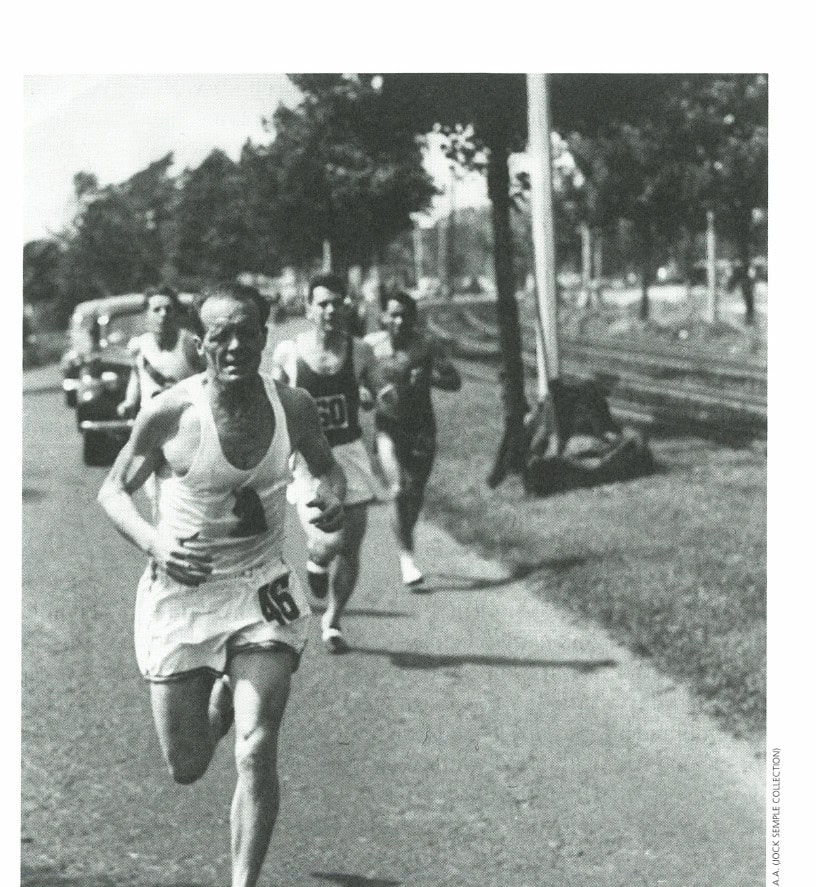
Nurmi came, but his suspension was not lifted and he was contracted to serve as the starter. Zabala promptly announced that he would attempt to break Nurmi’s world record.
Bang! Nurmi fired the gun and we were off. Zabala looked as if he might fulfill his promise as he jumped out front early. John Kelley went with him. Old Kel was but a boy then and he had not yet proven himself as a great marathon runner. Nevertheless, he put himself in Zabala’s back pocket. I was running in fifth place and as I watched Old John I thought he was playing the rabbit for his pal Henigan. Years later John told me he had misjudged the quickness of Zabala’s pace and truly had thought he could keep up with the Argentine. Johnny was great as a ten-miler, which probably explains that reasoning.
Those two ran away from us. Behind them we formed a pack: DeMar, Henigan, Whitey Michaelson, Bricklayer Bill Kennedy, Clyde Martak, who earlier had won the national championship at Washington, D.C., and myself.
After a few miles I turned to Kennedy and said, “If Zabala holds this pace, I’ll race you for second.” Kennedy just shot me a look.
After 12 miles, however, Zabala stepped off the track. He said he had new shoes which pinched his feet, but I never go for alibis. The man simply went out too fast and crapped out.
The rest of us settled down and soon we passed Old Kel, who also began cracking under the hot sun. At that point I took the lead. I held it for eight miles. I don’t know if I was crazy, or merely over-excited about the company, but I stretched my lead to a half-mile going around the 18 mile mark. Then it hit me again: the runs. I scooted into the woods as the crowd in the grandstand stood and pointed at me. I worked quickly, and when I came back out running I still had a lead, but I was weakened and I ran stooped over as the crowd applauded.
At 22 miles Michaelson caught me. He was strong and he kicked and he licked me by about half a mile. I took second, while DeMar finished third. The first place trophy was an enormous thing, and I had to suppress envy as I watched Whitey accept it. I got a pretty nice cup, but the difference was like caviar and canapes. I got a big hand from the crowd, but the next day I was back in the cage at my $11 a week job: a club hero, but still broke.
I piled on the marathons. A few weeks later I successfully defended my New England marathon title by winning the Manchester race, but the next day I got a letter from Bill Kennedy asking me if I’d hitch down to New York, for the Portchester Marathon. I looked at the date: it was two days away. My legs were still sore from Rockingham and Manchester, yet I had to go for Bill’s sake. He was the founder of the Portchester Marathon and he needed top-flight runners. He was having trouble getting sponsors without big names, and though it meant running two marathons in four days, I went.
When I arrived I was shocked. Bill had come up with the idea of a “handicap” marathon to attract newspaper attention and he had put me on scratch. Not only were my blistered feet killing me, but I had to wait 45 minutes while the other runners were sent off ahead of me. I’ve never been so restless. Pat Dengis was allotted 15 minutes, but in a fine gesture offered on behalf of my sore dogs, he forfeited half of it.
Bill Steiner, an Olympic runner from New York, and I were the last of three groups to go off. I was so stiff I felt as if I were running on stilts. By 10 miles I began to unwind and by 20 miles I had caught the entire field, except for Dengis. Soon I pulled even with him, but then I died. Only encouragement from my friends along the course kept me moving. I took sixth and finish with the second fastest time, and I was happy for the two silver medals I received, but nothing beat the appreciative look in Bill Kennedy’s eyes as he took me aside and said, “Thanks, Johnny.”
Shortly thereafter, the Y let me go. Even at $11 I was becoming too expensive, and they fired me so they could allow members a chance to work off their dues behind the locker room cage. With nothing better to do I hit the road. But a most fortunate thing happened: I received counsel that was to guide me toward a life long career.
Dengis, who was also unemployed, hitched with me. I had decided to join up with C.C. Pyle’s commercial cross-country runs. “Cash ‘n Carry” we called him. A real fly-by-night operator. Cash ‘n Carry operated a running circuit up and down the East Coast, which he rigged. As his troupe pulled into a town, Cash ‘n Carry would have already stationed himself in front of the local saloon taking bets. “Miraculously” the runner who lived closest to that town won that day’s elapsed time prize, except, of course, when the odds made it more practical to “tilt” the race to the man from East Oshkosh. Still, it was a job, and I was on my way to sign up with Dengis and I stopped at Al Monteverdi’s. Well, Monte blew up.
The Amateur Athletic Union had been formed in 1888 for the express purpose of curbing unscrupulous promoters such as C.C. Before then, athletics beyond college competition had come under the control of those who exploited them for profit. It was not uncommon before 1888 to find promoters who would announce prizes of substantial worth to attract both the athletes as well as huge crowds. Upon collection of gate receipts, however, the winners of the race might discover that the promoter had departed with the prizes.
All this is contained in a 1937 book entitled The Encyclopedia of Sports by Frank Menke. Other promoters, advertising a “strictly amateur” meet, would donate a trophy to the winner in full view of the audience, after which the promoter and victorious athlete would meet in some sheltered spot. The winner would give back the trophy, get cash, and the promoter would start shining up the trophy to award to some other “amateur” at a later promotion.
Since these “meets” offered the only outlet for both noncollege and post-college men to compete, the AAU, which recently was regrouped as the Athletics Congress, was created to remove non-professional sports from all taint of exploitation. In other words, to make running “pure,” to place it beyond the clutches of the likes of C.C. Pyle.
“Don’t throw your amateur status away on a crook,” Monteverde told me.
Monty, as we called him, held the official record for walking across the United States: 79 days, ten hours, and ten minutes from New York to San Francisco. He was 69 years old when he accomplished the feat. In the course
of his walk, he wore out the two 25-year-old aides he had hired to drive beside him.
“I’m broke, Monte,” I said, as I toweled off after a hard workout on the track Monte had built behind his house. Dengis picked the wax out of his ear. Monte, a veteran of 110 marathons, fixed me with both steel gray eyes.
“Running will be good to you in time,” he said, and he walked back into the house. “Don’t be a damn dope.”
Before long, Monte became a prophet. Back in Boston I was standing in the offices of the United States Shoe Machinery Company applying for a job when one of the young officers recognized me. “Semple,” he said, “you’re just the man.”
“I am,” I said, more as a statement than a question. By this point, I was no longer innocent.
“We’ve got a bit of a problem, Semple. I need to establish a road race. The general manager was entrusted me with responsibility for putting on an event at the carnival United Shoe will hold on the lawn this spring.”
The fella was smiling at me; I could see he wanted the information for free.
“I’m applying for a job,” I said.
His smile disappeared.
“What I’m saying is I’d love to help you out.”
He made the connection because he said, “Oh,” and he took my application from a fat pile his secretary had amassed, and he walked into a paneled room. A moment later he signaled for me.
During the meeting, the employment manager was called in, and I pitched my idea to a group of four executives: “I can form a club for you,” I said. “I’ll bring the national championship to United Shoe, just as I did for the Y in Lynn. But I want a job.” I mentioned that I was a carpenter, but the employment manager shook his head. “We’re all filled with carpenters,” he said. “Can’t expect an opening for a year. Maybe 18 months.”
“I’ll sweep the floor,” I said. “I’m hungry, I’ll do anything.”
“You’re hired,” the four said, nearly in unison.
I was assigned to the die department where I had to learn how to sharpen cutting dies which were used to stamp out leather for making shoes. They estimated that it would take me six months before I became proficient enough to go on piece work. I made the fantastic beginners rate of 40¢ an hour for a 40-hour week. I took home $16, but it was a job and soon I was able to pick up four extra hours on Saturday mornings washing the floor in the shop. It was better than pick and shovel work in zero degree weather, which is what I had been doing since the Y had laid me off.
I contacted several of my ex-YMCA runners and enlisted others in the factory who had run for Beverly High School. Before long I had assembled a damn fine team, and we made our debut at the North Medford 20-miler in March. Maybe it was the steady job. Or the new accommodations I was able to afford in a boarding house, or the load I felt lifted from my shoulders after I no longer had to sleep on my brother’s daybed, but I found myself at the front of the pack. The race came down to a three-way contest between Old John Kelley, Dengis, and myself. By 17 miles, Kelley pulled away—wearing a pair of S.T.A.R. Streamlines—but we won the team championship. That propelled us toward Boston, which we won, and finally toward the Nationals in Washington, D.C.
There our United Shoe team defeated 14 of the top teams in the world, including the Finnish-American and German-American clubs, which boasted two greats, Mel Porter and Paul DeBruyn.
I was fit to be examined. One day a letter came to the Shoe offices from a Harvard doctor, Dr. Dill, who expressed an interest in testing me in his Fatigue Laboratory as a “specimen.”
I weighed 150 pounds stripped. Wires were attached over my heart, diaphragm, and at two points on my back. The machine, which resembled an escalator, was switched on and I performed: first the speed was set at four mph and I ran for five minutes. My pulse rate rose to 120 beats per minute. Then I had my nose clogged with a gadget. Following a ten-minute rest, I ran again for five minutes while the machine was kicked up to seven mph. The machine was sloped, which simulated uphill running.
After another rest, my pulse registered 50 beats per minute, which Dr. Dill characterized as “extremely fit.”
I could have told him that without all the torture.
Worse, they didn’t pay me but they did feed me. I sat at a table with a group of Harvard boys and ate potatoes and eggs at faster than 60 mph.
The Olympics eluded me again in 1936, when I had my citizenship but not the ability.
One perk did remain, however: In 1937 DeMar got himself into a spat with the AAU over expense money. Six months earlier my United Shoe team had captured the team title again at Boston, while I finished ninth, and I was tapped by the AAU to replace Clarence on the Pan American team. The AAU claimed that DeMar had written a letter to the Washington Star, the sponsor of the Pan American trials, asking expenses based on his performance in the race. The funny part of it was that Clarence had an image as a model amateur. He was, and I’d defend DeMar to the last, but he did write the letter. He told me he was mad at race officials who had secured expensive accommodations while assigning the runners to dormitories. Modern runners such as Rodgers and Don Kardong have nothing on DeMar when it comes to ventilating righteous spleen.
I took seventh place at the Pan American Games on the campus of Southern Methodist University in Texas. The marathon, the climactic event, was run at 8 p.m. to avoid the heat. Fat chance. The course, a curious one-and-a-half-mile loop around the stadium, was lit by floodlights. God, it was hot. And water was ever more conspicuous for its absence. Every time we passed a fountain at the entrance to the stadium, I plopped in and splashed about. I took a dozen dips and I lost time, but I didn’t die.
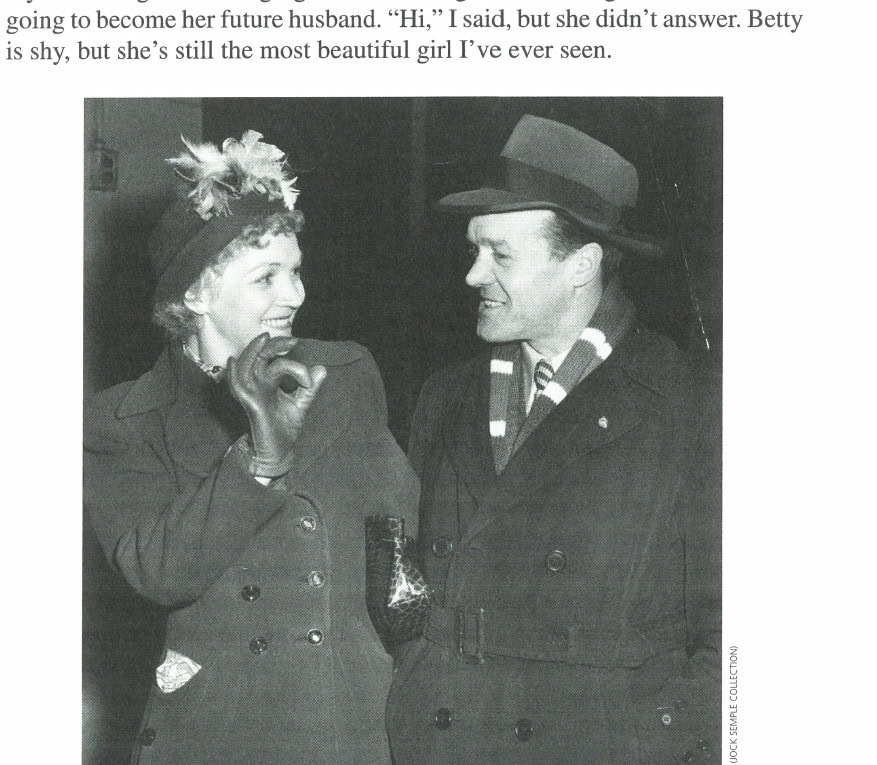
I got married. It is fitting that my feet should play a role, but I was dancing one night upon my return to Boston and as I sat down to have a punch I found myself sitting next to a gorgeous Scottish girl. I knew right then that I was going to become her future husband. “Hi,” I said, but she didn’t answer. Betty is shy, but she’s still the most beautiful girl I’ve ever seen.
We were married two years later in Allston, outside Boston. For sentimental reasons I asked the preacher to read us the vows while Betty and I turned toward a window which faced east. It was New Year’s Eve, and at exactly 7 p.m. (midnight in Great Britain) I said, “I do,” as Big Ben chimed in my mind’s ear.
That was it for 1938 and my bachelorhood as Betty and I rang in 1939, a watershed year that was to see me make the second most important connection of my life.
“Things aren’t going so well at Shoe,” I told Walter Brown after my team finished second at the Nationals in 1939. “Some of the bigwigs aren’t pleased that we didn’t win, and I will not be part of an outfit that does not respect a man’s giving a race his all.”
Walter knew what I was talking about. “Whenever you’re ready,” he said, and with that I disbanded the United Shoe team and shortly thereafter regrouped the team under the banner of the BAA Unicorn.
We did well, until the war came. I was working at the shipyards in South Boston. I missed only one day’s work. Even when the team traveled to Yonkers, I’d pile everybody back in the car on Sunday after the marathon and we’d drive all night so the boys could get to work by 7 a.m.
Then came Pearl Harbor, and with that I took a run down to the recruitment office.
“Can’t come in,” said the sergeant at the desk.
“Why not?” I said.
“Flat feet,” he said.
I looked down, and by God he was right!
“Aren’t you Johnny Semple, the marathon runner?” asked the sergeant behind him.
“I want to join the Gene Tunney program,” I said. “I want to be in the Navy. These dogs have run almost a hundred marathons and they have carried me around the world the equivalent of two times. America’s in the war now, I want to fight, and I won’t take No. Besides, who’s going to see my feet?”
“Let him in,” said the second sergeant. “He looks like the kind who plans to die with his boots on anyway.”
CHAPTER 6
Still, I loved being in the thick of things.
“Jock, anyone can rub his hands up and down a hockey player’s back. That kind of trainer is a dime a dozen. Go back to college. Get your sheet of paper. Become the real thing,” Win Green, the Bruin’s trainer, told me after I was released from the Navy in 1945.
While lying on my back in Saipan and thumbing through a copy of a Boston paper I had found an article about ex-athletes who had made careers for themselves in sports. I had that idea, too, but I knew I never could get into running as a track coach because I had never been to college. While stationed at Samson Naval base in Geneva, New York, I had helped drill the raw recruits, so I had experience. There I met Bill Kennedy again after many years, and he suggested I should use that experience to become a physical therapist.
Thanks to Win Green, I went back to school. Green sent me to Walter Brown, who had just created the Boston Celtics and Walter called over to Boston University for me. Though classes in the physiotherapy department had already begun, Walter got me a job as a carpenter at the school while I waited to be enrolled for the next term.
I can’t say enough for Walter Brown. Carpentry jobs at BU didn’t pay enough for a married man to live on, so Walter arranged for me to complement my salary by picking up a couple of bucks at the Garden. I guarded doors, and that kind of thing, but Walter made sure that I got the doors way up high so I could bring a book and study at night.
“Wanderlust Walter” they called him. His father, George V. Brown, had helped create the Boston Marathon in 1897, and Walter’s son, George, still shoots the gun. The Hopkinton area was picked as a site for the start of the race, not only because the course from west to east into Boston resembled the Greek marathon course, but because George Sr.’s farm was out that way. When George Sr. died in 1937, Walter at the age of 32 became not only president of the BAA but also general manager of the Garden/Arena Corporation.
Walter, who died at age 59 in 1964, was a promotional genius, in addition to being a very gentle man. Certainly he was world-renowned as an international sports figure. Even before he succeeded his father at the Arena, he had established a reputation for himself by coaching the United States hockey team to its first world amateur championship in Prague, Czechoslovakia, in 1933. In 1940, he was named president of the Arena and Boston Garden. Over the years he conjured many successful promotions: it was Walter’s idea to bring winter sports indoors at the Garden, and he built a huge indoor ski jump which attracted the world’s best skiers. In 1932 Walter discovered Sonja Henie while on a tour through Sweden with his hockey team. Almost from the moment Henie performed for an American audience at the Garden, she was received as a star, and her name became a household word. Walter created the Ice Capades, and later he created the Celtics, who were to bring him so many disappointments in the beginning.
Ultimately, the Celtics became a monument to the man, but in the late 1940’s Walter had to fight with Garden Corporation board members to keep them from folding the team. For five years the Celtics dripped red ink, before Walter finally succeeded in luring Red Auerbach, under whose coaching the Celtics became the world champions. But in truth the team survived only because Walter scraped the bottom of the financial barrel and purchased the staggering franchise from the disenchanted Garden directors.
Originally, Walter had disdained “bounceball.” He had been a Grade A hockey man exclusively. But after World War II he recognized people’s desire for an indoor game that could carry them through the winter between the football and baseball seasons, and with characteristic intensity, he set out to build the National Basketball Association. I’d get him on my rubdown table after he had spent a day upstairs on the phone with creditors. “How long do you think it’s going to take basketball to go over in this town?” he was asked by my patients on the table with him. “Five years, four if we can come up with a George Mikan,” he said as I applied the soothing oils.
Mikan, an early forerunner of the Kareem Jabbar big man, played for Minnesota. It did, of course, take five years. And then Walter’s plan only worked through luck of the draw which brought us Bob Cousy.
While I was recruiting my BAA team, I made part of my living at the Arena by taking the Celtics out for their pre-dawn run. Walter had just created the team and since he couldn’t afford a hotel for them, he kept the players bunked in the basement on cots. It was fitting actually: the Celtics couldn’t draw even their mothers to a game.
“Aww right, all you laggards!” I shouted into their gymnasium quarters every morning at 6 a.m. to wake them for a run around the Fens. A great bunch of guys, but with 22 wins and 38 losses their first year, they became the Eastern Division doormat, a niche they promptly retained for years.
Chuck Connors played for us then. Chuck would climb on my rubdown table and regale us with Shakespearean soliloquies, as well as renditions of “The Face on The Barroom Floor.” Chuck never asked for the infra red lamp on his sore knee. Instead, he had me give him ultraviolet in the face. “I have an audition,” he said. Which made no sense to me until Chuck moved to Hollywood. There he put in a pitch for a part and landed the title role on the “Rifleman” series.
In 1949 I had accepted Walter’s invitation to go to the world games as United States hockey team trainer. A year earlier I had traveled to Europe with the team for the Olympics, a job I was to take again in 1952. My arena had burned down, and I wasn’t making money any other way.
I returned in 1950 for the end of the Celtics season, and I resumed my duties as visiting team trainer. At that time, teams in the league couldn’t afford to bring their own trainer on the road, and for 17 years I served as the visiting team trainer at the Garden. Only the Ft. Wayne Pistons and New York Knicks brought trainers. The Pistons were incorporated with a company that made airplane pistons, so they wrote off losses that most of the other clubs were sustaining at that time. The Knicks were owned by Madison Square Garden, a lucrative corporation, so they operated in the black.
Today when I look on the bench and see the trainer taking care of the players, I’m astonished. They work hard in the dressing room, but it’s easier for them now with boys sitting on the bench, picking up jackets, taking out towels for the players and serving water. In the old days I was all alone. When a player went in and another came out, I covered him with a jacket and put another over his knees and legs because the ice underneath the floor sent a chill up through the boards. They never handed the towels back to me, but dropped them on the floor and I’d bend down and retrieve them all night. It wasn’t easy by any means, and the double-headers made it worse. I’d get to the Garden at six o’clock to tape the first team, then go out to the bench. By the third period I had to run back to the dressing room, get a boy to watch the team, and start fixing up the players for the second game. If an emergency occurred, I’d run back out to the court.
After the second team was taped and ready to go, I’d hurry back to the bench for the conclusion of the first game. Then it would be back to the dressing room to cut the tape off, administer first aid to any injuries, and sprint back out for the second contest.
I loved it, but the real ordeal came when I had a triple-header: three teams in town on one night with none of them carrying its own trainer. For example, if the Minneapolis Lakers, Philadelphia Warriors and Rochester Royals were scheduled, I was in trouble. I had to run between both dressing rooms, tape one team, then the other. During the first game, I sat with one team and commissioned a volunteer, that is, a local high school or college student, to sit with the other squad. We had a trio of kids who alternated the job. Little did I know it, but I was training troops of boys for the Federal Express Mail Service.
I’ll tell you, it was hectic. But I got the same money for three teams as I got for one. Things weren’t going well at the gate and I appreciated all that Walter had done for me. I had my private business, which paid me about $30 a week, and I just couldn’t see asking for more money. When I look and see today how much better conditions are, I feel like a pioneer. Sacrifice cleanses the soul, or some such saying. I had to believe it or I would have dived off Walter’s big ski jump.
One year the Celts made it to post-season play and, although they didn’t go all the way, the team picked up a few extra dollars. I had to wait a year for my money because Walter used the playoff sum to pay off debts that had piled up that season. I will say that those fellows—Sharman, McCaully, Cousy, Brannum and the others—never said a thing about the wait. Contrast that to some of the players today. I won’t say all of them are guilty, but too many worship money
as a god. I admired the Celtics for not saying “peep” about the delay in their paychecks. As for me, I wouldn’t have traded a cent for all the experiences I had. My share, $145, is not a princely sum compared to what they get today, but we were a team then, even those who played for the other side.
In 1950 the Chicago Stags ran into a heavy financial burden and were forced to drop out of the league. The league decided to send their three top players—Max Zaslofsky, Andy Phillip and Bob Cousy—to the Knicks, Philly Warriors and Celtics. But the teams couldn’t reach an agreement on who would get which player, so they dropped three names into a hat. New York picked Zaslofsky, a local New York City boy, Philly got Phillip and Boston selected Cousy.
At that time, the Celtic brass wasn’t exactly enamored of the choice. Little did they know. Cousy spent his first year as a sub, but when he cracked the starting lineup he proved to be the savior of the sport. If ever there was a man made for basketball, it was Bob Cousy: just over six feet tall, he had the physique of a 6-8 man, large hands, feet and terrific upper legs. Still, his greatest asset was his peripheral vision. He had cat’s eyes. He could see action behind him that enabled him to make breathtaking behind-the-back passes.
One afternoon Couz came in for a massage, to get loose for a game that night. He fell asleep on one of my tables as another of my patients walked in. “Hi, Bob,” the fella said, but Couz didn’t answer. The next time I saw this fella he told me he thought Couz was a snob. “Bob didn’t say a word,” he said. I told him Bob was asleep. “But his eyes were open,” the fella reported, and I had to explain that Couz had protruding eyeballs that made his eyes look like they were open. I remember an example of Cousy’s eye-opening play:
With a couple of minutes to go the Rochester Royals had a four-point lead over the Celts one day. Bobby Davies dribbled for the Royals, trying to kill time when suddenly Couz battled the ball away and drove in for an easy basket. Couz came right back and stole Davies’ inbound pass, scored again, and the game was tied. Seconds later Boston took possession again and won the ball game.
Well, this was unforgivable, Rochester’s squandering a four-point lead, especially in the days before the 24-second clock.
At the final buzzer the fans took the roof off the Garden. I rushed into the Rochester dressing room and grabbed the orange drinks I served the players. I piled them on a tray and kicked open the door to get through. Bang! The door came right back at me. The drinks went flying and the edge of the tray smashed into my forehead, slashing my brow. The culprit who slammed the door back at me, accidentally of course, was Les Harrison, coach and owner of the Royals, who had just finished bawling out his team. The next day I picked up the Boston Globe and saw that Clif Keane, like most of the other writers, had added color to the incident. In his own inimitable way, Clif wrote: “Jock Semple was entering the dressing room with refreshments whistling ‘Roamin’ in the Gloamin’ when boom, up went his tray, down went Jock, over went the orange drink . . .”
With all due respect to the great players down through time, I believe that Bill Russell revolutionized basketball. The Celtics won 11 World Championship titles in 12 years, beginning in 1957, largely due to the efforts of Bill Russell. Russell had led the U.S. Olympic team to a gold medal at the 1956 Olympics before he joined the Celtics, but from the moment of his arrival he introduced something new: the blocked shot. He made an art of pounding down the ball. Then he would grab it and start the fast break, which became the Celtics trademark. The appearance of Russell forced many pivot men out of the league, but one thing was true: the league never was the same again.
I had some fun at the side of the court. At one game I got into a row with ref Jocko Collins, and the ensuing fracas brought publicity to a sport starving for it.
In a game with Syracuse, the Celts were leading by one point when ref Sid Borgia disallowed a Boston basket and that set Red off. Sid would take no guff, though, and he slapped Red with a technical. Still, Auerbach wouldn’t stop and Borgia threw him out of the game. After a to-do on the floor, Red left. And I entered. I stormed up to Collins and blasted him about Paul Seymour, the Nats’ coach’s behavior, asking why Seymour hadn’t been thrown out of the game for a similar argument earlier. Jocko didn’t like that and he followed me into the dressing room at intermission where he grabbed me around the throat. Big John Kerr of the Nats sprinted over and picked Collins off me. But I was fuming. I started screaming at Collins through the referee’s door, “You can’t do that to me, Collins. You can’t do that to me.” I was wrong. Collins opened the door and attacked me again, ripping my clothes off before it was broken up.
These lighter moments brightened my days with the Celtics, and made the $10 I received palatable.
I got less than that for my efforts in putting on the Boston Marathon: spell it ZIP. In those days Garden employees did the work.
Still, I loved being in the thick of things. I ran my last marathon when I was 50 years old, and for tradition’s sake, I ran at Philadelphia over the Sesquicentennial course. Since that day I have limited myself to working in an official capacity—which I can say is much harder than running.
Just Call Me Jock will continue in our November/December issue. Jock meets John J. Kelley and sees the future of the Boston Marathon.
This article originally appeared in Marathon & Beyond, Vol. 6, No. 5 (2002).
← Browse the full M&B ArchiveMore like this
1,000+ stories from 19 years of Marathon & Beyond
The complete archive of the legendary long-distance journal — digitized and free to read.
