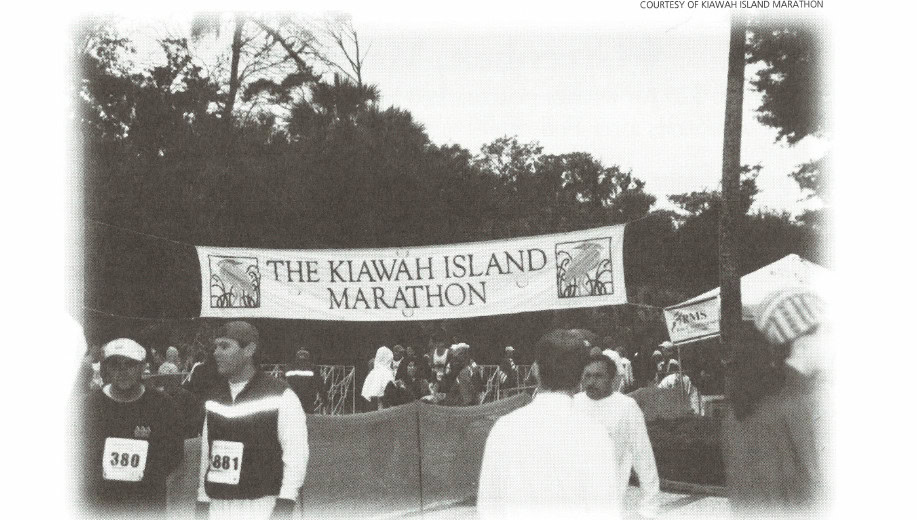
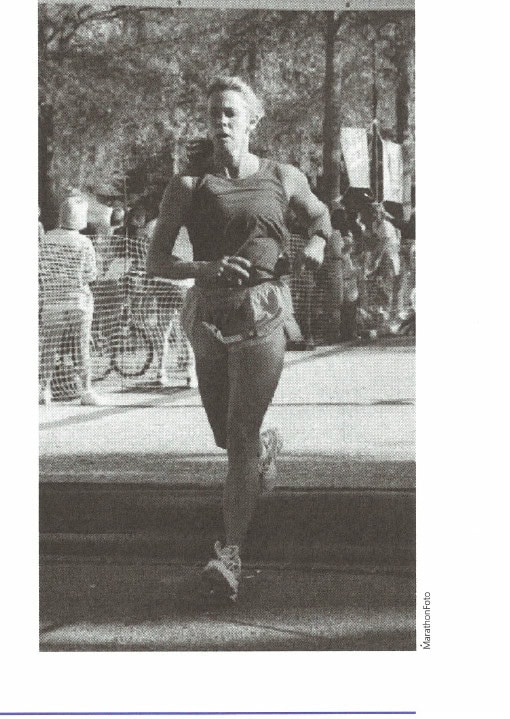
Kiawah Island
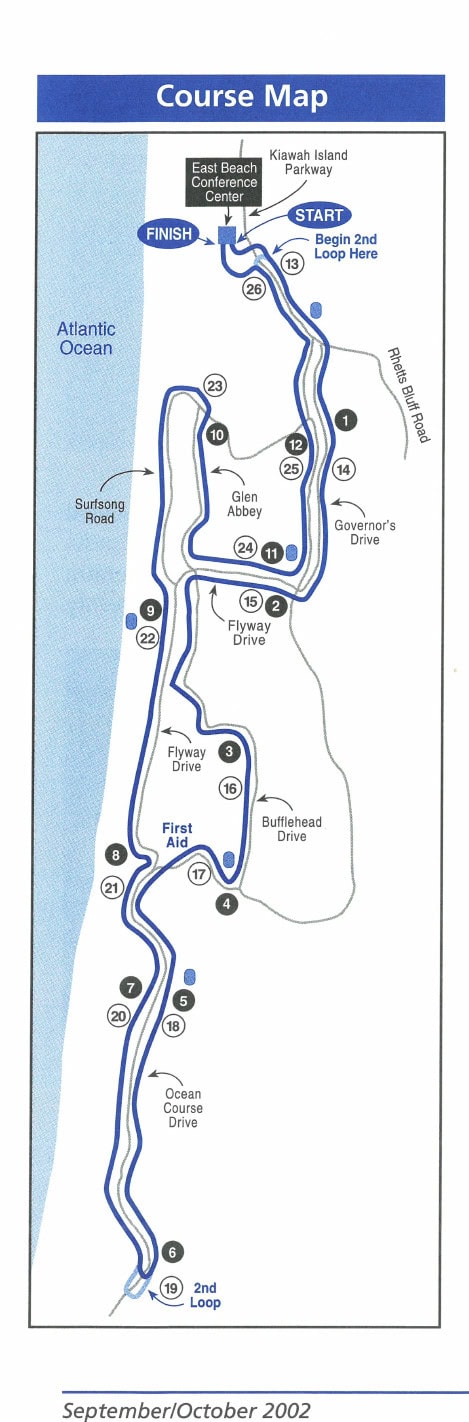
marker, the course winds right again onto Governor’s Drive, where you are
Kiawah Island likely to see majestic blue herons am standing by the edge of the lake off to the left. After a bit more than a mile,
Begin 2nd another sharp right will have you fly-
® ing down Flyway Drive, followed by
a sharp left onto Bufflehead Drive.
From there, you’ ll hop onto a path running parallel to Governor’s Drive for a short stretch before reaching the longest stretch of straightaway on the course, heading west on Ocean Course Drive for close to two miles, ca nars where you will reach the turnaround
pve and be directed onto the bike path running alongside the road for the next two miles back. This is a nice opportunity to see who is ahead of you on the way out and who is running behind you on the way back. You hear a lot of encouragement and salutations along this part of the course.
Now heading back to the start/finish area, you’ll make a left off the bike path back onto Flyway Drive and make another left on Surfsong Road. Just before mile 10, you’ll make another sharp right onto Glen Abbey, then onto the “Alley of Oaks,” the bike path running beside Flyway Drive. Finally, you’ ll turn left on the bike path parallel to Governor’s Drive and left on the bike path back to Kiawah Island Parkway, where you get to do it all over one more time.
If it all sounds confusing, just follow the runner in front of you and you should be OK. But if you find yourself in the lead, don’t do what
September/October 2002 KIAWAH ISLAND MARATHON #175
Runner’s Highs/Runner’s Lows
the lead runner did in 1999. He decided to take matters into his own hands around 11 miles when, instead of following the lead vehicle, he decided he knew the course better than anyone else and went left when he should have gone right. He ended up running off the course, but fortunately for the rest of the field, he was the only one who did.
RACE WEEKEND PARTICULARS
Race numbers and T-shirts may be picked up at the East Beach Conference Center starting on Thursday, from 4:00 p.m. to 7:00 p.m. On Friday, packet pickup continues from 10:00 A.M. to 8:00 p.m. Also on Friday, National Sporting Goods will be selling running attire and accessories. The Signature Shop will also be present, selling marathon logoware.
On the night before the marathon, there is a huge prerace banquet dinner at the East Beach Convention
Center, where a buffet is presented that includes a nice variety of pasta with light sauces, baked lemon chicken, a variety of salads, freshly
September/October 2002
baked breads, desserts, beverages, and beer. The cost is a little stiff at $24.95, but it gives runners the opportunity to make new friends and share war stories, so it should be placed on your to-do list. The buffet is served from 5:30 p.. to 8:30 P.M.
Immediately following the marathon, all full marathon runners displaying a race number are invited to join the celebration inside East Beach Conference Center from 10:00 a.m. to 2:00 p.m. Governor’s Hall is restricted to full marathon runners until the awards ceremony at approximately 1:00 p.m.
In addition, from 8:30 a.m. until noon, all 5K and half-marathon runners are invited to the Town Center
Mall for the outdoor party and awards ceremony. Race numbers are required for food and beverage service. 5K awards take place at approximately 10:00 a.m., followed by half-marathon awards at approximately 11:00 AM.
Finally, from 6:00 p.m. until 10:00 P.M. on race day, a gala postrace seafood buffet party is hosted by Kiawah Island Resorts. The cost is $25.50 per person and includes seafood chowder, a variety of salads, fresh rolls, roasted catfish, chicken pasta, green beans, seafood jambalaya, and assorted desserts and beverages. The party features a professional disc
jockey and a continuous replay : of the day’s race via video. Pe.
The Bottom Line
September/October 2002
We have weighed various aspects of a marathon within a 1,000-point scoring grid. Besides the author of the article, two dozen runners at the race were randomly chosen to score the race for us (KIM = Kiawah Island Marathon). The results follow:
1. HISTORY/TRADITION Evaluate the race’s sense of history and tradition. [Possible points: 30 KIM score: 22]
2. ENTRY FORM Is the race entry form clear, concise, attractive, complete, and easy to fill out? [Possible points: 20 KIM score: 20]
3. ENTRY COST
For most races, the entry fee covers between 30 and 50 percent of the cost of putting on the event. Rate the value of your dollar relative to this race. [Possible points: 30 KIM score: 25]
KIAWAH ISLAND MARATHON @
4, LOCALE/SCENICS
{s the race held in an area that is easy to get to and scenic and offers adequate food and housing services and nonrace activities for family and friends? [Possible points: 50 KIM score: 45]
5. REGISTRATION Is registration well organized and efficient? Does it bog down unnecessarily? [Possible points: 20 KIM score: 20]
6. PRERACE ACTIVITIES
Evaluate activities, such as a feeds, parties, and so on, during the days before the race.
[Possible points: 50 KIM score: 39]
7. EXPO
Does the expo offer a fair number and variety of booths relative to the race’s size? Are there quality exhibitors and good guest speakers?
[Possible points: 50 KIM score: 22]
8. COURSE
Take into consideration the following: degree of difficulty, certified, sanctioned, quality of road or trail surface, adequate mileage and directional markers, aid stations, medical coverage, race communications, accessibility to course for friends and family, typical weather, and so on.
[Possible points: 400 KIM score: 341]
9. RACE AMENITIES
This category includes race Tshirt, finisher’s medal, finisher’s certificate, adequate and efficient finish area, ease of sweatbag retrieval, showers, postrace refreshments, awards ceremony, raffles, results postcard, results book, and so on.
[Possible points: 250 KIM score: 209]
10. VOLUNTEERS
Are the volunteers experienced and adequate in number?
[Possible points: 100 KIM score: 83]
TOTAL SCORE FOR KIAWAH ISLAND MARATHON
826 points
The Rest of the Pack
Below, listed alphabetically, are other marathons profiled in Marathon & Beyond, the volume and issue number in which each race’s profile appeared, and the overall score each race received. If there is an asterisk (*) behind the score, it indicates that a member of the M&B staff has revisited that race and rescored it—either up or down—based on changes that have been made; the changes are briefly detailed at the bottom of the following list.
Adirondack Marathon (vol. 5, issue 2) 845 points Aspen Fila Skymarathon (vol. 4, issue 1) 863 points Atlanta Marathon (vol. 4, issue 5) 840 points Calgary Marathon (vol. 3, issue 2) 876 points Cincinnati Flying Pig Marathon (vol. 3, issue 6) 901 points Dallas White Rock Marathon (vol. 4, issue 6) 856 points Detroit Free Press Marathon (vol. 5, issue 3) 892 points Edmonton Marathon (vol. 2, issue 2) 814 points Fox Cities Marathon (vol. 3, issue 4) 865 points Glass City Marathon (vol. 6, issue 1) 862 points God’s Country Marathon (vol. 6, issue 2) 695 points Governor’s Cup Ghost Town Marathon (vol. 2, issue 1) 795 points Grandma’s Marathon (vol. 3, issue 1) 968 points Greater Hartford Marathon (vol. 6, issue 3) 898 points Honolulu Marathon (vol. 2, issue 4) 906 points Humboldt Redwoods Marathon (vol. 2, issue 3) 809 points Key Bank Vermont City Marathon (vol. 4, issue 2) 888 points Lake Tahoe Marathon (vol. 6, issue 4) 867 points Las Vegas International Marathon (vol. 1, issue 5) 831 points* Motorola Marathon (vol. 5, issue 6) 876 points Napa Valley Marathon (vol. 2, issue 5) 913 points Ocean State Marathon (vol. 5, issue 5) 886 points Philadelphia Marathon (vol. 1, issue 4) 838 points Pittsburgh Marathon (vol. 1, issue 6) 904 points Portland Marathon (vol. 3, issue 3) 943 points Quad Cities Marathon (vol. 4, issue 3) 885 points Royal Victoria Marathon (vol. 5, issue 4) 918 points San Francisco Marathon (vol. 1, issue 2) 804 points Santa Clarita Marathon (vol. 4, issue 4) 866 points Shamrock Sportsfest Marathon (vol. 2, issue 6) 866 points
September/October 2002 KIAWAH ISLAND MARATHON = 179
Steamtown Marathon (vol. 3, issue 5) 892 points Vancouver International Marathon (vol. 1, issue 1) 851 points* Wineglass Marathon (vol. 1, issue 3) 839 points Yukon River Trail Marathon (vol. 5, issue 1) 870 points
The Las Vegas score went up due to the race moving its expo from tents at Vacation Village to one of the major downtown hotels and expanding the expo. The finish line area has also been improved: with the new finish line area, the 90-degree turn into
the final 70 yards is now a thing of the past.
At Vancouver, the score has gone up based on several factors: many of the bridges (major uphills) have been removed from the course, as has the industrial area on the far end of the Lions Gate Bridge. In addition, the entire event has been consolidated into one area (the BC Place complex, which is one of the few remaining structures from Expo ’86), which contains the Vancouver Marathon offices, fitness and health expo, seminars, and the start/finish areas.
November 9, 2002 ° 7:30 A.M.
with approximately 21 through the Chickamau: hills at mile 7 and the same hills e Average temperature: 55 ¢ 2001 entrants: 400 (CR male: 2:27:31 CR female: 2:47:44) For more information, contact Chris Levan 2428 Fox Run Dr., Signal Mountain, TIN 37377 423/886-4099 ¢ Chris_levan@bcbst.com
You can download an application to the race at http://www.runchatt.org/ChickamaugaMarathon/CM-info.htm
_ Maur MARATHON
A KAMIOKA any
SUNDAY, SEPTEMBER 22, 2002
Win the 2002 Maui Marathon/ Marathon & Beyond Sweepstakes
For details, visit www.mauimarathon.com or www.marathonandbeyond.com sy
SPONSORED IN PART BY Pleasant Hawaiim Holidays.
Oceanfront Course ¢ Limited to 3200 Runners Carbo-Load Party ¢ Sports & Fitness Expo ¢ 5K Fun Run
rains! HAWAI? be y is For travel arrangements: 800-444-4097 | THE WESTIN MAUI
The Islands of Aloha Email: marathon@shore.net KAANAPALI BEACH
& DETROIT FREE PRESS/FLAGSTAR BANK e3 MARATHON
Presented by Greektown Casino
An Extraordinary Experience for the Ordinary Person.
The race of a lifetime is just around the corner. It’s our 25th anniversary year, and more than ever we are dedicated to giving ordinary people an extraordinary experience. Enjoy our historic race course, supportive staff and all the little extras you deserve. Come discover why Detroit’s marathon is the best-kept secret in the Midwest!
Detroit Hree Press FLAGSTAR Ay @-e BANK
MicuiGan’s Most-READ NEWSPAPER
GREEKTOWN CASIN 7
ale “lkiOhioHealth
Presented By
October 20, 2002
Fast, flat and fun!
Register online or contact us NOW for Registration Information
614.421.RUNN www.columbusmarathon.com
The Place to do 26.2
Sunday October 27, 2002 © $40,000 in Prize Money
CASINO ¢ NIAGARA
International Marathon Marathon © Half Marathon e In-Line Skate Marathon
Seminars © Runner’s Expo ¢ 14th AIMS World Congress Long Sleeve Tee Shirt ¢ Free International Breakfast Run Free Transportation to Start © Water & Gatorade Every Mile Pasta Party Post Race Party * Custom Medals
Register on Line at (eneetiweecom eens
Casino Niagara International Marathon 5515 Stanley Ave. Niagara Falls, Ontario, Canada, L2G 3X4
#ams the 14th AIMS World Gongress
Letters
THANKS FOR THE MEMORIES
Hal Higdon, thanks for the memories! (See “One for the Heart,” May/June 2002 issue.) I ran the Heart the year after you, in 1969. It was my first marathon, and I did not win. According to my scrapbook, the Columbia Missourian said you were unable to return in 69 because of a knee injury. Some other not-yet-old timers made it, however: Alex Ratelle and Arnie Richards. You also confirmed my memories of heat, humidity, what passed for “race support” in those days, and Easley Hill. I spent a great year in Columbia, and the Columbia Track Club was apart of it. Best wishes to race director Joe Duncan. Sal Citarella Novato, Calif.
SPEAKING MY OWN LANGUAGE
Ijustread the May/Juneissue of M&B, and I truly enjoyed Barry Lewis’s article, “Passion and Pain” —at times it was like reading George Sheehan. Barry truly captures the heart of ultrarunning. He writes, “It’s about taking part in the physical and emotional roller-coaster ride you almost always encounter during a long race . .. the lifetime of experiences that
September/October 2002
occur over the course of one single day.” That says it all. How can you explain that to anonrunner? One thing Tlove about M&B is the community it engenders. It’s good to pick up a publication and read articles from people who speak your own language. Barry has inspired me to hunt down a 100K before year’s end. Any chance of snagging Barry as the next “On the Road” columnist?
Gary Hernandez Claremont, Calif.
WAY TOO MUCH?
Inresponse to the Rich Benyo piece in the May/June 2002 issue, on training fora3:00marathon, we received quite a few letters, most of them concerning the potential difficulty of doing the two long/hard workouts in Week 13 (25-mile run at6:45-6:50 permile) and Week 14 (19 hilly miles at 7:00 per mile) in the 16-week program. Rich begins with a few general comments about the difficulty of the program and then answers the specifics of several of the questions.
Rich Benyo writes: 1. The 3:00 program is predicated on the runner’s coming to the program with a good number of years of long, hard running on the legs. The program is not
designed for the runner just embarking on a marathon-training program. Itis fairly simple to get the cardiovascular system in good condition; it is much more difficult to do the same with the joints, tendons, and muscles. Obviously, the older the runner is, the more years are going to be needed to get the biomechanical structure in shape to be able to handle a higher level of intensity and volume.
2. The training/racing philosophy behind the difficulty of the program is that the marathon, especially a marathon the runner enters with an ambitious time goal, is prone to difficulties—some of which the runner will have anticipated, others that will arise unexpectedly. It is important that the runner toe the starting line with as many advantages as possible. Although there is no such thing as a “failsafe” training system, by training through extremely difficult workouts, the runner’s body is set to “cruise” through the sub-3:00 effort, in part because the race itself is not much more difficult than several of the long/ hard workouts from the previous month.
3. There are two forms of confidence runners can take into their first sub-3:00 effort:
Intellectual confidence. This comes from logically and rationally evaluating recent workouts and performances to come to the conclusion that “Yes. This is something Ican do.” Alberto Salazar had a tough road course of roughly 19 miles thathe used before a marathon as ameasuring stick
to evaluate his fitness level. The better he performed on his test course, the more he knew, intellectually, that he could perform on race day.
Psychological confidence. This is a tough one. We can often intellectually evaluate the potential for our success, but psychologically we are filled with uncertainty. Toshihiko Seko, the great Japanese marathoner, claimed that going into the marathon, 90 percent of your success depended on psychology and only 10 percent on training.
The two tough workouts are designed to train the runner to a high level of fitness while stressing rapid recovery because the two workouts are only a week apart; they are also designed to stimulate a training peak so that the runner will enter the marathon ready to perform. The fact that the marathon itself is less of a stress than the two key workouts should allow the runner some wiggle room— latitude to overcome some unanticipated obstacles on race day since the race itself should be relatively easy compared with the two workouts.
We might also mention that this program for breaking 3:00 is not revolutionary or new. It was first preRunner’s World (pp. 56-64) and later inthe book Making the Marathon Your Event (Random House, 1992), and has been used by hundreds of runners, with a very high success rate. Are the workouts easy? No. If you build to them successfully, will your 3:00 marathon seem easy? Yes.
September/October 2002
Let’s consider some of the questions sent in by our readers. * * *
Your training schedule suggests that about half of the long runs up to 25 miles be done at faster than race pace and the other half about 10 seconds slower. This is contrary to everything else I have read or heard about long slow distance runs. Were all those times typos? If not, what is your reasoning for the unusually fast runs? I am presently training for a sub-3:00 [marathon] and would like to know. Gerard LeTendre
Via e-mail
Rich’s response:
Long slow distance is fine for the off-season and for building a base, but once the base is established the long slow distance must be abandoned for long fast distance. A runner cannot expect to run at a sub-7:00 pace for 26.2 miles without doing that or better in practice. The emphasis on long slow distance brings to mind the comment of the great Emil Zatopek when his critics quizzed him on why he was running dozens of high-speed 400-meter repeats; they felt he should be out running long slow distances if he was going to run distance events. “Talready now how to runslow,” was his reply. “Now I must learn to run fast.”
We can’t do in a race what we haven’t done in practice.
* * *
Your 3:00 training program relies on three main types of training runs: hills,
September/October 2002
mile repeats, and fast long runs, with moderate mileage and an emphasis on quality. But I was quite surprised at the scheduled 25-mile run at 6:456:50 pace just four weeks out from the target race. Can this be correct? Wouldn’t recovery from such a run essentially be equivalent to recovering from a full marathon? John Harrison Burlington, Conn.
Rich’s response:
The basis of the 3:00 training programis incremental workloads paired with quick recovery. If you examine the entire program, the long runs become increasingly ambitious (you’re already doing a 20-mile run at 7:00 pace back at week 3), but throughout the program you have been becoming increasingly good at recovering from increasingly harder workouts. The 25-mile workout, combined with the 19-mile hilly workout the following week, brings you to a peak, from which the 3:00 race should be relatively simple—when compared with what you’ve done to that point.
Ifwe were shooting for, say, asub2:50, it would even make sense to throw ina few overdistance long runs, that is, runs farther than the marathon distance, in order to make you superfit on race day.
ek OR
Ihave a couple of questions regarding Rich Benyo’s “Basic Training for a 3:00 Marathon.” First, a touch of background. My PR is 3:15:58, runin
December in Huntsville. I ran three marathons in 2001, all in that general range. My goal is to qualify for Boston, which, for me at age 29, is a3:10. Istarted running only a few years ago to lose weight after my college football career was over. Now ’mhooked on the competitiveness and the benefits to my mind and body.
1. Since Benyo’s program is set up for a 3:00 (6:50 or so pace), is it practical with a 3:10 goal (7:15 pace) to simply crank up my time allowance on each run by 25 seconds? For example, you have in the first week mile repeats at 7:00 and an 18-miler at 7:15.CanI assume my mile repeats should be at 7:25 and the 18-miler at 7:40?
2. The Monday run throughout the program is H [hills] or F [fartlek]. Should I be shooting for a time on the hills? Do I push myself like a tempo run?
3. Ihave absolutely no opportunity to run on a track. I’m assuming I can do the mile repeats ona treadmill. Ihave never done a lot of speed work, so I’m expecting this portion of the program once a week to make a big difference.
4. Can I plan this program over 17 weeks and take a “break week” in the middle? I always start feeling burned out by about 10 or so weeks into a program but am afraid that blowing off a week will do more harm than good.
5. My last question is the most important. This program is very different from any other I’ve looked at,
in terms of the speed of the long runs, and I’m a little concerned about being able to handle it. At eight weeks out, for example, there’s a 21-mile long run at a pace that’s 20 seconds faster than race pace! That’s 6:55 for me. IfIcan do thatI would have plenty of confidence, as long as it doesn’t require two weeks of recovery. Tony Mercurio Via e-mail
Rich’s response:
Some very good questions and some astute observations about the potential answer. Let’s go through each question.
1. Yes, it is possible to modify the 3:00 program to accommodate your goal of 3:10. Your estimates of slowing your pace accordingly make sense. Not that you suggest it, but I would not lower the number of miles you’re doing. By modifying the pace of the workouts to fit your slower time goal, you should do well. By keeping the total number of miles from the 3:00 program, you should have an advantage of going into your race with more strength in your legs.
2. You should do the Monday H or F like a tempo run, but always be conscious that this is a “recovery” run of sorts from your long/hard Saturday run. At the first hint of soreness or deadness, back off the speed. You’ Il be getting plenty of speed at the track each week, which leads to…
3. You will indeed see vast improvements once you introduce regular speed workouts into your trainSeptember/October 2002
ing. Everything within the programis integrated. Your speed workouts will make the long/hard runs easier because the leg turnover will not seem like sucha strain in the wake of your track workouts, which will increase your leg speed in other workouts. I would stay away from treadmills— unless it is a very good treadmill that is perfectly calibrated so that you are indeed running at the speed it says you are. Too many treadmills are off in regard to the advertised speed. An alternative to not having a track would be to lay out a one-mile road course and use it to do repeat miles.
4. If you take a week’s break in the middle of the program, it interrupts the flow of one long/hard workout into the next. Think of driving at 75 miles an hour onan interstate highway, only to suddenly come upon a mile of the roadway the highway department failed to pave.
5. My concern on your behalf is that you indicate in your e-mail that you have been running only a few years. On the positive side, you’re still under 30 years of age and therefore theoretically able to recover faster than an older runner. Most ambitious programs like this are the most benefit to runners who have quite a few years of marathoning on their legs. You have come very far very quickly but might want to get another year or two on your legs before embarking on this program. You should be able to get a feel of whether or not you are in over your head by the time you get six to seven weeks into the program.
September/October 2002
kk Ok
Something’s wrong. First, I read the response to “The Speed of Long Runs” question in “On the Mark” in the March/April 2002 M&B. The consensus seemed to be that marathoners should run their long training runs 45 to 80 seconds slower than their projected marathon pace (PMP). Ican go along with this range because most running authors (Higdon, Glover, Daniels, and others) suggest this same range.
But then I read Rich Benyo’s articles on training for a 3:30 marathon (March/April 2002) and for a 3:00 marathon (May/June 2002). He suggests long training runs at PMP or faster! Is Benyo trying to kill us? Or am I just seeing typos?
Scott Zimmerman Via e-mail
Rich’s response:
My program takes a different tack from the typical 3:00 marathon training program in that it attempts to make your effort as fail-safe as humanly possible by “overtraining,” with the assumption that on race day you’ Il be able to cruise through the sub-3:00. The program essentially gives youa buffer by bringing youto the line stronger than the typical 3:00 program. It is more predicated on the Nietzsche philosophy of “That which does not kill me makes me stronger” than are the typical marathon training programs. It does not go quite as far as Toshihiko Seko’s philosophy that in order to be successful in marathon
running you “must run on the edge of death.”
I suspect that if you surveyedmany of the American runners who were successful in the marathon in the ’70s and early ’80s, this program would not distress them.
RESPECT THE CULTURE
Iread with interest the article by Mary Nicole Nazzaro, “Running with the Dragons,” in your March/April issue. Jam an international flight attendant, and due to my schedule, I often have
Send your letters to
to train on layovers. We are guests of the countries we visit, and we should abide and adhere to certain codes of conduct and customs of that country. In the western world, a jog brais acceptable attire for running. In the Asian culture, it is not so. Even to this day, and out of respect for my culture, I wear a skirt to work, unlike most of my flying partners who enjoy the comforts of pants. Only when we respect the cultures of the countries we visit can we enjoy the people more. Cindy Goh Sausalito, Calif.
September/October 2002
Made of 100% Supplex—a lightweight, fast-drying, wind-blocking
fabric that’s cottony soft to the touch.
Great for Event Give-Aways 200-499 $9.98 each
i dehirt pri vive to TShi
Windshir prices compelitive 2 T-Shirts 500-999 $8.98 each
Best prices on Supplex windshirts ANYWHERE! If these prices don’t meet 1,000-1,999 $7.98 each your budget, please call for club price 2,000-4,999 $6.98 each arrangement. 5,000-7,999 $6.48 each
8,000-Up $5.90 each
Prices are based on blank garments with solid colored body and rib only.
All garments made to order. However, we occasionally have stock on black body with black rib (trim), our most popular color combination.
Call or write for Free Samples on any garment we make. M.TS. Sales Office Post Office Box 934 Orange Beach, Alabama 36561 (251) 980-1045 Fax: (251) 980-1046 E-mail: my3sons@gulftel.com Web site: www.gulftel.net/windshirt
On THE Mark
WHAT’S THE MAX? What is the
maximum number of hard marathons a runner can safely complete in a one-year period?
—Mat Holland
via e-mail
AND THE answer is 42. No, wait! That’s the answer to “What is the meaning of life?” from The Hitchhiker’s Guide to the Galaxy trilogy. It’s in the fourth book, as I recall. This answer may be a smaller number.
Really, there is no way to give a definitive answer here. There are too many subjective terms and variables to the question. But we can ruminate.
Forexample, what do we mean by “hard”? In the their day it was not uncommon for people like Ron Hill, Jack Foster, Bill Rodgers, and Dick Beardsley to run 5 or 6 marathons a year. More recently, Doug Kurtis sometimes ran 9 or 10 sub-2:20 marathons in a single year. But these were not “all-out” efforts. Hill, Foster, Rodgers, and Beardsley, all capable of bettering 2:12, might run 2 or 3 allout marathons and run the others in 2:15-2:20. Kurtis had a best of 2:13 and likely could have run at least 2:12 if he had made doing so a priority. Still, it’s hard to think that running 5:10-5:20 pace for 26 miles isn’t
somewhat hard. So does “hard” mean a tough but submaximal effort or an all-out fight to the death? You can do more of the former and less of the latter.
How fast is your hard marathon? Ihave come to believe that faster running does more damage to your muscles than slower running does, even if the slowerrun feels hard. When Iwas running well below 2:50, [found the end of the races to be all that marathon lore told us they should be. Every step was a struggle. If someone had added even a quarter of a mile to the end of the race I would have wanted to kill him.
Ittook about two weeks until I was able to train normally. Now that my times have crept back over three hours, T’ve found that, while the end of the marathon is still hard, I’m not as devastated as in my faster years. I’ve found myself half-wishing (OK, onequarter wishing) that the race was a 50K, knowing that I could continue for another five miles without much slowing the pace. I’m usually able to train normally three or four days after the race.
I think that I just can’t run fast enough anymore to do the damage to my muscles that I could when I was faster. I probably could run a hard marathon every month now, not that I want to. Is your “hard” pace 5:006:40 a mile or more like 7:30-9:30? I
September/October 2002
think you will be able to do more hard races if you are a bit slower.
What is the point of running your hard marathons? Do you simply want torun as many hard marathons as you can ina short span of time? Or are you hoping that your next hard marathon will be faster than your previous one? In the first case all you would need to do is recover from the last one and start the next one. Four to 6 weeks should be plenty of time for that. In the second case, you’ll need 2 to 4 weeks to recover, 8 to 12 weeks of training, and 1 or 2 weeks to taper, in which case you’re looking at three or four marathons a year.
What’s the weather like? It will take longer to recover from a marathon run in hot weather than from one run on a cool day.
Are you durable or fragile? Prone toinjury orillness, or pretty resistant? Enough said.
For how many years do you want to run your maximal number of hard marathons? If you only want to do this fora year or so, you might be able to manage eight or nine. But if you keep trying to do that for years on end, it will likely take a toll.
Finally, what do you mean by “safe”? If we’re talking about the possibility of being killed or crippled, there’s no practical upper limitto how many hard marathons you can run. The typical marathoner’s health problems—sore ankles, knees, hips, back, a spate of colds and flu—are really minor health problems. If you overreach and suffer from some of them,
September/October 2002
the worst that will happen is that you would have to lay off of hard marathons for a while, probably a longer while than you would like. But you will get better.
On the other hand, there have been cases of runners damaging themselves with one really hard race. Dick Beardsley and Alberto Salazar probably ran the 1982 Boston Marathon as hard as is humanly possible on a hot day. Neither one ever approached that level of performance again.
Likewise is Jim Peters, who ran most of the 1954 British Empire Games Marathon at world-record pace ona boiling hot day. He couldn’t finish and was never physically the same again.
So, with all of the above as a qualifier, I’m going to say that 4 to 6 hard marathons a year seems a reasonable, though possibly high, number for a well-conditioned runner to do in a year. Or maybe it’s 42.
Rich Englehart has run most of his life and has competed at virtually every
distance imaginable; he is a regular contributor to this magazine.
THE CONVENTIONAL wisdom says two marathons a year, and the fact that the biggest marathons are invariably scheduled either fall or spring supports this fact of human physiology. Just briefly doing the math, most competitive marathoners will want to set aside 10 to 12 weeks to train for a specific marathon, and then they will need 4 to 6 weeks to recover before they can race again.
Factor that in with a “mental health” break, and you are really pushing it if you try to squeeze a third marathon in there.
There are many examples of highlevel competitive marathoners successfully racing more often than that. My coach, Tom Fleming, who has many times informed me, “Do as I say, not as I do!” routinely ran four to six marathons a year. More recently, Gezahgne Abera, the Sydney Olympic champion, broke the rule only a little bit in 2000 by running Boston, Sydney, then Fukuoka, finishing in second, first, and fifth, respectively. Check out the Bill Rodgers Web site at www. billrodgers.com, and you will see he often did three to five marathons each year.
At the elite level, it also seems as though the rules are a little different for women and men. Elite women routinely get away with running more often, although the very best still stick
to the two-a-year rule. Joe LeMay
was one of America’s best long-distance runners in the decade of the 1990s.
ASSUMING THAT you are running hard marathons for quality and not quantity, Mat, the safe number is… four. And no more. Why? Because each all-out, don’t-stop-at-the-aidstations, sprint-to-the-finish marathon requires at least two months of preparation and one month of recovery. I
stumbled across this formula years ago, after experimenting (like most runners) with the “I’m-in-excellentshape-so-why-not-run-as-manyraces-as-possible?” approach to marathoning. The results were disastrous: constant fatigue, a pulled hamstring, heel spurs, a torn Achilles tendon. And no PR.
Three months of therapy. Six months of recovery. It was enough to have even me asking, “What’s wrong with this picture?” That’s when I decided to focus more on the process than the prize. I allowed myself more time to build and taper for each race and to rest afterward. And it worked great. Before I knew it, I was running faster than ever before—and running injury free.
I believe that “Say No to More Than Four” is a great rule of thumb for staying injury free. It should work well for you. I am willing to bet that you will see instant results. And maybe even a new marathon PR.
Tim Martin once won the Russian River Marathon;
more recently, he wrote the book There’s Nothing Funny About Running.
September/October 2002
In one source, find out everything you’ve ever
wanted to know about running! Turn to the
Running Encyclopedia for virtually any topic on ‘I running, from historical accounts to running aR ITF
personalities to training philosophies. It’s the
The ultimate source
one source you can count on to satisfy your ile epic thirst for running knowledge. i , , VEL
To order call toll-free
1-800-747-4457 Pet or order online at ATi aa ty) www.HumankKinetics.com ‘ $26.95 © ISBN 0-7360-3734-9
440 pages PW @ HUMAN KINETICS
f, The Premier Publisher for Sports & Fitness aA PO Box 5076 * Champaign, IL 61825-5076
Marathon _ Let Marathon Runner’s Handbook lead you to
1 race day with confidence. Nine-time Comrades Runner S | Marathon winner Bruce Fordyce translates years 5 of distance running experience into this all-in-one fi resource, complete with awe-inspiring full-color photos. You’ll find: ¢ detailed training programs for the 10k, half ear en marathon, marathon, and ultramarathon, * how to treat and prevent injuries, plus exercises to stretch and strengthen, * advice on finding comfortable shoes and running gear that will last.
& @ HUMAN KINETICS The Premier Publisher for Sports & Fitness 1 -800-747-445 7
About THE Authors
CHUCK BRYANT began running in 1972 as a high school juniorin Andalusia, Alabama. Two months after he moved to his present home of Miami, Florida, a bone infection stemming from a motorcycle crash led to the amputation of his lower right leg. Through competitive racewalking, he regained strength and stamina * / over the next few years and completed his first mara- = thon (6:22:41) in Miami in 1992. Driven by an irrational obsession with T-shirts, bagels, and lime-flavored electrolytes, Chuck has gone on to racewalk/jog 34 marathons in 28 states, with a PR of 5:30:00 (New York City, 1994). His perseverance is hindered most significantly by his total misunderstanding of excessive carboloading as a year-round practice.
DAVID SCHOENBLUM is a 45-year-old sales executive who grew up in the Jericho, New York, area but who now lives in Tampa and is very active with the Tampa Bay Runners. He began running in 1998 when lured into running a four-miler while on vacation with a girlfriend. He has been running steadily since then. Dave served as the Tampa Bay Runners newsletter editor (1999-2000) and vice president (2000-2001). He’s hoping to break 40 minutes for the 10K; he’s currently at 41:29.
DEBORAH SHULMAN lives in the foothills near Fort Collins, Colorado, where she can run and play on miles of mountain and valley trails. She moved to Fort Collins to pursue a graduate degree in physiology at Colorado State University. Prior to that Deborah lived in the mountains, worked in the ski industry, and enjoyed success as a competitive trail runner and Nordic skier. In 1997 she was fifth woman and first masters woman in the Pikes Peak Marathon. In 1996 Deborah rounded out her education with a Ph.D. in neuromuscular physiology. Her B.S. from the University of Maryland is in nutritional science.
ROGER ROBINSON, who ranks the best running novels in this issue, has previously survived the highrisk business of making literary judgments. Full professor of English at Victoria University of Wellington, New Zealand, since 1975 and formerly head of school and dean, Roger has twice been judge of New Zealand’s National Book Awards, as well as other literary competitions and fellowships, and was for several years one of the judging panel of the Road Runner’s Club of America’s Club Magazine Award. His publications include Heroes and Sparrows: A Celebration of Running (1986), the Oxford Companion to New Zealand Literature (1998), and Robert Louis Stevenson: His Best Pacific Writings (2002). Now based halftime in New York, Roger is senior writer for Running Times. He is working on two running-related books, running slowly in Central Park, and enjoying the 15th year of marriage to Kathrine Switzer. He previously held the masters record at Boston with 2:20:15 and the over-50 record at New York with 2:28:01.
THERESA DAUS-WEBER was the 1995 USATF masters 100K champion. She is a four-time member of the U.S. 100K teams and has a 100K PR of 8:22. Theresa, the 1992 Leadville Trail 100 champion, is only the second woman in history to complete Leadville 10 times. She is a frequent contributor to this magazine and lives in Littleton, Colorado.
RICH BENYO was editor of Runner’s World from 1977 to 1984. He came to RW weighing 207 pounds; within a year he had dropped 45 pounds, and within another year he had run his first sub-3:00 marathon. He is the author of 17 books on fitness, health, and sports, among them Making the Marathon Your Event (Random House, 1992) and Running Past 50 (Human
, Kinetics, 1998). Rich and Joe Henderson teamed up
Human Kinetics; it covers road racing, from the 5K to the marathon. Rich is currently the editor of the magazine you’re holding.
HAL HIGDON, senior writer for Runner’s World, spends summers in Long Beach, Indiana, and winters in Ponte Vedra Beach, Florida. While checking old diaries for information on his 1964 Windy City Marathon victory, Hal was astonished to discover he had run 110 miles in the week leading up to that race and
100 miles the week after. He climaxed that second week with a victory at the National AAU 30K Championships in Maryland and three weeks later placed fifth (first American) at Boston with his PR of 2:21:55. “Insane,” says Higdon. “I wish I knew then about training what I know now.” To learn what Higdon now knows and access training schedules from the 5K to ultramarathons, visit his Web site: www.halhigdon.com.
ROY HERRON beganrunning marathons to celebrate turning 45. It took 11 marathons, but Roy finally qualified for Boston and ran there in 2002. His sons John and Rick, age 12, and Benjamin, age 8, now run SKs with Roy and his wife, Nancy. Roy also runs for office, serving in the Tennessee Senate. A former minister, Roy is writing a book on spirituality and exercise called Faith and Fitness. A professional speaker, Roy has entertained, educated, and exhausted audiences all over the world. His e-mail is rherron@cddn.com.
JON ENTINE (www,jonentine.com), author of Taboo: Why Black Athletes Dominate Sports and Why We’re Afraid to Talk About It, is working on a book on genetic engineering and sports. Contact him at runjonrun@ earthlink.net.
MATT FITZGERALD was the 20th U.S. finisher at the 2001 Suzuki Rock ‘n’ Roll Marathon and is the author of Triathlete Magazine’s Complete Triathlon Book, forthcoming from Warner Books (spring 2003).
Stop Running
iS tease aad Unforgettable Marathon RNC
les Te Running in
TET TE
area) Ce Charl
Marathon & Beyond Subscription Form
Name.
..for a minute and read Marathon & Beyond, the only magazine that focuses on the unique needs of marathoners and ultramarathoners. Then START RUNNING longer, better, and smarter.
Marathon & Beyond features: @ Up-to-the-minute articles on training, race strategies, nutrition, and health.
B Accomplished runners’ stirring stories of their most memorable race, what it taught them, and what it can teach you.
@ Race profiles, and much more.
Serious runners can’t afford to miss one issue of Marathon & Beyond, so…
Address. City Daytime phone
Marathon & Beyond
206 N. Randolph,
Suite 502 Champaign, IL 61820
State ZIP
1-year (6 issues) $29.95—US; $46—Foreign; $40.07*—Canada
2-years (12 issues) $56—US; $88—Foreign; $75.97*—Canada
3-years (18 issues) $830—US; $128—Foreign; $109.68*—Canada *includes 7% GST
Check payable to Marathon & Beyond
September/October 2002
Marathon & Beyond Mission Statement
Marathon & Beyond’s mission is to provide practical advice on preparing for and running marathons and ultras. The magazine will do this by scouring the running world for the most reliable authors on a wide variety of topics that will allow the reader to enjoy a well-grounded perspective and knowledge of this sport and lifestyle. The magazine will also provide readers with a forum for sharing ideas, insights, questions, experiences, and concerns. M&B will not publish reviews of running shoes, apparel, or equipment, nor will it carry race reports or schedules of upcoming races.
Note to Potential Contributors
Science Advisory Board
Chairman—
Peter Wood, DSc, PhD, FACSM Pedro Pujol, MD
Professor Emeritus, Stanford University
Ellen Coleman, MA, MPH, RD California Angels Sport Clinic
Perry H. Julien, DPM Atlanta Foot and Ankle Center
Michael Lambert, PhD Sports Science Institute of South Africa
David E. Martin, PhD Georgia State University
Russell Robert Pate, PhD University of South Carolina
Olympic Training Center (Spain) William Oliver Roberts, MD MinnHealth SportsCare Consultants
Michael Leo Sachs, PhD Temple University
Keith Williams, PhD University of California, Davis
Melvin H. Williams, PhD Old Dominion University
Marathon & Beyond is amember of the NING
September/October 2002
BOSTON MARATHON
107t* RUNNING APRIL 21, 2003
02my0002prfp tb
Gi) DETROIT FREE PRESS/FLAGSTAR BANK © MARATHON
Presented hy Greektown Casino
An Extraordinary Experience for the Ordinary Person.
The race of a lifetime is just around the corner. It’s our 25th anniversary year, and more than ever we are dedicated to giving ordinary people an extraordinary experience. Enjoy our historic race course, supportive staff and all the little extras you deserve. Come discover why Detroit’s marathon is the best-kept secret in the Midwest!
Detroit Free Press FLAGSTAR og SSS A CBANK
MicHiGaw’s Most-READ NEWSPAPER
GREEKTOWN cae
This article originally appeared in Marathon & Beyond, Vol. 6, No. 5 (2002).
← Browse the full M&B Archive