

Knowthe Pain
It was at mile 35 of the 50-mile Jemez Mountains Trail Run in northern New Mexico, as I headed down what looked like a vertical drop but was actually a diamond-level ski run, when I figured out how to stop the pain in my two big toes as I ran.
I had already fallen early on rocks and later stubbed my toes hard on other rocks as I came down from 10,200-foot Cerro Grande. Other toes had blistered, but my left big toe was the worst, throbbing, throbbing, throbbing with each step. And the more I thought about it, the more it hurt.
So I stopped thinking about it. Instead, I thought about what was fine. My ear feels good, my pinky is fine, and my left elbow feels good, too, I thought. And that became my mantra: “My ear feels good, my pinky is fine, and my left elbow feels good, too.”
The race, which I ran in May 2008, was my first ultramarathon. I was lured into it by a friend and fellow runner, Luis Tueme, who was training for the Western States Endurance Run, a 100-mile race in the Sierra Nevada. Luis chose the Jemez Mountains Trail Run because it would give him the kind of elevation gain he would get in the California race but without the full distance. “
It’ll be fun,” he told me. And without giving it much thought, I agreed. Plus, a few other friends, Erika Prieto, Joaquin Santillan, and Luis’s brother, Mario, would be running the Jemez Mountains Half-Marathon, and Erika’s boyfriend, Oscar, was coming for the adventure. So it just seemed like a fun group trip for a weekend.
But now, as I made my way down the ski run, my feet wobbling as I tried to keep from just tumbling on the rocks, “fun” was the last word that came to mind. “Exhausting, draining, strenuous,” better described the race. Not “fun.”
Still, whatever it is in us runners that makes us run, that kept me going. So I made my way down the hill, came to a footpath in the next part of the race, and
© Jim Stein / www.jimsteinphotography.com
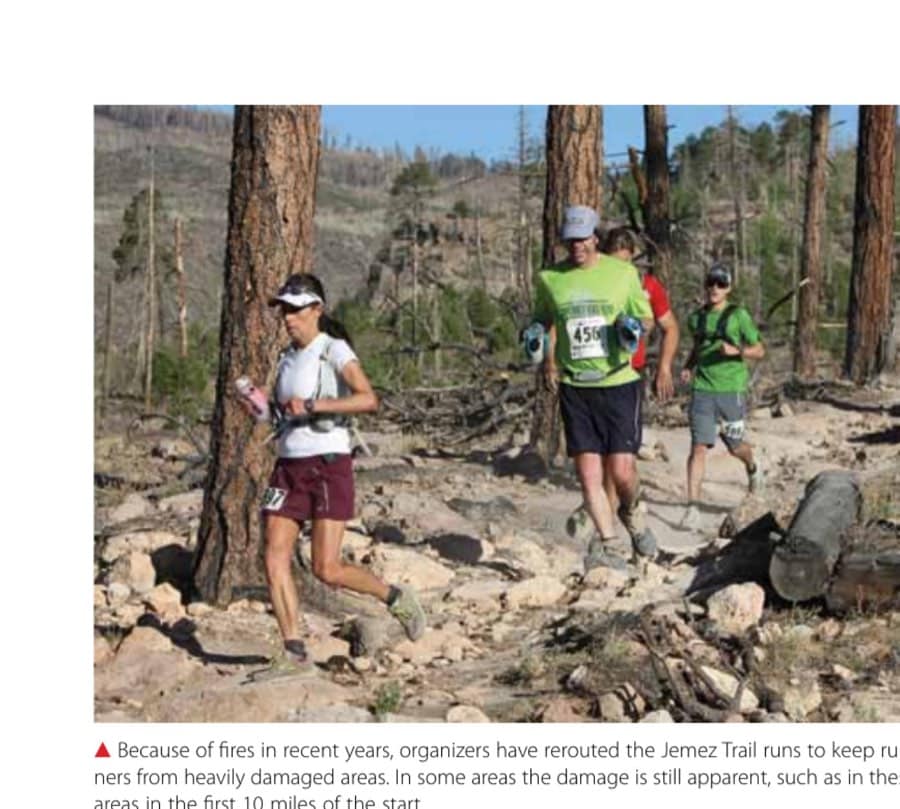
▲ Because of fires in recent years, organizers have rerouted the Jemez Trail runs to keep runners from heavily damaged areas. In some areas the damage is still apparent, such as in these areas in the first 10 miles of the start.
then ran down to the ski lodge that was the mile-36 aid station. There, Joaquin, Erika, and Oscar were waiting to check up on me. “You look better,” Erika said. “You looked horrible back at mile 28.”
It’s a matter of H2O I had become seriously dehydrated by mile 28. There is a stretch of the race, roughly from mile 20 to mile 28, where there is no aid station. This stretch includes a climb of some 3,000 feet, in which I rock-hopped and plodded through snow to the summit of Cerro Grande. And it was four miles along that stretch, after I reached the summit and after I stubbed my toes, hard, on the rocks on the downhill, that I ran out of water.
It was my own fault—I hadn’t loaded up on water at mile 20. But now, at mile 36, after having rehydrated and eaten pretzels and cranberries and salty peanuts and all sorts of other goodies, I had regained a bit of energy. “
What if we run with you for the next 12 miles?” Joaquin offered. I tried to give a neutral reply, simply because I didn’t want to put anyone else through what
I was going through. I wanted the company, and I wanted to finish, but how could I force anyone to enter into this madness? Luckily, Joaquin wasn’t really asking, and Erika—who had in the morning taken second in the half-marathon—was up for the run. So they came along with me, helping me keep my mind off pain and exhaustion by talking about all sorts of inanities. “
We’ve been eating like birds all day,” Erika mentioned. “I’m hungry.” “That doesn’t make sense,” Joaquin replied. “Birds eat a lot. They eat their body weight in a day. There’s no way we’ve eaten our body weight.” “
It’s a saying,” she said. “We’ve been stopping, eating, running, stopping, eating, like birds.” “It doesn’t make sense,” Joaquin continued, explaining in detail how much birds eat on average and how that would translate to hundreds of pounds in human weight.
All the while, we continued running up and down the trails, occasionally stopping and walking because my legs just wouldn’t run. Then I would pick it up again, trying to get the legs moving one more time, and they would follow.
The mating call of birds and people We were in a rhythm, and they were still talking, now going on about animal mating calls and how we humans have them (“Hey, baby, can I buy you a drink?”) and how in Mexico the piropos are more romantic versions of the same. And then I accidentally kicked a rock as we started to wind downhill, at around mile 40. “
My ear feels good, my pinky is fine, and my left elbow feels good, too,” I announced to no one in particular. “Huh?” Erika asked. “What are you talking about?” “I just hit a rock with my toe. Excruciating pain is shooting up my foot and up my leg right now. But I can’t think about what’s wrong.” “
Ah,” she said. “So what’s right is your ear, pinky, and elbow.” “The left one,” I added. “The left elbow feels pretty good.” And on we went, sometimes running, sometimes jogging, sometimes walking. A few of the other racers passed us. By this time, I didn’t really care about my time or place in the race. I just wanted to finish. At mile 43, a woman who seemed to be doing a very fast walk passed us. “
How far do you think we’ve got to go?” I asked her. “We must be getting close.” “We’re not close at all,” she said, almost angrily. “Ah, give me something, some hope, to keep going.” “No, I’m not going to lie to you,” she replied sternly.
I muttered under my breath: “Be that way.” And we kept moving, just running slowly, me with all the strength I had to muster a 13-minutes-a-mile pace. But then, something almost magical happened. I don’t understand it, but all of a sudden I got a burst of energy. I could run again. And I picked up the pace, ran harder, faster. I heard Erika’s GPS watch beep and asked her the pace. “
We’re now down to 9:30-mile pace,” she said. I picked up the pace more and more. And then I passed the angry honest lady. And then the guy from Arizona who had passed me a half hour earlier. And then a friend from southern New Mexico, Louie Telles, who is a tremendous ultramarathoner in his own right (but who had piled on the miles recently . . . another story). And Erika announced we were now running at eight-minute miles.
It just keeps getting better I didn’t get it; I just knew I had to keep going. One thing pushed me on—the finish line. I knew I was getting close, knew we were near the 48-mile mark, where Erika and Joaquin would leave me, and I got giddy. The pain started to go away, and I was able to run harder, to the last aid station, where I got some Gatorade and water and just kept striding.
ad
© Carmen Weddell
▲
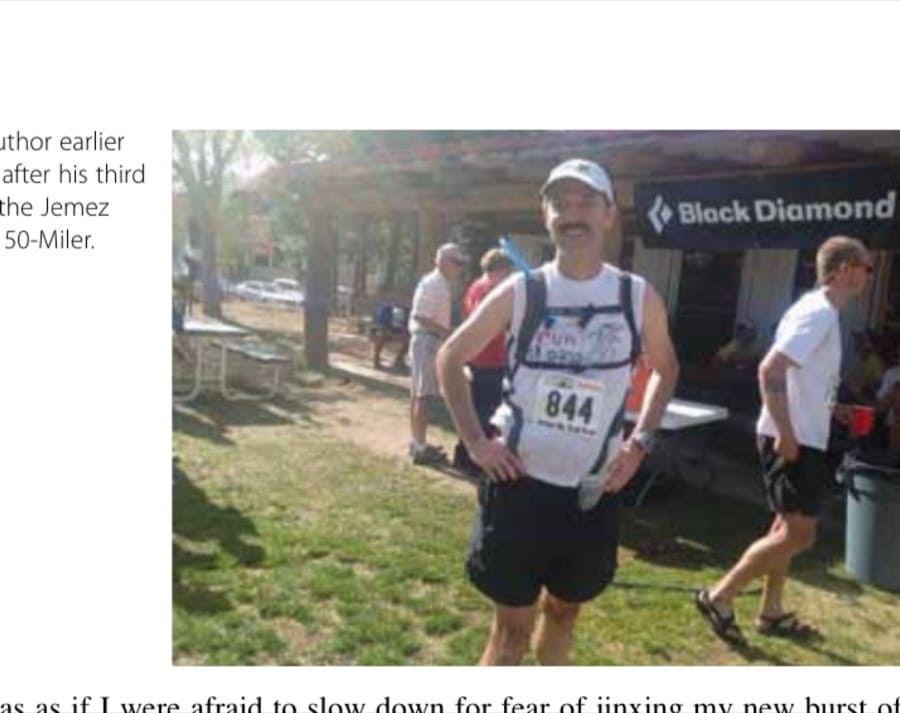
The author earlier this year after his third finish of the Jemez Trail Run 50-Miler.
It was as if I were afraid to slow down for fear of jinxing my new burst of energy. So I held the pace, walking only for the uphills, pushing on, actually looking at the pine trees and views and the creek, until the final hill where I came upon a couple of women who were walking. “
We’re pacers for one of the racers, but we did a bad job,” one said. “Our runner passed us a long time ago,” the other said with a laugh. I pushed up a hill and walked around some boulders up to a road where several people were shouting and cheering. And there I saw Joaquin and Erika and the others.
I knew, then, that I was 100 meters from the finish line. The pain no longer really mattered because I got to run the last few feet to the finish line where the clock was ticking my final time: 13 hours, 37 minutes, 5 seconds.
It was over, I was alive, and everything seemed OK. Now, a few days later, I’m glad I did the race. It was an amazing experience, and I might do another someday. But there is something, a truth, that I can’t forget: I don’t really care about my ear, my pinky, or my left elbow. Because my big toe is still hurting really bad.
This article originally appeared in Marathon & Beyond, Vol. 17, No. 6 (2013).
← Browse the full M&B ArchiveMore like this
1,000+ stories from 19 years of Marathon & Beyond
The complete archive of the legendary long-distance journal — digitized and free to read.
