

Largest Marathons And Their Trends
In 2014 at New York, a record for the most finishers in a marathon was set at 50,432. Thirty-nine years ago in 1976, the record was just 2,143 at the Schwarzwald Marathon in Bräunlingen, Germany. Prior to 1964 no marathon had more than 200 finishers except for the 1935 Japanese championship. Since the great running boom of the 1970s and early 1980s, the marathon has mushroomed in size. This study charts the rise in participation, showing which marathons took off when. We will identify not just trends for the largest marathons but also what is happening within nations, continents, and the world as a whole in the modern era. The largest marathons from the very beginning will be revealed. Observations about staging massive marathons and identifying the factors that encourage and stifle growth will also be made.
The graphs on the following pages contain a few dozen plots for the largest marathons. Each plot is a line through time representing an ongoing six-year average based on the number of finishers. For example, the Boston Marathon’s six-year average for the year 2013 is the addition of the number of finishers for 2008 + 2009 + 2010 + 2011 + 2012 + 2013, all divided by six. Those are the six years leading up to and including 2013, and the following table details the calculation:
The ongoing average for 2014 is 130,365 minus 21,963 for 2008 plus 31,805 for 2014, making 140,207 divided by six, which equals 23,368. So every year a rolling six-year average is determined. A six-year average is found because that is suitable for a trend to be seen. If the number of finishers each year were used, the resulting plots would likely be somewhat haphazard trying to account for anomalies. In the example of the Boston Marathon, 2013 was a lean year because of the bombing, but that was in part canceled out by 2011, an excellent vintage, and 2014 when the field was purposefully expanded by about 40 percent. If too many years are used, the plot is overly smoothed and the trends unresponsive or even lost. That is, it takes too long for the plot to respond to what is actually happening. A six-year average incorporates a few years of lag, and that applies where there are sudden changes
Boston Marathon six-year average for 2013 1
2
3
4
5
6
Average
2008
2009
2010
2011
2012
2013
2013
21,963
22,849
22,540
23,879
21,554
17,580
21,727½
130,365 total for six marathons / 6 years = 21,727½ ongoing average for 2013
in the number of finishers, although for our purposes six years is suitable to reveal the greater picture, which is what we are looking for. For an event to keep increasing the number of its finishers each year, it must have good marketing and organization and be financially viable and flexible to accommodate the needs of the runners. There may need to be a change of course and race headquarters to cope with larger numbers. Good weather helps and cooperative local authorities do too. Elite runners add prestige, indirectly encouraging more runners. Of course, factors beyond the marathon such as an earthquake or war can interrupt or even bring to an end a marathon. Our comparison of marathons allows us to see which ones were the biggest and when. That applies within countries as well as internationally.
Previous marathon-trend articles in M&B focused on quality rather than quantity. We will not combine quality and quantity, as that would be like mixing salt and sugar. We will examine quantity by way of two marathon divisions: 1. marathons with a six-year average of more than 20,000 finishers for the world; 2. marathons with a six-year average of fewer than 20,000 finishers for:
a. North America; b. Europe; c. Rest of the world We will list about 200 marathons in order of their six-year average number of finishers and create a medal table so that the countries that have “quantity” can be identified. We will not complicate this study by analyzing which groups participate in the marathon but will simply note that the phenomenal growth of the last decade or so was fueled by large increases in women and masters, typically running for recreation. Finally, the number of people running marathons as a global figure will be briefly investigated. *
*
*
Largest marathons The largest-marathons graph has plots for every event that has a six-year average above 20,000 finishers. So this is the major league, and the plots reveal a two-horse race between London and New York. These two giants battled with each other for
20 years from the mid-1980s to the mid-2000s until New York triumphed. That was mainly due to having the runners set off in waves in an attempt to minimize course congestion. Giant pens of runners, hopefully arranged in order of ability, are herded forward in a masterpiece of cattle-crowd management. London tries to solve the problem of too many starters by having three separate starts for the first few miles. Runners who want to race with fellow club mates but who are at different starts try to meet up where the routes merge, but unless you are 7 feet tall, that is almost impossible during the bulk of the field. The same applies for those in different waves. There is also the problem of meeting up after the race, collecting (and organizers transporting) kit, and getting home.
For the really big marathons, transport infrastructure is a major issue. Train stations act as bottlenecks, especially on platforms, trains stacking up because of the time it takes for passengers to get on or off. That can even affect the limit of a marathon as can the capacity of the roads on the way to the start and from the finish. Car parks and roads are simply too small to cater to the numerous thousands that run major marathons. So organizations have to commandeer mass-transit systems and load them to maximum capacity.
The Chicago Marathon with its double-wave start has recently overtaken London to claim the second spot. Chicago is the largest marathon with the start and finish in the same place, Grant Park, and there were more than 40,000 finishers in 2014! The start and finish are major factors in determining a marathon’s capacity as everyone congregates there. Another mass gathering occurs the day or days before the marathon at the expo or race headquarters. For example, tens of thousands turn up at Berlin’s peak time, 11:00 a.m. to 2:00 p.m., to collect race bibs the day before the race. Standing for hours in a queue at race HQ and spending the next day on a train are not ideal preparations before a marathon. Waiting to use one of the many hundreds of porta-potties is another negative. Twenty minutes before the start, and runners fertilize every bush also hydrated by a stream of urine. There are even queues of runners for the toilets en route. Chicago has one of the widest routes, and that helps ensure massive numbers are possible. Wide boulevards facilitate the endless caterpillar that crawls its way through the city. Numbers are such that the bulk of the field never thins, and any bottlenecks invite marathon-rush-hour traffic jams. Route changes such as avoiding the bottlenecks of the Tower of London’s cobbled streets sacrifice grandeur for convenience, but that does seem to have a detrimental effect on runner numbers. “Fun runners” may not mind having to wait en route, but that is far from ideal and suggests that a marathon is operating beyond its capacity. Peak flow at the finish of the Chicago Marathon, at the four and one-half hour point, is approximately 350 runners per minute. That is almost six runners per second. Double that around halfway and we see rows of a dozen runners wide every couple of meters apart clogging a highway. Chicago’s route takes in many of the city’s major landmarks and as with
other big-city marathons causes a major shutdown of surface streets. Chicago has more than 100 volunteer groups to help keep the masses under control. Obviously the course is a major factor in determining the number of runners.
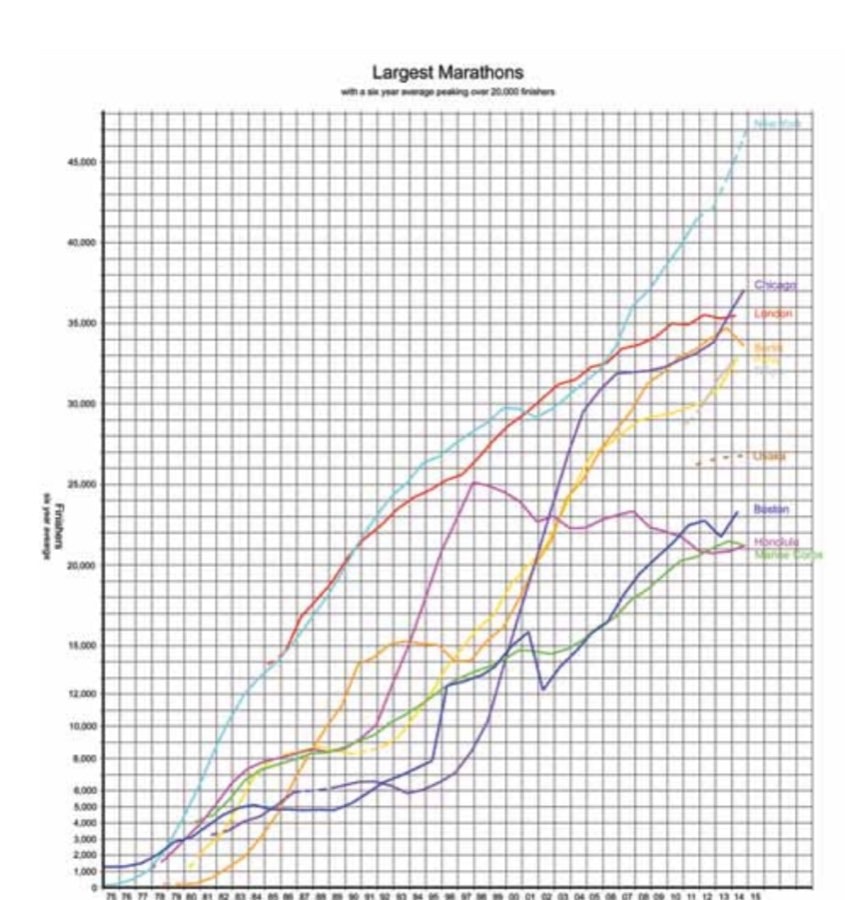
Chicago did not start to realize its potential until the turn of the millennium. A major boost happened in 1993 when LaSalle Bank started to sponsor the event. Sponsorship is one of the keys to financial scalability. Entry fees also help—New York’s edging towards $300 (more for international runners), generating $18 million, whilst London asks only for £35 ($56), providing £1.5 million ($2.5 million, plus bonded entries detailed below). Since the New York Road Runners,
which stages the New York Marathon, is a nonprofit organization, does it need to charge so much? Big marathons in the USA tend to pander to capitalism, swaying towards what the market can withstand. Europeans are much less tainted by commercialism and promote a more communist ethos supported by the state, as if the marathon is a right or an essential utility rather than a privilege, so entry is fair, and that encourages runners to donate to charity. All profits from the London Marathon organization are given to charity, £4.6 million ($7.4 million) in 2010, and in addition the runners raise a few quid, £52.8 million ($82.9 million) in 2012 (well over £1,000 per runner!), by far the largest donator by a marathon and probably by any sporting event. In 2012 runners in Chicago raised over $15 million and New York topped $25 million in 2013. The main reason why London is so charitable is the number of bonded charity entries, 13,000 runners, or 29 percent of London’s race entry. Charities buy bonded entries, which they “sell” on to runners for many hundreds of pounds. The bonded entries top the kitty to the tune of £4.0 million ($6.4 million, worked out from information on the London Marathon Trust’s website), helping to keep the normal entry fee sensible. The bonds are so sought after that charities can no longer get on the waiting list! Bigcity marathons can be very lucrative, and as donations to charities are a given, that helps big cities justify putting on their events.
Demand for spaces in big-city marathons ordinarily outstrips supply. In 2012 Berlin filled up within six weeks, having 70,000 subscribers for 40,000 numbers. Typically, 18 percent of entrants in large marathons do not finish, most being DNS (did not show) rather than DNFs. London is oversubscribed by four times, 170,000 applying in 2011. In 2013 a total of 303,450 subscribed to run the Tokyo Marathon! Tokyo and Osaka were long-standing elite-only races for men and women respectively that have recently opened their doors to the general populace. These races have yet to establish a definite trend so their full impact has only in part materialized. It is probable that Tokyo will become the second-largest marathon. Both Tokyo and Osaka have well surpassed the long-established Naha Marathon, which had a good 20-year reign as the largest marathon in the East. There are other Japanese marathons that may surpass a six-year average of 20,000 runners soon and even penetrate the top 10.
Berlin and Paris contested the largest marathon in Continental Europe until Berlin emerged as number one a half-dozen years ago, although in 2014 Paris almost had 40,000 finishers and is set to retake Berlin. These and London plus possibly Chicago are beginning to find their maximum capacity. Their plots have a convex section. Berlin organizers e-mailed me to say they had no plans to go above 40,000 entrants in 2013, preferring to maintain quality for quantity rather than quantity for its own sake, and in 2014 there were about 6,000 fewer finishers than in the previous year. Yet the trend is for seemingly full marathons to try even larger numbers. Can a marathon get too big? It can certainly find its organiza-
tion ridiculously complex with numerous departments that have to integrate, lest complications on race day surface. In that respect a marathon best gradually grow rather than suddenly arrive as a major player.
Marathon organizations have grown into amoebas with hard-to-control tentacles all sensitive to the needs of the runners and local communities. Local authorities need to be appeased, five boroughs for New York, six for London, and 29 neighborhoods for Chicago, plus those experiencing a hassle farther away. Costs spiral and new logistical problems rear their heads. Police, fire brigade, medical support, course constructors, aid/water/food stations, media and VIPs, cleaners and so on all need direction. There is so much that can go wrong that big-city marathons are major miracles.
Problems hammering downward dents in the plots for the biggest marathons include a stall to the Chicago Marathon in 2007, the year of the frying pan (hot weather). Numbers running in New York and Boston unnaturally dipped in 2001 and 2013, respectively, due to tragedies in their cities. The reaction to Hurricane Sandy meant New York was not run in 2012, and that accounts for the dashed section to its plot. In 1996 Boston’s average suddenly jumped up. That was because of its 1996 centenary where four times the number of runners were admitted, so Boston’s plot from 1996 to 2001 is elevated. Incidentally, 1996 was the first time runners were chipped at Boston, easing the results process. Since the Boston bombing in 2013, more runners have been permitted, which is a silver lining indeed. Boston has an entry cap despite runners having to satisfy qualification times. There are also four waves of runners. Incidentally, there were about 20 waves of starters for the Prudential 100 Mile Cycle Sportive through London, cycling more of a problem in quantity than running. Wheelchair marathoners are more like cyclists than runners. Boston was probably the first marathon to include wheelchairs, the year 1975. The March/April 2014 issue of M&B ran an article that included the logistics of the Boston Marathon giving insights into the magnitude of putting on a biggie.
Marine Corps in Washington, DC, and Honolulu are currently swapping places back and forth to be America’s fourth- and fifth-largest marathons, with Los Angeles not far behind on a separate graph. Marine Corps has a steady rise as if its growth is carefully controlled. A previous article on marathon trends in M&B noted Marine Corps specialized in quantity rather than quality. The attraction of running in capital cities is magnetic, the runners generating a special atmosphere, something local marathons simply cannot emulate. Honolulu experienced phenomenal growth throughout the 1990s, trebling its size in just seven years. That rise was totally unsustainable, fueling the potential to crash and burn. In 1998 Honolulu suddenly reversed its fortunes. Prize money was slashed in half and the number of high-quality performances has yet to fully recover. There are many problems created by a huge marathon that simply do not exist in other races,
and Honolulu became a victim of its own success. Honolulu is really a Japanese marathon inasmuch as that country accounts for 60 percent of finishers.
Largest marathons prior to the modern era The largest-marathons graph charts the modern era where New York and London dominated the world. Prior to that, Boston typically had the highest six-year average, but in terms of being the largest marathon each year, there were others that claimed the top spot. For two weeks in 1978 Chicago was the largest marathon ever until New York took over again. In 1976 New York quadrupled in size, being run in the five boroughs rather than around Central Park. However, that year the Schwarzwald Marathon in Germany was the largest, the last of its eight-year stint at the very top, with close to 2,000 finishers. Schwarzwald got in quickly before enough marathons appeared in Germany to offer alternatives. There were one to two dozen other marathons in Germany during Schwarzwald’s reign with only a few having more than 100 finishers. Last year there were over 80 German marathons with more than 100 finishers.
Boston was the first marathon to surpass 1,000 finishers, and that happened in 1969. During the mid-1960s the Equinox Marathon in far-off Fairbanks, Alaska, was the largest. How bizarre is that? If a town in the far-flung Alaskan wilderness could attract a few hundred runners back then (and still does), why was the rest of the world nonparticipatory? What extraterrestrial energy was in Fairbanks to cause events many decades before their time? Further back in time from the end of WWII to the early 1960s, the Polytechnic (technical British University/College now defunct) Marathon from Windsor to London held the accolade of the largest marathon. “Largest” is in a loose context because that marathon never topped 200 runners as the biggest field each year. In fact, the largest marathon in the late 1940s, Kosice in then-Czechoslovakia, had fewer than 100 finishers. Only the Japanese championship in 1935 had more than 200 runners prior to WWII. The first marathon to break 100 finishers may have been the 1909 Tour de Paris Marathon in France. The only other pre-WWII marathons with over 100 finishers listed on the Association of Road Racing Statisticians website are the 1930 Liverpool Marathon in England and 1938 German championships.
Largest second-tier North American marathons The graph for the second-tier marathons in North America shows that Los Angeles leads the way, is the sixth largest in North America, and just makes the top dozen in the world. That marathon skyrocketed in the late 1980s, its springboard the 1984 Olympics, and found its capacity close to 19,000 finishers. For a marathon to guarantee its plot on a graph it must have a minimum six-year average of 10,000
finishers. Only Rock ’n’ Roll San Diego and Walt Disney in Orlando qualify, so there is scope for other marathons to be included. Walt Disney is like Marine Corps, embracing participation, which is obviously nothing to be ashamed of and quite positive, especially for those marathoners who like company at a steady pace. Were the plots to use statistics of those who ran the marathon at least at jogging pace (circa four and one-half hours), Walt Disney’s six-year average would not break a couple of thousand. For many marathons in the West, particularly in the USA, the figures for finishers are primarily made up of those who post times reflective of swift walkers. Very generous cutoff times help boost numbers.
San Diego appears to have been left to die whilst new Rock ’n’ Rollers are being born. The Competitor Group owns Rock ’n’ Roll, which has burgeoned in the last 20 years, now offering at least 30 marathons worldwide. That includes
half-marathons and is the main reason why San Diego appears in rapid decline. Other Rock ’n’ Rollers, such as San Antonio, Arizona, Las Vegas, and Seattle (contrary to what the enclosed list suggests), are also in decline but as a whole festival of running are not, supporting the idea that more runners can be drawn for many races than for just a marathon alone.
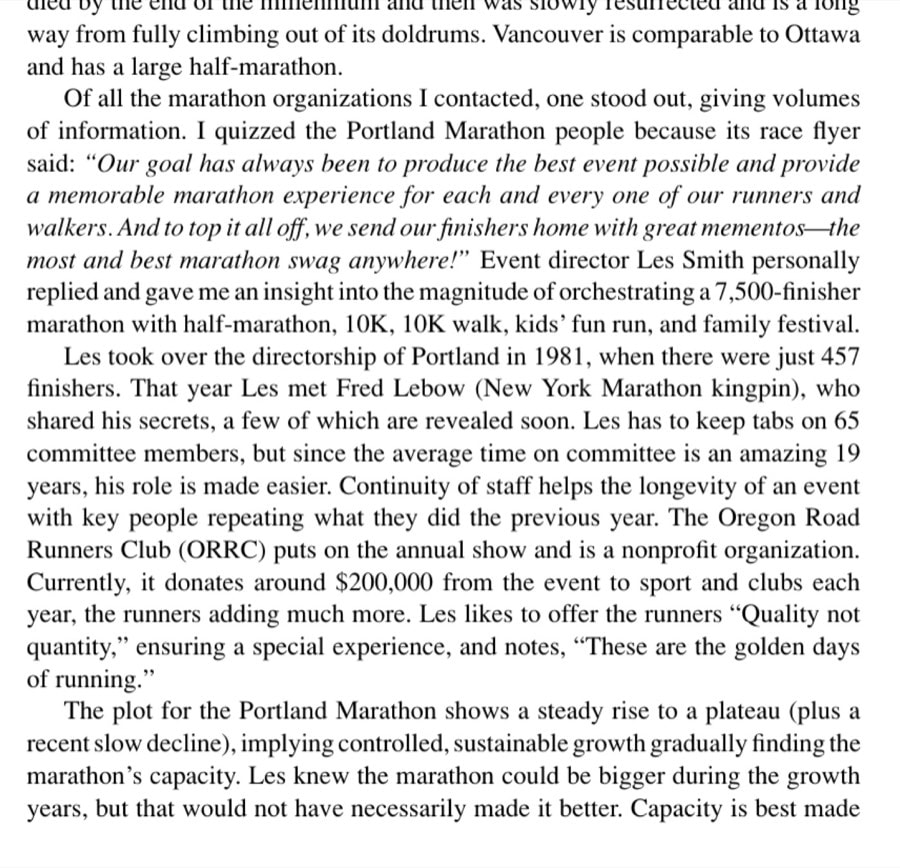
There has been a distinct trend, mainly in the USA and Canada, for marathons to become running festivals. For example, the Ottawa Marathon adds a half-marathon, 10K, 5K, family event, and something just for kids. Ottawa has 40,000 registrations, of which just over 10 percent are for the marathon. Incidentally, Ottawa has more women than men register for its events, 56 percent in 2012, paralleling races on the West Coast of America. Ottawa was one of the largest marathons in the world many decades ago. Today Grandma’s Marathon, in moderately populated Duluth, just outside Canada, is larger than any of Canada’s marathons, although the graph shows numbers are dropping. Montreal has the highest six-year average of the Canadian marathons, around 7,700 in the late 1980s, but that marathon died by the end of the millennium and then was slowly resurrected and is a long way from fully climbing out of its doldrums. Vancouver is comparable to Ottawa and has a large half-marathon.
Of all the marathon organizations I contacted, one stood out, giving volumes of information. I quizzed the Portland Marathon people because its race flyer said: “Our goal has always been to produce the best event possible and provide a memorable marathon experience for each and every one of our runners and walkers. And to top it all off, we send our finishers home with great mementos—the most and best marathon swag anywhere!” Event director Les Smith personally replied and gave me an insight into the magnitude of orchestrating a 7,500-finisher marathon with half-marathon, 10K, 10K walk, kids’ fun run, and family festival.
Les took over the directorship of Portland in 1981, when there were just 457 finishers. That year Les met Fred Lebow (New York Marathon kingpin), who shared his secrets, a few of which are revealed soon. Les has to keep tabs on 65 committee members, but since the average time on committee is an amazing 19 years, his role is made easier. Continuity of staff helps the longevity of an event with key people repeating what they did the previous year. The Oregon Road Runners Club (ORRC) puts on the annual show and is a nonprofit organization. Currently, it donates around $200,000 from the event to sport and clubs each year, the runners adding much more. Les likes to offer the runners “Quality not quantity,” ensuring a special experience, and notes, “These are the golden days of running.”
The plot for the Portland Marathon shows a steady rise to a plateau (plus a recent slow decline), implying controlled, sustainable growth gradually finding the marathon’s capacity. Les knew the marathon could be bigger during the growth years, but that would not have necessarily made it better. Capacity is best made
first before actual expansion. The marathon has been given priority over the other events, whose numbers are sensibly capped, such as the half-marathon at 2,500. Clearly, Portland is a success story and there are more good reasons for that. There are 91 course-entertainment groups at 54 sites! Wow! Portland is a carnival, albeit the “running public” provides the mobility. There are 4,700 volunteers, ensuring a very healthy ratio to the runners. There is a culture of support and reward, the “best swag” statement accurate. Portland won M&B’s best marathon medal of 2013 as voted by a panel of 25, and there are short- and long-sleeve souvenir shirts, a pendant, event coins, posters, rose (Portland is the city of roses), tree seedling (close to 200,000 planted since 1972), custom bibs, and more. Crikey!
Other marathons have cloned Portland’s many swag innovations. Portland is provision efficient, early closure of entries ensuring the right amount of stuff is ordered. Portland was the first marathon to properly cater to walkers, the year 1989. Today there is a generous cutoff time of eight hours. Also in 1989 the ORRC led by Les started a college for race directors! Nearly every major event director goes there. Everyone also goes to the race expo, 18,000 in 2013! Portland has grown to be a big player on the second-tier marathon scene and punches well above its weight considering the size of the city, but then it does have much historical importance as an epicenter for long-distance running. The Portland Marathon demographic is primarily local with 72 percent of the runners living within 50 miles, and there are runners from every state plus a score of countries. Interestingly, 58 percent of the marathon finishers are women and 70 percent in the half-marathon, which is unheard of!
The Philadelphia Marathon is fast emerging as a large marathon. The growth there is from the doldrums of the early 1990s when there was no big marathon in one of America’s largest cities. The plot of the Twin Cities Marathon has a practically 26-year linear section, an average growth of 156 runners per year. The Houston (largest winter marathon in North America) and Saint George Marathons also have long linear sections, suggesting they will continue to grow in earnest. Dallas and particularly California International are taking off. A few other sizeable second-tier North American marathons on the rise are Richmond, Big Sur, Toronto, Miami, and San Francisco, the latter three still arguably a bit low in participants considering the population of their extended metropolitan areas, although there is also the sizeable Nike Marathon (predominantly women) in San Francisco.
Relatively small marathons in North America parallel the larger events, most getting bigger. For example, the Napa Valley Marathon has been consistently adding 35 runners every year since the early 1980s, now with a six-year average of 1,772. Conversely, a little farther north in California, the Avenue of the Giants Marathon of similar size in the early 1980s to what Napa Valley is now has slumped in participation with only 279 runners finishing in 2008. Thankfully, that special forest marathon is picking back up in numbers again.
Largest second-tier European marathons After London, Berlin, and Paris, Stockholm is currently the fourth-largest marathon in Europe, recently surpassing Hamburg. Stockholm’s plot reflects the classic trend of 1980s boom, 1990s decline, and 2000s renaissance. Copenhagen is the other large marathon in Scandinavia (set to break a six-year average of 10,000 runners, probably in 2015) and would have been plotted but for lack of statistics prior to 2001. Helsinki was increasing but suddenly shrank to 35 percent of its size a couple of years ago. Incidentally, Scandinavia has the largest half-marathon in the world, Varvet at Goteborg, which is about 15 percent larger than the New York Marathon.
Germany is one of the powerhouses of the marathon but participation has slumped since the mid-2000s. Hamburg and Cologne are the biggest in Germany and have lost the most runners. Cologne suffered logistical and financial restrictions, which hit hardest in 2004. That year Essen had brief glory; Dortmund also had a few years of fame, as well as Duisburg and Dusseldorf, all of the Ruhr. The megalopolis that is the Ruhr could have one large marathon but instead its numerous cities have many smaller races. Munich is another that has declined, runners choosing to do new marathons in Germany starting up at the turn of the millennium such as Mainz and Mannheim. These two have now also seen a significant downturn.
Germany has many marathons in close proximity to each other, providing too much competition. The marathon-participation scene in Germany is a little different from France and Britain, whose runners tend to just do Paris or London. Germany has Berlin, but there are many large cities each with sizeable marathons too. Frankfurt bucks the German trend and has invested in its marathon. Fast times, decent prize money, and a weighty sponsor, BMW, have significantly added prestige. The plot for the once-largest marathon in the world of Schwarzwald is firmly put in perspective.
There is German-speaking success over the border in Switzerland by way of the Jungfrau Marathon; however, Zurich is in decline. In adjacent Austria, Vienna has been struggling, as its plot shows. That is mainly due to its half-marathon, which started in 2005, taking over, the total number of finishers for these and other events hovering just above 30,000 finishers, of which the percentage made up by marathoners is declining. A significant wedge of that is due to exercise guru Ulrich Strunz, who at the turn of the millennium weaved his magic, motivating the populace to train. The half-marathon is particularly popular all over Europe.
Italy has a proud marathon tradition, and Rome is rising well. Florence’s plot has recently accelerated while Venice, not plotted, has a steady rise. Farther west the other main Mediterranean marathon-loving nation, Spain, has experienced terrific growth in participation. Barcelona has one of the steepest plots of any
marathon and broke 20,000 finishers in 2012. Barcelona was the first city marathon to introduce doping control, in 1983. The 1992 Olympics held at Barcelona doubled numbers, but the following year it fell back to the norm. Farther down on the Costa Coast, Valencia has shown phenomenal growth and should break 10,000 in 2014. Inland, Seville is also dramatically growing. Data for Madrid is lacking but there is enough of its plot to show a positive trend. In the eastern Mediterranean, the emulation of the original marathon at Marathon, the Athens Classic, has had a revival. It had more than 10,000 finishers in 2010 for its centenary, settled back to 6,000, which could be due in part to the economic decline there, and improved to 7,600 in 2014.
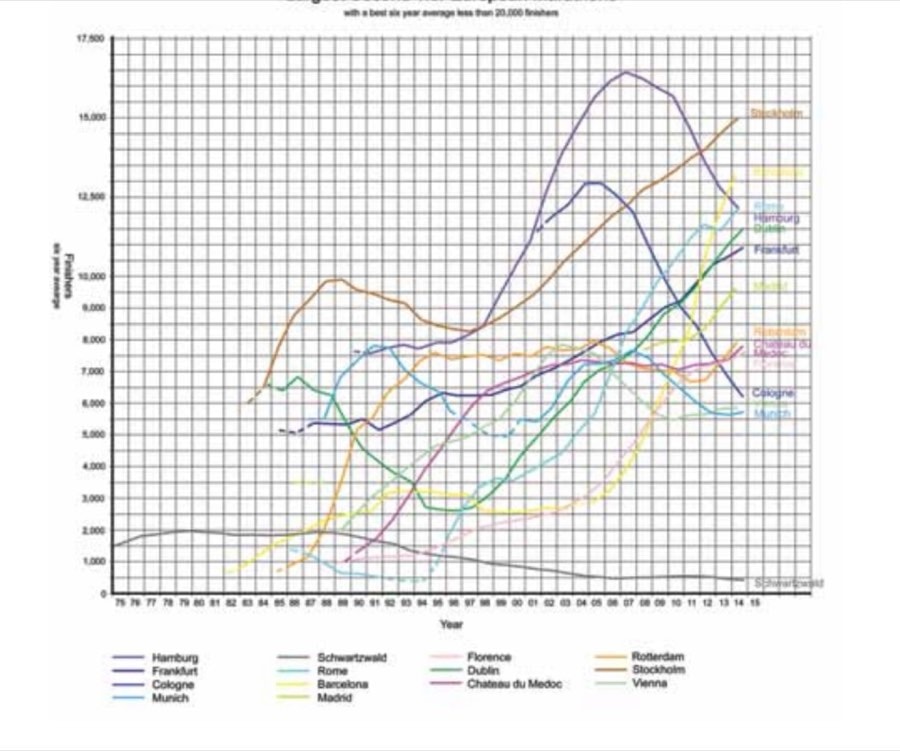
The Chateau du Medoc Marathon in France is one of Western Europe’s bestkept secrets. That is a gem of a marathon, which fills up in six weeks and has a theme of fancy dress. Its plot suggests full maturity has been reached, maximum course capacity accepted. The picturesque La Rochelle Marathon also has reached a plateau, 6,500 to 7,000 finishers as a six-year average. Rotterdam in the Benelux is another that has seemingly attained capacity. Nearby Amsterdam (not plotted),
the capital of the Netherlands, is still rising and has overtaken Rotterdam. Also in the Benelux, Brussels in Belgium has yet to fully take off. The Dublin Marathon has become increasingly popular and is the Irish London. Manchester, Liverpool, Leeds, and Glasgow have all recently resurrected their marathons after many decades of absence. Many British cities do not have a marathon, including the second largest, Birmingham, the closest being at Wolverhampton, with only a few hundred runners. Incidentally, during my early teens I ran the Birmingham Marathon in 1981 (which ceased to be soon after) and Wolverhampton Marathon in 1984. I was in the middle of the field and found these second- and third-tier marathons too populated for me to focus on the road ahead. I love a scenic marathon with a small field, which Britain has in abundance. Britain has a strong base of running clubs, and they specialize in putting on rafts of small marathons, many off road, reflecting a localized culture of self-sufficiency.
Warsaw in Poland has the highest rate of growth in Eastern Europe and should become the largest marathon in the region soon, overtaking Vienna, circa 6,000 runners. That is far larger than the Moscow Peace Marathon, for which data is lacking. The Cracovia and Wroclaw Marathons in Poland are also gaining ground. Prague and Budapest are rising, which is to be expected since much of Eastern Europe is becoming more indistinguishable from Western Europe (although current events suggest that Russia is showing resistance).
Largest second-tier marathons in Asia, Oceania, Africa, and South America Japan has recently seen a major boost in large-brand new second-tier marathons. Kobe, Kyoto, and Chiba Aqualine were all over 10,000 finishers in their first running, and there are many more new sizeable marathons too! The graph (for second-tier marathons) includes six Japanese marathons with a six-year average above 10,000. Virtually every marathon in Japan is significantly increasing in size with Fukuchiyama, Kawagauchi, Sasayama, Okinawa, Katsuya, Miyazaki, Tokushima, Nagano, Shimonoseki, Shimada, Hokkaido, and Sakura all soaring with a six-year average from 5,000 to 10,000 finishers. And there are bigger second-tier marathons around the Tokyo-Yokohama-Kawasaki conurbation. More women are increasingly running in Japan, aiding great growth. The recent earthquake and tsunami/nuclear incident caused a few marathons to be canceled.
Data for marathons in the East has improved since the mid-2000s onwards, helping to create plots on the enclosed graph. However, statistics for marathons in China and Korea are still patchy. For example, Chuncheon had 12,745 finishers in 2006, 10,073 in 2008, and only 1,500 in 2010, the only data I could find. Seoul is another marathon with sporadic unpredictable data not good enough to be plotted, and I could not find any figures for some of the largest Chinese marathons.
Asian marathon websites are impossible for me to decipher, and no organizers replied to my many e-mails. China could potentially house massive marathons, and Beijing jumped from 5,000 to 15,000 in the last few years.
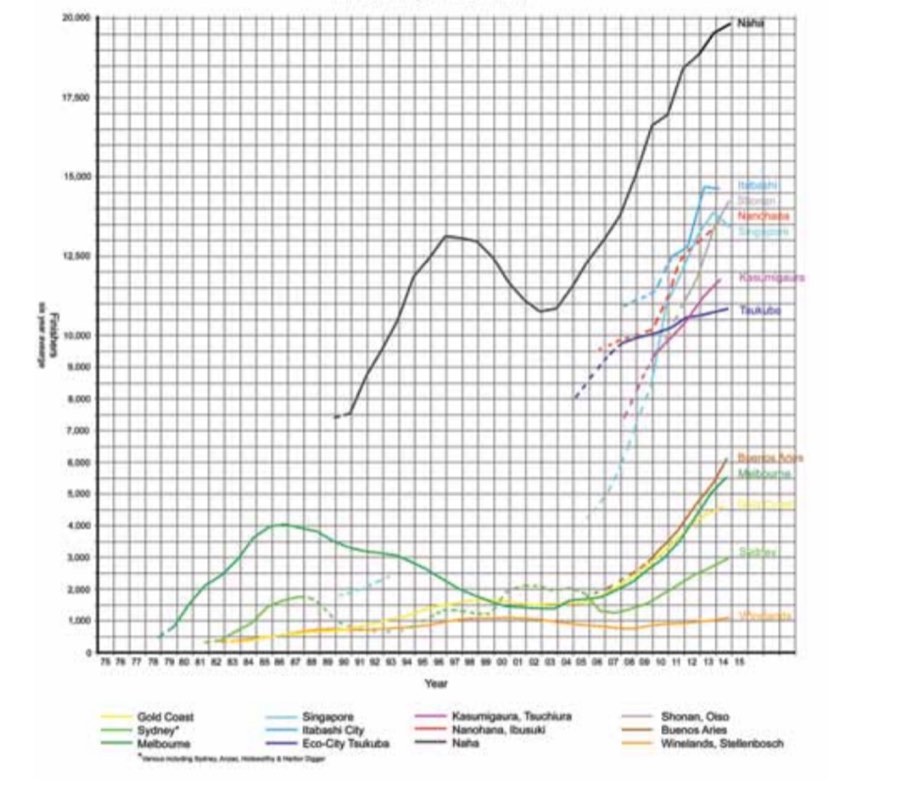
Australia’s three largest cities are the main marathons: Sydney, Melbourne, and Brisbane—Gold Coast, listed in order of population. The graph shows Melbourne has historically been the largest. Sydney has had an intermittent history. Jacob Bush, marketing and communications officer for the Gold Coast Marathon, says, “Our focus is on presenting Australia’s favorite holiday marathon each year and to ensure the marketing and delivery of our event continues to attract runners of all abilities from all over Australia and the world.” I quizzed Jacob about marathons competing against each other to be the largest and he replied, “We don’t necessarily set out to better Melbourne’s results, the two marathons enjoying an official partnership with each other.”
Recently, Auckland is doing well after a dreadful slump during the 1990s lasting 10 years. Statistics are scant for most marathons in the rest of the world. In Africa, South Africa has the largest marathons by way of Soweto (around 5,000 for a six-year average), with Pietermaritzburg, Benoni, and Johannesburg about 40 percent of the size. Only the Winelands at Stellenbosch, South Africa, has enough data to enable a long and accurate plot. The size of marathons is linked to the prosperity of countries, so Third World places do not have large marathons. Thus far Kenya and Ethiopia have had to be content with quality rather than quantity. However, there has been great participation by way of the Great Ethiopian Run (10K) at Addis Ababa. That has over 30,000 runners, with many more thousands tagging along. So maybe a massive marathon is possible in a Third World country that loves running.
In South America, Buenos Aires is the largest and has more than doubled in size during the last six years. There are three marathons in Brazil with around 3,000 to 4,000 finishers for a six-year average. All are improving as the continent experiences a marathon-running boom. The same is happening in Mexico, and there were close to 20,000 finishers in its capital-city marathon in 2014.
Largest-marathons list The largest-marathons list is based on a six-year average with the year the peak was achieved included. Every marathon with a six-year average greater than 2,500 or a single year greater than 2,500 from 2013 onwards makes the list. There are also a few inclusions with lower averages for interest. There is a column for the current six-year average as so many marathons are increasing in size. If the current six-year average is the peak, the entry is in green. Red is used where a marathon is considered to be in decline (less than 80 percent relative to its peak). Where there is decline, other marathons in the region usually take up the slack except it seems for Germany and across the borders in German-speaking areas.
A few cities have several entries where they have more than one distinct marathon or their marathon was resurrected after many years. Other cities with intermittent marathons have had those marathons combined but obviously not actually added together where there were two marathons in the same year. Some averages are listed with a ‘5’’ by their date, and that denotes a five-year average. That can be over a six-year span where one year the marathon was not held. Some countries have been grouped together as befits a region, ensuring that very similar cultures are truly represented in the medal table.
There are likely to be some marathons that I have missed. These are probably relatively new marathons from Asia and possibly Eastern Europe where websites are not in English. There may also be some older marathons in Western Europe
whose statistics do not feature in the ARRS website where most of the data was gleaned. Many thanks go to Ken Young, Andy Milroy, and others from ARRS without whom articles like this are not possible.
Largest Marathons based on a six-year average List comprehensive for marathons above a six-year average of 2,500 Marathons larger than 2,500 for a single marathon from 2013 all included Data endeavored to be correct and complete to the end of 2014 Cities may have several marathons within their statistics (the largest each year used) Color coding: Currently on a high Recession—Current size less than 80 percent of the previous high e = rough estimate a = approximate; 1, 2, 3, 4, 5, 6 = number of average ? = max size no data found; marathon probably over 2,500 average @ = two marathons on successive days for 1 year # = possibly more in earlier years
Rank/Marathon
Country
Max Size & Year
2014
1 New York 2 Chicago 3 London 4 Berlin 5 Paris 6 Tokyo 7 Honolulu 8 Boston 9 Marine Corps, Washington 10 Naha 11 Los Angeles 12 Hamburg 13 Walt Disney, Orlando 14 San Diego 15 Stockholm 16 Itabashi City 17 Shonan International, Oiso 18 Singapore 19 Nanohana, Ibusuki 20 Barcelona 21 Cologne 22 Rome 23 Tsuchiura, Kasumigaura 24 Dublin 25 Frankfurt 26 Eco-City, Tsukuba
USA USA Great Britain & Ireland Germany France Japan USA USA USA Japan USA Germany USA USA Sweden, Scandinavia Japan Japan Southeast Asia Japan Spain, Iberia Germany Italy Japan Great Britain & Ireland Germany Japan
41,5516 2011 37,118 2014 35,548 2012 34,716 2013 32,845 2014 32,758 2014 25,153 1997 23,368 2014 21,484 2013 19,836a 2014 19,160 2014 16,445 2007 16,441 2014 16,285 2008 15,001 2014 14,682 2013 14,285 2014 13,900a 2013 13,624e 2014 13,206 2014 12,961 2005 12,158 2014 11,775a 2014 11,505 2014 10,927 2014 10,849 2014
47,1045 37,118 35,534 33,590 32,845 32,758 21,246 23,368 21,244 19,836a 19,160 12,148 16,441 8,505 15,001 14,592 14,285 13,450a 13,624e 13,206 6,195 12,158 11,775a 11,505 10,927 10,849
Rank/Marathon
Country
Max Size & Year
27 Philadelphia USA 9,886 2014 28 Amsterdam Netherlands, Benelux 9,677 2014 29 Madrid Spain, Iberia 9,631 2014 30 Copenhagen Denmark, Scandinavia 9,250 2014 31 Edinburgh Great Britain & Ireland 8,745a 2014 32 Ciudad de Mexico Mexico 8,700e 2014e 33 Twin Cities, Minneapolis USA 8,608 2014 St Paul 34 Kawagauchi Japan 8,600e 2014 35 Seoul Korea 8,500e #2014 36 Brighton Great Britain & Ireland 8,3465 2014 37 Fukuchiyama Japan 8,250a 2014 38 Florence Italy 8,119 2014 39 Rotterdam Netherlands, Benelux 7,962 2005 40 Vienna Austria, Alps 7,841 2003 41 Rock ’n’ Roll Arizona USA 7,838 2009 42 Munich Germany 7,814 1991 43 Chateaux du Medoc, France 7,806 2014 Bordeaux 44 Portland USA 7,802 2011 45 Sasayama Japan 7,777 2014 46 Katsuya, Hitachinaka Japan 7,750a 2014 47 Montreal Canada 7,700a 1987a 48 Athens Classic Greece 7,624 2014 49 Okinawa Japan 7,538a 2014 50 Chuncheon Korea 7,500e 2008e 51 Beijing China 7,300e 2014 52 Hokkaido Japan 7,250e 2014 53 Tokushima Japan 7,210a 2014 54 Alps Maritime, Cannes France 7,128 2013 55 La Rochelle France 7,004 2010 56 Glasgow Great Britain & Ireland 7,000e 1987e 57 Grandma’s, Duluth USA 6,867 2008 58 Valencia Spain, Iberia 6,736 2014 59 Shimonoseki Japan 6,650a 2014 60 Houston USA 6,604 2014 61 Manchester Great Britain & Ireland 6,500e 1986e
62 Bolton Great Britain & Ireland 6,500e 1986e 63 Aoshima, Miyazaki Japan 6,500e 2014 64 Nagano Japan 6,150e 2014 65 Buenos Aries Argentina 6,134 2014 66 Shimada Japan 6,000a 2014 67 California International, USA 5,946 2014 Sacramento
2014 9,886 9,677 9,631 9,250 8,745a 8,700e 8,608 8,600e 8,500e 8,3465 8,250a 8,119 7,936 5,860 4,520 5,736 7,806 7,380 7,777 7,750a 2,273 7,624 7,538a 3,200e 7,300e 7,250e 7,210a 6,899 6,114 finished 5,907 6,736 6,650a 6,604 restarted see below finished 6,500e 6,150e 6,134 6,000a 5,946
Rank/Marathon
Country
Max Size & Year
2014
68 San Francisco 69 Hong Kong 70 St George, Utah 71 Venice 72 Melbourne 73 Rock ’n’ Roll Las Vegas 74 Warsaw 75 Prague 76 Helsinki 77 Sakura 78 Zurich 79 Austin 80 Poznan 81 Soweto 82 Xiamen 83 Ibigawa 84 Seville 85 Gold Coast 86 Rock ’n’ Roll San Antonio 87 Nike San Francisco (mainly women) 88 Dallas 89 Ehime, Matsuyama 90 Jungfrau, Interlaken 91 Mont St Michel 92 Richmond 93 Flying Pig, Cincinnati 94 Ottawa 95 Pittsburgh 96 Columbus 97 Milan 98 Country Music, Nashville 99 Tateyama 100 Vancouver Ruhr, Dusseldorf, Dortmund & Duisburg Atlanta Rio de Janeiro Detroit Schmiedefeld am Rennsteig Shincha, Kakegawa Miami Rock ’n’ Roll Seattle Senshu, Izumisano
USA China USA Italy Australia USA Poland Czech Republic Finland, Scandinavia Japan Switzerland, Alps USA Poland South Africa China Japan Spain, Iberia Australia USA USA
5,832 2014 5,800e 2014 5,719 2014 5,620 2014 5,535 2014 5,459 2010 5,278 2014 5,256 2014 5,253 2008 5,142a 2014 5,091 2009 5,080 2008 4,988 2014 4,950e 2014 4,800e 2014 4,700e 2014 4,678 2014 4,606 2014 4,594 2013 4,522 2013
5,832 5,800e 5,719 5,513 5,535 4,221 5,278 5,256 3,656 5,142a 3,283 3,461 4,988 4,950e 4,800e 4,700e 4,678 4,606 4,0085 4,4525
USA Japan Switzerland, Alps France USA USA Canada USA USA Italy USA Japan Canada Germany
4,5105 2014 4,500e 2014 4,494@ 2014 4,446 2005 4,355 2014 4,316 2011 4,296 2014 4,275 2014 4,251 2014 4,195 2005 4,151 2009 4,1335a 2014 4,081 2006 3,800e 2005e
4,5105 4,500e 4,494@ 3,442 4,355 4,003 4,296 4,275 4,251 3,613 3,084 4,1335a 3,528 2,850a
USA Brazil USA Germany Japan USA USA Japan
3,800e 3,800e 3,645 3,600a 3,600a 3,554 3,528 3,500a
1,570 3,800e 3,633 2,900a 3,600a 3,554 3,528 3,500a
2007e 2014e 2009 2006 2014 2014 2014 2014
Rank/Marathon
Country
Max Size & Year
2014
Kakogawa Cracovia, Krakow Toronto Waterfront Treviso Essen/Karstadt/Rund um den Baldeneysee Shizouka Munster Big Sur Toya Budapest Baltimore Iwaki Long Beach Wroclaw Fubon, Taipei Mumbai Sao Paulo Sydney Virginia Beach Mardi Gras Lala, Torreon Bataan Memorial Death March, White Sands Kochi Turin Washington (other than USMC) Oklahoma Toulouse Indianapolis Monumental Air Force, Dayton Lyon Mainz Belfast Anchorage Donostia, San Sebastian Curitiba Vermont City, Burlington Scottsdale Fiesta Bowl Auckland Loch Ness Nantes Victoria Reggio Emilia
Japan Poland Canada Italy Germany
3,450a 3,370 3,361 3,320 3,319
2014 2014 2014 2009 2007
3,450a 3,370 3,361 2,290 1,300a
Japan Germany USA Japan Hungary USA Japan USA Poland Taiwan India Brazil Australia USA USA Mexico USA
3,300e 3,298 3,252 3,200a 3,200a 3,160# 3,100a 3,083 3,026 3,000a 3,000e 2,900a 2,992 2,877 2,857 2,850e 2,814
2012 2007 2014 2014 2014 2013 2014 2014 2014 2014 2013 2014 2014 2014 2014 2014 2014
2,500e 2,520a 3,252 3,200a 3,200a 3,104 3,100a 3,083 3,026 3,000a 2,700e 2,900a 2,992 2,877 2,857 2,850e 2,814
Japan Italy USA
2,800e 2014 2,785 2014 2,775 2014
2,800e 2,785 2,775
USA France USA USA France Germany Great Britain & Ireland USA Spain, Iberia Brazil USA USA New Zealand Great Britain & Ireland France Canada Italy
2,747 2014 2,732 2014 2,721 2014 2,709 2014 2,6365# 2008 2,580a 2006a 2,570 2014 2,544 2002 2,526 2014 2,500e 2014e 2,484# 2014 2,467 1983 2,460 2014 2,453 2014 2,448 2014 2,438 2004 2,433 2014
2,747 2,732 2,721 2,709 1,001e 1,295 2,570 967 2,526 2,500e 2,484 finished 2,460 2,453 2,448 1,956 2,433
Rank/Marathon
Country
Max Size & Year
2014
Cleveland Memphis St Jude Santiago Long Island Lac d’Annecy Hartford Marseille Surf City, Huntington Beach Otawara Ogden Pietermaritzburg Bremen Denver Niigata Freiburg Eugene St Louis Milwaukee Lakefront Porto Istanbul Schwarzwald, Bräunlingen Steamtown, Scranton Rotorua Mannheim Guadalajara Moscow Hofu Bangkok Chester Napa Valley Brussels Johannesburg Dubai Mainichi, Beppu-Oita Lisbon Avenue of the Giants, Weott, Eureka Cape Town Tanaka, Tianzhong Manila Winelands, Stellenbosch
USA USA Chile USA France USA France USA Japan USA South Africa Germany USA Japan Germany USA USA USA Portugal, Iberia Turkey Germany USA New Zealand Germany Mexico Russia Japan Thailand Great Britain & Ireland USA Belgium, Benelux South Africa Abu Dubai Japan Portugal, Iberia USA
2,404 2014 2,404 2014 2,400a 2014 2,399 1984 2,390 2014 2,383 2014 2,300a 2011a 2,270 2014 2,270a 2014 2,241 2014 2,230e 2014e 2,200e 1990e 2,208 2013 2,200e 2014e 2,180 2009 2,161 2013 2,074 2013 2,036 2014 2,008 2014 2,000a 2014 1,984 1979 1,942 2014 1,941# 2009 1,939 2009 1,900e 2014 1,900e 2014 1,887 2014 1,833 2009 1,8005a 2014 1,772 2013 1,751 2014 1,750e 2014e 1,725 2014 1,700 2014 1,640 2014 1,578 1983
2,404 2,404 2,400a 635 2,390 2,383 1,500e 2,270 2,270a 2,241 2,230e 1,089 2,207 2,200e 1,258 2,097 1,993 2,036 2,008 2,000a 427 1,942 1,884 938 1,900e 1,900e 1,887 1,550e 1,8005a 1,769 1,751 1,750e 1,725 1,700 1,640 498
South Africa Taiwan, China Philippines South Africa
1,557 1,500e 1,150a 1,102
1,557 1,500e 1,150a 1,102
Japan Japan
26,6664e 2014 18,2454e 2014
Current Others Osaka Kobe
2014 2014 2014a 2014
Rank/Marathon
Country
Max Size & Year
Kyoto Chiba, Kisarazu Kita-Kyushu Kumamoto Anpang Starlight, Tainan Manchester (restarted) Nanao Yorkshire, York Liverpool Savannah Touraine Loire Valley Soja Milton Keynes Beigang Bonifacio Noboeka Shanghai Nagoya Women’s Incheon Birmingham Sheffield Monterrey
Japan Japan Japan Japan Taiwan, China Great Britain & Ireland Japan Great Britain & Ireland Great Britain & Ireland USA France Japan Great Britain & Ireland Taiwan, China Philippines Japan China Japan Korea Great Britain & Ireland Great Britain & Ireland Mexico
13,9233 2014 10,1813 2014 9,0801 2014 8,9812 2014 8,6551 2014 5,2912 2014 4,2231 2014 3,7832 2014 3,5363 2014 3,3404 2014 3,3231 2014 2,7782 2014 2,5873 2014 2,3003e 2014 2,7082 2014 ? ? ? ? ? mid-1980s ? mid-1980s ?
2014
The list shows that the number of marathons thins out upon reaching a sixyear average of 9,000 finishers. There is a big gap from 20,000 to 30,000, with only three marathons in that range. The cities that particularly punch above their weight are Honolulu and Naha in the Pacific Ocean. The remoteness of Honolulu and both marathons’ island status does not seem to be a barrier. Walt Disney in Orlando is oversized, but then that center represents Florida as if it were of Miami’s magnitude. Chateau du Medoc/Bordeaux, Alps Maritime/Cannes both in France, Brighton in England, Florence in Italy, and Portland in the USA do well for the size of their cities. The Bataan Memorial Death March Marathon at White Sands is oversized considering its somewhat remote location but is served by El Paso not too far away.
Some city marathons do not make the list or are “low shows.” Sizeable places not on the list in Canada and the USA include San Jose (served by San Francisco), Tampa Bay/St. Petersburg, Kansas City, Birmingham (USA), El Paso (probably reduced by Bataan), and Winnipeg’s Manitoba Marathon all of which have not had high enough consecutive years to warrant inclusion. “Low shows” on the list for the size of city include St. Louis, Toronto, Seattle, and Memphis St. Jude,
the latter having 14,000 in other events, its marathon somewhat sidelined and no longer the main event in terms of numbers. Sheffield, Stuttgart, Brussels, and Milan (plus Sydney) are a little lacking in numbers for their size, the first two currently without a marathon. Naples in Italy is ridiculously small for its size of city. Kiev, St. Petersburg, Minsk, Belgrade, and Bucharest, all in Eastern Europe, are no shows. Expect these to grow as the prosperity in Western Europe continues to spread east, Russia still having a long way to go judging by the lack of numbers in its marathons. There is likely to be marathon growth in less-developed countries, especially where modernization has transformed cities. For example, Wuhan, Tientsin, and Canton, all in China, could have marathons soon. Most major cities in the Third World do not have a marathon or a mass-participation event of any distance. The no and low shows are not as significant as the big-city marathons lacking in quality (some were highlighted in previous articles), of which there are many. This suggests attaining large numbers is easier than achieving quality. * * * The USA tops the medal table and with Canada plus Mexico added have almost as many points as the collective countries of Western Europe. That is unlike the number of quality marathons (as shown in previous M&Bs) where Western Europe is much further ahead. North America specializes in quantity but in terms of per head of population Japan is marathon mad. The gold, silver, and bronze marathon category criteria favor many events rather than one big race to get the most points and that suits Japan and the USA. The new marathons in the “
current others” list on pages 88–89 show that Japan is set to overtake the USA. Brazil is on the verge of making the medal table and the upcoming Olympics there should give a boost.
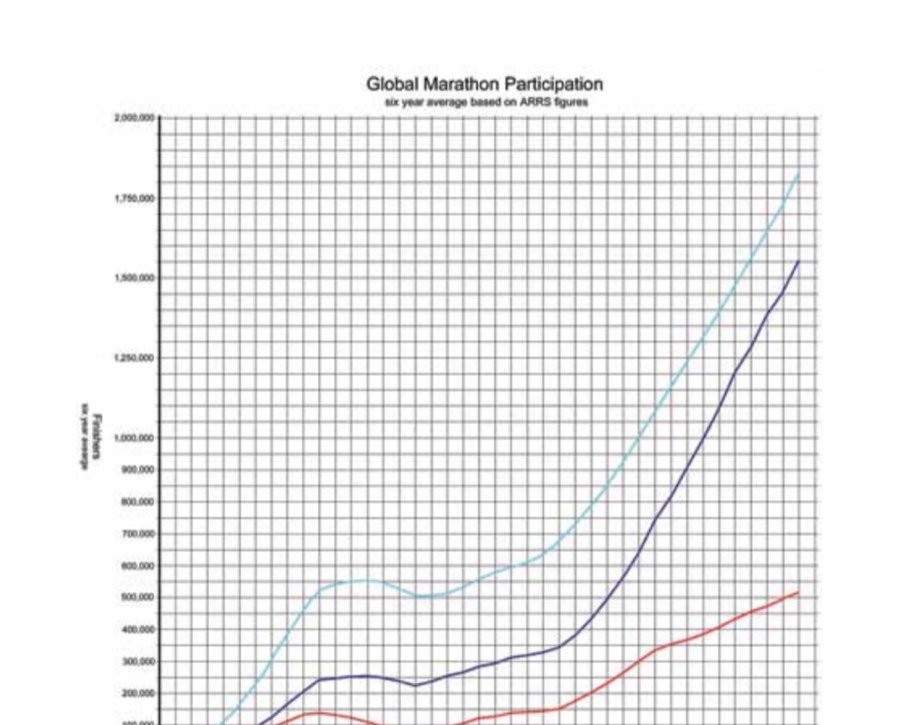
Global trend of marathon participation The graph showing global marathon participation is similar to that for world population, which suddenly rises. The downturn from the mid-1980s to the early 1990s is like the impact of “the plague,” after which growth is very dramatic. The figures for the whole world show no signs of deceleration. However, the USA has slowed its rate of quantity. The graph is for finishers as opposed to individuals, and it is likely that more than 1 million people will run a marathon for a calendar year within the next few years. The graph suggests approximately 26.2 million marathons have been run. The statistics are based on what is in the ARRS database, which, although it lists every sizeable marathon, does not always have the number of finishers available. The database has gotten more inclusive since the new millennium. In particular, the statistics for more marathons outside of the USA are being included. For example, the 2014 figures show Japan has increased its participation by 70 percent in one year to just over 405,000 finishers. That
Marathon Medal Table Based on gold for 20,000-3 points; silver for 8,000-2 points; and bronze for 4,000-1 point. ( ) = new marathons on the “current others” list probably adding to the score in the next few years Minimum of 5 consecutive years required for a marathon to qualify.
Rank
Country
Gold
Silver
Bronze
Pts.
1
USA
5
5
16
41
2
Japan
1 (1)
8 (5)
13 (1)
32 (46)
3
Great Britain & Ireland
1
3
3 (1)
12 (13)
4
Germany
1
3
1
10
5
France
1
0
4
7
6j
Italy
0
2
2
6
6j
Iberia (Spain & Portugal)
0
2
2
6
8
Scandinavia (Sweden, Denmark, Finland & Norway)
0
2
1
5
9j
Korea
0
1
1
4
9j
Benelux (The Netherlands, Belgium & Luxembourg)
0
1
1
4
11
Canada
0
0
4
4
12j
China & Taiwan
0
0 (1)
3
3 (4)
12j
Alps (Austria & Switzerland)
0
0
3
3
14j
Southeast Asia
0
1
0
2
14j
Mexico
0
1
0
2
16j
Australia
0
0
1
1
16j
Czech Republic
0
0
1
1
16j
Poland
0
0
1
1
16j
South Africa
0
0
1
1
16j
Argentina
0
0
1
1
16j
Greece
0
0
1
1
Key j = joint score
compares with 1.7 percent growth in the USA with 562,000 finishers in 2014. So we reaffirm that Japan is likely to overtake the USA as the nation that most participates in the marathon. The numbers of marathons as opposed to participants is unsuitable to plot as there are so many very small races. Instead, the number of marathons with more
than 1,000 finishers is suitable to advise the growth of the marathon, and we will once more plunder the ARRS database. Up to 1975 there had been a maximum of only two marathons with more than 1,000 finishers (not as a six-year average). The following year there were five and then 11, 24, 39, and 34 in 1980. There was a peak of 69 in 1983 by which time North America was holding fewer large marathons whilst Europe was increasing. The high of 1983 was not surpassed until 2000, and the following year there were 105 marathons with more than 1,000 finishers. That doubled in 2007, and in 2014 there were 299 “large” marathons (as of 25 December) listed on the ARRS database.
Summary In 2014 the 44 New York marathons broke a total of 1 million finishers, the most of any marathon, with a world market share of approximately 3.8 percent. No one
marathon dominates the world unlike the World Cup for soccer or the Olympics for sport in general. Instead there are marathon magnets in each country. The marathon is shared because many countries offer something unique in their flagship marathon(s). London has its historic landmarks, Rome its stylish buildings and cobbles, Boston its atmosphere, and even pan-flat PB potential coastal highrise Dubai has an attraction (even if the place resembles a giant building site). Cities may compete to be the biggest within their own country and even the world.
Having city-center marathons acts as a beacon for runners, and the most prestigious events are well oversubscribed. So there is plenty of slack to take up, and that is mainly by recreational rather than club runners. The demand for places in big-city marathons means they can expand if there is the capacity. However, city centers do not particularly lend themselves to mass gatherings, and that naturally causes difficulties. The courses of big marathons take in the sights and delights of their city centers, and that means using major main roads. With hindsight, cities would have been designed with nonvehicular superhighways for masses of cyclists and pedestrians. Big marathons are stuck with the limitations that cities come with. In that respect, the likes of New York, London, Chicago, Berlin, and Tokyo have limits, but with wave starts (or more wave starts) their size could possibly more than double. Could a custom-built facility with a 26.2-mile course on the outskirts of a city with its own transport links be the solution to expanding the marathon beyond 100,000 runners? A massive Olympic-style, purpose-built country park would be ideal not just for runners but also for triathletes and other sports groups too. There are large races that use motor-racing circuits, but tracks are too short for the marathon distance.
Expect the size of most marathons to keep increasing. Marathon participation is very much on the up, especially in the East. The nature of the marathon is to be long, and that allows for many to be spaced out on course. However, great numbers end up choking the marathon, unable to handle how fat it has become. Participants get consumed and are unable to run their own race, forced to conform to the prevailing pace. Bigger is not always better, and marathons can become too big to manage well. Getting to the start and back from the finish can feel like minimarathons in themselves. For all the disadvantages large marathons come with, they have great energy, excitement, and feeling of togetherness. In that respect, bigger is better, and even if you love the solitude of a small, scenic marathon, the experience of a big-city race is well worth having. The crowds make all the difference, helping the runners feel like stars. En masse, the human spirit can create an electric atmosphere making large marathons extra special. No wonder humanity has woken up to the great activity that is the marathon.
This article originally appeared in Marathon & Beyond, Vol. 19, No. 3 (2015).
← Browse the full M&B ArchiveMore like this
1,000+ stories from 19 years of Marathon & Beyond
The complete archive of the legendary long-distance journal — digitized and free to read.
