

Last Ass Up The Pass
The Leadville Trail Marathon is frequently confused with its more famous cousin, the Leadville Trail 100-Mile “Race Across the Sky.” The trail marathon is held each July, a month before the 100-mile race. Both races start and finish in downtown Leadville at 10,150 feet in elevation, but the 100-mile race traverses the Sawatch Range west of Leadville, topping out at notorious Hope Pass (12,580 feet), while the trail marathon traverses the Mosquito Range east of Leadville, topping out at notorious Mosquito Pass (13,188 feet). The 100-mile race climbs a total of 15,000 vertical feet over 100 miles for an average of 150 vertical feet per mile; the trail marathon climbs a total of 6,000 vertical feet over 26.2 miles for an average of 230 vertical feet per mile.
July 7, 2007: Leadville Trail Marathon, mile 21, the base of Green Mountain I was pinned down. My options were not good. The storm was getting worse. The hail had passed, but the freezing rain was soaking me. The temperature was falling fast and now there was lightning on Green Mountain ahead of me. The pine tree I was crouched beneath provided almost no shelter. My lime-green running jacket, pathetically light and thin, was providing very little protection. I had no gloves. My hands were numb. I was exhausted and dehydrated. I was alone. I was in last place. I had no idea how close ahead any other runners might be. My options were to stay where I was and risk hypothermia (which might kill me), or to keep running up Green Mountain and expose myself to lightning (which might kill me). Retreating, going back the way I had come, never entered my mind. Marathoners possess an obsessive drive to go forward at all costs at all times. At any rate, going back would simply take me farther and farther away from help.
Option 2 seemed best—extremely risky, yes, foolish, yes. I would be climbing through lightning onto a totally exposed mountain ridge, but at least I would be moving. The motion would take care of the hypothermia. The next aid station was only 1.5 miles away. I lived in Leadville. I had run this route many times. I wasn’t lost. I was just in trouble.
I decided to wait. Then I decided to make a run for it. Then I decided to wait. Suddenly two lights flashed ahead of me. I heard the roar of a truck. My stressed mind thought, Who’s out pleasure-driving in this weather?
The truck pulled off the road beside me. A race official got out. He came over to me. “We’re closing the course,” he said. I nodded. I got in the truck. The first DNF of my life.
March 1, 2008: Leadville Medical Clinic Two doctors diagnose severe hip pain as incipient arthritis. Both advise me never to run again. The next day I begin training for the marathon.
July 5, 2008: Leadville Trail Marathon It’s the day after my 62nd birthday. I’m walking from my house in Leadville four blocks to the marathon start line. Suddenly I think, It’s out of my hands now. The
ad
thought is from out of the blue. But I know what it means. It means that in my 14year career as a marathoner I have learned that preparation is everything. You’ve got to do the miles. It’s just that in my two years in the mountains of Colorado, after 32 years of running and living in the East, I’ve learned something else. I’ve learned that you have to do more than the miles. You have to have a plan. Last year, I had done the miles, but I had no plan, and the mountain had me for lunch. This year, I’ve done the miles and I have a plan.
My plan is this: 1. Resolve to finish no matter what, no matter how long it takes, no matter what the obstacles, period, end of story. This may sound obvious, but the truth is that in all my years of running marathons in the East, finishing
had never been an issue. I had never come to a start line doubting that I would make it to the finish line. 2. Prepare for anything, everything, especially bad weather. Stash extra gear, clothes, food, and water in the bushes at several points along the course.
3. Be prepared to continue running even if the race officials close the course. If the only way to continue running is to take off my bib and continue as a “civilian,” do it. It’s not about the finisher’s medal, it’s about being able
to say, for the rest of my life, “I finished Leadville.” 4. Use conservative race tactics oriented toward finishing, not best time. For example, use downhills for rest, not for increase of pace. 5. Accept the reality that I almost certainly will be last in the field. Last year
I was last when they closed the course. I’ve been a back-of-the-packer all my running life, proud to belong to the shuffling masses far back in the field, renowned not for our speed but for our willingness to endure—and
endure, and endure, and endure. But in races here in the mountains, things are different. The back of the pack is sparse indeed, if it exists at all, at least at the pace I can sustain. As a result, most of the time I’m all alone.
I’m the last man on the mountain. And therefore: 6. Prepare for a long, long day in the mountains. Projecting from last year’s run, which had taken me more than nine hours to cover 21 miles, I have to assume 11 to 12 hours to finish, and if I have a really bad day (not
impossible, it has happened before) or if there’s a protracted storm I have to ride out (not impossible, it has happened before), I might be out in the mountains when night falls. Therefore, stash a headlamp with my gear in the bushes.
As I walk to the start line, I review my plan. I feel prepared. I take a deep breath. I’m ready to give Leadville another shot.
© Kegan Kawano
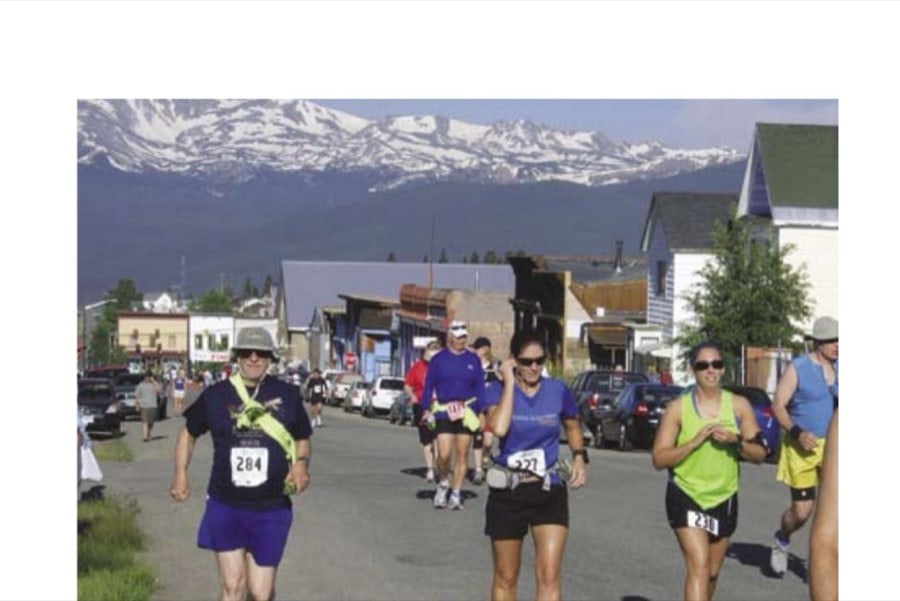
▲ With Mount Massive in the background, the author (284) starts the race with a spring in his step.
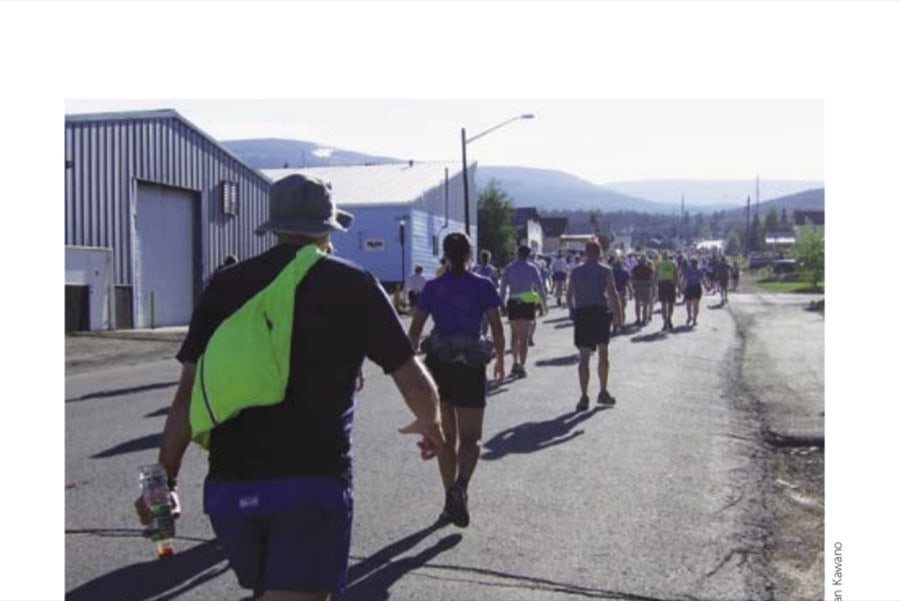
* * * The start gun pops. As the pack heads up East Sixth Street toward the mountains, I’m already at the back. But I feel strong, confident. My hip feels OK. Four months of training have reduced the pain to a manageable, intermittent dull ache.
I settle into a steady pace, using the run-jog-walk strategy I’ve developed over the past two years in the mountains: walk the uphills; run the downhills. Don’t stop. Keep moving. Rest by taking frequent walking breaks. Don’t push too hard. Don’t run for time. Stay consistent. Conserve energy. Eat. Drink. Focus. Watch the weather.
The first four miles are straight up over a series of ridges: Carbonate Hill, Iron Hill, Breece Hill, 1,500 vertical feet to the base of Ball Mountain. Halfway up Breece Hill I become intensely aware of how alone I am. I’m already in last place. I can see or hear no one ahead of me or behind me. But I don’t panic. I know exactly where I am. I know my way. I stick to my plan.
I don’t linger at the tent set up for the first water stop at the Venir Mine (mile four, 11,600 feet). I top off my water bottle and head around Ball Mountain, 3.5 miles of deceptively tough running. Below the pass between Ball Mountain and East Ball Mountain (mile six, 11,994 feet), I catch up with a few other runners. They’re
© Kegan Kawano
▲ Soon after the start, the author is already at the back of the pack. In the distance you can see the Mosquito Range, where the race is run. Mosquito Pass is the notch on top of the farthest ridge in the upper right center of the photo.
picking their way up a snow field leading up to the pass. The race officials have obligingly cut steps through the snow, but the steps are getting worn down. Several times I almost fall. Finally we get to the top of the pass and the other runners take off. I don’t try to keep up. I stick to my strategy. It’s OK if I’m last.
From Ball Pass, it’s a long four-mile downhill, back through the Venir Mine water stop (mile seven), then down through an old mining area called Stumpftown and on to the water stop at the Diamond Mine (mile 10, 11,200 feet). I feel good, but now the hard work begins: the ascent to Mosquito Pass, 2,000 vertical feet becoming progressively steeper as you rise. I head up. It’s the one section of the course where I pass runners coming the other way. Coming down off the pass through a series of steep switchbacks, they’re running hard, flying, seeming as light as hummingbirds. I, on the other hand, feel like a cement truck stuck in first gear inching my way up Mount Everest. One step, two steps, up, up, up, gasp, gasp, gasp, rest. Another step, two steps, up, up, up, gasp, gasp, gasp, rest. My head is throbbing. The air is getting thinner. Last year this section took everything out of me. By the time I got to the pass, I was dead meat. But this year I’m doing better. I’m pacing better, I’m better hydrated, eating better. I even pull ahead of another runner, briefly. Briefly, I’m not the last runner in the race. The other
runner, however, quickly makes an effort and passes me back. But that’s OK. I keep telling myself it’s OK to be last. At Mosquito Pass (mile 13, 13,188 feet) I circle Father Dyer’s grave and start back down. Last year I had been so exhausted that when I finally made the pass all I could think to do was find a place to lie down. I flopped down between two rocks, gasping for air. I lay there for 10 minutes, at least—big mistake. Lying down only succeeded in draining away what little fight I had left. I was finished, kaput. And I still had half the race to run! Or rather walk, shuffle, crawl, whatever.
So this year when I crest the pass, even though I feel exhausted, I immediately turn and head back down. I descend slowly. I’m not trying to pick up time. Time is irrelevant. I’m trying to rest, store up energy for the long miles ahead. But it’s really hard now. I’m really starting to feel the pain. More and more it’s becoming difficult to focus. It’s clear to me that even though I am drinking as much fluid as my body will absorb, I’m still becoming dehydrated. My legs are heavy. Take it one step at a time, I tell myself, one step at a time.
As I descend from Mosquito Pass I look out across the Arkansas River Valley. It’s a truly stunning view. If I weren’t in such pain, I might actually enjoy it. Far to the west, about 10 miles away, dark clouds are churning, pressed against the ridges of Mount Massive and Mount Elbert, lit by brilliant flashes of lightning. I carefully watch the weather all the way down off the pass. I’m wary but not afraid. If the storm moves this way, I’m prepared. As I slowly make it back down to the Diamond Mine water stop (mile 16), I am even cautiously optimistic. I think to myself, Maybe, just maybe I’m going to be able to pull this thing off. Nonetheless, as I enter the water stop, the race director himself approaches me and says, “How about calling it a day?”
For an entire year I have prepared myself for this moment, and yet I’m taken aback. For a moment I can say nothing. Then, a year of preparation kicks in and I say, “No, no. I’m going on.” An animated conversation ensues. Several volunteers gather round. The race director is pushing me hard to drop out. “It’s only mile 16 here,” he says. “I know,” I say. “
I can’t keep the volunteers. I’m going to have to let them go home.” “It’s OK,” I explain. “I’ve got stuff stashed ahead—food, water.” “The weather is deteriorating,” puts in a volunteer. I look to the sky. It’s gray. The clouds are closing in. “It’s OK,” I say. “I’ve got extra clothes.” “
We’ve had lightning reports,” says someone else. Again I look to the sky. No lightning is visible, but I say something about being careful. “Do you have rain gear?” asks another volunteer. “Yes.”
“Rain pants.” “Yes.” My replies are becoming clipped now, but I’m not angry. I understand where they’re coming from. And a race director wouldn’t be doing his job if he weren’t concerned about a last-place runner. I’m even appreciative, in a way. It’s just that I am so damned bull-headedly determined. Finally I say to the race director, “This is my one chance to finish Leadville.” I can tell he’s not happy with me, but I can’t help that. The conversation winds down. I move past the race director and away from the volunteers. I cross through the water stop, picking up a slice of orange, which tastes unbelievably delicious, and make my way back out onto the course.
As I head up toward Stumpftown, my legs are hurting. Each step is becoming more and more problematic. Last year at about this point I found a rock, sat down on it, placed my head between my hands, and wondered why I didn’t just stop. Just stop running. Quit. Give up. This year I see the exact same rock at the side of the trail. But this time I do not stop, do not sit down. And I do not wonder why I don’t stop—I know why I don’t stop. I push myself up to the next water stop, the Venir Mine again (mile 19), where I step behind a tree and retrieve my cache of dry clothes. I slip on a fresh, dry, medium-weight coat, rain pants, and gloves. The weather is turning nasty. The clouds over Ball Mountain are a rolling dark gray. But I see no lightning. That’s the key. Mentally, I cross my fingers. The fresh clothes revive me a little. They feel good against my skin.
As I exit the water stop the race director pulls up beside me on his ATV. No volunteers this time, just me and the race director, mano a mano. Again he suggests I drop out. I demur. “I can’t keep the volunteers here,” he says. “
I know. It’s all right.” “I’m going to have to shut down the water stop. Nobody’s going to be here when you get back.” “I understand. It’s OK. I’ve got plenty of extra food, water.” “I won’t be able to give you a finisher’s medal.” “
That’s OK,” I say. “I understand.” He pauses, looking me up and down. “It’s better that you drop out.” “Listen,” I say, glaring at him, my cooperative mood turning suddenly sour. “I am an experienced marathoner, I am an experienced runner, I am an experienced hiker. I live in Leadville. I’ve run these trails many times. I know what I’m doing.”
The race director gives a little chuckle and says, “You’re just like me—a tough guy.” Then he whirls around on his ATV and is gone. Watching him drive away, I feel a certain sense of pride. The more people try to get me to quit, the more determined I am to finish the race no matter what it takes.
I head out around Ball Mountain. It’s a long uphill from the water stop at the Venir Mine to Ball Pass. As in no other portion of the race I feel the need to
Bill Kramer
▲ The racecourse as seen from the top of Mount Massive.
remain focused. “Take it one step at a time,” I say to myself. “Don’t push. Don’t worry about the time.” My feet are killing me now. I know my overall level of pain and exhaustion is catching up to me. But if I can just get over Ball Pass, I tell myself, the last six miles of the course are all downhill—except for Green Mountain, that is, the infamous Green Mountain where, the year before, my first attempt to run Leadville had ground unceremoniously to a halt.
At Ball Pass (mile 20) the snow field is a mess. Two hundred runners coming and going all day long have turned the path down through the snow into mush. The steps are gone. The only way to get down is to slide down on my rump—just what I wanted to do after 20 miles of marathoning, slide down a snow field on my butt. And as I do, it starts to rain. Great. Blessedly, it’s just rain this time, not hail. Last year, at almost the same point in the race, the leading edge of a stormy cold front had brought hail, wind, and dropping temperatures, and that had been the end for me. This time, as the rain comes harder and harder, I pull my medium-weight coat up around my neck with my gloved hands and check the sky. No lightning. Good.
I descend from Ball Pass and cross into a stretch of trees. I pass the spot where the truck had picked me up the year before and emerge at the base of Green Mountain (mile 21). Now if I can just make it up this one last uphill. But the pain is starting to get the better of me, and I feel like I’m out of energy. I feel a sudden letdown. My mind is foggy. “Come on, Bill,” I say to myself, “don’t buckle now. Dig down. You have to go on. You have to.”
I begin my ascent. My legs are rubbery. They’re giving way. I stop, gasping for air. Then I set off again, climbing haltingly. I am reduced to an improvised climb up the ridge—one, two, three steps, stop, hands on knees, two giant gasps for breath, stand up, hands over head, two more giant gasps for breath, then repeat. One, two, three more steps, stop, hands on knees, etc. Slowly I inch up the ridge, eyeing the clouds overhead as my ascent grows slower and slower. The rain is still hard and the clouds are growing darker and darker, but I can see no lightning. As long as there’s no lightning . . .
Suddenly, I hear the sound of an ATV coming down from the top of the ridge. It’s the race director. He circles me, and says, “How’s it going, tough guy?” But the tone in his voice is different. Begrudging respect? Maybe. We talk briefly. Once more he suggests I drop out. I shake my head. He asks me if I intend to finish. I indicate that I do. He heads back up the ridge.
Exhausted, I finally reach the top of Green Mountain and approach the Venir Mine for the fourth and last time (mile 22). Not surprisingly, the water stop is no longer there. The tent is gone. But one or two volunteers are huddling in the rain next to a truck. Amazingly, they have prepared a small platter of refreshments just for me, the last runner of the day. I thank them profusely. The race director talks to me but this time he does not try to get me to drop out. He asks me if I know my way down the mountain. I tell him I do.
I head down Breece Hill. From now on it’s all downhill. I feel a surge of confidence. The rest of the course is not exposed. It’s protected by forests. It’s still raining, but mere weather can’t stop me now. Still, I remind myself that this section is a treacherous downhill. A cautious voice inside my head is saying, Don’t blow it, Bill, don’t blow it now . . . I measure each step. I’ve fallen on this section more than once in training, the last time only three weeks before, a fall so serious that for a time I wasn’t sure I would be doing the marathon at all.
Suddenly I hear the race director behind me on his ATV. I step off the path to let him pass. As he passes he says, “I’ll have your finisher’s medal for you at the end.” Or at least I think that’s
what he says. Did I hear him right? Or am I starting to imagine things? Distance runners are vulnerable to hallucinations after so long running. But either way I feel it’s beside the point because I’m almost to the base of Breece Hill (mile 24). Just two miles to go. Through the pain, my mind is beginning to clear a little and think the unthinkable: I’m going to do it. I’m actually going to make it. I’m going to finish Leadville!
With little surges of giddiness and strange, audible clicks and giggles and cries, in a mood slightly insane but utterly fine, I descend Iron Hill (mile 25) and reenter Leadville. In the rain I shuffle down the familiar pavement of East Sixth Street. I cross the finish line. 10:09:02. The race director is there. He claps me on the back. “Ten hours,” he exclaims. “You did it in 10 hours!” I can’t tell if he is amazed that I’ve finished in only 10 hours, or rather that I’m still upright and ambulatory after 10 hours. He leads me into the Sixth Street Gym, where the awards ceremony is in progress.
Keri Nelson, the first woman ever to win the Leadville Trail Marathon, is accepting her trophy. She is addressing the crowd. I sit down on the bleachers off to the side. I’m dripping wet. Water is pouring off me, puddling at my feet. Keri sits down. The race director takes the microphone and says to the crowd, “In the Marines they say they can teach you anything, except how not to quit.” He gestures for me to come up to the podium. I join him. He says, “This man does not know how to quit.” He hands me my finisher’s medal. Then he hands me a trophy. Never before in my life have I ever received, or expected to receive, a trophy. I stare down at it. The figure on the trophy is the back half of a burro. The inscription reads:
I take the microphone and look out at the crowd. All I can think is, “They’re all so dry!” Most of them finished hours ago. Keri Nelson finished in 3:58:08. They’ve been back to their motels, taking showers and napping. Still dripping wet, I speak into the microphone. “I’ve been running for 46 years,” I say, “and this . . . ” I lift the trophy high over my head like Rocky “… is what I’m proudest of.” ▲
The author’s Last Ass Up the Pass trophy.
© Kegan Kawano
Leadville Trail Marathon Last Ass Up the Pass
This article originally appeared in Marathon & Beyond, Vol. 15, No. 2 (2011).
← Browse the full M&B ArchiveMore like this
1,000+ stories from 19 years of Marathon & Beyond
The complete archive of the legendary long-distance journal — digitized and free to read.
