

Letit Snow
The early-morning symphony of snowplow blades scraping the city streets doesn’t have to bury your planned run. After a fresh drop of the white stuff, hit the trails or the roads for a physical and mental boost. As poet Wallace Stevens wrote, “One must have a mind for winter.” Here’s how to view the winter season with all its facets as a training opportunity.
Get snow tough A strong runner typically supplements his running with strength training. For a change of pace and scenery, you can leave the squats, plyometrics, and lunges at home and rely on the snow to strengthen those often-overlooked muscles.
Matt Fitzgerald, a sports nutritionist and author of numerous training books including Racing Weight, has found, “If you run on snow-covered trails after having previously run only on smooth, dry surfaces, you will wake up with muscle soreness the next day—proof positive that trail running in the snow activates the muscles differently.”
Another great aspect of snow is that it comes in all shapes and sizes: soft and fluffy, hard packed, slushy, and icy. These specific conditions will change the workout that you get while snow-running. “
If it’s deep snow, then you use your hip flexors and calves a lot more, and if it is slippery slush, then you use your glutes and lower leg muscles more in order to stay balanced and smooth,” says Dr. Stephen Gangemi, aka Sock Doc, an experienced runner and triathlete with 20 Ironman races under his belt.
So view that next 10-inch drop of wet and heavy snow as a special training ground. Dave Hannaford, elite sports podiatrist and ultrarunner, agrees, “Deeper snow requires the thigh, hip, hamstring, and ankle muscles to work more than usual without increasing impact forces. To lift the feet out of the footprint or to pull the foot and leg forward through looser snow requires fuller ranges of motion and stronger muscles.”
These leg workouts are not limited to the leg muscles; you may also notice you are working your feet more.
© Bryan Hitchcock
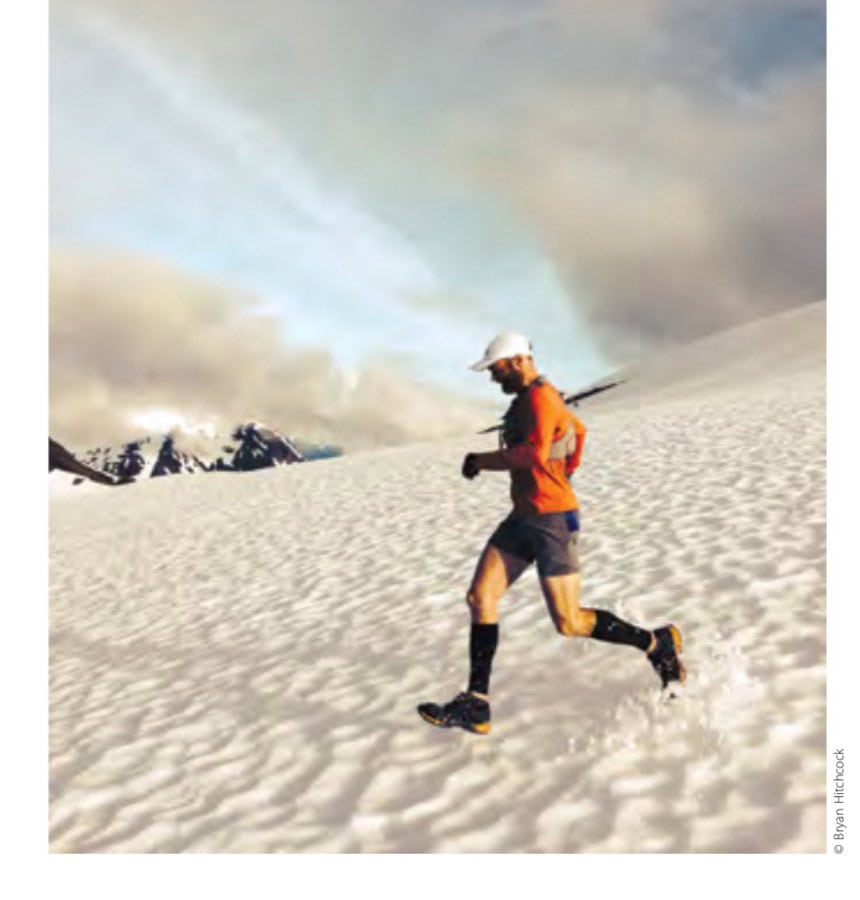
Fitzgerald says that, “There is a greater degree of activation in the ankle stabilizers and in the muscles of the feet.” One trail runner who has put in his time running on snow is Geoff Roes. He ran the 350-mile Iditarod in 2012 and says, “It’s a lot like running in sand. You use all kinds of muscles that you don’t otherwise use all that much.” “
The resistance of slipping on the snow can produce a greater workload with stronger backup muscles not usually used when running on a dry surface,” says US Olympian Jeff Galloway. While running in the snow, you are activating and firing muscles as you brace yourself for slippage, trudge through shin-deep snow, jump drifts, and contend with hidden rocks and ruts.
Test your mettle Running long distances requires the ability to sustain a level of uncomfortableness. It takes mental strength to leave a warm house for the brittle air of a 10-degree day. Your grit is tested even more when your shoes are soaked from slush, the wind is howling down your neck, and your next reprieve from the stinging snowflakes is an hour away. But it is worth it.
Roger Michel is an ultrarunner, adventure racer, and the owner of Evergreen Trail Runs, the largest trail-running series in the Pacific Northwest. He says, “Running in winter conditions is always hard no matter the equipment, and it helps to prepare for the tougher races or situations in life.”
You have to be a tough runner to do your Sunday 20-miler in spite of weather that has everyone else in the neighborhood huddling up to their fireplaces drinking hot cocoa. Taking advantage of the snow can also provide a mental edge. “
I find a better mental space while running in the snow. It helps keep me fired up and motivated during long West Coast winters,” says Gary Robbins, a dedicated snowshoe runner and trail ultrarunner. It is true that looking out a frosty window and seeing snowbanks reaching for the sky is intimidating, but after the run you will feel that you have tested your grit and are mentally stronger for your next race.
Finding good form Who isn’t interested in running form these days? Often overlooked is that snow running can help your form. I asked experienced trail runner Dr. Mark Cucuzzella about the advantages of running on snow. He said, “It works on balance and form. It is really hard to overstride and create a lot of friction. You learn to run closer to your center.”
Dr. Dave Hannaford agreed with this point: “Ice or firm snow is one of the best surfaces to learn proper form. I believe learning to run without slipping on icy surfaces is better than running barefoot for learning efficient running form and body position. A stride too long will cause a slide. If the body weight is not over the feet, runners will slip.”
The snowy or slippery conditions are a constant reminder of your form. If you let your form go, even momentarily, the snow will pull you back to reality.
The core Most runners would agree that core exercises are not the highlight of their training week. But they can be if you run in the snow. A good snow-running workout definitely beats crunches as far as the fun factor goes.
© Corle LaForce

I asked trail runner Dr. Cucuzzella whether running on snow strengthens the core. “Yes, you must have some connection between your feet and the snow, which allows proprioception to stabilize the core. This is the same principle in ski boots. You must feel the ground,” he said.
A simple run in the snow can strengthen abs and core muscles. Snow runners have noted the effects. For example, Elizabeth Primrose was the first-place female Canadian qualifier for the World Snowshoe Running Championships in 2012. “Trail running in the snow strengthens my core and stabilizers and improves my balance, especially in icy conditions. It also improves my concentration. When I am slipping and sliding, I have to think about more than just running,” said Primrose.
The winner of the 2012 Ice Age Trail 50-mile, Zach Bitter, trains and runs through the harsh Midwest winters in Madison, Wisconsin. While running on snow, he has noticed, “Anytime you are running more aggressively, you will torque your core more back and forth. Running through snow is going to get you twisting and turning more than, say, on a steady, smooth road.”
At the same time, it is beneficial to have a strong core to begin with. “It’s definitely helpful to come at snow running with a strong core already developed. Being prepared for the extra challenges inherent to running in snow allows the runner to relax and enjoy the beauty around her or him,” says Ben Luedke, founder and codirector of the Seattle Mountain Running Group.
A whole new scene No one can argue the beauty of a fresh snowfall. A clean blue sky is the canvas of snow draping on the pine trees, while the ground is a fresh palette for your landing feet. Winter’s powder can create a new world to explore and run through. Luedke says, “I think the aesthetic appeal of a snow-blanketed forest is one of the most alluring aspects of trail running in snow. The forest is extra quiet on snowy days, as the snow buffers sound.” Adding snow to the equation strengthens our appreciation for the beauty we run through day after day. Could it be that running in the snow is even a bit more fun?
Make it an adventure Traveling the same dry roads day after day can get boring. Winter weather graces our running playgrounds with new challenges and spruces up our daily routes. “It brings out the inner kid in me, makes me truly excited to run every time,” says Michel. He also adds that running on dry, regular ground becomes the norm, but running in the snow is always different. You deal with many variations of ground, such as deep, icy, soft, and slushy, or hard-packed snow. All of these variables can make for an epic run.” “
Some of the greatest benefits of trail running are psychological,” says Fitzgerald. “It’s fun and it offers a refreshing break from the routine of running on smooth surfaces. The importance of enjoyment in training is often overlooked. The more fun you’re having, the better you will perform.”
Luedke feels that running in the snow is sublime. He says, “It can be cold, wet, and gray in town, but after a short drive to a trail head, I’m running up and among snow-covered peaks.” Searching for lost sidewalks and hopping snowbanks adds a new dimension to the daily run.
Why not snowshoe? More and more trail runners are strapping on snowshoes to build strength, build core, and add some spice to their running.
In regard to snowshoeing, Gary Robbins said, “It incorporates more core and stabilizer muscles than any other form of running.” Robbins mentioned that he notices how snowshoe running helps develop balance and proprioception. Getting on the snowshoes will benefit your running and other sports. Primrose said, “Running in the snow has definitely helped me as a triathlete, especially snowshoe running. I use my hip flexors a lot more when I am running in the snow, which helps prepare me for getting on the bike in the spring.”
Get out there The next time you wake to some serious snow, take Luedke’s approach: “While nearly everyone else is dealing with conditions they dislike in town, my friends and I are having the time of our lives running up and down beautiful snowy trails with giant smiles on our faces.”
With giddy anticipation, you should await the next heavy snowfall. Adding or keeping this dimension of running in your repertoire will keep you strong. No doubt you will agree with Roes, who says, “When I get done with a long run in the snow, I feel it in muscles I didn’t even know I had.”
Whether you choose to run trails or snowshoe, one thing is sure, and well said by Fitzgerald: “Some of the greatest benefits are psychological. The importance of enjoyment in training is often overlooked. The more fun you’re having, the better you will perform.”
And as all runners agree, why not get strong while getting out and having fun?
Winter Running Safety Tips • Be prepared: if you are trail running, carry a larger hydration pack, emergency blanket, extra nutrition, headlight or flashlight, and cell phone in case of emergency. • Be cautious: the snow can hide all kinds of ankle-twisting obstacles.
Run with a shorter stride and try not to jump over obstacles to avoid landing on a hidden rock, hole, or root. • Gear up: dressing in the right gear is essential. You do not want to overdress or underdress. Try out a three-layer system of base, middle,
and shell. Wear sweat-wicking clothing. • Be shoe savvy: the right shoes can make or break your run. Try out some microspikes for icy conditions. Check out how to make your own: http://www.gobroncobilly.com/?p=40
This article originally appeared in Marathon & Beyond, Vol. 19, No. 2 (2015).
← Browse the full M&B ArchiveMore like this
1,000+ stories from 19 years of Marathon & Beyond
The complete archive of the legendary long-distance journal — digitized and free to read.
