

In My Father’s Footsteps
ONE SUNDAY morning as I sat at my kitchen table in Los Angeles nursing a hangover and smoking a cigarette, my father called me on the phone: “I’ve registered you for next year’s Marathon des Sables,” he said.
Gulp. I nearly choked. “Dad, you did what?”
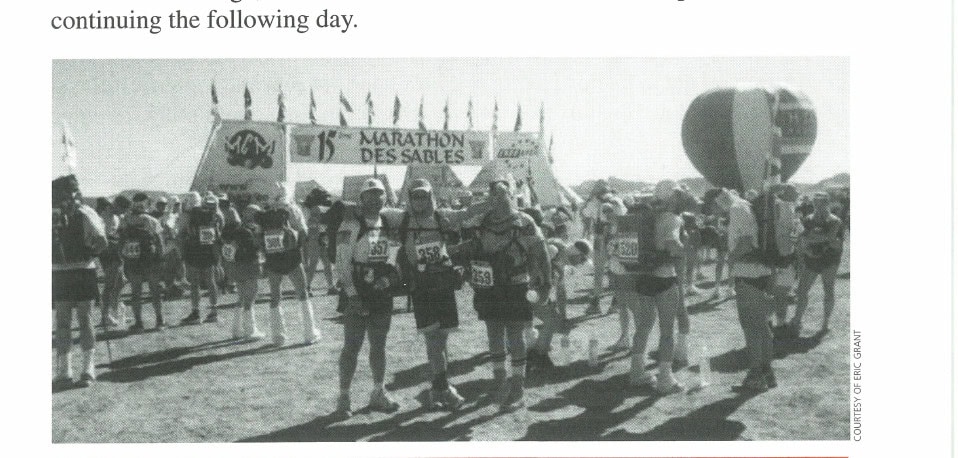
For those of you who don’t know, the Marathon des Sables (MDS) is a seven-day, 145-mile race through the Sahara Desert in Morocco in nearly full self-sufficiency—the race organizers provide only Berber tents at night and nine liters of water a day.
Since my father had competed in the MDS six times, I had seen the videotapes and heard the horror stories of blisters and exhaustion in this outdoor torture chamber for masochists. I had also seen the fierce gleam of near-madness in the competitors’ eyes at the finish line. They looked like men and women in the throes of epiphany. During a brief episode of imprudence, I had told my father I’d like to see what that felt like. Apparently, he had taken me at my word.
As soon as I hung up the phone, my sense of adventure and determination took over—not to mention my desire to get back in shape. Since my first and only year of college tennis, nine years earlier, I had laced up my running shoes only a few sporadic times. The desire had been there, but my willpower was never strong enough for me to follow through. Now I had a whole 10 months to prepare for one of the world’s worst endurance nightmares.
So, four times a week, I headed off to the Hollywood Hills or Venice Beach. The first day, I ran 30 minutes and woke up the next morning aching from waist to toes. A month later, I passed the 13-mile mark, and in November, after five months of training, I competed in my first marathon, in Long Beach.
With a pinched sciatic nerve, I hobbled across the finish line in 4:40. I couldn’t run for six weeks afterward, and even long walks aggravated the nerve. As the new year rolled in, I was growing apprehensive. The Marathon des Sables was in early April, just a little over three months off. By February, I was downright terrified.
My father calmed my fears by telling me that only the most experienced ultramarathoners would be running all the way. Most participants gruel it out and walk more than half the race. He told me to fill an old backpack with 25 pounds of water and walk, walk, walk.
So I walked everywhere with my backpack. On weekends, I would go hiking all day and even start jogging for short periods from lack of patience and growing confidence. I averaged about 70 miles a week, and a month before the race I did an approximate simulation of 110 miles over six days. I was beginning to feel confident that I was physically and mentally strong enough.
MOMENTS OF DOUBT
Two days before my father and I were to leave for Morocco, the fear gripped me that I had not prepared well enough to enjoy the thrill of an ultramarathon. Just a year before, I’d been smoking a pack of cigarettes a day and partying as if I were still in college. When I joined up with the runners in Ouarzazate, I felt like a fresh recruit on his first tour of duty, surrounded by hardened veterans on the front line of battle.
During the two days at the main encampment, we had our bags checked and weighed, submitted medical info, relaxed, trained, or meditated. I met more people like myself: men and women who were in it mainly for the challenge of surpassing themselves and with a goal of simply finishing.
My anxiety dissipated; I felt buoyed by excitement, exuberance, and anticipation.
At the starting line Sunday morning, I prepared to leave my father to amble at his own pace while I readied myself to tear off north and tackle the jagged ashen hills that lay across our path. “Don’t forget—it’s a long way to the finish line!” my father yelled after me.
I soon fell into a fast walk with short-time travel companion Rory, who convinced me to take it slow at first. He had competed in several Marathon des Sables and had placed ninth in the test run of the Desert Cup last November: a 104-mile race that Patrick Bauer, the organizer of the MDS, had set up in Jordan. “The first two days are a cinch. Save your energy,” Rory said. “You’ll be passing a bunch of these guys by day four.”
Rory was right. The first two days—17 and 21 miles, respectively, with relatively flat, rocky terrain and only a few minor sand dunes—were strolls in the park compared to the devastating third day, dubbed “Dune Day.”
The morning of the third day, we were told that 11 of the day’s 23 miles were large sand dunes. We would be supplied with only three liters of water, so proper water rationing was essential. This was the 15th annual and Year 2000 edition of the MDS, and Bauer was intent on stamping it with particular difficulty.
The elements conspired in Bauer’s favor. Night winds had been our constant companion since the day we’d arrived. We awoke every morning with crusty sand clots in our eyes, mouths, and noses—and in our freeze-dried meals. During the day, the temperature soared, peaking at 120 degrees on the third day. Everyone except the top runners slowed to a walk; many stumbled like zombies through the furnace of the dunes. A few had removed their shoes, unable to bear the intense buildup of heat. If I didn’t yet doubt that I would reach the end of this stage, I did wonder whether heatstroke would prevent me from continuing the following day.
Within two hours I was caught against the backdrop of some nightmarish film. I sipped the water, which now tasted like melted plastic, and every half hour or so would come across yet another person lying on the flank of a sand dune, huddled under a survival blanket. The sky soon lit up with explosions of emergency flares, and eight people had to be evacuated by the end of the day.
IN SEARCH OF A TENT
There seemed no end in sight, as it was impossible to know what our pace was in the dunes or how much distance we had covered. We had been told that a small tent would be set up at the end of the dunes to supply us with a half liter of water before we tackled the last two-mile stretch to the encampment. At the top of every dune, we scanned the sea of sand for some semblance of salvation but found none.
I fell in with two other runners from Switzerland. We scrambled up the dunes with frustration, slid down the other side, and emptied our shoes every 15 minutes. Eventually, we saw the spire of a tent, and we cheered. I poured my remaining water over my swollen hands, and the three of us jogged the next mile to reach the tent—only to discover that it belonged to a group of Parisian tourists who had come to the desert for a spiritual retreat of silence. The irony! Instead of silence, they hosted over 650 parched competitors who filed through their camp begging for water. Eventually, the tourists broke their vows and allowed several competitors to collapse in the shade of their tent. Later, the race organizers flew in a small medical team to hook up an IV unit to treat the more severe cases of dehydration and exhaustion.
My Swiss companions and I pushed on, fueled by frustration and the grim determination not to be beat. Forty minutes later, we reached the merciful end of the dunes and ran the last two miles to the finish line, completing the stage in 5-1/2 hours.
I felt that I had emerged from a deep hypnosis that had alternated between dream and nightmare. Suddenly, I felt etched on my face the same manic expression I had seen in the videotapes back in Los Angeles. I’d rarely felt happier.
An hour later, I was ambling around the camp, waiting for my father. Everywhere I looked, the gleams in my comrades’ eyes reflected a mixture of exhilaration and exhaustion. I began to understand why my father returned year after year; I felt thankful he had given me the opportunity to share this highly spiced slice of life with him. Unfortunately, this year his adventure would be cut short, as on the third day he failed to make the cutoff time.
He had been tramping through the sand at a slow though constant pace, stopping from time to time to bolster those who were lapsing into a state of
depression, where the mind is unable to comprehend why it’s pushing the body to such extremes, and where the idea of finishing seems a ridiculous concept. My father and a small group of stragglers just plain didn’t make it in time. He faced his forced abandonment with a smile that disguised his disappointment, leaving me with congratulations at surviving the day and words of encouragement for the next long stage of 48 miles.
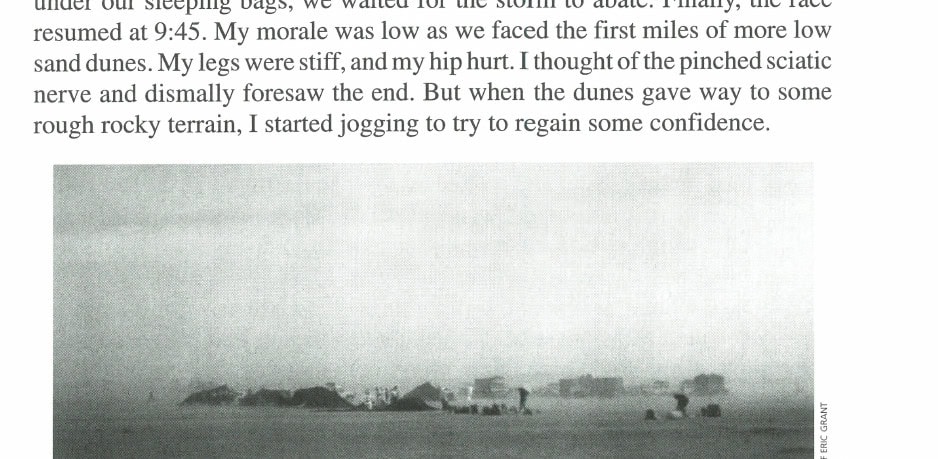
The start on the fourth day was delayed by a morning sandstorm. Huddled under our sleeping bags, we waited for the storm to abate. Finally, the race resumed at 9:45. My morale was low as we faced the first miles of more low sand dunes. My legs were stiff, and my hip hurt. I thought of the pinched sciatic nerve and dismally foresaw the end. But when the dunes gave way to some rough rocky terrain, I started jogging to try to regain some confidence.
After the first checkpoint, my stomach started to act up, and my nose began to bleed. I ran out of toilet paper and had to tear out pages of a small paperback I carried for evening reading. My head was spinning, and the back of my calves felt as if they were being branded with hot coals. The temperature had climbed above 110, and it was difficult to keep water down.
TAKING STOCK
I tried to concentrate on small things: sipping water every five minutes, putting one foot in front of the other. I tried to avoid thinking of the next control point and the total distance to be covered. When I arrived at the second control point at one o’clock in the afternoon, I sat down in the shade of a Land Rover and assessed my situation. My stomach had calmed, my legs felt like blocks of concrete but didn’t really hurt, and I was blessed with an absence of blisters.
My father had told me how he believed he had avoided blisters in the past: carrying three pairs of socks and changing every few hours, hanging the wet ones outside his backpack to dry. It had worked for him, and so far it was working for me. I realized that with only aching muscles as the extent of my pains, I was very lucky indeed.
I forgot my ailments, and they stopped plaguing me. One of the doctors taped up my calves, and I started out for the next checkpoint in high spirits, singing songs, though my mind felt like a barbecued marshmallow.
I arrived at checkpoint 4 (mile 29) and rested for an hour at the official sleeping post for those who could not push on through the night. I basked for a while in the convivial atmosphere that reigned there among the participants, with myriad languages and smells floating in the air. Night was falling, rendering the desert landscape even more magical.
I affixed my headlamp and pushed on through the night for the remaining 19 miles in company of another Swiss competitor, Mark. Although I had wanted to face much of the race alone, it was good to have company at night and after so many miles.
We passed through amazing surroundings of palm trees, villages, patches of irrigated land, and a mystical Kasbah that seemed to have appeared out of the Middle Ages, with its candlelit alleys and towering clay walls. Figures huddled in the shadows, or they waved and cheered us on. We emerged from the Kasbah into another long stretch of sand dunes, and I took a few moments to sit atop a dune swathed by the bluish moonlight that shone on the desert like a Hollywood spotlight.
Mark and I finished the stage at just past one in the morning. At the end of the first three days, I had ranked in the lower 500s out of 680 competitors. We’d finished this stage somewhere around 250. Rory and my father had been right, and although my initial goal had been to forget about “racing” and just finish, I couldn’t suppress a feeling of pride that I would in all likelihood finish relatively well.
The smile of relief on my father’s face was a warm welcome and great source of happiness. We had a definite connection. I was finally experiencing the camaraderie inherent to this race and testing my limits of endurance: which was the reason he returned each year. He just looked in my face, and I smiled back—and we knew.
MORE DROPOUTS
I was unable to fall asleep until five in the morning, but I rested all the next day as the remaining participants arrived throughout the day. Fifty more people dropped out during the fourth stage, and on the morning of the sixth day—the marathon stage—those who’d survived did not doubt that they would now finish the race, even though we faced another 26 miles in the relentless heat.
I walked and jogged with another tentmate, Serge, who was suffering from severely inflamed tendons. He felt frustrated to be forced to shuffle along for seven hours when the marathon was his favorite distance, but he faced the day without complaining, his body pumping out endorphins in high doses. I’d begun to feel a slight onset of exhaustive depression and was happy to have his company for mutual moral support.
Camp that night was almost a party because no one was particularly worried about the last stage: 11 miles through two villages nestled in the Draa Wadi. Aside from the front-runners, the departure that day resembled the retreat of Napoleon’s wounded troops from Moscow. Yet everyone was cheering and smiling. Patrick Bauer greeted us all at the finish line with a hug, a word of thanks, and congratulations—and also a medal.
I finished the race somewhere in the middle of the pack, with only a dead toenail and minor blisters. I felt empty and drained, grasping at emotional straws. It would take several days for my accomplishment to sink in, and for several weeks afterward I was floating on a cloud, feeling obnoxiously proud and confident. All I could think was, “When can I run again?”
NEXT UP: JORDAN
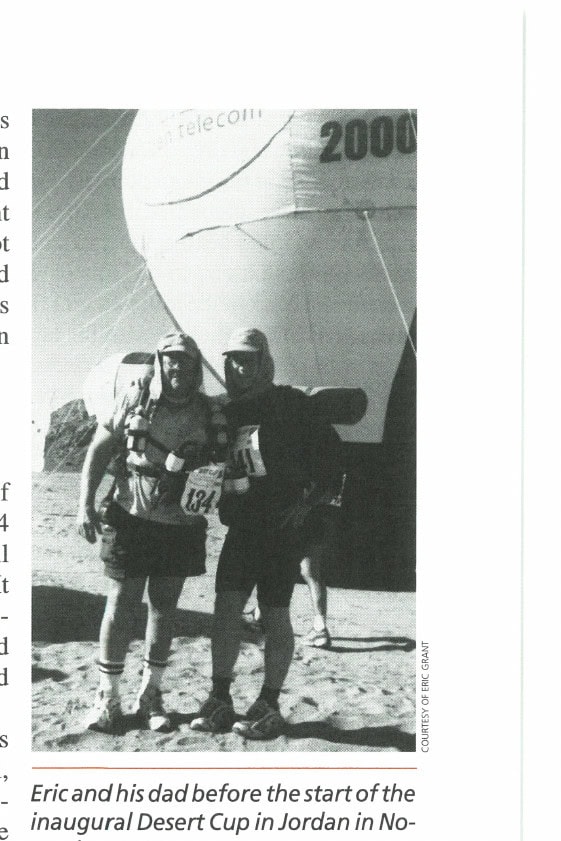
The answer came easily. My next race would be the inaugural Desert Cup scheduled for November 2000 in Jordan. My father had participated in the test run, and although he had dropped out after 40 miles, he was eager to return. I was excited but intimidated. The longest stage of the MDS had been just under 50 miles; this would be more than twice as long, and we wouldn’t have the luxury of a night’s rest between stages.
I gave myself very little time to recuperate, and soon after the MDS I fell ill for 10 days. When I started running several weeks later, I immediately felt a pain in my knee that I attributed to that poorly healed pinched nerve. I tried yoga and magnetism, saw physiotherapists and chiropractors, and something worked. But I was finding it difficult to feel inspired to exercise. My jagged year of preparation for the MDS weighed light in the balance against 10 years of dedicated laziness. I had little experience with consistent training, and I kept postponing the start of a rigorous training program.
At the end of August, fear finally motivated me. Once again, I loaded up a backpack with several gallons of bottled water, endured weekend hikes and occasional runs, and tried to walk as much as possible during the week. By the end of October, I was feeling in decent shape again, yet I was afraid it would not be enough. As my father said: “It’s like we’re heading off to the guillotine.”
My success at completing the MDS gave me a degree of confidence in my mental reserves, however, and I tried not to think of the distance too much.
TO THE START LINE
The main encampment—and the start of the race—was nestled in Wadi Rum, a large dried-up riverbed, the largest of its kind in Jordan. We would then head south for 20 miles, veer east for about 10, then head north for the remaining 75 miles to arrive in the ancient Nabatean city of Petra, carved into the desert rock.
The Jordanian desert is as magical and serene as the rolling dunes of the Sahara. We could feel the weight of history among the sea of petrified rose-tinted rifts and large mountainous formations of limestone that spotted the landscape.
The 176 competitors arrived at the encampment late Sunday night. We spent the next day checking bags, submitting medical info, relaxing, warming up, and enjoying our last real meals served by the race organizers.
Here the stress was not on weight but on calories. Each competitor had to judge his or her approximate arrival time and submit an estimate of caloric needs. In addition, we had to carry an emergency reserve of 2,000 calories and 2-1/2 bottles of water, as well as the required emergency flare, flashlight, compass, whistle, sleeping bag, sweater, and windbreaker.
Once again, the weather was a factor, but this time it wouldn’t be the heat. Although temperatures reached 85 degrees during the day, they would drop to 40 at night. The seasonal high winds and the climb to 5,000 feet after mile 65 meant that the windchill factor could force temperatures below freezing.
The first edition of the Desert Cup began at 8:30 on a Tuesday morning with high-spirited cries. Very soon, the small stream of runners thinned out. My initial goal was to maintain a four-mph pace, change socks regularly, and rest for 15 minutes at every checkpoint. The checkpoints were set up every seven to nine miles.
The difficulty in maintaining that pace, however, was that each mile in the soft desert sand seemed equivalent in effort to two miles on hard terrain. We knew from our road books that the first 65 miles of the race consisted of this uneven, sandy terrain.
I managed to maintain my pace, at times jogging out of frustration or on the few occasions where the sand was hard enough to maintain stable footing. By mile 30, I was already starting to feel my legs, but my mind would not allow me to think of the total distance. When I became too fixated on elements of the race—distance, pain, fatigue—I’d take a moment to breathe in the panorama and snap some pictures with a disposable camera.
At checkpoint 3, as I was going through my regular ritual of changing socks, stretching, and eating my salt and magnesium, I overheard a conversation
among several race representatives regarding the whereabouts of a certain Cedric Grant. Apparently my father had reached and left the first checkpoint within the time limits, but he had not yet appeared at checkpoint 2. They had crisscrossed between the checkpoints by Land Rover but had found no sign of him.
WHERE’S DAD?
They told me not to worry, which of course was pointless. It was almost 4 o’clock in the afternoon, and night fell at 5 o’clock in Jordan in November. It was true, however, that there was nothing I could do but continue the race and trust that my father’s good sense and good humor would see him through.
When night fell, I forgot my aches and pains. The moon was almost full, and it was easy to follow the trail without a headlamp. The landscape became a sea of shadows and bluish light.
I joined a French chemist named Sala who had finished the test run the previous year in just over 30 hours but was now plagued with gastroenteritis. He shared a lot of advice with me during the three hours we spent together, warning me of the long climb up to 5,000 feet after mile 65. “Whatever you do, try to do the climb during the day,” he said. “At night it can become numbingly cold.”
We reached checkpoint 5 (mile 37) at 8 o’clock, and we parted ways. Sala decided to rest and try to eat something, whereas I wanted to push on until at least the halfway mark while my energy was still strong. Another reason was that I had nothing in my backpack that I was tempted to eat.
I had completely miscalculated my food rations. I had not wanted to bring along anything that required boiling water and had therefore lapsed into the other extreme, packing mainly energy gels and powders. When I saw another competitor take out some bread and cheese from his bag, I charged off into the night to avoid feeling like a dog watching another chew on a very large and tasty bone.
When I reached checkpoint 7, my spirits soared. I was five miles from the halfway mark and only 17 hours into the race. Even more comforting was that I was greeted at the checkpoint by Patrick Bauer, who told me they had found my father at 7 o’clock that evening. He had had to drop out of the race, but he was fine and had been asking anxiously for news of me. Apparently, he had been marching along to the sounds of ABBA on his Walkman and had completely lost track of the trail markers. They found him several hours later, sitting on a small hill, signaling with his lamp and mirror.
I rested for 20 minutes, brushed my teeth, changed my socks, and felt like a new man. I reached checkpoint 8 at 4 o’clock in the morning. I’d kept telling myself that I would catch some sleep here, but with dawn approaching, it felt so cold that I had no desire to lie down. Also, I was now sick and tired of having my feet sink in the soft sand and desperately wanted to reach the 65-mile mark and the beginning of solid ground.
The terrain had leveled out, and the sand was harder than before. I couldn’t see anyone ahead of or behind me, which somehow filled me with nervous energy. I ran for occasional bouts because running didn’t hurt much more than walking. At 100K, I watched the sun rise over the mountains in the distance and once again felt happy to be part of this adventure.
TODAY’S PHILOSOPHY
I rested for 45 minutes at checkpoint 9 before taking off with a Swiss competitor, Baudoin Dunand. I asked him how he felt, and he mirrored my thoughts on the effects of this race: “I no longer think about anything in particular. I’m both empty and fulfilled.” After 65 miles of uneven sand, he no longer had the energy to run.
He charged on ahead of me at a faster walk, however, as my morale slowly sunk out of my shoes. The relief of leaving behind the sand and hitting a gravel path did not last for long. It was a steady uphill climb in increasing heat. I could already see the next checkpoint in the distance, but reaching it would take two hours of winding up and down and around what seemed like an immense quarry. The desert had given way to uninspiring surroundings.
Every 500 yards or so, I stopped and sat down. I knew that this couldn’t be a good idea, but my legs hurt at every step. For the first time I wasn’t sure I would finish the race; I wasn’t sure I wanted to keep on going. During the MDS, I had had difficult moments, but I’d never considered the race to be cruel. This was how I viewed the Desert Cup on that Wednesday morning. I knew that I wasn’t going much faster than two mph, which caused a severe drop in my morale. I tried telling myself, “Wait until the next checkpoint to see how you feel.” But I couldn’t face taking four hours to get there.
At that moment I was passed by a whistling Italian doctor, and I joined him. It was a struggle to maintain his pace, but I realized I could do it, and as we spoke of desultory subjects, the miles slipped away, and at 11:00 that morning, we finally reached the end of this interminable winding road.
Exhaustion had nearly put me into a trance. I collapsed at checkpoint 10, and for two hours I could not get myself up and moving. Slowly, however, the feeling of despair and disillusion ebbed. Officially, I still had over 40 hours to finish and only 30 miles to cover. There were no doubts in my mind now that I could and would finish; I only wondered what mental and physical state I would be in.
I was joined by Thierry Milliere, a Frenchman whose path I had crossed at various times during the race. As with most other participants at this point in the race, we had no desire to keep running or walking alone. He finally got me motivated to head out and face the longest stretch of the uphill climb to 5,000 feet, which Sala had warned me about.
Thierry pretty much talked me through to the end of the race. Even if I couldn’t always focus on what he was saying, his words kept my mind busy. As an experienced mountaineer—he has summitted the highest peaks on five of the seven continents—he was enjoying this “uphill stroll,” and his good spirits lifted mine.
As we reached checkpoint 11 at the peak of the climb, the sun was setting over the Wadi Araba, which extends into Israel, and for several hours an amazing blood-like haze settled over the distant mountains, as if grenadine syrup had been spilled on the horizon and mixed with the inky blackness of night.
STILL AT HIGH RPMs
I hadn’t slept in 36 hours, but my body was so revved up that I couldn’t even contemplate sleep. I just had to keep moving, despite the appearance of tendonitis in my right ankle that made my foot feel detached from my leg.
Thierry and I followed a gravel path lined with large boulders, through rolling hills spotted with villages and disparate lights. My tired mind played tricks on me—instead of boulders, I saw a large group of people reaching out like zombies over the gravel path. I even imagined a cable car stretching across the valley. Thierry poked fun at me until he mistook our hobbling shadows for two massive scorpions.
We soon had to put on sweaters and windbreakers, as the wind gusted up to 40 mph. I almost welcomed the cold, however, as it kept my mind off the pain in my legs and the tendonitis. At the last checkpoint, six miles before the finish, I collapsed in a Land Rover for a rest I couldn’t put off. The wind had blown away the tent a few hours earlier. Six miles was still six miles, and I needed the mental relief. Thierry pushed on.
I downed a painkiller for the last leg and jogged to make the miles pass faster. I felt manic. I slowed down as I reached the beginning of the 570 candlelit steps that lead down into the mystical ancient city of Petra. As I reached the last steps and made my way past the Treasury Temple (the setting for the final scene of Indiana Jones and the Last Crusade), all the bad memories of the race lifted. I shuffled alone through Petra, feeling like the last person on earth. These moments were the highlight of the race for me and an experience I’ll never forget.
I crossed the finish line in just under 42 hours, placing 65th out of 176 competitors. More than 40 had dropped out. My timing and rank, however, were just icing on the cake. They might mean more to me later, but just then I felt ecstatic at finishing, at overcoming what now seemed like a trek through heaven and hell. Unlike the Marathon des Sables, I had no immediate thought of returning the following year, but I knew this would not be my last ultramarathon.
THE HISTORIC theologian and reformer Martin Luther once observed that he could not possibly accomplish all his many tasks without at least four hours of prayer each day.
Similarly, many busy runners are almost religious about their workouts. They realize they could not possibly lift their heavy workloads and handle all their responsibilities without running.
“How can that be?” almost all nonrunners and many would-be runners ask. “Doesn’t running take too much time for busy people to do it?”
Following are ideas on how busy people can find that (1) running does not have to take time but can actually make time and (2) they can use their running time efficiently.
RUNNING CAN GIVE YOU TIME
Running can actually make time for you, giving you extra productive time. Do I sound like I’ve gone beyond my aerobic threshold? Probably. But consider the following example from my own experience.
In the fall of 2000, I worked full-time on Al Gore’s presidential campaign. And I do mean full-time. One hundred hour weeks were the norm for many of us, and anything less was the exception. For example, in one two-week stretch, a colleague and I both went to and spoke at meetings in 95 counties. Sundays were kept Sabbath for church and family, but the other six days a week we were “From can until can’t.”
Quite simply, I could not have done it were I not a runner and had I not kept running. To be sure, I missed running many days, and the runs I did get often were shorter than usual. But I could not have worked the hours or been as efficient without the mileage base I had going into the campaign and without the energy that came from continuing to run some during the campaign.
Running gave me endurance and helped me squeeze more hours worth of work out of each day.
RUNNING MAKES US MORE PRODUCTIVE
For several years I worked on one book manuscript and gathered material for another. But neither saw publication. Finally, a publisher contracted for my first book. Then I decided to train for my first marathon during the same months I had to complete the revisions and new chapters. My wife thought I had lost my mind.
Despite the doubts of both my bride and my editor, the marathon training helped enormously as I struggled to write and rewrite. It was no coincidence that I finished the book at the same time as I completed my marathon training.
My most productive writing has come during the time of my most productive running. Elizabeth Arnold, correspondent for National Public Radio, was quoted in Runner’s World as saying, “Running is like the pause before writing. Without it, the words don’t flow.” She is absolutely right.
Mind you, my editor occasionally scolded me for marathon training when she wanted me to complete chapters. But it was the combination of writing and running that worked most effectively for me.
This is true not just for writers.
I am an attorney and recently I wrestled with a lawsuit others and I are bringing on behalf of a client who has been terribly wronged. Something about the suit concerned me, but I could not figure out what it was. Then, near the end of a 22-mile run, the answer dawned on me. I realized what we needed to do before we filed the lawsuit. The answer just floated into my consciousness, perhaps as I was close to losing consciousness! But there it was. I returned to my office after the run and told my law partner what we needed to research before filing suit.
Creativity experts teach that creative moments often come after intense concentration and effort but only when ceasing that effort and relaxing by doing something else. That something else that is most productive for many of us is running.
THE HEALTHIER WE ARE, THE LESS TIME WE WASTE BEING SICK
It is not terribly profound, but it is something worth figuring into our cost-benefit analysis: the healthier we are, the less time we waste being sick.
This article originally appeared in Marathon & Beyond, Vol. 5, No. 5 (2001).
← Browse the full M&B ArchiveMore like this
1,000+ stories from 19 years of Marathon & Beyond
The complete archive of the legendary long-distance journal — digitized and free to read.
