

Men, it is said, live together and die alone. Runners live alone and die or suffer together. Only after a race does their reserve dissolve. In that common agony, they can reveal themselves to each other.
—George Sheehan, MD
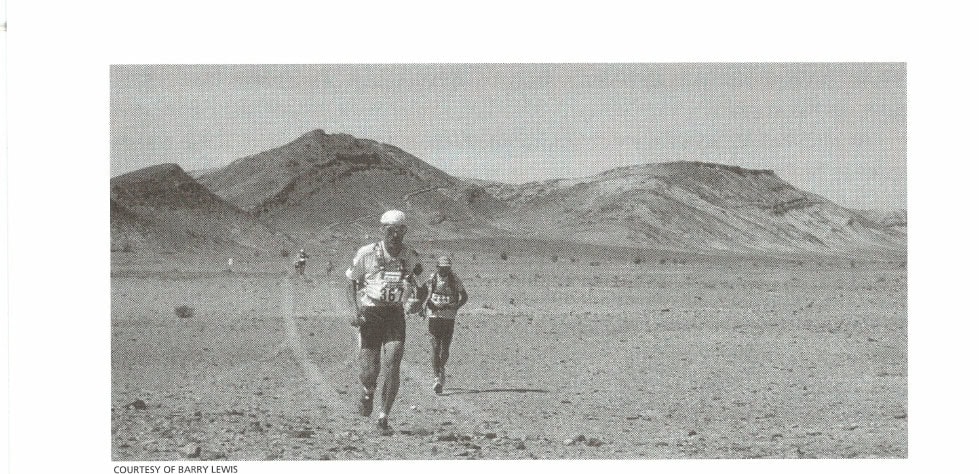
IT HAD been a long week, and although several hours earlier a part of me had been looking forward to the long trek, the midafternoon heat of the Sahara desert was wearing me down. I was less than halfway through the 76-kilometer stage and struggling with a bad stomach and a pulled groin muscle. My feet were beginning to blister and swell. I looked into the sea of sand ahead of me, saw the stratified hills that signaled its end, and realized that there I would begin another interminable climb.
The scene seemed all too familiar, and as my mind raced backward to an old film I had seen just before leaving for Morocco, I realized why. Starring Gene Hackman, Max Von Sydow, and Catherine Denueve, March or Die was one of those post-WWI Foreign Legion epics in which the undesirables of French society were sent to the same desolate region of the world upon which I was now treading. In the film, the motley band of legionnaires were here to avoid jail time or worse, commissioned to protect an archeological dig from the marauding Arabs who made the desert their home. They marched endlessly through the elements with packs on their backs, suffering from dehydration, nausea, sunstroke, and severe blistering. When they faltered, they were abandoned right where they fell.
Me, I had an honest job with an exciting future in the modern world, yet I had thrown my hat into the ring with 500 others from 30 countries to willingly experience the deprivation the legionnaires had been forced to endure. I was participating in what race organizers call “the toughest footrace in the world,” the Marathon des Sables (Marathon of the Sands).
Knowing it would be dark long before I reached camp—if I reached camp—I wondered if my fate would be the same as the characters in the film who had the misfortune to interpret the commandant’s words in the literal sense. “In the Legion,” he said, “you march, or you die.”
When it comes to athletic events, the use of superlatives always arouses suspicion—the Best, the Most Spectacular, the Highest, Longest, Gnarliest—but the description of the Marathon des Sables forces even the most cynical adventure seeker’s pulse rate to stir. Imagine it: a stage race covering roughly 250 kilometers (155 miles) through a vast desert wasteland, temperatures that regularly reach 125 degrees, self-sufficiency carried to an almost ridiculous extreme. No aid stations to speak of, no drop bags, no hope of a crew. A race organization that supplies little more than basic directions, timing functions, and sparse rations of water en route. In other words, the Sables is an arduous, exhausting, laborious, toilsome event that any self-respecting ultramarathoner would consider ideal.
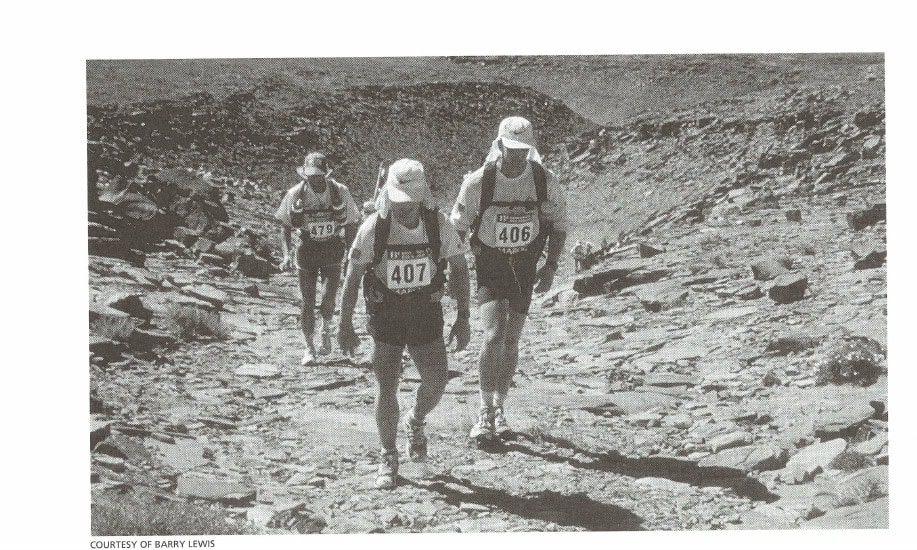
Participants in the Marathon des Sables can count on space in an open-sided tent every night and nine liters of water every day. Other than that, they’re responsible for everything they’ll need to survive the inferno of the Moroccan Sahara for the better part of a week. Besides carrying such mandatory items as antivenom pumps, signaling mirrors, and emergency flares, competitors must plan for their electrolyte, caloric, and clothing needs while minimizing the weight put in their packs. The terrain they traverse varies widely, from donkey tracks through rock-strewn plains to rough, dried-up river beds to mile upon grueling mile of fine, trackless sand. Such knowledge—along with horror stories of blinding sandstorms, excruciating blisters, rapid weight loss, and endless numbers of athletes laid out in medical tents seeking rejuvenation via intravenous drips—only adds to the event’s cachet. Designed to be harsh, the Marathon des Sables is proud of its moniker.
RACE ORIGINS
The Marathon des Sables was born as an extension of a personal quest for adventure undertaken by a young photographer from Troyes, France, more than a decade ago. Patrick Bauer’s love of individual physical effort drove him to conceive a self-sustained trek across 350 kilometers (217 miles) of the Sahara desert in 1984, and it was during the 12 days of nonstop travel (with a load weighing 35 kilograms, or 77 pounds) that he experienced what the French call “le Bapteme de la Solitude.” He was forever changed. So overwhelmed was Bauer with emotion upon his return home that he became obsessed with the idea of sharing the experience with others. The Marathon des Sables officially began the following year.
The race is traditionally held in Morocco in late March. The 1998 edition began on March 27, just one week after the best cross-country runners on the planet had converged on the North African nation for the annual World Championships. By all accounts, spring is a fabulous time to be visiting the souks of Marrakech or the resorts of the coast, but if you head across the High Atlas and Anti-Atlas Mountains, pass Ouarzazate (Wah-Zar-Zat), and continue westward 350 kilometers or so, you’ll encounter the true Sahara—absurdly dry and incredibly hot. What better place to hold an ultramarathon?
PROLOGUE
You tend to wake with a start. At least that’s the consensus among the multinational brigade with whom I’m sharing a tent. Where am I? you ask. Is this scene I’m looking at a dream, or is this real? Have I lost my mind? Is this Marathon of the Sands something I really must do?
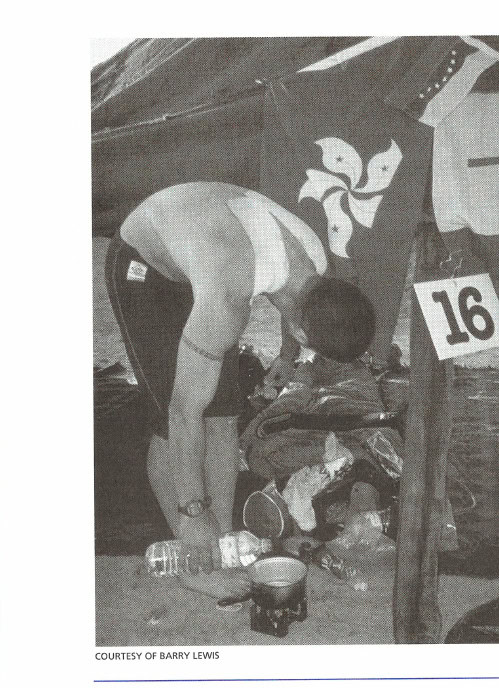
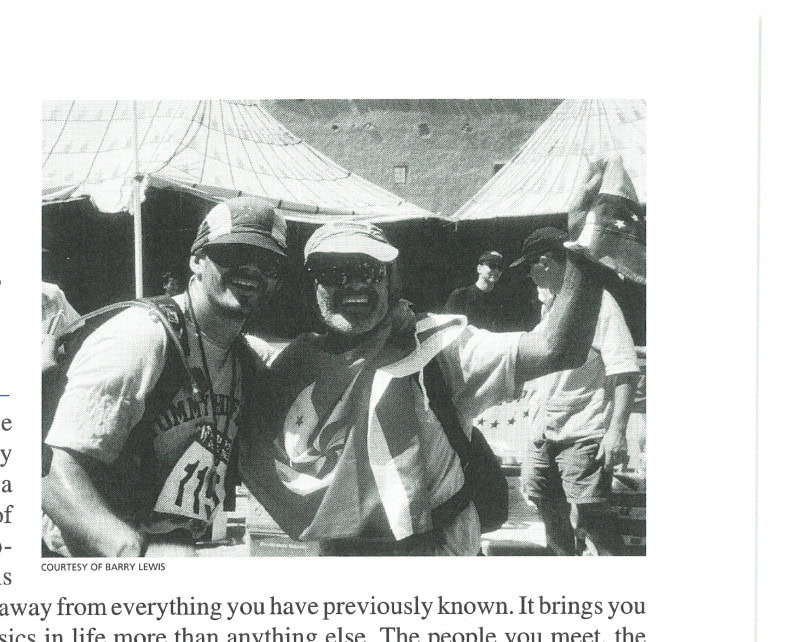
Tomorrow is Day One of the 13th edition of the Marathon des Sables. I sit up and look around Tent 16, one of 50 black canvas tarpaulins propped up by gnarled sticks in the midst of a vast open plain. The nine other runners squeezed into the open-sided shelter hail from Hong Kong, Venezuela, and various parts of the United States; they’ll be my roommates for the next seven nights.
Prepping for the Race
WHEN FIRST considering the Marathon des Sables, I realized that even with close to a decade of ultras under my belt, I’d rarely run the kind of weekly mileage I’d encounter during the race. Running with a light load was not altogether new: I had been commuting six to eight miles several times a week for close to a year. Still, I knew well that upping the mileage and increasing the weight I’d be carrying would be extremely hard. Adapting to heat while training through a northeastern winter was another challenge that I’d have to be willing to face. In spite of all my trepidation, or perhaps because of it, I applied for a media spot. Upon acceptance, I panicked. I had only about six months to train!
I had a pretty busy race schedule planned for the fall—a 50-miler in September, October, and November—so through that period, I kept to my normal routine. In the back of my mind, though, I knew that the physical demands of the Marathon des Sables would be different than those of an ordinary ultra, and I hated the thought of doing speedwork and hitting the weights. I’d learned to run through the tough spells that inevitably come during a 50- or 100-miler, but intervals and strength-training involve a whole different kind of muscular pain. I’d experienced that deep-down soreness for years as a rugby player, and I have to admit that since giving it up in favor of endurance-based activities, I’d become somewhat of a wuss.
I found a nice compromise in a circuit-training routine that rowing friends used for off-season conditioning, and within three weeks of starting their program in early December, the dreaded soreness became a thing of the past. Twice a week I sandwiched three sets of the nonstop, full-body circuit between an hour and a half of running; on most other days, I ran with a pack. On the weekends, I kept up my usual distance training, putting in between two and four hours a day on the trails.
I backed off for a couple of weeks before and after a January 50K race, and then resumed the program in earnest until the beginning of March. The mild winter was certainly no deterrent to outdoor running, but for the last three weeks I moved my training inside to prepare for the heat.
By then, fellow gym-goers were used to the sight of me arriving in full Goretex, pack on back, dripping wet—and heading straight for an exercise bike. The next phase, however, had them questioning my sanity: immediately upon arrival, I’d head into the sauna and run in place, do push-ups, and twist and shout until I was totally drained. Then I’d emerge and head for the treadmill, pack still in place, and start running uphill. Two weeks of this, intermingled with spinning classes, and I figured I was ready for the Saharan heat.
Nervous looks make their way around the tent as people exchange tidbits of personal history, running backgrounds, what they have done to prepare. The Hong Kong contingent has dubbed itself “Team Race for Hospice” after its effort to raise money on behalf of the Society for the Promotion of Hospice Care. The charity’s head of fundraising, three members of the Hong Kong police force, and a sports marketing businessman, make up the five-person team. One of them, Inspector Justin Shave, has been to the race before and accepts responsibility for conniving his friends into this year’s event.
“This is an unbelievably difficult thing to do,” Shave says by way of pep talk. “But, believe me, it’s worth every ounce of sweat, every painful step of the way. Just take it easy and get through; you’ll be in heaven at the finish line. Never forget that proper pacing is the absolute key.”
We slowly rise and wander over to the mess tent for the last real breakfast we’ll eat for a week. Then the endless ritual commences: before final check-in, every one of the 495 participants weeds through gear to reduce the mass in their packs. When you’ll be carrying a load for 230K, every fraction of an ounce counts. Obsessive discussions have been held for months and continue even now, mostly about caloric content per gram of food. Is dehydrated camp fare an effective evening meal? Should you bring a pot and stove for cooking, or simply rely on the rationed water bottles and hot desert sun? What do you eat during the day? Energy bars, gels, or more traditional foods like granola, beef jerky, and various nuts? Unlike most other times, many of the athletes have opted for foods with a high proportion of fat. Electrolyte replacement is also an issue, as are questions regarding sand-protective gaiters, extra socks, and the tradeoffs in sleeping bags—weight versus warmth.
Ultimately, the endless packing must cease, for it is time to sign in with race organizers and relinquish all excess gear. The lines are long, but it is an exciting time and a restless feeling pervades. Runners bob nervously to the beat of a Berber drummer while waiting to hand in medical papers and have the contents of backpacks examined and weighed.
When the check-in is over, a strange sensation takes hold of participants as the realization of what they’re in for begins to take hold. Runners can still jettison food if they wish, but from here on, they’re committed to their race numbers, the clothes they wear, and the bare essentials they have stashed in their packs.
The “Road Book” handed out by race organizers becomes a focal point for the rest of the day. Introductions and conversations dwindle as runners eagerly study the pages that provide the first real sense of the route. The total distance will be 229 kilometers (142 miles). The longest stage comes on Day Four—at 76K, the distance is slightly less than the anticipated 50 miles. On the downside, there seems to be an inordinate amount of sand, and the book’s descriptions refer to many rocky sections complemented by a series of hills.
After dinner, I take a stroll around camp, my headlamp lighting the way. Some tents are silent as runners retire early to battle travel fatigue; others are filled with sounds of laughter, singing, or nervous conversation. Kerosene lamps burn brightly in the tents of the nomadic merchants who sell silver, carpets, and jewels on the fringe of the camp. Farther out on the plain, a Berber drummer and flutist play monotonous music as dancers are silhouetted by a bonfire’s billowing flames.
Back in Tent 16, thin carpets cover the rough, rocky ground. Sleep comes easily for some; for others, like me, it’s an elusive mistress. I lie quietly in my bivvy sack, listening to the strange music mingling with the howl of the wind.
ON COMMENCE
You cannot create experience. You must undergo it.
—Albert Camus
It’s the second morning at the bivouac site, and the 10 members of Tent 16 are shivering from the cold, miserable night we’ve just spent together, sardine-like, in the far-from-weatherproof shelter made to hold no more than 6. The rain began the previous evening while we waited for dinner and only now, at 6:00 A.M., has it begun to let up.
The loosely woven black burlap tents of the encampment became saturated by midnight, and the resulting seepage looked like runoff from a slag heap next to a long-abandoned coal mine. The drippage made sleep even more difficult; it tasted terrible and stained everything in sight. As I try to shake the overwhelming feeling of weariness from my body, I recall the eerie episode that took place in the dead of the night.
In the midst of tossing and turning to avoid the rocks underneath and the drops from above, a motorcade of jeeps appeared, an assault team from nowhere crashing in out of the absolute black. Bright fog lights, indecipherable words, and loud rustling sounds amplified our paranoia. By the time I realized that Operation Coverup was an earnest attempt to install plastic tarpaulins between seeping tents and slumbering bodies, my imagination had exorcised all hope of getting to sleep. There had been too much talk of Jihad in the news recently, too many problems out in the Gulf. I had spent too much time reading Paul Bowles, whose haunting tales of Moroccan travel almost always leave the protagonists in serious trouble after innocent excursions go terribly wrong.
I wish I could stop shaking, but I’m wearing all the clothes I have with me: running shorts, two long-sleeved Coolmax shirts, silk-weight long johns, and a light nylon vest.
“This isn’t the way the Sahara desert is meant to behave,” I whisper to the fossilized inhabitants of the ancient seabed on which we have slept. Then, to the gray, tempestuous sky: “Bring on the heat.” Sure the course sounds tough, I tell myself, but counterbalancing the mixed bag of sand, rocks, and hills with cool weather somehow wouldn’t be right. If the temperature doesn’t rise into the 120-degree range, it would feel like cheating.
“Go on,” I say more loudly. “Make it a test!”
I know even as I utter these words that they’ll come back to haunt me, but dammit, I’d sweated in preparation for the toughest footrace in the world. I wanted it to be every bit as harsh, hard, and hot as they said it would be.
The “wrecking crew” of Berbers that dismantles the tents each morning and reassembles them at the end of each stage starts early. By 6:30 A.M., all of the race participants are sitting in the open plain on their sleeping bags; the trucks that will carry the tents to the next bivouac are loaded and ready to roll. In the distance, the white tents of the administrative area still stand tall, and when the winds shift, the smell of cooking floats our way from the mess. The medical staff, journalists, and support personnel might be chowing down, but there is no beefsteak or bread, no fried eggs or potatoes, no orange juice or percolated coffee with fresh milk on this side of the camp. It’s Day One. Self-sufficiency has officially begun.
ONWARD, OUTWARD, MORE ONWARD
Some athletes opt for oatmeal or dehydrated eggs warmed on fuel blocks or miniature stoves; for most, though, it’s a power bar and shot of energy drink. The stage is a short one, a “warm-up” of a mere 24K.
Essential Equipment
Getting used to running with a loaded backpack is an absolute must. I have tried many packs over the years and found that Ultimate Direction has the broadest variety of running packs. Chances are pretty good that they make one to fit your ideal. I was fortunate enough to have them make me a lightweight version of their popular Tailwind. It weighed less than two pounds, had a pocket for an internal bladder as well as external bottle holders, and contained the perfect amount of room. The Ultimate harness is comfortable and adjustable and does not cut into your shoulders or back because the system is designed to keep the weight on your hips.
A lightweight (1 to 1.5 pounds) sleeping bag good to freezing is also a must. I went for a polypropylene bag liner and bivvy sack instead, but I was often cold at night (it can get down to freezing in the Sahara) and didn’t save any weight. Sun protection is another essential. I wore long-sleeved Coolmax shirts (one for running, one for post), a brimmed cap with ear/neck flaps, long dryline cycling style shorts, and sunscreen on my hands and legs.
For pacing purposes, I wore a Polar heart rate monitor that I had used for several months before heading to the race. I was diligent in my prerace prep about learning where my comfort level was for certain distance and pace workouts, and I used this knowledge to set parameters for myself each day of the race. This helped me run within my capabilities; I simply refused to be sucked into other people’s pace.
Food is a very personal and experimental thing, but if there is one piece of advice worth hearing, it is to bring a variety of flavors in your electrolyte drinks. I hadn’t heeded this tidbit, and by Day Three I was sick of my orange Cytomax and begging for anything else. Mix up your flavors, and you’ll be glad you did. If you need on-the-run food, gels are palatable in the heat when nothing else is. I couldn’t manage anything solid during the day, but the tangy lemon-lime PowerGels really hit the spot; the sweet chocolate- and vanilla-flavored gels were harder to take.
Trail mix and granola are good snack foods, and I brought a ton only to jettison most of my supply after the weigh-in at the start of the race. I wish I’d kept more: the calories are essential if you don’t want to be a walking skeleton (which I was) by the end of the race. I generally started the day with a few handfuls of granola or an energy bar washed down with some pre-run energy drink; immediately upon finishing a stage, I’d drink some protein mix to begin the recovery process and give my body some much-needed fuel.
For night-time meals, I went for the Alpine Aire camping food (two-meal portion) and found that they cooked up wonderfully when mixed with some
water and left in the sun. Being a nonmeat-eater, I had a variety of pastas, beans, and rice. I used one packet a day and waited as long as I could before scoffing it down.
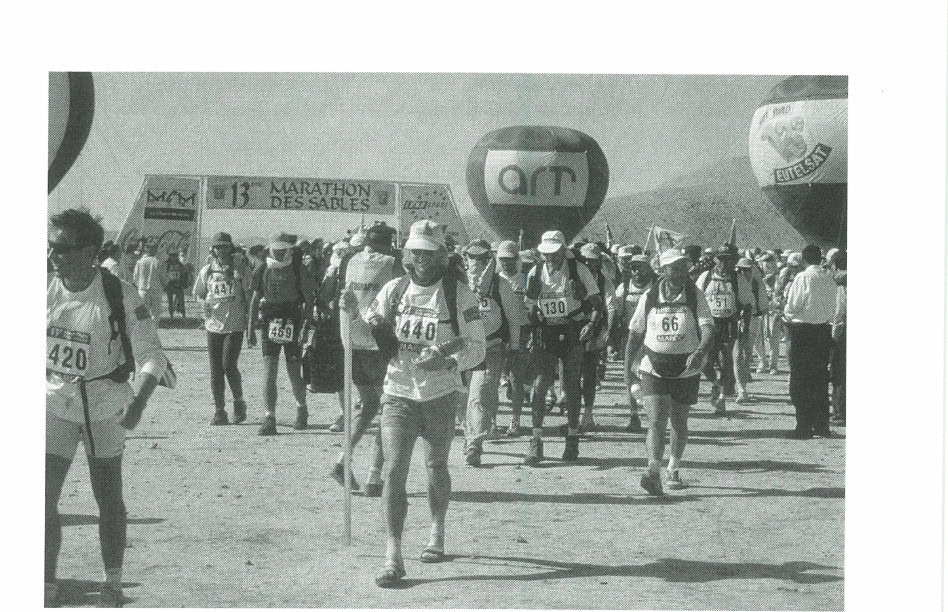
The atmosphere at the starting line is rather like a circus, and I can’t help thinking what a strange sight it must be to the nomads who have been hanging around camp trying to flog regional jewelry, trinkets, or blue Touareg cloaks. Helicopters circle overhead, endlessly filming while the flutes and drums of our adopted troupe of musicians reach a feverish pitch. Runners stretch nervously, adjust their backpacks, or dance like Whirling Dervishes to the repetitive tunes. Well-rested legs twitch in anticipation of the labor ahead. Chanting begins, and although voiced in many languages, the message to race director Patrick Bauer is clear: “Let’s get the show on the road!”
The starting gun finally fires. The prerace favorites, a pair of Moroccan brothers and a Russian who has won the race three times, disappear at a frenetic pace in a big cloud of dust. As I start moving, I realize that no amount of training can truly prepare a person for the reality of running this race. The load in my pack seems far heavier than I’d anticipated, and despite the still unseasonably cool temperature, a normally comfortable pace feels like a great deal of work. My heart rate is higher than I would like, and as the better-known American competitors pull away from me, I suffer from a panic attack.
“You should have come better prepared,” I chastise myself. “You didn’t run with your pack enough. You should have spent more time in the sauna. You’re physically and mentally weak.”
I shut out the mental noise and try to take in the vastness of the landscape, attempting to subdue my fear by focusing on the fact that I am here, that I am truly alive. As the course passes between two jebels (mountains) I feel as though I am on a planet in a distant galaxy more reminiscent of Star Wars than of the wondrous pictures I have seen of the moon. And yet I am somehow disappointed. I see no scenes from Lawrence of Arabia, nothing from The English Patient: no endless stretches of sand peppered by towering dunes. I reach Checkpoint One, at 9.5K, and go through the chute that corresponds with my race number. I receive my numbered water bottle, get my ration card punched, and continue on.
The second half of the stage takes runners across a petit lit d’oued asseche (small dried-up river bed) of loose sand, through another pass, and over a small rise. Most of the sandy stretches offer solid footing, and the going is good. I have finally loosened up and pass people throughout this section. I am pleased to see the finish line and cross it feeling refreshed. All of my tentmates arrive in top spirits; we cheerily share our impressions of the day and speculations about what lies ahead. Incredibly, all apprehension is gone.
“This is as easy as it gets,” says Alex Blodgett when he arrives at his tent, several doors down from mine. The Canadian-based businessman had been a steady stream of prerace advice, for he had completed the event the previous spring. “The short day, the tail wind, the cool temperature, the rain-packed sand. Believe me, it won’t get any better than this. Tomorrow will be a whole different thing.”
REALITY CHECK
You leave the gate of the fort or the town behind, pass the camels lying outside, go up into the dunes, or out onto the hard, stony plain and stand awhile, alone. Presently, you’ll either shiver and hurry back inside the walls, or you’ll go on standing there and let something very peculiar happen to you, something that everyone who lives there has undergone and which the French call le bapteme de la solitude. It is a unique sensation and it has nothing to do with loneliness, for loneliness presupposes memory. Here in this wholly mineral landscape lighted by stars like flares, even memory disappears; nothing is left but your own breathing and the sound of your heart beating. A strange, and by no means pleasant, process of reintegration begins inside you, and you have the choice of fighting against it, and insisting on remaining the person you have always been, or letting it take its course. For no one who has stayed in the Sahara for awhile is quite the same as when he came.
—Paul Bowles, Baptism of Solitude
Tent 16 came through the first day in pretty good shape. Fidel, the Venezuelan, has several marathons in his background and feels good about his preparations. He is relaxed as he eats his granola and prepares for the second day of the race. Anita, an endurance athlete from Florida, is like me—tired from lack of sleep but glad finally to be on the move. Rick, another Floridian who spends much of his time as an engineer on the shipping lines of the Great Lakes, stuffs an amazingly comprehensive kitchen into his oversized pack and jokes about the long walk ahead. Phil, from Nevada, smiles and packs meticulously as though awaiting inspection at boot camp. Chris tells fellow members of Team Race for Hospice that his plan is to follow the infamous ultra motto of Team Slug. “I may have come here to drop some weight,” he says while sipping his ritual tea, “but I don’t want to die. My plan is to start slow and ease off.”
On Day Two, as Blodgett had predicted, the harsh race we had all come for truly began. The prelude may have been smooth sailing, but according to the Road Book, the 37K between the Dunes of D’Ifert and Oued Ahssia promised to be a challenging route of sand and stones punctuated by a series of climbs and descents. The temperature was also expected to climb; we would be following sandy river beds and wide open plains.
On this day Chris’s plan to “ease off” became the modus operandi for all but the most competitive of participants; pace was dictated by the heat and the course. The first several kilometers were sandy yet runnable, but just past the village of Tarbhalt, the route entered a dried river bed, where the going became incredibly tough.
SINKING IN
Plowing through ankle deep, loose sand while wearing a backpack reminded me of a winter hike I’d taken years earlier through ice-crusted snow. A friend and I had gone on a day trip with female companions; being manly men, we’d agreed to carry the food. The lightweight ladies skipped across the crusty surface without any trouble, but my friend and I sank to our knees with every step. We were supposed to be the real athletes of the group, but within two hours, we were far in the rear. An hour later, only halfway to the summit, we sat down, had our picnic, and admitted defeat. The descent was even more miserable because gravity simply added its force to our weight. That evening, I had the worst leg cramps of my life and was sore for a week.
The Sahara desert, however, doesn’t allow you to think about snow for long. While gritting my teeth and struggling along through this 8K stretch, I begin to realize how hot it has become. It isn’t yet noon. At 19 kilometers, we enter the valley of Atkounamass, and the temperature soars; later reports claim the temp climbed to 120 degrees.
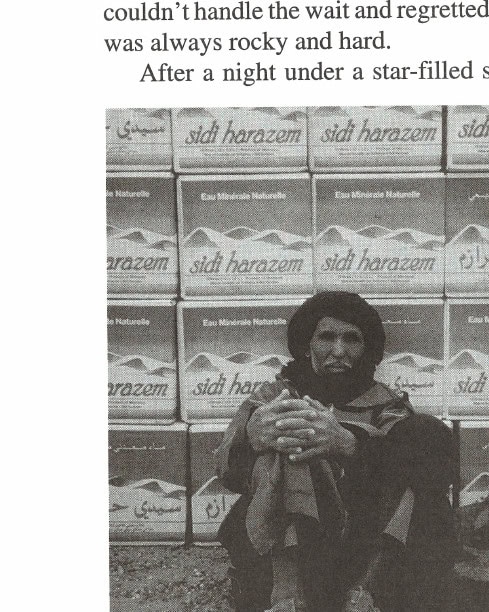
The finish line is a welcome sight, as it will be for the rest of the race. A series of inflatable balloons marked with sponsors’ logos flanks the official finish banner, and just beyond sits the red, white, and blue monolith emblazoned with a hundred repetitions of the words “SIDI HARAZIM.”
Made of case upon case of bottled water, the small SIDI fortress housed the lifeblood of the athletes. Each participant received three bottles at the end of each stage. Besides symbolizing survival in the form of fluid, the stack of boxes also represented a chance for a half-decent sleep. While some athletes carried sleep pads with their gear, the majority of us did not. Instead, we waited in line to collect the boxes that held the water bottles. Securing a box might take an hour of standing, exposed, in the scorching Saharan sun. On one occasion, I couldn’t handle the wait and regretted it all night long. The ground we slept on was always rocky and hard.
After a night under a star-filled sky—the stuff astronomer’s dreams are made of—the mood at the bivouac site on Day Three is subdued. With two days on the legs and a 36K stage that promises a pair of climbs, several sandy patches, and a final 5K stretch over a string of dunes, it’s no surprise that tension is high. Compounding matters is the knowledge that tomorrow’s terrain is going to be equally difficult—and the distance will be more than double today’s.
A Look Too Far
I have been running off and on with Eric Speck, a 26-year-old physical therapist from Alaska, and we start off together, but he pulls ahead as we pick our way across a rocky plain and turn into the gully that leads to the first climb of the day. According to the Road Book, the ascent lasts almost two kilometers before descending to Checkpoint One at 10.5K. The problem is that the summit of the jebel is devoid of an obvious path, yet the directions clearly indicate to keep heading straight. Several runners around me are confused. We take a variety of routes: some scamper down one side of the hill in a southeasterly direction while others head back from whence they came. I continue across the rocky ridge to the high point, hoping to gain a glimpse of the checkpoint below. I arrive at a sheer drop-off with no sign of a checkpoint or route.
“Shit!” I yell, and hear similar lamentations in various languages from behind me and somewhere below. I sense that the southeast is the wrong direction, so I backtrack and look for a way to descend on the north side of the hill. After what seems like an hour, I have finally picked my way down to a track, and when I get to it, I see the water station at last. Runners are arriving from the east, and I race downward to burn off the angst of having lost time and energy by making a bad choice.
I later learn that similar feelings of frustration weighed on many participants during the next section of the course—a hot windless slog through a low stone-filled plain. Sand, a semidried river bed, and a shrub-dotted open stretch lead to the final checkpoint—and the start of the dunes. I have been looking for Eric the entire way but am certain he is miles ahead. I actually enjoy this final segment of sand dunes because they are small, rising and falling like a field of moguls on a well-traveled mountain of snow. Rather than cut a straight but tiring path up and down, I twist and turn between the bumps like I’d done years before on many a ski slope. I find that the ground is less likely to give underfoot at the corners of the dunes and that the small sprigs of vegetation between mounds of sand are good indicators of solid ground. I don’t struggle at all; I actually feel that I’m moving well and pass a dozen or more people over the last several kilometers of the day.
I’m surprised to learn that Eric has not yet arrived. He loses nearly an hour to me on the day; he went down the first mountain on the southeast side and took far longer than I to get back around to the checkpoint. He has also developed a serious pain in his knee.
The field has spread out significantly during Stage Three and, despite the 9:00 A.M. start, runners are still coming in as dusk falls. The medics are busier then ever with blister repair, backs rubbed raw by packs, severe sunburn, shrub cuts, and dehydration of varying degrees. While I had expected there to be attrition, it surprises me how many dropped out in the first two days. By the hobbling visible at the start of Day Four, it’s clear the number of finishers will continue to thin.
The Longest Day
It almost always never keeps getting worse.
—Variation on an old ultra quote
The morning ritual has been well established by now; as soon as the wrecking crew dismantles Tent 16, Team Race for Hospice rallies around Justin for a hot cup of tea. Stage Four is the real test of the race, but it does come with a silver lining: competitors have two days to complete the 76K. As they sip on their tea, Mavis and Carol talk about their plan to walk as far as they can during daylight, camp out at the nearest checkpoint, and then resume their trek on Day Five, finishing whenever they can. Mark, the fastest of the group, confers with me on heart rates and ponders a strategy for the long distance and heat.
“If I go a little harder before it gets too hot,” he suggests, “then I can put some distance in the bank and back off in the afternoon when it really starts to cook.”
“You know what they say about that,” I chuckle. “It’s like using a credit card. It’ll come back to haunt you, with interest attached.” I had learned the hard way, more times than I care to remember, the folly of going out too fast.
The notion of beating the heat becomes moot for Mark, Eric, myself, and 57 others when we learn that the top 60 in the standings will start at noon—three hours after the rest of the pack. We have already eaten our morning rations and planned our drinking strategy, but we’re forced to linger in hot tents while the heat builds. We fidget and grumble until we begin.
Eric has never run beyond a marathon before, and since we’re close to each other in the standings, he decides to hold back at the start and run at my ultramarathon pace. The route starts out through a shrub-strewn field of sand; the going is comfortable, but within two kilometers, I’m hobbling from a tightness gripping my left leg near the groin. I recall slipping in the dunes the day before and realize I must have strained a muscle. I curse to myself, stop to stretch, resume my plodding, and wrap tape around my leg at the first checkpoint at 12.5K. The checkpoint marks the start of a stretch of dunes bigger than we have experienced to date. We see footprints heading in all directions, so I take a compass bearing to keep us on track. We emerge at the far end right on the mark.
Eric’s knee is little better than my strained groin, so we stick together, running as much as we can. At 18.5K, we hit the first of a series of climbs. Eric starts walking more frequently and eventually I pull away, worried that if I walk too much, my leg will seize up altogether and I won’t be able to resume at any real pace. It isn’t long, however, before my true Achilles heel rears its head: my stomach begins to act up. I have been moving well, all things considered, but I know from experience that when my gut goes sour, the death march begins.
By the time I reach Checkpoint Four, at 44K, I can’t shake the vision of doomed legionnaires from March or Die out of my head. I decide to wait for Eric, hoping my mindset takes a positive turn and my gastric distress subsides.
The Mental Edge
The reality of the Marathon des Sables is that the psychological aspect is every bit as important as the running itself. Race conditions are difficult, there’s no doubt about it, and the heat, distance, and terrain exact a physical toll. As the days wear on, however, the moving encampment that the runners look longingly for at the end of each stage takes on the feel of a refugee camp. As one of the British journalists quipped at the midpoint of the race, “the bivouac reminds one of The Turd World.” Laughter goes a long way toward dealing with the temporary deprivation of privacy, cleanliness, and fresh foods, as does previous travel experience in conditions that are less than ideal.
Also, since it’s a French-run event, the communication system is a little bit vague. If, for example, you learn a mere hour before the start of the longest stage that you and the rest of the top 60 competitors will begin three hours later than everyone else, don’t blow a gasket. Instead, scrounge all the extra water you can to keep from dehydrating during your lay-around, check every tent’s garbage bag for discarded food, then kick back and relax. Energy is a precious commodity out there—blowing it away in a fit of anger will do you far more harm than good. Grin and bear the petty aggravations. They’re inevitable in foreign lands, and by the middle of Day Four, you’ll need every ounce you would have expended in throwing a fit.
When looking at the psychological side of the race, I contacted some of the experts in the ultramarathon/adventure race world to see what they thought. “You know what they say about these things: the hardest race is the one you’re doing at the time,” said Marshall Ulrich, a man whose list of ultra accomplishments make any ordinary 100-mile finisher feel like a wimp. He’s done the Badwater race across Death Valley half a dozen times and won it on four occasions; he finished top 10 in each of the 100-milers he ran when pursuing the Grand Slam; and he’s done numerous Eco Challenges, the Raid Gauloises, and ESPN XtremeAdventure Races.
“The heat, running with a pack, they will add to the challenge for sure,” said Ulrich, “but the stage-race format will allow you to recover a bit. I don’t know if it’s really the toughest race, but what it comes down to is how hard you are pushing yourself, how close you are to your personal edge. A lot of that stuff you can overcome by using your head.” Ulrich was using the ’98 Marathon des Sables as preparation for Badwater, a race he considered a mind-blower of a whole different kind.
Adventure racer Robert Nagle took part in the 1997 Marathon des Sables, and “while it’s quite a unique adventure,” he said it could hardly be classified the toughest race in the world. “There are races like the Barkley Marathons and Hardrock 100 out there, and there’s no doubt they’re harder than this. Still, it’s quite an exercise in planning and minimalism when you have to be totally self-sufficient and race with your pack.”
If you’ve done any ultramarathons before, you’ll have some idea of the games that long distances can play with your mind. The best advice I’ve ever heard comes in the form of a riddle: Question—how do you eat an elephant? Answer—one bite at a time. Translated for Psych 101, this means breaking the mind-boggling whole into manageable chunks and taking it step by step, one chunk of desert at a time.
At M*A*S*H
The checkpoint is the first one I have spent any real time at—I usually just get my ration card punched, take my water, and leave—and more than anything else it resembles a Mobile Army Surgical Hospital unit. Filthy, tired, dehydrated athletes are scattered all over the place. The sound of moaning fills the still desert air. Some strip off to stay cool while others lie shivering in sleeping bags in spite of the heat. Many tend to their raw, blistered feet; still others are cooking food on their portable stoves. I mix electrolyte drink in the bladder I have in my pack and try to eat some trail mix, but I gag at the thought. Forty-five minutes pass, and Eric finally arrives. I feel no better, but when he is ready to go, I follow. The sun is starting to set.
We stick together this time and pull each other over more hills, across dry river beds, and through another series of dunes. We turn on our headlamps when it’s essential to find route markers and to let the roving race vehicles know we’re there, but we run without them as much as we can. The stars are infinite, and we both comment on how small a place we occupy in the world.
We stop at the remaining checkpoints and see familiar faces at every one. We come upon Mark Macey, a well-known lawyer and adventure racer from Colorado; he lies prostrate in a medical tent with an intravenous drip in his arm. “I was going down,” he says cheerfully the next day when I see him in camp, “and giving me the bag of fluid was all the medics could do. I told them I was dehydrated and had been sick, and they wanted to pull me out of the race. I said,
‘No way. Give me the hour penalty and give me the drip.’ Two hours later, I was back on the course.”
At last, the lights of the encampment shine in the distance, and the finish appears before we have time to complain about the cruel mirage. A film crew that has been tracking the race pounces on me as soon as I cross the line, and I barely hold onto the contents of my stomach as I choke out some words. I stagger over to the medical tent, ask for an antinausea injection, and tear the wrap off my leg. It’s after 11:00 P.M.
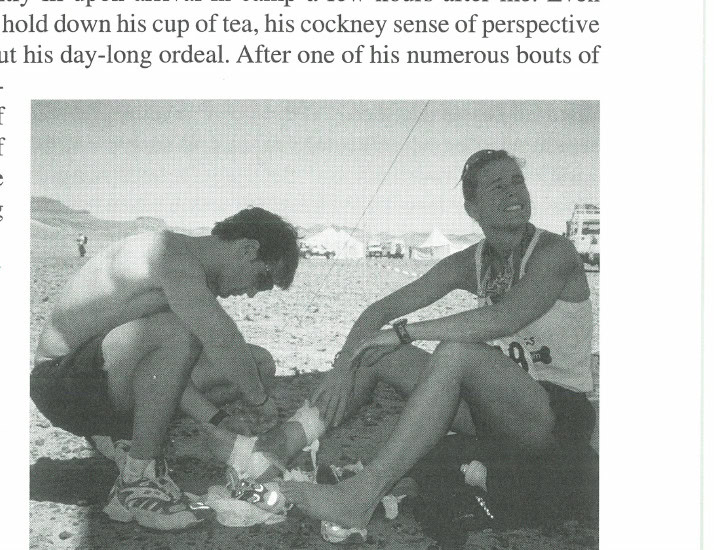
I wake on Day Five wondering if I’ve slept. If I think I’ve had a miserable night, I need merely glance around to realize that many people feel far worse than I. Many of the tents are still half-empty, indicating that runners who had started three hours before Eric and me have been moving across the desert all through the night. My stomach is still queasy, and I’m cold, so I beg Justin for a cup of tea when he fires up his stove. I know he’s struggled with his pot and heating blocks, and I feel like a terrible scrounge, but I also know that I’ve got to sort out my stomach as soon as possible and take in some food. He relents, and I ease back on my cardboard pad, sipping tea and daydreaming about ice cream. I’m thankful that I finished the longest stage with a day to spare, giving me a much needed “rest” day.
I am shaken from my reverie by the sound of “Try to Look at the Bright Side of Life” coming from the tent opposite mine. The group of British Army officers responsible are trying to cheer up one of their own, a strapping lad who had become violently ill upon arrival in camp a few hours after me. Even though he couldn’t hold down his cup of tea, his cockney sense of perspective shone on throughout his day-long ordeal. After one of his numerous bouts of vomiting and diarrhea, a member of the medical staff gave him some stomach-settling pills.
“Anything else I can do for you, Monsieur?” asked the Medic, preparing to leave.
“There is one thing mate,” came the reply. “Just leave me the nurse.”
ALL GOOD THINGS COME TO AN END
Eric’s knee was swollen; Macey was still dehydrated; and Marshall Ulrich, an American ultra/adventure racer known as a heat specialist, was so weak from day after day of diarrhea that he staggered when he walked across camp. Lisa Smith, another top adventure racer, had such painful blisters that she could barely stand—but that wasn’t her biggest concern: a prerace stress fracture had recurred in her foot. I felt like a distraction when I went to show Eric the blood that had pooled in my thigh as a result of the groin strain, but he graciously gave me something from his personal medical kit between tending to patients from his immediate group. Together, he and the three others were known as Team Stray Dog; while they might resemble the walking wounded in this event, not one of them ever considered abandoning. By the start of Stage Five, however, 51 had dropped from the race.
The penultimate stage is a true marathon of 42K and the last real chance for the competitive runners to make up ground, so the pace is brisk from the start. I run with tentmates Mark and Eric for a time, but both slowly drop off, and though I’m eager to prevent further injury to my leg, I feel surprisingly strong. I realize that the previous stage’s stomach problems had forced a slow pace, so while I wasn’t fueling properly, neither was I under a great deal of strain.
Running alone, I think about my tentmates and how Mavis and Carol came in late in the day smiling and laughing; they’d camped out as planned. Rick, despite no real base of training, was also all smiles, despite terrible sores on his feet. Justin and Mark alternated grumbling with high jinx, Fidel wished he had been placing better, Anita and Phil were running steady and having a good deal of fun. Chris, on the other hand, had had just about all he could take. “This isn’t a race anymore,” he had declared when he arrived at Tent 16 shortly before his female teammates on Day Five. “This is boot camp. I swear, they want somebody to die. That stage was absolute hell!”
I run steadily as the heat rises and wonder how Dan Jensen, an American below-the-knee amputee, has managed to keep his own spirits up. He has to deal with a raw, sore stump, the painful torque on his leg from slipping in the sand, and the hundred other discomforts suffered by everyone else. I am fortunate enough to bunk with him at the end of the race and gain a little insight into this extraordinary man.
Dan Jensen isn’t bitter when he talks about his missing leg but is simply matter-of-fact. “I stepped on a land mine in February, 1971,” he says, “while out on patrol. My lower leg was blown off; the bone was sticking out all over the place.” Rather than dwell on the loss, he jumps into the passion for life he has developed since prosthetic technology has caught up with athletic need. “With this new flex foot,” he beams, “I can run incredibly well. Can you believe that five years ago, I spent most of my time as a musician in bars? I’ve done a bunch of marathons, the Leadville 100-Mile Mountain Bike Ride, and have been training with the National Cross-Country Ski Team. Last fall, I accomplished a dream when I was invited to Ironman Hawaii, and now I’ve done this. It’s simply amazing what the human body is able to do.”
Which, of course, is the point of the Marathon des Sables—to examine what the human machine is capable of, and to do it up close and personal, to experience it for oneself. With the longest day behind them, few who start the marathon stage will not complete it, even if it takes them well into the night. When they arrive at the bivouac, competitors are treated to two cans of Coca Cola, which they have been promised all week. Every bit of food they have left is eaten, for the final stage is but a formality, a mere 14K. A lightheaded feeling is pervasive; in some tents, the revelry lasts until dawn.
The following day, the tattered band of athletes ran across a field of small dunes and through fine sand before passing a village 4K into the stage. We reemerged into the world of the living as we followed a dirt road and dodged children, adults, bicycles, and donkey carts for the next several kilometers. At 8.5K, gravel turned to tarmac, and we all knew we were nearing the end of our week-long ordeal. I can’t recall a more welcome sight than the elaborately tiled archway marking the entrance to Rissani—unless it was the finish banner in the center of town.
EPILOGUE
Immediately when you arrive in the Sahara, for the first or the tenth time, you notice the stillness. An incredible, absolute silence prevails outside the towns. Within towns, even in the busy markets, a hushed quality stills the air, as if the quiet is a conscious force that, resenting the intrusion of noise, minimizes and disperses sound right away. Then there is the sky, compared to which all other skies seem faint-hearted efforts. Solid and luminous, it is always the focal point of the landscape. At sunset, the precise, curved shadow of the earth rises into the sky swiftly from the horizon, cutting it into light section and dark. When all daylight is gone, and the space is thick with stars, the sky is still of an intense and burning blue, darkest directly overhead and paling toward the earth, so that the night never really grows dark.
“Why go?” The answer is that when a man has been there and undergone the baptism of solitude he can’t help himself. Once he has been under the spell of the vast, luminous, silent country, no other place is quite strong enough for him, no other surroundings can provide the supremely satisfying sensation of existing in the midst of something that is absolute. He will go back, whatever the cost in comfort and money, for the absolute has no price.
—Paul Bowles, Baptism of Solitude
It’s inevitable, of course, that people reach the end of the Marathon des Sables and, through their tears of joy at accomplishing the impossible, utter the words, “Never again.” Bowles has something, though, when he says the absolute draws back those who have experienced it. Every year, the Marathon des Sables grows in size, but every year, a large percentage of entrants are competitors from previous years returning for more.
Blaise Supler, a public defender from Washington, D.C., is a typical case. She had done the race in 1997, and despite saying throughout that she would be lucky to survive and would never even consider running again, she was back the following year. “I cried more that week than I have in 10 years; physically it was every bit as tough as I thought, but mentally and emotionally it was far more difficult. I was totally trashed. But before a week had gone by, all that was replaced by this amazing sense that it was all worth it. You remember the friendships you’ve made, the hardships you’ve shared, the places you’ve been.”
Five-time finisher Mary Gadams has a similar sense of the race’s appeal. “I find this race takes you away from everything you have previously known. It brings you back to the basics in life more than anything else. The people you meet, the friends you make, the experience of the desert—these things keep drawing you back. And after finishing, you feel like there’s nothing you can’t do. It really changes your outlook on life. When you’ve done it once, it’s the type of race where you can continue to challenge yourself year after year.”
All of which, perhaps, hearkens back to the wisdom of the late Dr. Sheehan. Like layers of skin being peeled from an onion (or, in this case, flaking from a sun-scalded nose), perhaps those who dare to voluntarily suffer ultimately come closer to exposing their souls. Perhaps the line between clarity and confusion in this crazy world can be found when runners agonize together and share what they find when the layers have revealed the truths hidden inside. Perhaps these things happen in the desert, changing forever those who take part in The Marathon of the Sands.
Editors note: Barry Lewis was the top North American finisher in the 1998 Marathon des Sables, completing the course in 25:29:39, good for 30th place overall. For more information about the Marathon des Sables, visit the Web site: www.sand marathon.com. If you’re thinking of doing this race, sign up early.
This article originally appeared in Marathon & Beyond, Vol. 3, No. 6 (1999).
← Browse the full M&B ArchiveMore like this
1,000+ stories from 19 years of Marathon & Beyond
The complete archive of the legendary long-distance journal — digitized and free to read.
