

“Like A Cat Chases Mice”
” Tom Osler Teaches Us That As We Age, There Is Glory and Fulfillment in the Chase Itself. by R i c hard E n g l ehart
“T
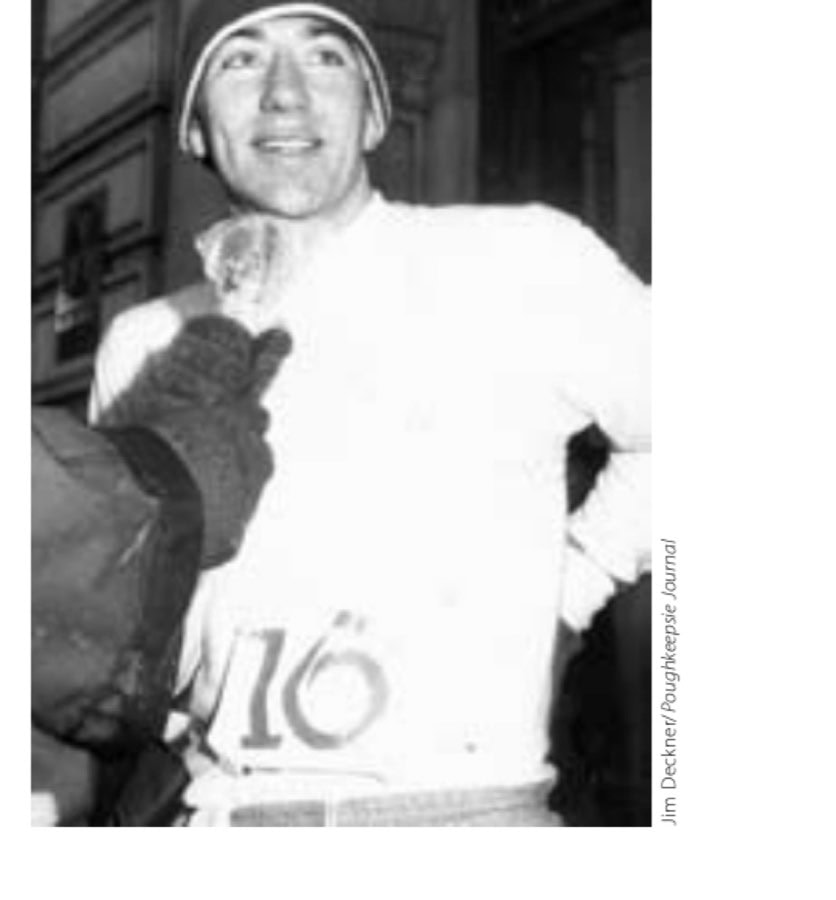
It is a warm day in March 1967 as the national 30-kilometer championship is being contested over a three-lap course in Arlington, Virginia. One of America’s best marathoners, Lou Castagnola, is in the lead. In about a month, Castagnola will become one of a very small number of Americans to run a marathon in less than 2 hours, 20 minutes by running 2:17 and finishing in fourth place at the Boston Marathon. He has been stalked by an athlete who for much of his running career has been a midpack runner and who was given
Jim Deckner/ Poughkeepsie Journal
he success of the East Germans in the 1976 Olympic Games has called attention to the supposed advantages of employing technology to assist in the training of runners. I say bunk! The joys of running alone in the forest will never be replaced by the laboratory, nor will the inspiration of a truly charismatic coach ever be replaced by the man in white taking blood samples. . . . Frankly, I believe that running is far too complicated for successful technical analysis at this time. It is the runners themselves, through their direct empirical findings, who will point the way.” —Serious Runner’s Handbook by Tom Osler
the nickname “Turtle” by Browning Ross, one of America’s best distance runners and founder of the Road Runners Club of America. Those two men will race again at Boston, and Castagnola will finish 12 minutes and 15 places higher.
But today it is unseasonably warm, and Castagnola seems to be weakening. His pursuer runs well in the heat, and as he closes the gap, he begins to think the unthinkable. Perhaps he can win this race. “
But I knew Castagnola was much faster than I was,” the Turtle relates. “I knew that if it came down to a finish, he’d destroy me. So I started to wonder if there was something I could do to get away from him. I knew he was struggling and thought that if I could make one big move, I might break him. There was a Volkswagen ahead of us leading the way. I ran up to it and said to the driver in a voice loud enough for Castagnola to hear: ‘I’m ready to make a run for the finish now. Could you stay with me and show me the way?’”
It worked. Castagnola let go, and Tom Osler was a national champion.
The Dubiousness of “Talent” Among distance runners, it often seems that “talent” is a dirty word. However great or minimal our successes, we resist believing that they result from some sort of inborn ability. That is for sprinters. We prefer to attribute our successes to hard work and intelligence. We would love to be able to claim that we’ve done more with less basic ability than any other distance runner. But who among us truly can claim to be the Athlete Who Has Done More With Less? Of course, no one can truly say, but Tom Osler is the man who might have the most legitimate claim to that title.
Nearly 40 years after winning the national championship at 30K, Tom Osler answers the door to his Glassboro, New Jersey, home wearing old-style cotton sweatpants, a yellow New Balance sweatshirt, and a white pair of Nike running shoes. A bald spot on top of his head is the only sign of age. His hair is still brown and pulled into a short ponytail. He teaches mathematics at Rowan University. I try to decide whether he looks like a math professor but realize that I haven’t seen enough math professors recently to know. I’m roughly 20 minutes late and make a slight apology but decide that anyone who lives in New Jersey must be used to guests arriving late because they were stuck in a traffic jam.
His wife, Kathy, is at the eye doctor with his youngest son, Bill, who has moved in with them as a caretaker in the wake of health problems that affected both Tom and Kathy. Tom explains that usually Kathy would fix lunch and offers food. Not feeling hungry, I say “No, thanks.” Tom persists, and it dawns on me that perhaps he is hungry and doesn’t want to eat if I don’t. I say that I will eat, and he then says that he isn’t terribly hungry and doesn’t need to. We settle foodlessly onto couches in the living room. Tom asks why I want to write about
him. I explain that I have made sort of a mission of trying to present to today’s distance runners some of the running ideas and thinkers that were helpful to me decades ago. I mention that M&B had published an article I had written about the German coach Ernst van Aaken. “
Did you know him?” Tom asks of van Aaken. I say that I didn’t and had written the article from secondhand sources. “But who I did know passably well,” I tell him, “was Arthur Lydiard.” Tom’s face perks up. “
Maybe you can tell me something about this,” he begins. “I’ve always wondered what happened between Lydiard and Peter Snell that led to that falling-out they had in 1963.” Snell, arguably the best of all the runners that Lydiard had coached, had a brief falling-out with Lydiard between the Rome and Tokyo Olympics that was reconciled in time for Snell’s preparation for Tokyo. I explain that I had talked with both men about the split at different times, and Tom’s face perks up even more. It becomes clear that this is going to be as much discussion as interview, and I tell him the story as I know it. Eventually, I work the conversation to me and then to my interest in Tom Osler.
As I progressed from a 4:34 marathon runner to a 2:35 marathon runner in the 1970s, I was largely self-coached. There was nowhere near as much information about how to train available as there is now (which may have been more of a blessing than it now seems), and I, like most marathon runners, had to rely on other runners and the few books and articles that were available. Two books were highly influential for me, and Tom Osler figured prominently in both of them.
When I First Heard of Tom I first heard of him as one of the six runners profiled in Joe Henderson’s classic Long, Slow Distance: The Humane Way to Train. Joe described how the one-time “Turtle” slowed his training pace, increased his mileage, and went from midpack finisher to one of the best road racers in the country. The other book, the conditioning of distance runners (no capitals in the title), was written by Tom himself and is still considered a classic by runners of a certain vintage. “
I wrote that because I thought I had something to offer,” he explains four decades later. Osler was, by his own description, a “nerdy” kid. “I was a very good student when I was 12 or 13, but I didn’t have many friends. This bothered me, and I thought that if I were on some sort of team, it might help.”
It was 1954. His family lived in a working-class neighborhood in Camden, New Jersey. His street had a section of row houses in which the Oslers lived and a factory across the street. Osler saw results from a local high school track meet in the newspaper. The winning time for the mile was 5 minutes, 15 seconds. He wondered whether he could run that fast.
The grounds of the factory across the street were almost exactly a quarter mile in circumference, so he timed himself with a wristwatch for an all-out run of four laps around the factory. He recalls running in “7 minutes, maybe 6:30.” He reasoned that with some training, the 5:15 mile was a definite possibility, so he ran that same hard mile every day. A family member suggested that he join the high school track team. He eventually ran the mile in 4:58 and became one of the best high school milers in Camden.
At about this time, Browning Ross was starting the Road Runners Club of America. Ross lived in the Philadelphia area, and Philadelphia was, at the time, one of the few places in the United States where an out-of-school runner could find regular competition. In January 1955, Osler, then 15, entered Philadelphia’s Shanahan Marathon, one of only a handful of marathons in the U.S. in those days. The temperature was a windy 15 degrees, and Osler smeared Vaseline on his legs and then put on a pair of jeans. The Vaseline froze and he dropped out at 11 miles, but it was an important day in his running career.
Many of the best marathon runners in the U.S. were there. (There weren’t all that many marathoners in that day and age.) He had a chat with Ted Corbitt, who was to become something of an idol to Osler for the calm, matter-of-fact way that he approached mammoth challenges. He also met Jack Barry, another of the country’s leading marathoners and a resident of the Philadelphia area. Barry taught Osler about interval training, and Osler went from running a hard mile every day to doing interval training for an hour a day. He would finish his first marathon as a 16-year-old in 3:27.
The increased training brought only marginal improvement in Osler’s mile racing. His best time for 440 yards was 64 seconds. He was getting the lesson in reality that sports can teach so well. But he enjoyed the sport too much to give it up and wasn’t dissuaded from it by the disappointing mile performance. Nor was he discouraged by the absence of a cross-country or track team when he enrolled at Drexel Tech. Browning Ross had an active schedule of road races in the area, and Osler ran in them, usually finishing slightly ahead of the middle of the field.
The Wisdom of Arthur Lydiard In 1962, Arthur Lydiard wrote Run to the Top, explaining the way that he had trained the New Zealanders who had won three medals in the distance events at the 1960 Olympics. Osler read the book and, “That, in my mind, justified the value of slow running.” He abandoned the hard miles run around the factory and the hour-long interval sessions in favor of extended slow runs. It was a radical switch. At the time, slow running was believed to be useful only for warming up, cooling down, resting between intervals, and having
something active to do on rare rest days. Osler made it a staple of his running system. He settled into a seven-minute-per-mile pace and began covering longer distances while wearing regular leisure dress shoes. The running shoe was still a few years in the future.
No one ran on the roads in those days. All running was done on a track or in a park. But Osler found those venues too limiting for the distances he covered, so he began doing runs out and back, runs on roads. A contemporary learned of his long, slow training and told him, “I couldn’t do that.” “
He didn’t mean he couldn’t train like I did,” Osler recalls. “He meant that he couldn’t bring himself to run on the roads.” This unorthodox training began to pay off. Osler went from being a runner who would finish perhaps slightly ahead of the middle of the pack to one who would finish among the leaders. He spent about two years doing only slow training and frequent racing. In 1963, he began to add some faster work for short periods of time and found that he could race as much as 20 seconds per mile faster when he did this sort of work. In August 1965, he won his first national championship, at 25 kilometers, in Rochester, New York. He won his first marathon, the Ruthrauff Marathon in Philadelphia, that same year on the day after Christmas in 2:34:07. In 1968, he won 28 races, was second 10 times, and was third another 10 times.
The following year Osler ran 10 miles in 52:40.2, won the aforementioned national 30-kilometer championship in 1:40:40.8, and ran 2:29:04 at Boston. In August of that year, his friendship with Ted Corbitt inspired him to think about ultramarathons and to take longer runs. With running buddies Neil Weygandt and Ed Dodd, he began running from Collingwood to Atlantic City, New Jersey, a distance of 50 miles. It took three tries before they could finish. A key to their success was taking heavily sugared drinks as they went. They would make iced tea, for example, from a sugared mix and then add sugar to it. This led to another national championship, this one at 50 miles in 5:52:33, three seconds off the U.S. record at the time.
It was during this stretch of time that he began teaching mathematics at St. Joseph’s College in Philadelphia, and he also began dating Kathy Richter, who would become his wife. The years between 1965 and 1967 were Osler’s most successful running years, and he was asked by many people who had known him as a midpacker how he had improved so much.
Tom’s Slim Edition of Running Knowledge He answered the question that year by writing the conditioning of distance runners. Twice the size of a 3-by-5 card and 29 pages long, the book is simplicity itself. It describes the value of slow base training, lays out some hypothetical schedules,
Gary L. Sivers/ Courier Post
and moves the reader to a description of the value of faster training and how to fit it into the program. At the time, the only running publications in the country were Track & Field News, a very fledgling Distance Running News (eventually to become a somewhat less-than-fledgling Runner’s World), and Browning Ross’s Long Distance Log. The Log was losing money despite its shoestring operation. Ross published it as a way for the few scattered distance runners in the U.S. to keep in touch with the sport and each other. But Ross did have access to a printing press. He and Osler struck a deal. Ross’s printer would print the booklet, and Ross would get to keep any money it made to offset the losses he was suffering by publishing the magazine. In fact, the booklet did make a profit, and Long Distance Log got itself out of the red.
The next few years for Osler were busy with professional and family matters. Osler married Kathy in 1968, earned his Ph.D. in mathematics in 1970, and became a father to Eric Thomas Osler. He took an appointment as an assistant professor of mathematics at Rensselaer Polytechnic Institute that year and in 1972 returned
Tom training with his wife, Kathy, in 1968.
to New Jersey to teach at Glassboro State College, now Rowan University, where he continues to be employed. His interest in ultrarunning persisted. He and Ed Dodd began researching the performances of athletes who had contested multiday endurance events in the late 19th century. At about this time, an old man lay dying in Philadelphia’s Hahnemann Hospital. He had a scrapbook filled with newspaper clippings about these events. When he died, a hospital employee with an interest in running took the scrapbook, and it worked its way to Browning Ross, who passed it along to Osler and Dodd. They tried to understand how these athletes had covered the immense distances that they did. Eventually, it struck them that the old-time athletes must have mixed in a fair amount of walking during their runs.
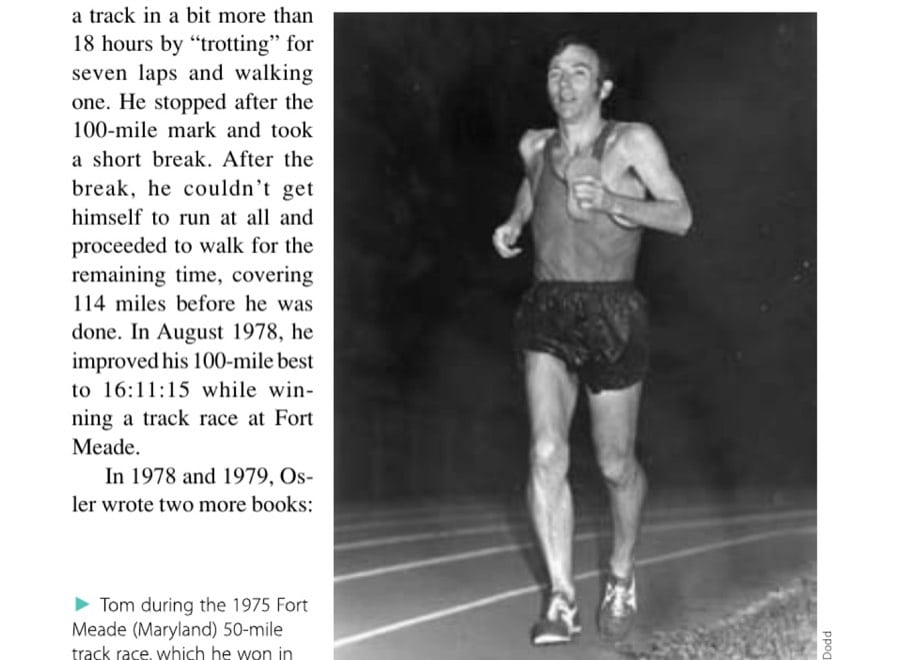
Osler’s interest in ultrarunning was more than academic. In August 1975, within two weeks of the birth of second son William, he won a 50-mile track race at Fort Meade, Maryland, in 5:49:14. By December 1976, Osler was ready to apply his ideas about sugared drinks and walking breaks to his own racing. A fund-raising event was scheduled at Rowan University in which Osler was to run for 24 hours. He ran 100 miles on a track in a bit more than 18 hours by “trotting” for seven laps and walking one. He stopped after the 100-mile mark and took a short break. After the break, he couldn’t get himself to run at all and proceeded to walk for the remaining time, covering 114 miles before he was done. In August 1978, he improved his 100-mile best to 16:11:15 while winning a track race at Fort Meade. In 1978 and 1979, Osler wrote two more books:
© Ed Dodd
Serious Runner’s Handbook in 1978 and Ultrarunning: The Next Frontier the following year. Serious Runner’s Handbook is written in a question-and-answer format that attempts to deal with any topic that a serious, competitive runner might have. Ultrarunning, written with Dodd, combines a history of longer-thana-marathon races with advice about preparing for and competing in such events. Both were published by the book division of Runner’s World.
Royalties for Taking Walking Breaks Kathy returns from the eye doctor and also offers lunch. This time it seems as if there is a bit more hunger all around, so we head to the kitchen table. The business of mixing running with walking, which seemed so odd 30 years ago, has of course become mainstream, and there are marathon training programs that preach it and make a tidy profit in so doing.
Half-jokingly, I ask whether Tom has ever thought that he should get royalties from those programs. “Money doesn’t mean anything,” he snorts. “Besides, I didn’t invent the idea. It had been around for nearly a century.”
Nonetheless, I tell him that as far as I can tell, the first modern references to the practice turn up in his writings. Then I recall that Ernst van Aaken was preaching the same thing in the 1950s, but in German, and I amend my comment, saying that Osler’s writings are the first modern reference in English to mention mixing running and walking. He seems to consider this point, and the conversation moves on. “
If you were writing conditioning today,” I query, “would you change anything?” “When I wrote it,” Tom replies, “I was a young man at the height of my physical powers. Running seven minutes per mile seemed to me the slowest thing anyone could do. Today, if I tried to run a seven-minute mile, it would kill me, literally. I’d have to take that into account.” “
If you were writing the book today, but for young men at the heights of their physical powers, would you change anything?” I counter. He thinks for a few seconds. “No. I think I said everything I had to say.”
The comment about running seven-minute miles literally killing him leads to a discussion of what must surely have been the darkest period in Tom’s and Kathy’s lives. On January 23, 2003, Tom awoke at 4:00 a.m. feeling nauseous and dizzy. He went to the bathroom, where he vomited and collapsed. When he came to, he went back to sleep and woke up at 8:00 feeling OK. At 1:00 in the afternoon, he ran a 5K race and finished in what for him was a normal time. On January 25,
© Ed Dodd
Tom Osler, 200 yards from the finish of a hot and humid 4-mile race in July 2008.
he suffered more vomiting and dizziness and went to the hospital, thinking that he had some sort of stomach bug. While he was lying in the emergency room, a young doctor walked by and looked at his face. “
You’ve had a stroke,” the doctor told him. Tom said that he hadn’t. The doctor persisted, asking how Tom would explain the dilation in one of his pupils. He had Tom shut his eyes and try to touch his fingertip
to his nose. He couldn’t. A stroke was diagnosed, caused by a blood clot at the base of his skull. He spent two weeks in the hospital and recovered fully. By March, he was doing a bit of running again. Less
than a year later, he celebrated the 50th anniversary of his first race. At that point, he had run more than 1,800 races in those 50 years. In early 2005, Kathy Osler was suffering from back pain that had gotten pro
gressively worse. They thought it was arthritis, but it turned out to be multiple myeloma, a blood cancer that destroys bones. She was in terrible pain and had to stay in a hospital bed that the Oslers put in their living room.
But Tom continued to run and race. In May of that year, he blacked out after a 5K race, falling backward and hitting his head on a curb, reviving himself but acquiring a small concussion. At the end of the month, Kathy began receiving
treatment for her cancer. In July, after another 5K race, Tom again blacked out. He had gotten a drink and was talking to a friend when everything began to go dark. “I’m losing it,” he told the friend, and collapsed. His heart was fibrillating,
beating so rapidly that it wasn’t pumping any blood. A critical-care nurse had also
run the race, and an ambulance was near the finish line with an external defibrillator. Tom awoke about 15 minutes later in the ambulance feeling very good. “I felt like I should get out of the ambulance and go home,” he said.
It Wasn’t the Artery Blockage That Felled Him At the hospital, he was diagnosed with a complete blockage of a major artery, but doctors told him that the blockage had not caused his problem. “It was an old blockage. It had been there for years. They knew that because I had grown capillaries all around it. Essentially, I had grown my own bypass.”
The problem was instead electrical in nature. He was told that he had had coronary disease for quite some time. He now has a defibrillator in his chest. The doctors told him that he absolutely should continue to run, but not to overdo it.
Six days after leaving the hospital, he began walking and running again. “Surprisingly, I feel very good. I began entering races again. But I vow never to push myself into the uncomfortable zone. I run easily at the back of the pack as a participant, which I love doing. Serious racing is over for me, but running, which is in my blood, remains a daily activity that gives me great satisfaction.”
It could seem very depressing, perhaps even morbid, sitting at lunch with two people who have stood at death’s door and turned away and who still have
Printer: Insert Stone Steps 50K ad
major health problems. But it’s not. If anything, it’s uplifting. Kathy chats about how happy she is that I am there. [Kathy’s cancer cannot be cured, but it can be managed very well.] “You’re the first company we’ve had since I got sick who isn’t part of the family.”
Tom explains that as a mathematics professor, he has the “best job in the world. The students are just wonderful, and they treat me like I’m a god. I never want to retire.” He describes his latest training innovation. He calls it “slogging.” I gather that the word derives from a combination of “slow” and “jogging” but forget to ask. It involves “using the basic movement of running in place but with just the slightest bit of forward movement.”
He will do this for as much as two hours at a time but moves at a speed of roughly 3 miles per hour. He covers six miles in his long slogs and is often passed by walkers. He still races on most weekends, usually at 5K, but he has recently run both the Broad Street 10-Mile and the Philadelphia Distance Run, a half-marathon. “
I think that if I didn’t do the slogging for two hours, my leg muscles would not be able to run a long enough time to have finished those races.” “So it’s time on your feet,” I interject. “Exactly.” Osler’s best time for six miles is 30:30. He could once cover his maximum “slogging” distance in a quarter of the time he now uses. Serious long-term athletes spend an enormous amount of time and energy developing their physical strength to its maximum. When that stage of life has passed, when athletes know that they will never again perform as well as they once did, it can be unsettling, if not devastating. I ask how he adjusted to the time when he knew he had run his last PR. I’m not surprised to learn that Tom experienced no personal crisis at that time.
The Crisis of the Mile in 1957 “Probably the most critical time for me came in my senior year of high school, 1957. For the first two years of my running, I ran a fast mile for time every day. In the third year, I met Jack Barry, who would be a mentor for me for about five years. Jack introduced me to modern interval training. In the winter of 1957, I trained about one hour a day doing repeat 220 sprints. I was sure that my best mile time would drop from 4:58 to at least 4:30 or maybe 4:20. To my shock, the best I could do was 4:54: a mere three-second improvement after a tenfold increase in training time. I then realized that I would never be a great runner. “
But it did not take long for me to realize that there was much more to running than winning. Hell, I learned to love running for the sheer joy of feeling
© Ed Dodd
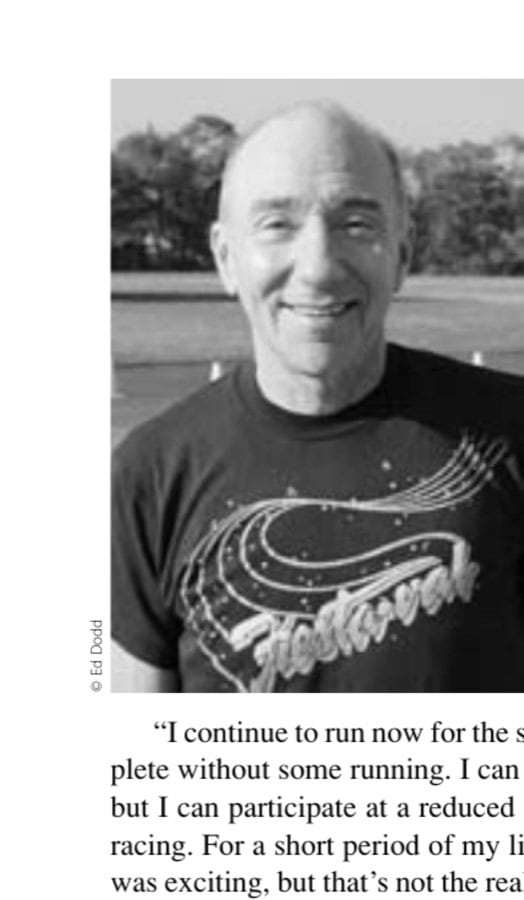
Tom Osler, moments after finishing his 2,060th race (July 2008) in 54 years of running.
my body surge forward. I was born to run, and I could feel my body telling me that it never wanted to stop. I decided to continue racing also because I enjoyed the company of other runners. So I decided to quit running
hard and just enjoy myself. For about six years, I ran and raced at every opportunity. In a field of about 50 runners, I would finish about 15th or 20th. Then in 1964, much to my surprise, I began to improve. I was now
finishing about third to fifth. This is due to the LSD [long slow distance] that I learned from reading Lydiard. “I continue to run now for the same reasons. I love it, and a day seems incomplete without some running. I can no longer race because of my heart problems,
but I can participate at a reduced effort. In truth, I really don’t miss the serious racing. For a short period of my life, I was near the front of the pack. I admit, it was exciting, but that’s not the real reason I was running. Like a cat chases mice, I was born to run.”
Talking with Tom and Kathy turns out to be as far from morbid and depressing as anything can be. I came to visit Tom Osler because as a young man, at the height of my physical powers, he had inspired me to try to extend the height of
those powers and had shown me a way to do it. Now, as a no-longer-young man who is trying to adjust to no longer being near the height of those physical powers, I find that Tom Osler is once again inspiring and teaching me. Even when
the cat can no longer catch most of the mice it chases, it will continue to try. As will Tom. As will I. Lunch has come and gone. Kathy has settled into the next room. I recall the old Saturday Night Live sketches about “The Thing That Wouldn’t Leave” and
decide that I don’t want to become that thing. As I stand up to go, Tom and I quickly review his career as a runner and writer. We drift back to the conditioning of distance runners, and Tom says again that he wrote it to help people and
he hoped it had done so. I tell him that he has helped me tremendously. He seems pleased, and I depart to face whatever the indignities the New Jersey traffic will inflict, knowing that being an old, slow runner is infinitely better than being a former runner.
This article originally appeared in Marathon & Beyond, Vol. 12, No. 5 (2008).
← Browse the full M&B ArchiveMore like this
1,000+ stories from 19 years of Marathon & Beyond
The complete archive of the legendary long-distance journal — digitized and free to read.
